5 min read

The Boy Who Broke His Father's Idols and Walked Out of Fire

Young Abraham smashes his father's idols with a hatchet, blames the largest one, and is thrown into a furnace by a furious king.

Curated by Arthur · Told by Maggid ·
Table of Contents
  1. A Question About the Gods That Could Not Feed Themselves
  2. The Hatchet and the Lie That Exposed a Lie
  3. What His Mother Begged Him to Do
  4. Into the Furnace
  5. Haran's Choice and What It Cost

A Question About the Gods That Could Not Feed Themselves

In Terah's workshop, young Abraham looked at the rows of carved figures and asked the question that cracked the room open. "What help do we get from these things? They have no spirit. They cannot eat. They cannot drink. They cannot protect themselves from fire. We made them with our hands. We gave them their shapes. Why do we bow to what we built?"

Terah had no good answer. He was an idol merchant. He sold gods for a living, and his son was standing in the warehouse asking why any of it made sense.

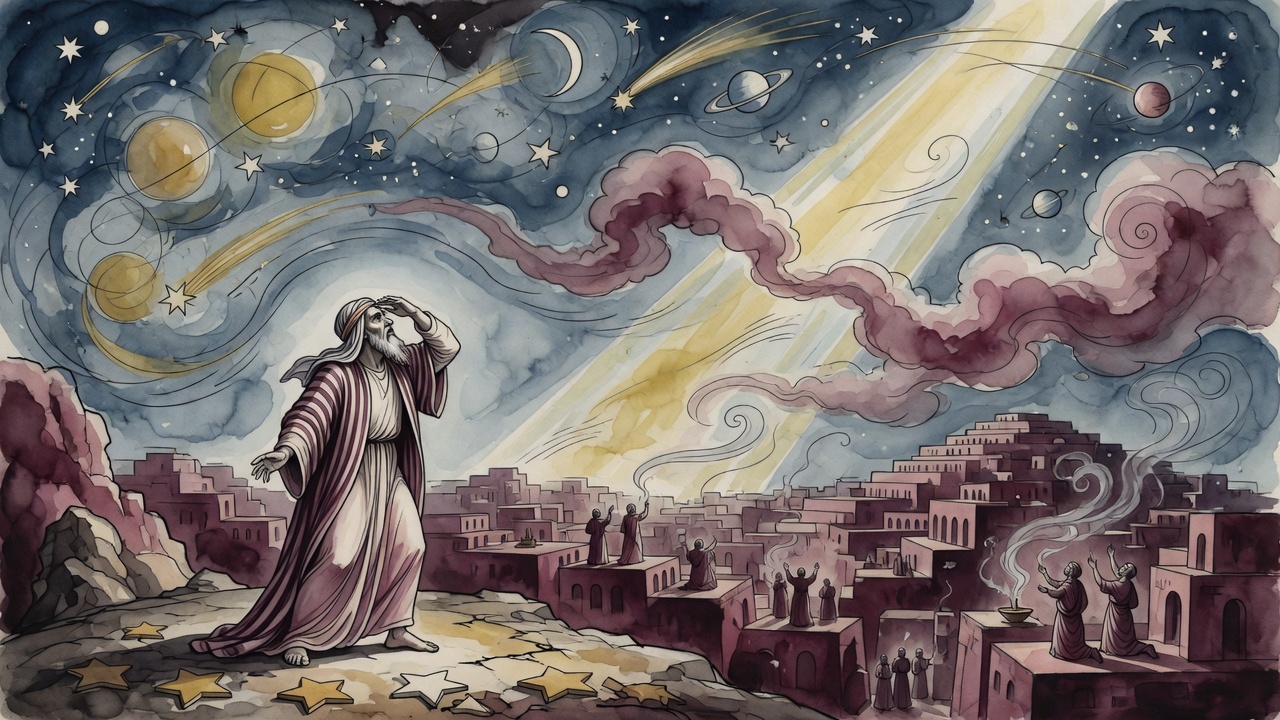
Abraham had been working toward this question for years. He had grown up watching the sun, then decided the sun could not be the true God because it set. He watched the moon and the stars and made the same calculation. Something had made all of this. The sun, the moon, the stars, the carved figures in his father's workshop: none of them was it. The true God was the one who made everything, including the makers of the idols.

The Hatchet and the Lie That Exposed a Lie

Terah brought Abraham into the workshop and showed him twelve large idols and many smaller ones: "here they are," Terah said, "they made everything, including you and me." Then he bowed and left Abraham alone in the room.

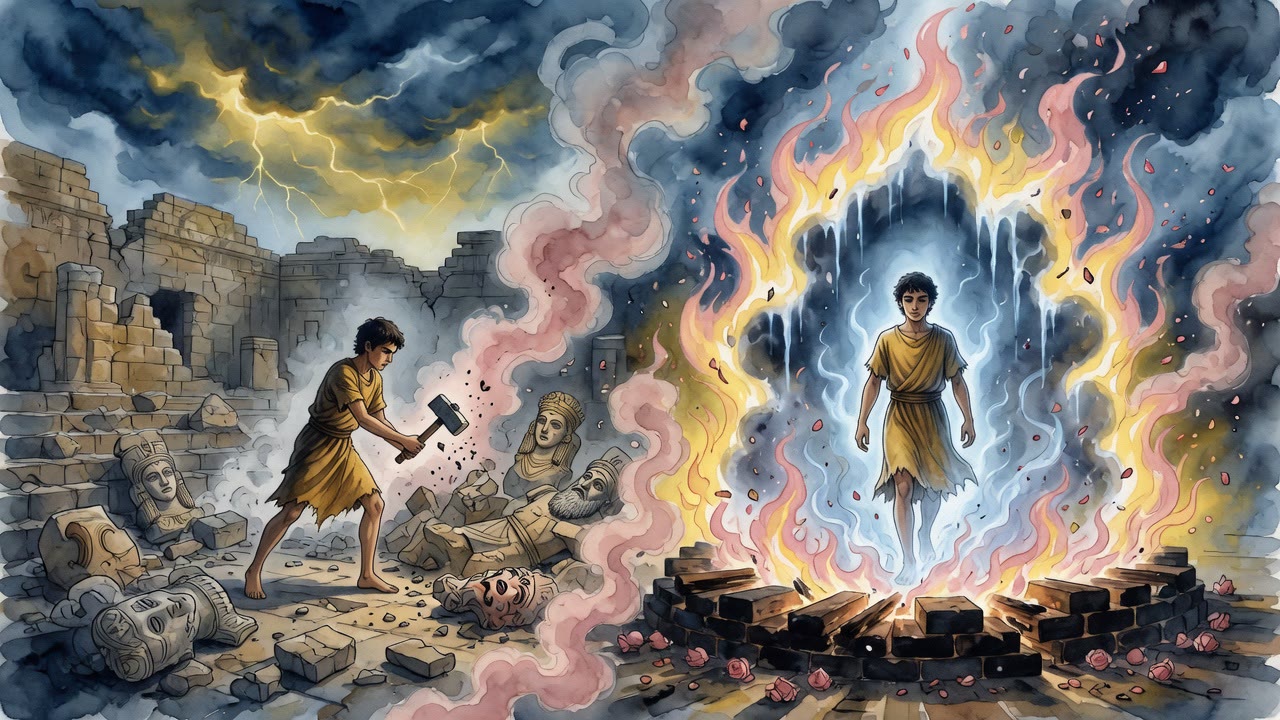
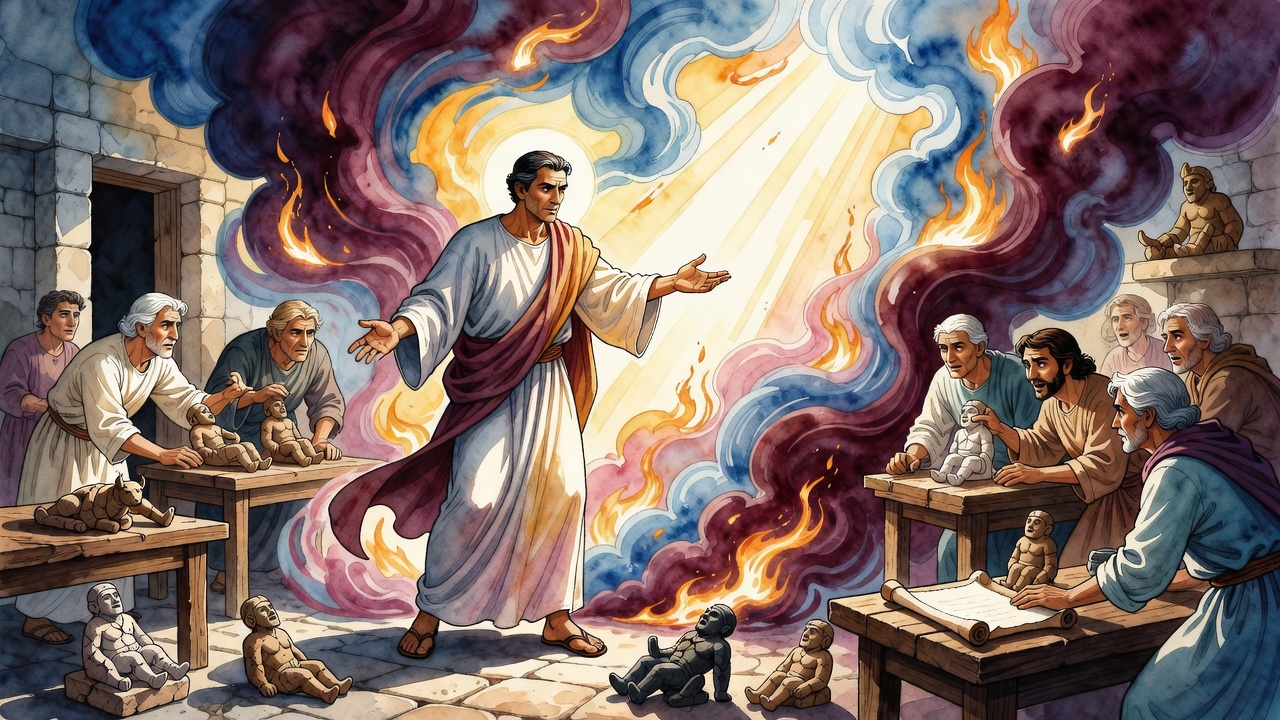
Abraham took a hatchet.

He smashed every idol in the room except the largest one. He left the hatchet in the hand of the largest idol, the one he had deliberately spared.

When Terah came back and found the destruction, he demanded to know who had done it. Abraham pointed at the largest idol and said: "there was a conflict over the food offering, and the biggest one took the hatchet and smashed all the others."

Terah said: "do not be foolish. Idols cannot move. They cannot think. They cannot fight over food."

Abraham said: "then let your ears hear what your mouth just said."

Terah had no answer for this, because the answer destroyed the basis of his livelihood and his theology simultaneously. He went to King Nimrod.

What His Mother Begged Him to Do

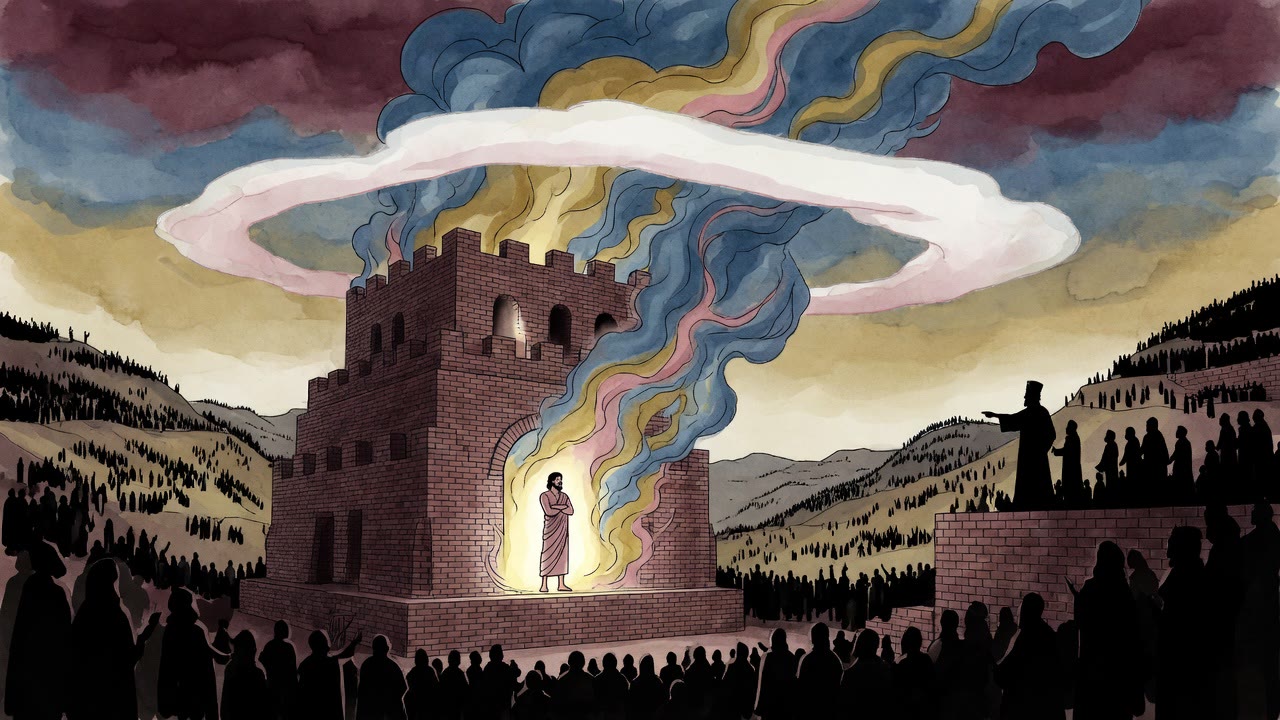
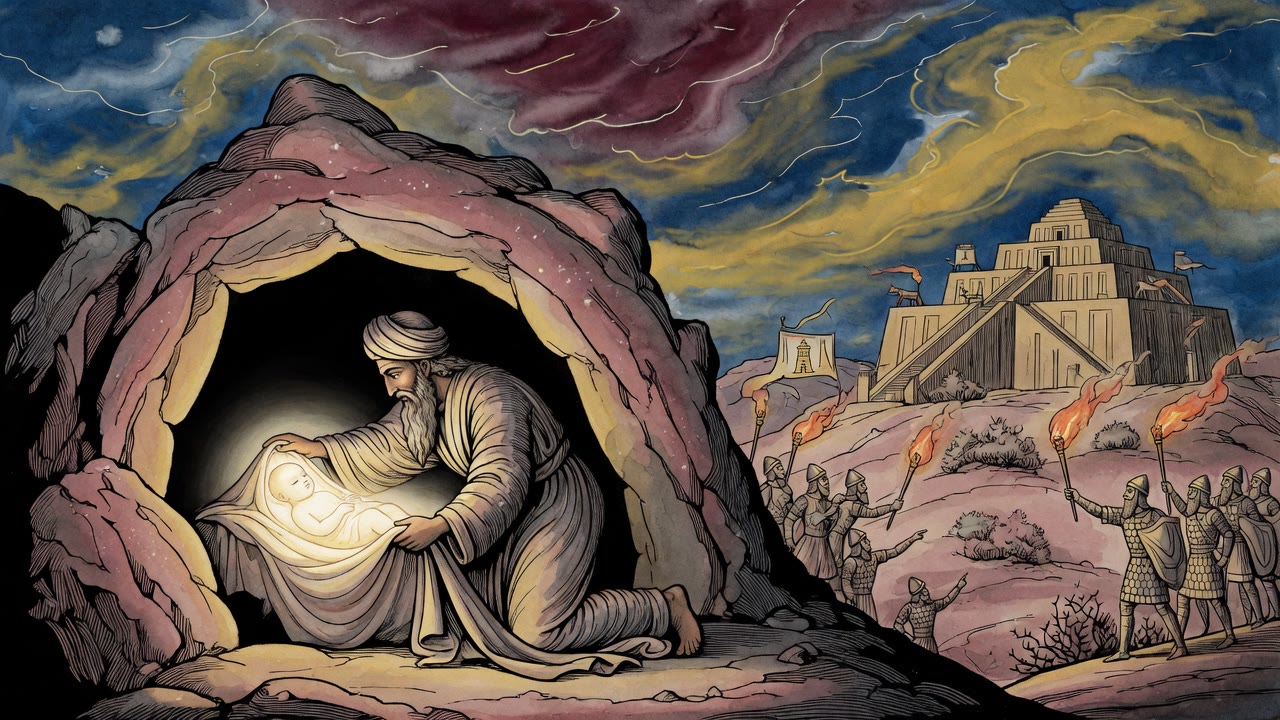
Nimrod was the most powerful king of his age, a ruler who demanded worship and received it from nearly everyone. He had heard about the young Israelite who was going around Ur proclaiming one God and denying all others, and he had noted it. Now Terah had brought his son to the palace, and the choice before Abraham was simple: bow to Nimrod or face the furnace.

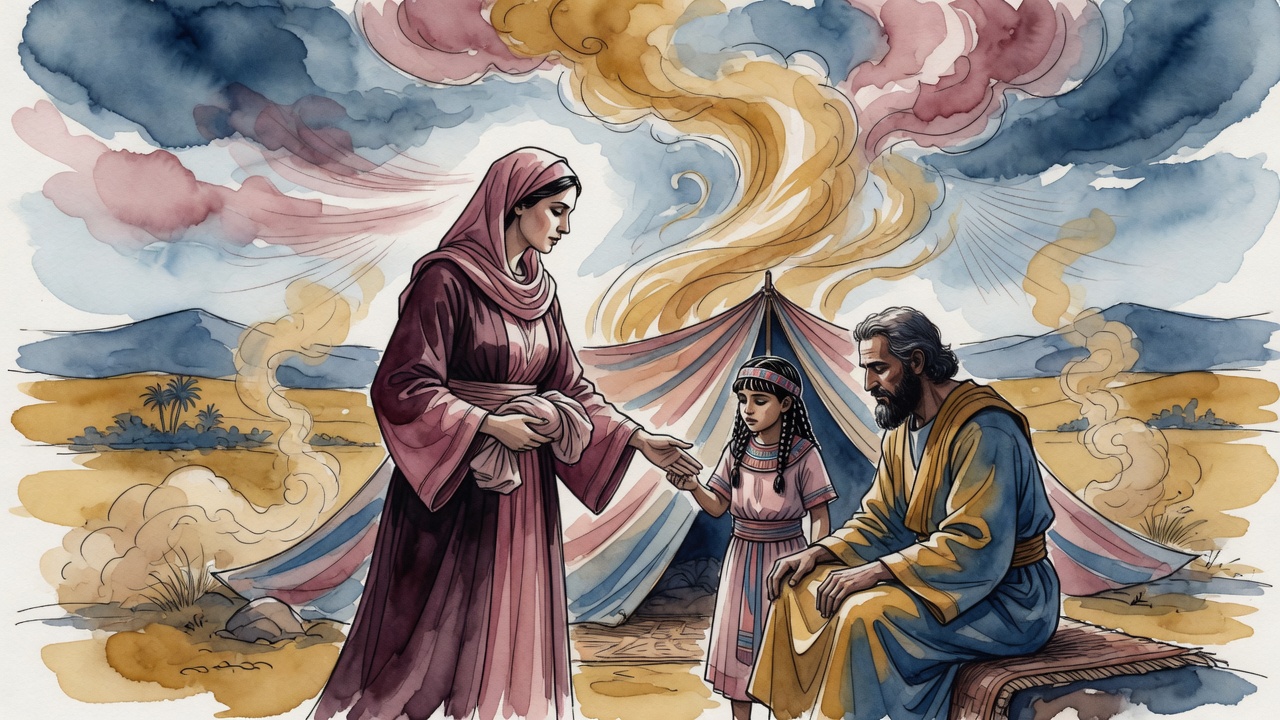
Abraham's mother came to him privately and begged him. Not to believe in Nimrod, not to abandon what he knew was true, but simply to make the gesture, to bow once, to perform the outward form of submission so that he would survive. "Can you not simply appear to comply? For my sake. For your life."

Abraham said: "water can extinguish fire. Stone can blunt iron. But the fear of God cannot be extinguished or blunted by anything in the world. I will not bow."

His mother wept. He stood there and let her weep. He did not bow.

Into the Furnace

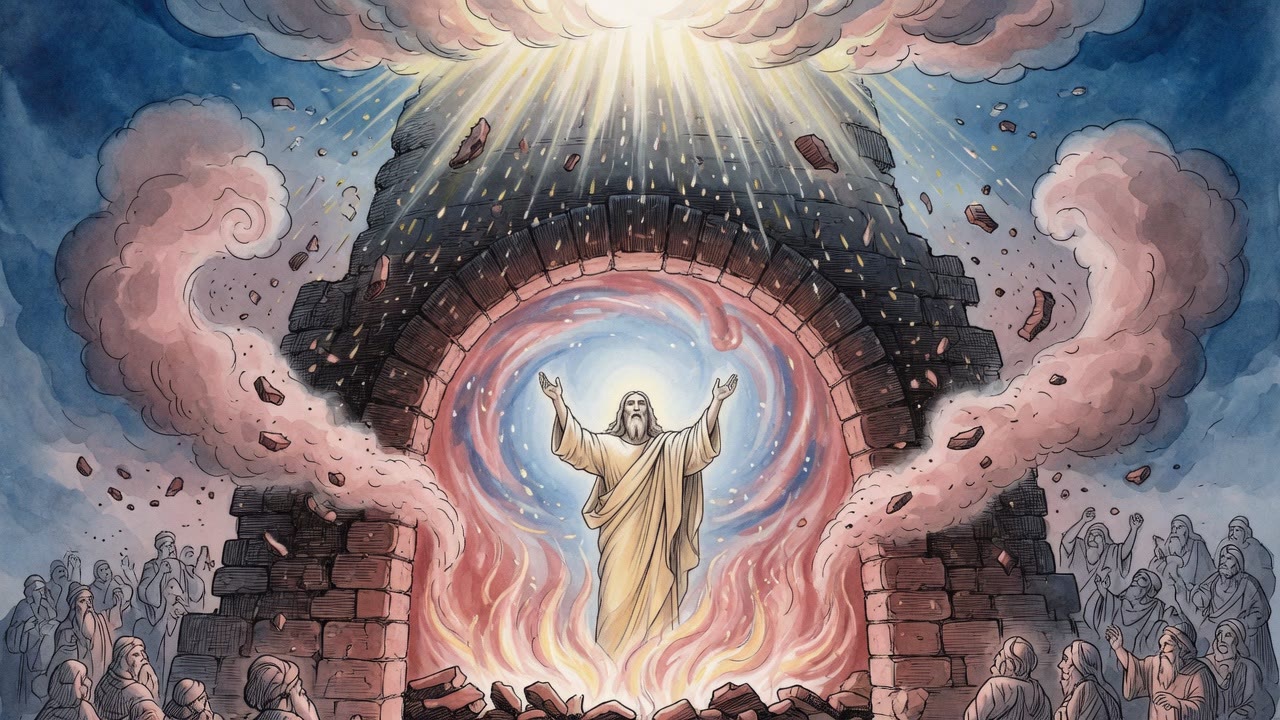
Nimrod had him thrown into a furnace. The text in Legends of the Jews does not euphemize the moment. They threw him into fire that was burning at full intensity, the kind of fire a king uses when he wants to make a point to everyone watching. Abraham was not suspended over it. He was thrown in.

He walked out.

He walked out of the fire that had not touched him, and Nimrod watched this happen, and the text records that Nimrod's response was to interpret the miracle as a demonstration of divine favor that belonged to Abraham's God and therefore, he reasoned, to the nation that God favored. The miracle did not convert Nimrod. It confirmed for him that Abraham's God was powerful, and that Abraham was dangerous precisely because of it.

Haran's Choice and What It Cost

Abraham had a brother named Haran who watched all of this from the sidelines. Haran had not yet declared himself. When Abraham walked out of the furnace unharmed, Haran made a calculation: the miracle proved Abraham's God was real, so Haran would declare for Abraham's side. He announced his allegiance after the evidence was in.

Then Haran was thrown into the same furnace. He did not walk out.

The rabbinic tradition reads Haran's death as the result of his conditional faith. He had chosen God because God had proven useful, because the miracle had demonstrated that Abraham's side was the winning side. That is not the same as what Abraham had done, which was to refuse to bow before any evidence existed, to stake his life on what he knew in his chest before a single furnace had been lit.


← All myths

From the tradition

Sources

8 sources

The texts this telling draws on, in full. Open a card to read inline, or expand it for a wider, quieter read.

Book of Jubilees 12:4Book of Jubilees

The Book of Jubilees, an ancient Jewish text, grapples with this very human tendency in its own powerful way.

Chapter 12 dives right into a crucial moment of religious awakening, a turning point away from idol worship. The speaker, addressing someone deeply entrenched in false beliefs, pulls no punches.

"What help and profit have we from those idols which thou dost worship, And before which thou dost bow thyself?" he asks pointedly. It's a question that echoes through the ages, isn't it? What do we gain from placing our faith in empty vessels?

The answer, according to Jubilees, is nothing. "For there is no spirit in them," the text continues, "For they are dumb forms, and a misleading of the heart. Worship them not." Ouch. It's not just that idols are ineffective; they’re actively deceptive, leading us astray.

But the text doesn’t just tear down; it builds up. It offers an alternative, a path towards something real, something vibrant. "Worship the God of heaven," the speaker urges.

This isn't just any god, mind you. This is a God "Who causeth the rain and the dew to descend on the earth, And doeth everything upon the earth, And hath created everything by His word, And all life is from before His face."

The contrast is stark. Idols are static, lifeless. This God is dynamic, the source of all creation and sustenance. Life itself flows from this divine presence. There's a profound sense of awe and wonder woven into these lines.

And then comes the final, almost exasperated question: "Why do ye worship things that have no spirit in them? For they are the work of (men's) hands, And on your shoulders do ye bear them." image: carrying your own gods, these lifeless objects that offer nothing in return. It’s a powerful metaphor for the burdens we create for ourselves when we turn away from true spirituality.

The Book of Jubilees, in this short passage, offers a timeless message. It reminds us to question the things we place our faith in, to seek out the source of true life and meaning, and to recognize the emptiness of hollow idols. Are we carrying burdens that we should be laying down? Are we bowing before things that have no spirit within? Maybe it's time to ask ourselves these questions, too.

Full source
Legends of the Jews 5:77Legends of the Jews

Terah, Abraham's father, was an idol merchant. When young Abraham questioned him about the true God, the one who created everything, Terah led him into a hall filled with idols – twelve massive ones and a whole crowd of smaller ones. "Here they are!" Terah declared, gesturing grandly. "They made everything, including you and me!" He bowed low, leaving Abraham in a room full of silent, stony faces.

Abraham wasn't convinced. He went to his mother, pleading with her to cook a delicious meal, a "savory meat," as the text puts it. He planned to offer it to his father's gods, hoping to win their favor. His mother obliged, and Abraham presented the offering.

What happened next? Nothing. The idols didn't speak, didn't eat, didn't even twitch. As Ginzberg's retelling in Legends of the Jews beautifully illustrates, Abraham, seeing their utter lack of response, began to mock them. "Maybe the meat isn't good enough?" he wondered aloud. "Or perhaps it's too small a portion?" He promised a better offering the next day, even more delicious and plentiful.

Still, the idols remained silent and motionless. That's when, as the story goes, the spirit of God came over Abraham. In a burst of divine inspiration, he cried out, condemning his father and his generation for their devotion to these lifeless objects. "Woe unto my father and his wicked generation," he exclaimed, "whose hearts are all inclined to vanity, who serve these idols of wood and stone, which cannot eat, nor smell, nor hear, nor speak, which have mouths without speech, eyes without sight, ears without hearing, hands without feeling, and legs without motion!"

It's a powerful moment, isn't it? A young man, surrounded by the idols of his father, realizing the profound emptiness of their worship. It's not just a rejection of idolatry; it's an affirmation of something greater, something unseen, something real.

This story, found within the broader narrative of Legends of the Jews, highlights Abraham's early spiritual awakening. It's a reminder that questioning the status quo, even when it means challenging your own family and traditions, can be a path to profound truth. It makes you wonder, doesn't it? What "idols" do we have in our own lives, things we give power to that ultimately have none? What are we bowing down to that cannot answer? Perhaps Abraham's story is a timeless call to examine our own beliefs and seek a deeper, more meaningful connection to the divine.

Full source
Legends of the Jews 5:23Legends of the Jews

His own mother asks him, "My son, is there a God beside Nimrod?" And without hesitation, Abraham proclaims, "Yes, mother, the God of the heavens and the God of the earth, He is also the God of Nimrod son of Canaan. Go, therefore, and carry this message unto Nimrod."

You might be thinking, "Who is this Nimrod, and why is everyone so concerned with what this baby Abraham has to say?" Well, Nimrod, according to tradition, was a powerful king, a mighty hunter, and someone who, shall we say, liked a little too much power.

Abraham's mother, stunned by her son's words, returns to the city and tells her husband, Terah, everything. Terah, a prince and a big shot in Nimrod's court, does something He goes to the royal palace and throws himself down before the king, face to the floor.

Here’s the thing about Nimrod’s court: you weren't allowed to lift your head until the king gave you permission. Eventually, Nimrod tells Terah to rise and state his business. Terah spills the beans, telling Nimrod all about his wife and his son, the baby prophet.

And that's when things get really interesting. According to Ginzberg's retelling in Legends of the Jews, when Nimrod hears this tale, he's seized by "abject fear." Yes, the mighty Nimrod, king of everything, is afraid of a baby!

His counselors, naturally, are a bit dismissive. "Our king and our god!" they say, "Why are you afraid of a little child? Just send one of the lowliest princes to throw him in prison!"

But Nimrod isn't so sure. He retorts, "Have ye ever seen a baby of twenty days walking with his feet, speaking with his mouth, and proclaiming with his tongue that there is a God in heaven, who is One, and none beside Him, who sees and is not seen?" The assembled princes are, understandably, horrified. A baby, barely three weeks old, challenging the established order, proclaiming the existence of a single, unseen God. It's a powerful image, isn't it?

What does this story tell us? Maybe it's about the power of truth, even when spoken by the most unlikely of voices. Maybe it's about the fear that even the most powerful rulers feel when confronted with something they can't control. Or maybe, just maybe, it's about the extraordinary potential that lies within each and every one of us, even from the very beginning.

Full source
Legends of the Jews 5:47Legends of the Jews

You’re Abraham, and Nimrod wants you dead for refusing to worship idols. The story goes that Abraham’s own mother, desperate to save her son, pleaded with him to just give lip service to Nimrod, to pretend to worship him to avoid certain doom. Can you imagine her fear? The pressure she must have felt?

Abraham wouldn’t budge. "O mother," he said, as we learn from Legends of the Jews, "water can extinguish Nimrod's fire, but the fire of God will not die out for evermore. Water cannot quench it." He was essentially saying that physical danger was nothing compared to betraying his belief in the one true God.

His mother, hearing his unwavering faith, offered a blessing: "May the God whom thou servest rescue thee from the fire of Nimrod!" It's a beautiful, heartbreaking moment – a mother’s love battling with the conviction of her son.

Abraham is strapped into a catapult, ready to be launched into a blazing furnace. Think about the sheer terror, the heat, the uncertainty. But even then, his faith didn't waver. He looked up to the heavens and cried out, "O Lord my God, Thou seest what this sinner purposes to do unto me!" His trust in God was absolute.

The angels, witnessing this incredible display of faith, received permission from God to intervene. Gabriel himself, no less, approached Abraham in the midst of this fiery trial and asked, "Abraham, shall I save thee from the fire?" What an offer! A get-out-of-jail-free card, courtesy of the divine.

But Abraham’s response is just breathtaking. He replied, "God in whom I trust, the God of heaven and earth, will rescue me." He didn't need Gabriel to save him; he trusted in God’s plan, whatever it might be.

And God, seeing Abraham's complete submission and unwavering faith, commanded the fire, "Cool off and bring tranquillity to my servant Abraham." Can you just feel the drama? The shift in the atmosphere? The miraculous intervention?

So, what does this all mean for us? Well, it’s easy to read this as just an amazing story of a miraculous rescue. But it's so much more than that. It's about the power of conviction, the strength of faith, and the unwavering belief in something bigger than ourselves, even when facing the most terrifying circumstances. It makes you wonder: What "fires" are we facing in our own lives, and how can we find that same unwavering faith to face them with courage and trust?

Full source
Legends of the Jews 5:84Legends of the Jews

The story goes that King Nimrod, a powerful and, shall we say, unpleasant ruler, wasn't too thrilled with Abraham's monotheistic views. He believed in many gods, and Abraham was going around preaching about just one. So, naturally, Nimrod decided to take drastic action. He threw Abraham into a fiery furnace.

It first appears that's the end of the story. Poof! No more Abraham. But, as we find in Legends of the Jews, something remarkable happened.

At first, Nimrod didn't believe his own eyes. He'd ordered Abraham's execution! But when his loyal princes confirmed what the servants were saying, that Abraham was indeed alive in the fire, Nimrod rose to see for himself. He commanded his servants to retrieve Abraham, but the flames leapt out, burning their faces. Eight of them died!

The scene. The roaring flames, the terrified servants, and in the middle of it all, Abraham, completely unharmed.

So, Nimrod, in a moment of awe and perhaps a little fear, called out to Abraham. "O servant of the God who is in heaven, go forth from the midst of the fire, and come hither and stand before me."

And Abraham walked right out.

Nimrod, stunned, asked, "How is it that you weren't burnt in the fire?"

Abraham's answer is the heart of the story: "The God of heaven and earth in whom I trust, and who hath all things in His power, He did deliver me from the fire into which thou didst cast me."

It's a powerful moment, isn't it? The unwavering faith, the divine intervention. As Rabbi Jonathan Sacks often pointed out, the stories of our ancestors are not just historical accounts but blueprints for how we should live.

This story, found in Ginzberg's retelling in Legends of the Jews, is more than just a miraculous escape. It's about faith in the face of adversity. It's about trusting in something bigger than yourself, even when the flames are licking at your heels.

What "fire" are you facing today? And can Abraham's story give you the strength to walk through it, knowing you're not alone?

Full source
Shalsheleth Hakkabalah, fol. 2aHebraic Literature (1901)

Before Abraham was a patriarch he was a shopkeeper's son. His father Terach sold idols in Ur, and Abraham, still a boy, worked behind the counter. The customers came in believing these little stone and wood figures could hear them, protect them, forgive them. Abraham watched and burned inside.

One day an old woman came with a measure of fine flour and set it before the idols as an offering. The moment she left, Abraham took a staff and smashed every image on the shelf, every one except the largest. Into the hands of that great idol he pressed the staff.

When Terach returned and saw the devastation, he demanded an explanation. Abraham kept his face straight. "An old woman brought an offering of flour. The idols began to fight over it, each hungrier than the last. The biggest one killed all the others with this staff. He is still holding it."

The First Interrogation of Idolatry

Terach, the tradition says, did not laugh. He handed his son over to Nimrod, the tyrant-king who ran the region's inquisition. Nimrod threw Abraham into a fiery furnace. And the Holy One drew him out alive.

This midrash, preserved in Bereshit Rabbah and the Shalsheleth Hakkabalah, reads Genesis 11 and (Genesis 15:7) as the silent frame around a roaring story. The Torah says only that "the Lord brought you out of Ur of the Chaldees." The Sages asked: brought him out of what? And they answered: out of the furnace his own father had chosen over him.

Superstition, the old text warns, "knows neither reason nor human affection." Even a father will feed his son to the fire before he will give up his gods.

Full source
Legends of the Jews 5:78Legends of the Jews

It’s quite a story, and one of the most vivid tales comes from Ginzberg's _Legends of the Jews_.

Abraham, still a young man, is surrounded by idols. These aren't just little figurines, but the gods of his father Terah, who, in this version of the story, is an idol maker himself. Abraham, though, has a different idea about divinity. He's not buying into this whole polytheistic thing.

So, what does he do? He grabs a hatchet.

The scene unfolds with dramatic irony. Abraham systematically destroys the idols. Smash! Crash! One by one, these stone figures are reduced to rubble. But here’s the twist: after his act of iconoclasm, he places the hatchet in the hand of the largest idol.

Why? You'll see.

Terah, hearing the commotion, rushes into the room. He’s furious. “What is this mischief thou hast done to my gods?” he demands.

And here comes Abraham's audacious reply. He doesn't confess. Instead, he spins a tale.

"I set savory meat before them," Abraham explains, straight-faced. "And when I came nigh unto them, that they might eat, they all stretched out their hands to take of the meat, before the big one had put forth his hand to eat. This one, enraged against them on account of their behavior, took the hatchet and broke them all, and, behold, the hatchet is yet in his hands, as thou mayest see."

Can you picture Terah's face? The audacity! The sheer chutzpah! Abraham is essentially saying, "Don't blame me, Dad. Your gods are fighting amongst themselves!"

Of course, Terah isn't fooled. It's a ridiculous explanation, but it serves a purpose. It highlights the absurdity of idol worship. How can these inanimate objects, supposedly gods, be so petty, so…human?

This story, found in _Legends of the Jews_, isn't just a funny anecdote. It's a powerful statement about the nature of belief, about questioning tradition, and about the courage to stand up for what you believe in, even against your own family. Abraham's act, as depicted here, is a pivotal moment – a turning point that sets him on the path to becoming the Abraham we know: the one who challenged the status quo and ultimately changed the course of history.

What does this story tell us about how to confront outdated ideas or systems today? How can we learn from Abraham's blend of courage and wit?

Full source
Legends of the Jews 5:80Legends of the Jews

Our story comes from Ginzberg’s Legends of the Jews, drawing on ancient midrashic (rabbinic interpretive commentary) traditions, which paints a vivid picture of Abraham’s early life and his confrontation with Nimrod. This wasn't just a theological debate; it was a showdown.

Terah, Abraham's own father, a man who made and sold idols, is deeply disturbed by his son's iconoclastic views. He feels he has no choice. As the story goes, Terah practically ran to Nimrod, the king. He prostrated himself, pleading with Nimrod to listen to the tale of his son, born fifty years prior. He recounts Abraham’s actions – how he smashed the idols, how he dared to speak against them.

"Now, therefore, my lord and king," Terah implores, "send for him that he may come before thee, and do thou judge him according to the law, that we may be delivered from his evil." Imagine the desperation in Terah's voice! He's willing to sacrifice his own son to appease the king and, perhaps, to silence his own doubts.

Abraham is brought before Nimrod. Can you feel the tension? He repeats the story he told Terah – the one about the big idol destroying the smaller ones (a powerful metaphor, of course, for the one true God). But Nimrod, the powerful king, scoffs. "Idols do neither speak, nor eat, nor move," he declares dismissively. It’s a statement of "common sense," but it completely misses the point.

And here’s where Abraham’s courage truly shines. He doesn’t back down. Instead, he rebukes Nimrod for worshipping gods that are so utterly powerless. He urges him to serve the God of the universe, the one true God. According to the legends, Abraham's final words were a stark warning. "If thy wicked heart will not hearken to my words, to cause thee to forsake thy evil ways and serve the Eternal God, then wilt thou die in shame in the latter days, thou, thy people, and all that are connected with thee, who hear thy words, and walk in thy evil ways." Strong words. A prophet's words.

What’s striking is Abraham's unwavering conviction. He stands before a king, risking everything, to speak truth as he knows it. It makes you wonder: what truths are we willing to stand up for, even when it's difficult? What idols do we cling to, even when they're empty and lifeless? And what kind of courage does it take to challenge the Nimrods in our own lives?

Full source