5 min read

The Divine Child Who Grew From a Small Mind to a Great One

Born from the supernal Mother's womb with only a splinter of mind, the divine child Zeir Anpin waited cosmic years for his great brains to descend.

Curated by Arthur · Told by Maggid ·
Table of Contents
  1. A Child Assembled From a Broken World
  2. Three Days in the Hands of Father and Mother
  3. The Years at the Breast
  4. The Head That Waited to Be Filled
  5. When the Great Mind Came Down

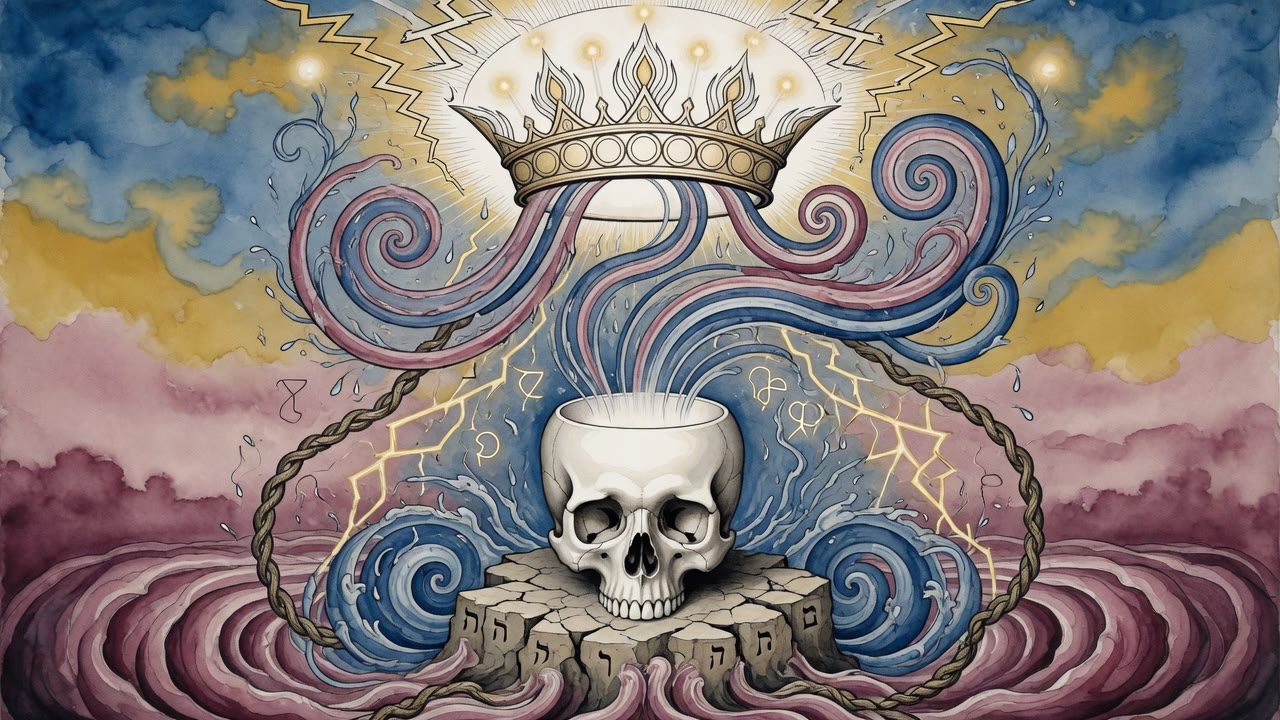
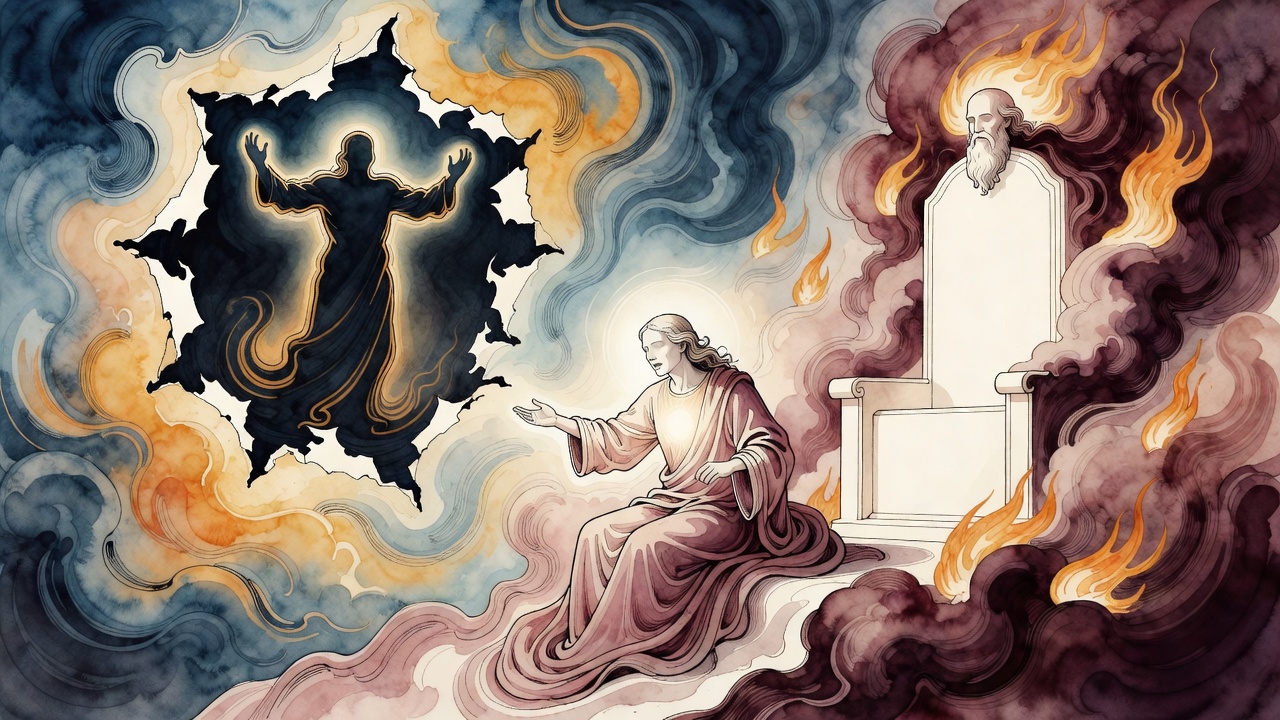
They call him the Small Face, and when he was first drawn out of the womb his skull held only a splinter of mind. Not the wide, settled knowing of his parents. A flicker. Enough to breathe by, not enough to reason. The Kabbalists gave the condition a name, katnut, the small mind, and they meant it the way anyone would say it of an infant left blinking in a room built too large for him.

The Divine Child Who Grew From a Small Mind to a Great One Click for full size

His full name is Zeir Anpin, and he is no small thing. He is the six feeling-powers of the living God, love and restraint and beauty and endurance and splendor and the foundation that gathers them, bound into one persona and set to grow up like a boy.

A Child Assembled From a Broken World

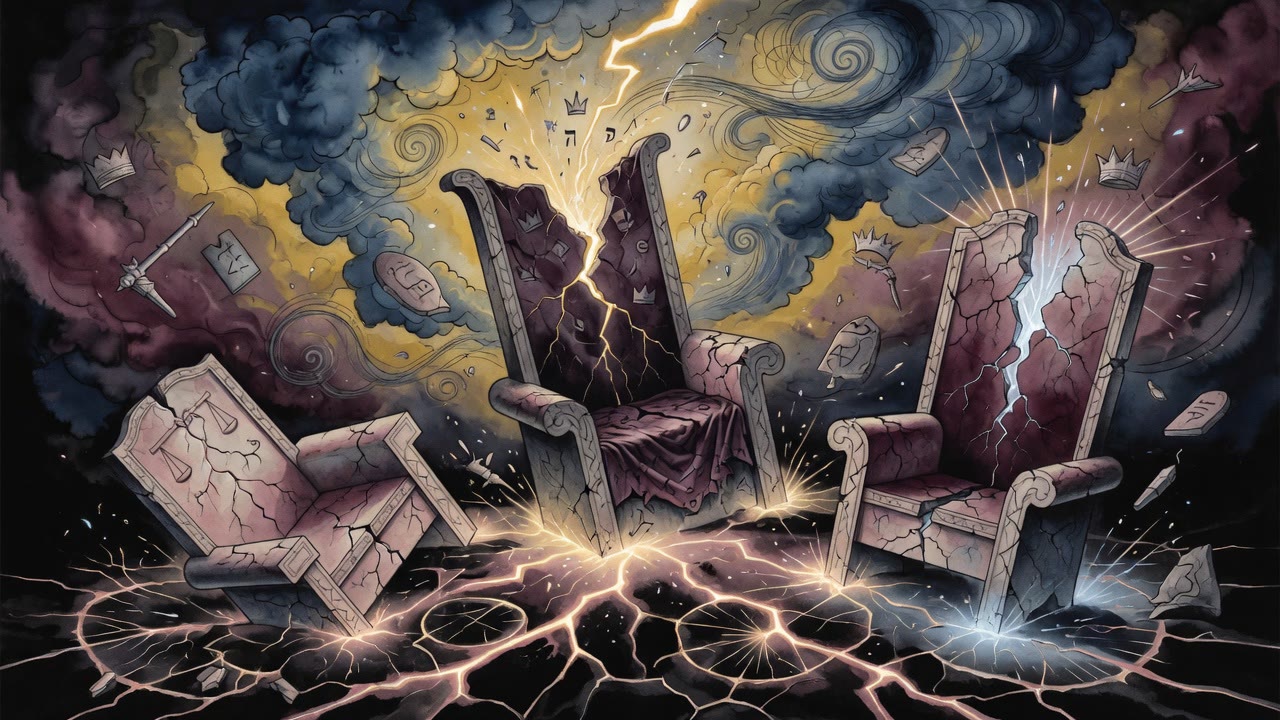
Before he could be born he had to be built, and he was built out of wreckage. In an age before this one, vessels had stood ready to hold the divine overflow, and they had shattered. The breakage, shevirah. Sparks scattered. The husks of the broken vessels rained down through the worlds.

From that debris the child was assembled on three levels. First the lights, the Orot, the radiance that had fled and now had to be coaxed home. Then the sparks, the Nitzotzot, the glittering fragments caught in the ruins. Last the vessels, the Kelim, the structure that would give him a shape to stand in. The lights came back through the foundation of the Mother's Understanding. The sparks were mended, strangely, through the very seam where the vessels had first torn apart. The place of the wound became the place of the healing.

Three Days in the Hands of Father and Mother

Abba, the Father, went to work on the first day and arranged the child's right side, the whole flank of mercy. On the second day Imma, the Mother, took the left side into her hands and set its severities in order. On the third day the Father handed everything he had shaped over to the Mother, and the boy and the bride beside him were bound together as one.

Then came the counting of sparks, and the counting had the shape of a pregnancy. Six sparks entered him on the first day, six on the second, and on the third day seven, one more than the rest, because on that day the lights of Father and Mother had joined. Thirty-seven sparks came in across thirty-seven days, forty days from the start, and this was the count spoken over every human embryo in the womb, formed, the old teaching says, by the light of the Mother. Forty-six sparks over forty-six days carried him to nearly three months, the span after which a hidden thing in a woman can be confirmed to exist at all.

The Years at the Breast

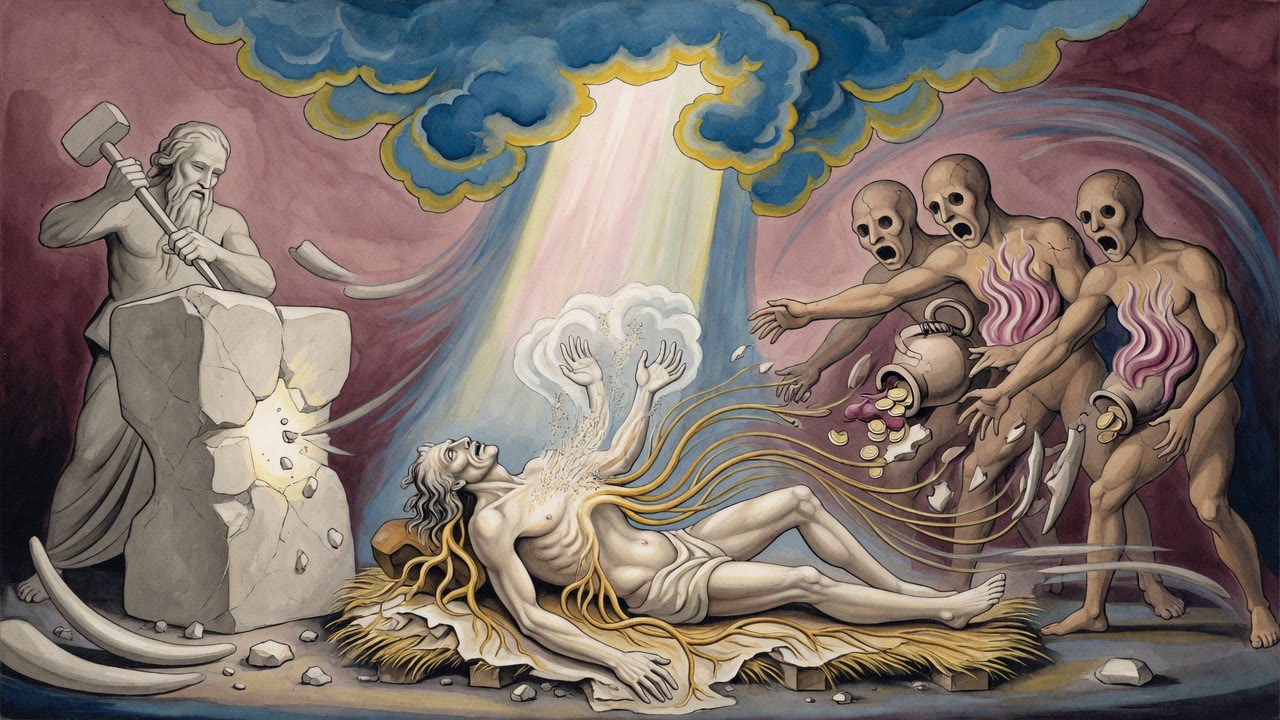
Born, he still could not think. He could only take in. For twenty-four months the child nursed, and the milk did quiet work, scouring the three lowest powers in him, splendor and foundation and kingship, clean of the husks that still clung. His small mind grew a shade wider. Where an infant's flicker had been only the barest vital breath, now a spirit stirred in him, a fuller soul settling into the half-built vessels. Still not the great mind. Still not the parents' steady calm.

The Head That Waited to Be Filled

A grown God's persona sat with a child's brain, and had to wait. The adult intelligences, the mochin, the brains of wisdom and understanding, were not his by birth. They had to descend into him from above, from the Father and the Mother, and fill the empty upper chambers of his skull.

The descent was slow past all mortal patience. Eleven years and a day, the reckoning ran. Seven strands of the Mother's Understanding entered him across seven years, one region of the mind opening in each, and on the final day, the last, the crown of that Understanding came down and locked into place. The feelings he had been born with rose upward and hardened into thought. New foundations grew beneath them. The boy's own emotions became, at last, a mind.

When the Great Mind Came Down

With the brains came a flood. Loving-kindnesses, Hassadim, spilled down from the level of his chest, pooled in his foundation, and climbed again through all six of his limbs until the whole body of him ran with mercy. Behind them came five severities, Gevurot, descending to be sweetened in that same foundation, judgment folded into kindness so it would not scorch. The kindnesses swelled the child himself. The severities passed to the bride at his side and grew her instead, so that neither stood complete without the other.

The small mind was gone. In its place stood gadlut, the great mind, the wide and settled knowing he had reached toward since he was a splinter of thought in a shattered world. The child had grown up. God's own face had come of age.


← All myths
From the tradition

Sources

4 sources

The texts behind this telling. Some cards carry a translation of the source; others are our own retelling of it, and each card says which. Every card links out to the original.

Asarah Perakim LeRamchal 4:3Asarah Perakim LeRamchal

Retold in our words. Read the original at the link below.Sefaria-hosted English translation · CC-BY

Jewish mysticism, especially the Kabbalah, offers some breathtakingly complex yet profoundly beautiful answers.

This passage talks about the building up, the edification, of something called Zeir Anpin (ZA). Now, Zeir Anpin is a complex concept, often understood as a representation of the emotional attributes of God, a kind of "son" in relation to the divine Father and Mother. But how does this "son" get built? According to the Ramchal, it happens on three levels: through lights (Orot), sparks (Nitzotzot), and vessels (Kelim).

Think of it like this: imagine a shattered vase. The Orot are the radiant colors and designs, the inherent beauty that was once there. The Nitzotzot are the tiny, fragmented pieces, the scattered remnants of that beauty. And the Kelim are the structural pieces, the parts that gave the vase its form and held everything together.

The text goes on to explain that the Orot, which initially departed, return and are repaired through a process involving three iburim. Iburim literally means "gestations" or "impregnations," referring to periods of seven, nine, and twelve months. These aren't literal pregnancies, of course, but metaphorical stages of development and refinement. They're a way of describing how something broken is slowly, painstakingly, brought back to wholeness.

So, who are the parents in this cosmic rebuilding? We're told that Imma (Mother) and Tevunah (Understanding) unite and become one. They essentially house three locations of Yesod, which means "foundation": the Yesod of Imma, the Yesod of Tevunah, and the place of the "breakage" (shevirah) when they separate. This "breakage" refers to a crucial event in Kabbalistic cosmology – the shattering of the vessels, a primordial catastrophe that scattered sparks of divinity throughout creation.

Now, pay close attention because this is where it gets really interesting. The Kelim of Zeir Anpin are repaired through the Yesod of Tevunah. The sparks (Nitzotzot) are repaired through that very place of breakage, that original wound. And the lights (Orot) are repaired through the Yesod of Tevunah, although another version suggests it’s through the Yesod of Binah (Intelligence).

What does all this mean? It suggests that even in the deepest fractures, even in the places of greatest pain and loss, there is a potential for healing and restoration. The very act of remembering the breakage, of acknowledging the wound, becomes a source of repair for the scattered sparks.

The Ramchal drives the point home with a powerful analogy, linking this cosmic process to something very earthly: the three compartments of the uterus. As we find in the Talmud (Niddah 31a), the womb is a place of creation, of gestation, of potential. It's a microcosm of the divine process, a reminder that even in the darkness, life can emerge.

Isn't that a beautiful thought? That the very structure of the universe, from the grandest cosmic processes to the most intimate biological realities, reflects a continuous cycle of breaking and mending, of loss and redemption? It's a reminder that even when things fall apart, there's always the possibility of rebuilding, of finding the scattered sparks and piecing them back together, making something new, something whole, something even more beautiful than before.

Full source
Asarah Perakim LeRamchal 4:9Asarah Perakim LeRamchal

Retold in our words. Read the original at the link below.Sefaria-hosted English translation · CC-BY

It might sound strange, but Kabbalah, Jewish mysticism, often speaks of the Sephirot – the emanations of God – in terms that mirror human development: gestation, birth, nursing, and maturation. a fascinating passage from the Asarah Perakim LeRamchal, a work attributed to the great Kabbalist, Rabbi Moshe Chaim Luzzatto (Ramchal), where he describes just that, in relation to Zeir Anpin (ZA), often associated with the six emotive attributes of God: loving-kindness, strength, beauty, victory, splendor, and foundation.

Ramchal outlines four stages of Iburim, or gestations, for Zeir Anpin, each a period of spiritual formation. Think of it like this: ZA isn't just "born" fully formed. It undergoes a series of refinements. There are two Iburim related to ZA’s exterior and two related to its interior. The first, for the exterior, lasts 12 months, followed by one of 9 months. But for its interior, these periods shorten to 9 months and then 7 months. What's going on here? Well, these varying lengths might represent different aspects of spiritual development, some requiring longer periods of refinement than others.

Then comes Yenikah, or nursing, lasting 24 months. This stage is specifically linked to the clarification of Hod (Splendor), Yessod (Foundation), and Malchut (Kingdom). These three Sephirot represent crucial aspects of divine manifestation, and this "nursing" helps to purify and refine them.

The process doesn't stop there! ZA’s Gadlut, or maturation, takes a whopping eleven years and a day! Why so long? Ramchal explains that the seven parts of NEHI of Tvunah (Understanding) enter into ZA over seven years, with its crown entering on the final day.

Now, things get really interesting. As ZA matures, the revealed Hassadim (Loving-kindnesses) descend from the "chest" downward, gathering in Yessod and then rising through the lower pillars, ascending through all six extremities.

Following the Hassadim, five Gevurot (Strengths) descend and are sweetened in Yessod. Two and a half descend initially, with the remaining portion being sweetened as the Hassadim ascend. This interplay between Hassadim and Gevurot is crucial. It's about balance – the tempering of divine judgment with divine mercy.

Finally, we learn that the Hassadim contribute to the growth of Zeir Anpin itself, while the Gevurot contribute to the growth of Nukvah, the feminine aspect of divinity. This highlights the inherent duality and interdependence within the divine realm. Masculine direction occurs on the right, and the direction of Nukvah on the left.

What does all this mean for us? Perhaps it's a reminder that spiritual growth is a complex and ongoing process, mirroring the intricate dynamics within the divine. Just as Zeir Anpin undergoes stages of gestation, nursing, and maturation, so too do we. Our own journeys of self-discovery and refinement echo the celestial processes described by the Kabbalists. That our inner lives are connected to the very fabric of the cosmos.

Full source
Asarah Perakim LeRamchal 4:6Asarah Perakim LeRamchal

Retold in our words. Read the original at the link below.Sefaria-hosted English translation · CC-BY

The great Kabbalist, Rabbi Moshe Chaim Luzzatto, or Ramchal as he's more commonly known, gives us some incredible insights into this in his "Ten Chapters of Wisdom" – Asarah Perakim. First, let's understand some of the key terms Ramchal uses. He talks about NEHI, HAGAT, and HABAD. These are acronyms representing different Sefirot (the divine emanations), or divine emanations, in Kabbalistic thought. NEHI refers to Netzach (Eternity), Hod, and Yesod (Foundation); HAGAT to Chesed (Lovingkindness), Gevurah, and Tiferet (Beauty); and HABAD to Chochmah, Binah, and Da'at (Knowledge). Think of them as different aspects of the divine light manifesting in the world. He also refers to NRNHYNefesh (the vital soul), Ruach (spirit), Neshamah (the higher soul), Chayah, and Yechidah – the five levels of the soul.

So, what happens to these aspects of our being during Ibur, gestation or embryonic development? Ramchal tells us that during this stage, our NEHI and HAGAT represent the external aspects, while the HABAD represents the Nefesh, the most basic level of the soul, within them.

Then, what about during Yenika, the nursing or suckling stage? Now, the NEHI and HAGAT remain the external aspects, but the HABAD now represent the Ruach, the spirit, within them. The soul is developing, growing more complex.

It's during Gadlut, adulthood or maturity, that things really get interesting. Ramchal explains that during Gadlut, these HAGAT rise up and become HABAD, and the NEHI take their place, with new NEHI being renewed below. Essentially, the different aspects of the soul are constantly shifting, transforming, and interacting. The HABAD, representing wisdom and understanding, descend into everything, corresponding to the Neshamah, the higher soul, which contains all five levels: NRNHY. The NRN within the HY are their Makifim, their surrounding or encompassing forces. All the Kelim, the vessels, return as external aspects in relation to them.

Ramchal emphasizes a structure of three within three: NEHI, HAGAT, and HABAD existing within each of NEHI, HAGAT, and HABAD themselves. This creates a complex interplay of forces within the soul.

And finally, and perhaps most profoundly, Ramchal draws a parallel between these spiritual processes and our physical bodies. Just as we have flesh, nerves, and bones, we also have NRN within them. It's deeply intertwined with our bodies, animating them and giving them purpose.

So what does it all mean? Perhaps it's a reminder that we are constantly evolving. That our souls are dynamic, changing, and striving towards greater understanding and connection. That our physical and spiritual selves are inextricably linked. And that, just as Ramchal suggests, by understanding these processes, we can gain deeper insights into ourselves and our place in the universe. A truly powerful thought to carry with us, don't you think?

Full source
Asarah Perakim LeRamchal 4:2Asarah Perakim LeRamchal

Retold in our words. Read the original at the link below.Sefaria-hosted English translation · CC-BY

Kabbalah, Jewish mysticism, delves deep into these mysteries. The source turns to a fascinating passage from the Asarah Perakim LeRamchal, a work attributed to the great Kabbalist Rabbi Moshe Chaim Luzzatto (the Ramchal), that describes the process of integration and formation, almost like a cosmic embryology.

It speaks of three days of integration. But what does that even mean?

On the first day, Abba (Father) arranges the right side of ZOUN. ZOUN, by the way, is an acronym for Zeir Anpin (the Lesser Countenance) and Nukvah (the Female), representing the masculine and feminine principles in the divine realm. So, on day one, the Father principle organizes the masculine aspect.

On the second day, Imah (Mother) arranges the left side. Now the feminine aspect gets its divine organization. It’s all about balance. Then, on the third day, Abba gives what it has created to Imah, and they (ZOUN) become linked. They unite! This union is key – the masculine and feminine principles joining together. The Ramchal is laying out a blueprint for how these fundamental forces interact.

Now, things get even more interesting. The text mentions three Milu'im: Mah, Sag, and Av. Milu'im refers to "fillings" or "completions" of the divine name, representing different levels of manifestation. The Milu'i of Mah is 19, of Sag is 37, and of Av is 46. These numbers aren’t arbitrary; they hold deep significance in Kabbalistic numerology, or gematria.

And here's where it connects to something really tangible: the formation of a child.

The text then dives into the Tikun, or "repair," of ZA (Zeir Anpin). It says that six sparks out of the 19 enter on the first day, six enter on the second, and seven on the third. Why six? Because the rays (Sefirot) of ZA are repaired by them. And on the third day, there's one more because of the union of the lights – that crucial coming together of Abba and Imah.

Then we have 37 sparks in 37 days, totaling 40 days. the verse states: "The child is formed by the light of Imah." This is understood to correspond to the initial stages of fetal development, nurtured by the maternal influence.

Finally, 46 sparks in 46 days, which is about three months – the time it takes to confirm a fetus.: the Kabbalists saw a parallel between these divine processes and the actual development of life in the womb.

What does it all mean?

This passage from the Asarah Perakim LeRamchal offers a glimpse into the Kabbalistic understanding of creation and formation. It suggests that the same divine energies and processes that operate on a cosmic scale are also at play in the creation of new life. It invites us to see the sacred in the mundane, the divine blueprint in the miracle of existence.

Full source