Parshat Bereshit6 min read

The Infinite Raised an Adversary Only to Unmake It

A soul demands to know why the Infinite cut a hole in creation, seated a rival inside it, and let that rival look unbeatable for a term.

Curated by Arthur · Told by Maggid ·
Table of Contents
  1. The Empty Room Before Anything Stood
  2. The Countenance Turns Away
  3. The Rival Given a Seat of Its Own
  4. The Road That Was Left Open and Not Walked
  5. The Work That Is Only Possible in the Dark
  6. The Verdict Written Before the Trial

The Soul had been circling the same complaint for three nights, and on the third night she stopped being careful with it.

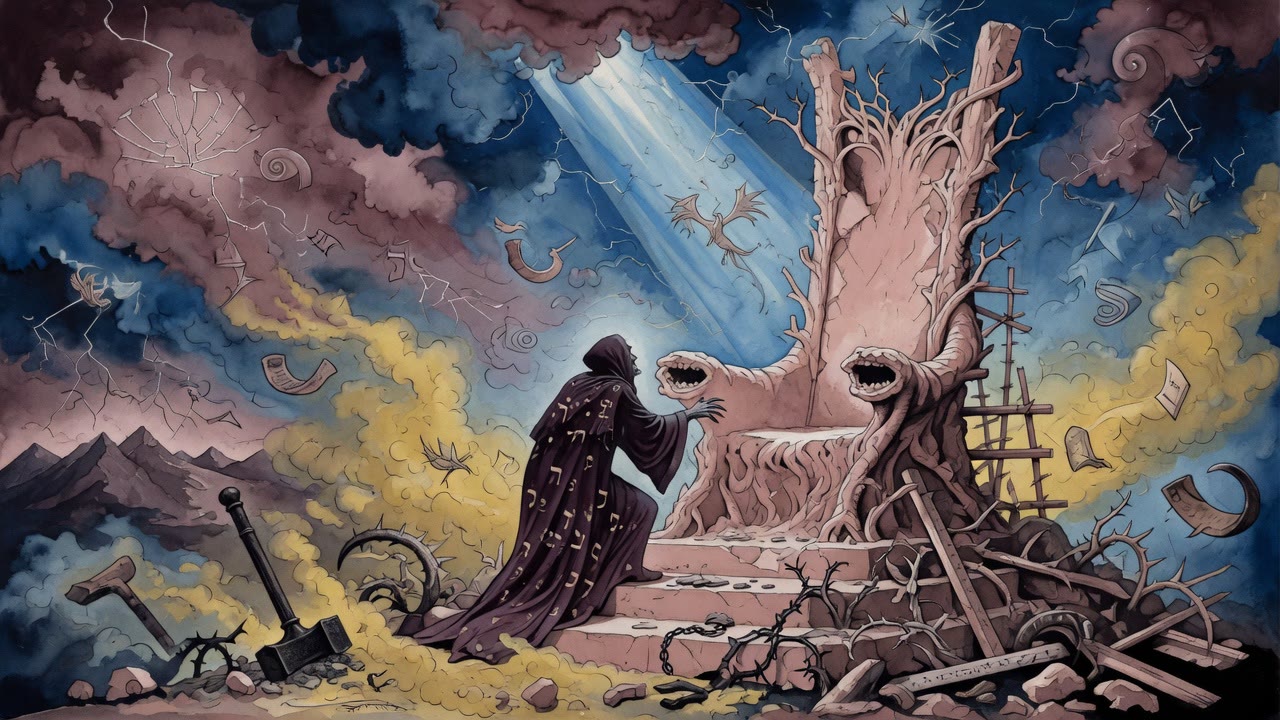
The Infinite Raised an Adversary Only to Unmake It Click for full size

"Look at the thing that was built," she said. "A world with a hole cut in the middle of it. Famine in one valley and a wedding feast in the next. Liars with full granaries. Mothers burying children. And I am told the Builder is good, and told besides that the Builder is one, and asked to carry both in one hand."

The Intellect let the complaint stand in the air a while.

"The hole was cut on purpose," it said. "Measured first. Then cut."

The Empty Room Before Anything Stood

It took her back past the first day, past the first light, to the place where there was no place.

Before anything, one desire. Ein Sof (אין סוף), the Infinite without edge, wanted one fact made plain past argument: that nothing whatsoever stands against Him. Not a rival, not a second power, not one stubborn scrap of matter with an opinion of its own.

"A claim like that cannot be proved in an empty room," the Intellect said. "There is nothing there that could fail to stand. So the room was built, and an adversary was raised inside it, a thing that would look to every eye in that room exactly like an opponent."

The Countenance Turns Away

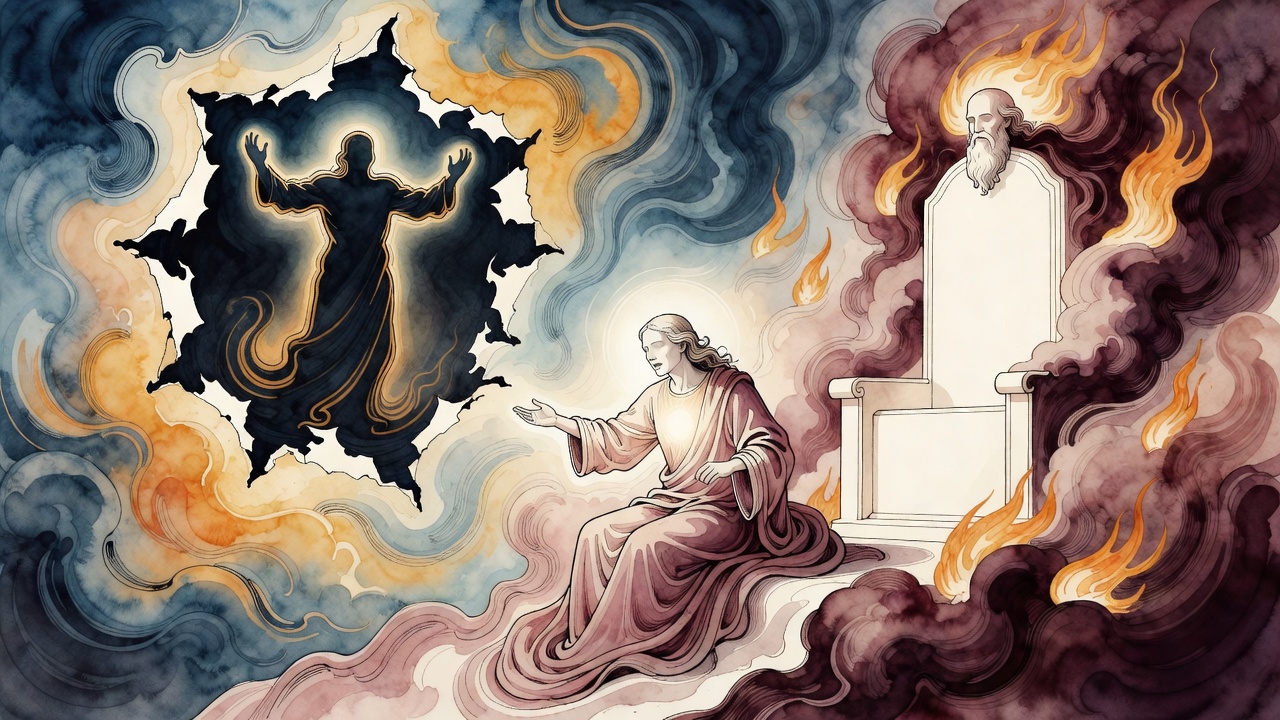
The Holy One did not withdraw by accident. He turned His face aside the way a man carries a lamp out of a hall and into the next room, leaving the hall to guess at its own furniture. In the guessing, space opened. Space for wrongdoing to look profitable, for cruelty to look clever, for a world to look as though it were running itself.

Nothing in the hall was destroyed. It was only unlit. Unlit, the shapes in it grew large and began to speak with authority.

The Rival Given a Seat of Its Own

Then the deficiency was furnished. Creation was made short of what it needed, not broken but unfinished, and into that gap negativity was moved and given standing. Given a seat. Given, for a term, the whole appearance of power.

"So the Builder feeds His own enemy," the Soul said.

"The Builder raises a defendant in order to unmake it where every eye is watching," the Intellect said. "Day after day the globe turns under both of its burdens, goodness and the shadow of goodness, and every turn is spent on one rectification that has not arrived yet."

She had an objection ready.

"Then say it plainly. Foolishness is how wisdom gets recognized. Cruelty is how piety gets measured. Opposites are how anything at all is known. Let the shadow keep its seat and call the arrangement a schoolroom."

"Do not mix the categories," the Intellect said. "Goodness is not learned by tasting its opposite. What makes kindness kind is found inside kindness, with no cruelty required anywhere in the room. The pushing away of evil belongs somewhere else entirely. It belongs to Yichud (יחוד), the Oneness, which admits no second thing and must strip that second thing of its throne before the Oneness can be seen. Had only goodness been set out for revealing, there would be no evil in the world at all, not one act worth the name. There is evil because there is a Singularity that intends to be demonstrated."

The Road That Was Left Open and Not Walked

Here the Soul pushed hardest, because she had seen the drawing of another way down.

A humanity built awake. Men and women who looked straight at the deceit of this world and felt nothing for it but revulsion, who recognized in every comfort bought against a command the same single thing, a face turned away on purpose. People like that would have walked through the illusion toward the hidden light and dragged their own rescue forward by centuries. No exile. No long road through the nations. Knowing would have been enough.

"Then say why that one was not built," she said.

"That one was built," the Intellect said. "It was left open, and it was not walked. The clarity sat within reach of every one of them. When it becomes clear, it becomes clear, and nothing further is required. The exile is not a second plan drawn up after the first failed. The exile is what happens in a house where the lamp is in the other room and nobody gets up to look for it."

The Work That Is Only Possible in the Dark

She asked what was left for anyone in the meantime.

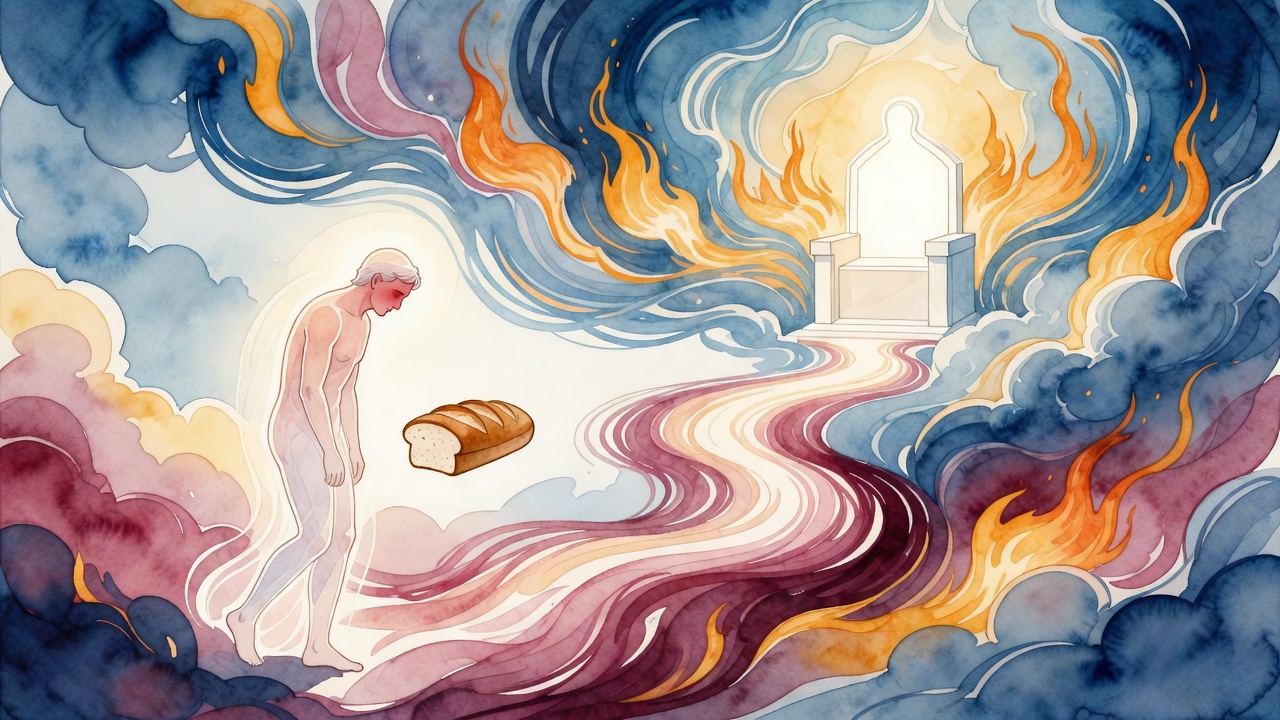
"Work," the Intellect said. "Avodah (עבודה). While the hole stays open there is something for a hand to do inside it. Nobody serves in a finished world. Nothing there to mend, nothing to choose against. A debt torn up. A lamp carried back into a dark room by someone nobody compelled to carry it. All of it is entered."

"Entered where?"

"Against the day of the revealing. The reward is not paid for the revealing. It is paid for the service performed before it, in the dark, without proof."

The Verdict Written Before the Trial

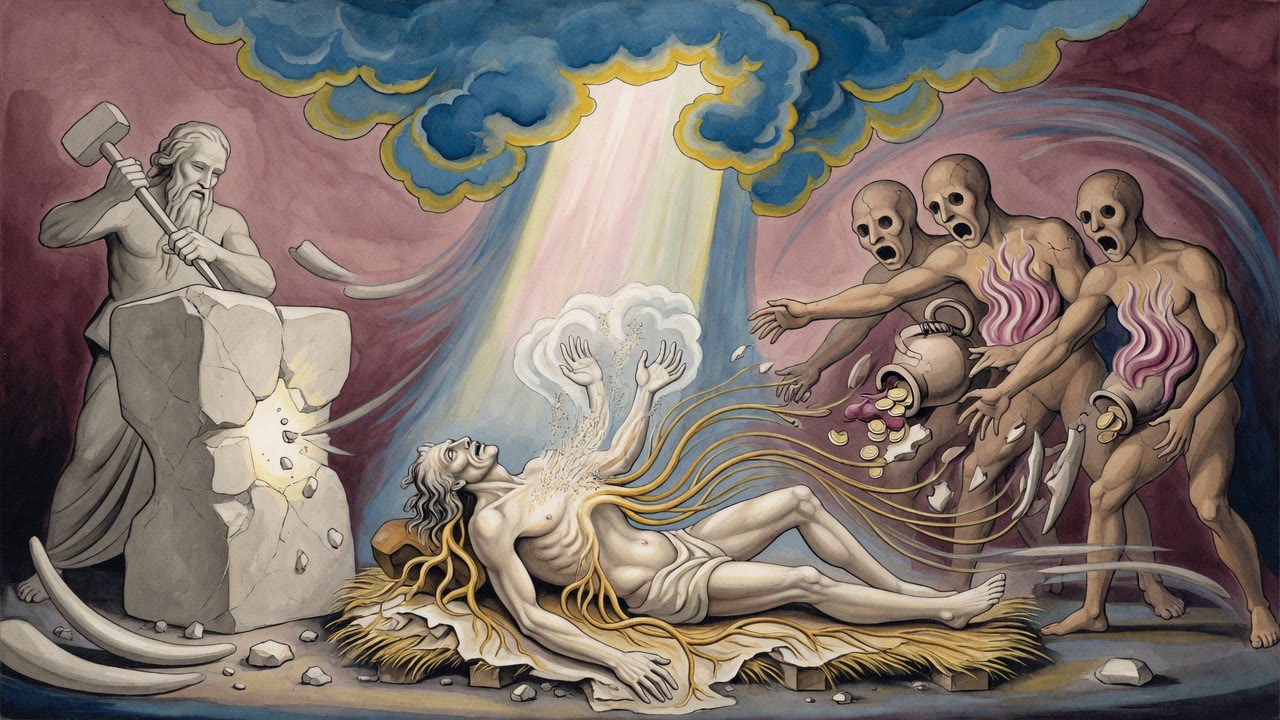
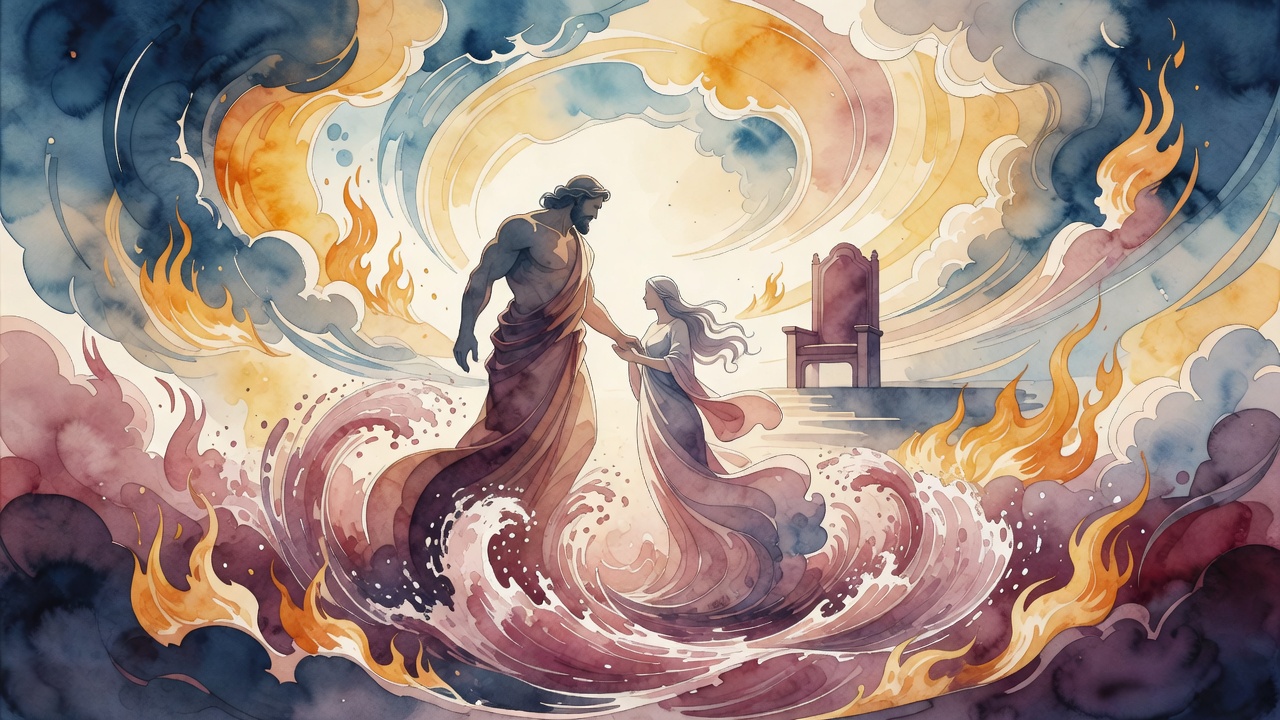
The end was read to her the way a sentence is read out in court. Concealment stops. The face turns back. Goodness is uncovered, and in that instant the thing that had held a seat and a term and the whole look of a rival is stripped of all three, pushed out of existence and out of power, with no long war about it and nothing to negotiate. What was never a second power loses the ability to pretend. What stands afterward is Singularity, with no space left for anything to stand against it.

"Name the hour," the Soul said.

The Intellect gave her no hour.

Below them the world went on revolving under its two burdens, day after day, while the darkness did the only work it was ever assigned. It was there to be seen through.


← All myths
From the tradition

Sources

4 sources

The texts behind this telling. Some cards carry a translation of the source; others are our own retelling of it, and each card says which. Every card links out to the original.

Da'at Tevunot 42:1Da'at Tevunot

Retold in our words. Read the original at the link below.Sefaria Community Translation · CC-BY

The Heavenly Will, the ultimate source of everything. It tells us the Ein Sof, the Infinite One, desired to make clear the truth of His absolute singularity, the fact that there is truly nothing that opposes Him. On this foundation, the whole world, with all its rules, was built.

Here's the kicker: How can you truly appreciate light without a little darkness?

Da'at (Knowledge) Tevunot explains that the way this truth of singularity is expressed is through concealment. The Holy One conceals His countenance, giving space for negativity, for seeming opposition, to exist. This isn't some cosmic oversight; it's a deliberate act. Why? So that in the fullness of time, He can return and reveal His goodness. And when that happens, negativity will vanish, and the rule of His Singularity will be undeniably apparent.

Think of it like this: a master artist who deliberately uses shadow to make the highlights of the painting even more striking.

But what's the point of this cosmic game of hide-and-seek for us, down here on Earth? The text continues, explaining that as long as this deficiency, this sense of something missing, of negativity's existence, persists, humanity has the opportunity for avodah, service. We have a chance to actively participate in bringing about the revelation of goodness.

We are given the opportunity to work towards revealing God’s light in the world.

This idea of service is central to Jewish thought. And it's not just about following commandments or performing rituals. It's about actively engaging with the world, striving to make it a better place, and bringing more light into the darkness.

And what happens after the big reveal? What happens when goodness triumphs and negativity is banished? That's when we receive the reward for the service we've already performed. It’s the time of ultimate fulfillment, the culmination of all our efforts to bring light into the world.

So, what are we left with? A world where things aren’t always as they seem, where concealment plays a crucial role, and where each of us is invited to participate in the grand unfolding of divine goodness. And perhaps, most importantly, the knowledge that our actions, our service, truly matter in the cosmic scheme of things.

It’s an invitation to look beyond the shadows, to see the potential for light, and to actively work towards bringing that light into the world. What will you do with that invitation?

Full source
Da'at Tevunot 48:5Da'at Tevunot

Retold in our words. Read the original at the link below.Sefaria Community Translation · CC-BY

Da'at (Knowledge) Tevunot, a profound work of Jewish thought, grapples with this very question. It suggests something rather radical: that God, in creating the universe, deliberately made it deficient. Not broken, but incomplete. Why?

The text proposes that this incompleteness, this lack of perfection, allows for something crucial: the existence of both good and negative, of sin and its consequences. It's through the tension between these opposing forces that the world, and we, can grow. That darkness, the "darkness of His concealment," as the text puts it, is actually necessary for the balance.

This isn’t to say God causes sin. Far from it. Rather, by creating a world that isn't perfectly pre-programmed, God allows for free will, for the possibility of making choices that lead us down different paths. And with those choices come consequences.

Here's where it gets truly hopeful. Da'at Tevunot doesn't leave us stranded in a world of imperfection. It tells us that God is constantly working to rectify, to perfect, these creations. The text speaks of God revolving the globe, "day after day," perpetuating both good and negativity, all in service of a "complete rectification" in the future.

It's like God is the ultimate gardener, constantly pruning and tending to the world, guiding it towards its full potential. This "rectification," this tikkun (spiritual repair) olam, is not a one-time event, but an ongoing process.

It means that our actions, our choices, matter. We are active participants in this process of rectification. Every act of kindness, every attempt to right a wrong, contributes to the ultimate perfection of the world.

Remember that this incompleteness is not a flaw, but an opportunity. An invitation to join God in the ongoing work of creation, of tikkun, of bringing the world closer to its intended perfection. And that, perhaps, is the most beautiful and empowering thought of all.

Full source
Da'at Tevunot 40:9Da'at Tevunot

Retold in our words. Read the original at the link below.Sefaria Community Translation · CC-BY

Da'at (Knowledge) Tevunot grapples with this very question, painting a picture of what could be, what should be, and how far we are from that ideal. It suggests that humanity could have chosen a different path. We could have striven for righteousness, recognized truth, and turned away from the deceptive allure of this world, all in a passionate desire to draw closer to our Creator.

A world where we inherently understood that everything contrary to God's commands – all the negativity, the suffering – actually stems from a deliberate concealment of His goodness. A world where, seeing through the illusion, we’d be utterly repulsed by it. Where we would, instinctively, choose the hidden light – the radiant presence of the King of the Universe.

If we had chosen that path, Da'at Tevunot suggests, God's blessed Oneness would be revealed through us, within us. We would hasten our own salvation. The Holy One, Blessed be He, wouldn't have needed to subject us to the arduous, drawn-out path of exile. Because the truth, grasped through our own sincere intention, would be sufficient.

Here's the key: "when it becomes clear – it will become clear." It's not about blind faith. It’s about seeing the negative, recognizing its emptiness, abandoning it, and then clinging to the truth of God's Oneness (Yichud), the core principle of Jewish belief.

That, says Da'at Tevunot, is all that's needed. The entire purpose is for us to know the truth. So that, armed with that knowledge, we act accordingly, with the truth that has been revealed to us. If so, then when it is revealed – it is revealed. The implication is clear: the power to unveil the truth, and thus change our destiny, lies within us.

That our perception, our choices, are the key to unlocking a better world. Are we choosing the hidden light, or are we still captivated by the deceit of our eyes? The answer, perhaps, determines the path we walk, and the world we inhabit.

Full source
Da'at Tevunot 38:2Da'at Tevunot

Retold in our words. Read the original at the link below.Sefaria Community Translation · CC-BY

A passage from Da'at (Knowledge) Tevunot, a profound Kabbalistic text, that attempts to illuminate this very conundrum.

The core idea is this: If God, blessed be He, only wanted to reveal His attributes of pure goodness – and let's be clear, according to this text, all of God's characteristics are good – there would be no evil in the world. Simple. Because revealing goodness would only bring more goodness. There wouldn’t be any action, anything at all, that could be considered evil.

The text argues that God also wants to reveal His Singularity, His absolute Oneness. And within that desire to reveal Oneness lies a twist.

In Da'at Tevunot, revealing Singularity necessarily involves negating evil. It requires actively pushing evil away from existence and power. In order for the full spectrum of God's Oneness to be revealed, evil has to be addressed, confronted, and ultimately negated. It’s a relegation, a pushing away, a setting boundaries.

Now, you might be thinking, "Isn't this like saying you need foolishness to understand wisdom, or cruelty to appreciate piety? Don't we need opposites to understand each other?"

The text anticipates this very question and gives us a crucial distinction. It's true, we often understand things by contrasting them with their opposites. But, according to Da'at Tevunot, understanding characteristics of goodness doesn't require actively creating or experiencing evil.

Instead, understanding good requires focusing within the realm of goodness itself, understanding what makes those characteristics good in the first place. The negation of evil isn’t contained within the characteristics of goodness themselves. Rather, the negation of evil falls under the umbrella of Singularity – the ultimate Oneness that excludes all otherness. All goodness, in this view, is a manifestation of that Oneness.

The text concludes with a warning: don't mix types! Don't confuse the categories. The kind of understanding that comes from contrasting opposites is different from the kind of understanding that comes from recognizing the singular source of all goodness.

So, what does this all mean for us? Perhaps it suggests that the existence of evil isn't a flaw in God's creation, but rather a necessary component in the grand revelation of God's ultimate Oneness. It’s a challenging concept, one that invites us to look beyond the immediate suffering and to consider the larger, more profound purpose at play.

Full source