6 min read

The Coupling Inside God That Feeds Creation's Waters

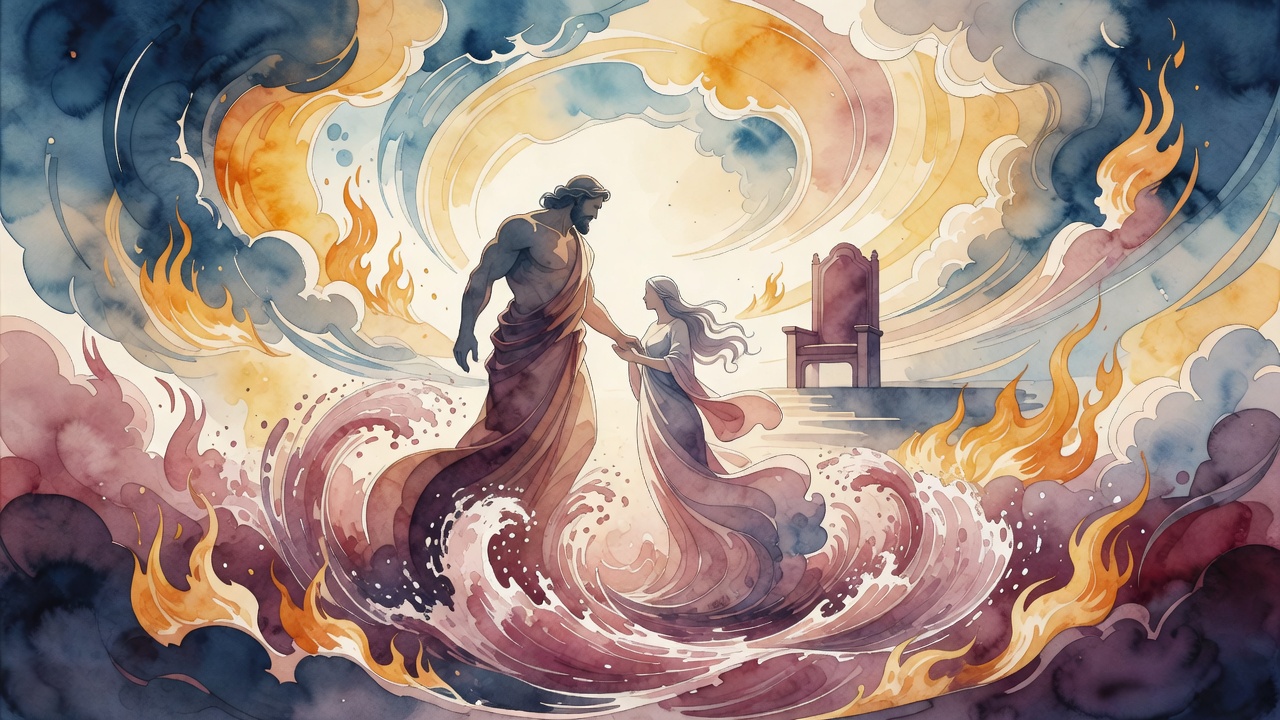
Deep in the hidden body of God, a Father and Mother conceive a Son, who turns to face his Bride as the feminine waters rise to feed creation.

Curated by Arthur · Told by Maggid ·
Table of Contents
  1. The Father and the Mother Trade Their Gifts in the Dark
  2. The Son Folds in the Womb and Learns to Stand
  3. The Mother Builds a Bride From His Hindmost Light
  4. The Son Turns to Face Her
  5. The Waters Rise and the Blessing Falls
The Coupling Inside God That Feeds Creation's Waters Click for full size

The Father and the Mother Trade Their Gifts in the Dark

Before there was a world to hold them, two faces leaned close inside the hidden architecture of God. The elder is Abba, the Father, and his name is Wisdom. Beside him is Imah, the Mother, and her name is Understanding. They did not stand apart. They pressed into each other and traded what each carried. The Father gave the Mother the high thing, the portion that stands tall, and drew back from her the low thing, the portion that bends and receives. Neither kept only what was his own. Each gave, each took, and in the trading a child quickened in the Mother.

Higher still, an older face held them both. The Ancient One carried the Father and Mother in his chest the way a body carries breath, and they were sometimes two and sometimes one, so close that when the Mother rose toward the Father the seam between them all but vanished.

The Son Folds in the Womb and Learns to Stand

The child had a name before he had a shape. They called him Zeir Anpin, the Lesser Countenance, the small face set against the vast one above. In the womb of the Mother he lay folded, six limbs pressed three against three, a seventh part resting beneath him like a floor. He could not yet stand. He could not yet give.

Then the Mother nursed him. His lower limbs sank into place and his heart came forward, and what had been hidden in him began to show. His lower powers climbed and turned into higher ones, until the strength in his chest rose into the thought in his head and he stood upright, awake, a countenance that could look out and be looked at.

The Mother Builds a Bride From His Hindmost Light

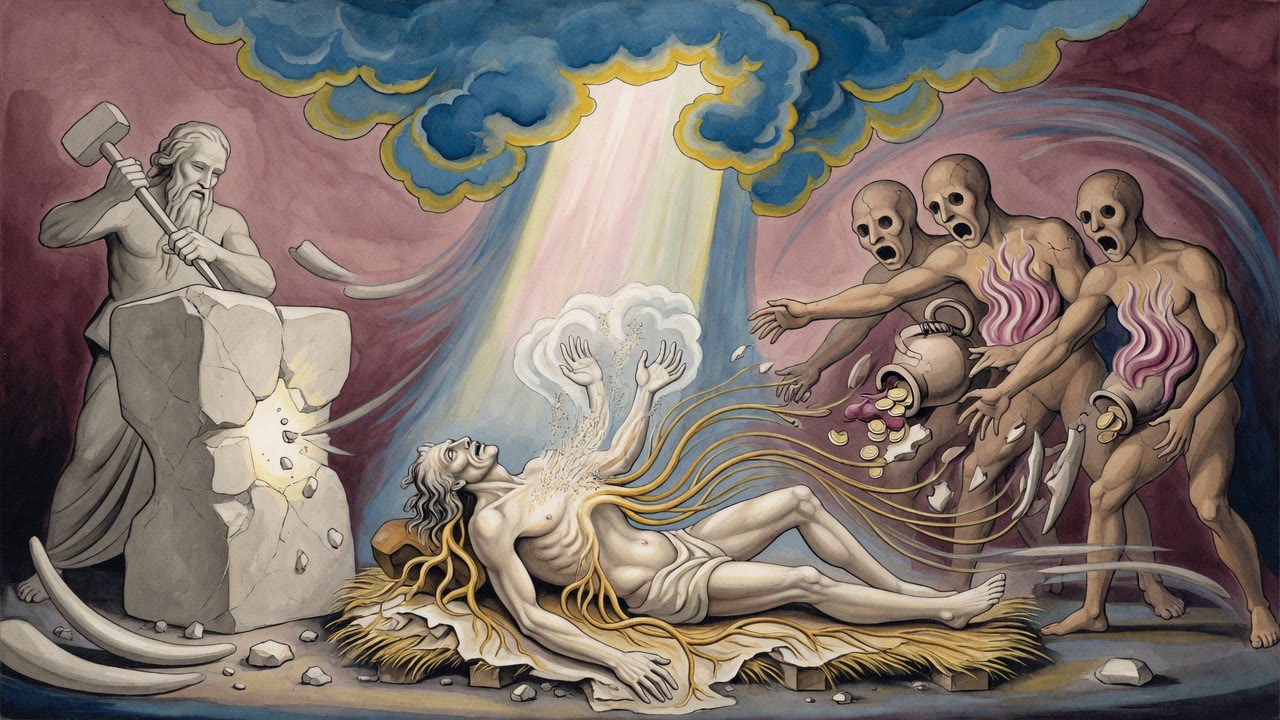
He was not meant to stand alone. While he grew, the Mother reached behind him, into the light that fell down his back, the part of him that faced away, and from that hindmost radiance she began to build a woman. She set the beauty of his spine into the crown of the new one. She set the two pillars of his flanks into her wisdom and her understanding. She set his foundation between the bride's shoulders and let the rest run down through the length of her.

The work took twelve years and a day. The severities came down through her by measure, one span at a time, and then climbed back from bottom to top, a year to rise, a year to rise again, a year to raise her crown, until the woman was whole. The extra day was hers alone. In this one thing the Bride went first and finished a breath ahead of the one she was cut from.

She had a name too. Nukva, the Feminine, the seventh face after the six of him. At the start she was nothing a hand could hold, one bright point of pure need. Now she stood at his back, joined to him spine to spine, the two of them hemmed together so that neither could see the other's face. "You hem me in behind and before," runs the old line, "and lay Your hand upon me." That was their whole world at first. Touching, and blind to each other.

The Son Turns to Face Her

A coupling back-to-back gives nothing to the world. The Son knew it. So he turned.

He came around to face the Bride, and she lifted her eyes to meet him, no longer a single node of need but a full countenance grown to his own height. This is the turning everything below waits for. When his face finds hers, the two who were sometimes two and sometimes one become one on purpose, and the channel that runs from the hidden Father down to the last edge of creation opens end to end.

The Waters Rise and the Blessing Falls

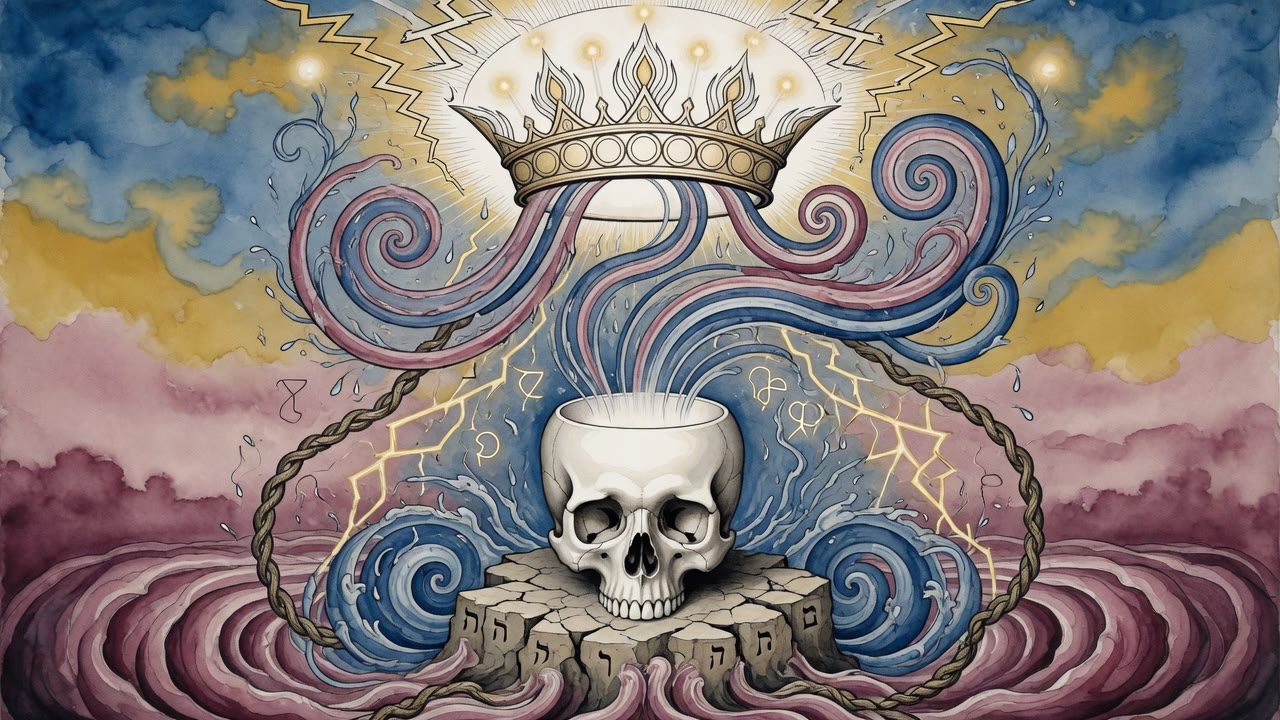
The Son does not begin it. The Bride does. From below her, from the far floor of things, she gathers the feminine waters and sends them up. They are made of longing, the raw need of everything that has been made and everything still broken, the cry of vessels that cracked and spilled their light. She raises that flood toward him, and as it climbs it sifts the wreckage, sorting the sparks from the shards.

The waters reach him and he answers. Light pours down out of him into her, the light that carries his name, and she takes it and holds it and closes around it. What rose as need descends as seed. Inside her it settles and is set in order and grows, folded again into a womb, and then it comes forth born, the way the kings of an older ruined world are lifted out of their graves and remade, ten days and ten days and ten days and ten days, until each broken power stands again crowned in its place.

This is the single act the worlds are strung upon. Not a picture of creation. The engine of it. Every mercy that falls as rain, every child, every dawn, every scrap of blessing that reaches the lowest room of the world, falls through that one seam where the Son faces the Bride and the waters rise to meet the light. Let the two of them turn away from each other and the channel shuts and the world goes dry. Let them face, and heaven empties itself downward without end.


← All myths
From the tradition

Sources

4 sources

The texts behind this telling. Some cards carry a translation of the source; others are our own retelling of it, and each card says which. Every card links out to the original.

Asarah Perakim LeRamchal 3:8Asarah Perakim LeRamchal

Retold in our words. Read the original at the link below.Sefaria-hosted English translation · CC-BY

It explores the intricate relationships between different aspects of the divine, using evocative terms like ABBA, IMAH, and MAH. Ready to dive in?

" Now, a bit. ABBA, often translated as "Father," represents the divine masculine principle, the source of wisdom and intellect. IMAH, "Mother," embodies the divine feminine, the source of understanding and nurturing. MAH and BEN are divine attributes, representing different aspects of God's being. According to Rabbi Ginsburgh, MAH indicates something of "lowliness" and is thus associated with the feminine, whereas BEN indicates something of "highliness" and is thus associated with the masculine.

The text continues, describing a dynamic exchange: "When they unite with each other, ABBA gives his BEN to IMAH and takes the MAH from IMAH for Himself." It's a reciprocal relationship, where each partner both gives and receives.

Here's where it gets even more interesting. "Two MAH on the right: ABBA and ISRAEL SABBA, and two BEN on the left: IMAH and TEVOUNAH." ISRAEL SABBA, often translated as "Ancient Israel," is another expression of the divine masculine, representing a higher, more primordial level of wisdom. TEVOUNAH, meaning "Understanding," is a higher expression of the divine feminine, going beyond just simple understanding to encompass profound insight. This arrangement highlights the balance and symmetry within the divine realm, with the masculine and feminine energies mirrored and interconnected.

But how do ISRAEL SABBA and TEVOUNAH fit into all this? The Asarah Perakim LeRamchal explains that "the Malkhut (Sovereignty) of ABBA and IMAH become separate Partzufim (a divine configuration) (the divine configurations)." Malkhut refers to the divine attribute of Kingship, the manifestation of God's will in the world. Partzufim are divine "faces" or configurations, representing different aspects of the divine personality. So, what we're seeing is a further differentiation and refinement of the divine energies.

Furthermore, "half of their Tiferet (Beauty) and Netzach (Eternity) clothe as mochin within them." Tiferet is the divine attribute of beauty and harmony. Netzach is endurance or victory. Mochin refers to divine intellect or consciousness. What the Ramchal is saying here is that the lower attributes of ABBA and IMAH act as the higher intellectual forces for ISRAEL SABBA and TEVOUNAH. This shows how the lower sefirot (the divine emanations) impact the higher sefirot.

The text then states that "ABBA and IMAH were made complete from there upwards." This completion suggests that the initial interplay between ABBA and IMAH sets the stage for further divine unfoldment and wholeness. "Then, ABBA and IMAH became kelim in the chest of ARICH ANPIN and ISRAEL SABBA in its navel." Kelim are vessels, and ARICH ANPIN is another divine configuration, representing God's long-suffering patience and compassion. This shows how the lower sefirot become vessels for the higher sefirot.

Finally, we arrive at a crucial point: "ABBA and ISRAEL SABBA, IMAH and TEVOUNAH are sometimes two and sometimes one when they unite with each other." This highlights the paradoxical nature of the divine. They are distinct entities, each with their unique attributes, yet they are also deeply interconnected, capable of merging and becoming one. According to Rabbi Ginsburgh, it is when the feminine rises to the masculine that this phenomenon occurs.

So, what does all this mean for us? This passage invites us to contemplate the dynamic interplay of masculine and feminine energies, not just within the divine realm but also within ourselves and the world around us. It’s a profound invitation to explore the mysteries of the Kabbalah and to find our own place within the divine dance.

Full source
Asarah Perakim LeRamchal 5:3Asarah Perakim LeRamchal

Retold in our words. Read the original at the link below.Sefaria-hosted English translation · CC-BY

The Ramchal, Rabbi Moshe Chaim Luzzatto, offers a glimpse into this mystery in his "Ten Chapters on Divine Wisdom" (Asarah Perakim LeRamchal), and it's a journey worth exploring. First, during the ibbur, or "gestation" stage, we find the VAK – the six extremities of Zeir Anpin (ZA), often understood as the "Lesser Countenance" or the masculine principle – arranged in a three-on-three configuration. Then, Malkhut (Sovereignty), representing the divine feminine and the final emanation, is positioned as the fourth element, resting upon Yesod (Foundation).

Next comes the yenika, or "nursing" phase. The NEHI (Netzach, Hod, Yesod – Victory, Splendor, Foundation), which are lower Sefirot (divine attributes), descend, while the HAGAT (Hesed, Gevurah (Severity), Tiferet (Beauty) – Loving-Kindness, Severity, Beauty) become more revealed. Malkhut, in this stage, remains attached to the rear of Tiferet, a connection to beauty and balance.

Finally, we reach gadlut, the "adulthood" or "maturity" stage. Here, the HAGAT ascend and transform into HABAD (Hokhmah, Binah (Understanding), Daat (Knowledge) – Wisdom, Understanding, Knowledge), the higher intellectual Sefirot. Malkhut rises with them, taking root in Daat, which represents knowledge and connection.

How does this construction of the Nukvah actually happen? It's built, crucially, from the "rear" aspects of Zeir Anpin’s NEHI. Tiferet of ZA finds its place within Keter (Crown, the highest of the ten sefirot) of the Nukvah. Netzach and Hod of ZA reside within Hokhmah and Binah of the Nukvah. And Yesod of ZA? That settles into Daat of the Nukvah, positioned, figuratively, "between her shoulders." This refers to the initial portions of the NEHI; the rest is distributed throughout her body.

This process takes time, a symbolic twelve years and a day.

Why twelve years? Because the measure of Yesod in the masculine principle is considered to be two parts, resulting in eight parts (or years) for eight parts of her body. That Yesod ultimately resides at the end of her Tiferet. From that point, the Gevurot, representing severity and judgment, descend to the level of her own Yesod in a single day.

Then they return, from bottom to top. One year from Yesod to Tiferet, another year from Tiferet to Daat, then a year to build her own Keter, and finally, a year from Daat to Keter. All told: twelve years and a day. The extra day signifies that the Nukvah precedes the masculine in this particular aspect of creation.

What a detailed process!

The Ramchal concludes with a powerful image: the DOUN (often read as ZOUN), the male and female principles, joined back-to-back. It evokes the verse from (Psalm 139:5): "You hem me in behind and before..." This intimate connection, this constant interplay, speaks to the profound relationship between the masculine and feminine aspects of the Divine.

What does it all mean? Well, it's a reminder that creation, even on the most cosmic scale, is a process. It requires stages of development, hidden connections, and a delicate balance between seemingly opposing forces. It’s a process that unfolds with purpose and intention, leading to a profound and intimate connection. And maybe, just maybe, understanding this divine dance can help us better understand the intricate dance within ourselves.

Full source
Asarah Perakim LeRamchal 3:3Asarah Perakim LeRamchal

Retold in our words. Read the original at the link below.Sefaria-hosted English translation · CC-BY

He describes the process of zivug, often translated as "union" or "coupling," but in Kabbalah, it's far more than just a simple coming-together. It’s the engine of creation itself. So, how does this divine zivug actually work?

In Ramchal, it begins with the Nukvah, the feminine aspect of the divine, raising the Mayim Nukvin, the "feminine waters." Think of these waters as the accumulated yearnings and needs of creation. This upward movement initiates a process of refinement, a sifting through the kelim, the "vessels." These vessels, according to Kabbalah, contain the divine light, but are often broken or flawed. The raising of the Mayim Nukvin helps to sort and repair them.

What's the result of all this upward movement? The lights of Mah descend. Mah is one of the names of God, representing a specific level of divine emanation. These descending lights are then arranged within the Nukvah, a stage called ibur, or "gestation. The divine feminine receiving and nurturing the divine light.

Then comes leidah, "birth." The lights, now formed and ready, emerge to take their place in the cosmic order. The Ramchal continues, explaining that when the lower realms ascend to the level of the higher realms, reaching their stature, this is gadlut, "adulthood" or "greatness." Initially, it "suckles," dependent on the higher realm, but gradually perfects itself, clothes itself, and gains independence.

This whole process, this elevation of the Melachim, the "kings" or "powers," takes forty days. Why forty days? The Ramchal breaks it down for us: ten days for Hessed and Netsah, reaching up to the level of Netsah of Atzilut (the World of Emanation). Ten days for Da'at (Knowledge) and Tiferet, ascending to Yessod. Ten days for Gevurah (Severity) and Hod, rising to Hod. And finally, ten days for Yessod and Malkhut (Sovereignty), until they reach the level of Malkhut. Each set of ten days represents a specific stage of spiritual ascent, aligning with the sefirot, the ten attributes or emanations through which God manifests in the world.

It's a complex and layered system, but the Ramchal’s breakdown provides a framework for understanding the dynamic interplay between the divine realms. Perhaps it's a reminder that creation is not a one-time event, but a continuous process of yearning, refinement, and birth. And perhaps, just perhaps, we each have a role to play in raising the Mayim Nukvin, in longing for a more perfect world, thereby inviting the divine light to descend.

Full source
Asarah Perakim LeRamchal 5:1Asarah Perakim LeRamchal

Retold in our words. Read the original at the link below.Sefaria-hosted English translation · CC-BY

Whoa, hold on. a little. Asarah Perakim LeRamchal, or "Ten Chapters of the Ramchal," is a foundational text in Kabbalah.

So, what exactly is the Noukvah de ZA?

First, Noukvah (נוּקְבָּה) in Aramaic literally means "female." In Kabbalah, it represents the feminine principle, the receiver of divine energy. ZA, or Zeir Anpin (זְעֵיר אַנְפִּין), means "small face" and represents the masculine principle, the giver.

The Ramchal tells us that the initial state of this Noukvah is just a point. Just a single, concentrated… something. It's the seventh Sefirah (a divine emanation), following the six preceding ones. Now, the Sefirot (סְפִירוֹת) are the ten emanations of God, the ten attributes through which the Divine manifests in the world.

So, this tiny point, this Noukvah, is the seventh in line. Why is that important? Because it sets the stage for everything that follows. It’s the potential, the seed from which something grander will grow.

But how does a single point become something more substantial? That's where the ascent of ZA comes in. When ZA, the masculine principle, ascends, the Noukvah rises with it. It’s a process described in three stages: Ibour, Yenikah, and Gadlut.

These three words are loaded with meaning. Ibour (עיבור) is gestation, like a fetus developing in the womb. Yenikah (יניקה) is suckling, the nourishment a baby receives from its mother. And Gadlut (גדלות) is adulthood, full maturity. The Noukvah doesn't just instantly spring into being. It undergoes a process of development, nurtured and sustained by its connection to ZA. It gestates, it's nourished, and then it matures.

We all start somewhere, often feeling like that tiny point. But through connection, through nurturing, through striving, we too can ascend and reach our full potential.

The Ramchal offers us a glimpse into the inner workings of the Divine, and in doing so, he also offers a profound lesson about ourselves. That even the smallest beginning holds the promise of greatness.

Full source