Parshat Bereshit6 min read

The Infinite Withdrew and Left a Wound of Empty Space

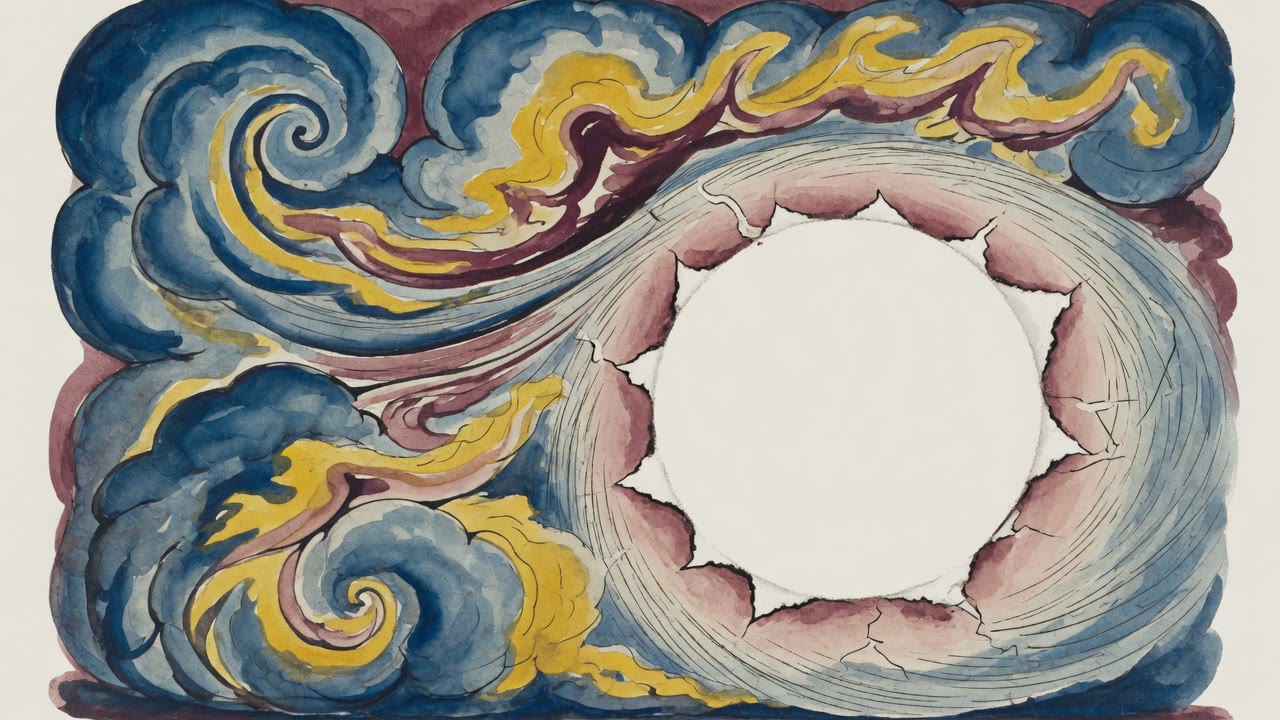
The Infinite filled all reality until no world could exist, so it contracted inward and tore a round hollow of empty space for creation.

Curated by Arthur · Told by Maggid ·
Table of Contents
  1. The Light That Left No Room for a World
  2. The Infinite Contracts Into Itself
  3. A Round Wound of Pure Absence
  4. The Single Thread Descends Into the Dark
  5. Vessels Born From the Rebuffed Light
  6. The Second Withdrawal and the Ejected Vessels
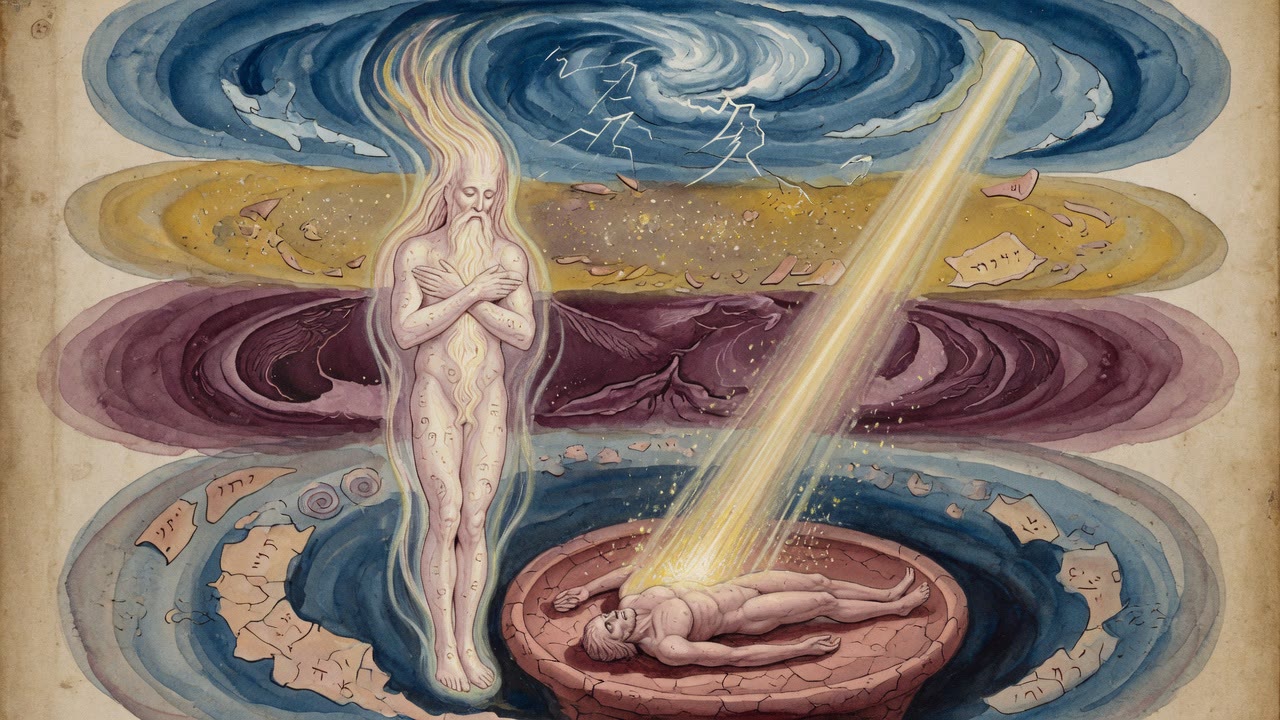
The Infinite Withdrew and Left a Wound of Empty Space Click for full size

The Light That Left No Room for a World

Before the first day, before darkness or deep or water, there was only fullness. The Ein Sof (the Infinite) filled every direction of reality with a single undivided light, and that light left no gap where a second thing could stand. There was no here and no there, because here and there need a border, and the light knew no border. A world wanted to exist. It could not. Perfection, poured out without limit, crowds out everything that is not itself.

The trouble was not scarcity. The trouble was abundance. A candle cannot be seen at noon, and a cup cannot hold water in the middle of a sea. Nothing could receive the light, because to receive is to be separate from the giver, and nothing was separate. The Infinite was alone with its own brightness, and its brightness was a wall.

The Infinite Contracts Into Itself

So God did the one thing an endless being should not be able to do. He made Himself smaller. Not smaller in size, for size did not yet exist, but smaller in presence. He drew His light inward, gathering it back toward a center, pulling the fullness away from one region of Himself the way a held breath is pulled deep into the chest. This drawing back has a name in the mouths of the mystics who mapped it. They call it Tzimtzum (contraction), the self-limiting of the Limitless.

A giver with no one to receive is not truly giving. Light that only shines, and is never taken in, keeps the whole distance between itself and every possible other. To make an other at all, the Infinite had to stop filling. It had to leave.

A Round Wound of Pure Absence

Where the light withdrew, it left a hollow. Not a room inside the light but an absence torn open at the center of everything, round and dark, a space that the Infinite had vacated on purpose. This was the first emptiness that had ever been. Into a fullness that had never known a gap, God opened a wound in Himself, and the wound became a womb.

The empty round was the only place a world could ever grow, because it was the only place the light did not already own. Every heaven and every grain of dust that would ever be created would take its shape inside that vacated dark. The absence was not a failure of the light. The absence was the light's gift.

The Single Thread Descends Into the Dark

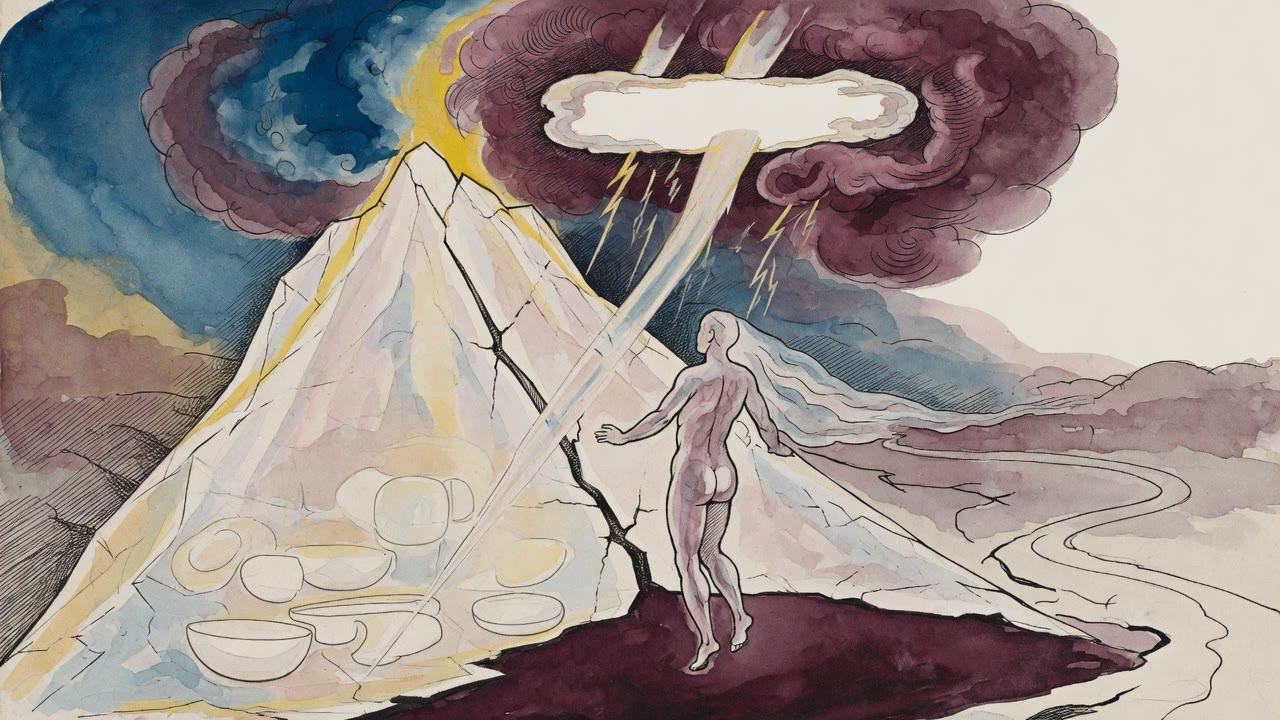
The Infinite did not abandon the hollow. From the surrounding light a single thin line reached down into the emptiness, one narrow thread where before there had been an ocean. Through that thread, and only that thread, the light returned into the dark it had left, measured now, thin enough that the void could bear it without drowning again.

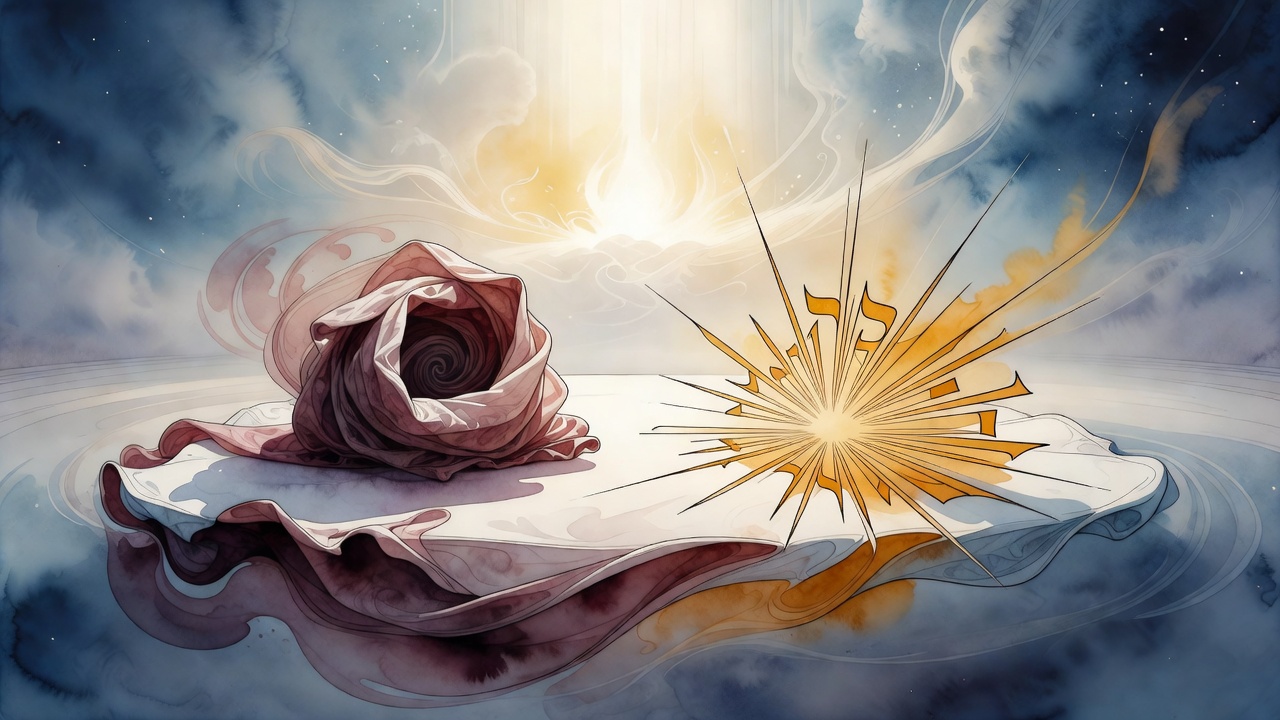
The lowest reach of that descending light was a level the mystics name Malkhut (Kingship), the final vessel, the place built only to receive. Here the strangeness deepened. A partition rose across Malkhut, a barrier that held the supernal light back from entering the last vessel, and left that lowest level dark. The Infinite had contracted once to make the void. Now, within the void, it withheld its light again, refusing to pour into the very vessel shaped to be filled.

The refusal was not cruelty. A vessel that only swallows light stays forever a stranger to the one who fills it, a taker and nothing more. A vessel that turns the light back, that declines to simply receive, has done the one thing the light itself does. It has given. In that single act of holding back, the lowest and most separated level took on the trait that could close the distance to its Source.

Vessels Born From the Rebuffed Light

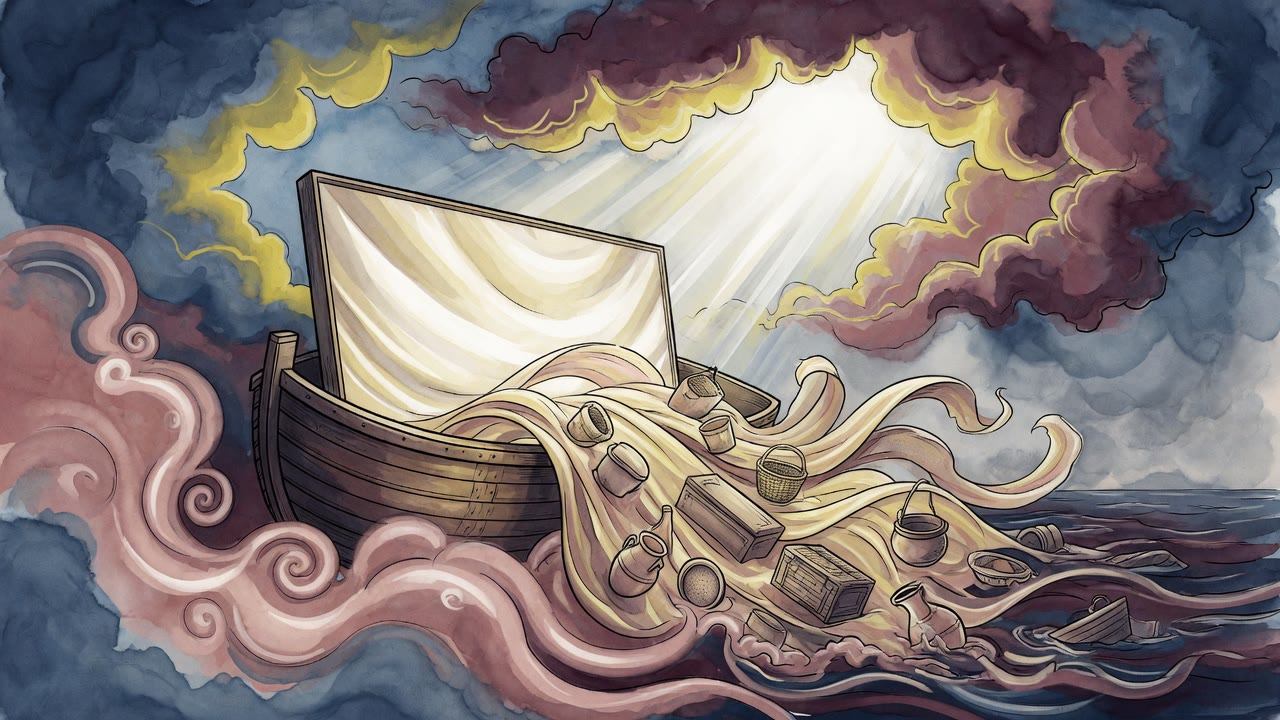
The light that struck the partition did not vanish. It rebounded. It crashed against the barrier and turned back on itself, and in that collision something new was forged. The light driven back, the light forbidden to enter, hardened into vessels of its own. Radiance meant only to give became, through the force of being refused, a thing that could receive.

The paradox held. Pure giving light, blocked at the wall, flowed backward and became the walls of new vessels throughout the divine configurations. What resistance rebuffed, resistance also built. The barrier that starved one level fashioned the cups that every other level would drink from.

The Second Withdrawal and the Ejected Vessels

Once was not enough. A second contraction followed the first, and this one moved a vessel that was never meant to move. Malkhut, which had always sat at the bottom of every level as its final end, climbed. It rose out of its place and fastened itself to Bina (Understanding), a level far above it, the way a foundation might tear loose and graft itself to an upper story. The end of the level was dragged upward and lodged beneath Chokhma (Wisdom), nested inside Bina where it had no right to be.

The climb threw the lower vessels out. Bina, Tiferet (Beauty), and Malkhut were expelled from each level and cast down from the rank they had held. What remained above was thin: two vessels only, Keter (Crown) and Chokhma, holding two lights, Nefesh (the life-soul) and Ruach, the lowest breaths of the soul.

And the lights ran the other way. Where the vessels lost their lower three and kept the lowest two, the lights kept the lowest two and lost the higher three. Nefesh and Ruach (the spirit-soul) stayed within the level while the greater lights above them were pulled up and out. Vessel and light traded places in the same wound. What one gave up, the other held. Presence and absence changed sides again, as they had from the first instant the Infinite pulled back and let a world begin inside the dark it had opened in itself.


← All myths
From the tradition

Sources

4 sources

The texts behind this telling. Some cards carry a translation of the source; others are our own retelling of it, and each card says which. Every card links out to the original.

Kalach Pitchei Chokhmah 4:8Kalach Pitchei Chokhmah

Retold in our words. Read the original at the link below.138 Openings of Wisdom, trans. Rabbi Avraham Greenbaum, Azamra Institute (2005) · CC-BY

The Kabbalists, those mystical explorers of Jewish tradition, wrestled with this very question when contemplating the creation of the universe. And their answer? It involves a cosmic contraction, a divine act of self-limitation called Tzimtzum (God's self-contraction to make room for creation).

The Tzimtzum is a wild concept, almost paradoxical. It suggests that before anything could be created, before our world with all its imperfections could exist, God, or Eyn Sof (the Infinite), had to, in a sense, make room for it.

Why this cosmic withdrawal? Because perfection, in its undiluted form, leaves no room for anything else. There's no space for us, for our efforts, for our growth. If everything was already perfect, what would be the point of anything?

The act of creation, according to this Kabbalistic understanding, begins with this concealment of perfection. It's like a painter starting with a blank canvas, a musician beginning with silence. This "void," this space created by the Tzimtzum, becomes a realm governed by imperfection, a realm where service, our work, our striving, becomes relevant.

But here's the beautiful part: the purpose of this initial concealment isn't to leave us stuck in a world of flaws. No, no, no. It's to reveal something even more profound: how those very deficiencies can be rectified through the power of God's oneness. The goal, if you will, is to bring the world back into a state of unity, a rectified state, through our actions and devotion.

So, the Kabbalists are telling us that the story isn't complete unless perfection is first concealed. This allows for the possibility of imperfection, and with it, the opportunity for avodah, service, work, spiritual practice. This continues until the perfection of God's oneness and unity is revealed, and all the deficiencies are, ultimately, healed.

That our struggles, our imperfections, aren't accidents, but integral parts of a larger cosmic process. That through our efforts, through our dedication to repairing the world (tikkun olam), we participate in the unfolding of divine unity. Does this reframe your own struggles in a new light?

Full source
Petichah LeChokhmat HaKabbalah 14:1Petichah LeChokhmat HaKabbalah

Retold in our words. Read the original at the link below.Sefaria-hosted English translation · CC-BY

Kabbalah, the Jewish mystical tradition, grapples with this very feeling. And it offers a radical solution, a cosmic act of self-limitation called tzimtzum (constriction).

What does tzimtzum actually mean? Sounds beautiful. But here's the rub: pure, unadulterated receiving, without any capacity to give back, creates an unbridgeable chasm between the receiver and the Giver.

So, to "save the created beings from the enormity of this distant separation," as it says in Petichah LeChokhmat HaKabbalah, something drastic had to happen. A mystical first constriction, a tzimtzum, was implemented.

The passage speaks of separating the "fourth level" – Malkhut (Sovereignty) – from all the holy partzufim (a divine configuration) (the divine configurations). Okay, Partzufim are like divine configurations, aspects of the Godhead. And Malkhut? It represents the final level, the realm of manifestation, of receiving.

This tzimtzum, this constriction, is described as the formation of a partition. This partition prevents the supernal light from entering the final receiving vessel of Malkhut. It leaves that level "devoid of any light." Imagine that: a deliberate act of withholding, creating a void.

Why would the Divine do that?

Here’s the key: by refusing to simply receive, Malkhut creates a situation where receiving becomes an act of giving. It's like giving a friend the opportunity to do you a favor. Suddenly, the dynamic shifts.

This idea of shifting the dynamic is crucial. Because once Malkhut achieves this, this ability to give through receiving, it's no longer "enormously separated" from the Emanator. It now shares the quality of giving, forming a connection. As the author of Sulam (a key Kabbalistic commentary) calls it, an "equating of form." A shared characteristic that bridges the gap. And Kabbalah is telling us that this is true even on the cosmic scale.

So, this wasn't just a one-time event. That "all the holy partzufim emerged with a partition placed upon their respective vessels of Malkhut so that they would not receive light in their fourth level." This principle of self-limitation, of creating space for reciprocity, is built into the very structure of creation.

That the greatest act of love, of creation, involved a deliberate act of holding back. Perhaps it's a reminder that true connection requires more than just taking; it requires the ability to give, even in the act of receiving.

Full source
Petichah LeChokhmat HaKabbalah 15:1Petichah LeChokhmat HaKabbalah

Retold in our words. Read the original at the link below.Sefaria-hosted English translation · CC-BY

It's also at the heart of a deeply mystical concept in Kabbalah, the Jewish esoteric tradition.

Imagine the universe overflowing with divine energy, and then, a sudden pulling back, making space for creation itself.

Before this contraction, the fourth level was meant to serve as a vessel. But something shifted. After the tzimtzum, new vessels had to be fashioned within the holy partzufim (a divine configuration) (the divine configurations). Partzufim? Think of them as divine faces or configurations, aspects of the Godhead. They're not physical, of course, but represent different ways God manifests.

These new vessels, according to Petichah LeChokhmat HaKabbalah, were created through a fascinating process: the "rebuffing of the returning light." This involves a "fusion through collision," where the supernal light crashes against a partition. Picture it: brilliant light, a barrier, and something new emerging from the interaction.

But here's the real kicker. This "returning light" – initially just light that was prevented from being received – somehow becomes a receiving vessel itself. How does that work? Light meant for giving now taking on a function of receiving. It's like a river changing course and flowing upstream.

As the author of the Sulam commentary points out, if the supernal light is wholly giving, how can it become a receiver? It’s a valid question. It’s the kind of question that makes Kabbalah so compelling! this way. Maybe the act of being rebuffed, of encountering resistance, is what allows the light to develop a capacity for receptivity. The light that was blocked from entering the fourth level wasn't destroyed; it was transformed. Perhaps it's in that very struggle, in that very limitation, that the potential for a new kind of vessel is born.

The things we initially resist might ultimately be the things that help us grow. What if the very things that seem to hinder us contain the seeds of our greatest potential?

Full source
Introduction to Sulam Commentary 13:1Introduction to Sulam Commentary

Retold in our words. Read the original at the link below.The Sefaria Sulam, 2023 · CC-BY

Kabbalah, the Jewish mystical tradition, talks about something similar happening on a cosmic scale, through a concept called tzimtzum (God's self-contraction to make room for creation), or constriction. And after this initial constriction, there's another one! It’s this “second constriction” that really shakes things up, and that’s what

Each level of reality, in Kabbalistic thought, is built from these five sefirot.

So, what happens after this second constriction? Well, imagine Malkhut, which is usually the end of a level, suddenly decides to move upwards, connecting with Bina. It's like the foundation shifting and attaching itself to a higher story of the building. This upward movement effectively pushes the "end" of that level higher, specifically placing it under Ḥokhma, nestled within Bina.

What's the result? According to the Sulam Commentary, this movement essentially ejects the lower vessels – Bina, Tiferet, and Malkhut – from that particular level, "negating" them from their previous placement (we'll explore this "negation" further in section 17). So, from this point on, every level is left with just two vessels: Keter and Ḥokhma, along with two corresponding lights – Nefesh (Soul) and Ruach (Spirit).

But here’s the twist! This applies only when we're talking about the vessels, the containers. When it comes to the lights themselves, it’s actually the reverse! The lights of Nefesh and Ruach remain within the level, while the higher lights – Neshamah (Breath), Ḥayah (Life), and Yeḥidah (Singularity) – are negated, or withdrawn, from that level.

A constant ebb and flow between vessel and light, between presence and absence. What does it all mean? Perhaps it suggests that even in divine realms, there are shifts and changes, withdrawals and unveilings. And isn't that a beautiful, if slightly unsettling, thought?

Full source