5 min read

A Soul Was Cut From the Mountain of Light

No axe touched God. A change in the vessel of receiving turned All into part, and a soul found itself separate enough to love, fear, and choose.

Curated by Arthur · Told by Maggid ·
Table of Contents
  1. Before There Was a Name for Separation
  2. The Vessel That Made a Border
  3. Eternity Without a Library
  4. Part That Still Tastes Like Whole
A Soul Was Cut From the Mountain of Light Click for full size

Before There Was a Name for Separation

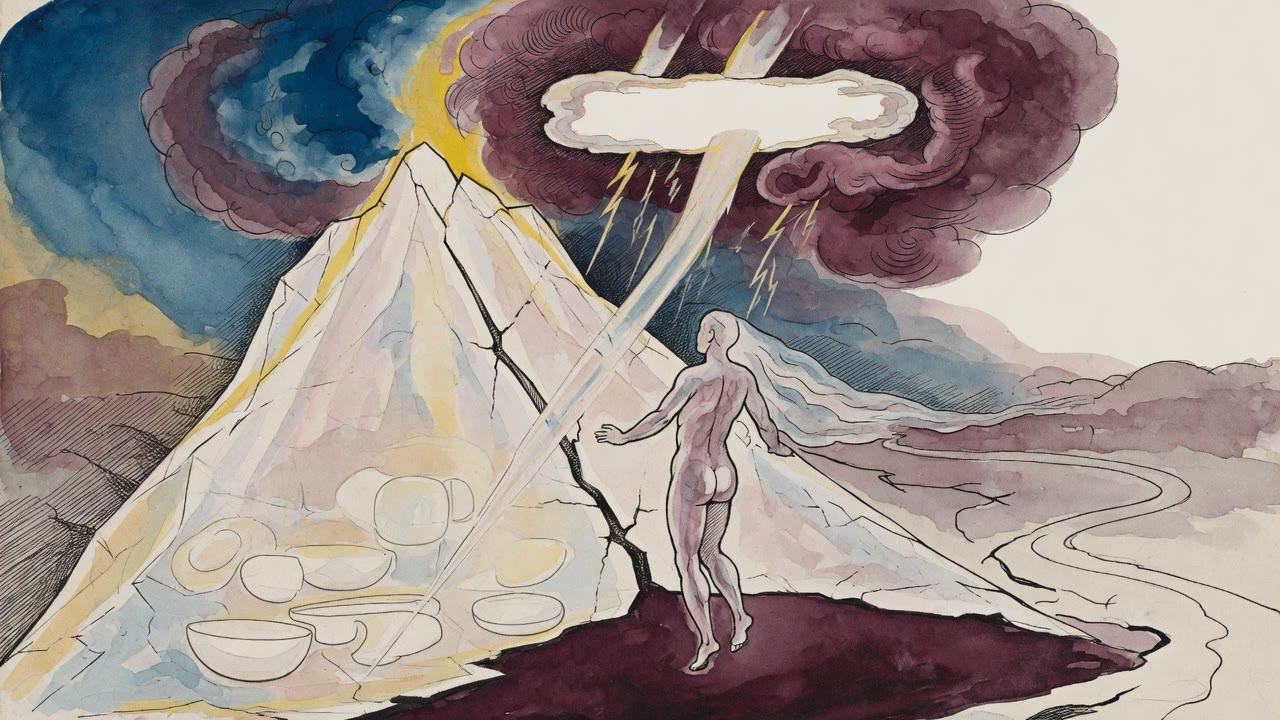
There was light without edge. Call it the mountain, if a mountain can be endless and still be one. Within that All, nothing needed a name, because nothing stood apart enough to answer to one. Then a soul became able to say "I," and the saying was already a distance.

The kabbalists dare a sentence that should break the mouth. The soul of a person is a part of God above. Not a metaphor for inspiration. A claim of substance. God is the whole. The soul is the part. Like a stone hewn from a mountain, except the image fails as soon as it helps.

Because no axe can cut the Infinite. No chisel can enter Ein Sof. So how does a part exist at all? The question is not academic when the part is the one waking up cold.

The Vessel That Made a Border

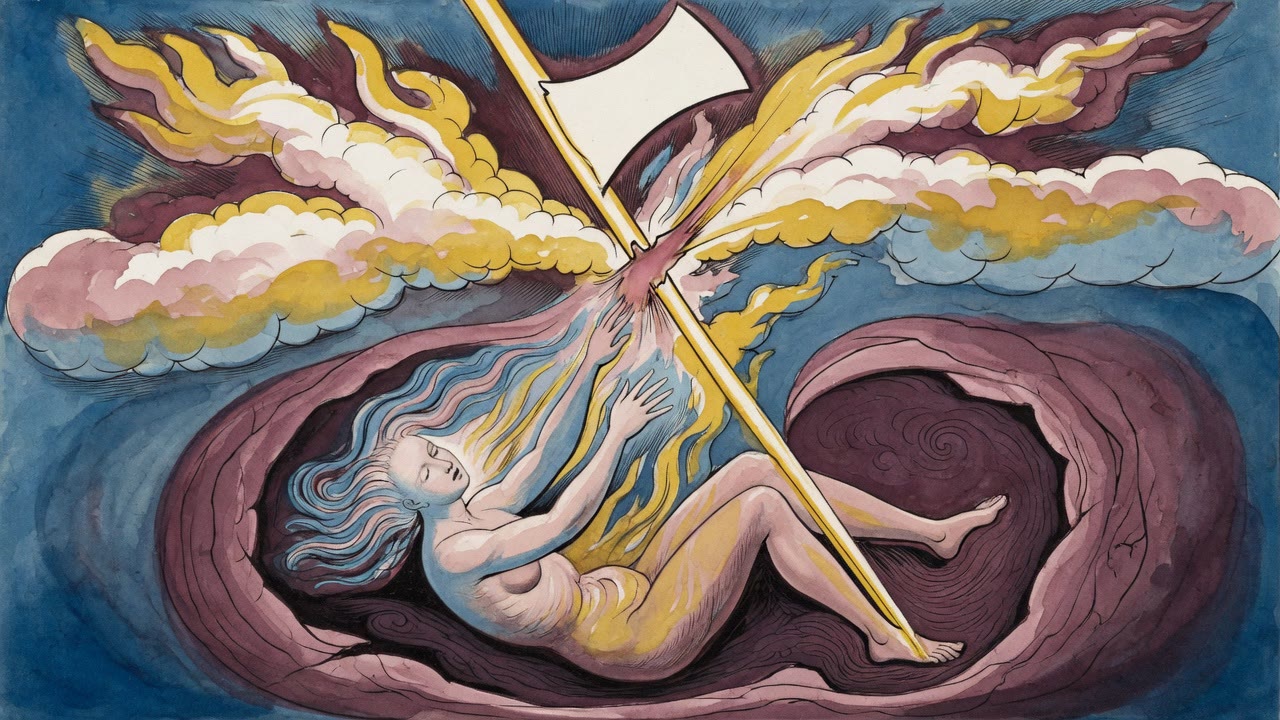
The cut was not violence done to God. The cut was a change of form in the receiver. Divine light flowed from the pre-existing reality of God's essence straight toward souls. From the side of that light, there is no difference between the soul and God's essence. The difference appears in the vessel: a limited measure of light held in a desire to receive, and that limit turns All into part.

A soul named, in the telling, only as Neshama (the higher soul) felt the moment like cold air after a sealed room. Suddenly there were edges. Suddenly there was thirst. Thirst is the first autobiography of a separate self. "I need" is the sentence that proves the stone is no longer the mountain, even if the stone's matter is mountain-matter.

Neshama panicked. "Have I fallen?" A voice that was not a voice answered by increasing the thirst and also increasing a second desire: to give. The second desire was the rope back toward likeness. The first desire was the wall that made a self possible. Without the wall there is no one to love. With only the wall there is no one worth being. The path would be the tension between them for every life to come.

Eternity Without a Library

Philosophers later told Neshama, across many mouths in many cities, that a soul lasts only as long as its knowledge. Fill the storehouse, live forever. Empty the storehouse, dissolve. Neshama, wearing bodies, sometimes believed them. Schools can be persuasive. Fear of death can be more persuasive. It stacked arguments like sandbags against the river of ending.

Then a life came in which Neshama loved a person who forgot every lesson illness could erase and still remained, unmistakably, a giver. The sick woman offered her last clear hour to calm a stranger's child. Knowledge had thinned. Essence had not. Neshama understood in the room's dim light: eternity is not a scholarship. The soul's blood is the desire to give, equal in form to the Life-Force. Knowledge is reward. It is not the wick.

The body still died. The giving form did not measure itself by the corpse's unfinished books. Neshama left that life carrying less trivia and more proof. In the next life it studied again, but as a servant of giving, not as a ransom paid to death.

Part That Still Tastes Like Whole

Neshama learned to live the paradox without dissolving it into slogan. From the side of the light, no difference. From the side of the vessel, a real part, a real person, a real judgment, a real love that can fail. The mountain is not less because a stone stands in the sun and chooses.

On the hardest day, Neshama almost worshiped its own separation, mistaking the wall for a god. On the clearest day, it almost erased itself, mistaking union for the refusal of responsibility. The path between those cliffs was ordinary mitzvah (a commandment): give, repair, receive in order to give again. A cup of water. A returned insult left unreturned. A coin moved from a full pocket to an empty one without theater.

When asked, late in a certain body, "Are you God?" Neshama laughed the way a stone would laugh if stones could remember the mountain. "I am a part that can face the whole," it said. "That is already more miracle than an axe." The questioner waited for a longer answer. Neshama gave him bread instead, and the bread did the rest of the theology.

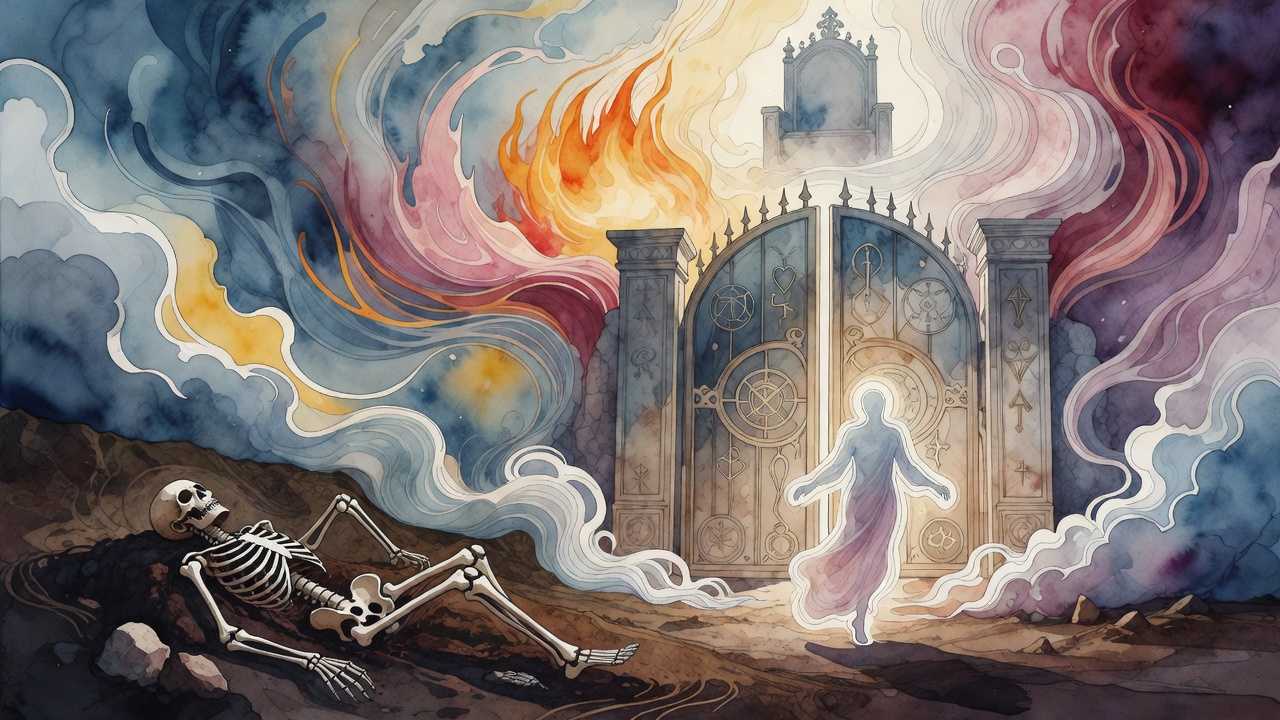
At the end of that body Neshama did not rush back into All as if the part had been a mistake. It returned the way a finished tool returns to the hand that made it, still shaped, still useful, still marked by the work. The mountain received it without erasing the mark. That, too, is a kind of love.


← All myths
From the tradition

Sources

3 sources

The texts behind this telling. Some cards carry a translation of the source; others are our own retelling of it, and each card says which. Every card links out to the original.

Baal HaSulam's Introduction to Zohar 2:4Baal HaSulam's Introduction to Zohar

Retold in our words. Read the original at the link below.Sefaria-hosted English translation · CC-BY

One question that often pops up is about the nature of the soul. The Kabbalists, those masters of Jewish mystical thought, tell us something pretty: that the soul of a person is actually a part of God, a piece of the Divine. Sounds incredible. But what does that REALLY mean? How can we even begin to wrap our heads around that?

That's the question that Baal HaSulam, one of the great modern Kabbalists, grapples with in his introduction to the Zohar, that foundational text of Kabbalah. He poses it as an "inquiry," a challenge to our understanding. He points out that the Kabbalists describe the relationship between God and the soul as one of "whole" and "part." God is the whole, the soul is the part.

He uses a striking image to illustrate this: imagine a stone hewn from a mountain. The stone is essentially the same substance as the mountain; the only difference is that it's now a separate piece. It’s a part that was once connected to the whole.

Here's where the problem comes in. With a stone, we can understand how it's separated. An axe, a physical tool, does the work. But how can something like that happen with God? How can a "part" be separated from something that is, by definition, indivisible? How can we even conceive of the soul, that spark of the Divine within us, as just a fragment of God's very essence?

It's a tough question, and one that gets at the heart of what it means to be human, to be spiritual beings in a physical world. The idea of separation implies a kind of division, a cutting off. But can something truly be cut off from the Infinite?

This isn't just an abstract theological puzzle. It's about our relationship with the Divine. If our souls are truly part of God, what does that say about our purpose? About our potential? About the very nature of reality itself? It’s a question that invites us to delve deeper, to explore the mysteries of creation and our place within it. It challenges us to move beyond simple answers and embrace the complexity of the Divine-human connection.

Full source
Baal HaSulam's Introduction to Zohar 9:2Baal HaSulam's Introduction to Zohar

Retold in our words. Read the original at the link below.Sefaria-hosted English translation · CC-BY

Kabbalah, Jewish mysticism, wrestles with this very idea – the relationship between us, our souls, and the Divine. And in his "Introduction to the Zohar," Baal HaSulam, one of the greatest Kabbalists of the 20th century, offers a mind-bending perspective.

He argues that from the point of view of the divine light – the ohr elyon – which is received by the vessel – the kli, our desire to receive – there’s essentially no difference between our soul and God's essence. that divine light flows directly from God's essence to our souls. It’s a direct connection, a pure stream.

So, what is the difference then?

In Baal HaSulam, it all comes down to a matter of scale, of quantity. The soul is merely a part of God’s essence. That limited amount of divine light received by our vessel, our kli, that's what creates a sense of separation. It's this change in form that transforms the light from being in the category of "All" to being in the category of "part."

It's like a stone quarried from a mountain. The stone is still made of the same material as the mountain, but it's now a distinct piece. The mountain is everything, encompassing it all, and the stone is merely a piece of that everything.

The distinction, then, is that one is "all" – kol – and the other is "part" – chelek.

This can be a tough idea to wrap your head around. We’re talking about incredibly lofty concepts here, things that dance on the edge of what language can even express. And Baal HaSulam himself acknowledges this, saying that he can't expound much more on the subject.

But the core takeaway is powerful: we are connected to the Divine. The difference isn’t in the what, but in the how much. We are a piece of the Divine, a spark of the infinite, striving to return to the source from which we came.

Remember that you are a part of something infinitely greater. And that perhaps, the journey of life is simply the journey of remembering that connection, of bridging the gap between "part" and "all."

Full source
Baal HaSulam's Introduction to Zohar 25:1Baal HaSulam's Introduction to Zohar

Retold in our words. Read the original at the link below.Sefaria-hosted English translation · CC-BY

One of the most fascinating concepts is the eternality of the soul. Now, some philosophers thought that maybe it’s all about knowledge, that the more you learn, the more eternal your soul becomes. But Baal HaSulam, in his introduction to the Zohar, that foundational text of Jewish mysticism, offers a different perspective. He says that the eternality of the soul isn't about how much we know, but about its very nature. What is the essence of a soul? According to Baal HaSulam, it's the inherent desire to give. That's powerful. It's not about hoarding knowledge or accumulating achievements. It's about that fundamental drive to connect, to share, to contribute. Knowledge, he says, is a reward for the soul, not its core.

That brings us to another mind-bending question: the resurrection of the dead, or Techiyat HaMetim. We know the body is imperfect. I mean, it's temporary. Baal HaSulam even explains that the soul can’t fully purify itself until the body decomposes. So why bring it back?

It seems kind of counterintuitive.

The sages tell us that the dead will be resurrected with their blemishes. Yeah, you heard that right! But there's a reason for it. It’s so that people can recognize them. So no one can say, "Hey, that's not the same person."

But, there’s something deeper going on here. The resurrection isn’t just about physical recognition. It touches on the idea of wholeness. Even with imperfections, even with the marks of our earthly journey, we are still fundamentally ourselves. The body, despite its limitations, played a crucial role in the soul's journey. Maybe the resurrection is about bringing all those elements back together, the soul and the body, in a renewed state of being.

And maybe, just maybe, that's a crucial part of what carries on, eternally.

Full source