7 min read

How the Soul Fell From the Endless Light Into a Body

She rested inside the Endless with no name and no edge, until one wanting opened in her like an axe and split her all the way down into flesh.

Curated by Arthur · Told by Maggid ·
Table of Contents
  1. One Light With No Edges
  2. The Axe That Was Not Iron
  3. She Crossed Into Atzilut and Kept No Name
  4. In Beriah She Was Given a Vessel and a Name
  5. Down Through Formation and Making
  6. She Woke Inside a Body and Could Not See the Mountain
How the Soul Fell From the Endless Light Into a Body Click for full size

One Light With No Edges

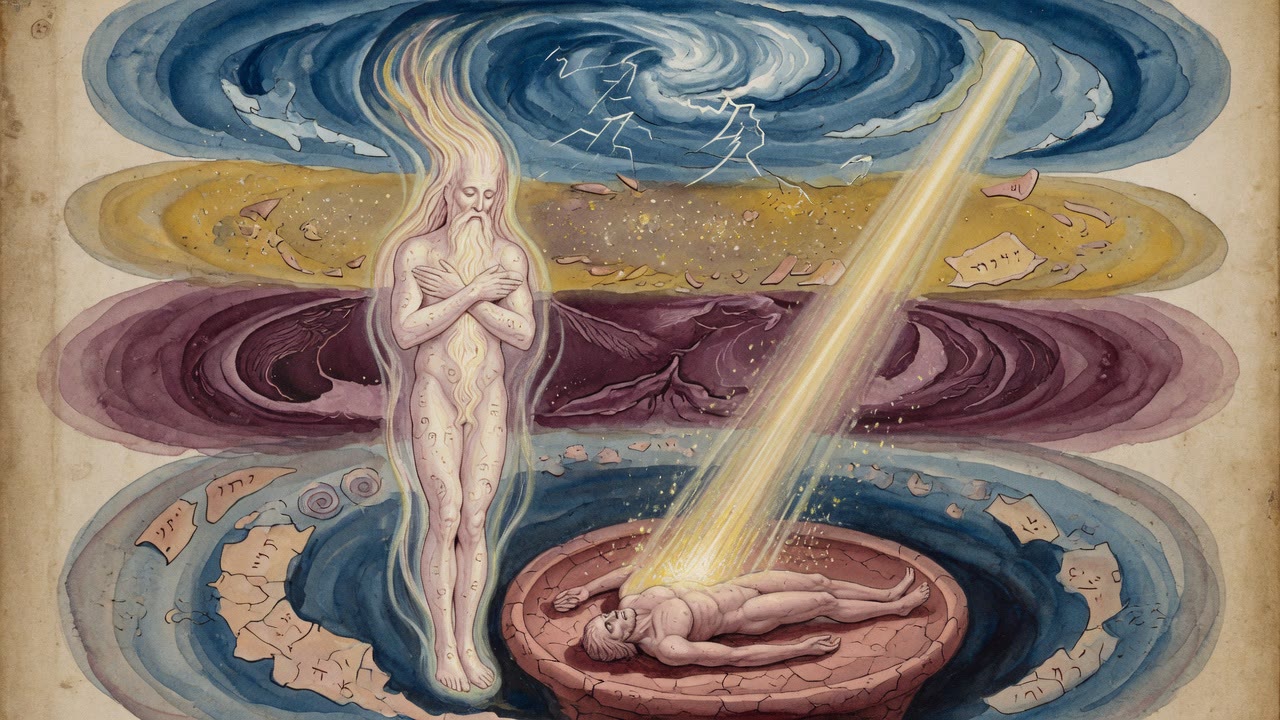
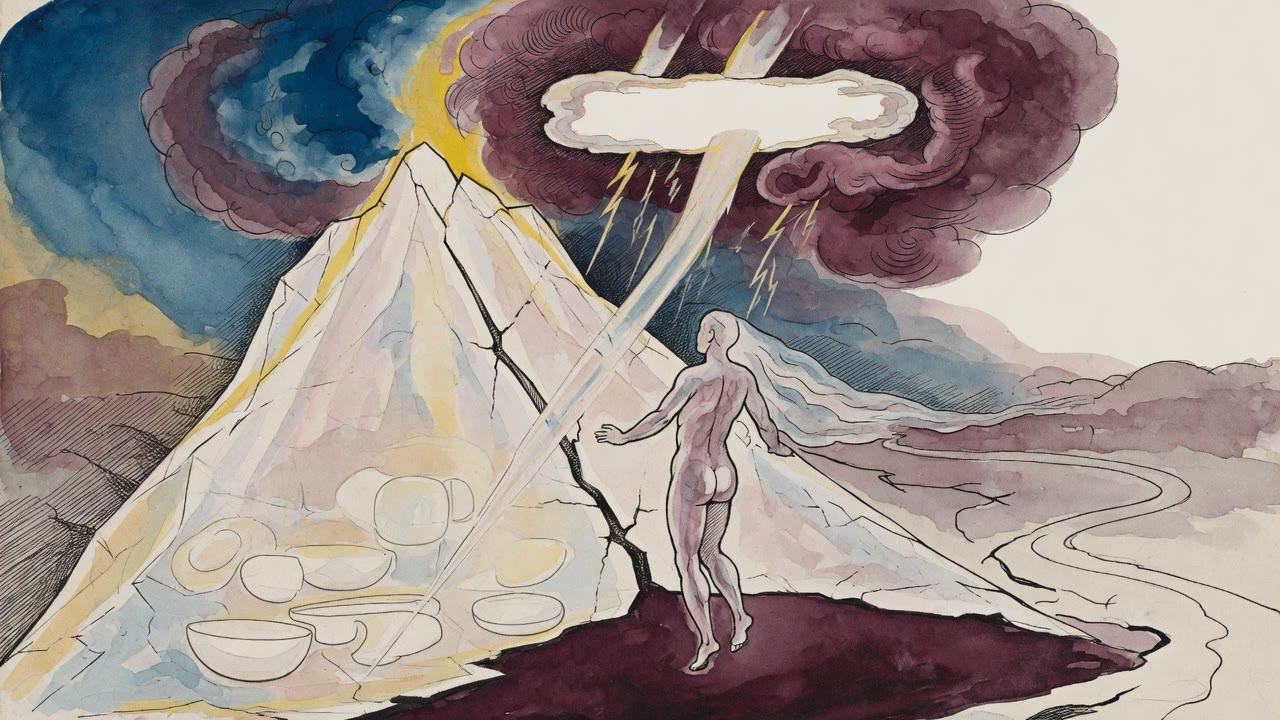
Before she was a soul she was not anything that could be counted. She lay inside a light that had no rim and no floor, a brightness men would later strain to name and call Ein Sof, the Endless. There was no her. There was no here. To speak of a part of that light was like pointing at one grain inside a mountain and calling it a separate stone. The grain is the mountain. It has no face of its own, no line where it stops and the rock begins.

She rested in God the way that grain rests in the mountain, with nothing between them, because between requires two, and there were not two. She wanted nothing, because the light around her lacked nothing and left nothing to want. She did not know she was anywhere. That was the whole of her peace, and she would spend the rest of her long fall trying to remember it.

The Axe That Was Not Iron

Then something moved in her that had never moved in the light. A wanting. A small hollow that opened and asked to be filled. She reached toward the brightness the way an open hand reaches, and in that reaching she became something the light was not.

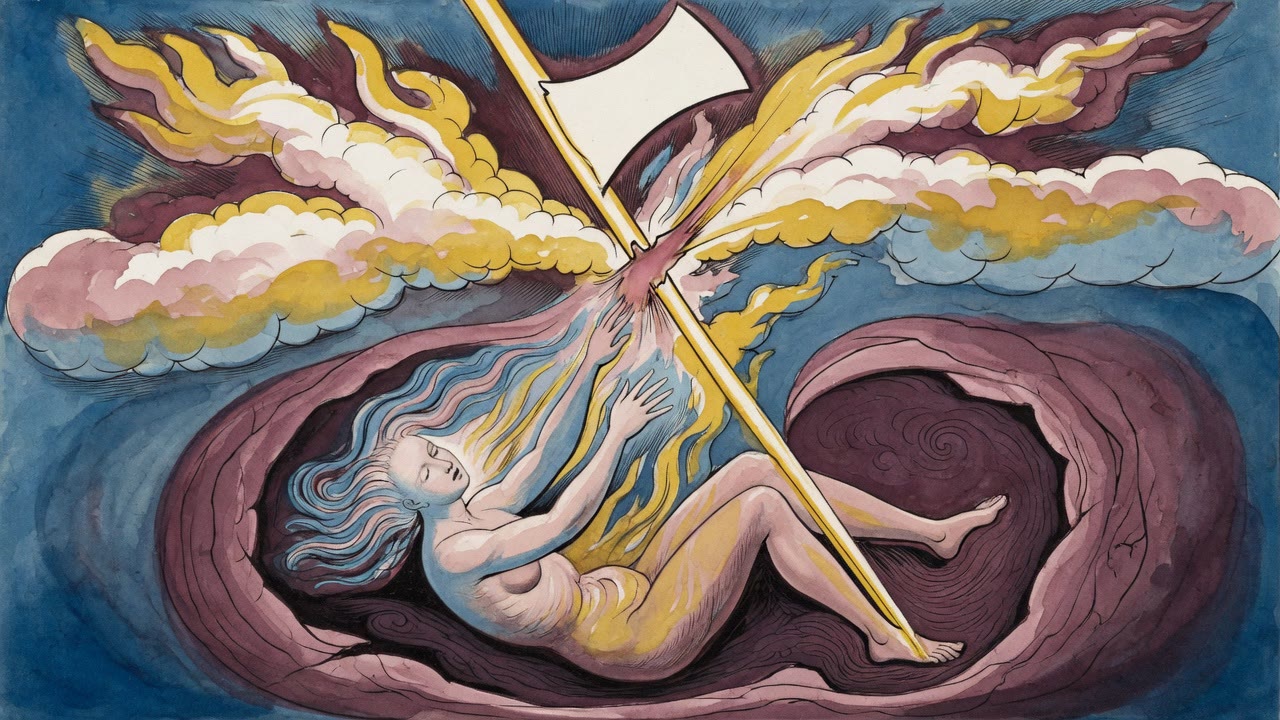
For the light wanted nothing. It received from no one, because there was no one above it to give and it lacked no thing that could be added. Her wanting was the one shape it did not hold. And that single difference did the work of an axe. Not iron, not edge, not any blade that could be lifted, only a difference of will splitting her from the stone. The wider the gap between what she craved and the fullness that craved nothing, the farther she stood from the mountain, though she had not moved a hair's breadth in any direction a body could walk.

She had thought distance was made of miles. She learned it was made of unlikeness.

She Crossed Into Atzilut and Kept No Name

The wanting carried her down into the first world below the Endless, into Atzilut, the world of emanation, where everything is still Divinity and He, His life, and His attributes are one. She had crossed a border, but nothing yet called her by a name. She was not a neshama (the higher soul), not a soul in the way the word is meant, because a thing needs an edge before it can be counted, a vessel before it can be filled, and she had none.

Light poured into her and through her until she could not find where she ended. A glass drowned in the very radiance it holds cannot be seen. There is no glass. There is only shining. She was a drop still lying in the ocean, un-scooped, no different from the water on every side. She clung to His essence and could not have said whether she clung or simply was.

In Beriah She Was Given a Vessel and a Name

Then she fell again, and the falling brought her into Beriah, the world of creation, and there a second thing rose in her stronger than the light. The vessel. Now she had an edge. Now she had a hollow with walls, a cup lifted from the sea, and the moment the cup closed around her she was a drop with a shape of her own, water that had taken a form no other water shared.

They gave her a name then. Neshama. Soul. She had emerged and stood apart from His essence, no longer drowned, no longer the grain that cannot be told from the mountain. She was someone.

She braced for the fall to feel like a wound. It did not. The vessel they had handed her was not only a mouth for taking. It was also a hand for giving, and the instant she turned it outward, wanting to pour rather than only to swallow, she matched her form to the One who pours and never needs. The likeness held her. She had a name and an edge and still she stayed pure, still she stayed wholly spiritual, tethered by the one desire that made her resemble her source.

Down Through Formation and Making

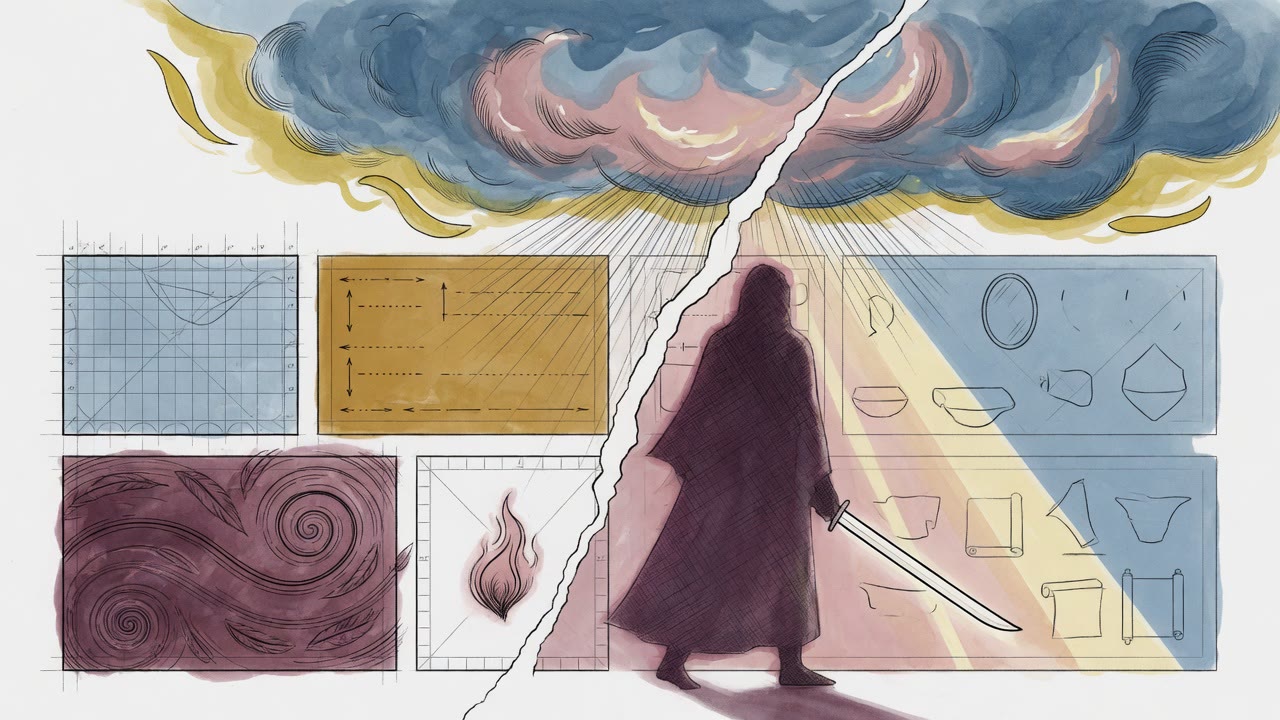
The descent was not finished. Below Beriah waited Yetzirah, the world of formation, and beneath that Asiyah, the world of making, the last and heaviest floor, where light grows dim and forms grow thick and hard. With every world she crossed, another layer closed over her the way cloth closes over a lamp. The brightness did not leave her. It only grew harder to see through the thickening, the way a coal keeps its fire under ash.

The covering settled over her. She could still remember the shining, but each world set the memory farther back, until the ocean she had come from was a rumor she carried and could no longer point to.

She Woke Inside a Body and Could Not See the Mountain

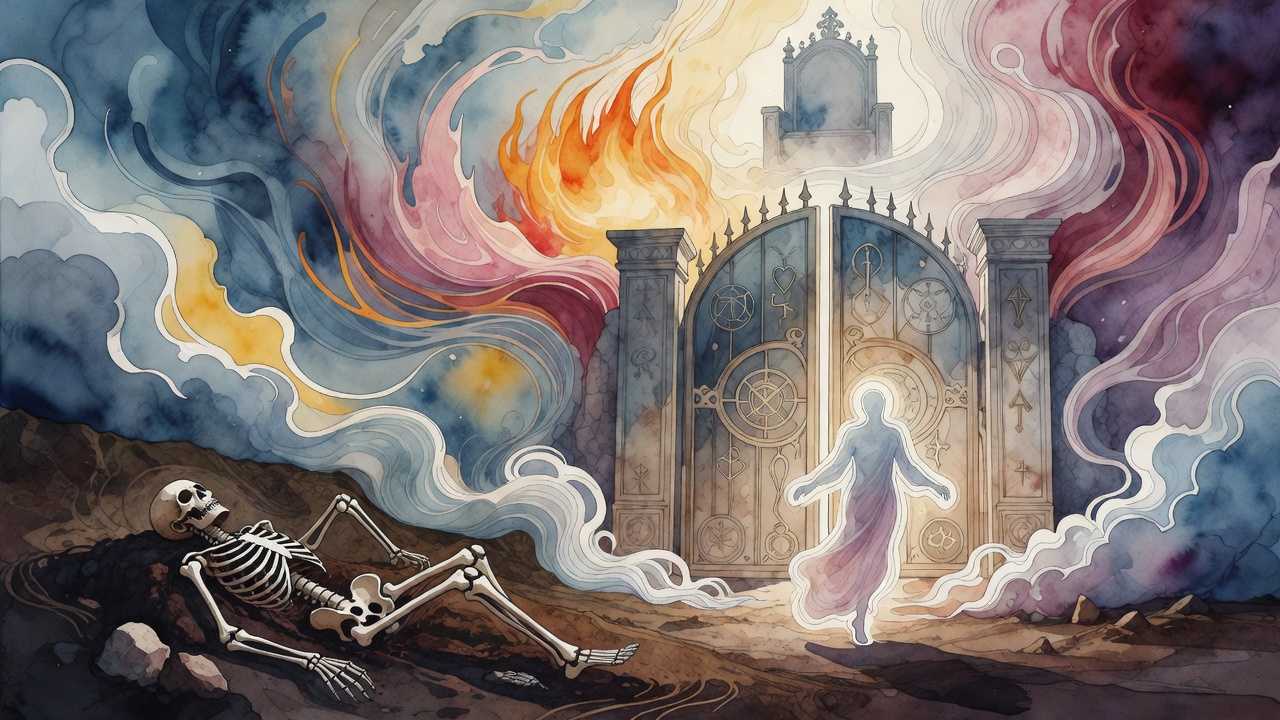
At the bottom of Asiyah she woke inside flesh.

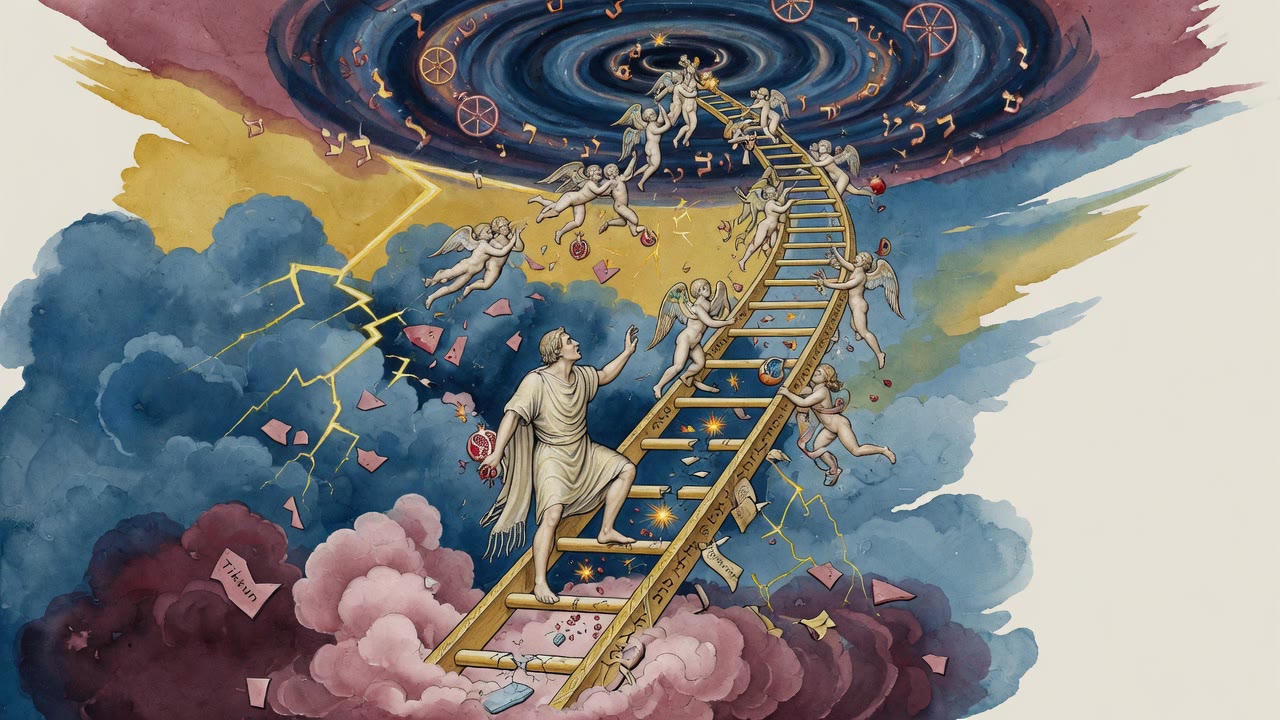
She had a chest that rose and fell, a pulse, a weight that held her to the ground. Around her stood a world of edges as hard as her own, and not one of them was the light. She reached the way she had reached at the very beginning, when the first wanting opened in her, but now her hand closed on air and bread and other hands, on everything except the brightness she was sure she had once known without a single wall between them.

Somewhere under the ash the coal still burned. She could feel the heat of it and could not find the fire. So she did the only thing a drop can do once it remembers the sea. She ached upward. She spent her days trying to turn the vessel outward again, to give until her shape matched the Giver, because the axe that had cut her was made of unlikeness, and unlikeness was the one wound she still had the power to close.

"I came from that," she said, to no one a body could see. "I will climb until the wall between us is thin enough to pass."


← All myths
From the tradition

Sources

4 sources

The texts behind this telling. Some cards carry a translation of the source; others are our own retelling of it, and each card says which. Every card links out to the original.

Baal HaSulam's Introduction to Zohar 8:1Baal HaSulam's Introduction to Zohar

Retold in our words. Read the original at the link below.Sefaria-hosted English translation · CC-BY

That feeling, that intuition… Kabbalah, the Jewish mystical tradition, wrestles with it directly. And one of the biggest, most mind-bending questions it tackles is this: If our souls are somehow connected to God, how did they ever separate?

" He hones in on this precise paradox. How can we even dare to speak of souls as "part of God"?

Think of it like this: imagine a mountain. Now, picture a stone being quarried from that mountain. While the stone is still part of the mountain, there's no real distinction between them. The stone is just… part of the whole. It’s literally a piece of the mountain.

Here’s where it gets tricky. When that stone is separated from the mountain, it’s because of some external action. Someone had to do something to break it off. But can we apply that same logic to God? Can we say that something acted upon God’s essence to separate out our souls?

That's the core of the problem! It feels almost blasphemous to suggest that anything could act upon the Divine in that way. How can we, as finite creatures, even begin to fathom how souls – how we – could have separated from the very essence of the Creator?

The Kabbalists, especially as interpreted by Baal HaSulam, don't shy away from these difficult questions. They dive headfirst into the paradox, seeking to understand the nature of the relationship between the Creator and creation, between the infinite and the finite. This is the invitation to explore the mysteries of the Zohar, a central text of Kabbalah. It's an invitation that demands we confront our own understanding of self, of God, and of the very fabric of reality.

So, are our souls truly pieces of God? And if so, what does that mean for our lives, our choices, and our ultimate destiny? It's a question that echoes through the ages, inviting us to explore the deepest mysteries of existence.

Full source
Baal HaSulam's Introduction to Zohar 9:1Baal HaSulam's Introduction to Zohar

Retold in our words. Read the original at the link below.Sefaria-hosted English translation · CC-BY

Like an invisible wall is standing between you and... well, anything? According to Kabbalah, that feeling might be more real than you think.

The great Kabbalist, Baal HaSulam, in his "Introduction to Zohar," explores this very idea. He uses a potent image: a physical axe severing a stone from a mountain. But he's not talking about geology; he's talking about spirituality.

What exactly does he mean? He argues that differences in form – The bigger the difference, the greater the distance. So, what's the core difference between us, the created, and the Creator?

Here's where it gets interesting. Baal HaSulam points to the soul's innate desire to receive pleasure. This, he says, is something that simply doesn't exist within God. Can you imagine a state of being with absolutely no lack, no need, no craving for anything? That's the essence of the Divine, according to this line of thinking. "Heaven forfend!" he exclaims, "From whom could God receive?!"

That desire to receive, that drive within us, creates a separation. It's the wedge, the axe that detaches us from God's essence, making us into individual creatures. This isn't a punishment; it's simply the consequence of different forms.

Now, before you despair, thinking we're forever cut off, there's an important nuance. Everything we do receive, all the light and goodness that fills our souls, still flows from God's essence, from a "pre-existing reality," as Baal HaSulam puts it. We're not entirely cut off. There's still a connection, a lifeline to the source.

Think of it like this: the stone, though separated from the mountain, is still made of the same stuff. It still carries the mountain's essence within it. Our challenge, perhaps, is to remember that connection, to strive to bridge that gap created by our inherent desire, and to move closer to that original source of all being. Because even with that axe between us, the mountain is still calling.

Full source
Petichah LeChokhmat HaKabbalah 6:3Petichah LeChokhmat HaKabbalah

Retold in our words. Read the original at the link below.Sefaria-hosted English translation · CC-BY

Kabbalah, the Jewish mystical tradition, offers some pretty mind-bending answers. The source turns to one of those answers, specifically regarding the four levels of the soul.

In Petichah LeChokhmat HaKabbalah, it all starts with Ein Sof (אין סוף), often translated as “the Infinite.” When a soul is drawn from this Ein Sof and enters the world of Atzilut (אצילות), the world of emanation, it's at its first level of existence.

Hold on, it's not quite a "soul" yet – not in the way we usually think of it. At this stage, it's not yet called a neshama (נשמה). The term neshama implies a certain… divergence. A separation from the Emanator – that’s God, blessed be He. It means the soul has left the undifferentiated oneness of Ein Sof and is beginning to exist as a distinct entity.

Why is this divergence important? Well, think about it this way: before something can be recognized as an individual, it needs a form, a container – what Kabbalists call a vessel. Before the soul has this form, it's essentially indistinguishable from the divine essence.

It's like a drop of water in the ocean – before you scoop it up, it's just part of the ocean. Once you put it in a cup, it becomes a separate entity, a drop. Similarly, at this initial stage, the soul hasn't yet acquired its "cup," its vessel.

The text goes on to say that, in this first level of development, the vessel isn't even really recognizable as a vessel. It's entirely subsumed by the light, completely absorbed in the divine radiance. It's like trying to see the glass when it's filled to the brim with light. You can't distinguish between the container and what it contains.

It suggests that even before we're fully formed, before we even have a sense of individual identity, we are connected to something vast and infinite. Our journey as souls is a process of gradual differentiation, of developing our unique vessels while still remaining tethered to our divine source. It's a journey from pure potential to realized being. And that, my friends, is a pretty awesome thought.

Full source
Petichah LeChokhmat HaKabbalah 7:1Petichah LeChokhmat HaKabbalah

Retold in our words. Read the original at the link below.Sefaria-hosted English translation · CC-BY

Kabbalah, Jewish mysticism, wrestles with this very idea, especially when it comes to understanding the soul. Where does it come from? How does it become… us? to a fascinating piece from the Petichah LeChokhmat HaKabbalah, an introduction to the Wisdom of Kabbalah. It talks about different worlds, different levels of existence, and how our souls journey through them.

The passage begins by describing the world of Atzilut (Emanation). Atzilut is often considered the highest, most unified realm. Here, everything is Divinity. As the Tikkunei (spiritual repair) Zohar (Introduction 3b) puts it, "He, His life, and His attributes are one." No separation. No distinction between the Creator and creation. It's all God. Even the souls that pass through Atzilut are said to still cling to His essence. They're not yet fully formed, individual entities. They’re still part of the Divine “soup,” so to speak.

Then comes a shift. The text moves on to the world of Beria (Creation). In Beria, a second level becomes dominant: the level of the "vessel." Now, in Kabbalah, a "vessel" isn't just a container. It represents the will to receive, but more importantly, the will to give. It's the capacity for interaction, for relationship. It’s our ability to connect with the Divine and with each other.

So, what happens when the soul descends into Beria? It acquires the kind of "vessel" that exists there. And here's the key moment: it's then that it's called neshama. Neshama – the soul, in its more recognizable, individual form. At this point it has already emerged and separated from His essence. It's no longer just a drop in the ocean. It's a drop that’s taken on its own unique shape, its own identity. It now merits its own name: neshama.

Now, don't get the wrong idea. This separation isn't a fall from grace. The text emphasizes that this vessel, this neshama, is still extremely pure. Why? Because it equates its form with that of the Emanator by acquiring the will to give. The very act of wanting to give, to connect, to emulate the Divine, keeps it connected. It remains, therefore, wholly spiritual.

The soul’s journey from undifferentiated unity to individual expression, all driven by the desire to give. We start as part of something infinite, and through the development of our own unique "vessels," our capacity for giving and connection, we become individuals, while still remaining deeply connected to the Divine source.

Remember the journey of the neshama. Remember that even in our individuality, we are still part of something bigger, something sacred. And that our very capacity to give and connect is what keeps us tethered to the Divine. What are you giving today? How are you connecting? Perhaps those questions are the key to understanding your own unique neshama.

Full source