Parshat Bereshit6 min read

The Waters That Rise in Longing to Complete the Divine Child

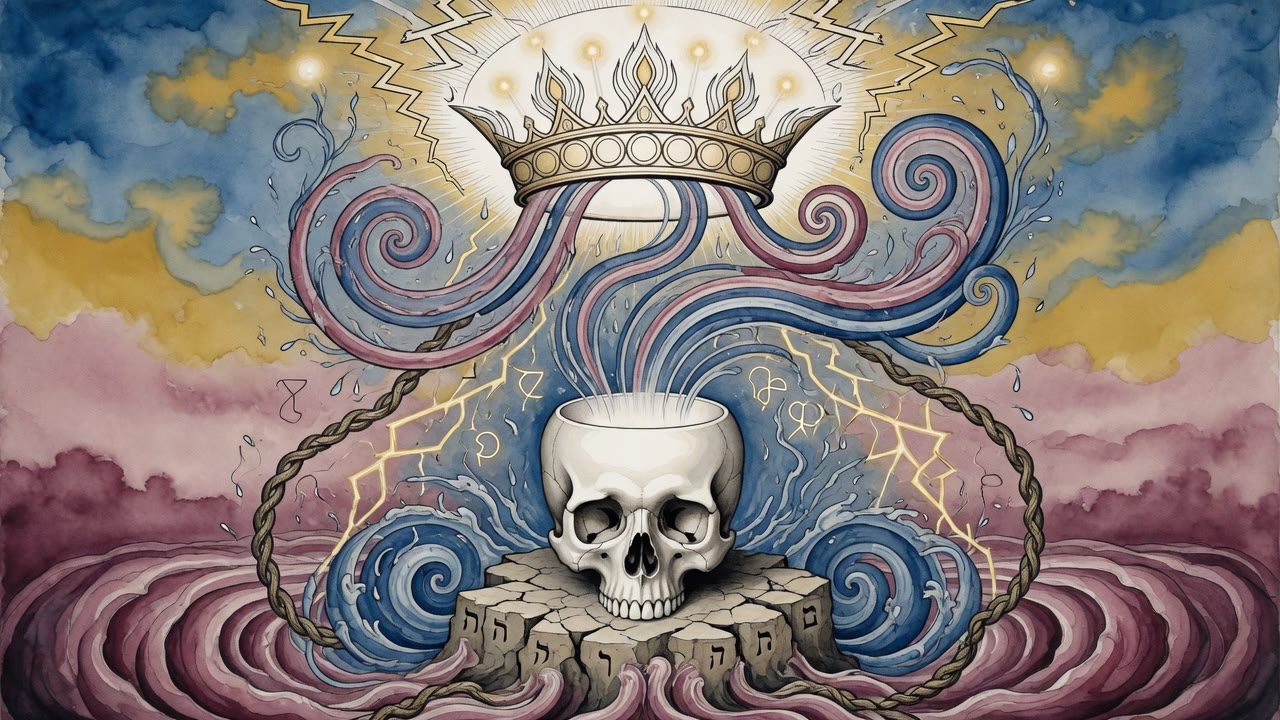
Below the highest crown a divine son stood with an empty skull, waiting for waters to rise in longing before a mind could be poured into him.

Curated by Arthur · Told by Maggid ·
Table of Contents
  1. The Child Who Stood Unfinished
  2. The Arms of the Ancient One
  3. The Waters That Rose in the Dark
  4. The Descent and the Mating
  5. The Letters That Spelled the Image
  6. Like a Hen Over Her Chicks
The Waters That Rise in Longing to Complete the Divine Child Click for full size

The Child Who Stood Unfinished

Deep below the highest crown, where the divine folds in on itself, a figure stood only half-made. They called him Zeir Anpin, the Small Face, the divine son. He had a body of nine parts, arms and legs and a torso shaped like a man, and an empty skull. No mind had come into him yet. He could not begin the work of a world, because a world begins in thought, and thought had not yet flowed down to fill him.

Above him stood his Father and his Mother, folded into a single form. On the right, the masculine, Abba. On the left, the feminine, Imma. Not two figures side by side but one configuration, the innermost Face of all, and they did not stir on their own.

What held them was a pair of arms.

The Arms of the Ancient One

The arms belonged to Arikh Anpin, the Ancient One, the long and patient Face whose crown ran higher than any name could climb. Abba rode along his right arm, Imma along his left, and each arm bent in three places. In the shoulder sat wisdom, understanding, and knowledge. In the forearm, loving-kindness, strength, and beauty. At the wrist, the lower three that carry everything down to the world. Their own crowns rested in the Ancient One's throat and reached as far as his navel, and from the navel down his whole body lay wrapped in them, the Father covering one half, the Mother the other.

From the chest of each, a foundation extended, reaching lower still. And when the Father and the Mother turned at last toward the unfinished child below, they stretched their legs down into him, all the way to the edge of the world.

The Waters That Rose in the Dark

Nothing could move until longing moved first. Far beneath the whole configuration, in the worlds of Creation, Formation, and Making, the lowest realms began to stir. This was Nukva, the receiving one, the Female with all her branches, dressed in every adornment the lower worlds could hang on her. She gathered the refined desire of everything below her and sent it climbing upward through the dark, the rising the old tellings call the female waters.

A law was fixed into that realm, older than the mating it governed. There are no male waters without female waters, and no female waters without desire. The heights could not pour down until the depths climbed first. A promise once spoken over the first woman ran through it still, "your desire shall be for your husband," and here the promise was not a punishment but an engine. Without the yearning that rose from below in the dark, the heights stayed shut and the child above stayed empty.

The Descent and the Mating

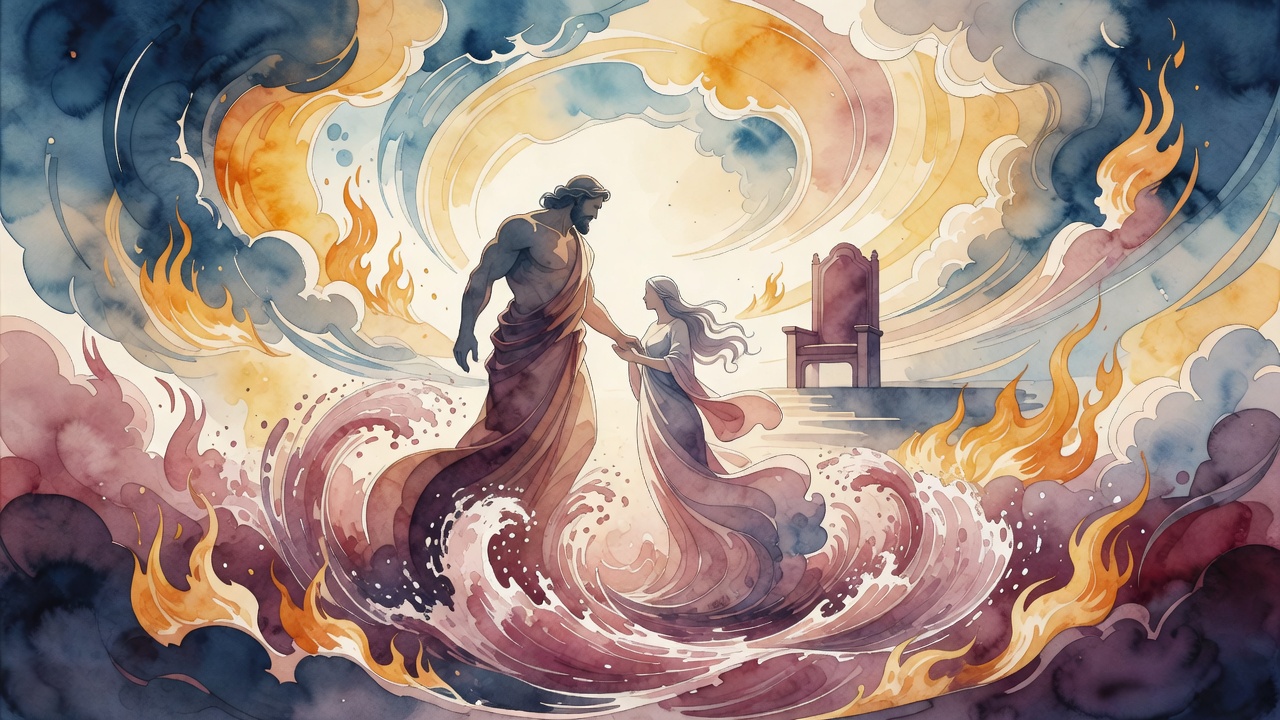
The female waters reached the height, and the height answered them. Male waters came down to meet the rising flood, and the two braided into one, the body of the coupling. This was the zivug, the union, and it happened twice, a first joining and then a second, as though a single embrace could not hold everything that had to be born from it.

Out of that mating a mind was conceived. Not a thought inside a head that already stood ready, but the very thought that would make the head a head at all. The Father and the Mother, wisdom itself and understanding itself, had made between them the intelligence the child had been standing there without.

The Letters That Spelled the Image

Now the mind had to be carried in, and it came clothed. The lower limbs of the Father and the Mother, their victory and glory and foundation, entered the nine parts of the child from within, and that entering is sealed with the letter tsade. The upper seven, wisdom running down to beauty, wrapped around him from the outside, written with lamed and mem. Set the letters together and they read tselem, image, the divine image a body must be dressed in before anyone can call it whole.

One thing lay folded deeper still. The child's mind did not drop straight from Abba and Imma, who stood too high above him to reach so low. It came from a nearer Father and Mother beneath them, Yisrael Sabba and Tevunah, the second pair. From their chest downward the mind was measured out to him, degree by patient degree.

Like a Hen Over Her Chicks

As the mind settled into him, new limbs unfolded and fell behind the child, sinking level by level until they reached the height of his chest. And the nearer Mother bent over him the way a hen spreads herself across her chicks, covering what was still soft and half-formed underneath her. The homely picture sits there in the middle of all the geometry, a bird sheltering the young while they harden into shape.

The empty skull was empty no longer. The Small Face, who had stood unfinished above the edge of the world, had taken in his first mind and grown for the first time. And below him the worlds that had sent their longing up through the dark now had someone above them who could think, and answer, and begin the work of a world.


← All myths
From the tradition

Sources

3 sources

The texts behind this telling. Some cards carry a translation of the source; others are our own retelling of it, and each card says which. Every card links out to the original.

Asarah Perakim LeRamchal 6:3Asarah Perakim LeRamchal

Retold in our words. Read the original at the link below.Sefaria-hosted English translation · CC-BY

When we explore the Kabbalah, into texts like the Asarah Perakim LeRamchal (Ten Chapters by Ramchal), we find ourselves swimming in a sea of metaphors, all trying to capture something incredibly profound about the nature of creation itself.

Today, a passage that speaks of "male waters" and "female waters." Now, before you picture some kind of cosmic plumbing system, let's remember that These "waters" represent the very essence, the very substance, of the masculine and feminine principles as they come together in the act of union.

The verse reads, "The male waters and the female waters are the body of the mating. The male waters are from the male, and the female waters are from the female." Sounds straightforward. But it's more than just a simple biological equation. It's about the flow of energy, the exchange of qualities that are inherent in both the masculine and feminine aspects of the Divine.

Here's the kicker: "There are no male waters without female waters and no female waters without desire." This is key. It emphasizes the interdependence, the essential need for both aspects to be present for anything to happen. It's not just about physical union, but about the yearning, the ratzon (desire), that fuels the entire process. This idea is even hinted at in the Torah itself, in (Genesis 3:16), "your desire shall be for your husband, yet he shall rule over you." It's a complex verse, often interpreted in terms of power dynamics, but here it emphasizes the vital role of desire in the relationship between male and female.

The text then shifts to describing the "Female," and how she includes all her branches, adorned with all her adornments. It speaks of the worlds of Creation (Beriah), Formation (Yetzirah), and Actualization (Asiyah) – the whole ladder of existence below the highest realm of Emanation (Atzilut). All these realms, refined by the Female, are aroused for the "Small Face" (Ze’ir Anpin) to connect with Him.

Who is this "Small Face"? Well, in Kabbalistic terminology, Ze’ir Anpin is often used to describe the masculine aspect of the Divine that is actively engaged in the world. And the Female? That's the Nukvah, the feminine aspect that receives and nurtures. So, all of creation, all these worlds, are yearning, are "aroused" to unite with the Divine Masculine.

And then comes the powerful image: "So She mates with Him, the first intercourse and the second intercourse." Again, we need to remember this isn't literal. It's a metaphor for the ongoing process of creation, the constant flow of energy between the Divine Masculine and Feminine. It's the source of all existence. This union, this zivug (coupling), is the engine that drives everything.

What does this all mean for us? That we, too, are part of this dance, this interplay of masculine and feminine energies. And that desire, that yearning, is not something to be ashamed of, but a vital force that connects us to the Divine source of all things.

Maybe, just maybe, understanding these concepts can help us see the world, and ourselves, in a new light. A light filled with the promise of endless creation and boundless love.

Full source
Asarah Perakim LeRamchal 7:3Asarah Perakim LeRamchal

Retold in our words. Read the original at the link below.Sefaria-hosted English translation · CC-BY

The most innermost Partzufim (a divine configuration) (the divine configurations) of all, Think of them not as separate entities, but as a single Partzuf. The masculine aspect is on the right, and the feminine on the left. The Ramchal goes on to paint an image of incredible complexity: on the "arms" of ARIKH ANPIN, we find Abba ("Father") on the right and Imah ("Mother") on the left.

The arm divided into three sections. The first represents HABADChochmah (Wisdom), Binah (Understanding), and Da'at (Knowledge). The second section is HAGATChesed (Loving-kindness), Gevurah (Strength/Judgment), and Tiferet (Beauty). And the third section is NEHINetzach (Victory), Hod (Splendor), and Yesod (Foundation). According to the Ramchal, their Keter (Crowns, the highest Sefirot (the divine emanations)) reside in the throat of ARIKH ANPIN, extending down to its navel.

It gets even more intricate. The body of ARIKH ANPIN, down to the navel, is covered by Abba and Imah, each taking up half. Yesod, the Foundation, extends downwards from the chest of Abba and Imah. Their Keter is situated in their chest, and the remainder of their beings occupies the NEHI portions. And just like them, Yesod also has a similar arrangement emerging from their chests.

The text continues, telling us that when they – Abba and Imah and Yesod – interact with ZA (Zeir Anpin, the "Small Face," often associated with the son), they extend their "legs" into it, reaching with it to the very edge of the world. This is where things get truly metaphorical and symbolic. It speaks to the influence and reach of these divine configurations, extending their power and influence throughout all of creation.

What does it all mean? It's a complex symbolic representation of the divine flow, the interactions between different aspects of God, and how creation itself is structured and sustained. It's a reminder that even within the most abstract and seemingly inaccessible concepts of Kabbalah, there are layers of meaning waiting to be explored. It's a cosmic dance, a divine architecture, a story whispered in the language of symbols. And, perhaps, by confronting these ideas, we can glimpse a little deeper into the mysteries of existence itself.

Full source
Asarah Perakim LeRamchal 3:10Asarah Perakim LeRamchal

Retold in our words. Read the original at the link below.Sefaria-hosted English translation · CC-BY

In Kabbalah, the mystical tradition of Judaism, this feeling, and the process of becoming complete, is beautifully illustrated through the intricate dance of the sefirot, the divine attributes, and their influence on the spiritual realms. a fascinating piece of this puzzle from the Asarah Perakim LeRamchal, a profound text by the influential Kabbalist, Rabbi Moshe Chaim Luzzatto (known as the Ramchal).

The mochin of ZA come from Abba (Father) and Ima (Mother). These aren't just abstract concepts; they are the divine archetypes of wisdom and understanding. These mochin are "clothed" in their kelim, their vessels, and together, they constitute the tselem. But how does this actually happen?

The key lies in understanding the interconnectedness of all things. The Malkhut (Kingdom, the final sefira) of the higher realms becomes the inner essence of the lower realms. The Malkhut of Abba and Ima, the sources of wisdom and understanding, resides within ZA. Think of it like a set of Russian nesting dolls, each fitting perfectly within the next, influencing and shaping each other.

Here's where it gets particularly interesting. The Netzach (Eternity), Hod, Yesod (the sefirot of Victory, Glory, and Foundation) of Abba and Ima, their lower aspects, enter into the nine parts of ZA. The Asarah Perakim LeRamchal uses the Hebrew letter Tsade (צ) to symbolize this. It’s part of the word tselem (image), so it's like a visual cue. Meanwhile, the seven richonot, the first seven sefirot from Hokhmah (Wisdom) to Tiferet (Beauty), including Daat (Knowledge), encircle ZA from the outside. These are represented by the Hebrew letters Lamed (ל) and Mem (מ). Together, these letters, Lamed-Mem-Tsade, form a powerful image of ZA being formed and shaped by the divine forces.

But wait, there's more!

The text then distinguishes between Abba and Ima and another pair: Yisrael Sabba (IS) and Tevunah (T). Abba and Ima, while distinct, are still a higher level. ZA is the lowest of all, and his mochin actually come from Yisrael Sabba and Tevunah. Their Malkhut, their essence of kingship, is ZA's tselem. The text calls Yisrael Sabba and Tevunah the "second ISOT."

From the chest of this "second ISOT" downwards, mochin are attributed to ZA. And what happens in return? New Netzach, Hod, Yesod, those lower aspects, fall, degree by degree, behind him, down to the level of the chest. The Asarah Perakim LeRamchal beautifully compares this to a mother hen sheltering her chicks, a vivid image of nurturing and protection. From the chest of the "second ISOT" upwards corresponds to those letters Lamed and Mem again. This whole process, the giving and receiving, the shaping and being shaped, is described as the "first growth" of ZA.

What does all this mean for us?

Well, on a personal level, we can see ZA as a mirror reflecting our own journey towards wholeness. We, too, receive mochin, insights, and understanding from higher sources, from our teachers, our experiences, and our own inner wisdom. We are constantly being shaped by these influences, and in turn, we shape the world around us. The Kabbalists are showing us that the divine dance of creation is not a one-time event but an ongoing process in which we are all active participants.

The next time you feel that sense of incompleteness, remember the image of ZA, receiving and integrating the divine attributes, striving for wholeness. It's a reminder that growth is a process, a continuous cycle of giving and receiving, and that even in our imperfections, we are part of something far greater than ourselves.

Full source