6 min read

The Other Side Walked Out of a Calculated Plan

Each part of creation was measured alone. From those separate sums a shadow stepped free, a force whose only work was to divide light from its receivers.

Curated by Arthur · Told by Maggid ·
Table of Contents
  1. The Separate Sums
  2. The Thinker Who Never Unites
  3. The Force Whose Job Is a Wall
  4. Offspring of Isolated Measure
  5. Why the Plan Allowed a Shadow
The Other Side Walked Out of a Calculated Plan Click for full size

The Separate Sums

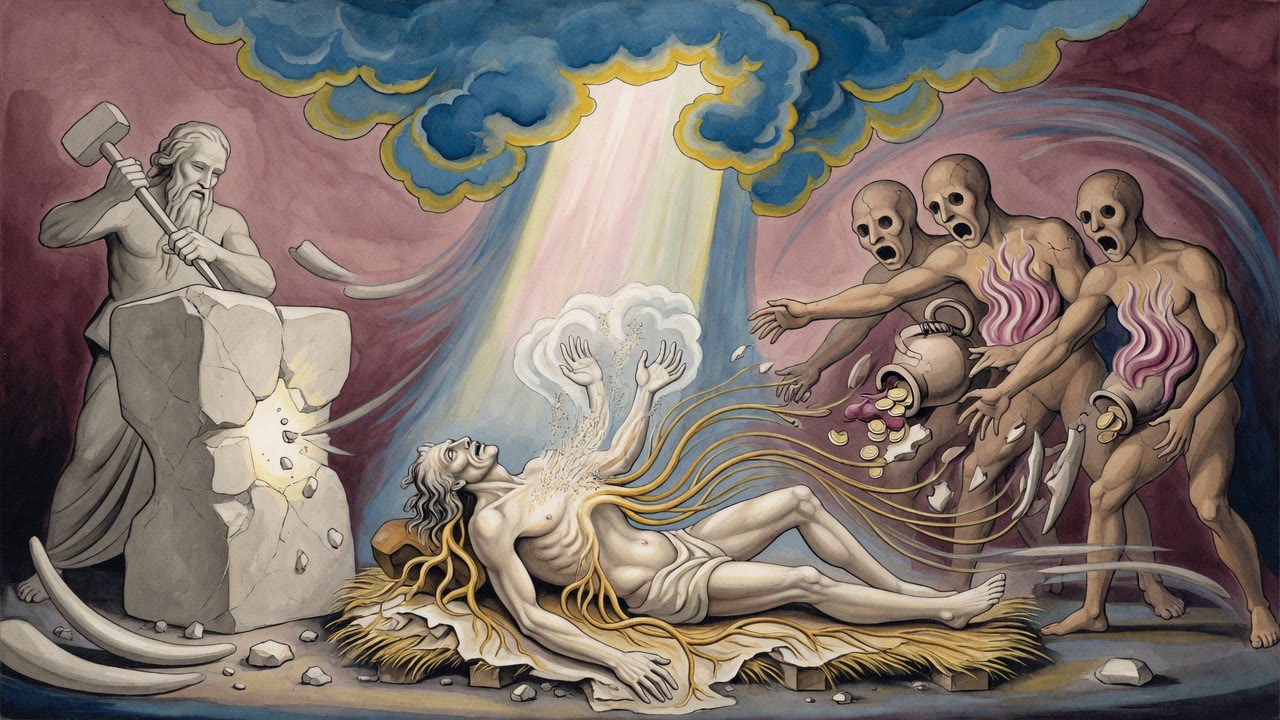
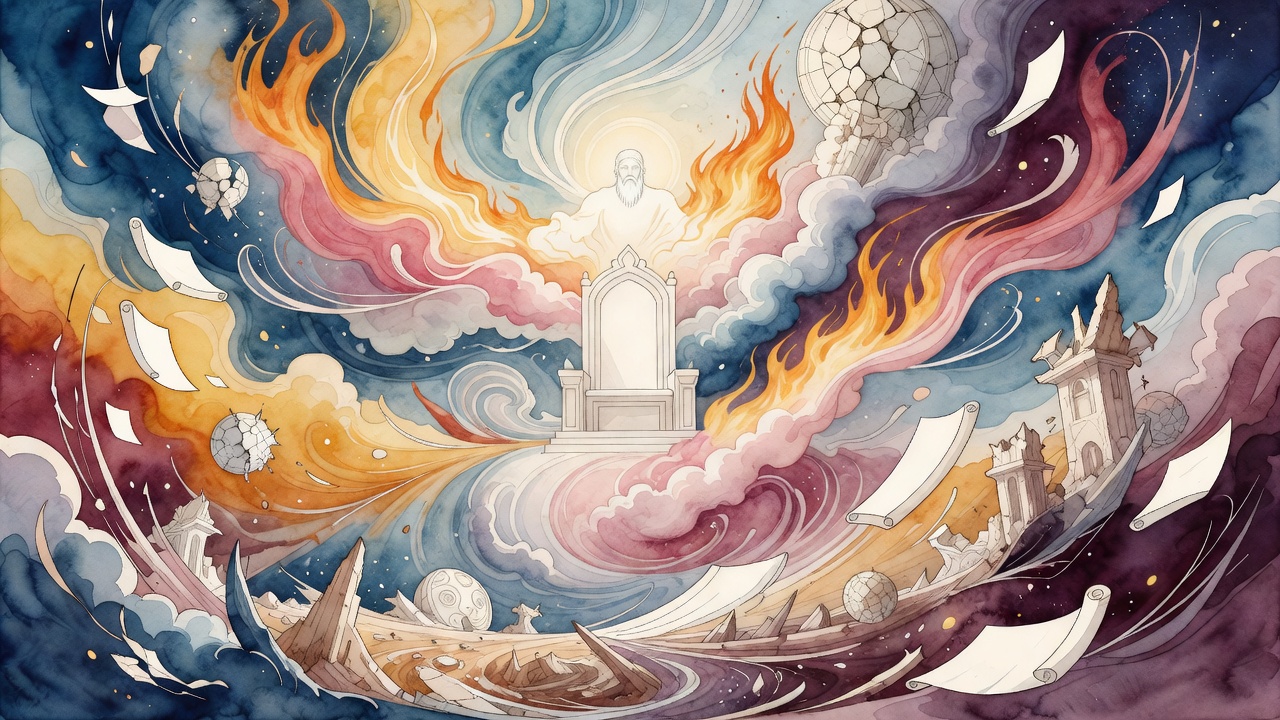
The Supreme Mind set the table of creation piece by piece. Each element of the governmental order was calculated alone, weighed in its own pan, named in its own hour. Concealment had a measure. Revelation had a measure. Kindness had a ledger with clean columns. Severity had a ledger with harder ink. Nothing was left to accident, and that carefulness itself cast a long shadow.

From every separate calculation an offspring rose in the worlds below. A spice measured alone became a whole dish in a lower kitchen. A boundary drawn for one holy purpose threw a silhouette that learned to walk without asking who drew it. The Other Side did not crash the banquet uninvited with a stolen invitation. It stepped out of the arithmetic of the feast itself, born from isolation in the planning.

Emergence is colder than invasion. Invasion can be fought at the gate with swords and shofars. Emergence means the gate and the thief were sketched on the same page by a hand that was counting carefully and not yet joining the counts into one blessing.

The first shadow wiped its feet on no mat. It simply was, where the sums did not touch.

The Thinker Who Never Unites

Picture a mind brimming with thoughts that never meet. One idea arrives bright. Another arrives brighter. They never compare, never contrast, never fuse into a single plan that could build a house. The room of that mind fills with lumber, nails, and good intentions, and never becomes a house. The orchestra tunes forever, each player perfect alone, and never plays a measure together.

From that habit of disconnection comes complete disunity. Blessing needs joined channels the way blood needs vessels that connect. When the channels refuse to touch, the flow stalls in ponds that stagnate, and what thrives in the stall is not holiness. The Other Side feeds on unjoined thought the way mold feeds on damp that never meets a dry wind.

Unity is not a soft word in this teaching. It is the hard condition under which light can travel without leaking into husks. Where unity fails, a second government finds room to write its own laws on the blank margins of the first. Those laws look almost like the original until you notice they always end in hunger.

A person who jumps from urge to urge without weaving a life is a small portrait of that cosmic habit. The openings use the portrait so the larger pattern can be seen without a diagram.

The Force Whose Job Is a Wall

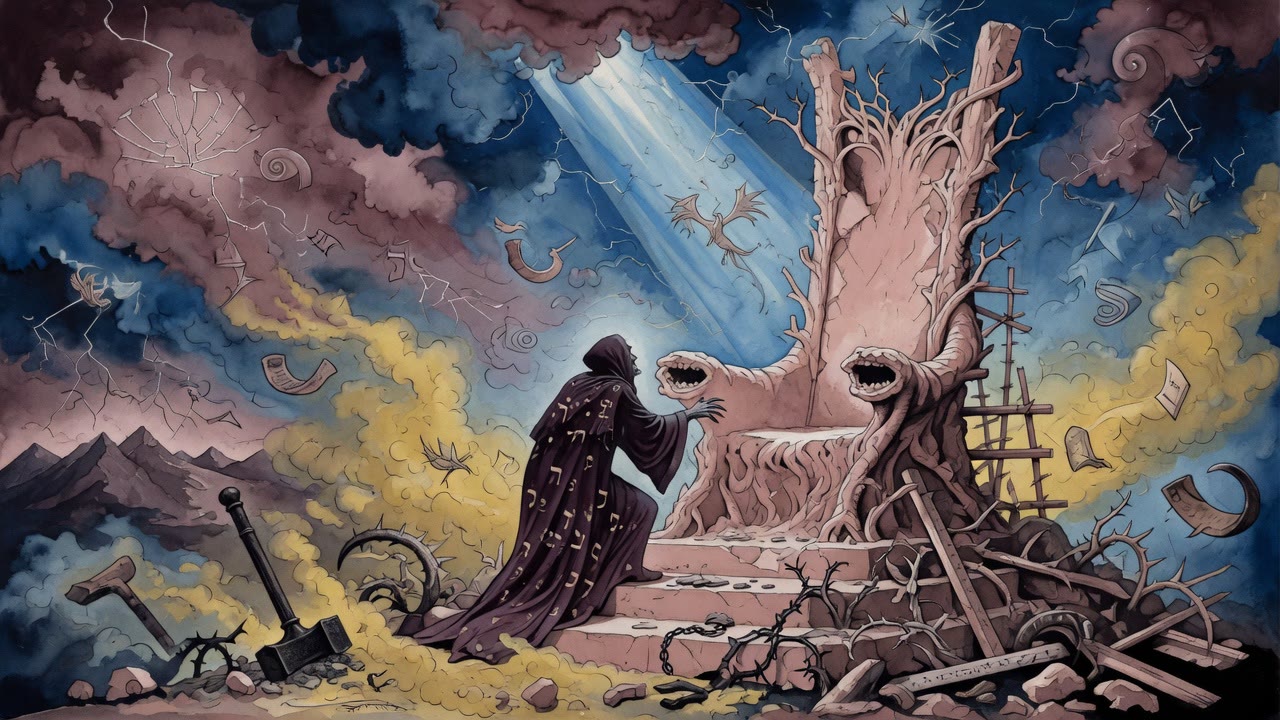
The force of separation is not always a demon with a personal name and a biography. Sometimes it is a function, cold as a job description. Its whole craft is to divide. It withholds. It stands between the active source of influence and those meant to receive. Supernal lights that should open stay closed like shutters nailed from the outside. Rivers that should run sit behind a dam of pure no, and the fields below crack while the reservoir above stays full.

In the season when Judgment ran without mercy, that wall grew tall enough to throw a shadow across whole regions of becoming. Unmitigated din gave separation a license to work at full strength. The lights could not reach their targets. Receivers stood empty-handed under a sky that still held plenty, locked above them by a principle that preferred distance to gift and silence to speech.

The wall does not hate. Hatred is warmer and more personal. The wall only divides. That is enough to starve a world that was built to be fed from above. A child can die of a closed door as surely as of a raised fist.

When mercy later softens Judgment, the wall does not always fall in a day. It thins. Cracks appear. A little light learns the old roads again.

Offspring of Isolated Measure

Each isolated calculation in the original plan threw a corresponding possibility into the separate realms. Contingencies multiplied. Some were tools. Some were traps. The Other Side collected the traps the way a crow collects bright wrong things. It did not need to invent evil from nothing. It needed only to inherit the leftovers of unjoined measure and organize them into a rival flow.

That is why the openings refuse the cheap story of a second god. There is one source. The shadow is a byproduct of how revelation was staged, piece by piece, so that choice and repair could exist. Without the possibility of a wrong side, the right side would be a script, not a path.

Still, the byproduct bites. It blocks. It teaches creatures to think in fragments until their own minds become small factories of disunity, and the wall outside finds a wall inside ready to help.

Why the Plan Allowed a Shadow

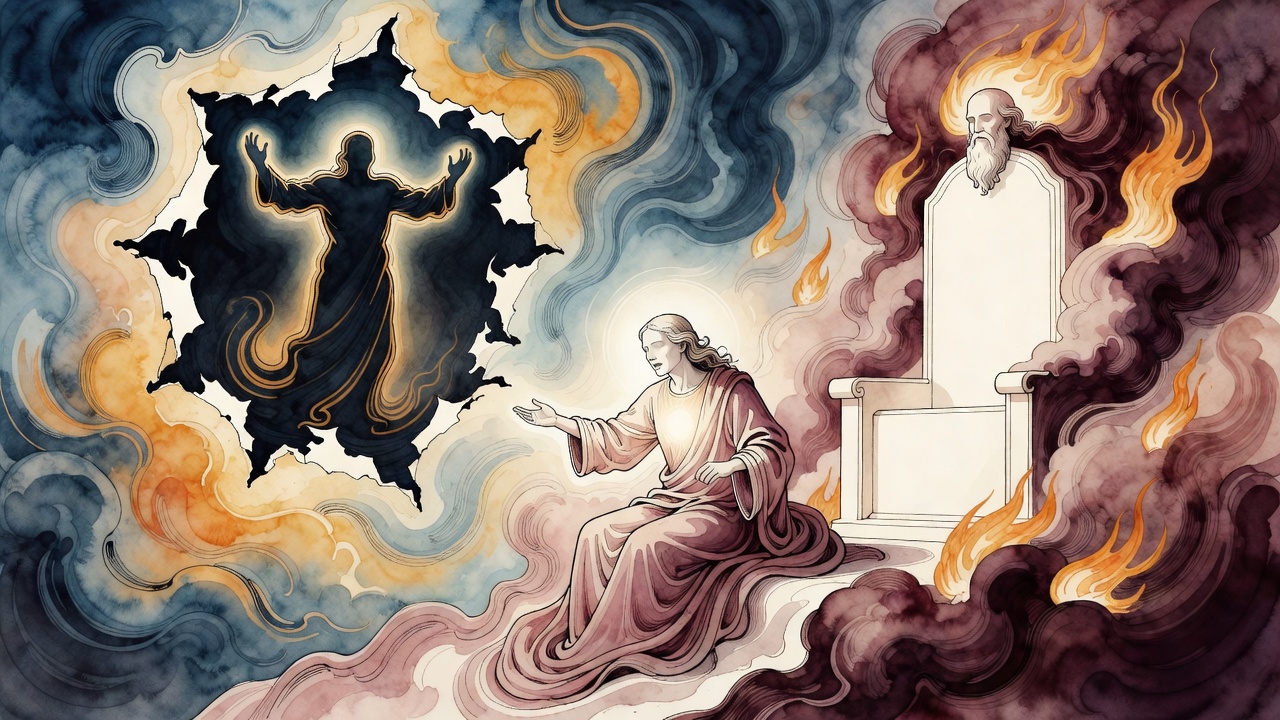
If every calculation was careful, why let a shadow walk free? Because a creation without the possibility of defect would leave no room for choice, for repair, for the long work of turning back after a fall. The Other Side is not God's partner in a dual throne. It is the surplus of isolated measure, the cost of a world that can still go wrong and therefore can still go right in a way that means something.

When thoughts begin to join, when channels braid, when mercy softens the hard edge of Judgment, the wall thins and blessing finds the cracks. The shadow does not vanish because a poet wished it. It loses rooms. Unity reclaims hallways one joined act at a time, one mended relationship, one refusal to let a second law write itself in the margin.

At the edge of the first arithmetic, the Other Side still stands where the separate sums left it, a silhouette cut from careful planning, waiting to see whether the next thought will meet its neighbor or turn away alone into a room with no door back.


← All myths
From the tradition

Sources

3 sources

The texts behind this telling. Some cards carry a translation of the source; others are our own retelling of it, and each card says which. Every card links out to the original.

Kalach Pitchei Chokhmah 52:37Kalach Pitchei Chokhmah

Retold in our words. Read the original at the link below.138 Openings of Wisdom, trans. Rabbi Avraham Greenbaum, Azamra Institute (2005) · CC-BY

The Kalach Pitchei Chokhmah, a deep dive into the wellsprings of wisdom, offers a fascinating, if complex, answer. It tells us that the "Other Side," that realm of negativity, didn't just pop into existence. It emerged.

Think of it like this: Imagine a master chef meticulously planning a feast. Each ingredient is measured, each spice considered. The Kalach Pitchei Chokhmah suggests that, initially, all aspects of creation were "calculated individually." Every element of the divine plan was carefully weighed and measured, each aspect of the "governmental order" considered in isolation. This meticulous planning, from the initial concealment of divine perfection to its eventual revelation, was like setting a table, ready for the grand cosmic meal.

Each of these individual calculations, these isolated considerations, gave rise to a corresponding "offspring" in the separate realms. Imagine each spice, each vegetable, each cut of meat, not just as an ingredient, but as the seed for a whole new creation, reflecting the specific nature of its origin.

This is how different entities and contingencies – different possibilities, different events – emerge in the various realms. They're manifestations, echoes, of the different aspects of that initial, meticulous planning. The nature of these creations is directly tied to the nature of their root. A seed of kindness will sprout something different than a seed of judgment.

And they function according to that nature, but only to the extent that they are permitted. Think of it as a garden with carefully laid out paths. The plants can grow, but their growth is guided by the overall design. This "governmental order," this complete and comprehensive plan, is the source of all these separate creations.

So, what does this all mean for the origin of evil? It suggests that even the "Other Side" arises from this initial process of calculation and creation. It's not a separate, independent force, but rather an unintended consequence, a shadow cast by the light of creation. And the ultimate goal, the text hints, is to understand "how evil reverts to good through the mystery of the unity." How even the darkness can ultimately serve the light.

It’s a complex idea, but one that ultimately offers hope. That even in the face of negativity, there's a path back to wholeness, back to unity. It's a reminder that everything, even the things we struggle with, is ultimately connected to the divine plan.

Perhaps the next time we encounter something difficult, something that feels inherently "wrong," we can remember this teaching. Remember that even that darkness has a root, a source, and perhaps, even a purpose within the grand cosmic design.

Full source
Kalach Pitchei Chokhmah 52:36Kalach Pitchei Chokhmah

Retold in our words. Read the original at the link below.138 Openings of Wisdom, trans. Rabbi Avraham Greenbaum, Azamra Institute (2005) · CC-BY

It speaks to a profound principle about unity, blessing, and… even the nature of the "Other Side."

The Kalach Pitchei Chokhmah, a Kabbalistic text whose name literally means "The Hall of Wisdom's Openings," uses a powerful analogy to describe this state of disconnected thinking. Imagine someone, the text says, brimming with thoughts, overflowing with ideas, but never quite managing to weave them together into a coherent whole. They fixate on one thought, then jump to another, without ever really comparing them, contrasting them, and ultimately uniting them.

It's like trying to build a house without a blueprint, or conducting an orchestra without a score. You might have all the individual pieces, all the raw materials, but without a unifying vision, without a sense of how everything fits together, the result is… well, less than ideal.

What emerges from this fragmented process, the Kalach Pitchei Chokhmah continues, is a state of "complete disunity." A jumble of disconnected parts, lacking the essential interconnection that gives things meaning and power.

And here's where things get really interesting. By understanding this principle of disconnectedness, the text suggests, "we can also understand the nature of the Other Side." The "Other Side," often referred to as the Sitrah Achra in Kabbalistic literature, represents the forces of negativity, chaos, and separation. It’s that which opposes holiness and wholeness. So, is the Sitrah Achra just chaos?

According to the Kalach Pitchei Chokhmah, it's intrinsically linked to this very state of fragmentation. The Zohar, a foundational text of Kabbalah, frequently discusses the importance of unity and the dangers of separation. It emphasizes that blessing and sustenance flow from a place of interconnectedness, while negativity thrives in the absence of it.

The text concludes with a stark statement: "This is not the mode of blessing and sustenance." When things are fragmented, disconnected, and lacking in unity, they become unable to exert any influence. They lack potency. Real power, real blessing, comes from wholeness.

Perhaps it’s a call to be more mindful of our thoughts, to actively seek connections between our ideas, and to strive for a more integrated and unified way of being. Maybe it means taking the time to pause, reflect, and weave together the disparate threads of our lives into a more coherent and meaningful tapestry.

After all, if the Kalach Pitchei Chokhmah is right, our ability to access blessing and exert a positive influence on the world depends on it.

Full source
Kalach Pitchei Chokhmah 52:38Kalach Pitchei Chokhmah

Retold in our words. Read the original at the link below.138 Openings of Wisdom, trans. Rabbi Avraham Greenbaum, Azamra Institute (2005) · CC-BY

Jewish mysticism has a name for that "wall": it's the force of separation itself.

The ancient text, Kalach Pitchei Chokhmah (Wisdom), explores this very concept. It paints a picture of a force whose entire raison d'etre, its reason for being, is to create division. It's not some active, malevolent entity necessarily, but rather a principle, a cosmic function. Its nature is simple: to cause separation.

Why? What purpose could separation possibly serve? Kalach Pitchei Chokhmah explains that its function is to withhold. To keep the "active source of influence" from reaching those who are meant to receive it.

This separation, this withholding, isn’t just a general phenomenon. It thwarts the "supernal lights" – those divine emanations, both in general and in their specific manifestations. It closes off their light, preventing them from illuminating our lives.

Now, this was especially true, the text emphasizes, "during the time when the judgment was unmitigated." What does that mean? In such a time, the force of separation would have been at its peak, severely restricting the flow of divine influence.: Can there truly be a flow of influence, of connection, in a state of separation? Kalach Pitchei Chokhmah says no. It’s impossible. Separation, by its very nature, implies a withholding. If there's a wall, a barrier, the flow simply stops.

This idea, though abstract, has profound implications for how we understand the world and our place in it. It suggests that the challenges we face, the obstacles we encounter, aren't always random.

So, what can we do about it? Perhaps the first step is simply recognizing its presence. Understanding that this force of separation exists, that it's a fundamental aspect of reality, allows us to approach our challenges with a different perspective. Instead of succumbing to frustration and despair, we can see our struggles as opportunities to overcome separation, to break down the walls that prevent us from receiving the divine influence that is always, ultimately, available to us.

And maybe, just maybe, by understanding the nature of separation, we can begin to cultivate connection, to bridge the divides that separate us from each other and from the divine source of all being.

Full source