The Eight-Hundred-Parasang Wilderness of Coiling Serpents
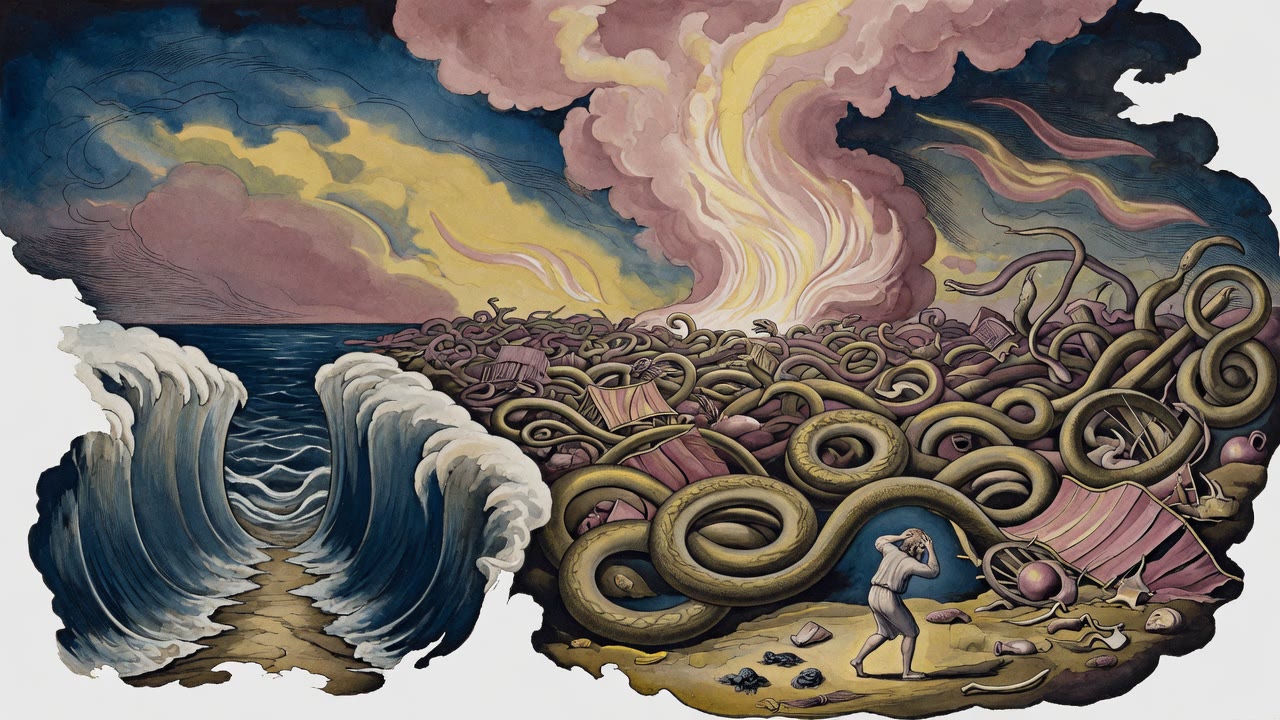
The sea still stood in two walls behind them when the ground began to move. Serpents thick as olive-press beams did not make way.
Table of Contents
 Click for full size
The Ground That Moved
The water still hung in two walls behind them when the mud of the sea floor gave way to grit. Then the grit went gray and flat and ran out past sight. This was the wilderness of Shur. Eight hundred parasangs across. Eight hundred parasangs deep.
It was not empty.
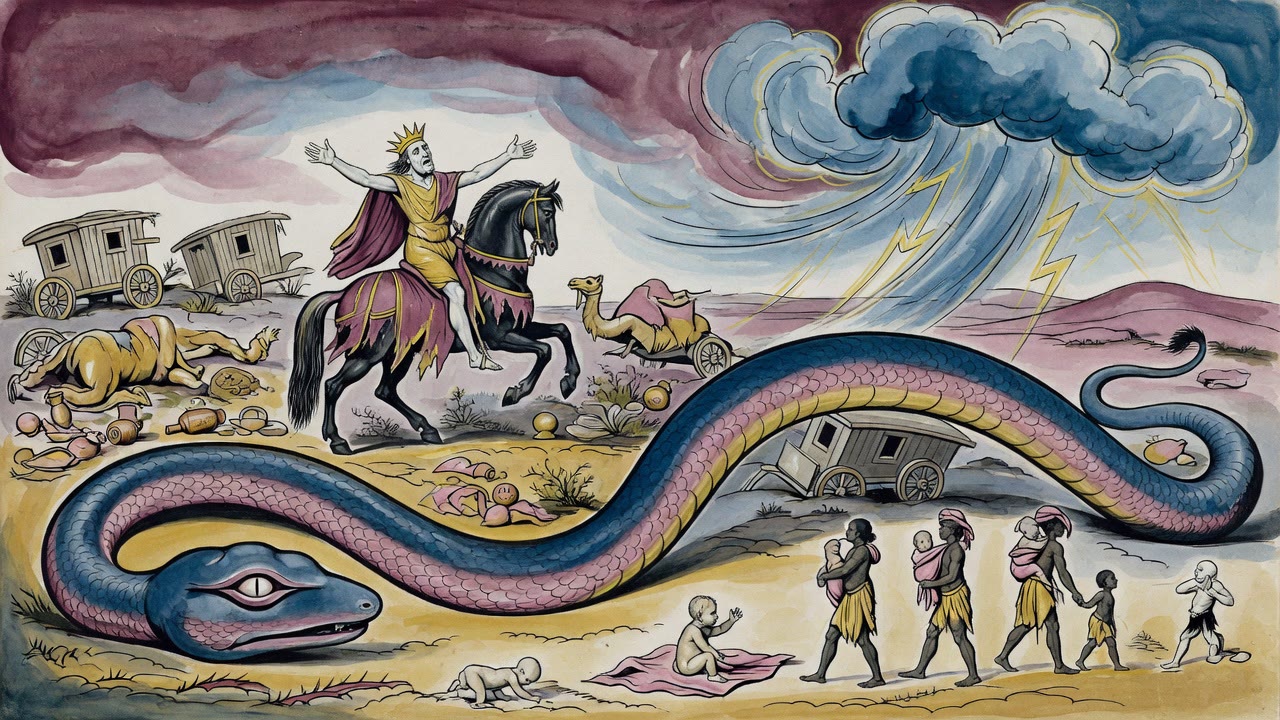
Under the heat the floor of the waste was alive. Serpents lay coiled there as thick as the beam of an olive press, the great timber that crushes the fruit, and they did not flee the marching feet. Scorpions crouched in the rock cracks, large enough to fill a house. A person crossing here did not pick a path between dangers. The danger was the ground itself, a wilderness of coiling serpents from wall to wall.
One viper was worse than the rest. They called it the akhas (עכס). It did not need to strike. When a bird flew overhead and its shadow slid across the sand, the akhas lifted its head, and the bird died in the air and dropped to the ground limb by limb, taken apart before it landed. A shadow was enough. Jeremiah had a word for a country like this. He called it a land of tzalmavet (צלמות), the shadow of death: a place where shade itself kills.
King Shapur Fed It Three Caravans
Long after Israel had gone through, a king came to the edge of the same waste and learned what it was. Shapur stood at the head of his column and sent the first caravan forward into the flat gray distance. A serpent rose out of the ground and swallowed it whole. Animals, drivers, freight, gone in one motion. He sent a second caravan. The serpent swallowed that one too. He sent a third. The same.
Shapur sat down in the dirt and could not move. He had emptied three caravans into a single throat and the throat was still open. The captain of his army stood over him and would not let him grieve in peace.
"Why are you just standing there?" the captain said. "Bring ten mighty men."
The king brought them. The captain set them to work. "Fill the rows with straw," he told them, and the men bound great bundles of dry straw, row upon row, until they had a wall of the stuff. Then they rolled the bundles toward the waiting mouth.
The serpent did what a serpent does. It swallowed. It took the first bundle and the second and the tenth, swallowing straw the way it had swallowed the caravans, and the straw went down and packed its belly tight. The body began to swell. It swallowed too far to stop and too far to turn, until the great length of it lay bloated and stuck on the ground, unable to gather itself to strike. The ten men climbed onto it and killed it where it lay.
The Woodcutter Who Went Bald
The terror of the place did not need a king's caravans to prove itself. A single glance could do it, and there was a man in the Land of Israel who carried the proof on his head for the rest of his life.
They called him Merutah, the Plucked One, and the name was the whole story. Before that day he had hair like any man. He went up a mountain to gather firewood, the ordinary errand of an ordinary morning, and somewhere among the brush and the cut branches he came on a serpent lying asleep on the ground.
The serpent did not wake. It did not see him. There was no strike, no bite, no venom, no chase. The man simply stood there and looked at the sleeping thing, and that was enough. The hair of his head fell out where he stood, every strand of it, and no hair ever grew on him again until the day he died. From then on his neighbors had a name ready for him whenever he passed: Merutah, the man the serpent had plucked bald without once opening its eyes.
Israel Walked Anyway
Set the woodcutter beside the king and the size of the crossing comes clear. One man went bald from the sight of a single sleeping snake. A king with an army and ten strong men fed three whole caravans to one serpent's mouth before cunning brought it down. And through this same eight hundred parasangs of coiling serpents and house-sized scorpions and shadow-killing vipers walked a nation of former slaves, with their children, their flocks, their old people, their infants at the breast.
No straw bundles. No mighty men. No army. They walked into the killing ground that unmade a king and they came out the other side, and the serpents that swallowed caravans whole let them pass. Rabbi Yose bar Rabbi Hanina, who knew exactly how wide and how deadly that waste was, said the only thing left to say about it.
"Great is our God, who saved us from that wilderness."
← All myths