From One Finger of God to the Open Hand of Rescue
Egypt's sorcerers could copy blood and frogs but failed at lice. From that single admitted finger the rabbis traced the whole open hand of Israel's rescue.
Table of Contents
 Click for full size
The Limit of Dark Craft
The magicians had matched everything so far. Blood in the Nile, frogs swarming out of the water onto the land, they had reproduced both signs in miniature, showing Pharaoh that Moses was not working alone in some unprecedented register. Egypt had its own channels to whatever stood behind natural things.
Then the dust of the ground became lice, and their hands went still.
They tried. They concentrated their skill on the same dust that had produced millions of biting insects and nothing came. So they turned to Pharaoh and said the sentence no court sorcerer ever wants to say in front of his master: this is the finger of God. Not our finger. Not our instruments. Something else entirely.
Why the Lice Defeated Them
The Yalkut Shimoni on Torah, which gathered older midrashic voices into one running commentary on the Hebrew Bible, asks what specifically broke the magicians at that particular plague and not the earlier ones. Rabbi Eleazar gave the answer that turns the whole episode into a theological argument about the boundary of created power. A demon, he said, cannot create anything smaller than a grain of barley. Rav Pappa drove the point deeper: not even a camel can any demon produce from nothing. What the dark arts do is gather and redirect what already exists, the way a conjurer works with real rope and real sleight of hand. They produce nothing from nothing. That is not in their charter.
The lice were too small to herd. They had to be created from the ground up, out of dust, from nothing at all. And the capacity to make something from nothing belongs to one source only. So the most feared magicians in the ancient world stood in the dust of Egypt and conceded, in front of their king, that they had run against the edge of what they could reach.
One Finger and Then the Whole Hand
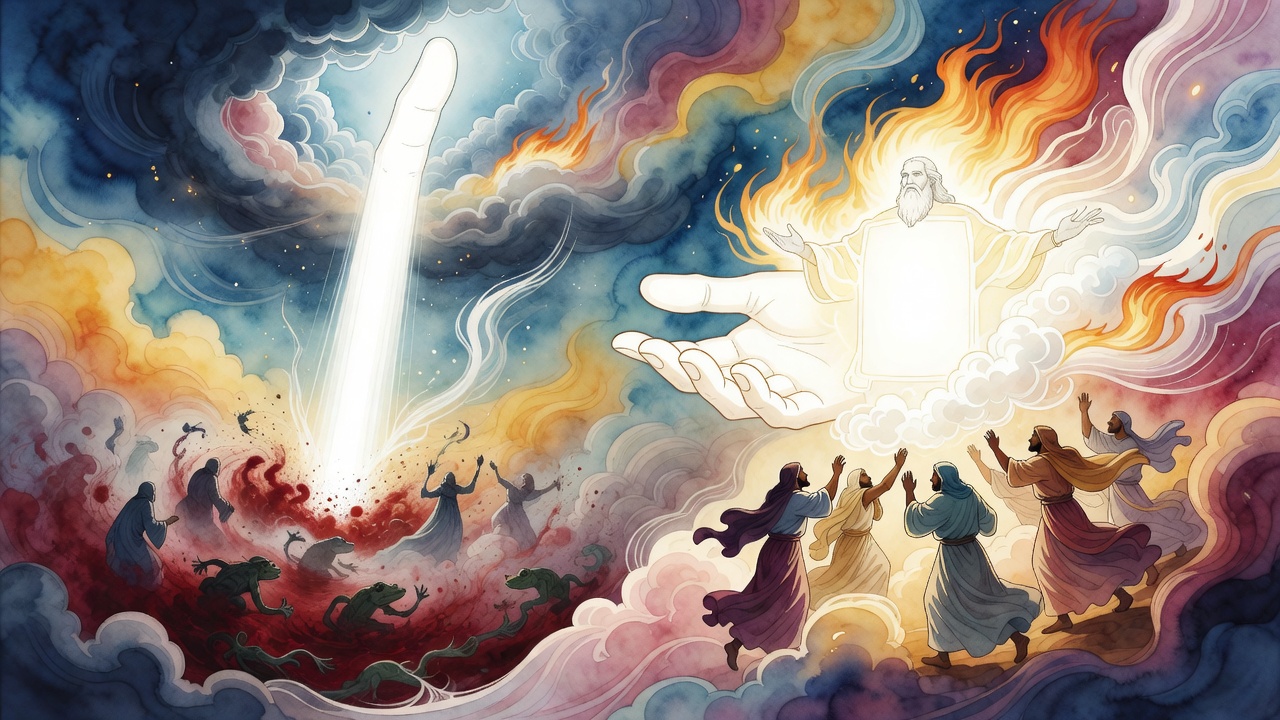
From that single admitted finger, Rabbi Ishmael built something far larger. He read the vocabulary of body parts across the two great rescues: the Exodus from Egypt and the crossing of the sea. At the Exodus, it is a finger: this is the finger of God. At the sea, it is a hand: Israel saw the great hand that God laid upon Egypt.
If a finger produced the ten plagues, what does a hand produce? Five fingers, five times as much. Rabbi Ishmael counted: fifty plagues at the sea, one for each notch on the hand that the finger belonged to.
What had started as a sorcerer's admission of defeat became, through this arithmetic, a map of the whole rescue. The finger is one plague. The hand that belongs to the finger is ten. The arm is more. And behind the arm stands the whole power of the One who reaches.
Light and Dark at the Same Crossing
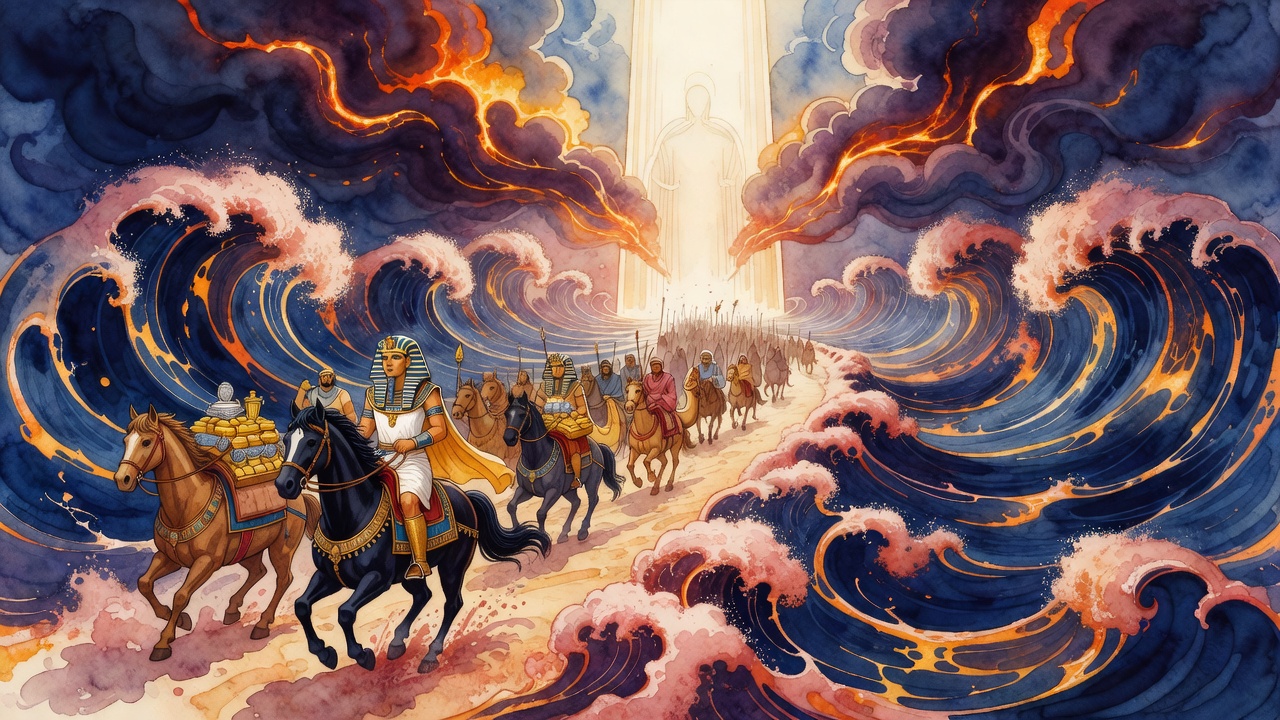
The Yalkut pairs this tradition with the scene at the sea where the pillar of cloud served two opposite purposes. It was cloud and darkness for Egypt, and it lit up the night for Israel. The same phenomenon, the same pillar, produced light for the people being rescued and blindness for the army pursuing them. One cloud face to one direction, another face to the other.
The midrash reads this as the completion of the finger's argument. The darkness that the cloud poured over Egypt was the other side of the light it gave Israel, the same divine act viewed from different positions. What felt like blinding to the chariot drivers was the underside of what felt like guidance to the people walking toward the water. The same hand, the same fingers, working both at once.
← All myths