The Serpents of Shur and the Kings Who Could Not Cross
A king lost three caravans to the serpents of Shur and a woodcutter lost his hair to one glance, yet slaves and infants crossed the same waste untouched.
Table of Contents
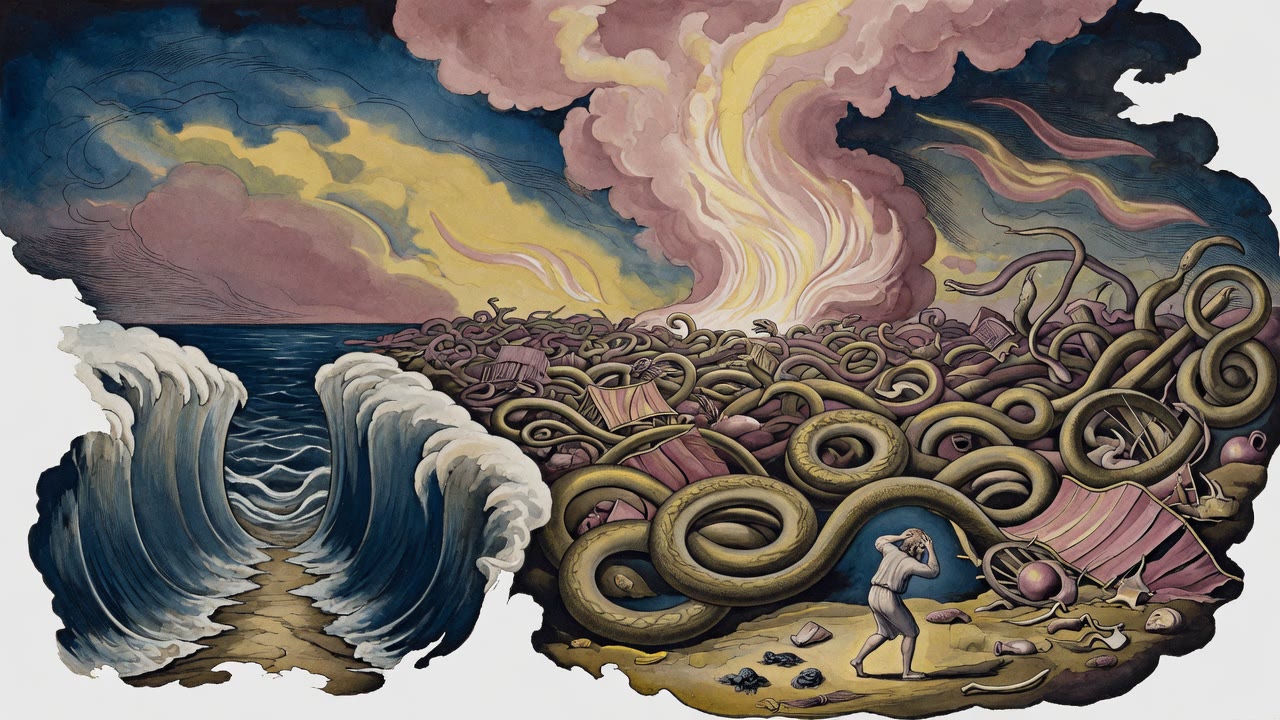
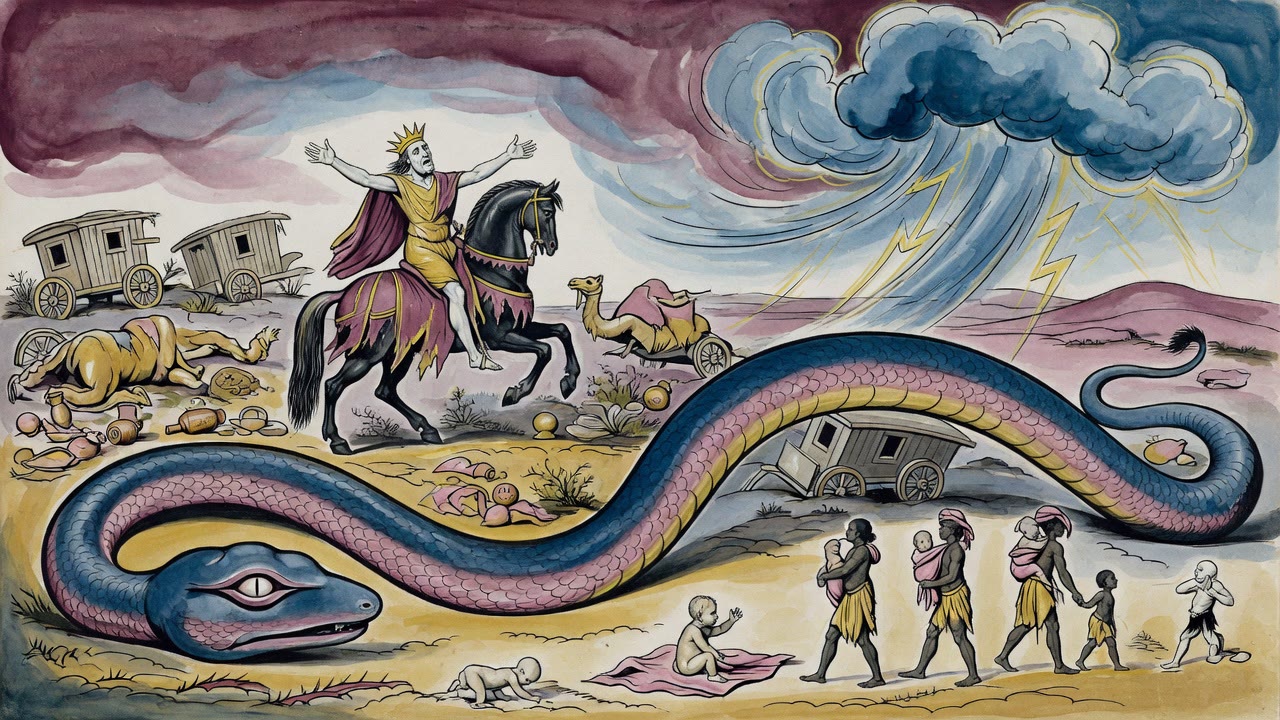
The water still hung in walls on either side when Israel walked out of the Reed Sea and onto dry sand, and the sand kept going. It went for eight hundred parasangs in every direction, a waste so wide a man could walk it for months and never reach a well. They called it the Wilderness of Shur, and the ground there was alive in the worst way. Scorpions the length of a hand crouched in the shade of every rock. Serpents lay coiled like the great wooden beams of an olive press, thick as a man's waist, long enough to swallow a caravan whole. And above them moved the things that flew.
 Click for full size
The Birds That Burned in Midair
The flying serpent did not need to bite. A bird crossing the sky above it would catch fire in midflight, feathers gone to ash before the body finished falling, because the heat that came off the creature scorched everything it passed beneath. The prophets remembered this place by its monsters. They spoke of the viper and the flying serpent together, the land of trouble and anguish, and they were not exaggerating. A single one of these serpents could throw itself against a cedar and split the trunk down its length. Into that land walked a nation of former slaves with their children and their flocks, and nothing touched them.
That was the thing no one could explain. The serpents were there. The scorpions were there. The flying death was overhead. Israel passed through and kept passing, and the coils that could crush a wagon stayed where they lay.
The King Who Lost Three Caravans
Long after, a king named Shabur tried to cross that same ground with his court and his caravans, and he learned what the wilderness was without protection over him. His first caravan went ahead. A serpent rose from the sand and swallowed it, men and beasts and goods, and was gone. He sent a second. The serpent swallowed that one too. He sent a third, and the third vanished into the same throat, and the king sat down in the sand and could not move for grief.
His scholars stood around him while he sat there useless. "Why are you sitting idle?" they asked him. "Bring us ten strong men." He brought them. The scholars ordered great sacks, the kind merchants pack, and had the men fill every one of them with straw until they bulged. Then they rolled the sacks across the sand toward the place where the serpent waited.
The serpent did what it knew to do. It swallowed. It took the first stuffed sack and the second and the next, gulping straw it mistook for caravans, and the straw went down and stayed down and filled it past bursting. Its belly stretched and split. It lay there heaving, unable to coil, unable to strike, unable to so much as drag itself across the sand, and the ten strong men walked up to the helpless length of it and killed it. Shabur watched the thing that had eaten three of his caravans die because it could not stop eating, and he understood at last what kind of ground he had wandered onto. Israel had crossed it without a single sack of straw, without ten strong men, without a plan.
The Man Who Went Up for Firewood
In the Land of Israel there lived a man who went up the mountain one ordinary morning to gather wood. He was no king and had no scholars and no escort. He climbed among the rocks looking for fallen branches, and then he saw it. A serpent lay sleeping in the sun, one of the great ones, close enough that he could see the slow swell of its breathing.
It did not see him. That was the only mercy in the moment. The serpent slept on, and the man stood frozen above it, knowing that if it opened its eyes he was already swallowed. He did not run. He could not run. He stood there in a terror so total that something gave way inside his body, and the hair began to fall from his head. It fell out where he stood, every strand of it, and it never grew back. Not that year, not the next, not on the day he died an old man. People who met him afterward did not know his name, so they made one from what the serpent had done to him without ever waking. They called him Merutah, the Plucked Bare One, the man the wilderness had skinned of his hair with nothing but the sight of a sleeping snake.
What the Sea Had Already Decided
Set the two beside each other and the silence speaks. A king with an army and a wise court loses three caravans and barely survives by trickery. A woodcutter loses his hair forever from one glimpse of a snake that never even noticed him. These were the strongest men the land could field against the serpents of Shur, and the serpents broke them.
And Israel had walked the whole eight hundred parasangs of it, slaves and infants and old women and sheep, straight out of the parted sea and into the worst country in creation, and the beams of the olive press lay still and the things overhead did not descend. No straw. No ten strong men. No plan. The serpents that swallowed Shabur's caravans and stripped Merutah bare simply did not move while Israel went by, and no one in that crowd of refugees ever knew how close they had walked to being eaten.
← All myths