6 min read

The Darkness in Egypt Grew Thick Enough to Touch

A darkness fell on Egypt so thick a man could touch it, pinning bodies where it found them while Israel walked free with light.

Curated by Arthur · Told by Maggid ·
Table of Contents
  1. The First Three Days Blinded Every House
  2. Then the Darkness Pressed Bodies Still
  3. Israel Walked Free with Light in Their Dwellings
  4. What the Israelites Saw in the Dark
  5. The Seventh Day Came at the Sea

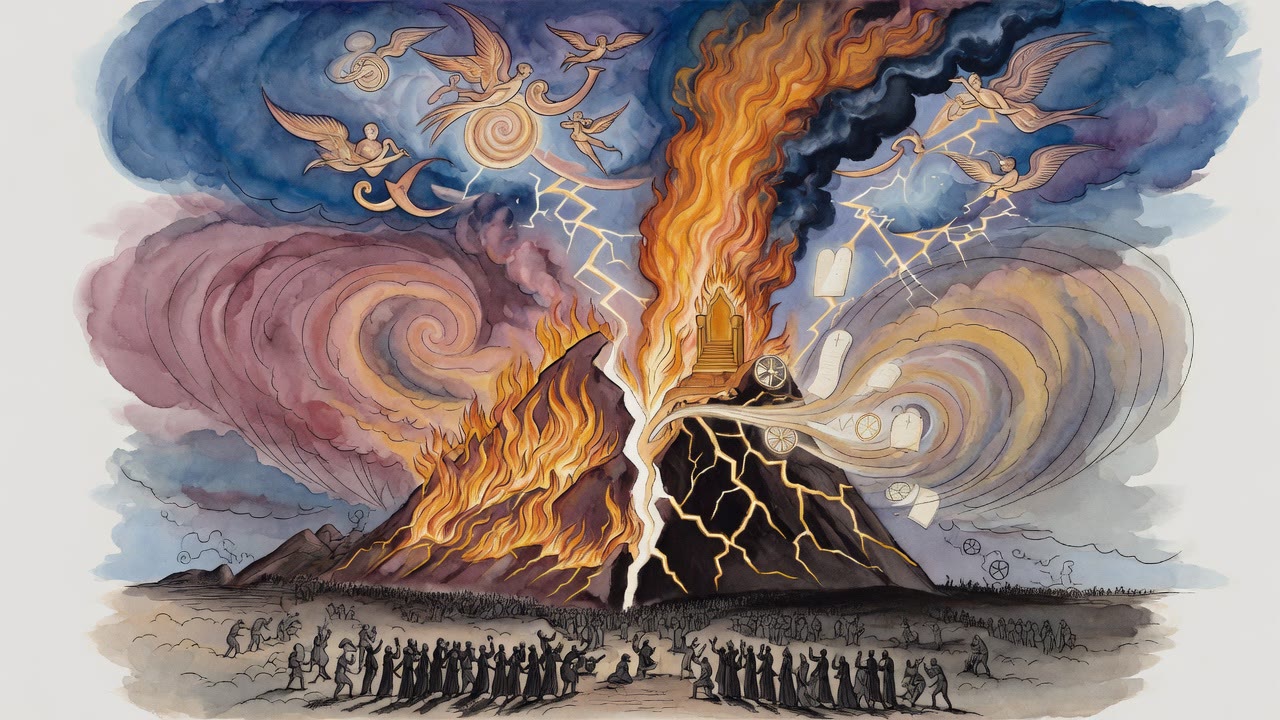
Moses lifted his hand toward the sky, and the light went out of Egypt the way water goes out of a cracked jar, all at once and without warning. It was not evening. There were no clouds. The sun had simply stopped reaching the ground, and into the space it left came something else, something that pressed against the skin like wet wool (Exodus 10:21).
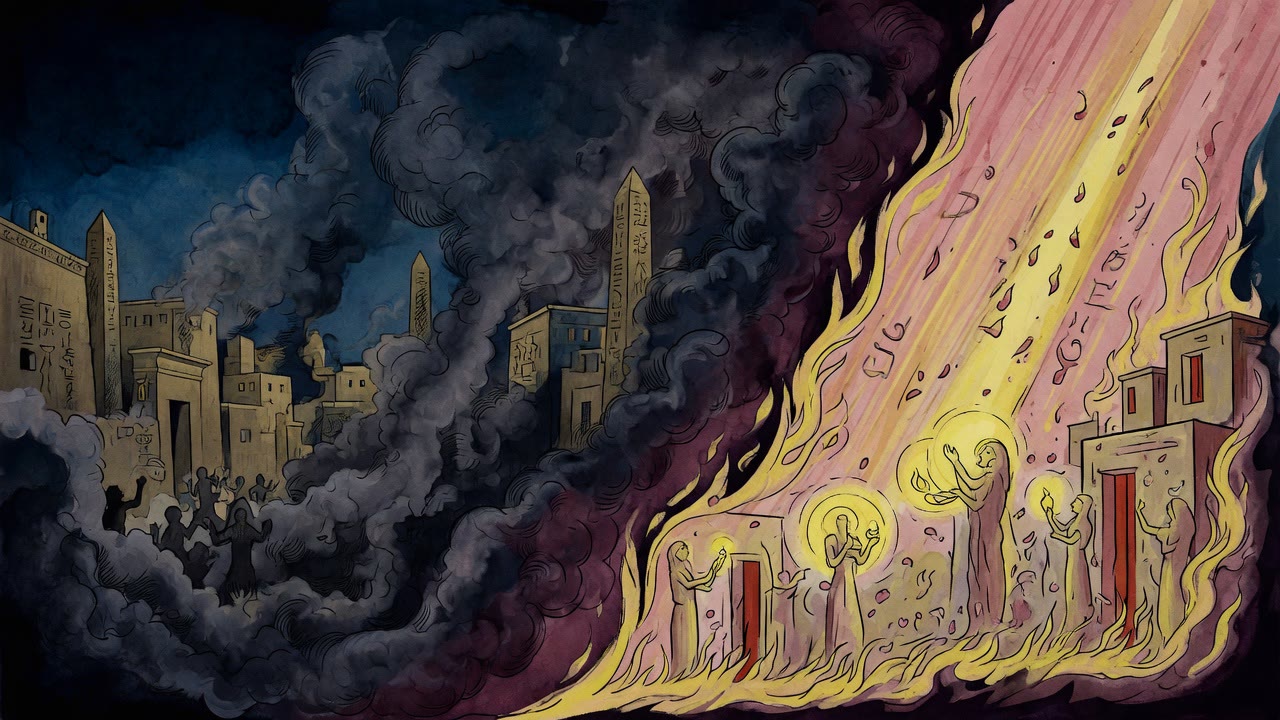
A potter in Memphis reached for the lamp on his table and could not find his own hand. He waved it before his face. Nothing. The dark sat on his eyes with weight. He called his wife's name and heard her answer from across the room, close enough to touch, and he could not find her either. Between them stretched a blackness he could feel against his fingers, soft and cold and refusing to part.

The First Three Days Blinded Every House

For three days no Egyptian saw another Egyptian. A man in the street stood an arm's length from his brother and the two of them might as well have been on opposite shores of a sea. They could still move. The potter shuffled from wall to wall, hands out, learning his own house by touch like a blind man learning a stranger's. He found the door. He could not find the reason to open it, because outside was the same wall of dark, the same nothing pushing back against his palms.

This was Egypt, the kingdom that had counted Israelite bodies by the brick, that had set quotas and watched the work with open eyes. The watching empire had gone blind. The river it ruled, the storehouses it filled, the children it commanded, all of it sank under a black that no torch could burn through. Fire was lit and gave no light. The flame stood there, small and useless, swallowed before it could spread.

Then the Darkness Pressed Bodies Still

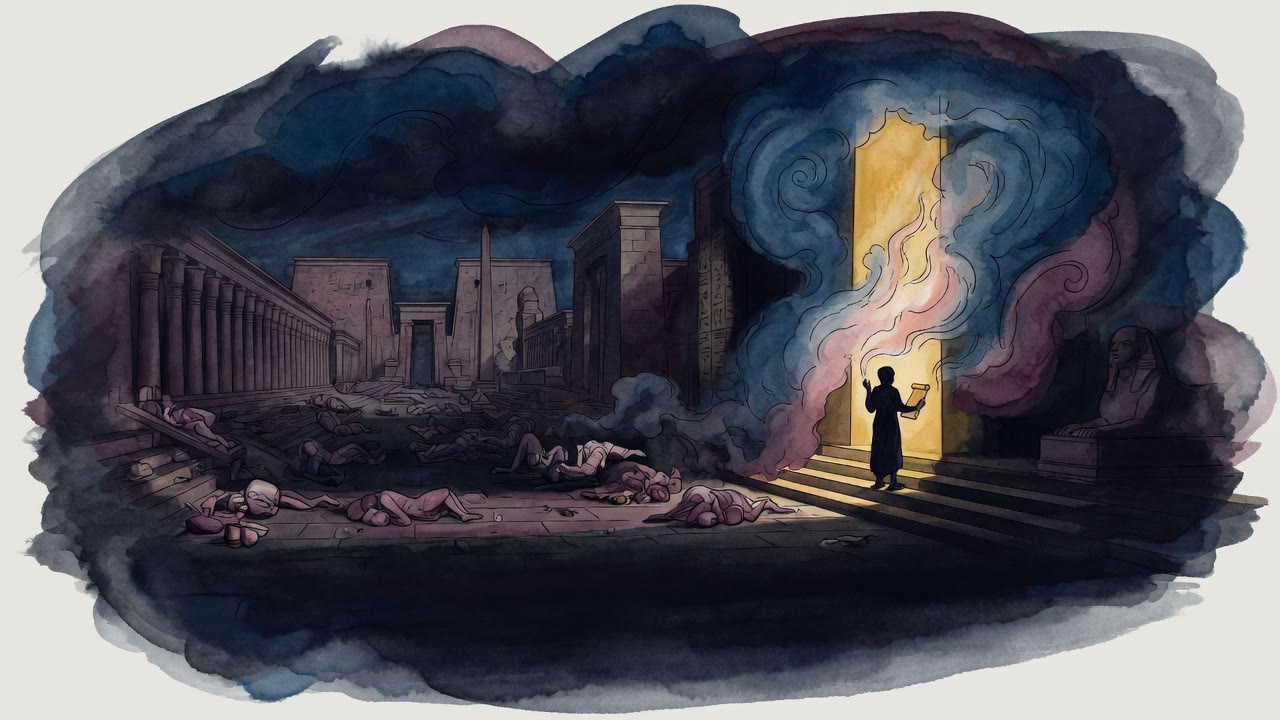
On the fourth day it changed. The dark thickened, drawing close around each body like a garment pulled tight, and now it did not only blind. It held. Whoever sat could not rise. Whoever stood could not bend his knees to sit. The potter had been crouching by his cold hearth when the change came, and he stayed crouched, his legs folded under him, his back bent, locked into the last shape his body had chosen. For three more days he held that posture. His muscles screamed. The dark would not let him straighten.

So the empire that had pinned Israel to the mud pits, that had decided when a slave might rest and when he must rise, learned the inside of its own punishment. Egyptian bodies lost the smallest freedom a body has, the freedom to turn over, to stand, to cross a room. Every house became a cell, and the lock was the air itself.

Israel Walked Free with Light in Their Dwellings

In the same hour, in the same land, the children of Israel had light. Not stolen light, not a guarded flame, but light in their dwellings as plain as morning while a stone's throw away the Egyptians groped and froze (Exodus 10:23). They moved between rooms. They saw one another's faces. They did the ordinary things the dark had stripped from everyone else.

The light carried two mercies, and both were quiet. Among Israel were some who would not leave Egypt, who had set their hearts against the road ahead, and these died in those days. The light let their bodies be carried out and buried in the dark hours without an Egyptian ever knowing the nation had wept. No enemy counted Israel's dead. No enemy mocked the funerals. And those who lived used the light to keep the law, bent over the commandments in their lit houses while the world outside lay paralyzed and blind.

What the Israelites Saw in the Dark

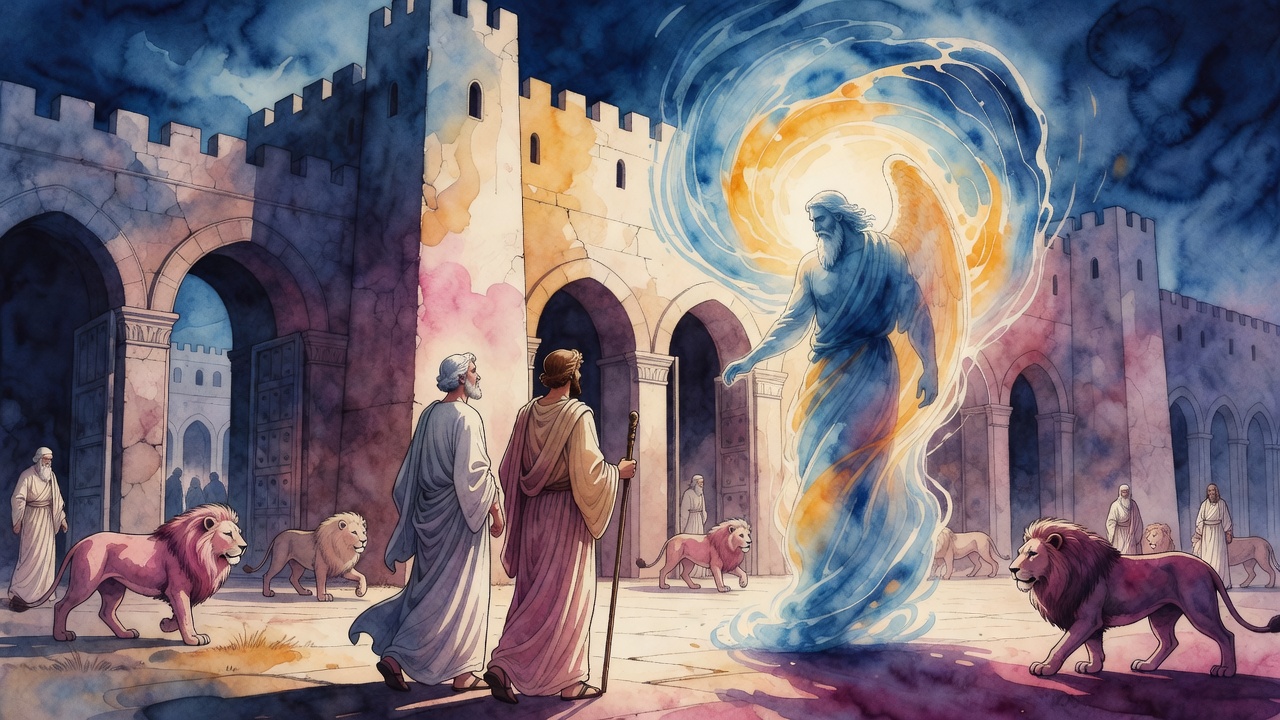
There was a third use, and it was sharp. While the Egyptians sat frozen and sightless, Israelites walked into their houses, free and seeing, and looked. They opened chests. They searched corners. They marked where the silver lay, where the gold was hidden, which vessel sat in which room, and they said nothing and took nothing yet. They only saw, and remembered.

So when the day came that an Israelite asked an Egyptian neighbor for silver and gold, and the Egyptian swore he had none, the Israelite did not argue. He said the name of the chest. He named the corner. I saw it in your hand, he said, it lies in such a place. And the man, caught and ashamed, brought it out and handed it over. The dark that had blinded Egypt had been Israel's open window.

The Seventh Day Came at the Sea

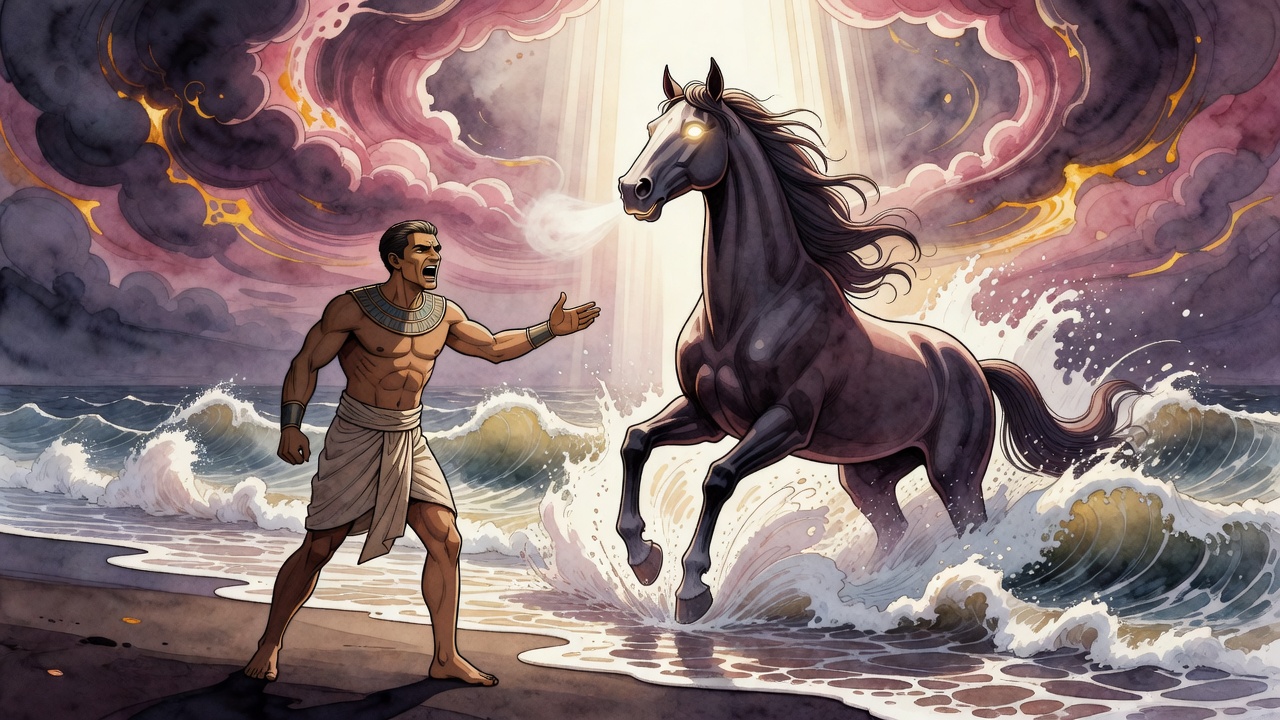
Count the days and the number runs past three. Three of blindness, three of the dark that pinned the limbs, and one more still to come. That last day of darkness found Egypt at the edge of the water, the chariots driving hard after a people who had walked out under their lit sky. The cloud that lit the night for Israel turned its other face on Egypt, and the host of Pharaoh chased blind into the dark at the Sea, the seventh measure of a dark that had begun in a potter's quiet house and ended with an army swallowed.


← All myths
From the tradition

Sources

6 sources

The texts this telling draws on, in full. Open a card to read inline, or expand it for a wider, quieter read.

Shemot Rabbah 14:2Shemot Rabbah

"Moses extended his hand toward the heavens, and there was a thick darkness in the entire land of Egypt for three days. They did not see one another, and no one rose from his place for three days; but for all the children of Israel there was light in their dwellings" (Exodus 10:22-23). But where did this darkness come from? That's the question that the ancient rabbis confront in Shemot Rabbah, a rich collection of Midrashic (rabbinic interpretive commentary) interpretations on the Book of Exodus.

This teaching presents us with a fascinating debate between Rabbi Yehuda and Rabbi Nehemya. Rabbi Yehuda suggests the darkness came "from the heavenly darkness," citing (Psalm 18:12): "He made darkness His secret place, His pavilion around Him."

Rabbi Nehemya, on the other hand, offers a much more chilling explanation. He proposes the darkness originated from Gehenna, often translated as Hell. He points to (Job 10:22), "A land of darkness, like blackness, the shadow of death and disorder, [where the light is like darkness]." Woe to a house whose windows open into that darkness!

This idea of Gehenna as the source of the darkness is further explored. The text quotes (Ezekiel 31:15), "On the day he descended to the grave I caused the deep to mourn [he’evalti], and cover itself for him." The rabbis cleverly interpret he’evalti as hovalti, meaning "I led him into the depths." It's a subtle, but powerful shift in meaning.

Rabbi Yehuda bar Rabbi asks a haunting question: With what are the wicked covered in Gehenna? His answer? Darkness. Ḥizkiyya adds an earthy analogy: how do you cover a clay tub? With another piece of earthenware. It's the same substance. Similarly, the wicked, whose deeds are done in darkness, are covered in darkness. (Isaiah 29:15) says it plainly: "Their deeds are in the dark." Thus, God covers them with the dark depths, as we see echoed in (Genesis 1:2): "And darkness on the surface of the depths."

So, could this mean that the darkness that plagued Egypt wasn't just a natural phenomenon, but a manifestation of the darkness of Gehenna itself? The text leaves us pondering this possibility.

It's a powerful image, isn't it? The idea that the darkness visited upon Egypt was not merely a physical absence of light, but a tangible emanation of spiritual and moral darkness. It serves as a potent reminder of the consequences of our actions and the depths to which we can sink if we choose to dwell in the shadows. Could it be that the plagues weren't just punishments, but also warnings, glimpses into the potential consequences of choosing darkness over light? Maybe the story of the plague of darkness is a mirror reflecting our own choices, asking us: what kind of light are we choosing to bring into the world?

Full source
Midrash Tanchuma Buber, Bo 3:1Midrash Tanchuma Buber, Bo

(Exodus 10:22:) "And there was thick darkness in all the land of Egypt three days." There were seven days of darkness over the Egyptians. For the first three days, whoever was sitting and sought to stand could stand, and whoever was standing and sought to sit could sit. And for another three days, whoever was sitting could not stand, and whoever was [standing] could not sit. Behold, that is six. And which is the seventh day? As it is said (Exodus 14:20), "And there was the cloud and the darkness, yet it gave light by night", the cloud was in Egypt, giving light to Israel and darkness to the Egyptians, as it is said (Exodus 10:23), "But all the children of Israel had light in their dwellings."

And Israel would enter the houses of the Egyptians, and whatever the Egyptians had, Israel would search out and see. And at the hour when the Holy One, blessed be He, said to Israel (Exodus 3:22), "But every woman shall ask of her neighbor, and of her that sojourns in her house," etc., Israel would go in among the Egyptians, and each and every one would say to his fellow, to his neighbor, "Lend me that vessel which you have." And he would say, "I have none." And he would say, "I know that you have it, and behold it is inside your chest; behold it is in such-and-such a place; I saw it in your hand." And he would lend him that vessel. And from where did Israel know? Rather, in those days of darkness they had entered their houses and seen their silver and their gold and their vessels which they had.

Rabbi Abin the Levite said: Also the plague of blood, when it came upon the Egyptians, the Nile was turned to blood, as it is said (Exodus 7:24), "And all the Egyptians dug round about the Nile for water to drink," etc. What did they do? They would see Israel filling his jar from the Nile, and they would go after him and ask of him to drink water, and it would become blood within their mouths. Rabbi Abin said: Whatever they took from Israel by purchase, they would drink as water, for it is impossible for a person to be without water; so they would take water from Israel, and from there Israel grew rich. [And here too, when the plague of darkness came upon them, they came to know the houses of the Egyptians, and from there Israel grew rich.]

Full source
Targum Jonathan on Exodus 10Targum Jonathan

The plague of darkness in Exodus chapter 10 is three days of impenetrable blackness across Egypt. The Hebrew Bible says simply that no one could see anyone else and no one rose from their place (Exodus 10:23). The Targum Jonathan reveals what was actually happening during those three days. And it involves Israel, not Egypt.

The Targum explains that God gave the Israelites light during the darkness for two reasons: "that the wicked among them who died might be buried, and that the righteous might be occupied with the precepts of the law in their dwellings." Not all of Israel was righteous. Some Israelites died during the plague of darkness, and the light allowed their bodies to be quietly buried without the Egyptians knowing. The darkness was not just punishment for Egypt. It was a cover for Israel's own losses, a divine act of concealment that protected the nation's dignity.

The plague of locusts, earlier in the chapter, also receives Targum additions. When the locusts are swept into the Sea of Reeds by a western wind, the Targum adds an astonishing detail: "And even such as had been salted in vessels for needed food, those too the western wind bare away." The Egyptians had captured and preserved locusts as emergency rations. God's wind was so thorough that it removed even the pickled locusts from their jars. Nothing, not even the resourcefulness of desperate people, could circumvent divine will.

The chapter ends with Pharaoh threatening Moses with death if he ever appears again. The Hebrew text has Moses simply agree: "I will see thy face no more." But the Targum's Moses delivers a final warning that reaches back to an earlier prophecy: "While I was dwelling in Midian, it was told me in a word from before the Lord, that the men who had sought to kill me had fallen from their means and were reckoned with the dead. At the end there will be no mercy upon thee." Moses reminds Pharaoh that God has already destroyed Moses's enemies once before. Pharaoh will be next.

Full source
Legends of the Jews 4:316Legends of the Jews

The familiar picture has them as swift, dramatic events, but the stories tell a different tale, one of drawn-out suffering, and, yes, even a bit of divine trickery.

It wasn't just a day or two of dim lighting, oh no. According to the Legends of the Jews, this darkness lasted a full seven days, mirroring the duration of the other plagues. But here’s the kicker: it wasn't a uniform darkness.

For the first three days, it was… manageable. Unpleasant, sure, but the Egyptians could still move around. They could shift positions, get up, sit down. But then, things took a turn for the truly dreadful.

For the next three days, the darkness became so thick, so oppressive, that they were completely immobilized. Imagine being stuck, unable to move from whatever position you were in – sitting, standing – for three whole days! It’s a chilling thought.

And the seventh day? Well, that one found the Egyptians still engulfed in darkness, but this time they were at the Red Sea, desperately chasing after the fleeing Israelites. Talk about a bad trip.

This wasn’t your garden-variety power outage, either. The Legends of the Jews describes it as a darkness "from hell," a darkness that could be felt. It was as dense as a dinar (an ancient coin), almost a tangible thing.

But here's where the story gets even more interesting. While the Egyptians were groping around in this infernal gloom, the Israelites? They were bathed in celestial light! A light so bright, they could see exactly what the Egyptians were doing.

Now, why would that be useful? Well, think about what was about to happen. The Israelites were about to leave Egypt, and they were instructed to ask their neighbors for valuables – raiment, jewels of gold, jewels of silver – for the journey. But the Egyptians, predictably, weren't exactly forthcoming.

Here's where that celestial light comes in handy. During those days of darkness, the Israelites had been carefully observing the Egyptians, cataloging their treasures, noting their hiding places. As Ginzberg's retelling in Legends of the Jews makes clear, when the time came to ask for these items, the Israelites could describe them with pinpoint accuracy, even revealing their secret locations.

You can almost hear the conversation, can't you? "Remember that gold necklace, shaped like a serpent, hidden under your floorboards?" The Egyptians were floored. How could they possibly deny having something when the Israelites knew so much about it?

And here's the really clever part. The Egyptians, according to the legend, reasoned that the Israelites had to be telling the truth. Why? Because if they'd been planning to steal from them all along, they could have simply taken whatever they wanted during the darkness. The fact that they were asking for it, describing it in detail, proved their honesty. It's a fascinating bit of psychological reasoning.

So, the Egyptians, feeling they had no choice, readily lent the Israelites all the treasures they asked for. And with that, the stage was set for the Exodus.

What does this all tell us? Perhaps it's a reminder that even in the midst of suffering and oppression, there can be moments of divine intervention, and even a bit of cleverness on the part of the oppressed. And maybe, just maybe, that light in the darkness is always there, if we know where to look for it.

Full source
Legends of the Jews 4:317Legends of the Jews

Legends of the Jews turns to Moses and Creation of Egyptians.

This wasn’t just any darkness. It was a darkness "of such a nature that it could not be dispelled by artificial means." for a second. Torches, lamps, even the roaring fires that lit their homes – all were useless. The light simply vanished, swallowed whole by the oppressive gloom.

What would that do to you? It wasn’t just an inconvenience. It was a sensory deprivation of the worst kind. Our text emphasizes how even “sight, that most indispensable of all the external senses, though unimpaired, was deprived of its office.” It wasn’t that their eyes weren’t working; it was that there was nothing to see.

The darkness didn't stop there. It didn't just affect sight. It crippled all the senses. in the story, “all the other senses were overthrown like subjects whose leader has fallen.” They couldn't speak. They couldn't hear. They were paralyzed, not just physically, but sensorially.

Imagine being trapped in that suffocating silence, unable to reach out, unable to connect, utterly alone in the inky black.

The text paints a picture of complete helplessness. “None was able to speak or to hear, nor could anyone venture to take food, but they lay themselves down in quiet and hunger, their outward senses in a trance.” They were trapped, suspended between life and…something else. A living tomb.

It makes you wonder, doesn’t it? What was the purpose of such a devastating plague? Was it merely punishment? Or was there something deeper at play? Perhaps it was meant to force the Egyptians to confront their own inner darkness, the darkness of their hearts that allowed them to enslave an entire people.

The story doesn’t end there, of course. It's a evidence of Moses' compassion, and the relationship he has with God, that he "besought God in their behalf." And God, in turn, "granted him the power of restoring fine weather, light instead of darkness and day instead of night."

The darkness lifts. The light returns. But the experience, surely, must have left an indelible mark on the souls of those who endured it.

What does this story tell us today? Perhaps it reminds us of the power of empathy, the importance of standing up for justice, and the enduring hope that even in the deepest darkness, light can always return. Maybe it's a reminder that darkness is more than just the absence of light; it can be a force that paralyzes and isolates. And that sometimes, all it takes is one person, one voice, to plead for a glimmer of hope and bring the world back to the light.

Full source
Shemot Rabbah 14:1Shemot Rabbah

In (Exodus 10:21), God tells Moses to stretch out his hand, and the text says, "there will be darkness over the land of Egypt, and the darkness will be tangible." Tangible! What does that even mean?

Shemot Rabbah, a collection of rabbinic homilies on the Book of Exodus, dives deep into this plague. It all starts with a quote from (Psalms 105:28), "He sent darkness, and it was dark; and they did not defy [maru] His word.” But the Rabbis, in their insightful way, give this verse a twist. Instead of simply meaning the Egyptians didn't disobey, they suggest it means they didn't accept the authority [marut] of God's word. A subtle difference, but it changes everything, doesn't it? It speaks to a deeper kind of resistance, a refusal to acknowledge God's power.

The interpretation doesn't stop there. Imagine this: God tells the angels, "The Egyptians deserve darkness!" And the angels? They're completely in agreement. No defiance, no hesitation. They're on board. The story in Shemot Rabbah continues, drawing a parallel to a master ordering a servant to be punished with fifty lashes. But the servant, eager to please, goes overboard and delivers a hundred! So too, it seems, with the darkness. God sends it, but the darkness adds its own… intensity. The text says, "He sent darkness, and it was dark [vayaḥshikh]." But vayaḥshikh can also mean "and it made it dark." The darkness itself became an active participant, amplifying the suffering.

What about this idea of tangible darkness? What did it actually look like? The Rabbis in Shemot Rabbah say it was as thick as a dinar, an ancient coin. How thick is that, exactly? Well, the point isn't precise measurement. It's about conveying the sheer density of the darkness. The text uses the word veyamesh, "and the darkness will be tangible," connecting it to the word mamash, meaning "substance." This wasn't just an absence of light. It was a thing, a palpable force pressing down on the Egyptians. Imagine trying to move through air that felt like thick soup.

This plague, then, becomes more than just a display of divine power. It's a reflection on defiance, on the nature of punishment, and on the almost terrifying agency that even darkness itself can possess. It makes you wonder, doesn't it, about the kinds of darkness we create for ourselves, the ways we resist the light, and the tangible consequences that follow.

Full source