Parshat Tetzaveh6 min read

Moses Felt the Anointing Oil Run Down His Own Beard

Moses tipped the holy oil over Aaron's head and felt it slide onto his own beard. One wet drop nearly broke him with fear.

Curated by Arthur · Told by Maggid ·
Table of Contents
  1. The Drop That Felt Like Theft
  2. The Voice From Above the Tent
  3. Which Brothers Israel Did Not Want
  4. The Verse That Named Aaron First
  5. Oil That Would Not Run Out

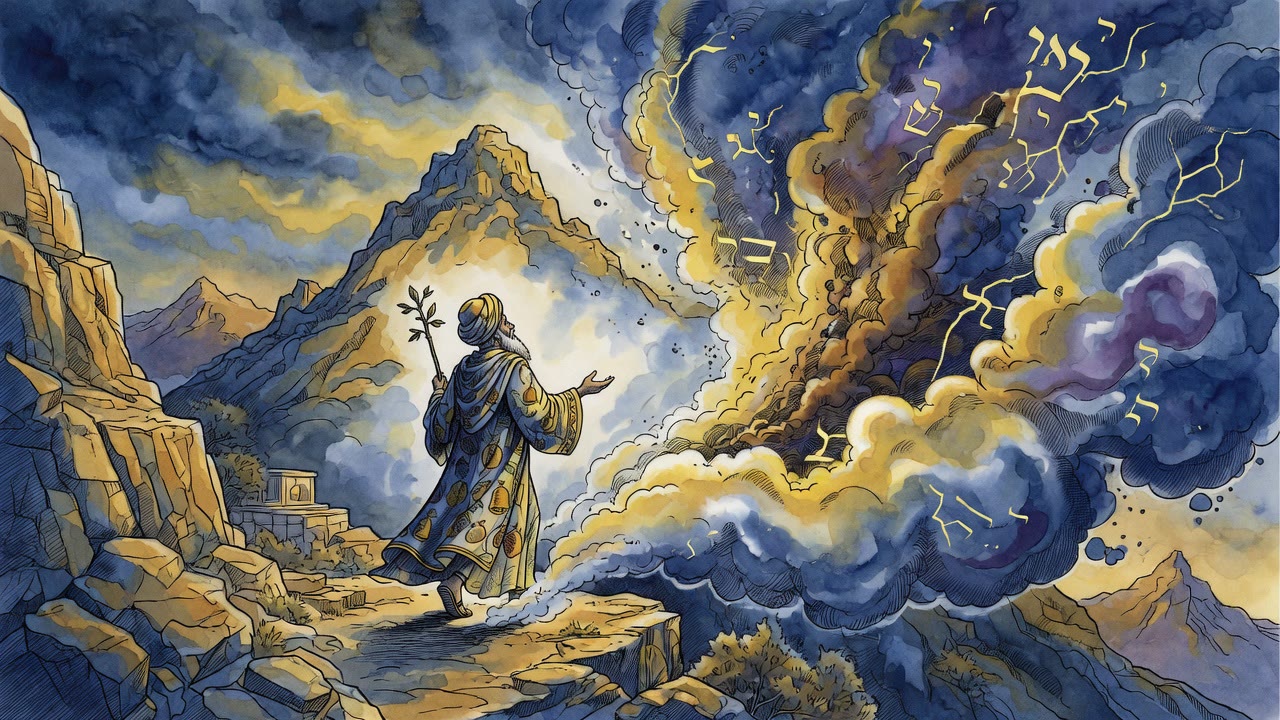
The horn of oil was heavier than it looked. Moses held it over his brother's bare head and tipped it, and the oil came out slow and golden and warm against the desert morning, and it spread through Aaron's hair and slid down toward his collar. Moses watched it move. Then he felt something he had not expected. A wetness on his own face. A bead of the holy oil, cool and sliding, working its way down through his own beard.
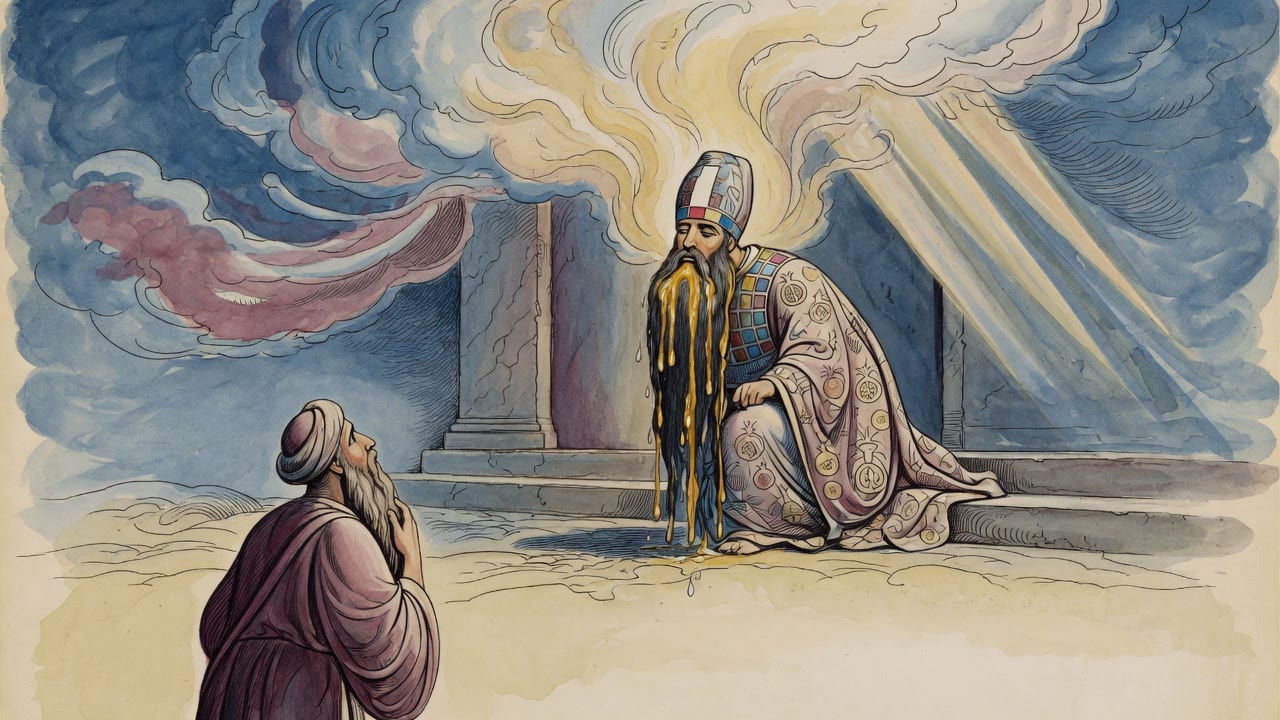
His hand stopped. Seven days he had been told to do this, and on the first morning he had already gone wrong. The oil was sacred, set apart, forbidden for any common use, and here it was running down the cheek of a man who was not the priest, who had no business wearing it at all. He had stolen from the consecration. He had taken for himself what belonged only to Aaron.

The Drop That Felt Like Theft

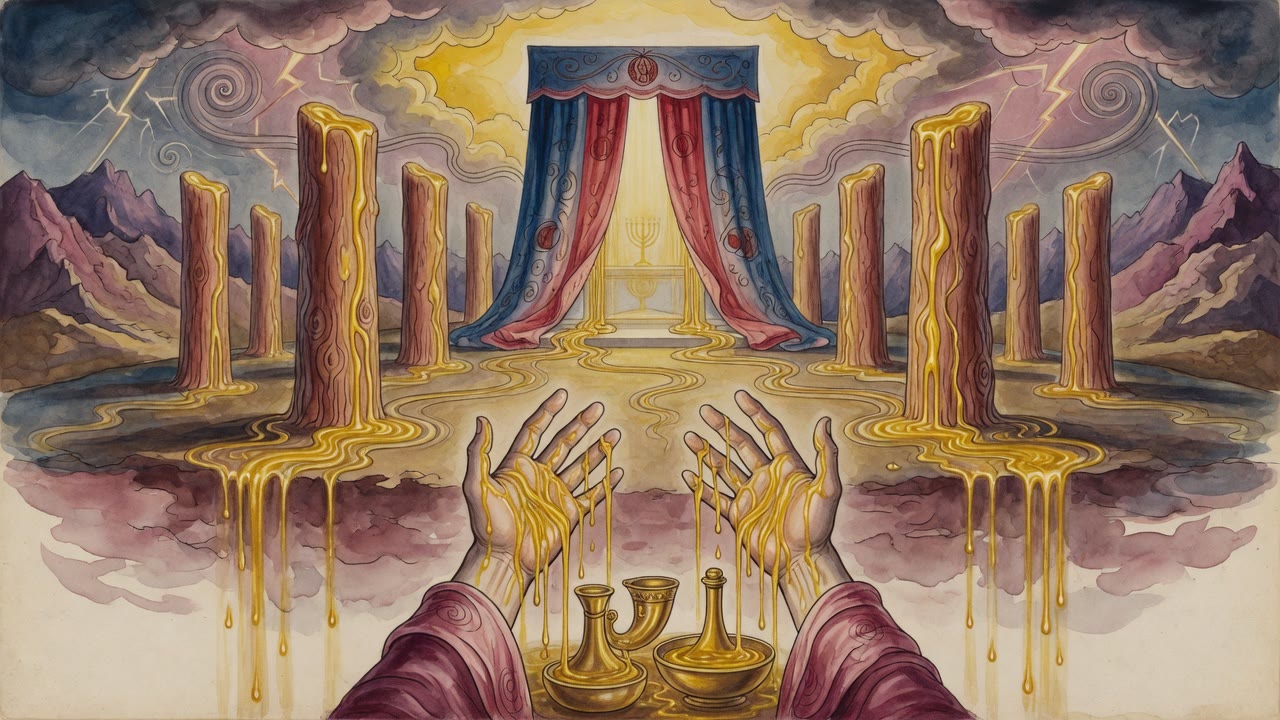
You have to understand how little oil there was. Twelve measures, no more, twelve pitchers' worth to anoint a whole sanctuary and everything inside it. The lampstand, the table, the altar, the basins, the curtains' poles, and then Aaron himself and his sons, day after day for a week. Every drop was counted. Every drop was holy. To waste even one was to spit on the thing God had commanded with His own mouth.

So when Moses felt that bead crawl down his beard, his stomach turned. He had not meant to. He had only poured. But the oil had a will of its own, it seemed, and it had found his skin, and now he stood there with the horn shaking in his hand and a single terrible thought beating in him. I have profaned it. I have used the holy oil on myself.

The Voice From Above the Tent

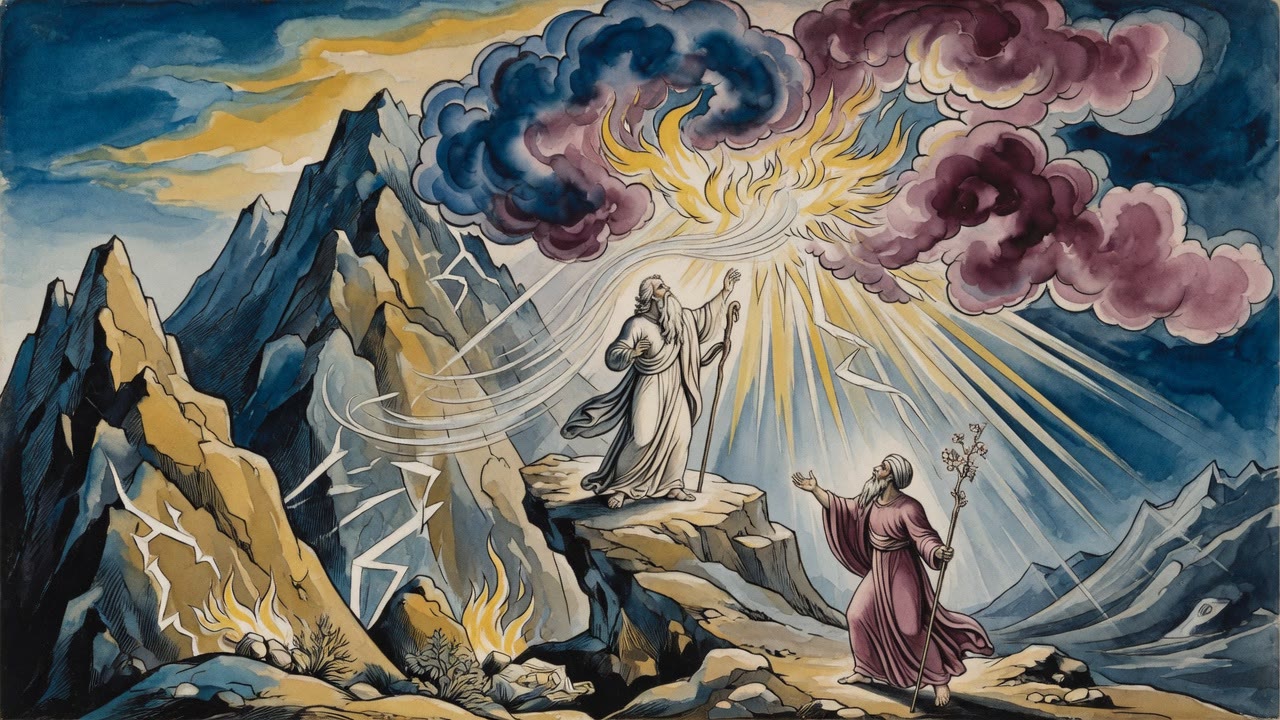
He did not have to carry the fear long. A voice came, the kind that does not arrive through the ears so much as settle into the chest. It told him to be still. The oil on his beard was no theft and no waste. It was, the voice said, like the precious oil upon the head running down upon the beard, the beard of Aaron, running down upon the collar of his garments (Psalms 133:2). The same psalm sang of brothers dwelling together. The oil had run from Aaron to Moses on purpose, and it counted as blessing, not as crime.

Moses breathed. The horn steadied. He understood, then, that the oil had not made a mistake. It had drawn a line between two men and called it good, and the line ran straight through the place where brothers either tear at each other or hold each other up.

Which Brothers Israel Did Not Want

There had been so many brothers before these two, and almost all of them had ended badly. Cain rose up against his brother in a field and left him in the dirt. Ishmael and Isaac split apart under the same father. Jacob fled from Esau across a wilderness with his brother's fury at his back. Brotherhood in the old stories was a wound waiting to open.

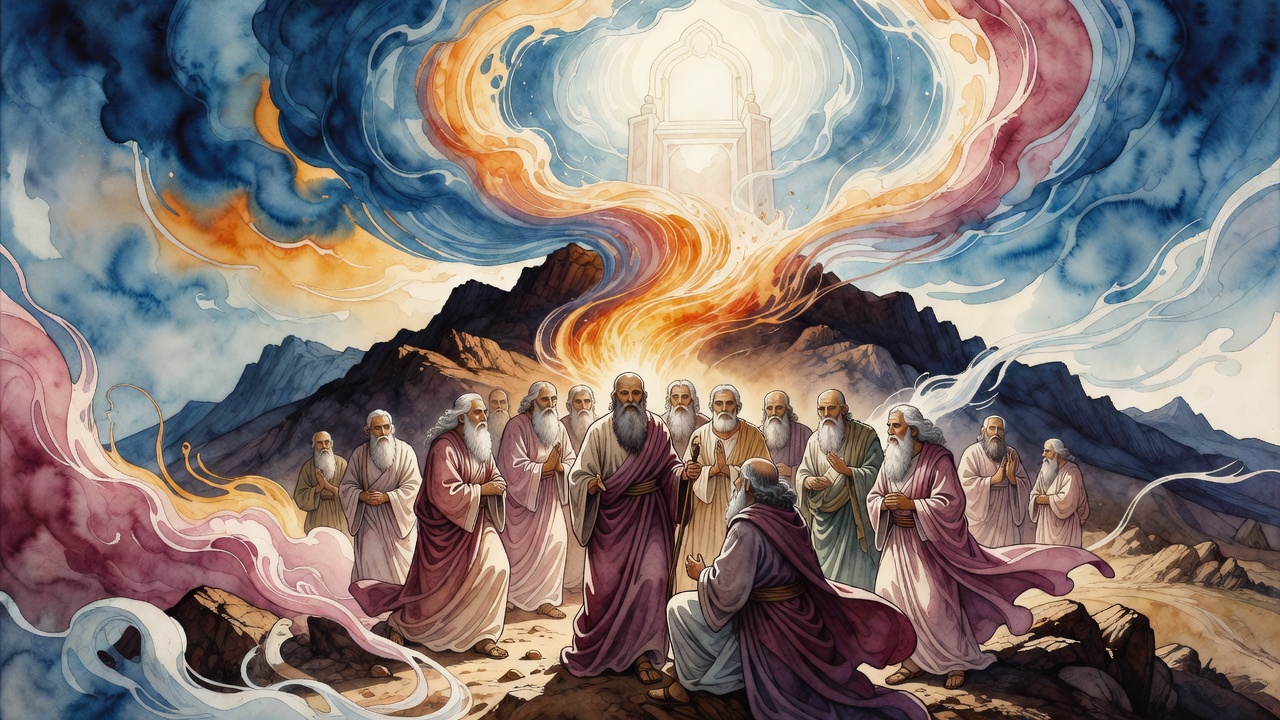
That is why, the teaching says, Israel once begged God for something specific. Make Yourself like a brother to me, they said, but not like all brothers, not like the ones who hated and grudged and grasped. Like Moses and Aaron. Brothers who loved one another, who raised one another up, who rejoiced when the other was given something great. When Israel wanted to describe the closeness they craved with God, those two men with the oil between them were the only example clean enough to use.

The Verse That Named Aaron First

The proof of it was hidden in a line that looks like nothing. A genealogy, the sort of sentence people skip. These are the generations of Aaron and Moses (Numbers 3:1). Aaron's name comes first. Then the verse lists only Aaron's sons, not one child of Moses, as though Moses had quietly stepped aside and let his older brother stand at the head of the family roll.

This was the same Aaron who had been speaking God's word to the slaves in Egypt while Moses was still a stranger keeping sheep in Midian, the older brother who could have resented the younger one chosen over him and did not. Neither man begrudged the other his greatness. So the verse let Aaron go first, and Moses let it, and the small surrender in that word order was the whole relationship in miniature.

Oil That Would Not Run Out

The strangest part is what became of the twelve measures. By every reckoning they should have been gone in days, used up on the sanctuary alone. They were not. The oil lasted. It anointed Aaron and his sons through all seven days, and then it kept on going. It anointed the high priests who came after Aaron, one generation reaching back to touch the same horn, and it anointed kings besides, all the way down the long centuries to the days of Josiah, and still it had not failed.

It is a fitting thing for that oil to be the one that would not end. The drop that frightened Moses on the first morning was the same substance that would outlast crowns and dynasties, a thin golden thread tying the brother who poured to the brother who received, and then tying both of them forward through every anointed head that followed. Moses had thought he ruined it. He had only watched it begin.


← All myths
From the tradition

Sources

2 sources

The texts this telling draws on, in full. Open a card to read inline, or expand it for a wider, quieter read.

Aharon, And These are the Generations of Aharon and MosheOtzar Midrashim (Eisenstein)

These are the generations of Aaron and Moses. [Betai Midrashot (rabbinic interpretive commentary) Third Chamber] Our rabbis taught: Brothers who are partners and who increased assets, even if their father left them only a bed or an axe, divide equally. Why? Because they are brothers (Baba Bathra 143b), and you find that partners who are brothers were beloved before the Holy One, blessed be He, like Moses and Aaron, about whom the community of Israel said before the Holy One, blessed be He: "Who will make you like a brother to me etc." Since the Holy One, blessed be He, calls Israel "brothers", as it says "For my brothers and companions' sake etc." (Psalms 122:8), she said before Him: "Who will make you like a brother to me", not like all brothers who hated one another, but like Moses and Aaron who loved one another and raised one another and rejoiced in each other’s greatness (Numbers Rabbah 21:3, Exodus Rabbah 5:5, Tanhuma Shemot 27). Know this from what we read regarding "And these are the generations of Aaron and etc." This entire passage, Aaron prophesied to them in Egypt, and from where do we know that Aaron prophesied to them in Egypt? As it says "And a man of God came to Eli etc." (I Samuel 2:27) and it is written "And I chose him etc." (Psalms 105:26). Therefore Moses said: Aaron my brother was prophesying to them all these years, now I will go to him. The Holy One, blessed be He, said to Moses: Moses! He rejoices in your greatness. When? When he was anointing Aaron with the anointing oil, the oil bubbled and flowed down Aaron’s beard. Moses thought it was on his own beard, as it says "Like the goodly oil upon the head etc." (Psalms 133:2). What is "upon the beard"? One beard! Did Aaron have two beards? Rather, it flowed down on Aaron's beard as if it was on Moses' beard (see Vayikra Rabbah 3). The Holy One, blessed be He, said to Moses: By your life, any greatness that I bestow upon Aaron is through you that I bestow upon him, as it says "And you shall bring near to yourself Aaron your brother, and this is the thing that you shall do to them" (Exodus 28:1, 29:1). Therefore it says "And these are the generations of Aaron and Moses." This is what the verse says: "A crown of elders are children’s children etc." (Proverbs 17:6). When are elders praised? When their children follow their deeds. What is the reason? "Instead of your fathers will be your sons etc." (Psalms 45:17). Therefore it says "And these are the names of Aaron’s sons, the firstborn Nadab etc." Another interpretation: "And these are the generations of Aaron and Moses" - in every place it puts Moses before Aaron, as it says "And Moses and Aaron did all these wonders," and in one place it puts Aaron before Moses, as it says "He is Aaron and Moses, whom the Lord said to them etc." (Exodus 6:27), teaching that they are equal to each other (Mekhilta Bo, Tanhuma Bo 5, Bereishit Rabbah end of 91, Vayikra Rabbah 34). And in every place it puts Joshua before Caleb, as it says "And Joshua son of Nun and Caleb son of Jephunneh" (Numbers 14:6), and in one place it puts Caleb before Joshua, as it says "Except for Caleb son of Jephunneh etc." (ibid. 14:30), teaching that they are equal to each other. In every place it puts the father before the mother, as it says "Honor your father" etc., and in one place it says "A man, his mother and his father shall you revere" (Leviticus 19:3), teaching that they are equal to each other. But the Sages said: The father precedes the mother in every place, because he and his mother are obligated to honor his father (Kiddushin 31b). One verse says "He is Moses and Aaron", and one verse says "And the sons of Amram: Aaron and Moses and Miriam etc.... and Moses, the man of God, his sons were called to the tribe of Levi" (I (Chronicles 23:13)-14), R' Berechyah and R' Yehudah ben Korchah: all those forty years that the Israelites were in the wilderness, Moses did not refrain from serving as High Priest (Shocher Tov 99, Pesikta Parah, Vayikra Rabbah 11). This is what is written: "Moses and Aaron among His priests etc." (Psalms 99:6). R' Berechyah said in the name of R' Simon: We learn from here: "And the sons of Amram: Aaron and Moses and Miriam etc.... and Moses, the man of God, his sons were called etc." Moses was counted among the priests, "And these are the generations of Aaron and Moses." Until the Tabernacle was erected, He spoke to him (Moses) in the thornbush, as it says "And God called to him from amid the thornbush." And He spoke to him in Midian, as it says "And the Lord said to Moses in Midian." And He spoke to him in Egypt, as it says "And it was on the day that the Lord spoke to Moses in the land of Egypt." And He spoke to him at Sinai, as it says "And these are the generations of Aaron and Moses on the day that the Lord spoke to Moses at Mount Sinai." [And He spoke to him] from the Tent of Meeting - "How good are modesty and humility etc." [And He returned and spoke] from the Tent of Meeting: "And the Lord spoke to Moses in the Wilderness of Sinai etc." The Holy One, blessed be He, said: My glory, that I should speak from within, as it says "And when Moses would come etc." (Exodus 34:34). The Holy One, blessed be He, established three leaders for Israel, and these are they: Moses, Aaron and Miriam, as it says "And I sent before you Moses, Aaron and Miriam." And in their merit the Israelites were sustained in the wilderness: the manna through the merit of Moses, as it says "And He fed you the manna." Know that it was through the merit of Moses that it descended, for when Moses was gathered in, what does it say? "And the manna ceased etc." (Joshua 5:12). Through the merit of Aaron, the Clouds of Glory, and know that when Aaron was gathered in, "and the soul of the people grew impatient on the way" (Numbers 21:4), because the sun beat down upon them (see end of Midrash on the Death of Aaron below). Through the merit of Miriam was the well, for when Miriam passed away, what does it say? "And there was no water for the congregation etc." (Numbers 20:2). You have thus learned that through the merit of these three the Israelites were sustained - fortunate are they! Moses and Aaron encamped from the east, as it says "And those encamping before the Tabernacle" (Numbers 3:38), and adjacent to them were three tribes: Judah, Issachar and Zebulun. And because they were adjacent to Moses and Aaron, they merited to be great in Torah, as it says "The scepter shall not depart from Judah" (Genesis 49:10), "And from the children of Issachar, men who understand the times" (I Chronicles 12:33), and similarly it says "And from Zebulun they that handle the pen of the scribe" (Judges 5:14), because they were neighbors of Torah, for there is no greater trait than Torah, as it says "The Torah that Moses commanded us" (Deuteronomy 33:4). Therefore it says "And these are the generations of Aaron and Moses." Another interpretation: This is what the verse says: "Behold how good and how pleasant etc." (Psalms 133:1). And so you find that never were there brothers who loved each other like Moses and Aaron, as it says "And these are the generations of Aaron and Moses etc." It teaches that most brothers hate each other: Cain hated Abel, as it says "And Cain rose up against Abel his brother and killed him" (Genesis 4:8). And Ishmael hated Isaac, as it says "And Sarah saw the son of Hagar the Egyptian laughing etc." (Genesis 21:9). And Esau hated Jacob, as it says "And Esau said in his heart: 'The days of mourning for my father will draw near, and I will kill Jacob my brother'" (Genesis 27:41). And similarly Abimelech killed his brothers, as it says "And he came to his father's house, to Ophrah, and killed his brothers" (Judges 9:5). And similarly Jehoram killed his brothers, as it says "And Jehoram rose up...and killed all his brothers by the sword" (II Chronicles 21:4). [It teaches that] brothers hate each other, but Moses and Aaron loved each other and cherished each other, and both were great and equal, as we read regarding "And these are the generations of Aaron and Moses." "Your two breasts are like two fawns" (Song of Songs 7:4) - this is Moses and Aaron, the majesty of Israel. Therefore it says "And these are the generations of Aaron and Moses." Just as these breasts are the adornment of a woman, so Moses and Aaron are the majesty of Israel (Shir Hashirim Rabbah 4:12, Midrash Shmuel 15). Another interpretation: "Your two breasts" - just as these breasts are the beauty of a woman, so Moses and Aaron are the beauty of Israel. Therefore it says "And these are the generations of Aaron and Moses."

Full source
Legends of the Jews 3:64Legends of the Jews

It wasn't just about hammering tent pegs and hanging curtains. There was a whole ritual, a consecration, full of wonder and divine intervention.

One of the most fascinating aspects was the anointing with holy oil. Now, it first appears, "Okay, they used oil. So what?"

In tradition, only twelve lugs of oil were available. A lug, by the way, is an ancient liquid measurement, roughly equivalent to a large pitcher. Just twelve pitchers of oil to anoint everything? Sounds impossible. But a miracle happened. As Legends of the Jews, so wonderfully retold by Louis Ginzberg, tells us, that small amount of oil wasn't just enough to anoint the sanctuary and its vessels. It wasn't just enough to consecrate Aaron and his sons over seven whole days. It lasted and lasted! This same oil, miraculously, was used to anoint all of Aaron's successors as high priests, and even several kings, all the way until the time of Josiah!

The miracles didn't stop there. When Aaron himself was being anointed, something truly special occurred. Two drops of the holy oil clung to his pointed beard, hanging there like shimmering pearls. Can you picture it? Beautiful. But here's the thing: they didn't fall off. Even when he trimmed his beard, those drops miraculously rose back up, nestling into the roots of his hair. It’s wild imagery!

Now, Moses, ever the conscientious leader, was initially worried. Was this wasteful? Was it disrespectful to let the holy oil, meant for sacred purposes, seemingly go to waste on Aaron's beard? Aaron himself also felt uneasy, concerned that this "accident" might be construed as using the holy oil for personal benefit.

But then, a bat kol, a divine voice, spoke out to reassure them both! The voice quieted Moses' concerns about waste and soothed Aaron's worries about misuse. The message was clear: this was no accident. This, too, was part of the divine plan.

What does it all mean? Perhaps it's a reminder that even in the most precise rituals, there's room for the unexpected, the miraculous. Perhaps it shows us how God's blessing overflows, exceeding our limited expectations. And maybe, just maybe, it's a reminder that even the smallest details, like two drops of oil on a beard, can be imbued with divine significance. Food for thought, isn't it?

Full source