Parshat Chukat5 min read

Aaron Walked Into the Cloud and Accepted Death

Moses dreaded telling Aaron his death had arrived, but Aaron climbed the mountain willingly and disappeared into the cloud.

Curated by Arthur · Told by Maggid ·
Table of Contents
  1. The Question Moses Could Barely Ask
  2. The Garments Passed to Eleazar
  3. The Voice From Inside the Cloud
  4. All Israel Wept

Moses could face Pharaoh, but he could not face his brother.

He had spoken plagues into Egypt. He had stood before a sea with an army behind him. He had listened while God threatened to erase Israel and begin again. But the command that morning was smaller and more unbearable. Take Aaron up the mountain. Strip off the priestly garments. Give them to Eleazar. Let Aaron die there.

Moses prayed through the night because no sentence would form cleanly in his mouth. Aaron had spoken for him when he stammered. Aaron had stood beside him before kings. Aaron had buried two sons after fire came from the sanctuary. Now Moses had to tell the older brother who had carried him that the last climb had come.

The Question Moses Could Barely Ask

He began at a distance.

"My brother," Moses said, "what is written about Abraham?"

Aaron knew the verse. Abraham was promised that he would come to his fathers in peace and be buried in a good old age. Moses let the words hang between them, then moved closer to the blade hidden inside them. If God told a man that his death had arrived today, not after another hundred years, not after delay or argument, what should that man answer?

Aaron did not flinch.

"The Righteous Judge is trustworthy in me."

Then he understood what Moses could not say. He did not make his brother speak it twice. He rose and said they should go up, because the Lord had told him.

The Garments Passed to Eleazar

The mountain received three men.

Moses climbed with Aaron and Eleazar while Israel watched from below. At the summit, the priesthood had to move from father to son. The garments could not be buried with Aaron. The breastpiece, robe, sash, tunic, and turban belonged to service, and service had to continue.

Still, Moses had to remove them from a living man.

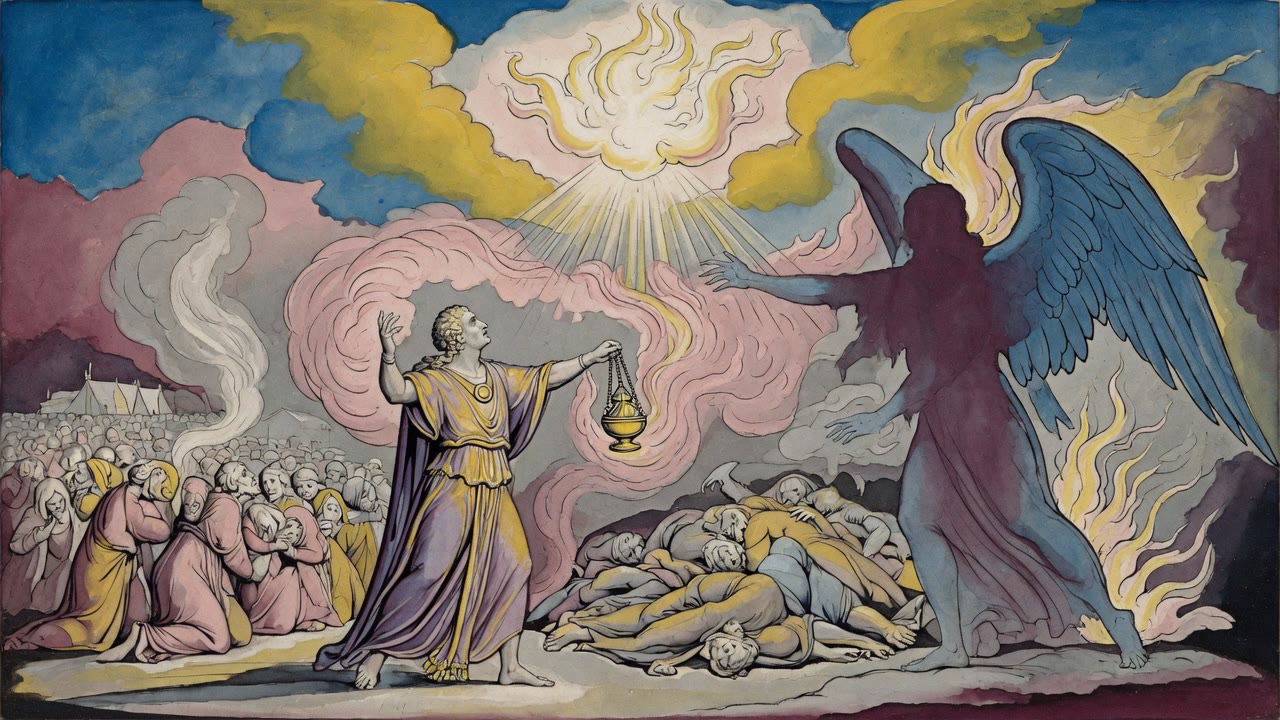
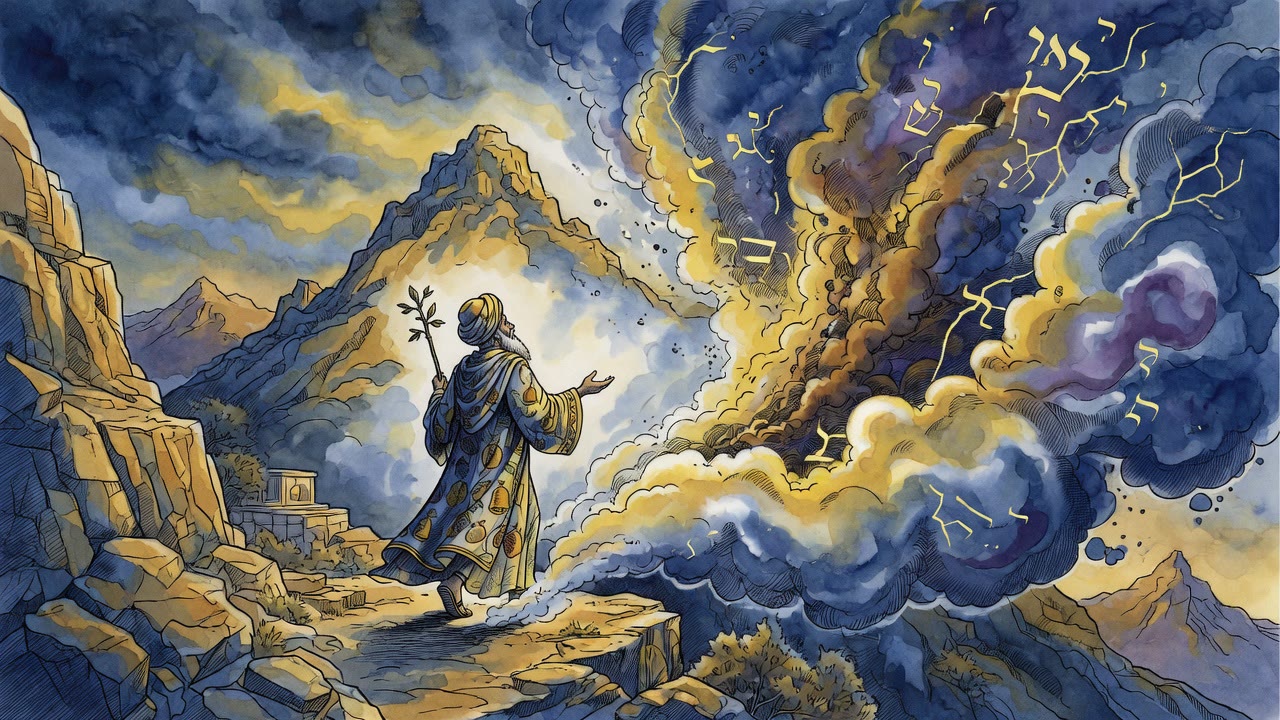
As each garment came away, a cloud of glory descended and covered what love could not bear to expose. The cloud rose around Aaron's ankles, then his knees, then his waist and chest, each layer of light answering a brother's trembling hands. Eleazar stood beside them receiving the clothes of office while his father vanished by degrees.

The people below saw nothing but cloud on the height. Moses saw enough to know that God had come personally to make modesty around death.

The Voice From Inside the Cloud

Aaron's voice came from where his body could no longer be seen.

"My brother, what is the death of the righteous like?"

Moses called into the brightness. He could not see Aaron anymore. The cloud had taken him past the reach of ordinary sight.

Aaron answered that he was not worthy to describe it. Then he said the sentence that turned dread into wonder. He wished he had come earlier.

Death had not met him like an enemy on the road. It had opened like a chamber filled with presence. The tradition says Aaron died by the divine kiss, the soul drawn out without violence, as breath leaves a flame when the room changes around it. Moses had dreaded bringing him there. Aaron, once inside the cloud, wanted more of what was there.

All Israel Wept

Moses and Eleazar came down without him.

The camp understood before words traveled. Aaron was gone. The mourning lasted thirty days, and the whole house of Israel wept, men and women together. That detail mattered. Aaron had spent his life making peace inside homes. He entered quarrels that would have split husbands and wives apart and coaxed each side back toward the other. When he died, every restored house knew whose absence had entered it.

His death also changed the wilderness itself. Miriam had died and the well had closed. Aaron died and the clouds of glory withdrew. Moses would die and the manna would stop. Israel learned that miracles had rested on human merit, not machinery. Protection had worn the faces of three siblings.

The cloud on the mountain did not make the loss smaller. It made the loss holy. Aaron accepted death before death touched him, and because of that, the climb became his final act of priesthood.

At the foot of the mountain, the silence did not feel empty. It felt like the space left by a man who had spent his life filling rooms with peace.


← All myths

From the tradition

Sources

6 sources

The texts this telling draws on, in full. Open a card to read inline, or expand it for a wider, quieter read.

Yalkut Shimoni on Torah 787Yalkut Shimoni

Moses had the worst errand of his life. God told him to bring his brother up the mountain to die. He could not bring himself to say the words.

Aaron said them for him. "My brother, do you know what is written about Abraham?" Moses said yes. Aaron quoted the verse: "You shall come to your ancestors in peace and be buried in a good old age" (Genesis 15:15). Then Aaron asked a question that cut through everything: "If God told you today that you would die, right now, not after a hundred and twenty years, what would you say?"

Moses answered: "The Righteous Judge is trustworthy in me."

"Then let us go up," Aaron said. "The Lord has told me." And he walked after his younger brother up the mountain, willingly, to accept death.

The angels watched in astonishment. "When Isaac was bound on the altar and did not resist, you marveled," they said to one another. "Come see a greater thing, a man following his younger brother to accept death of his own free will."

At the summit, Moses had to remove Aaron's priestly garments and dress Eleazar in them. But how? He could not leave the High Priest naked. God said, "You do what you need to do, and I will do what I need to do." As Moses removed each garment, the cloud of glory descended and covered Aaron's body, ankles, waist, neck. Aaron watched himself disappear.

"My brother," Aaron called from inside the cloud, "what is the death of the righteous like?"

Moses called back: "Where are you?"

Aaron's last words drifted out from behind the veil of light: "I am not worthy to tell you. But I wish I had come here earlier" (Numbers 20:28).

When Moses heard that, he desired the same death for himself. And when his own time came, God took Moses's soul with a kiss, "by the mouth of God" (Deuteronomy 34:5), just as Aaron had wished for him.

Full source
Chronicles of Jerahmeel XLIXChronicles of Jerahmeel (Gaster, 1899)

God told Moses that the time had come for Aaron to leave this world. Moses prayed all night, agonizing: "How can I tell my brother his life is ending?" God answered with a promise. He would not hand Aaron's soul over to the angel of death.

Moses devised a plan. Normally, princes waited at Aaron's door each morning. On this day, Moses reversed the order, he, Eleazar, and all the princes rose early to wait on Aaron instead. When Aaron came out and saw Moses standing among them, he asked: "Why have you changed your custom?" Moses could not answer yet. "I cannot speak until we leave this place."

As they walked, Moses placed Aaron in the middle, the position of honor. The Israelites noticed and whispered to each other: "The Holy Spirit has been removed from Moses and given to Aaron." They rejoiced, because they loved Aaron even more than Moses, he was the man who loved peace and pursued it. Moses led them to a cave on Mount Hor, where he found a prepared bed, a burning lamp, and a table. He asked Aaron to remove his priestly garments, one by one, and hand them to his son Eleazar. When Aaron stood stripped of his vestments, Moses told him to lie down, close his eyes, and stretch out his hands and feet.

In Chronicles of Jerahmeel, a 12th-century Hebrew chronicle translated by Moses Gaster in 1899, Aaron asked in that final moment: "Is this what troubled you all day?" Moses said: "Yes." And Aaron died by the kiss of God, peacefully, without the angel of death, exactly as God had promised. Moses and Eleazar came down from the mountain weeping. When the people saw Eleazar wearing his father's garments and Aaron nowhere in sight, they understood. All Israel mourned Aaron for thirty days.

Full source
Aharon, Midrash on the Death of AharonOtzar Midrashim (Eisenstein)

Midrash on the death of Aaron "I lost the three shepherds in one month" (Zecharia 11:8); and thus, in one month, Aaron, Miriam, and Moses died. Miriam died on the 1st of the month of Nisan, and the well closed up; and in the second of Nissan, Aaron's sons died; On the first of Av, Aaron died, and the clouds of glory dissipated; On the seventh of Adar Moses our teacher, and God's servant, died. Even though they didn't all die in the same month, it's considered as if it were one month. Each had a gift that they gave to the Israelites. By the merit of Miriam, God gave the well, by the merit of Aaron, the clouds of glory, By the merit of Moses, the Mana. When Miriam died, the well closed so the Israelites could see that it was by her merit that God granted them the well. Moses and Aaron bewailed her internally, and the Israelites did so publicly. Moses didn't know about the Israelites mourning until after six hours, when the Israelites came to them and said: "how long will you sit and mourn?" He said to them "should I not continue to mourn my sister who has died." "They said to him: "just as you mourn for one soul, all the more so mourn for all of us." He said to them: "why" They said to him "because we do not have water to drink." He stood and went and saw that there was no water in the well, and he began to argue with them, he said:"did I not say to you that I can't carry this people on my own, did I not appoint for you officers for the thousands, and officers for the hundreds, and the fifties, and the twenties, I gave you officials, and chiefs, and great elders, and they are to busy themselves with your problems." They said to him: "Everything is on you, for you are the one who brought us out of Egypt and brought us to this terrible place, if you give us water, everything will be fine, but if you don't, then we will stone you." When Moses heard this, he fled from them and went into the tent of meeting. God said to him "Moses what is going on?" Moses said before the Master of the World: "your children want to stone me, and were I not to have fled, I would have already been stoned to death." God said said: "how long will will you speak ill of my children, was it not enough for you that I told you at Horeb, just a little more and they will stone you. Now go and pass before them and see whether they will actually stone you, and it is said the Torah: "God said to Moses, pass before the people." Moses went first and his cohort after him, and Moses didn't know which rock God had intended to give to them for bringing out water. The Israelites found a rock that was dripping, and they stood upon it. When Moses saw them standing on it, he turned around and said to God "how long will you put our lives at risk?" He said to them, "until I bring water out of the rock." The Israelites said: "give us water so that we can drink!" Moses responded to them "How long will you continue to rebel? Does a creation rebel against its creator? As such, you are rebelling against God. Moses said: "God wants to give you water." The Israelites said: "you are the prophet who shepherds us in the dessert and now you say you don't know which rock God intends you to bring water out of? Moses and Aaron gathered the people around a different rock, as it says in the Torah "Moses and Aaron gathered the community at the face of the rock." Moses said to himself: "If I command the rock to bring out water and it doesn't, I'll be embarrassed before the community, and they will say to me, 'Moses, where is your alleged wisdom.'" At the very same moment Moses told the Israelites, "you know that God can do miracles for you, and you know that miracles are beyond me. For when the knowledge of man is divinely inspired, it is not his own knowledge or wisdom. Moses brought down his staff upon the back of the rock, and he did so himself, as he spoke to the israelites, as it says in the Torah "from this rock, we will bring you water." The rock began to fill itself to bring out water, and when Moses saw it, he lifted his arm again and struck the rock, as it says in the Torah "he hit the rock twice with his staff." This time though, blood came out, as it says in the Psalms, "yes, he hit the rock and the waters flowed (Psalm 78:20)." It's a flow of blood, as we see from the laws of menstruation "when a woman has a discharge of blood (Leviticus 15:25)." Moses came and said to God "the rock isn't bringing out water, only blood." God said to the rock: "why are you only bringing out blood, and not water?" The rock said "Master of the Universe, why did Moses hit me?" God then asked Moses, "why did you hit the rock?" Moses responded: "In order to bring out water." God said: "Did I tell you to hit the rock? Did I not tell you to speak to it with words?" Moses responded: "I did speak to it, but nothing came out!" God responded "did you not command all of Israel "in justice you shall judge your people (Leviticus 19)? Thus, why didn't you judge the rock with justice? This is how I raised you in Egypt, as it says in scripture 'God fed him honey from the rock, (Deuteronomy 32:13).' It befits you to lead, and thus say to my children "listen you rebels!" Don't read "rebels" rather "idiots" shotim (also a hominem for drinkers). They are idiots, and you have your eyes open. A nation of idiots will not enter the land of Israel, as it says in the Torah "you will not bring this community..." Therefore God said to Moses, "tell the rock to turn it's blood into water." It is thus written in scripture: "who turned the rock into a pool of water, the flinty rock into a spring (Psalm 114:8)." (Note this is a Psalm recited during Hallel on Rosh Chodesh, the beginning of the month). When they reached the beginning of the month, God said to Moses, "your time has come to an end." Moses said before him, "please God, let it not be soon." "It is tomorrow" responded God, thus Moses was distressed all day, for he didn't know when exactly his death would come.... Go now, and return to Aaron and tell him that the time has come for him to depart this world. It is also the time for all those who are at least 50 years old who you led for the duration of the Exodus. Get up, it is the time for the seventy elders, and those with the officials of Israel shall come with Eliezer and Aaron, and they shall gather at Moses's tent, and they asked about his welfare, and after that they will go to the Tent of Meeting. This is the order in which they should go: Moses in the middle, Aaron to his right, Eliezer to his left, and the Elders on either side, and all of Israel behind them, and then all of them should enter the Tent of Meeting. Aaron should sit to the right of Moses, who will sit at the head. Eliezer will be at his left and the officers behind them. And you will say to him: "God decrees that Moses and Aaron will die." And God said to Moses: "my servant Moses, in every part of my house you were faithful, you have been a great speaker, and but there is a great request that I must ask of you, and it's hard for me to ask. Moses asked: "What's the request?" God said: "You need to gather your brother unto his people (bury your brother), for he will not enter the land that I have given to the Israelites, those who rebelled against my commandments at Merivah. Moses said: "God, all is known and clear to you and your holy throne, for you are master of the world, and all of your creations that you created in this world, and by your hand they came to be, and by your hand you will do that which you will, but it is not apparent to me how you could ask me to tell my brother that he is going to die. My brother is greater than me, and how can I speak to him and tell him to go up to the mountain of Hor where he will die." God responded to Moses: " do not tell him with words, rather take Aaron and Eliezer his son and bring them to the mountain of Hor, and there you will go up with them and speak to him softly and gently, but also in a way that he will understand what's going on. When the three of you are on the mountain, strip Aaron of his clothes, and dress Eliezer his son in them, and Aaron will be gathered unto his people, and die there. When Moses heard this, he was deeply troubled in his heart, and he didn't know what to do. He cried a great and mighty cry, until it was time was time to deliver the news to his brother Aaron that he would die. Moses was steadfast to act, and went with this brother Aaron to tell him of the matter. He went to the Tent of Meeting and found Aaron there. That very day, Moses taught the custom: sit and cry only until the crowing of the rooster. Moses called Elieer and said to him: " go and get the elders and the officers, for God has told me of an important matter. They came and gathered at the tent of Aaron. Aaron stood and found Moses standing. Aaron said to Moses: "my brother, why have you taught us this custom today?" He said to him: God is revealing something that I must tell you." He said to him: "Speak!" He responded, "not until we leave here." Moses stood and dressed Aaron with the eight vestiges of the priestly clothing within Aaron's tent. After that he left. Therefore it was added as a custom that day that one should sit and cry only until the crowing of the rooster." Aaron was placed in the along with Moses; to their right was Joshua, to their left, the elders. The officers were both here and there, and all of Israel was behind them. Because the Israelites saw Aaron with the same respect as Moses, they rejoiced a great rejoicing, and said that "Aaron is ascending farther toward the spirit of God. Because they loved him, they all came out after him, and when they arrived at the tent of meeting, Aaron requested to enter the tent, but Moses wouldn't let him. Moses said to him: "Let's go outside of the camp, for that is the intended direction." Aaron said to him: "tell me what did God say to you?" Moses responded: "I'll tell you once we get to the mountain." Moses commanded the people (just as he did at Sinai, and just as Abraham did his lads on the way to Moriyah) stay here until we return to you, me, Aaron and Eliezer will go up to the top of the mountain, we will hear the word of God, and then we will return. The three of them went up. Moses wanted to say something to Aaron, but didn't know how, and didn't know what to say. Moses finally said: "Aaron my brother, what are the appointed things that that God has given you?" He responded: "These" He said: "What?" Aaron said: "God has given me the altar, the table, upon which sits the bread of welcoming." Moses responded: "These are the things that God has appointed to your hand, but now, God has something that he is asking of you." "What is it" Aaron asked? "God has given you a light," said Moses. Aaron asked: "What are you talking about, god has given more more than just a single light, God has given me seven (the lights of the menorah), and they are currently lit in the Tent of Meeting. Moses gave Aaron the sense that he was talking in parable, and that the candle of which he was referring, was really Aaron's soul. As it says in scripture: "the soul of man is the light of God (Proverbs 20:27)." Moses saw that Aaron still didn't understand the parable. He said to him "in truth, you are called simple," as it says in scripture: "and of Levi it is said, your Urim and Tumim (being read here is your light and your simpleness) are for a man of your faith." Immediatly, the cave opened at its mouth. Moses said: "Aaron my brother, enter the cave." Aaron responded "ok," and Moses request to strip Aaron of his clothing. Is it possible that when he stripped his clothing, he died naked, and was buried naked? God forbid! Rather, every high priest wears eight of the priestly garments, but the lower priests wear four. Aaron wore, eight, and Eliezer wore four. Moses only took four of Moses's clothes from Aaron and gave them to Eliezer to make him the high priest. Aaron still remained with four vestiges of clothing. They said to Eliezer, wait here until we leave, and Aaron and Moses entered. They saw a made bed and a set table with a menorah lit, and the angels of God standing on either side. Aaron said to Moses: " my brother, how long will you hide from me what God has told you? You know that For you know that although God speaks to you first, God's mouth testifies on my behalf. Even now he is setting out to meet you, and he will be happy to see you. Why do you conceal the matter which the Holy One entrusted to you?even if it is about my death, I will accept it with joy. Moses said to him: "Since you mentioned the subject of death, I will confirm your suspicion, and say that it is a matter of death which he spoke to me. I was afraid, however, to inform you of it. Your death is not like that of anyone else, for the ministering angels have come to carry you away. Aaron said to him: "My brother Moses, why didn't you tell me in the presence of my Maker, my wife, and my children?" Moses answered: " My brother, do you not know that it is forty years since you made the calf and that you deserved to be killed then, but I stood in prayer and supplication before God, and God saved you from death, as it is written: "Moreover, God was angry enough with Aaron to have destroyed him; so I also interceded (Deuteronomy 9:20). Is my death then going to be like your death? For when you die, you will have me to bury you, but when I die, I will not have my brother to bury me. When you die, your sons inherit your station, but when I die others will inherit my honor." Thus he comforted him with his words.

Full source
Aharon, And These are the Generations of Aharon and MosheOtzar Midrashim (Eisenstein)

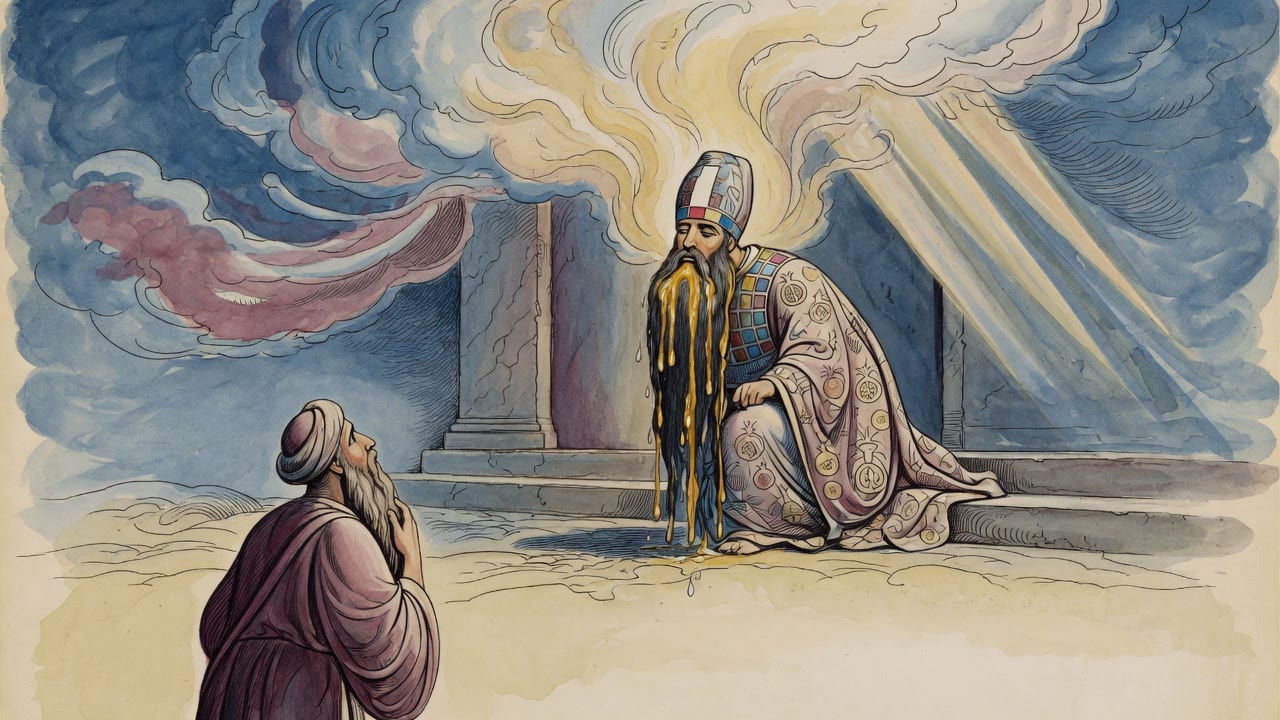
These are the generations of Aaron and Moses. [Betai Midrashot (rabbinic interpretive commentary) Third Chamber] Our rabbis taught: Brothers who are partners and who increased assets, even if their father left them only a bed or an axe, divide equally. Why? Because they are brothers (Baba Bathra 143b), and you find that partners who are brothers were beloved before the Holy One, blessed be He, like Moses and Aaron, about whom the community of Israel said before the Holy One, blessed be He: "Who will make you like a brother to me etc." Since the Holy One, blessed be He, calls Israel "brothers", as it says "For my brothers and companions' sake etc." (Psalms 122:8), she said before Him: "Who will make you like a brother to me", not like all brothers who hated one another, but like Moses and Aaron who loved one another and raised one another and rejoiced in each other’s greatness (Numbers Rabbah 21:3, Exodus Rabbah 5:5, Tanhuma Shemot 27). Know this from what we read regarding "And these are the generations of Aaron and etc." This entire passage, Aaron prophesied to them in Egypt, and from where do we know that Aaron prophesied to them in Egypt? As it says "And a man of God came to Eli etc." (I Samuel 2:27) and it is written "And I chose him etc." (Psalms 105:26). Therefore Moses said: Aaron my brother was prophesying to them all these years, now I will go to him. The Holy One, blessed be He, said to Moses: Moses! He rejoices in your greatness. When? When he was anointing Aaron with the anointing oil, the oil bubbled and flowed down Aaron’s beard. Moses thought it was on his own beard, as it says "Like the goodly oil upon the head etc." (Psalms 133:2). What is "upon the beard"? One beard! Did Aaron have two beards? Rather, it flowed down on Aaron's beard as if it was on Moses' beard (see Vayikra Rabbah 3). The Holy One, blessed be He, said to Moses: By your life, any greatness that I bestow upon Aaron is through you that I bestow upon him, as it says "And you shall bring near to yourself Aaron your brother, and this is the thing that you shall do to them" (Exodus 28:1, 29:1). Therefore it says "And these are the generations of Aaron and Moses." This is what the verse says: "A crown of elders are children’s children etc." (Proverbs 17:6). When are elders praised? When their children follow their deeds. What is the reason? "Instead of your fathers will be your sons etc." (Psalms 45:17). Therefore it says "And these are the names of Aaron’s sons, the firstborn Nadab etc." Another interpretation: "And these are the generations of Aaron and Moses" - in every place it puts Moses before Aaron, as it says "And Moses and Aaron did all these wonders," and in one place it puts Aaron before Moses, as it says "He is Aaron and Moses, whom the Lord said to them etc." (Exodus 6:27), teaching that they are equal to each other (Mekhilta Bo, Tanhuma Bo 5, Bereishit Rabbah end of 91, Vayikra Rabbah 34). And in every place it puts Joshua before Caleb, as it says "And Joshua son of Nun and Caleb son of Jephunneh" (Numbers 14:6), and in one place it puts Caleb before Joshua, as it says "Except for Caleb son of Jephunneh etc." (ibid. 14:30), teaching that they are equal to each other. In every place it puts the father before the mother, as it says "Honor your father" etc., and in one place it says "A man, his mother and his father shall you revere" (Leviticus 19:3), teaching that they are equal to each other. But the Sages said: The father precedes the mother in every place, because he and his mother are obligated to honor his father (Kiddushin 31b). One verse says "He is Moses and Aaron", and one verse says "And the sons of Amram: Aaron and Moses and Miriam etc.... and Moses, the man of God, his sons were called to the tribe of Levi" (I (Chronicles 23:13)-14), R' Berechyah and R' Yehudah ben Korchah: all those forty years that the Israelites were in the wilderness, Moses did not refrain from serving as High Priest (Shocher Tov 99, Pesikta Parah, Vayikra Rabbah 11). This is what is written: "Moses and Aaron among His priests etc." (Psalms 99:6). R' Berechyah said in the name of R' Simon: We learn from here: "And the sons of Amram: Aaron and Moses and Miriam etc.... and Moses, the man of God, his sons were called etc." Moses was counted among the priests, "And these are the generations of Aaron and Moses." Until the Tabernacle was erected, He spoke to him (Moses) in the thornbush, as it says "And God called to him from amid the thornbush." And He spoke to him in Midian, as it says "And the Lord said to Moses in Midian." And He spoke to him in Egypt, as it says "And it was on the day that the Lord spoke to Moses in the land of Egypt." And He spoke to him at Sinai, as it says "And these are the generations of Aaron and Moses on the day that the Lord spoke to Moses at Mount Sinai." [And He spoke to him] from the Tent of Meeting - "How good are modesty and humility etc." [And He returned and spoke] from the Tent of Meeting: "And the Lord spoke to Moses in the Wilderness of Sinai etc." The Holy One, blessed be He, said: My glory, that I should speak from within, as it says "And when Moses would come etc." (Exodus 34:34). The Holy One, blessed be He, established three leaders for Israel, and these are they: Moses, Aaron and Miriam, as it says "And I sent before you Moses, Aaron and Miriam." And in their merit the Israelites were sustained in the wilderness: the manna through the merit of Moses, as it says "And He fed you the manna." Know that it was through the merit of Moses that it descended, for when Moses was gathered in, what does it say? "And the manna ceased etc." (Joshua 5:12). Through the merit of Aaron, the Clouds of Glory, and know that when Aaron was gathered in, "and the soul of the people grew impatient on the way" (Numbers 21:4), because the sun beat down upon them (see end of Midrash on the Death of Aaron below). Through the merit of Miriam was the well, for when Miriam passed away, what does it say? "And there was no water for the congregation etc." (Numbers 20:2). You have thus learned that through the merit of these three the Israelites were sustained - fortunate are they! Moses and Aaron encamped from the east, as it says "And those encamping before the Tabernacle" (Numbers 3:38), and adjacent to them were three tribes: Judah, Issachar and Zebulun. And because they were adjacent to Moses and Aaron, they merited to be great in Torah, as it says "The scepter shall not depart from Judah" (Genesis 49:10), "And from the children of Issachar, men who understand the times" (I Chronicles 12:33), and similarly it says "And from Zebulun they that handle the pen of the scribe" (Judges 5:14), because they were neighbors of Torah, for there is no greater trait than Torah, as it says "The Torah that Moses commanded us" (Deuteronomy 33:4). Therefore it says "And these are the generations of Aaron and Moses." Another interpretation: This is what the verse says: "Behold how good and how pleasant etc." (Psalms 133:1). And so you find that never were there brothers who loved each other like Moses and Aaron, as it says "And these are the generations of Aaron and Moses etc." It teaches that most brothers hate each other: Cain hated Abel, as it says "And Cain rose up against Abel his brother and killed him" (Genesis 4:8). And Ishmael hated Isaac, as it says "And Sarah saw the son of Hagar the Egyptian laughing etc." (Genesis 21:9). And Esau hated Jacob, as it says "And Esau said in his heart: 'The days of mourning for my father will draw near, and I will kill Jacob my brother'" (Genesis 27:41). And similarly Abimelech killed his brothers, as it says "And he came to his father's house, to Ophrah, and killed his brothers" (Judges 9:5). And similarly Jehoram killed his brothers, as it says "And Jehoram rose up...and killed all his brothers by the sword" (II Chronicles 21:4). [It teaches that] brothers hate each other, but Moses and Aaron loved each other and cherished each other, and both were great and equal, as we read regarding "And these are the generations of Aaron and Moses." "Your two breasts are like two fawns" (Song of Songs 7:4) - this is Moses and Aaron, the majesty of Israel. Therefore it says "And these are the generations of Aaron and Moses." Just as these breasts are the adornment of a woman, so Moses and Aaron are the majesty of Israel (Shir Hashirim Rabbah 4:12, Midrash Shmuel 15). Another interpretation: "Your two breasts" - just as these breasts are the beauty of a woman, so Moses and Aaron are the beauty of Israel. Therefore it says "And these are the generations of Aaron and Moses."

Full source
Legends of the Jews 5:60Legends of the Jews

The Legends of the Jews, that incredible collection of stories and expansions on the biblical narrative compiled by Louis Ginzberg, recounts just such a moment. We find Moses facing the imminent death of his brother, Aaron. Can you imagine the weight of that?

That "there was a tumult in his heart, and he knew not what to do." He wept so passionately, the grief threatened to overwhelm him. But Moses, ever the faithful servant of God, knew he had a duty. He had to carry out God's command. He had to inform Aaron of his impending death.

Think about the weight of that task.

It had been the custom for forty years, during their wanderings in the desert, for the people to gather each morning. First before the seventy elders, then, guided by the elders, before the princes of the tribes. Finally, all of them would appear before Eleazar and Aaron, and together they would go to Moses to offer their morning greetings. A daily ritual, a rhythm of life in the wilderness.

But on this day, everything was different.

Moses, after a night spent weeping, summoned EleazarAaron's son – at the first crow of the cock. "Go and call to me the elders and the princes," he instructed, "for I have to convey to them a commission from the Lord."

Accompanied by these men, Moses went to Aaron. Seeing Moses, Aaron asked, "Why hast thou made a change in the usual custom?"

Moses replied, "God hath bidden me to make a communication to thee."

"Tell it to me," Aaron urged.

But Moses insisted, "Wait until we are out of doors."

And so, Aaron donned his eight priestly garments – the sacred vestments, symbolic of his holy office – and together they went outside.

This small detail is so poignant! Before receiving such difficult news, Aaron dresses in his full priestly regalia. Was this out of respect for God? For Moses? Was it a sense of duty overriding his own fear and grief? The text doesn't say, but it adds a layer of depth to the scene.

What follows, of course, is the unfolding of God's will, the acceptance of mortality, and the transition of leadership. But this moment, this quiet change in the daily routine, this heavy burden placed upon Moses, it speaks volumes about duty, grief, and the human condition. And it reminds us that even the greatest among us face moments of profound sorrow and uncertainty.

Full source
Legends of the Jews 5:65Legends of the Jews

Legends of the Jews turns to Death of Moses of Aaron.

How do you break such devastating news to someone you love?

That Moses struggled, searching for the right words, the gentle approach. He couldn't just blurt it out. He needed to prepare his brother, Aaron.

So, Moses starts with a question, a seemingly innocent one: "Aaron, my brother, hath God given anything into thy keeping?" It's a roundabout way of getting to the point, a delicate probe into Aaron's understanding of his own mortality.

Aaron, ever the faithful servant, replies, "Yes."

"What, pray?" asks Moses, carefully.

Aaron answers, "The altar and the table upon which is the shewbread hath He given into my charge." The shewbread, or "bread of the presence," was a special offering, a symbol of God's constant provision. Aaron saw his role as a caretaker of these sacred objects.

Moses presses on, "It may be that He will now demand back from thee all that He hath given into thy keeping." He's getting closer, hinting at the impermanence of things, the temporary nature of earthly possessions.

Aaron, still not understanding, asks, "What, pray?"

Moses tries a different tack. "Hath He not entrusted a light to thee?"

Aaron, thinking literally, responds, "Not one light only but all seven of the candlestick that now burn in the sanctuary." He’s referring to the menorah, the seven-branched candelabra, a powerful symbol of divine light and presence. He sees himself as the guardian of these physical lights.

What Moses was really trying to get at, of course, was the soul. "The light of the Lord," which God had given into Aaron's keeping, and which He was now demanding back. Moses was trying to lead Aaron to understand that God was calling his soul back to Him.

But Aaron, in his "simplicity," as the text puts it, doesn’t catch the allusion. He doesn't grasp the deeper meaning behind Moses' words.

So, Moses, perhaps realizing that Aaron wasn’t going to understand the veiled message, doesn't go into further particulars. Instead, he simply remarks, "God hath with justice called thee an innocent, simple-hearted man."

It's a poignant moment, isn't it? Moses, burdened with the knowledge of his brother's impending death, and Aaron, serene in his faith, unaware of what awaits him. It leaves us wondering, is it better to know, or to remain in innocent simplicity? And what does it say about the nature of communication, especially when the stakes are so incredibly high?

Full source