Parshat Tzav6 min read

Twelve Logs of Anointing Oil That Never Ran Out

Moses made twelve logs of sacred oil in the wilderness. It anointed priests, vessels, and kings for centuries and never diminished by a drop.

Curated by Arthur · Told by Maggid ·
Table of Contents
  1. The Measure That Could Not Be Enough
  2. The Miracle Hidden in a Single Word
  3. David and the Day the Oil Caught Fire
  4. What the Second Temple Was Missing
  5. Jacob's Stone and the Beginning of Everything

The Measure That Could Not Be Enough

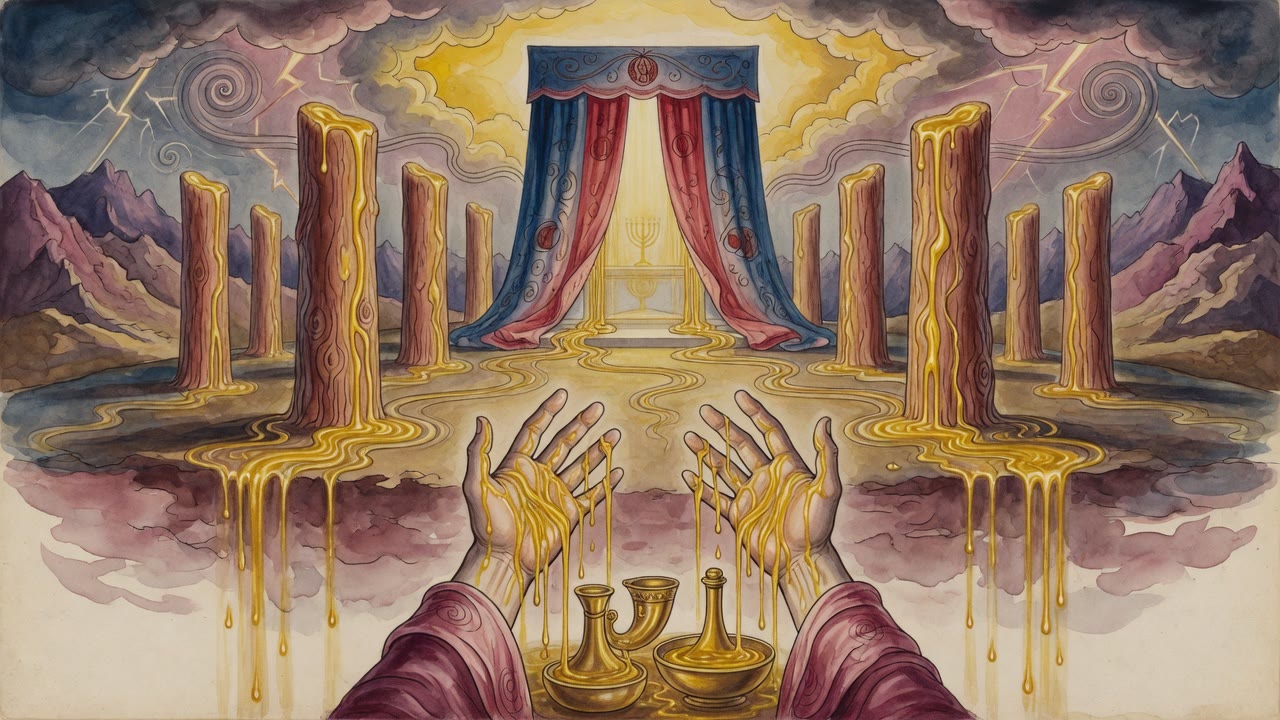
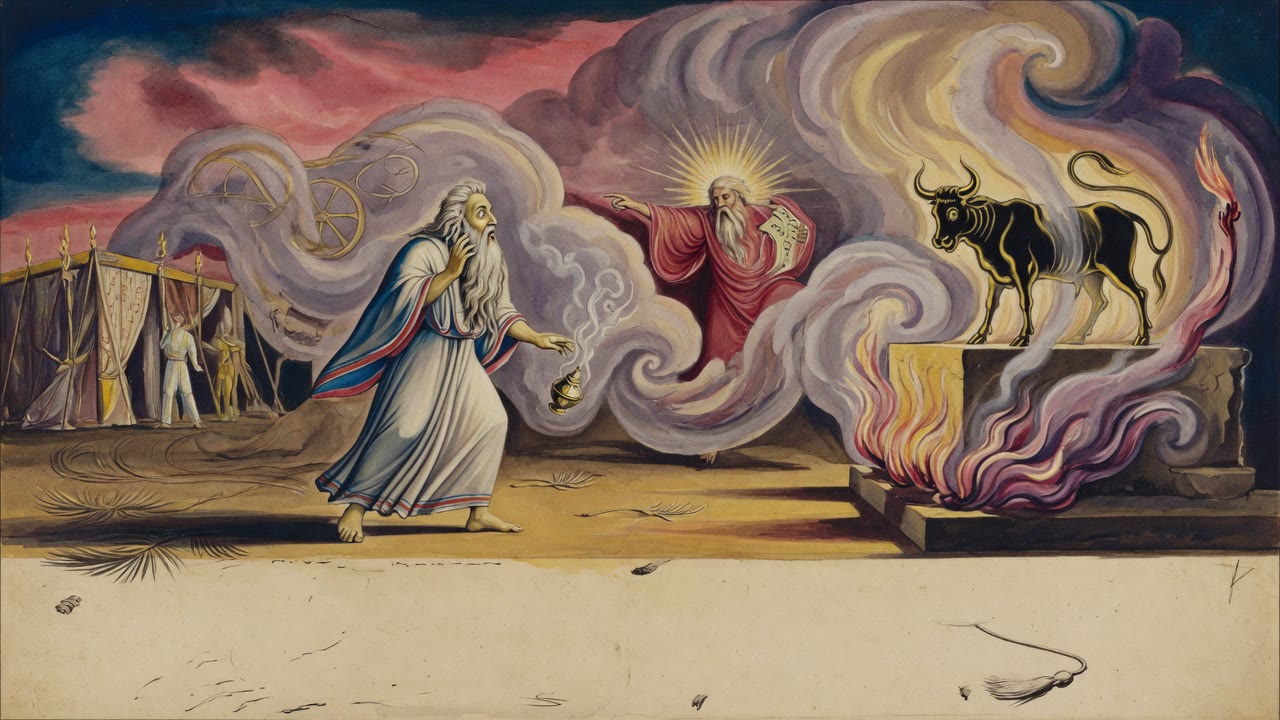
Moses stood in the wilderness with twelve logs of oil and a recipe for something the world had never seen. The formula was precise: five hundred shekels of myrrh, two hundred fifty of fragrant cinnamon, two hundred fifty of fragrant cane, five hundred of cassia, and a hin of olive oil. The ingredients were measured and combined. The result was a deep golden liquid with a scent that carried the weight of consecration. Twelve logs. A lug was an ancient liquid measure, roughly equivalent to a large pitcher. Twelve pitchers of oil, and a task before him that seemed mathematically impossible.

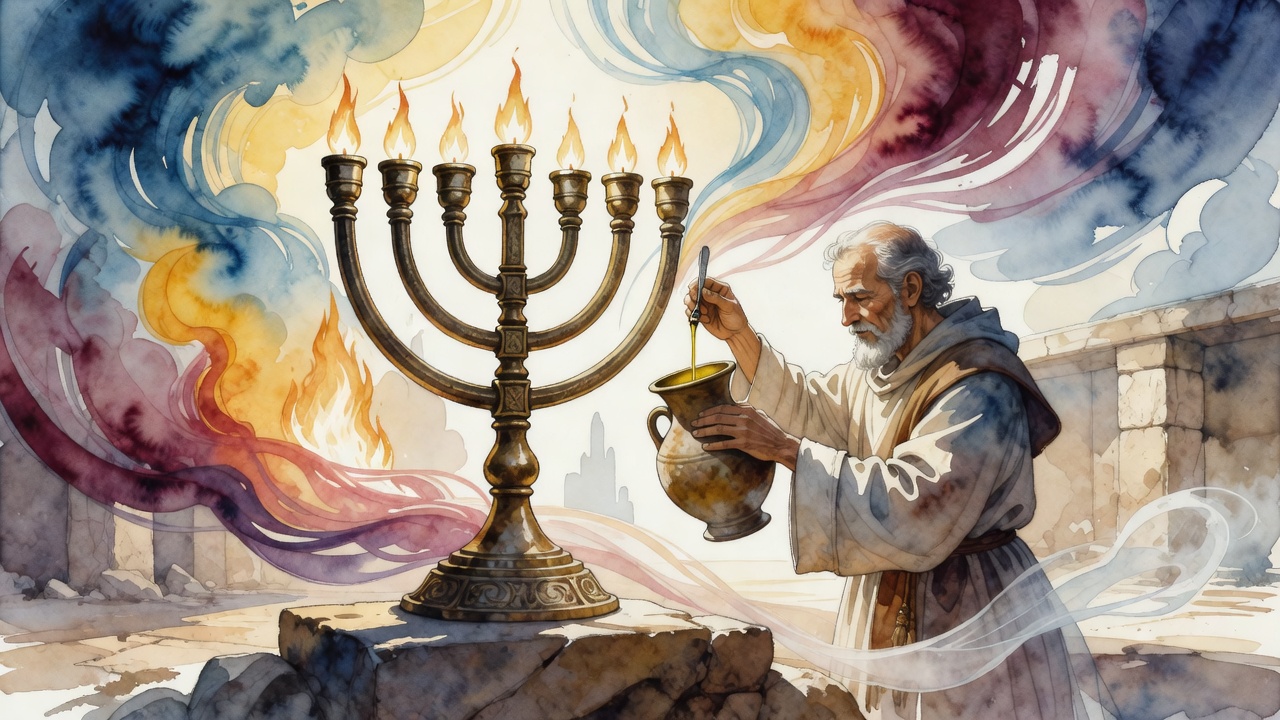
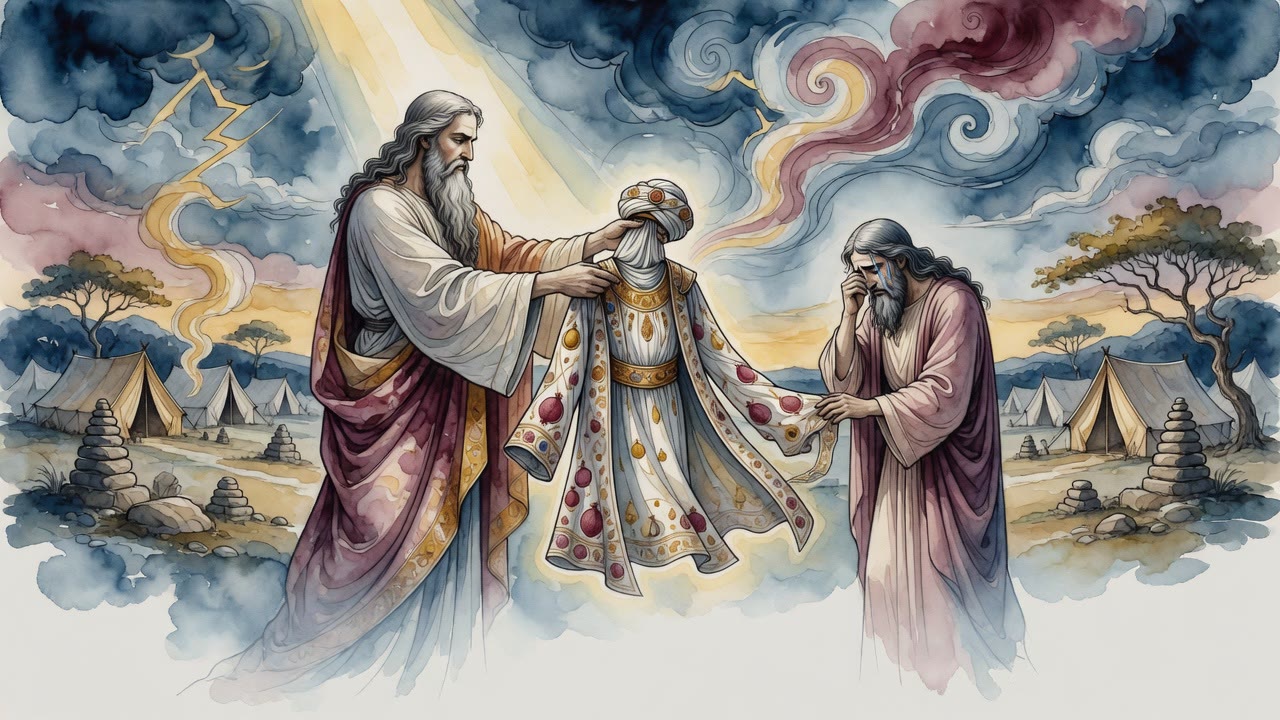
The golden altar needed anointing. The bronze altar. The table of showbread. The seven-branched menorah. Every implement belonging to each of these. The basin. Its stand. All of Aaron's priestly vestments. Aaron himself, seven days of consecration for one man. His four sons. Future high priests who would be ordained for centuries to come. And, as it turned out, the kings of Israel, from Saul forward, whenever a new dynasty required divine confirmation. Twelve logs. The numbers did not work and yet they worked.

The Miracle Hidden in a Single Word

Rabbi Yehuda ben Rabbi Ilai noticed something in the Hebrew text. The passage in Exodus specifying the anointing oil used an unusual word: zeh, meaning this or that, with a numerical value in gematria of twelve. He read the verse as an embedded hint about quantity. Twelve log of oil. That's all. Take it or leave it. And from this, the rabbis concluded that what happened with the oil was a planned miracle, not an oversight. God had specified the insufficient amount deliberately, knowing that the oil would last not because more was added but because the same supply would serve every need from Moses' day forward.

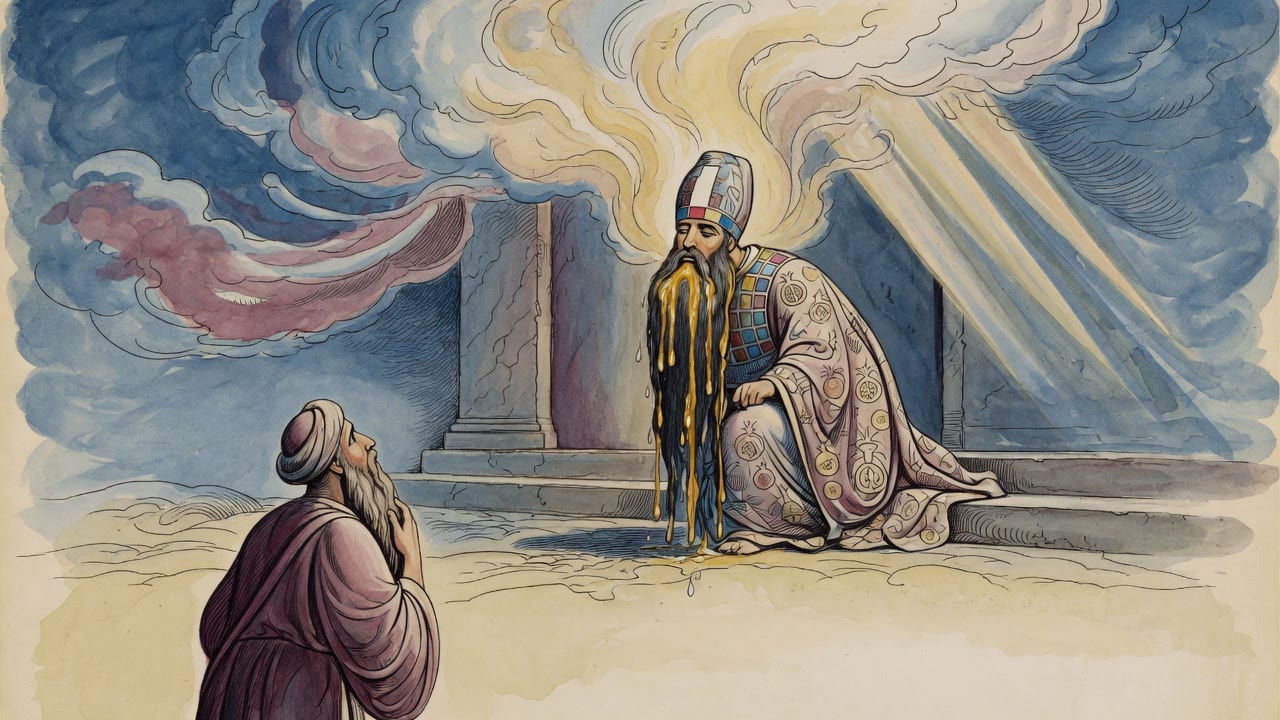
The oil never diminished. It was poured over the corner of Aaron's head, running down his beard to the edges of his garments, and the vessel it came from was as full after as before. Priests were anointed generation after generation and the supply held. The Tabernacle became the Temple and the Temple was the center of a kingdom and still the oil from the wilderness multiplied itself into every ceremony it was needed for, never increasing in the vessel, never decreasing.

David and the Day the Oil Caught Fire

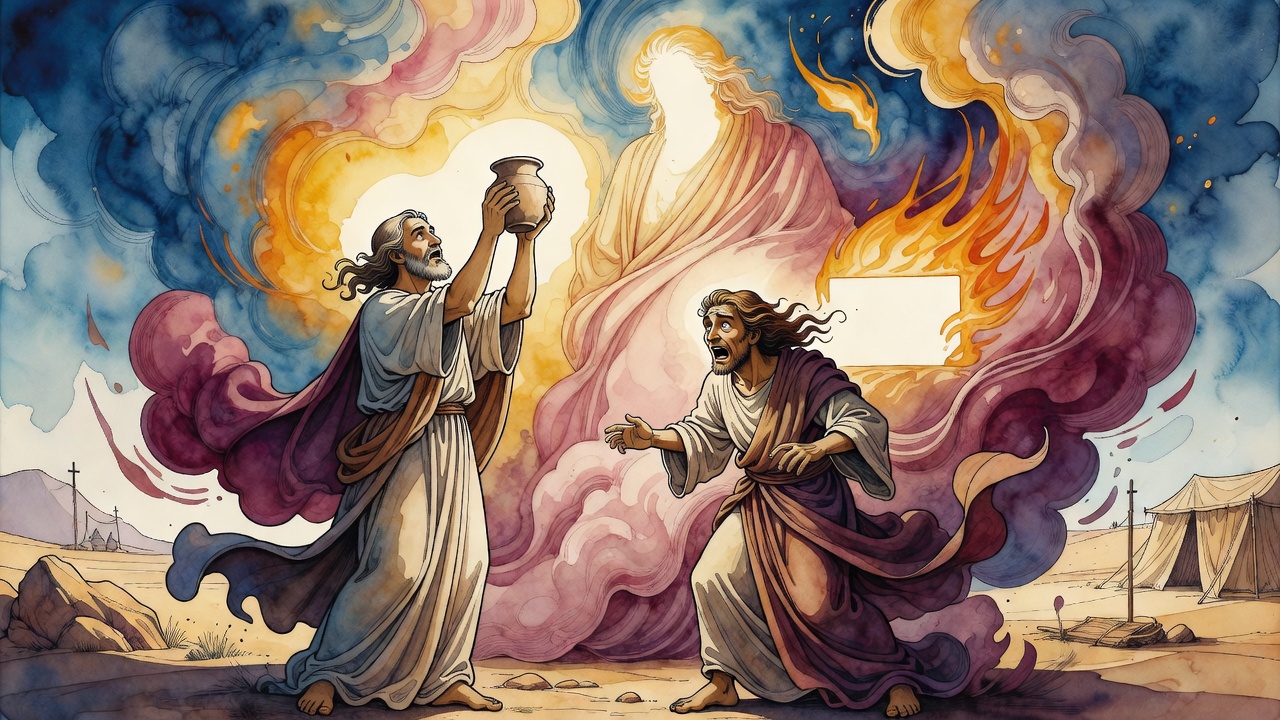
When Samuel came in secret to the house of Jesse in Bethlehem, he was looking for the next king of Israel among Jesse's sons. He passed over the eldest, the second, the third, working through seven brothers before asking whether there were any others. There was one more, out in the fields with the sheep: the youngest, David, whom Jesse had not thought to summon. Samuel anointed him on the spot. According to the traditions surrounding this moment, the instant the oil touched David's head it ignited, not burning him but blazing visibly around him, announcing what it was doing to everyone present. A gift of prophecy came with it. His spirit deepened. Something that had been latent in him became suddenly active.

Doeg the Edomite was present and saw what happened. He was the greatest scholar of his generation, brilliant, respected, and from the moment he saw the oil ignite over David's head, he was possessed by a jealousy he could not contain. When he reported to Saul that David had been anointed, he did not simply relay information. He infected the king's mind with his own fear that David's rise would displace everyone currently powerful. The oil that consecrated the shepherd boy set in motion the enmity that would pursue David for years.

What the Second Temple Was Missing

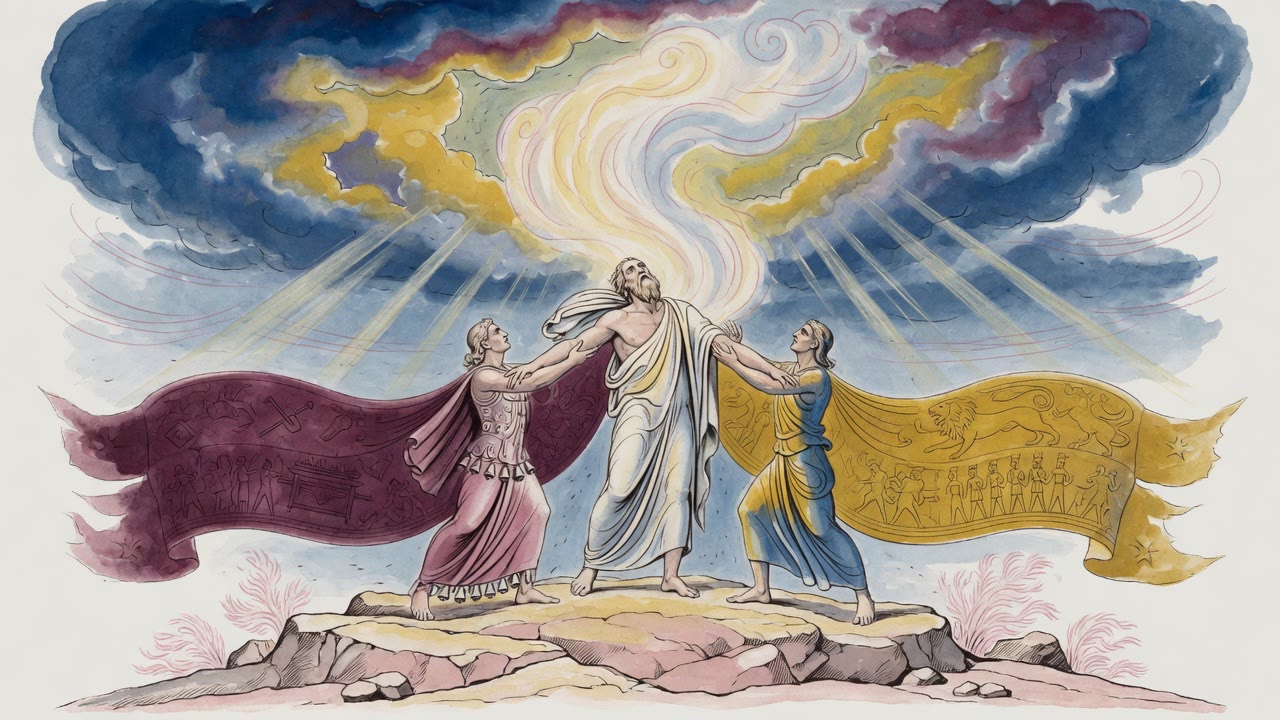
When the exiles returned from Babylon and built the Second Temple, they assembled the structure, trained the priests, resumed the sacrificial calendar, and discovered what they lacked. Five things were present in the First Temple that were absent from the Second: the heavenly fire that descended to confirm the altar, the Divine Spirit that animated prophecy, the Ark of the Covenant, the Urim and Tummim worn on the high priest's breastplate, and the anointing oil that Moses had made in the wilderness. The Second Temple had reproductions and approximations, but not these.

The absence of the oil meant that the priests of the Second Temple period were not anointed in the way Aaron had been. The chain from Moses' wilderness compound to David's kingship had been broken. The tradition would not return until the time the sages placed beyond their own generation. The twelve logs Moses had mixed in the desert remained hidden somewhere, along with the Ark, along with the fire, waiting for a restoration none of them would live to see.

Jacob's Stone and the Beginning of Everything

The anointing oil had a prehistory even before Moses. When Jacob woke from his dream of the ladder at Bethel, he took the stone that had been under his head, set it upright as a pillar, and poured oil over it. The oil he used had come to him from heaven, enough to fill a jug to its mouth, a gift endorsing what had happened at that place. He called the location Beit El, the House of God. What he did with the stone at Bethel was the first anointing in the family's history, the founding act of a practice that would run through Moses' workshop in the wilderness, through Aaron's ordination, through David's ignition in a field, all the way to the high priests of the First Temple and then, abruptly, stop. The oil from heaven and the oil Moses made were two ends of the same thread, pulled taut across centuries.


← All myths
From the tradition

Sources

8 sources

The texts this telling draws on, in full. Open a card to read inline, or expand it for a wider, quieter read.

Vayikra Rabbah 10:8Vayikra Rabbah

Moses stood in the wilderness, preparing a special oil. According to Rabbi Yehuda ben Rabbi Ilai, this wasn't just any oil; it was a vessel for miracles from the very beginning. The text in Exodus (30:31) specifies "zeh shall be the sacred anointing oil for Me." Zeh? What’s so special about that word? Well, in Hebrew, letters also have numerical values, a system known as gematria. And the numerical value of zeh? Twelve.

So, twelve log – a liquid measure – of oil. That’s it. Now, think about everything this oil was used for!

In our text in, Vayikra Rabbah, it was used to consecrate the golden altar, the bronze altar, the table, the candelabrum – all their implements, even the basin and its base. And not just them, but also future High Priests and even kings! I mean, how much oil could possibly be left after all that?

It seems impossible. It should have been used up just soaking the branches used to infuse the oil with fragrance! The Midrash (rabbinic interpretive commentary) asks: How much was burned? How much was absorbed by the wood? How much soaked into the cauldron? And yet, according to this tradition, the oil miraculously never ran out.

Even if a High Priest was the son of a High Priest for ten generations, he still needed to be anointed! But here's a twist: you don't anoint a king who's the son of a king.. usually. So why was Solomon anointed?

Well, that was because of Adoniyahu, David's son, who tried to seize the throne. To make it absolutely clear that Solomon was the rightful heir, anointing him was a necessity. We see similar situations with Yoash, who was anointed because of Atalya, and Yehoahaz, because his older brother Yehoyakim was next in line. These were exceptional circumstances that called for anointing.

And the really amazing part? The Midrash concludes by saying that this original amount of oil, this "zeh," will remain intact in the future! A constant, unbroken connection to that initial act of consecration.

There's a fascinating little detail about where and how kings are anointed. Kings are only anointed near a spring. We see this in the story of Solomon in (1 (Kings 1:3)3), where he's taken down to Gihon to be anointed. And they're anointed from a horn – a keren. Why a horn? Because, the text explains, Saul and Yehu were anointed from a cruse (a simple jar), and their reigns were transient. But David and Solomon? Their kingdom was meant to be eternal, so they were anointed from a horn, symbolizing strength and enduring power.

So, what do we take away from this story? It's more than just a quaint legend about a never-ending supply of oil. It's about the power of consecration, the importance of legitimate leadership, and the enduring promise of the Davidic line. It reminds us that even within the seemingly mundane details of ritual, there are layers of meaning and miracles waiting to be discovered. And it makes you wonder, what "oil" do we have in our lives that, against all odds, continues to sustain and inspire us?

Full source
Legends of the Jews 3:64Legends of the Jews

It wasn't just about hammering tent pegs and hanging curtains. There was a whole ritual, a consecration, full of wonder and divine intervention.

One of the most fascinating aspects was the anointing with holy oil. Now, it first appears, "Okay, they used oil. So what?"

In tradition, only twelve lugs of oil were available. A lug, by the way, is an ancient liquid measurement, roughly equivalent to a large pitcher. Just twelve pitchers of oil to anoint everything? Sounds impossible. But a miracle happened. As Legends of the Jews, so wonderfully retold by Louis Ginzberg, tells us, that small amount of oil wasn't just enough to anoint the sanctuary and its vessels. It wasn't just enough to consecrate Aaron and his sons over seven whole days. It lasted and lasted! This same oil, miraculously, was used to anoint all of Aaron's successors as high priests, and even several kings, all the way until the time of Josiah!

The miracles didn't stop there. When Aaron himself was being anointed, something truly special occurred. Two drops of the holy oil clung to his pointed beard, hanging there like shimmering pearls. Can you picture it? Beautiful. But here's the thing: they didn't fall off. Even when he trimmed his beard, those drops miraculously rose back up, nestling into the roots of his hair. It’s wild imagery!

Now, Moses, ever the conscientious leader, was initially worried. Was this wasteful? Was it disrespectful to let the holy oil, meant for sacred purposes, seemingly go to waste on Aaron's beard? Aaron himself also felt uneasy, concerned that this "accident" might be construed as using the holy oil for personal benefit.

But then, a bat kol, a divine voice, spoke out to reassure them both! The voice quieted Moses' concerns about waste and soothed Aaron's worries about misuse. The message was clear: this was no accident. This, too, was part of the divine plan.

What does it all mean? Perhaps it's a reminder that even in the most precise rituals, there's room for the unexpected, the miraculous. Perhaps it shows us how God's blessing overflows, exceeding our limited expectations. And maybe, just maybe, it's a reminder that even the smallest details, like two drops of oil on a beard, can be imbued with divine significance. Food for thought, isn't it?

Full source
Shir HaShirim Rabbah 3:2Shir HaShirim Rabbah

We see it used for anointing, for lighting, for cooking. but what's the deeper symbolism? to a fascinating exploration from Shir HaShirim Rabbah, a collection of rabbinic interpretations on the Song of Songs.

The verse Rabbi Aḥa, quoting Rabbi Tanḥum ben Rabbi Ḥiyya, suggests that the plural "oils" refers to the two major anointings in ancient Israel: the oil used for the priesthood and the oil used for kingship. – these weren't just any jobs; they were sacred roles, set apart by a special, sanctified substance. Kings and High Priests were literally "set apart" for their inaugurations.

That's just the beginning. The Rabbis go on to say that the "oils" can also represent the two Torahs: the Written Torah (the Tanakh, or Hebrew Bible) and the Oral Torah (the interpretations and traditions passed down through generations, eventually written down in the Talmud). Both are essential, both illuminating in their own way.

Rabbi Yudan offers another perspective: "Your name is like poured oil [shemen]." He connects the word for oil, shemen, to the idea of greatness, shamna, suggesting that engaging with Torah elevates a person. It's like pouring oil on someone, enriching them. In fact, Rabbi Yudan cites (Isaiah 10:27), "The yoke will be broken because of the oil," and applies it to King Hezekiah and his contemporaries. Because they immersed themselves in Torah study, they were able to break the yoke of Sennacherib, the Assyrian king.

Now, here's where it gets really interesting. The text explores the properties of oil itself as a metaphor for the Jewish experience. Just as oil is bitter at first but sweet at the end, "your beginning may be small, but your end will soar very high" (Job 8:7). It's a reminder that growth often comes from struggle and that perseverance leads to a sweet reward.

And just as oil improves only through crushing, Israel repents only through a form of "crushing," a period of difficulty that leads to introspection and return. It's a tough image, but it highlights the idea that hardship can be a catalyst for spiritual growth.

Think about how oil doesn't mix with other liquids. Similarly, the text suggests that Israel "does not intermingle with the nations," referencing (Deuteronomy 7:3), "You shall not marry them." This isn't about separation in a negative way, but about maintaining a distinct identity and preserving unique traditions.

There's a fascinating analogy about a cup full of liquid. If you add a drop of oil to a full cup, the oil will overflow, not the other liquid. So too, if someone's heart is full of cynicism and they hear words of Torah, the Torah may not penetrate. But on the other hand, if there IS space for Torah in the heart, it can displace cynicism. It's a powerful reminder that what we choose to fill ourselves with has a direct impact on our ability to receive wisdom.

The text continues: just as oil brings light to the world, so too, Israel is a light for the world. "The nations will walk by your light" (Isaiah 60:3). And just as oil is superior to all other liquids, so too, Israel is superior to all nations. "The Lord your God will place you supreme" (Deuteronomy 28:1). These are bold statements about the potential for moral and spiritual leadership.

Finally, there's a curious observation: oil doesn't produce a sound when poured. The text interprets this to mean that Israel doesn't "produce a sound" in this world – they don't always respond to their antagonists, but rather accept things in silence. However, in the World to Come, that will change. As it says in (Isaiah 29:4), "You will be brought down and you will speak from the ground," culminating "with thunder and with earthquake and great noise, storm and tempest and the flame of a consuming fire" (Isaiah 29:6).

What does it all mean? This passage from Shir HaShirim Rabbah uses the simple image of oil to explore profound themes of identity, resilience, and the transformative power of Torah. It reminds us that even in the midst of hardship, there is the potential for sweetness, light, and ultimately, redemption. Isn't it amazing how much meaning can be extracted from something as simple as a drop of oil?

Full source
Legends of the Jews 4:12Legends of the Jews

It’s a story filled with twists, turns, and a whole lot of hidden potential.

The Bible tells us Samuel anointed David in secret (1 (Samuel 16:1)3), and according to Legends of the Jews, this anointing wasn't just symbolic. It sparked something within him. A gift of prophecy bloomed, and his spirit deepened. But such remarkable growth doesn't go unnoticed, does it? Especially when you have someone like Doeg around.

Doeg wasn't just anyone. He was, as Ginzberg tells us, the greatest scholar of his time. Think of him as the resident intellectual, the guy everyone respected for his wisdom. But beneath that veneer of respectability, there was a serpent of envy, coiled tight.

When Doeg heard that Saul, the king, was planning to bring David into his court as an attendant, something snapped. He couldn’t bear the thought of this young upstart gaining favor. So, he hatched a plan. A nasty one. Instead of praising David honestly, he showered the boy with excessive flattery. Why? To make Saul suspicious, to plant seeds of doubt and jealousy. According to Legends of the Jews, he succeeded, at least in part.

But here's the thing about destiny. Sometimes, it's hard to derail. Saul, despite Doeg's machinations, couldn’t completely shake his interest in David. David had already made an impression on the king, long before the anointing. It was an encounter that showcased David's cleverness and, more importantly, his unwavering sense of justice.

Let’s rewind a bit. A rich woman, forced to leave her home, needed to safeguard her fortune. She couldn't carry it, and she didn't trust anyone. So, she hid her gold coins in jars of honey – a clever idea. She then asked a neighbor to keep them safe. But the neighbor, alas, was not so honest. He discovered the gold and helped himself.

When the woman returned, her honey jars were returned too, but the gold was gone. She had no proof, nothing to accuse the neighbor with. The court dismissed her case. Can you imagine her despair? She appealed to the king, but even Saul felt powerless.

As she left the palace, defeated and heartbroken, she crossed paths with young David and his friends. Sensing her distress, David, in his youthful boldness, demanded an audience with the king. He believed he could uncover the truth. Saul, intrigued by the boy's confidence, gave him the go-ahead.

So, what did David do? He ordered the honey jars to be broken. And there, stuck to the inside of the jars, were two gold coins. The thief had missed them! They were the irrefutable proof of his dishonesty. Justice, it seemed, had a champion in young David. That story is recounted in Legends of the Jews, which draws it from older midrashic (rabbinic interpretive commentary) sources.

It's a powerful reminder, isn't it? That even in the face of seemingly insurmountable obstacles, even when envy and deceit try to cloud the path, integrity and a little bit of ingenuity can shine through. And sometimes, just sometimes, they can pave the way for a king.

Full source
Shir HaShirim Rabbah 9:3Shir HaShirim Rabbah

Our Rabbis certainly did. They grappled with this very question, especially when comparing the First and Second Temples in Jerusalem.

In Shir HaShirim Rabbah, the Rabbis explore the verse, "We have a little sister" (Song of Songs 8:8), interpreting it as a reference to the returning exiles from Babylon. But why "little"? Because, the text explains, their numbers were small. And then comes a truly poignant line: "And she has no breasts" (Song of Songs 8:8). This, they say, alludes to five crucial things missing in the Second Temple that were present in the First.

What were these missing elements? Heavenly fire, anointing oil, the Ark of the Covenant, the Ruach (spirit) HaKodesh (Divine Spirit), and the Urim ve’Tummim (oracular devices used by the High Priest). That's quite a list. It's a stark reminder that the Second Temple, while holy, was somehow diminished.

There's an interesting textual point brought up here. The verse from Haggai (1:8), "I will accept it and be honored [ve’ekaveda]," is written without the letter heh at the end. The numerical value of heh is five, a subtle allusion, according to the Rabbis, to those five missing elements.

But the Rabbis didn’t just lament what was missing. They also explored why things were this way. "What shall we do for our sister?" (Song of Songs 8:8) becomes a question about missed opportunities. There was a decree, the text says, that "Whoever has crossed the Euphrates has crossed, and whoever has not crossed shall not cross." This refers to the opportunity to return to Israel from Babylon.

The text continues, "I am a wall." Here’s a powerful idea: Had Israel ascended from Babylon "like a wall", united and strong, the Temple wouldn't have been destroyed a second time. It suggests that internal division and a lack of collective will contributed to the tragedy.

We even get a glimpse into a personal anecdote. Rabbi Ze’eira, a Babylonian Jew, goes to the marketplace and is rebuked by a local who blames his ancestors for the destruction. Ouch. Rabbi Ze’eira, initially defensive, realizes the painful truth: everyone bears some responsibility. He then hears Rabbi Shila expounding on the very same idea – that a united return could have prevented the Second Temple's destruction. It's a powerful moment of self-awareness and communal responsibility.

The Midrash (rabbinic commentary) then shifts to the idea of God as an advocate for Israel. Even with those missing elements in the Second Temple, God still defends us. The text reminds us that after the later prophets (Haggai, Zechariah, and Malachi) died, direct prophecy ceased. However, the Bat Kol (Divine Voice) remained.

The text shares stories of the Sages relying on the Bat Kol for guidance, even in the absence of full prophecy. There are accounts of Hillel the Elder, Shmuel HaKatan, Yoḥanan the High Priest, and Shimon HaTzadik, all receiving messages or insights through this Divine Voice. It's a evidence of God's continued presence, even in times of perceived absence.

Rabbi Ḥonya, quoting Rabbi Reuven, offers a beautiful analogy: Even if the king isn't physically present, his image still holds power. Similarly, even after prophecy ceased, God's presence remained with Israel, though perhaps not as directly responsive as before.

The text then returns to the theme of the Babylonian exile and its consequences. Rabbi Yoḥanan suggests that the "trembling heart" mentioned in Deuteronomy (28:65) – a state of anxiety and fear – accompanied the exiles upon their return. Rabbi Shmuel, however, believes that they were healed upon their return. Reish Lakish, on the other hand, criticizes the Babylonian Jews for not forming a "wall" upon their return, implying that their lack of unity contributed to the Temple's downfall.

Finally, the Midrash ends with messianic overtones. Rabbi Abba bar Kahana says that seeing Babylonians filling the benches in the Land of Israel is a sign of the coming Messiah. Rabbi Shimon ben Yoḥai offers a similar idea, connecting the presence of a "Persian horse" (Babylonia was under Persian rule) in the Land to the Messiah's arrival. The text even explores the figures who will usher in the messianic era: the seven shepherds and eight princes.

What are we to make of all this? It seems to me that these Rabbis were wrestling with profound questions about history, responsibility, and the nature of God's presence in the world. They weren't simply offering historical analysis; they were searching for meaning in the face of loss and change. They invite us to consider what it means to be a community, how our choices impact the future, and how we can find hope even when things feel incomplete. Perhaps, by learning from the past, we can build a better future – a future where we rise together, like a wall.

Full source
Bereshit Rabbah 69:8Bereshit Rabbah

Bereshit Rabbah turns to Jacob Anoints the Stone Pillar with Heavenly Oil.

We find ourselves in (Genesis 28:18). Jacob, after his famous dream of the ladder stretching to heaven, wakes up "early in the morning, and he took the stone that he had placed beneath his head, and established it as a monument, and poured oil on the top of it." (Genesis 28:18). But what's the deal with the stone? Why oil? And why is this moment so significant that it's pondered over in Bereshit Rabbah 69?

Well, that oil wasn't just any oil. "He provided to him, from the heavens, enough to fill a jug to its mouth." It’s as if the heavens themselves were endorsing Jacob's actions, validating his experience at this place.

The place itself? It gets a new name. "He called the name of that place Beit El; however, Luz was the name of the city initially" (Genesis 28:19). Beit El, the House of God. But what about Luz? Bereshit Rabbah lingers on this earlier name, revealing a city steeped in mystery and resilience.

"However, Luz – this is Luz, in which they dye sky blue wool." A practical detail, perhaps, but it paints a picture of a vibrant community. But the stories don't stop there. This Luz, we're told, was unconquerable. Sennacherib attacked it, but couldn't displace its people. Nebuchadnezzar tried to destroy it, but failed. The angel of death, it's said, had no dominion over Luz!

So, how did its people die? Well, when they grew too old, they would voluntarily leave the city walls to pass on. It's a strange image, isn't it? Almost a willing surrender to the inevitable, but outside the protective embrace of Luz.

Rabbi Abba bar Kahana offers another perspective on the name: "Why is it called Luz? Anyone who would enter it would proliferate mitzvot (commandments) and good deeds like an almond tree [luz]." (Note: Mitzvot are commandments or good deeds). So, Luz isn't just a place; it's a catalyst for spiritual growth, a generator of goodness.

And the Rabbis add to the mystique: "Just as a luz has no opening. so, too, no man could ascertain the location of the city entrance." It was hidden, inaccessible, a secret known only to those within.

Where was this hidden entrance? Rabbi Simon says it was at the entrance of the city itself. Rabbi Elazar, quoting Rabbi Pinḥas bar Ḥama, suggests it was at the entrance of a cave, accessible through a hollow almond tree. Imagine that – a secret passage through the heart of nature itself!

The text then references (Judges 1:24-25), where the sentries capture a man emerging from the city and promise him benevolence if he shows them the way in. He does, the city is smitten, but the man and his family are spared.

Rabbi Yanai and Rabbi Yishmael draw a powerful conclusion from this story: "If this one, who did not go with his hands or with his feet, but because he showed them with his finger, was saved from suffering, Israel, who perform acts of kindness with their great ones and their lesser ones with their hands and with their feet, all the more so."

It's a powerful lesson about the ripple effect of even the smallest act of kindness. If a mere gesture of pointing could earn salvation, how much more reward awaits those who actively engage in acts of loving-kindness?

So, what does all this mean for us? This passage from Bereshit Rabbah isn't just about a stone, a city, or a dream. It’s about resilience, about the power of place, and about the enduring importance of kindness. Luz, though perhaps lost to history, lives on as a symbol of hidden strength and the potential for goodness that resides within us all. Maybe, just maybe, we each carry a little bit of Luz within us, waiting to be discovered.

Full source
Targum Pseudo-Jonathan on Exodus 30:24Targum Pseudo-Jonathan on Exodus

The recipe for the holy anointing oil is exact and extravagant: five hundred minas of myrrh, two hundred and fifty of sweet cinnamon, two hundred and fifty of sweet calamus, five hundred of cassia, all in the shekel of the sanctuary. And then olive oil. Targum Pseudo-Jonathan preserves a detail the Hebrew leaves numeric and cold: twelve logas of olive oil, a loga for each tribe of the twelve tribes (Exodus 30:24).

Why was the oil tribe-weighted?

This targumic expansion transforms the anointing oil from a temple commodity into a covenantal act. The oil was not simply enough oil to complete the blending. It was exactly twelve measures, one drawn in the name of every tribe. Reuben's measure, Simeon's, Levi's, Judah's, and on through Benjamin. When Moses poured the oil on Aaron's head, the oil of every tribe flowed down together. When he anointed the altar, the altar received the oil of every tribe at once.

The sages read this as a quiet but radical claim. The priesthood belonged to Aaron and his sons, drawn from the tribe of Levi alone. But the oil of their anointing belonged to all Israel. The priests were Levite by birth, but national by sanctification. No single tribe could own the consecration of its own worship. Every tribe had to pour its log into the mixture, or the priest was not truly the priest of Israel.

The spices, meanwhile, were fragrance, myrrh for preservation, cinnamon and calamus for sweetness, cassia for strength. The recipe came down from Moses exactly, and the midrashim preserve the tradition that duplicating it for personal use was a capital sin (Keritot 5a). This was the oil of the people. No one got to copy it for themselves.

The Maggid learns: true consecration takes oil from every tribe.

Full source
Yalkut Shimoni on Torah 388:1Yalkut Shimoni on Torah

It was taught: Rabbi Yehudah says, many miracles were done with the anointing oil that Moses made in the wilderness, from its beginning to its end. At its beginning it contained only twelve log. See how much a pot absorbs, how much the roots absorb from it, and how much the fire burns away. Yet with it the Tabernacle and all its vessels were anointed, Aaron and his sons throughout all seven days of consecration, and with it high priests and kings were anointed. Even a high priest who is the son of a high priest requires anointing, but they do not anoint a king who is the son of a king. If you say, why did they anoint Solomon? Because of the dispute of Adonijah. And Joash? Because of the dispute of Athaliah. And Jehoahaz? Because of Jehoiakim his brother, who was two years older than he. The master said: even a high priest who is the son of a high priest requires anointing. From where do we know this? As it is written, "and the anointed priest in his place from among his sons" (Leviticus 10:15). Let the verse say, "the priest who is in his place from among his sons." What is "the anointed"? Learn from it that he requires anointing. And they do not anoint a king who is the son of a king, as it is written, "that he may prolong his days over his kingdom, he and his sons" (Deuteronomy 17:20): kingship is an inheritance. From where do we know that when there is dispute he requires anointing? Scripture says, "in the midst of Israel," meaning when there is peace in Israel. They anoint the kings of the house of David, but they do not anoint the kings of Israel. If you say, why did they anoint Jehu son of Nimshi? Because of the dispute of Joram son of Ahab. From where do we know that kings of Israel are not anointed? Scripture says, "Arise, anoint him, for this is he" (I Samuel 16:12): he requires anointing, and no other requires anointing. And because of the dispute of Joram son of Ahab, should they misuse the anointing oil? It was with pure balsam.

And Jehoahaz, because of Jehoiakim: but was there anointing oil then? Was it not taught that when the Ark was hidden, the jar of manna was hidden, and the flask of anointing oil, and Aaron's staff with its almonds and blossoms, and the chest that the Philistines sent as a gift to the God of Israel, as it is said, "and put the vessels of gold that you return to Him as a guilt offering in a chest at its side" (I Samuel 6:8)? Who hid it? Josiah hid it, as it is said, "And he said (to the priests, the consecrated people) [to the Levites who taught all Israel, who were holy to the LORD]: Put the Ark (of the covenant of the LORD) [the holy Ark] in the house that Solomon (made) [built]... (to make His name dwell, for) you no longer have a burden on the shoulder" (II Chronicles 35:3). Rabbi Elazar said: this is derived by the word "there" from "there," by "keeping" from "keeping," and by "generations" from "generations." Rav Pappa said: Jehoahaz too was anointed with pure balsam. The Sages taught: how do they anoint kings? In the shape of a crown. And priests? In the shape of ki, or chi. What is ki? Like the Greek letter chi. One baraita taught: at first they pour oil on his head, and afterward they place oil between his eyelashes. Another baraita taught: at first they place oil between his eyelashes, and afterward they pour oil on his head. This is a dispute among Tannaim: one master says anointing is preferable, and one master says pouring is preferable. What is the reason of the one who says pouring is preferable? Because it is written, "and he poured [from the anointing oil]" (Leviticus 8:12). And the one who says anointing is preferable holds that anointing is greater because it was increased for the service vessels. But is it not written there "and he poured," and afterward "and he anointed"? This is what it means: why did he pour? Because he anointed.

The Sages taught: "Like the good oil upon the head, running down upon the beard, the beard of Aaron" (Psalms 133:2). Like two drops of pearls, they hung for Aaron in his beard. It was taught: when he spoke, they rose and settled at the roots of his beard. Over this matter Moses was anxious, lest, Heaven forbid, I have misused the anointing oil. A heavenly voice went out and said, "like the dew of Hermon that descends upon the mountains of Zion" (Psalms 133:3): just as this dew has no misuse, and so on, so here there is no misuse. Still Aaron was anxious, saying, perhaps Moses did not misuse it, but I did. A heavenly voice went out and said, "Behold, how good and how pleasant it is for brothers to dwell together" (Psalms 133:1): just as Moses did not misuse it, so you did not misuse it. The Sages taught: they anoint kings only by a spring, so that their kingship may be drawn out, as it is said, "And the king said to them, Take with you the servants of your lord... and bring him down to Gihon, and Zadok the priest and Nathan the prophet shall anoint him there" (I Kings 1:33-34).

The Sages taught: one who smears anointing oil on an animal or vessels is exempt; on Kutim or on the dead, he is exempt. Granted, for an animal and vessels, it is written, "upon human flesh it shall not be smeared" (Exodus 30:32), and animals and vessels are not human. The dead also, since one has died, he is called dead and is not called human. But why is one exempt for Kutim? Because it is written, "And you My flock, the flock of My pasture, you are human" (Ezekiel 34:31): you are called human, and Kutim are not called human. Is that so? Is it not written, "and human souls, sixteen thousand" (Numbers 31:40)? That verse comes to exclude animals. And is it not written, "And should I not have compassion on Nineveh, the great city, which has in it more than twelve myriads of human beings" (Jonah 4:11)? That too comes to exclude animals. Or say as the Tanna taught before Rabbi Elazar: whoever is subject to smearing is subject to the prohibition "it shall not be smeared," and whoever is not subject to smearing is not subject to "it shall not be smeared." How much must one smear to be liable? Rabbi Meir says: any amount. Rabbi Yehudah says: an olive-bulk. In what do they disagree? Rabbi Meir holds that it is written "upon human flesh it shall not be smeared," and it is written "whoever puts any of it"; just as smearing is any amount, so putting is any amount. Rabbi Yehudah holds that we learn putting upon a stranger from putting in general: just as putting in general is an olive-bulk, so putting here is an olive-bulk.

One who smears kings and priests: Rabbi Meir holds him liable, and Rabbi Yehudah exempts him. Rabbi Meir holds that Scripture says, "whoever puts any of it upon a stranger," and a king and priest now are strangers. Rabbi Yehudah holds that we require one who is a stranger from beginning to end, and a king and priest were not strangers from the outset. The matter itself: a Tanna taught before Rabbi Elazar, whoever is subject to smearing is subject to "it shall not be smeared." Rabbi Elazar said to him: you have spoken well. It is written lo yisakh, "it shall not be smeared"; read it as lo yasikh, "he shall not smear," and read it as lo yisukh, "he shall not be smeared." Rav Chananya taught before Rava: From where do we know that a high priest who took from the anointing oil on his head and put it on his belly is liable? As it is said, "upon human flesh it shall not be smeared" (Exodus 30:32). Rav Ada bar Ahavah said to Rav Ashi: how is this different from what was taught, that if a priest smeared himself with oil of terumah, the son of his Israelite daughter may roll in it and need not be concerned? He said to him: there it is written, "and they shall die for it, because they profane it" (Leviticus 22:9), and once they have profaned it, it has become profane. But regarding the anointing oil, it is written, "for the crown of the anointing oil of his God is upon him" (Leviticus 21:12). There were seven liquid measures in the Temple: a hin, a half-hin, and so on. Rabbi Shimon says: there was no hin there, for what use did a hin have? Rather, there was an additional measure of a log and a half, with which he measured the high priest's meal offering, a log and a half in the morning and a log and a half in the afternoon. Rabbi Shimon spoke well to the Rabbis. And the Rabbis? It was the hin that Moses made for the anointing oil, as it is written, "and olive oil, a hin" (Exodus 30:24). One master holds: since it was not needed for generations, he made it only for that time and it was hidden away. The other holds: since it existed, it existed. A hin is twelve log, as it is written, "olive oil, a hin," and it is written, "this shall be a holy anointing oil" (Exodus 30:31): zeh, "this," in gematria is twelve.

Full source