The Flax Beater and the Mothers Who Fell in Their Houses
Leah prayed not to be given to Esau. The whole country mocked her anyway. Jacob meant to send her out until four sons filled the yard.
Table of Contents
Leah wept about it for years before anyone thought to ask her. The two households had settled it without a document and without a discussion. The elder daughter to the elder son. The younger daughter to the younger son. Rachel would have Jacob. Leah would have Esau.
 Click for full size
She said the same sentence into the dark, night after night. May it be His will that I do not fall to the portion of that wicked man.
The Arrangement Everybody Had Agreed On
Nobody arranged a rescue. There was a girl saying one sentence until her eyes were raw, and then the arrangement both camps had treated as settled came apart. She went to the wedding tent first, ahead of her sister.
Morning came. Jacob looked at the woman beside him and it was not Rachel. The seven years he had worked sat in the room like a debt unpaid. He did not strike her. He set his mind on sending her out.
What the Women Behind the Loom Said
Then the whole country turned on her.
Sailors coming off the boats mocked her. Travelers on the road mocked her. The women crouched in the pits behind the loom, working the warp weights with their hands, stopped to mock her. This Leah, they said. Her inside is not like her outside. She walks around looking like a righteous woman, and a righteous woman does not do that to her own sister.
She had prayed her way out of Esau and into a marriage where she was the one nobody had wanted. Jacob's tent held two wives, and everybody knew which one he had worked seven years for. Leah stood inside her own house, hated, with the wedding night following her from village to village.
The loom-women went back to their weights. The mockery did not stay in the pits. It walked with her into the tent and sat down where a husband's love was supposed to sit.
A Beater Does Not Waste His Arm on Bad Flax
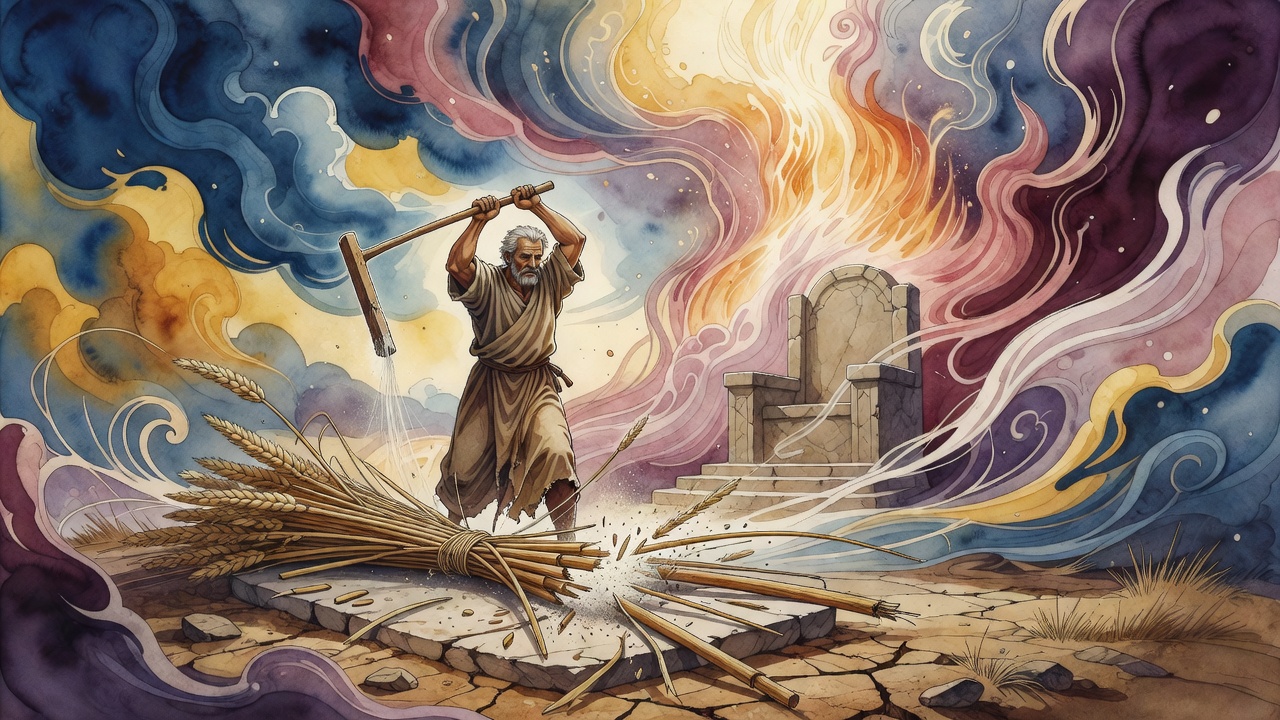
In a courtyard a flax beater lifted a poor stalk, tapped it once against the stone, and set it aside. One hard blow would have split it, and there would have been nothing left worth spinning. He picked a thick stalk and brought the mallet down, and down again, until the fibers opened and the stone rang. He spent his arm on flax that could take it.
A potter at the kiln never raps the thin-walled pots. One knock and they are shards. He goes down the line of the sturdy ones, knocking each of them over and over. They ring. They hold.
A householder with two cows, one strong and one feeble, does not stand there weighing the decision. The yoke goes on the strong one.
God does not test the wicked. They are a churning sea that throws up mud, and one blow and they are done (Isaiah 57:20). He tests the ones who can take it (Psalms 11:5). Leah was good flax. The mallet kept coming.
The Women Who Fell Inside Their Houses
She was not the only one on the floor. God holds up all who fall, and the ones who fall inside their own houses, where nobody outside can see it happen, are the barren women (Psalms 145:14).
Sarah had spent decades there. Abraham's younger brother Haran was fathering children at an age that made the family arithmetic look absurd, and Abraham had none. The price of a conception in that house ran higher than pearls. She was hauled into Pharaoh's palace and came out of it untouched, and Pharaoh, who had watched what happened to his household on her account, took his own daughter and handed her over as Sarah's servant girl. Better my daughter a maidservant in that house, he said, than mistress of any other. Her name was Hagar, and she walked out of Egypt behind a barren woman.
Leah heard that kind of falling in her own walls. Hated is a quiet sound. It does not need a street.
Am I Divorcing the Mother of These
God saw that Leah was hated, and He opened her womb (Genesis 29:31).
Reuben. Then Simeon. Then Levi. Then Judah. Four sons in the years when Rachel had none, and a woman who had been bent double inside her own tent straightened up and stayed standing.
Jacob counted the boys in the yard. He put his hand on a small head, then another, then another. He put the divorce out of his mind.
"Am I going to send away the mother of these?" he said, and that was the end of it. Six of his sons came out of Leah in the end, and a daughter.
Years later, in Egypt, at the very end of his life, the old man made Joseph swear not to bury him there. Then Israel bowed down over the head of the bed (Genesis 47:31).
The head of Jacob's bed was Leah. The girl who had wept herself sick over a marriage arrangement was the one he bowed toward when he had nothing left to bargain with, and she was already buried in the cave at Machpelah, waiting for him to be carried up.
← All myths