The Flesh Still in Their Teeth and the Measure of Justice
The quail were still in their mouths when the plague hit. The Mekhilta reads the wilderness to learn how God measures punishment against the size of a sin.
Table of Contents
 Click for full size
Before They Swallowed
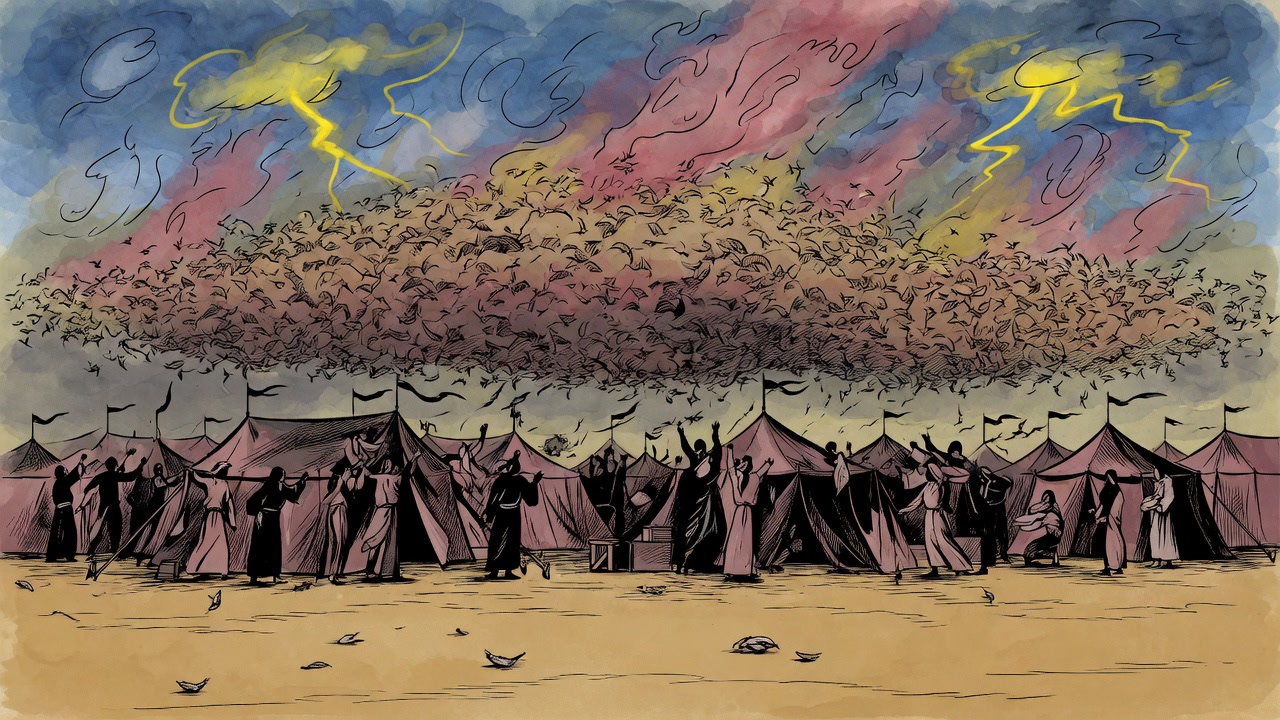
The meat was still in their mouths when the killing began. Not after they swallowed. Not the next morning. The quail were caught between their teeth, the grease still on their fingers, when the wrath of God burned through the camp at Kibroth-hattaavah, the graves of craving.
That timing is the starting point for one of the most precise pieces of moral analysis in ancient Jewish literature. The rabbis of the Mekhilta deRabbi Yishmael, the tannaitic commentary on Exodus shaped around the third century CE in the school of Rabbi Yishmael, were not satisfied with a God who swings a single blunt instrument at a crowd. They went into the wilderness story with calipers.
One Plague, Two Kinds of Death
The phrase that stopped them was in Numbers 11:33: the flesh was still between their teeth, it was not yet cut off, and the anger of the Lord burned against the people. Read the surrounding verses carefully and a problem appears. The same plague did not kill the same way, and the people it killed were not all guilty of the same thing. Some collapsed immediately. Others lingered and suffered longer. The sages drew a line through the dead.
The relatively decent person, the man who had been swept up by the collective appetite without being its driving force, ate the quail and was struck at once. Violent and fast, the punishment was proportional: bad, but quick, emptying him out and letting him go. The person whose craving ran deeper, who had instigated and inflamed the complaint about manna and meat from the beginning, ate the same food and was not struck immediately. The flesh stayed in his teeth. The punishment extended itself to match the sin, reaching back into the person who had turned a manageable hunger into an organized demand against heaven.
A Canaanite and a Principle
The second thread in this analysis is more technical. Rabbi Eliezer, working in the same tannaitic tradition, examines a passage in the Torah where God punishes a Canaanite's sin along with the sin of the Israelite who sinned through him. The Canaanite was the occasion of the transgression but not the Israelite. The Israelite made the choice. But both are punished in the Torah's reckoning.
Rabbi Eliezer pressed the principle: if God holds a bystander accountable for enabling a sin he did not himself commit, what does that imply about the instigator? And then the inference worked backward to the quail. The person who craved and clamored and organized the demand was more culpable than the person who simply followed the crowd's example. The punishment reaching them while the flesh was still between their teeth was calibrated to that additional culpability.
Who Gets Punished First
The third teaching extends the analysis outward into a principle of divine justice that operates across the whole Torah. When God punishes, He punishes the instigator first. Not last, not equally mixed into the mass punishment, but first and specifically. The person who set the sin in motion carries a priority in the reckoning that follows.
The Mekhilta builds this case through a series of biblical comparisons. In the stories of punishment that run from Egypt through the wilderness, the pattern holds. The leader of a transgression receives the first blow. This is not mercy toward the followers. It is a precise accounting that distinguishes between the person who moved and the person who was moved, and assigns consequence accordingly.
The calipers the sages applied to the wilderness story were not instruments of cruelty. They were instruments of justice, and the distinction matters enormously. A God who applies the same punishment to the man who organized the craving and the man who simply craved, to the one who threw the first stone and the one who threw the last, would be a God of brute force. The Mekhilta's God measures. He reads the difference between a man who craved and a man who led others to crave. He arrives before the swallowing is finished, and the timing is not arbitrary.
← All myths