Parshat Noach6 min read

The Giant Kings Who Tried to Plug the Flood

Before the waters rose, titans ruled a fertile earth. When the deep broke open, the giants jammed their feet into it and drowned defying God.

Curated by Arthur · Told by Maggid ·
Table of Contents
  1. The Old Man Who Warned of Rain
  2. The Boast Against the Deep
  3. The Day Both Skies Opened
  4. The Water Turned to Fire
  5. The Terrors Left Roaming the Plains

The women of the old world gave birth in litters of six, and the newborns landed on their feet. Before the milk was dry on them they stood, spoke the holy tongue, and leapt in the grass like spring lambs let loose. No cradle held them. No mother nursed them long. They ran from the womb into the open, and the earth was thick with them, an entire race born already running.
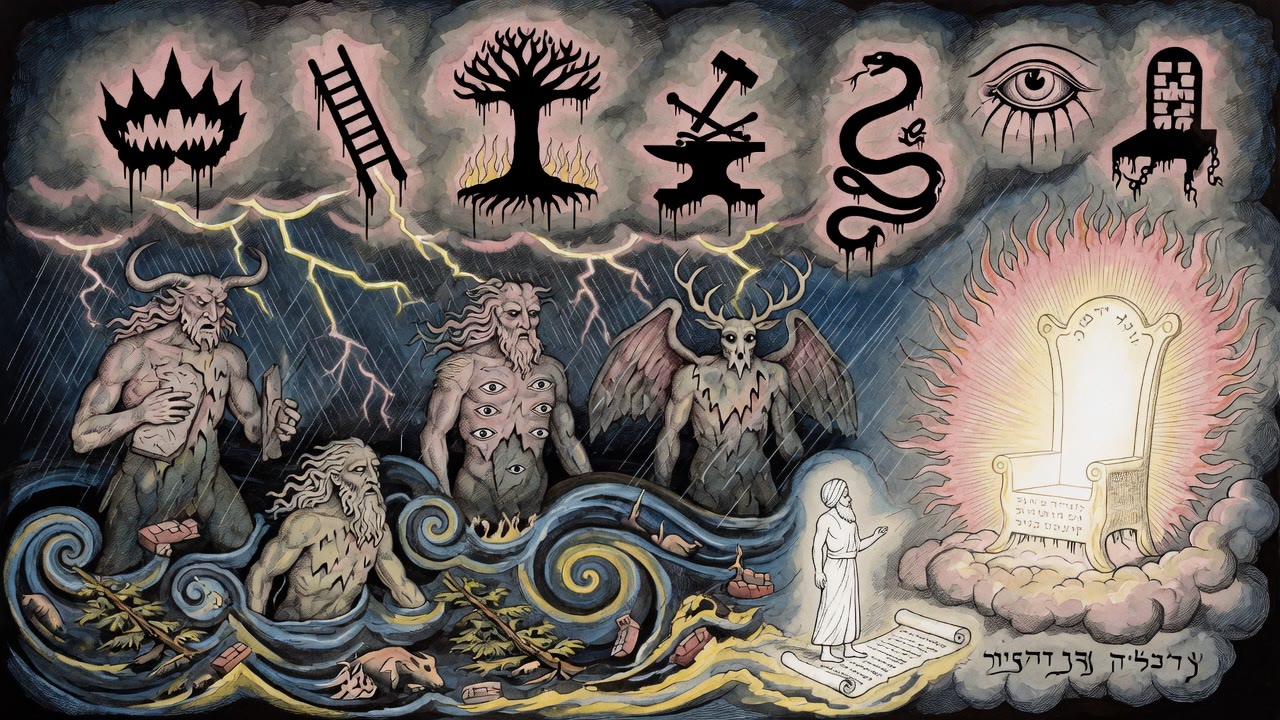
This was the world before the water. Fertile past reckoning, fearless past sense. The fields fed everyone and the seasons never failed, and the people who walked those fields grew tall as towers and answered to nothing above them. They danced and they multiplied and they took whatever the ground offered, and the ground offered everything.

The Old Man Who Warned of Rain

Into this world walked Noah, and he begged them to stop. "Turn from your ways and your evil deeds," he said, "or He will bring the waters of the Flood upon you and wipe out every seed of the children of men." He said it in the markets and he said it at the wells. He pointed at the sky.

They laughed at him. Then they did something worse than laugh. They held a council and decided that if the world was to end, no more children would inherit it through them. "We will hold back from multiplying," they said, "so as not to bring more children of men into the world." When they went to their wives they spilled their seed on the ground, deliberately, so nothing would take root. The earth drank what should have become sons and daughters, and the soil itself turned foul with it.

And God looked at the earth, and behold, it was ruined. The very word for their corruption was the word for that wasted seed poured out on the dirt. They had taken the most generative world that ever existed and made it barren on purpose, out of spite, to cheat the Flood of its harvest before it arrived.

The Boast Against the Deep

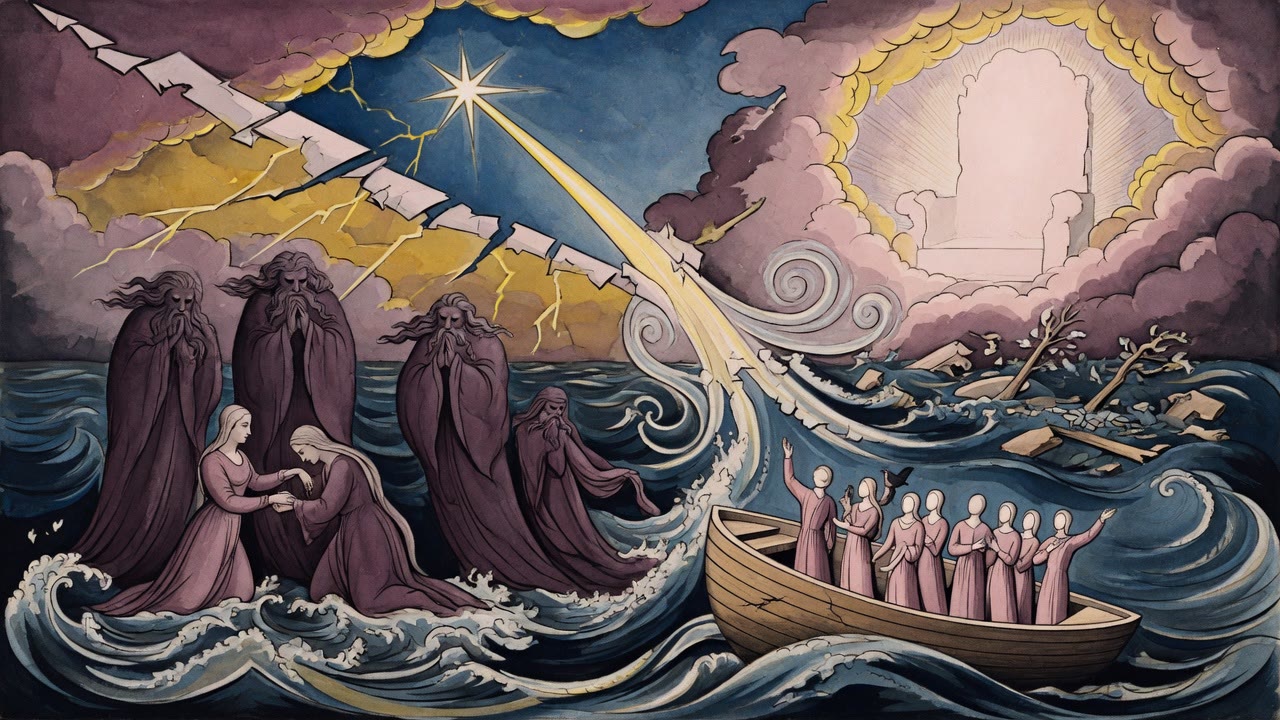
The giants were not afraid, and they said so. They measured the threat against their own enormous bodies and found it laughable. "If He sends the waters down from heaven," they said, "we stand so tall the flood will not climb past our necks. And if He sends the waters up from the deep below, the soles of our feet are wide enough to seal every spring in the abyss."

It was not an empty boast to them. They believed it. They had never met a force their size could not stop, and the deep, after all, was only water, and water rose from holes in the ground, and they had feet.

The Day Both Skies Opened

The Flood did not come gently, and it did not come from one direction. It came in the six-hundredth year of Noah's life, in the second month, on the seventeenth day. The old reckoning began the year at the world's completion, so the second month was the month of rains, and the Holy One chose the month of rain to drown the world He had made.

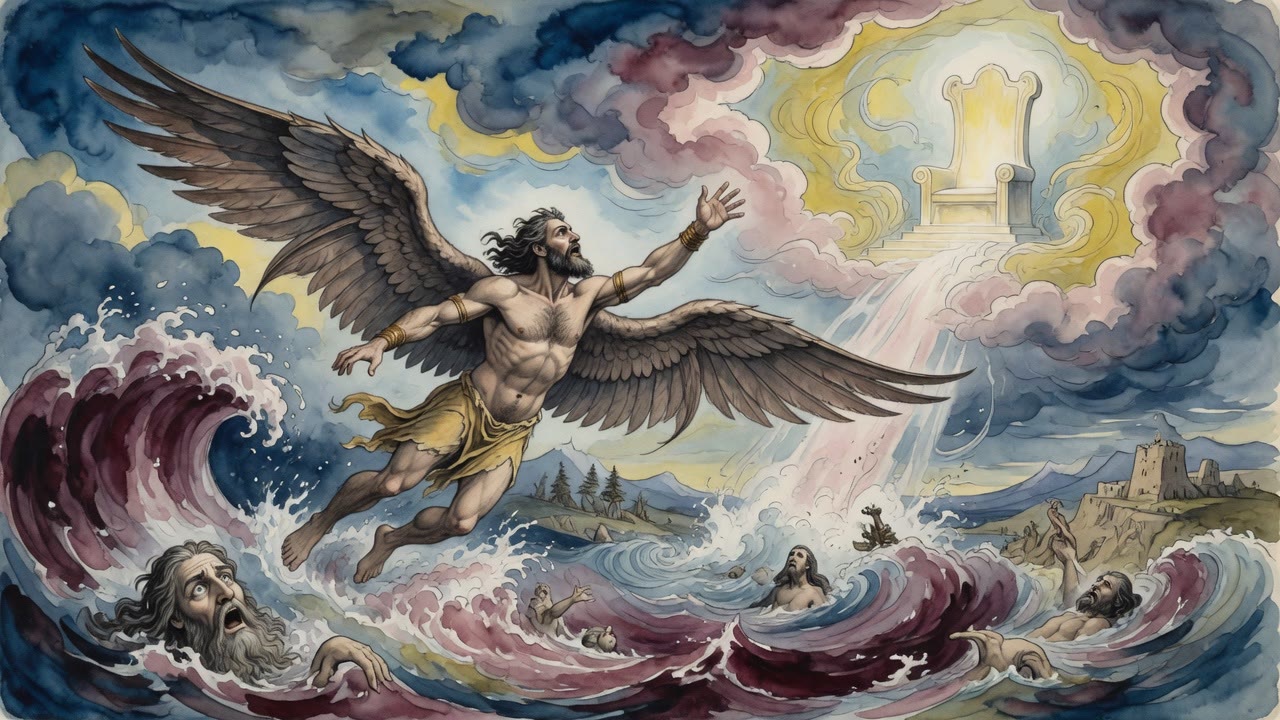
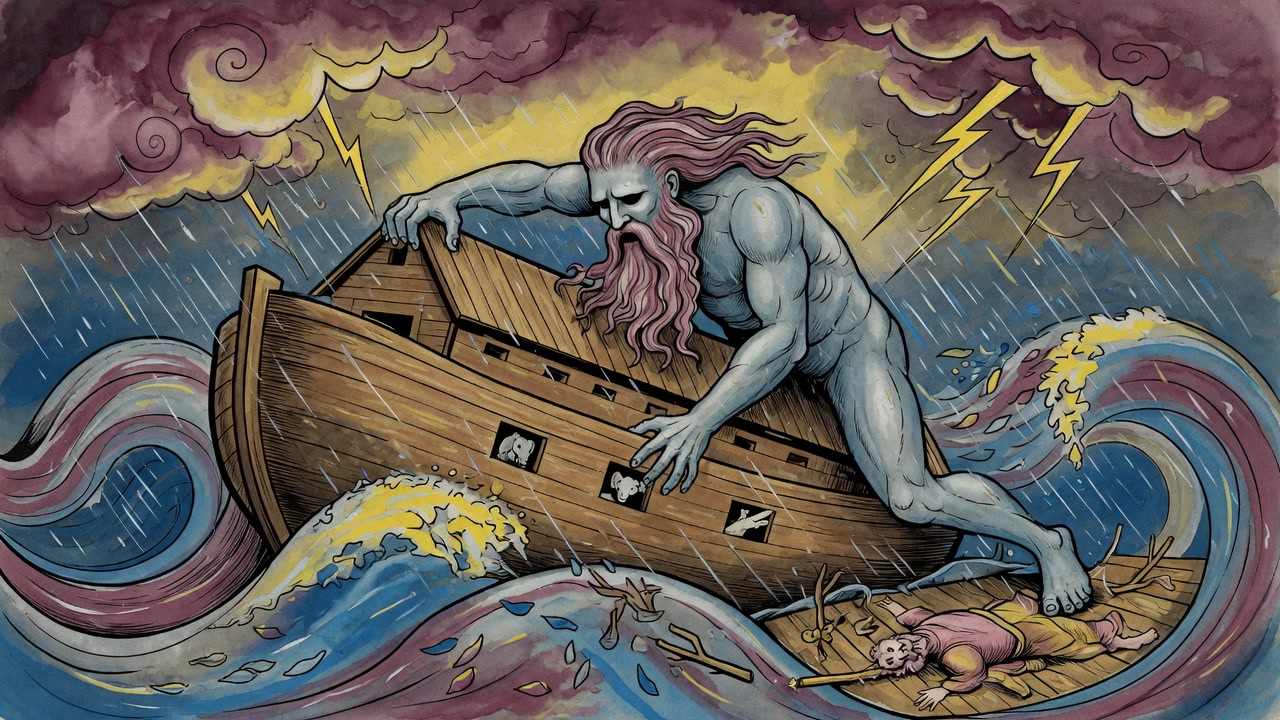
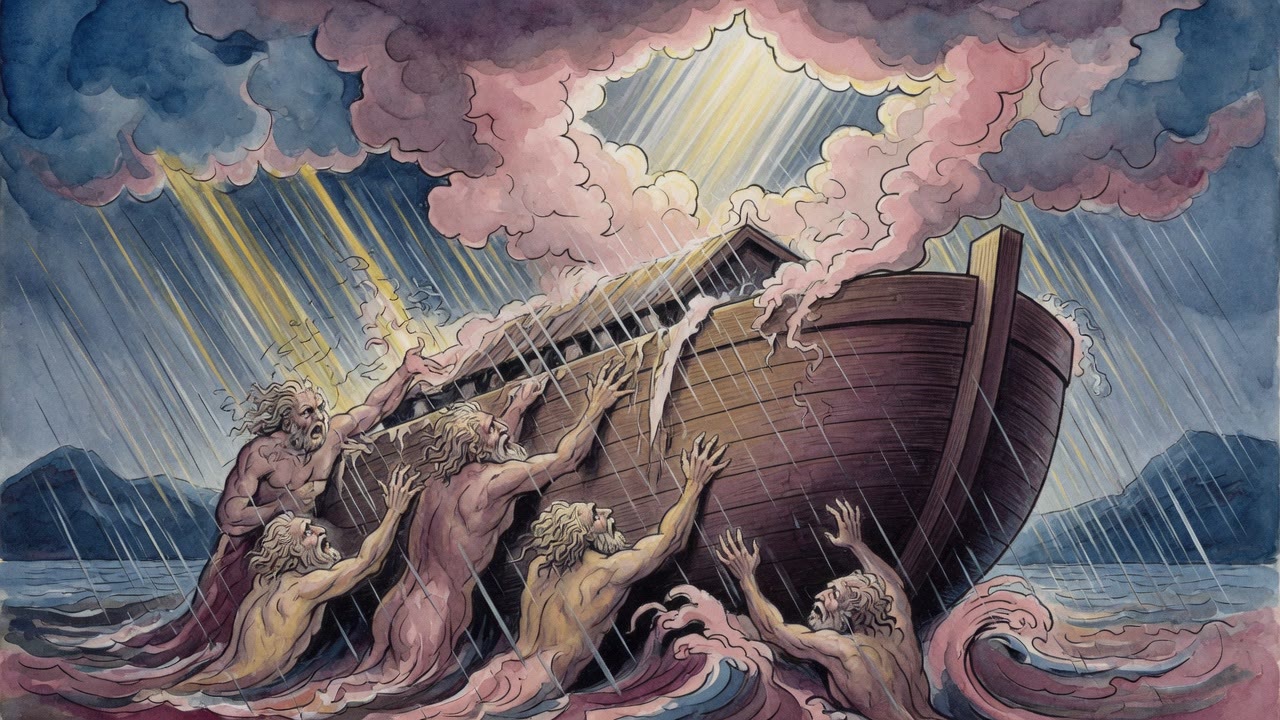
On that day all the fountains of the great deep burst open at once. The springs the giants had bragged about plugging blew upward like wounds in the earth, and the giants ran to them. With their sons beside them they threw themselves down onto the breaking ground, jamming their wide feet and their massive bodies into the gushing fountains, holding back the deep with sheer weight, exactly as they had said they would.

For a moment, perhaps, it held. Then the windows of heaven opened over their heads, and the rain came down on the backs of the giants who were bent over plugging the springs. Water from below and water from above, and the rebels crushed between them, pressing down on the deep while the sky pressed down on them.

The Water Turned to Fire

Then the Holy One did the thing they had not measured. He heated the deep. The waters they were holding shut grew hot beneath their feet, hotter, until the springs ran like a furnace. The boiling deep rose against them and burned their flesh and peeled the skin off their bodies. Their own strength held them in place over the heat. The harder they pressed to seal the springs, the longer they cooked in them.

When the water grew warm they vanished. When it grew hot they were gone, consumed out of their place, melted off the face of the world they had owned an hour before. The towers of that fertile age came apart in the steam. The race that ran from the womb on its first day stopped running, all at once, in the scalding springs they had sworn to plug.

The Terrors Left Roaming the Plains

The Flood took the world, but it did not take all of them. Some seed of the giants survived past the water and scattered into the land east of the Jordan, and there they bred their terrors back into the world. Generations later, when four kings swept down through Canaan, they cut their way through the leftovers of the drowned age, and the old Aramaic tongue named those peoples by their weight. It called them the Giants who lived at Ashtaroth-Karnaim, the Strong who held Hametha, and the Terrible who filled the plain of Kiriathaim.

They were the remnant, the survivors of the generation that had mingled with the Watchers and the children that union produced. The land between the Flood and the patriarchs was never an empty stage. It was haunted by what the water had failed to finish, and one of them, Og of Bashan, would still be standing tall enough to terrify a wandering people generations on. The water had peeled the skin off their fathers in the boiling springs. The sons it missed kept walking the plains, waiting for smaller men to come and stand where giants stood.


← All myths
From the tradition

Sources

4 sources

The texts this telling draws on, in full. Open a card to read inline, or expand it for a wider, quieter read.

Pirkei DeRabbi Eliezer 22:9Pirkei DeRabbi Eliezer

Pirkei DeRabbi Eliezer turns to The Fantastical World That Existed Before the Flood.

In Rabbi Levi, in those days, people were… different. Astonishingly fertile, for one thing. "They bare their sons," he says, "and increased and multiplied like a great reptile, six children at each birth!" Can you imagine? Six babies at once, all the time! And it gets even stranger. "In that very hour they stood on their feet, and spoke the holy language, and danced before them like sheep."

That’s a lot to take in. Rabbi Levi is referencing the verse, "They cast their young like sheep, and their children danced" (Job 21:11), painting a picture of almost instantaneous maturity and… well, a lack of reverence, perhaps? A kind of wild, untamed joy, disconnected from a sense of something higher?

Here’s where the story takes a darker turn. Noah, seeing the wickedness around him, tries to warn the people. "Turn from your ways and evil deeds," he pleads, "so that He bring not upon you the waters of the Flood, and destroy all the seed of the children of men."

Their response? Utter defiance. They refuse to repent. But even more shockingly, they decide to limit their procreation, but not through righteous means. "Behold, we will restrain ourselves from multiplying and increasing, so as not to produce the offspring of the children of men." But how? "When they came to their wives they spilled the issue of their seed upon the earth so as not to produce offspring."

This is a powerful and disturbing image. The text then quotes (Genesis 6:12), "And God saw the earth, and behold it was spilled." The word in Hebrew is vatishahet (ותִּשָּׁחֵת), often translated as "corrupt," but here carrying the literal sense of wasted seed. It's a deliberate act of rebellion, a perversion of the natural order.

Their arrogance doesn't end there. They mock the impending Flood. "If He bring from heaven the waters of the Flood upon us, behold, we are of high stature, and the waters will not reach up to our necks; and if He bring the waters of the depths against us, behold, the soles of our feet can close up all the depths." Imagine the hubris! They actually believe they can plug up the entire abyss with their feet!

So, what do they do? "They put forth the soles of their feet, and closed up all the depths."

But of course, you can't outsmart the Divine. "What did the Holy One, blessed be He, do? He heated the waters of the deep, and they arose and burnt their flesh, and peeled off their skin from them." The punishment fits the crime, doesn’t it? Their arrogant attempt to control the waters results in their own fiery demise.

The text then quotes (Job 6:17), "What time they wax warm, they vanish; when it is hot, they are consumed out of their place." But it offers a clever midrashic (rabbinic interpretive commentary) (interpretive) reading: "Do not read thus ('When it is hot,' bachumo בְּחֻמּוֹ), but (read) 'in his hot waters' (bachamimayv בְּחֲמֵימָיו)." A subtle shift in pronunciation, and suddenly the verse speaks directly to their fiery end in the heated waters of the Flood.

It’s a chilling story, isn't it? A story of incredible potential twisted into utter depravity. It makes you wonder: What happens when we, as humans, become so consumed with our own power and our own desires that we lose sight of the sacredness of life itself? What "waters" will ultimately rise up to meet us?

Full source
Targum Pseudo-Jonathan on Genesis 7:11Targum Pseudo-Jonathan on Genesis

The Flood did not arrive gently. Targum Pseudo-Jonathan on (Genesis 7:11) dates it with astonishing precision: the six-hundredth year of Noah's life, the second month, the seventeenth day. The Targum pauses to explain its own calendar. Until this moment the months were counted from Tishri, the beginning of the year from the completion of the world. So the second month of the old reckoning was Marcheshvan, the month of rains. The Holy One chose the month of rain to end the world with water.

Then the Targum opens a door the plain text never opens. On that day all the fountains of the great deep broke up. And the giants, the gibborim, gathered at those fountains with their sons and tried to stop them. Picture it. The waters of the deep are boiling up from below, and the towering sons of the Watchers throw themselves into the breach, trying to plug the earth like a shattered dam. They fail. The windows of heaven open above them, and the Flood comes at them from both directions at once.

This is the Targum's mythic signature. The giants, those half-angelic rebels the earth had groaned under for centuries, meet their end at the very fountains they tried to seal. Strength against the Creator is strength thrown into a fire. The takeaway, as the old darshanim tell it: when the Holy One opens both the deep and the sky, there is no wall anyone can build between them.

Full source
Targum Pseudo-Jonathan on Genesis 14:5Targum Pseudo-Jonathan on Genesis

Targum Pseudo-Jonathan on (Genesis 14:5) turns a military roll call into a tour of the archaic world's titans. Kedarlaomer's coalition sweeps through the land and smites three peoples the Aramaic labels in weight-bearing nouns: the Giants (gibboraia) which were in Ashtaroth-Karniam, and the Strong who were in Hametha, and the Terrible who were in the plain of Kiriathaim.

The Hebrew Bible uses specific names here. Rephaim, Zuzim, Emim. The Targumist translates each name into its essence: Giants. Strong. Terrible. The ancient land of Canaan, in this reading, is still populated by the remnants of the pre-flood titans. (Some of these giants will return by name when Moses sends his spies in (Numbers 13:33); Og of Bashan will be named explicitly as a survivor in (Deuteronomy 3:11).)

This is one of the Targum's signature concerns. The world between the flood and Abram is not an empty stage. It is haunted. Remnants of the generation that intermarried with angels (Genesis 6:4) are still roaming the plains east of the Jordan. Kedarlaomer's army is not merely a political power; it is the force that finally clears these archaic giants off the map. Or tries to.

Abram will soon be drawn into this world of titans. The covenant with a seventy-five-year-old shepherd is about to intersect with an apocalyptic-scale battle against pre-historic giants. The Targum is setting the scale. When you read the next few verses, remember: the man who will go rescue Lot is walking into a war fought by Giants, Strong, and Terrible. His three hundred and eighteen servants will not merely defeat a coalition. They will stand where giants stood.

The Holy One specializes in pairing small men with enormous theaters.

Full source
Yalkut Shimoni on Torah 55:2Yalkut Shimoni on Torah

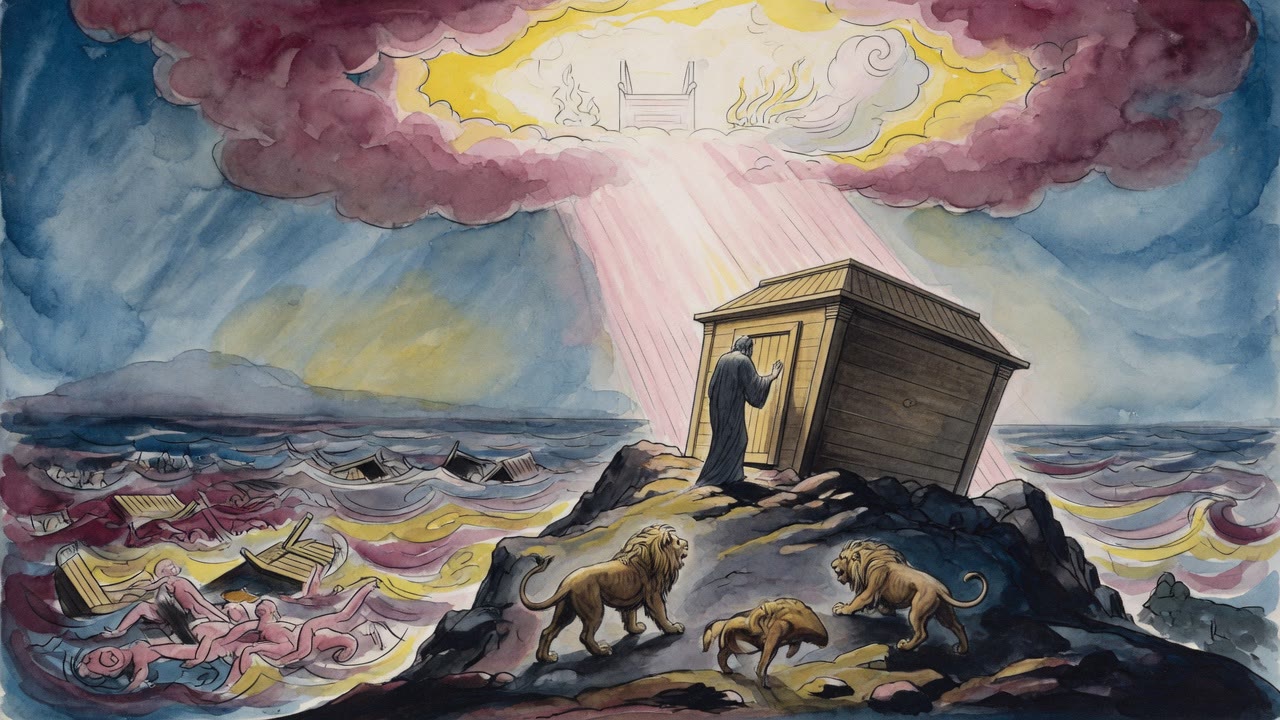
(Genesis 6:17) "And I, behold, I am bringing." Behold, I agree with the words of the angels who said, "What is man, that You remember him?" "The flood of waters upon the earth." They were waters, but once they descended upon the earth they became a flood. "Everything that is on the earth shall expire," shall shrivel. (Genesis 6:18) "And I will establish My covenant with you." You need a covenant. The mighty ones, one of them would put his foot upon the deep and stop it up, and put his hand upon a window and stop it up, and when he came to enter the ark his feet would become tangled. This is what is written: "The shades tremble beneath the waters and their inhabitants" (Job 26:5). A lion would come to enter the ark and its teeth would be blunted. This is what is written: "The roar of the lion, and the voice of the fierce lion, and the teeth of young lions are broken" (Job 4:10). You need a covenant because of the fruit that you are gathering in, so that it not grow moldy, not rot, and not change. "And you shall come into the ark." Rabbi Chiyya bar Abba said: You were a carpenter, but without My covenant that was with you, you would not have been able to enter. This is what is written, "And I will establish My covenant with you." When? "When you come into the ark." "You and your sons." Rabbi Yehuda bar Simon and Rabbi Chanin said in the name of Rav Shmuel bar Yitzchak: Once Noah entered the ark, procreation was forbidden to him. This is what is written: "you and your sons" by themselves, "and your wife and your sons' wives" by themselves. "In want and in famine, solitary" (Job 30:3): if you see want coming into the world, regard your wife as though she were solitary, for in the coastal towns they call a menstruant woman galmudah, solitary. Rav Huna said: "And to Joseph were born two sons." When? "Before the year of famine came" (Genesis 41:50). Once Noah went out, the Holy One, blessed be He, permitted him, as it is written, "Go out from the ark, you and your wife" (Genesis 8:16). (Genesis 6:21) "And you, take for yourself of every food." Rabbi Abba bar Kahana said: He brought pressed figs in with him. It was taught in the name of Rabbi Nehemiah: most of what he brought in was pressed figs. Rabbi Abba bar Kahana said: He brought vine shoots for the elephants, hatzuv plants for the deer, and glass for the ostriches. Rabbi Levi said: He brought vine shoots for planting, shoots for fig trees, and grafts for olive trees. According to Rabbi Abba bar Kahana, "and it shall be for you and for them" means something that is for you and for them. According to Rabbi Levi, "and it shall be for you and for them" means you are primary and they are secondary to you. "And gather it to yourself": a person gathers a thing only if he needs it. (Genesis 6:22) "And Noah did" refers to the preparation for the making of the ark. (Genesis 7:1) "And the LORD said to Noah: Come, you and all your household, into the ark, for I have seen you righteous before Me." We find that one says part of a person's praise in his presence and all of it not in his presence. Not in his presence, what does it say? "Noah was a righteous, whole man" (Genesis 6:9). In his presence, what does it say? "Righteous before Me in this generation." (Genesis 7:2) "Of every clean animal you shall take for yourself" and so on, "a man and his wife." Is there marriage for an animal? Rabbi Shmuel bar Nachmani said that Rabbi Yochanan said: from those with which no transgression had been committed. How did he know? Rav Chisda said: He passed them before the ark. Any that the ark received, it was known that no transgression had been committed with them. Rabbi Abbahu said: from those that came by themselves.

Rabbi Yehoshua ben Levi said: A person should never bring an ugly word out of his mouth, for Scripture bent eight letters and did not bring out an ugly word, as it is said, "and of the animal that is not clean" (Genesis 7:8). Rav Pappa said: nine, as it is said, "If there is among you a man who is not clean" (Deuteronomy 23:11). Ravina said: ten, counting the vav of "clean." Rav Acha bar Yaakov said: sixteen, as it is said, "For he said, It is an accident; he is not clean, surely he is not clean" (1 Samuel 20:26). The school of Rabbi Yishmael taught: A person should always speak in a language of honor, for with a male zav Scripture called it "riding," and with a female zavah it called it "sitting," and it says, "and you choose the tongue of the crafty" (Job 15:5). What is the force of "and it says"? If you say this applies only in matters of Torah but not in rabbinic matters, Scripture teaches, "and you choose the tongue of the crafty" (Job 15:5). And if you say this applies only in rabbinic matters but not in ordinary speech, Scripture teaches, "and the knowledge of my lips speaks clearly" (Job 33:3). But is "riding" not written of a woman? Is it not written, "Rebecca arose, and her maidens, and they rode" (Genesis 24:61)? There, because of fear of the camel, that was the way. Is it not written, "Moses took his wife and his sons and set them riding" (Exodus 4:20)? There, because of his sons, that was the way. Is it not written, "and she was riding on the donkey" (1 Samuel 25:20)? There, because of the fear of night, that was the way; and some say there was no fear of night, but nevertheless. But does the Torah not write "unclean"? Rather, wherever the expressions are equal, it speaks in a language of honor; wherever the words are more numerous, it speaks in the shorter language, for Rav Huna said in the name of Rabbi Meir: A person should always teach his student by the short path. But "riding" and "sitting" are equal, and it says "riding." There were two students in Rav's neighborhood sitting before him. One said, You have made this teaching as tired as that other thing, and one said, as tired as a kid. Rav did not speak with the one who had used the uglier expression. There were two students sitting before Hillel, and one of them was Rabban Yochanan ben Zakkai, and some say they were before Rabbi, and one of them was Rabbi Yochanan. One said, Why are grapes harvested in purity, but olives harvested in impurity? And one said, Why are grapes harvested in purity, but olives not harvested in purity? He said: I am assured that this one will issue rulings in Israel. Not many days passed before he issued rulings in Israel. There were three priests. One said, My portion reached me the size of a bean; one said, My portion reached me the size of an olive; and one said, like the tail of a lizard. They investigated him and found in him a trace of disqualification. But was it not taught that one does not investigate from the altar and above? Rather, say: they found in him disqualifying arrogance. And if you wish, say: he was the one who degraded himself.

There was a certain gentile who would go up and eat the paschal offering in Jerusalem. He said, It is written, "No uncircumcised male shall eat of it" (Exodus 12:48), and it is written, "No foreigner's son shall eat of it" (Exodus 12:43), yet I eat from the finest of the fine. Rabbi Yehuda ben Beteira said to him: When you go up there, say to them, Give me from the fatty tail. When he went up, he said to them, Give me from the fatty tail. They said to him, The fatty tail goes up to the Most High. They said to him, Who told you this? He said to them, Rabbi Yehuda ben Beteira. They said, What is this before us? They investigated him and found that he was a gentile, and they killed him. They sent to Rabbi Yehuda ben Beteira: Peace to you, Rabbi Yehuda ben Beteira, for you are in Nisibis and your net is spread in Jerusalem. Rav Kahana grew ill. The Rabbis sent Rabbi Yehoshua son of Rav Idi and said to him: Go check what his condition is. He went and found that his soul had rested. He tore his garment, turned the tear behind him, and came back. They said to him, Has his soul rested? He said to them: I did not say it, "one who brings out a bad report is a fool." Yochanan of Chakuk went out to the villages. When he came back, they said to him, Did the wheat turn out well? He said to them, The barley turned out well. They said to him, Go give news to the horses and donkeys, as it is written, "and the barley and the straw for the horses" (1 Kings 5:8). What should he have said? Last year's crop turned out well, or else, the lentils turned out well. Rav, son of Rabbi Chiyya's brother and son of Rabbi Chiyya's sister, when he went up there, Rabbi Chiyya said to him, Is my father alive? He said to him, My mother is alive. He said to him, Is my mother alive? He said to him, My father is alive. Rabbi Chiyya said to his attendant: Remove my shoes, and carry my garments after me to the bathhouse. Learn three things from this: a mourner is forbidden to wear sandals; a distant report of death is observed only one day; and part of the day counts as all of it. (Leviticus 11:4) "The camel": it is not written here, "because it does not divide the hoof," but rather, "because it brings up the cud." "And the hare": it is not written here, "because it does not divide the hoof," but rather, "because it brings up the cud." (Leviticus 11:7) "And the pig": it is not written here, "because it does not bring up the cud," but rather, "because it divides the hoof." (Genesis 7:3) "Also of the birds of the heavens" and so on. If you say seven of every kind, one of them would be left without a mate. Rather, seven males and seven females of every kind. Not because I need them, but "to keep seed alive upon the face of all the earth" (Genesis 7:3).

Full source