6 min read

The Ox Angel of Rain and the Staff of the Unseen World

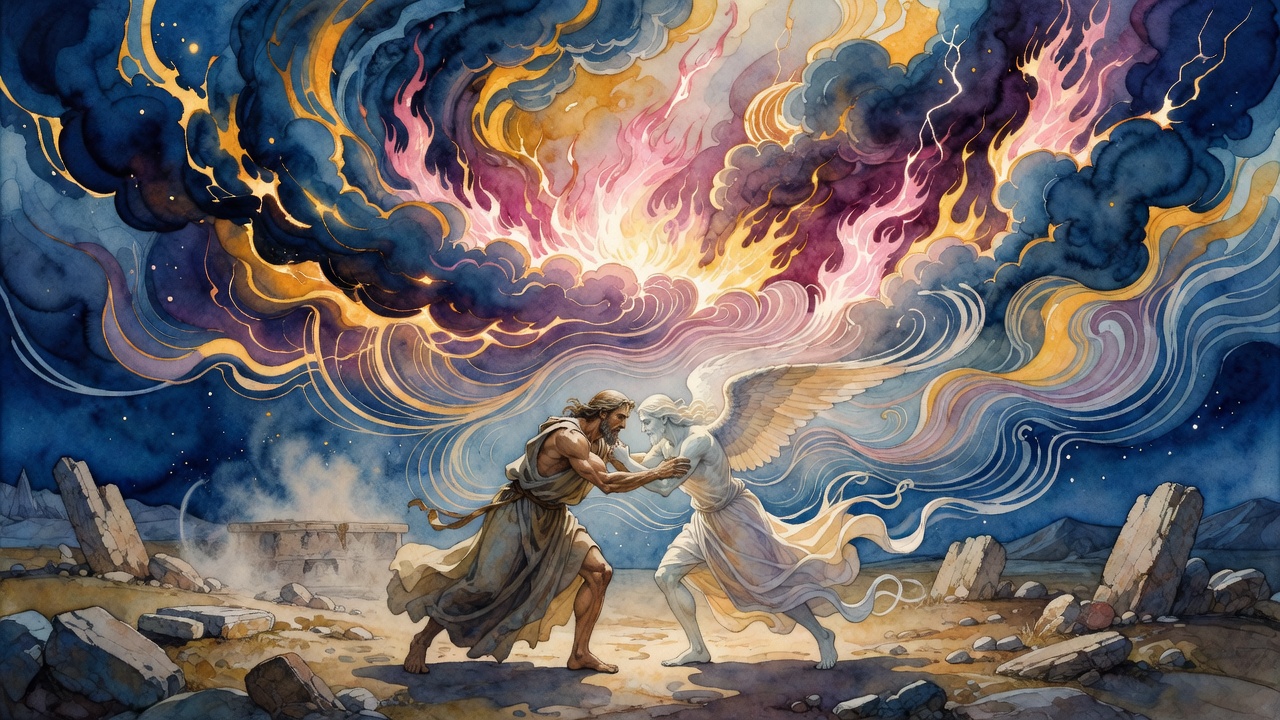
A calf-shaped angel with a torn lip speaks the rain up and down, two friends weigh as a nation, and Michael crosses all heaven in one beat.

Curated by Arthur · Told by Maggid ·
Table of Contents
  1. The Ox Who Splits the Waters
  2. The House With Four Doors
  3. When Two Men Are Worth Six Hundred Thousand
  4. The Defender Who Arrives in One Beat

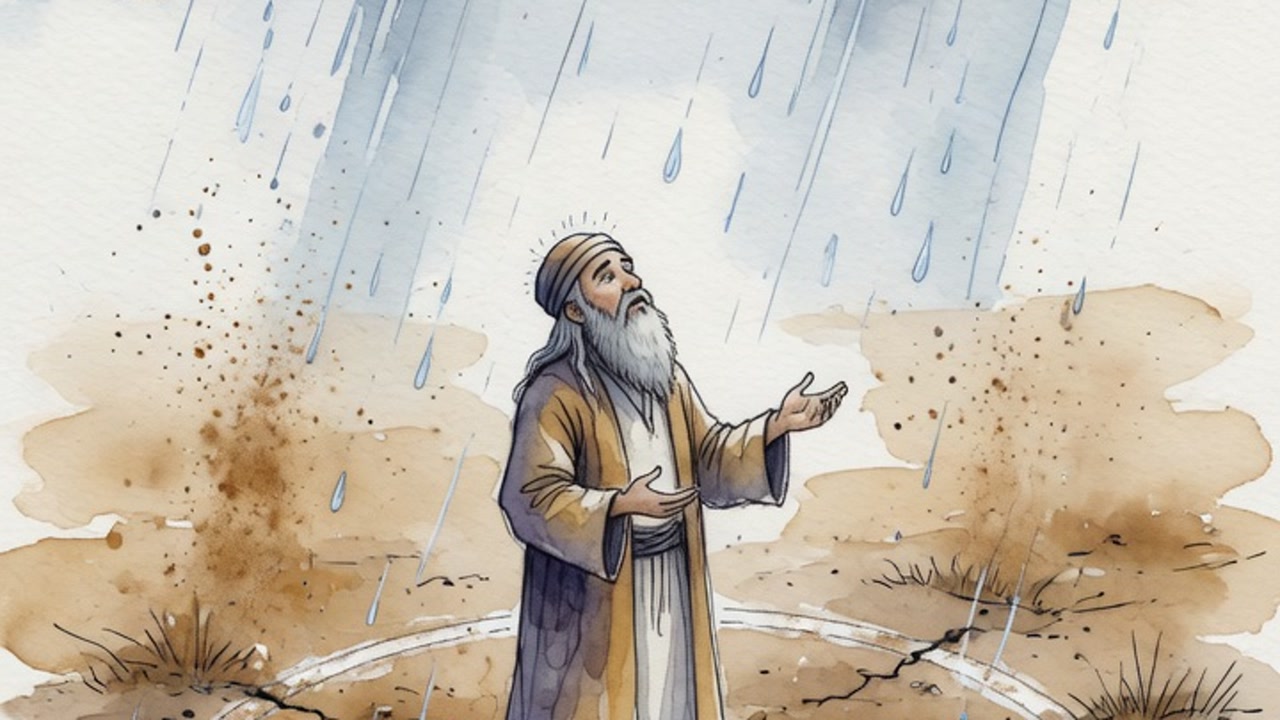
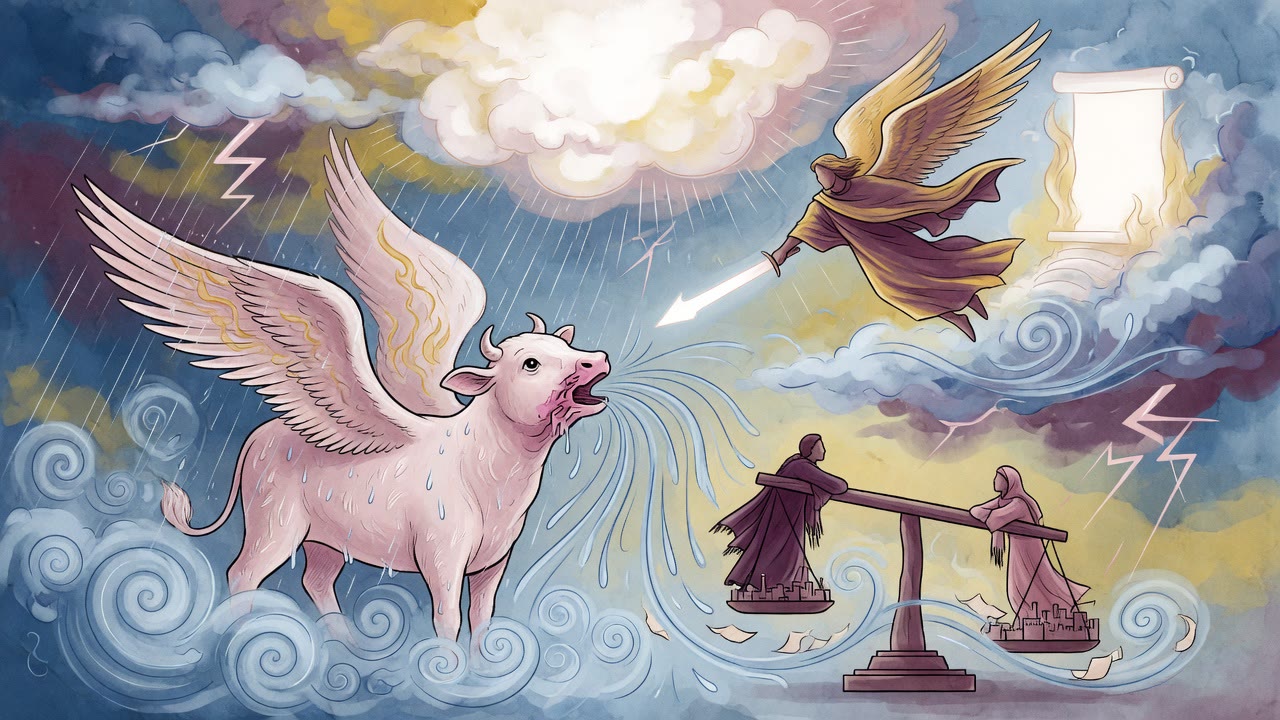
Look closely at the gray hour before a storm and you may catch the shape of the thing that brings it. He stands the size of a young ox, this one called Ridya, and his lower lip hangs split and parted as if a knife once opened it and never finished. His hooves rest on nothing. Below him gapes the lower deep, the dark water that hides under the ground. Above him hangs the upper deep, the water folded into the sky. Ridya stands wedged between the two like a man holding a door open with both arms.
The Ox Who Splits the Waters

He does not pour the rain. He speaks it.

To the deep above him he turns his cloven mouth and says, "Drip down your waters." The sky loosens. To the deep below he bends his great head and says, "Spring up your waters." The wells answer from underneath. The water that runs down the window and the water that rises cold from the spring are two halves of the same conversation, and Ridya stands in the middle conducting both, lip split so the words come out doubled.

Rabbah, who walked the roads of Babylonia and was not a man given to soft talk, swore he had seen the beast himself. Not in a dream. With his own eyes he watched the calf-shaped angel stand in the seam of the world and call the flowers up out of the dirt. He pointed to the verse afterward, the one that says the blossoms appear on the earth, as if to say: that is the receipt. That is what Ridya's voice does when it lands.

The House With Four Doors

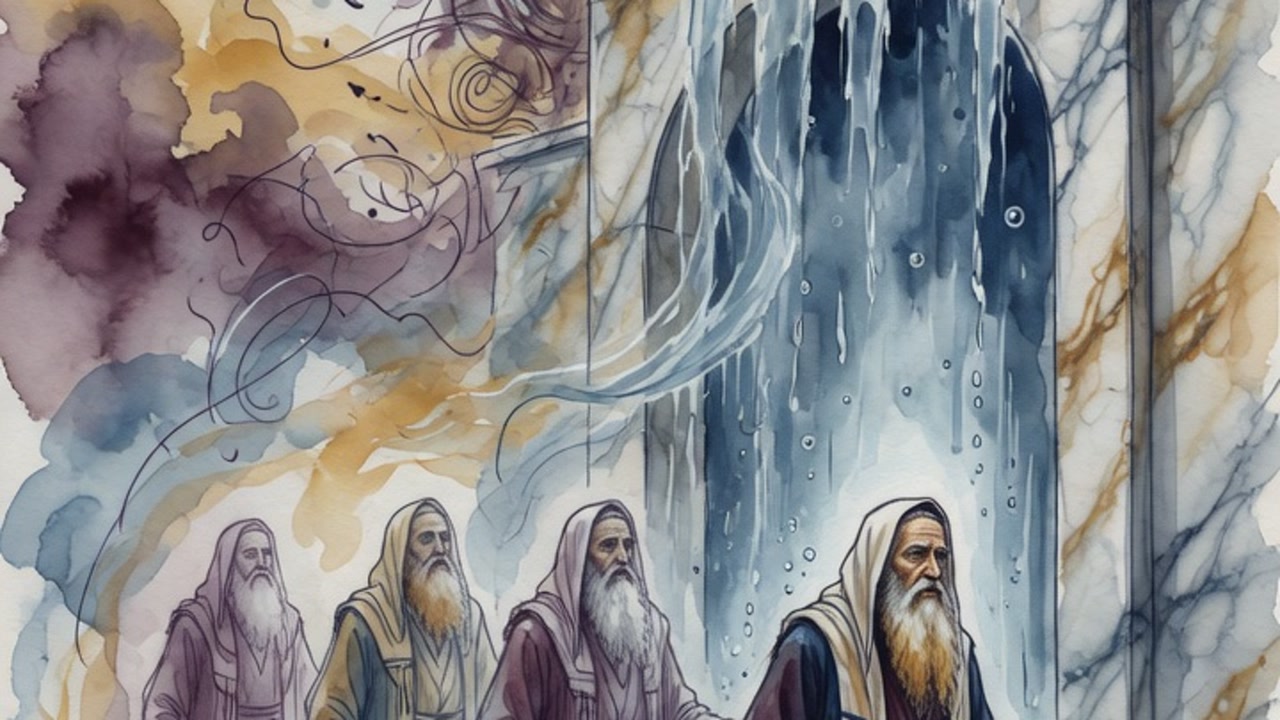
The rain falls on the just and the unjust, and so does the work of the unseen staff, but heaven keeps a ledger on the houses below it. Two sages, Ulla and Rav Chisda, were walking a road when they passed a doorway, and Rav Chisda stopped and groaned from somewhere deep in his chest.

"Why are you sighing," Ulla asked him. "Sighing breaks half a man's body."

"How can I not sigh," Rav Chisda answered. He looked at the broken doorframe. This was the house of Rav Chana bar Chanilai, and once it had run like a small kingdom of bread. Sixty cooks by day, sixty more by night, and food for anyone who came. Its master kept his hand already inside his pocket so that no poor man, walking up, would have to wait even the length of a heartbeat and feel ashamed. Four doors stood open in the four directions, and whoever entered hungry left full. In drought years they scattered wheat and barley outside in the dark, so the proud poor, the ones too embarrassed to take grain in daylight, could come at night and gather it unseen. "Now it is ruins," Rav Chisda said. "How can I not sigh?"

Ulla had an answer, and it was not gentle. From the day the Temple fell, a decree went out over the houses of the righteous that they too would empty. It is enough for the servant to share the fate of his master. The Master of the world had left His own house in rubble. Who was Rav Chana to keep his doors?

When Two Men Are Worth Six Hundred Thousand

There is a blessing for almost everything heaven sends across a road. For graves of Israel, a blessing that names God as the one who will raise the dead in judgment. For a friend not seen in thirty days, a blessing of thanks for being kept alive to this hour. For a friend gone twelve whole months, the heavier blessing reserved for the resurrection itself, because after a year, the rabbis said, a lost thing and a lost man are mourned the same way.

And then there is the strangest accounting of all. Rav Pappa and Rav Huna met a man named Rav Chanina on the road and recited two blessings over the sight of him. He answered that he had recited three over them. "When I saw the two of you," he said, "I counted you in my eyes as equal to six hundred thousand of the house of Israel." So he had added the blessing said only before a vast crowd, the one that praises the God who knows all secrets, the God who alone can read what is hidden inside that many separate hearts. Two friends on a road had weighed, in his sight, as much as a whole nation standing at Sinai.

The Defender Who Arrives in One Beat

The unseen staff is enormous, and it is timed. The sages measured the angels by how far they must fly to reach the earth, and the answer was a ladder of dread and mercy. The Angel of Death needs eight flights to cross from his place to a single soul. In a year of plague, when the work runs heavy, he needs only one. Elijah covers the distance in four. Gabriel, who came to Daniel flying swiftly, does it in two.

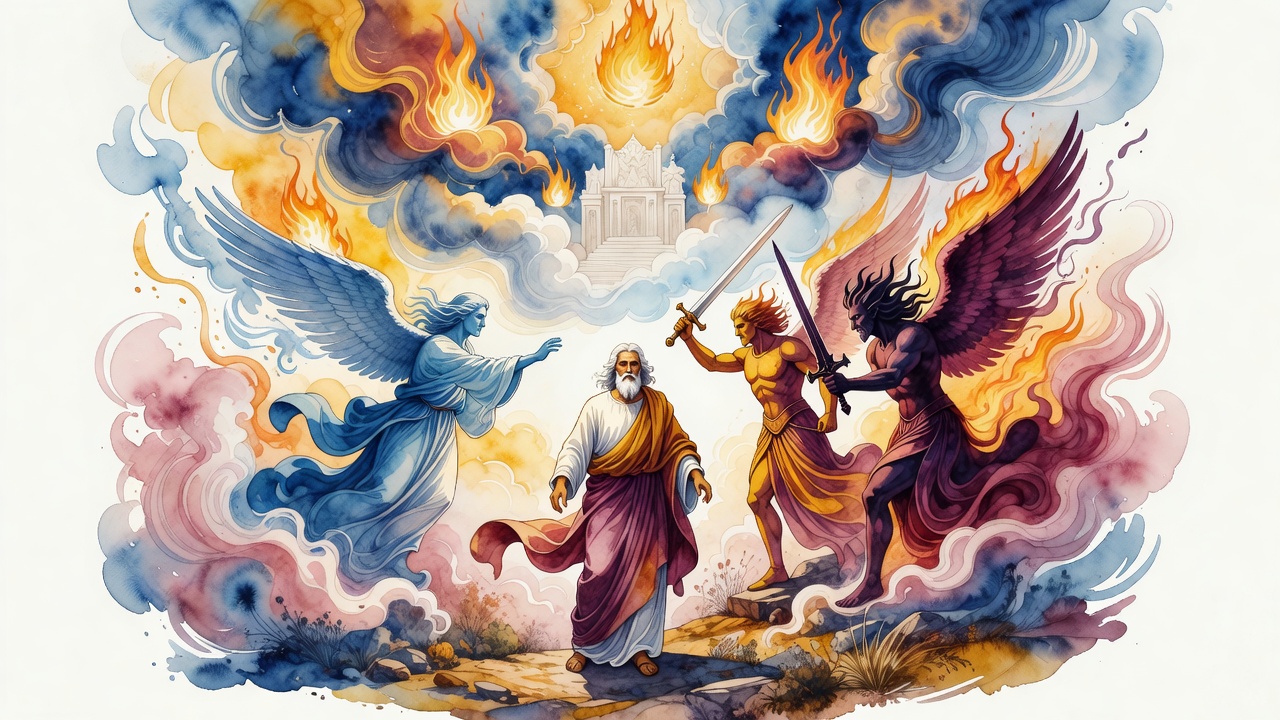
And then there is Michael, the prince who stands for Israel, named in the verse where one of the seraphim flew to the prophet with a coal. Michael needs one. The whole height of heaven, top to floor, in a single beat of his wings. When the destroyer can come in one flight, the defender can come in one flight too, and that is the only race in the sky that matters. The rain falls. The doors of the righteous fall. The blessings are counted. And somewhere above all of it a calf with a torn lip keeps the upper water talking to the lower, while the great prince waits at the edge of the firmament, one wingbeat from the ground.


← All myths
From the tradition

Sources

3 sources

The texts this telling draws on, in full. Open a card to read inline, or expand it for a wider, quieter read.

Ta'anit 25bTalmud Bavli, Ta'anit

Rabbah said: I myself saw this Ridya (angel of rain). It resembles a calf, and its lips are parted, and it stands between the lower deep and the upper deep.

To the upper deep it says: Drip down your waters. To the lower deep it says: Spring up your waters, as it is said: "The flowers appear on the earth, etc." (Song of Songs 2:12).

Full source
Berakhot 58bTalmud Bavli, Berakhot

The Sages taught: One who sees the houses of Israel inhabited and tranquil recites: Blessed…Who establishes the border of the widow. One who sees them in ruins he recites: Blessed…the true Judge. One who sees the houses of the nations of the world inhabited recites: “The Lord will destroy the house of the proud, but He will establish the border of the widow” (Proverbs 15:25). And if he sees them in ruins he recites: “God of vengeance, Lord, God of vengeance, shine forth” (Psalms 94:1).

The Gemara relates that Ulla and Rav Ḥisda were once walking along the road when they came upon the doorway of the house of Rav Ḥana bar Ḥanilai. Rav Ḥisda groaned and sighed. Ulla asked him: Why are you sighing? Didn’t Rav say: Sighing breaks half of one’s body? As it is stated: “Sigh, therefore, you son of man; with the breaking of your loins” (Ezekiel 21:11); sighing breaks a person down to his loins. And Rabbi Yoḥanan said that sighing breaks even one’s entire body, as it is stated: “And it shall be, when they say unto you: Why are you sighing? That you shall say: Because of the tidings, for it comes; and every heart shall melt, and all hands shall be slack, and every spirit shall be faint, and all knees shall drip with water” (Ezekiel 21:12).

Rav Ḥisda said to Ulla: How can I not sigh? We see this house where there were sixty cooks during the day and sixty cooks at night who would cook for anyone in need, and Rav Ḥana never removed his hand from his pocket because he thought: Perhaps a well-born poor person might come and in the time that passed until he put his hand in his pocket to give him charity, the poor person would be embarrassed. Moreover, that house had four doors open in all four directions, and anyone who entered hungry left satiated. And they would scatter wheat and barley outside during years of drought so that anyone who was embarrassed to take the grain during the day could come and take it at night. Now that the house has fallen in ruins, how can I not sigh?

Ulla said to Rav Ḥisda: You have nothing about which to sigh, as Rabbi Yoḥanan said as follows: From the day that the Temple was destroyed a decree was issued upon the houses of the righteous that they would be destroyed, as it is stated: “In mine ears said the Lord of hosts: Of a truth many houses shall be desolate, even great and fair, without inhabitant” (Isaiah 5:9). And Rabbi Yoḥanan said: In the future, in the end of days, the Holy One, Blessed be He, will restore them to their original locations and their inhabited state, as it is stated: “A Song of Ascents of David. They who trust in the Lord are as Mount Zion, which cannot be moved but abides forever” (Psalms 125:1). From this verse one may infer that just as in the future the Holy One, Blessed be He, will restore Mount Zion to its inhabited state, so too, in the future the Holy One, Blessed be He, will restore the houses of the righteous to their inhabited state, so you have no reason to sigh. Seeing that he was still not satisfied, Ulla said to him: It is enough for a servant to be like his master. Since God leaves His home, the Holy Temple, in ruins, one should not be distraught over the destruction of the houses of the righteous.

The Sages taught in a baraita: One who sees graves of Israel recites:
Blessed…Who formed you in judgment,
and Who nourished you in judgment,
and Who sustained you in judgment,
and collected your soul in judgment,
and in the future will raise you from the dead in judgment.
And Mar, son of Ravina, concludes the formula of this blessing in the name of Rav Naḥman:
And Who knows the number of you all,
and Who in the future will restore you to life and sustain you.
Blessed…Who revives the dead.
One who sees graves of gentiles recites: “Your mother shall be sore ashamed, she who bore you shall be confounded; behold, the hindermost of the nations shall be a wilderness, a dry land, and a desert” (Jeremiah 50:12).

Rabbi Yehoshua ben Levi said: One who sees his friend after thirty days have passed since last seeing him recites: Blessed…Who has given us life, sustained us and brought us to this time. One who sees his friend after twelve months recites: Blessed…Who revives the dead. As Rav said: A dead person is only forgotten from the heart after twelve months have elapsed, as it is stated: “I am forgotten as a dead man out of mind; I am like a lost vessel” (Psalms 31:13), and with regard to the laws of lost objects, it is human nature to despair of recovering a lost object after twelve months (see Bava Metzia 28a).

The Gemara relates: Rav Pappa and Rav Huna, son of Rav Yehoshua, were once walking along the road when they met Rav Ḥanina the son of Rav Ika. They said to him: When we saw you we recited two blessings over meeting you: Blessed…Who has shared of His wisdom to those who revere Him, and: Who has given us life…as they had not seen him in over a month. He said to them: I too, once I saw you, considered you in my eyes as equivalent to six hundred thousand of the house of Israel, and I recited three blessings over you. I recited those two that you recited, as well as: Blessed…Who knows all secrets, which is the blessing recited upon seeing six hundred thousand Israelites. They said to him: Are you all that clever? They fixed their gaze upon him and he died.

The Gemara continues to discuss the obligation to recite a blessing over unusual phenomena. Rabbi Yehoshua ben Levi said: One who sees spotted people recites: Blessed…Who makes creatures different. The Gemara raises a challenge: One who saw a person with unusually black skin, a person with unusually red skin, a person with unusually white skin [lavkan], an unusually tall and thin person, a dwarf, or one with warts [darnikos] recites: Blessed…Who makes creatures different. However, one who sees an amputee, a blind person, a flat-headed person, a lame person, one afflicted with boils, or spotted people recites: Blessed…the true Judge, not: Who makes creatures different.

The Gemara answers: This is not difficult. This, where Rabbi Yehoshua ben Levi says to recite: Who makes creatures different, refers to a case where the individual was spotted from when he was in his mother’s womb, since birth. While this, where one recites: The true Judge, refers to a case where the individual only became spotted after he was born. The Gemara remarks: The language of the baraita is also precise as it draws a parallel to other cases, as it taught that a spotted person is similar to an amputee, which, in general, is a handicap incurred after birth. The Gemara concludes: Indeed, conclude from this.

The Sages taught: One who sees an elephant, a monkey, or a vulture (Rashi) recites: Blessed…Who makes creatures different. One who saw beautiful or otherwise outstanding creatures or beautiful trees recites: Blessed…Who has such things in His world.

We learned in the mishna that over zikin, one recites: Whose strength and power fill the world. The Gemara asks: What are zikin? Shmuel said: A comet. Shmuel also said: The paths of the sky are as clear to me as the paths of my city, Neharde’a, except for comets, that I do not know what they are. And we learn through tradition that a comet does not pass the Orion constellation, and if it does pass Orion, the world will be destroyed. The Gemara asks: Don’t we see that comets pass Orion? The Gemara rejects this: The aura of the comet passes Orion and it appears as though the comet itself passes. Rav Huna, son of Rav Yehoshua, said a different answer: It is merely that vilon, one of the firmaments, rips and furls and the light of the next firmament is seen, and this appears like a comet. Rav Ashi said another explanation: It is not a comet that passes Orion, but a star that is uprooted from one side of Orion, and another star, from the other side of Orion, sees it and gets startled and shudders, and appears as if it is passing.

On the subject of stars, the Gemara notes that Shmuel raised a contradiction between the implications of two verses with regard to constellations. On the one hand it is written: “Who makes Ursa Major, Orion, and Pleiades, and the chambers of the south” (Job 9:9); Orion precedes Pleiades. And on the other hand it is written: “He Who makes Pleiades and Orion” (Amos 5:8); Pleiades precedes Orion. So how is this reconciled? The Gemara replies: Were it not for Orion’s heat, the universe could not exist because of the cold of Pleiades; and conversely, were it not for the cold of Pleiades, the universe could not exist because of the heat of Orion.

And we learned a tradition that if the tail of the constellation Scorpio did not rest in the River of Fire, anyone stung by a scorpion would not survive. And that is what the All-Merciful said to Job of the relationship between heat and cold among the stars: “Can you bind the chains of the Pleiades or loosen the bands of Orion?” (Job 38:31); God alternates intensifying the power of different constellations in order to raise or lower the temperature.

With regard to Pleiades, the Gemara asks: What is Pleiades [Kima]? Why is it called by that name? Shmuel said: Because it is approximately a hundred [keme’a] stars, as that is the number of stars in that constellation; some say that they are concentrated and some say that they are dispersed.

With regard to the verse: “Who makes Ursa Major, Orion, and Pleiades” (Job 9:9), the Gemara asks: What is Ursa Major [Ash]? Rav Yehuda said: It is the star called Yota. This name was unfamiliar as well, so the Gemara asks: What is Yota? There is disagreement; some say that Yota is the group of stars comprising the tail of Aries, while others say that Yota belongs to the head of Taurus. The Gemara concludes: And it stands to reason in accordance with the opinion of the one who said that Yota is the group of stars comprising the tail of Aries, as it is written: “Or can you guide Ursa Major with her sons?” (Job 38:32); apparently it was incomplete and the tail appears

Full source
Ein Yaakov, Berakhot 1:19Ein Yaakov, Berakhot

Michael reaches his destination in one flight.

Ein Yaakov, Berakhot 1:19 turns angelic speed into a hierarchy of heavenly urgency. Rabbi Elazar says the verse "then flew to me one of the seraphim" (Isaiah 6:6) teaches more about Michael than the verse describing Gabriel, who comes "flying swiftly" (Daniel 9:21).

The sages measure the angels by how many flights they need. Michael arrives in one. Gabriel needs two. Elijah needs four. The Angel of Death needs eight, and in a time of plague, he needs only one.

The list feels strange until its fear becomes clear. Heaven is not empty space. It is crowded with missions, messengers, delays, and sudden arrivals. Some angels bring mercy. Some bring warning. Some arrive so quickly that the world has no time to prepare.

Michael's single flight gives the passage its hope. The defender can move faster than terror. Gabriel may rush. Elijah may travel. Death may come with frightening speed. But Michael, the great prince who stands for Israel, crosses heaven in one motion when help is needed.

Full source