6 min read

The Priest Kept the Altar Burning After Sunset

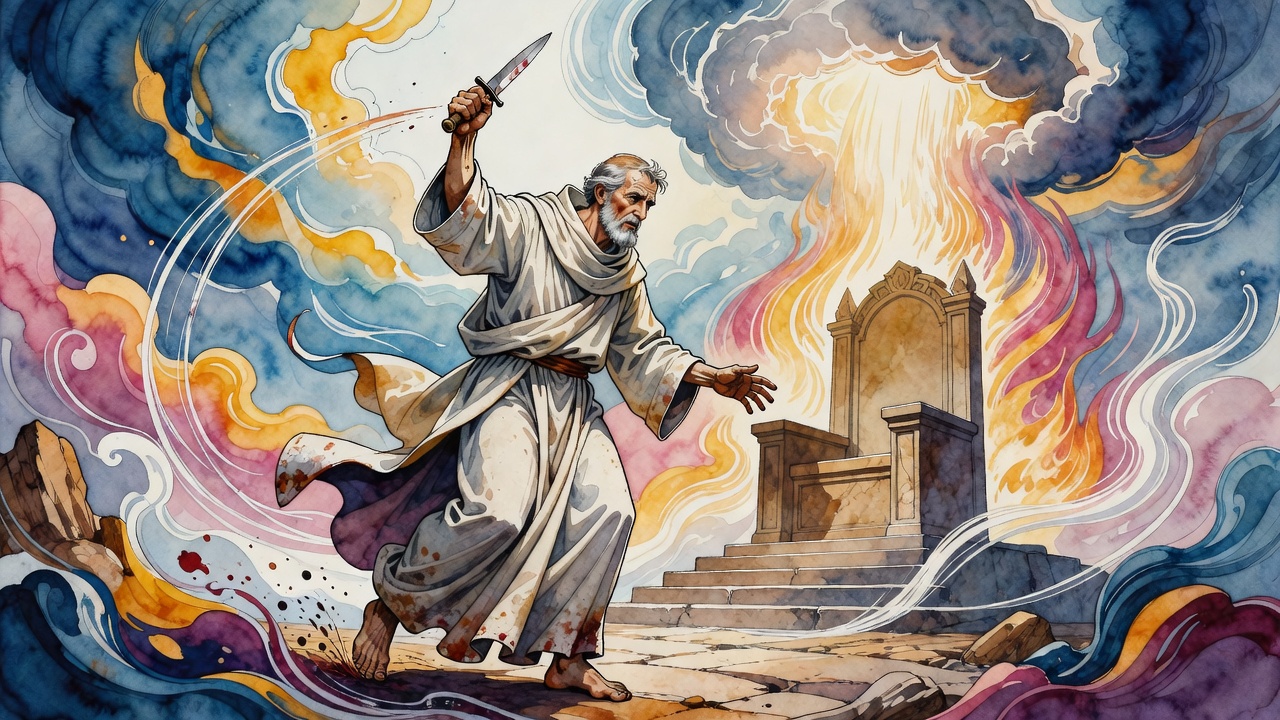
A priest fed limbs to the fire after the last daily lamb. Night wind moved the ash heap. No private hand could claim what the altar still held.

Curated by Arthur · Told by Maggid ·
Table of Contents
  1. The Last Lamb Before Dark
  2. Creatures of the Night on the Fire
  3. The Apple of Ash at the Summit
  4. Morning by Morning, Day by Day
  5. What the Night Was For
The Priest Kept the Altar Burning After Sunset Click for full size

The Last Lamb Before Dark

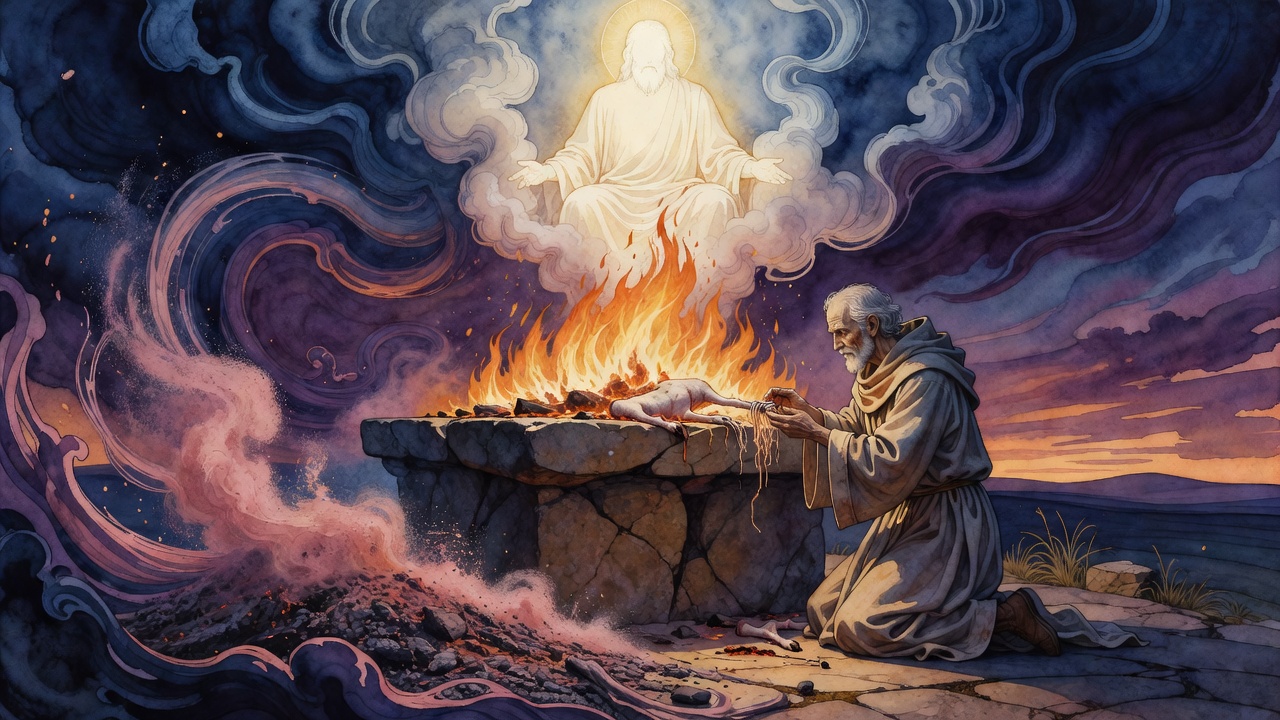
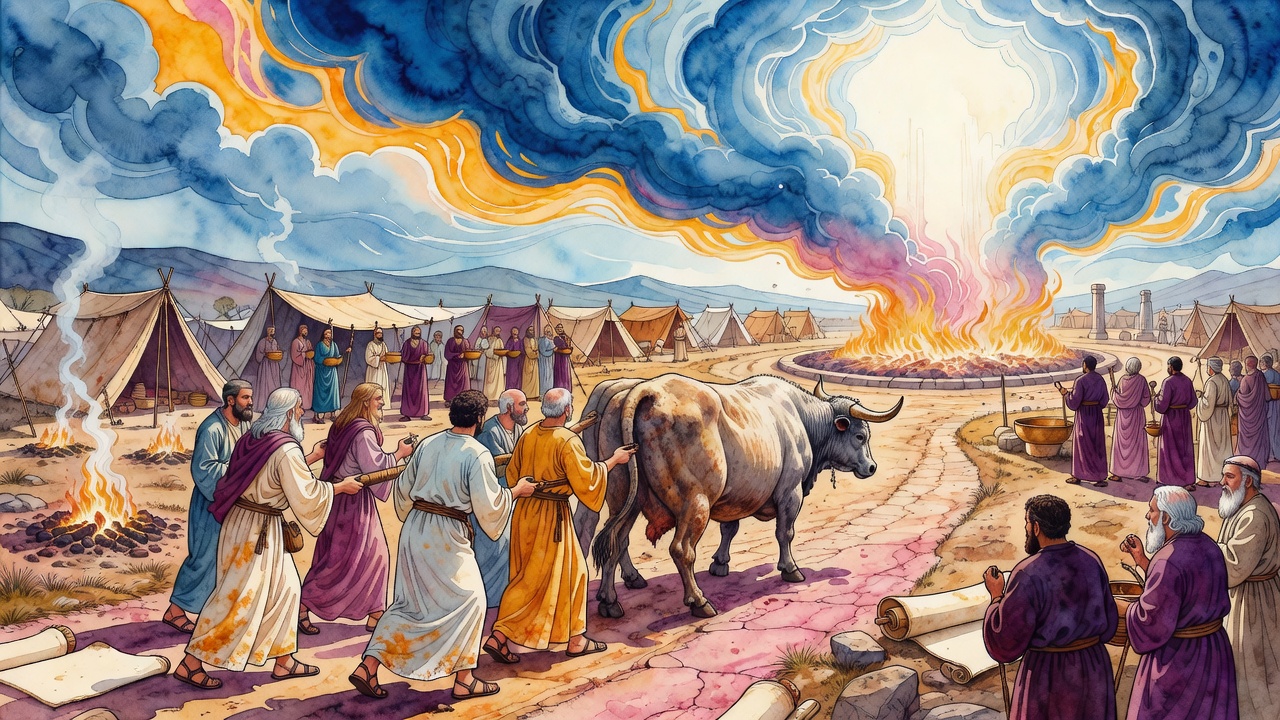
The priest lifted the afternoon tamid and felt the day close like a door. Smoke from the morning lamb still clung to the courtyard stones. Between those two continual offerings every other gift had to find its hour, and after the evening lamb nothing new was allowed to climb. The rule was a pair of bookends made of fire. He set the lamb on the wood and watched fat catch. Sunset pressed red along the western wall. Somewhere beyond the gates, Jerusalem turned toward sleep. Inside the court the altar still owed the night its work.

He remembered the order Abaye later set down from received tradition and from Abba Shaul. First the great wood arrangement, because its atonement is the work that holds every later act. Then the clearing of ash. Then the slaughter of the morning tamid. Then the lighting of the lamps, the incense, the meal, the pancakes, the libations, the additional festival offerings when the calendar demanded them. Sequence was not decoration. Sequence was how holiness kept from tripping over itself at dawn.

Tonight the order had already run its course. What remained were limbs and fat pieces already placed, still hungry for flame after the sun went down.

Creatures of the Night on the Fire

Some gifts to God are creatures of the night. Burnt-offering limbs may be laid as the sun sinks and left to smolder until dawn. Daytime measures are different. The handful of meal, the frankincense, the incense, the priestly meal offerings answer to daylight rules and do not stretch into the dark the same way. The priest knew the difference in his wrists. Meat that springs off the fire he gathers back. Grains of incense that leap from the flame, even the smallest, he does not return. Incense has already done its work. The fire does not call it home.

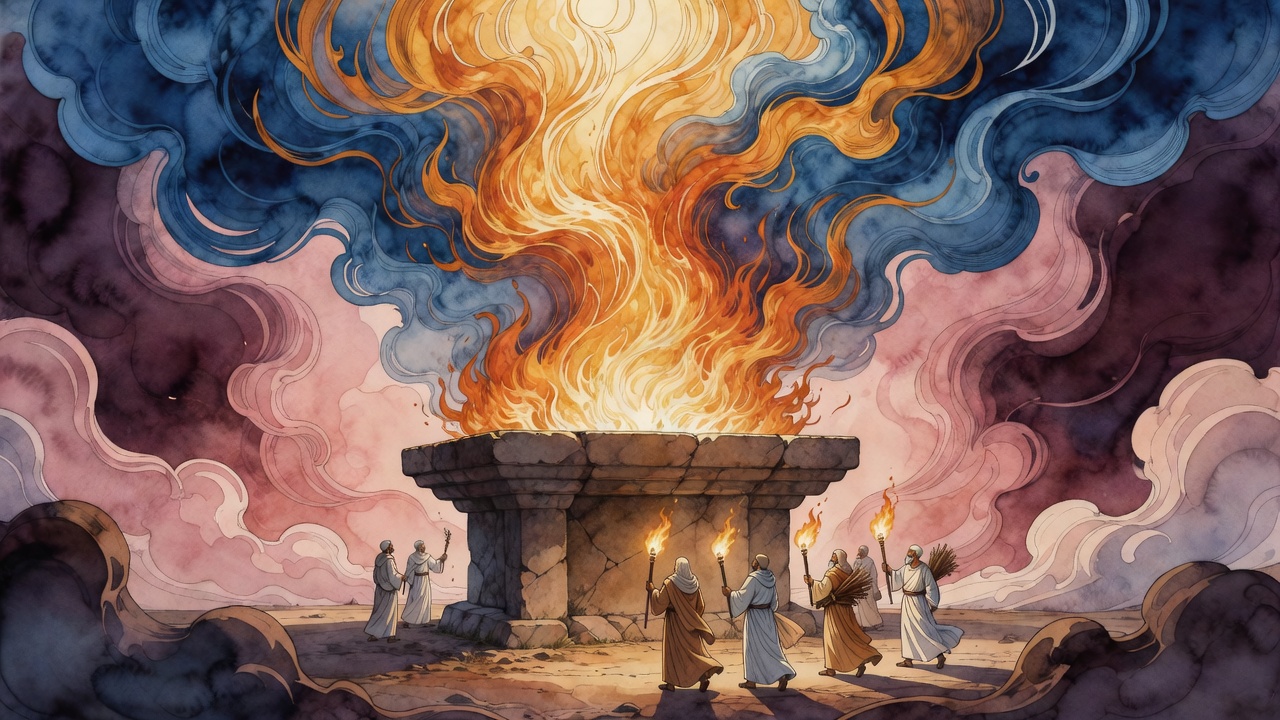
He raked a glowing coal toward a stubborn piece of fat. Sparks rose and died against the stars. The evening tamid had sealed the day, yet leftovers already dedicated were not a second opening of the altar. They were the fire finishing what the day had begun. Rav Huna would later split the verses that way. Ordinary order ends with the evening lamb. Night burning belongs to what was already on the wood.

A junior priest whispered that the ash looked ordinary enough to sweep for private use. The senior did not answer. The mound at the summit, the tapuach, the apple-shaped heap, still wore the fingerprints of the holy.

The Apple of Ash at the Summit

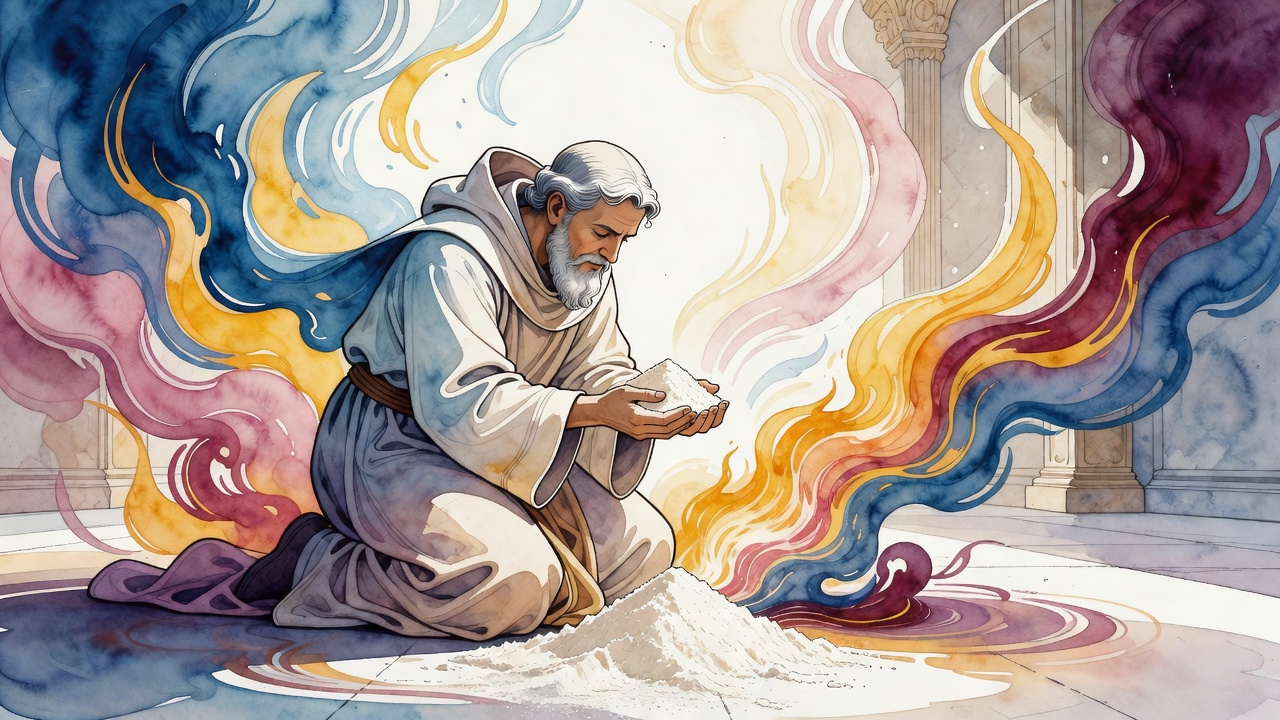
Once the fire finished its work, ash settled into a small crown at the top of the altar. Rav and his peers would argue whether that ash remained sacred property or had become ordinary once its purpose was served. The argument was not about thrift. It was about the threshold after service, the in-between status of something finished that still bears the mark of the altar.

The priest set his foot on the ramp and felt heat through the sole. He would not scrape a finger of that heap for a household pot. What once belonged to the altar does not lose its dignity all at once. Even waste that looks like waste can still be off limits. The night wind cooled the edges of the mound and left the center warm. He left it alone.

Below, the courtyard channel carried the day's blood away. Above, the ash waited for morning removal under the same discipline that had opened the day with wood and the morning lamb.

Morning by Morning, Day by Day

Abaye's choreography returned in the priest's mind like a drum. One phrase hurries a rite forward. Another holds it back. "Morning by morning" against "day by day." The service moves because someone remembers which act must come first so the next can stand clean. Without the great wood, later atonement has no floor. Without the first tamid, the day has no mouth. Without the last tamid, the day has no seal.

He thought of the people who would rise outside the walls and never see this order. They would smell smoke and call it religion. On the stones it was sweat, timing, and the refusal to let hunger for speed scramble the sequence. A festival's additional offerings still had to wait their place. Pancakes and libations still had to follow their cues. Holiness is a schedule kept under pressure.

A dog barked in the lower city. The priest did not turn. The fire needed another limb before midnight if the fat was to finish by first light.

What the Night Was For

He fed the fire until the piece sank into coal. No new offering arrived after the evening seal. No private hand reached for the ash. The altar kept its dignity through the dark the way a locked gate keeps a street from becoming a market. When dawn came, the same hands would clear ash, arrange wood, and open the day again with the morning lamb. Night had not been emptiness. Night had been the fire's second shift, the honest completion of what the sun had already claimed.

The priest wiped grease on a cloth reserved for the court and stood a moment with his face to the heat. Somewhere a child would wake and think the Temple never slept. He knew better. The Temple slept in order, woke in order, and burned between the two according to law. That was enough glory for one night on the stones.


← All myths
From the tradition

Sources

4 sources

The texts behind this telling. Some cards carry a translation of the source; others are our own retelling of it, and each card says which. Every card links out to the original.

Yalkut Shimoni on Torah 480:4Yalkut Shimoni on Torah

Translation of the source text.Torat Emet (Yalkut Shimoni) · CC-BY-NC

It was taught: I would know only of things whose manner is to be offered at night, such as the limbs and the fat-pieces, which one brings up and burns from sunset and which go on being consumed all through the night. As for things whose manner is to be offered by day - such as the handful of meal, the frankincense, the incense, the meal offering of priests, the meal offering of the anointed priest, and the meal offering accompanying libations - from where do we learn that one may bring them up and burn them from sunset? [The objection:] From sunset? But you said their manner is to be offered by day! Rather, the question is: From where do we learn that if one brought them up at sunset, so that they go on being consumed all through the night, this is valid? Scripture teaches, "This is the instruction of the burnt offering" - it included [these too].

But "at sunset" you do not find a case, since the fire must have taken hold in the greater part of the offering [before nightfall]. This is no difficulty: here the concern is the catching of the fire, and here it is the rendering permissible. Rabbi Eliezer teaches it as "from sunset" and applies it to the portions that have sprung off the altar. And likewise Rabbi Yannai said it applies to portions that have sprung off. But did not Rabbi Yannai say: Incense that has sprung off the top of the altar, even its tiniest grains, one does not return them? For Rabbi taught: "Which the fire consumes the burnt offering upon the altar" - the consumed remains of a burnt offering you return, but you do not return the consumed remains of the incense. Remove the incense from here, and so forth.

Full source
Yalkut Shimoni on Torah 482:3Yalkut Shimoni on Torah

Translation of the source text.Torat Emet (Yalkut Shimoni) · CC-BY-NC

Abaye arranged the order of the daily service according to the tradition and in accord with Abba Shaul. The great arrangement precedes the second arrangement of incense, as it was taught: "It is the burnt offering on its firewood upon the altar all night until morning" - this is the great arrangement; "and the fire of the altar shall be kept burning on it" - this is the second arrangement of incense. Perhaps I should reverse it? It stands to reason that the great arrangement takes precedence, for its atonement is greater. On the contrary, the second is preferable, since its coals are brought inside! Even so, the one whose atonement is greater is preferable. Or say: if one finds no wood for the second arrangement, does one not bring it from the great arrangement?

The second arrangement of incense precedes the laying of the two logs of wood, as it is written, "and the priest shall burn wood on it morning by morning" (Leviticus 6:5) - "on it" and not on its fellow, implying there is a fellow. But this "on it" is needed for itself! Two instances of "on it" are written. The laying of the two logs precedes the clearing of the inner altar; for although here it is written "morning by morning" and there "morning by morning," even so that which makes possible the offering is preferable. Is this comparable? What is it that makes the second arrangement possible? The two logs of wood. The laying of the two logs is done for the great arrangement! Rabbi Yirmeya said: simply more wood. Ravina said: since he has begun with the arrangement, he completes it. Rav Ashi said: the logs of wood enable the incense, for if one finds no wood for the second arrangement, does one not bring coals from the great arrangement?

The clearing of the inner altar precedes the trimming of five lamps. What is the reason? Abaye said: I have it as a tradition; the reasoning I do not know. Rava said: it is like Resh Lakish, who held that one does not pass over the commandments; and when he meets one first, it is the altar he meets first - for it was taught: the table stood in the north, drawn two and a half cubits from the wall, and the menorah in the south, drawn two and a half cubits from the wall; the altar was centered and stood in the middle, drawn a little outward. Let us tend them together! Since it is written, "and the menorah opposite the table" (Exodus 26:35), we require that they face one another. Rava said: learn from Resh Lakish that to pass the strap over the head-phylactery is forbidden.

The trimming of five lamps precedes the blood of the daily offering; the blood of the daily offering precedes the trimming of two lamps. What is the reason? Abaye said: that "morning by morning" of the two logs of wood, which is not needed, cast it here and there: cast one to the trimming of five lamps, that it precede the blood of the daily offering, and cast one to the blood of the daily offering, that it precede the trimming of two lamps - here three and there two. And cast one to the blood of the daily offering that it precede the trimming of two lamps; for although here two and there two, the one that atones is preferable. Rav Pappa said to Abaye: say rather, cast one to the clearing of the inner altar that it precede the blood of the daily offering, three here and two there, and cast one to the blood of the daily offering that it precede the trimming of five lamps - although here two and there two, the one that atones is preferable. If so, by what do you interrupt between them? This works well for Resh Lakish, who said: why do they trim and trim again? To rouse the whole courtyard. But for Rabbi Yochanan, who said "morning by morning" means divide it into two mornings, what is there to say? Ravina said to Rav Ashi: this "morning" of the wood, is it superfluous? It is needed for itself, since the Merciful One said let it precede the second arrangement of incense! He said to him: did we not establish "on it" and not on its fellow, implying there is a fellow? And why is it that he does the trimming of five lamps first? Let him do the trimming of two lamps. Since he has begun, he does the greater part. Then let him do six! Scripture says, "when he trims the lamps," and lamps are no fewer than two. The trimming of two lamps precedes the incense, for Scripture says, "morning by morning when he trims the lamps," and afterward "he shall burn it." The incense precedes the limbs, for it was taught: let the thing of which "morning by morning" is said precede the thing of which only one morning is said. The limbs precede the meal offering, for it was taught: from where that nothing should precede the morning daily offering? As it is said, "and he shall arrange the burnt offering on it" - and Rava said: "the burnt offering," the first burnt offering. The meal offering precedes the pancakes; burnt offering and meal offering. The pancakes precede the libations, the name "meal offering." The libations precede the additional offerings; sacrifice and libations. The additional offerings precede the bowls of frankincense - but was it not taught that the bowls precede the additional offerings? It is a dispute of Tannaim, for it was taught: the additional offerings precede the bowls; Rabbi Nechemya says the bowls precede the additional offerings. Abaye said: it stands to reason like the one who says the additional offerings precede the bowls - did you not say "morning by morning" is to give precedence? Here too "day by day" is to delay. What is the reason of the one who says the bowls precede? He derives "statute, statute" from the pancakes. If he derives from there, let him derive the entire matter from there! For this purpose "day by day" is effective, to delay.

Full source
Yalkut Shimoni on Torah 484:3Yalkut Shimoni on Torah

Translation of the source text.Torat Emet (Yalkut Shimoni) · CC-BY-NC

From where do we know that nothing should precede the morning continual-offering? Scripture says "and he shall arrange upon it the burnt-offering." What is the proof? Rava said: "the burnt-offering" means the first burnt-offering. From where do we know that nothing should be delayed after the afternoon continual-offering? Scripture says "and he shall burn upon it the fats of the peace-offerings." What is the proof? The verse says "upon it" the peace-offerings, and not upon its fellow the peace-offerings.

Rava said to him: but perhaps it is peace-offerings that are not brought after it, yet a burnt-offering may be brought? Rather, Rava said: "the peace-offerings upon it" means: complete with it all the offerings, all of them. Rav Huna raised a contradiction: it is written (Exodus 23:18) "the fat of My festival-offering shall not remain overnight until morning", until morning it shall not remain, but all night long it may remain; and it is written "and he shall burn upon it the fats of the peace-offerings", "upon it" means complete all the offerings with it. He raised the contradiction and he himself resolved it: in a case where they were left over.

Full source
Yalkut Shimoni on Torah 483:4Yalkut Shimoni on Torah

Translation of the source text.Torat Emet (Yalkut Shimoni) · CC-BY-NC

It was stated: regarding one who derives benefit from the heaped ash that lies upon the altar, Rav said one does not incur the law of trespass against it, and Rabbi Yochanan said one does incur trespass against it. Before the removal of the ashes, all agree there is no dispute. When they dispute, it is after the removal of the ashes. Rav holds one does not incur trespass, for its commandment has already been fulfilled. And Rabbi Yochanan holds that since it is written "and the priest shall put on his linen garment" (Leviticus 6:3), since the priest still requires the priestly garments for the act, the ash remains in its sanctity.

Full source