5 min read

They Carried the Bull Past Three Camps to Burn

Priests hauled a communal bull beyond Israel, Levites, and the sanctuary ring. Blood had already spoken inside. The body still had to die in the right dirt.

Curated by Arthur · Told by Maggid ·
Table of Contents
  1. Hands on the Head in the North
  2. Blood at the Outer Foundation
  3. Beyond Three Rings of Camp
  4. What the Channel Took and What the Fire Took
  5. The Heart That Had to Match the Act
They Carried the Bull Past Three Camps to Burn Click for full size

Hands on the Head in the North

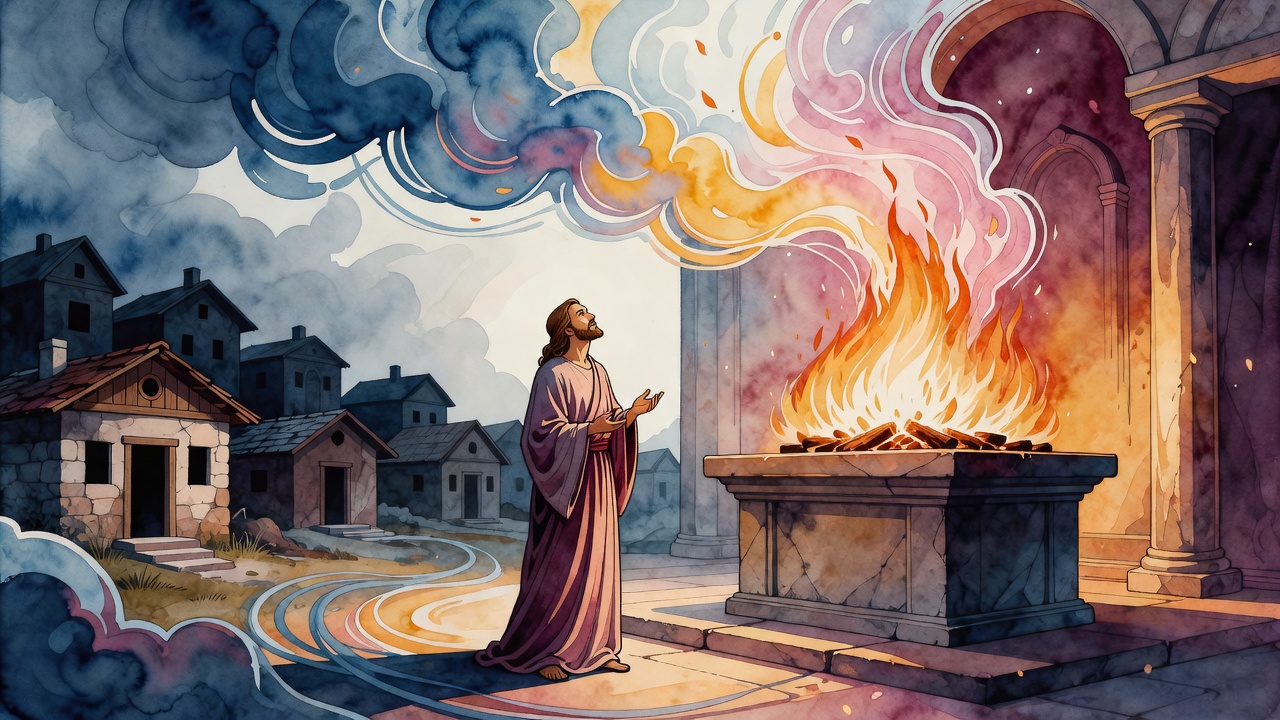
The man pressed both palms onto the bull's skull until the hide shifted under his weight. The courtyard's north wind cut through linen. Slaughter for this sin offering had to happen in the north, and the blood had to be caught in the north, as if geography itself were part of confession. He had come for idolatry's shadow, for the dread that a community's failure needs a body large enough to carry communal shame. The wording that stretches laying-on-of-hands even to such a case left him no soft exit. The bull waited. The knife waited. The priests waited with a basin that would not leave the north until it was full.

When the cut came, heat and salt filled the air. Blood rose in the vessel the way a verdict rises in a court. Intent mattered. A bull slaughtered for the wrong purpose is not a machine that still atones. "Sin-offering" and the tight little word "it" demand that every act be done for this work and this animal. Atonement is not automatic. It depends on the right act, in the right place, with the right heart.

Blood at the Outer Foundation

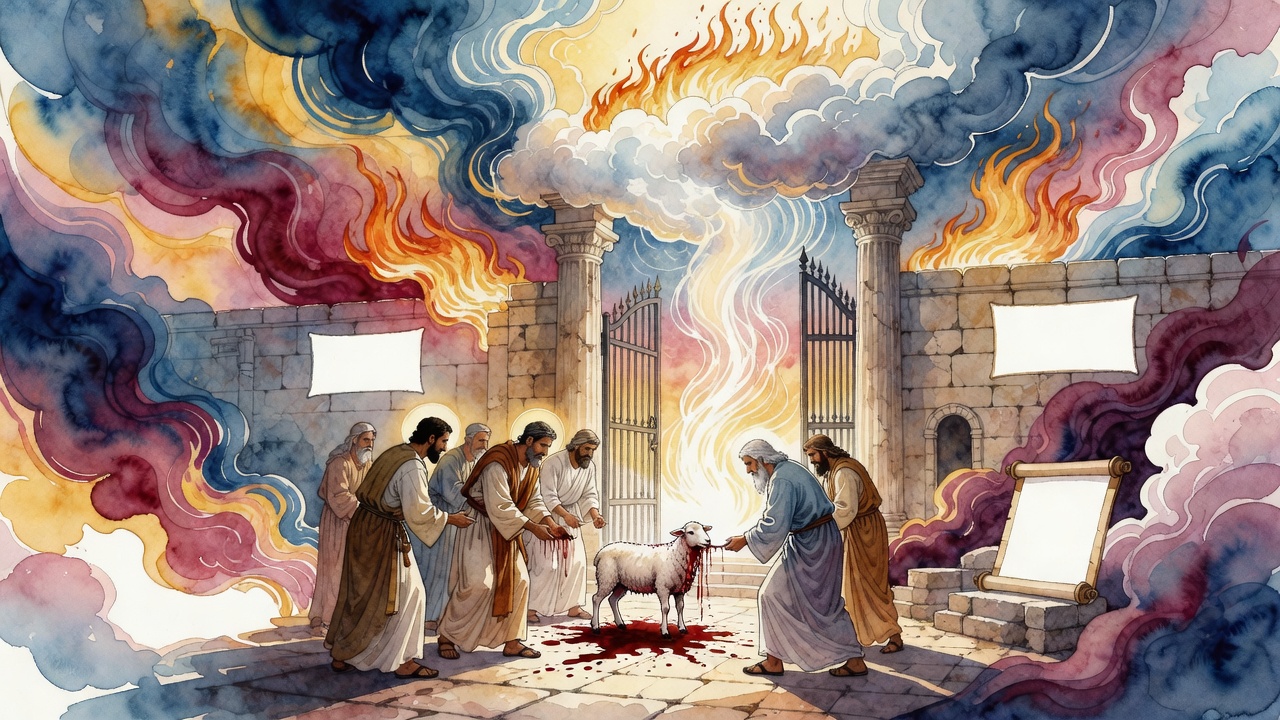
They did not take this blood to the base of the inner golden altar. The command sends sin-offering blood to the foundation of the great outer altar, the altar of the burnt offering. Rabbi Ishmael presses the logic hard. Even leftover blood that accomplishes no atonement on its own still earns a precise pouring place. Direction is not a shrug. The priest faces as the law teaches. Fat follows the pattern already set for the peace offering: covering fat, membrane, kidneys, lobe of the liver, all measured against the earlier model so the service moves as one coherent act.

Four applications left their mark. Remainder from the cup that completed the work went to the foundation. Other cups drained toward the courtyard channel, unless the stricter reading of Rabbi Elazar son of Rabbi Shimon claimed every leftover for the base. A single repeated word became the hinge on which the blood's fate turned. The man who had laid hands watched red run where the stones met earth and felt no relief yet. The bull's body still lay heavy, unfinished.

Beyond Three Rings of Camp

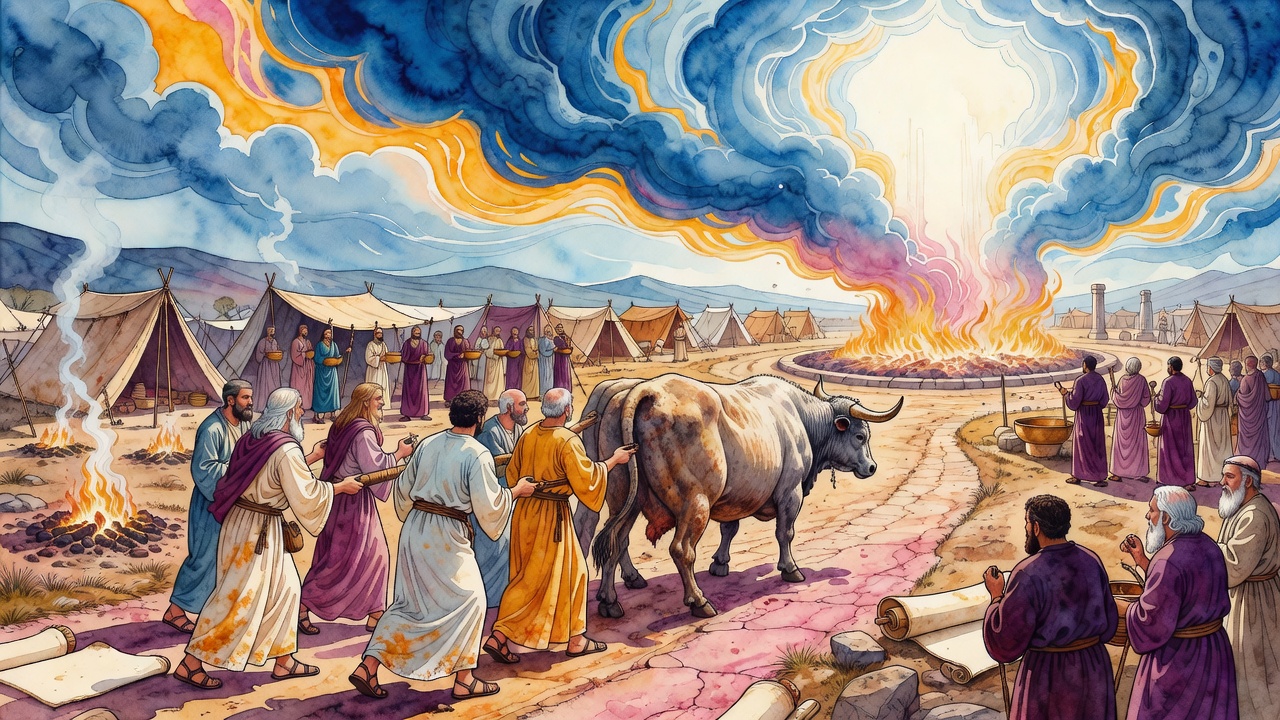
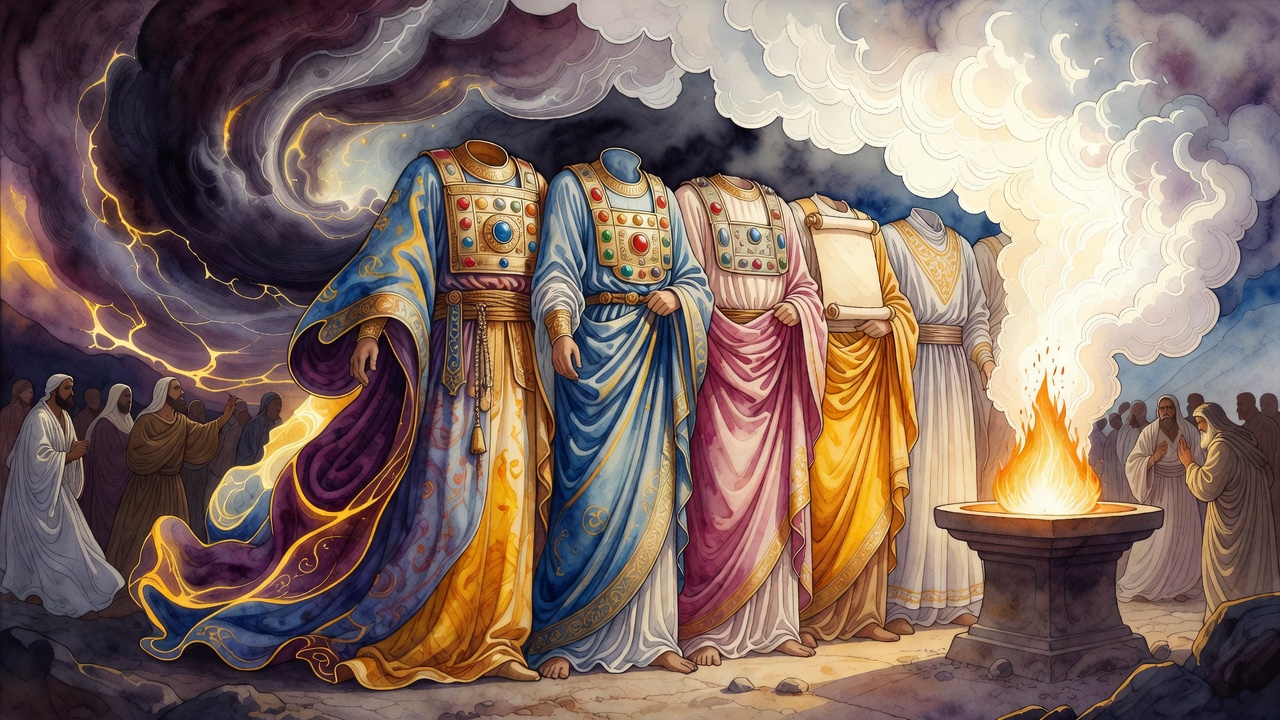
Once the blood had done its work inside, the carcass had to leave. Not just beyond the inner court. Beyond all three camps that ringed the sanctuary in the wilderness pattern: the camp of the Divine Presence, the camp of the Levites, the camp of Israel. The burning place sat outside that triple ring, as if communal sin must be carried past every circle of belonging before fire may finish it.

Priests and helpers took the weight. Hide scraped shoulders. The walk was long enough for silence to grow ugly. Children peered from tent flaps and were pulled back. The animal had to remain fit at the point of burning; a disqualification on the road would waste the whole chain of intent. They crossed thresholds that smelled of cooking pots, then of Levitical storage, then of pure court dust, and finally of open scrub where the wind did not care about holiness.

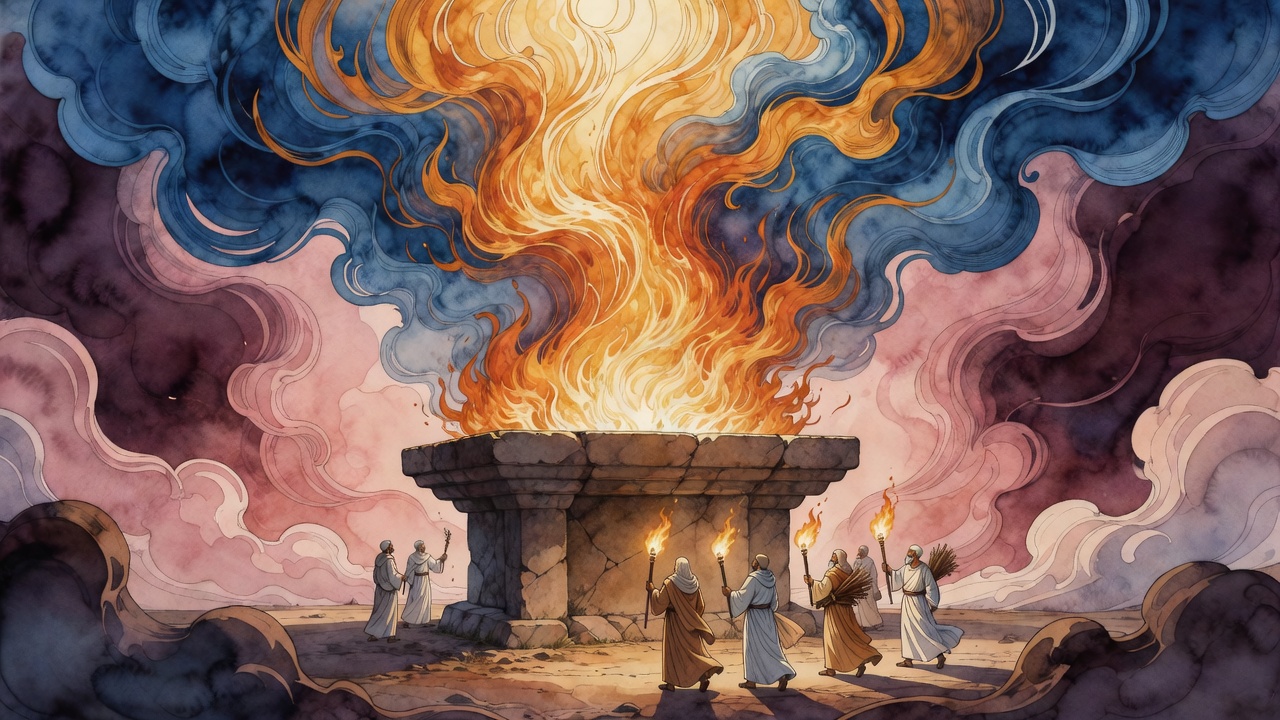
At the pit they stacked wood. Flames took skin and flesh and the parts the altar had not claimed. Smoke climbed without the courtesy of courtyard walls. The man who had confessed on the head stood far enough back that sparks could not reach him and still close enough that he could not pretend the bull had vanished into a metaphor.

What the Channel Took and What the Fire Took

Back in the court, blood that belonged to the foundation had already sunk into sacred base. Blood meant for the channel was already leaving toward the Kidron's cousins in later ages, or toward wilderness runoff in the first pattern. The split is not cruelty. It is map-making. Some blood speaks upward from the altar's foot. Some blood exits so the court does not drown in what it has received.

The fire outside spoke a different sentence. Inside, life is applied with precision. Outside, the remainder of the body is reduced until nothing of the communal failure can be butchered for a feast. The bull does not return as stew. It returns as ash on wind that has already crossed three camps.

Night found the man washing. Water ran pink off his wrists. He had wanted a quicker mercy. The rite gave him distance, geography, and heat instead.

The Heart That Had to Match the Act

By morning the outer smoke was a gray smear on memory. The altar's foundation held its dried testimony. The north of the court looked ordinary again, which is how ordinary places hide their hardest work. He understood, without liking it, that communal atonement is a procession. Hands, north, blood, foundation, three camps, fire. Skip a station and the chain breaks. Perform every station with a crooked intent and the chain was never whole.

He walked back through the camp of Israel and did not speak of the bull. Speech would have made it smaller. The body had already said enough, burning past the last ring where the people sleep.


← All myths
From the tradition

Sources

3 sources

The texts behind this telling. Some cards carry a translation of the source; others are our own retelling of it, and each card says which. Every card links out to the original.

Yalkut Shimoni on Torah 469:23Yalkut Shimoni on Torah

Translation of the source text.Torat Emet (Yalkut Shimoni) · CC-BY-NC

"And he shall bring forth the bull outside the camp" (Leviticus 4:21), outside the three camps. "And he shall burn it", while fit, and not unfit. "As he burned the first bull", from here they said: the bull of the anointed one and the bull of the congregation stand together; the bull of the anointed one takes precedence over the bull of the congregation in all its rites. One might think the idolatry goats should also precede it. And it would follow by reasoning: if a single bull takes precedence over it, should not a bull and a goat take precedence over it? Scripture says "the first bull", and the idolatry goats are not first. "The sin-offering of the assembly": Scripture made it a paradigm for every sin-offering of the assembly, that it be burned. One might think even the festival goats; Scripture says "it." And what did you see to include the idolatry goats and to exclude the festival goats? After Scripture included and excluded: just as these are distinct in that they come for a transgression of a known commandment, the festival goats are excluded, since they do not come for a transgression of a known commandment. But is not the goat of the Day of Atonement not brought for a transgression of a known commandment, and yet it requires burning? Rather, just as this one is distinct in that its blood is brought into the innermost chamber, the festival goats are excluded, since their blood is not brought into the innermost chamber. "Sin-offering", that all its rites be for the sake of a sin-offering. "It", to exclude the case where he slaughtered it not for its own sake.

Full source
Yalkut Shimoni on Torah 469:33Yalkut Shimoni on Torah

Translation of the source text.Torat Emet (Yalkut Shimoni) · CC-BY-NC

"And its blood he shall pour out at the foundation of the altar of the burnt offering" (Leviticus 4:25) and not at the foundation of the inner altar. Rabbi Ishmael said: If the remnants of a sin offering, which do not effect atonement, are placed upon the foundation, then the first blood of the burnt offering, which does effect atonement, surely it is fitting that it be placed upon the foundation. If so, why is it stated "at the foundation of the altar of the burnt offering"? It means the foundation that is on the side of the altar where the burnt offering is offered. "At the foundation of the altar of the burnt offering, which is at the entrance of the Tent of Meeting" - this is the southern foundation. One might think it is the western foundation. You say no: just as we find when he comes out from the Sanctuary he places the blood only on the foundation nearest to him, so too when he comes down from the altar he places the blood only on the foundation nearest to him, and which is that? The southern foundation. "And all its fat he shall burn upon the altar like the fat of the sacrifice of peace offerings" (Leviticus 4:26): just as is specified for the peace offering - the fat that covers, the membrane that is peeled off, the two kidneys and the lobe - so too here, the fat that covers, the membrane that is peeled off, the two kidneys and the lobe.

Full source
Yalkut Shimoni on Torah 469:38Yalkut Shimoni on Torah

Translation of the source text.Torat Emet (Yalkut Shimoni) · CC-BY-NC

"And he shall lay his hand upon the head of the sin offering" (Leviticus 4:29) - to include the sin offering for idolatry in the laying on of hands. "And he shall slaughter the sin offering in the place of the burnt offering" - that its slaughter be in the north. "In the place of the burnt offering" and "the priest shall take" (Leviticus 4:30) - that the receiving of its blood be in the north. From here they said: if he slaughtered in the north and received in the south, or in the south and received in the north, it is invalid, until he slaughters in the north and receives in the north. "And all its blood he shall pour out" - above [in an earlier passage] it says "and its blood he shall pour out" (Leviticus 4:25), and below it says "and all its blood he shall pour out." From where do you say that a sin offering whose blood was received in four cups, and he gave from this one a single application and from that one a single application - one might think they all are poured out upon the foundation? The verse teaches "and all its blood he shall pour out." One might think that even if he gave only from one of them the four applications, they all are poured out upon the foundation; the verse teaches "and its blood he shall pour out." How so? That one [the cup used] is poured out upon the foundation, and the others are poured out into the channel. Rabbi Elazar son of Rabbi Shimon says: from where that even if he gave only from one of them the four applications, they all are poured out upon the foundation? The verse teaches "and all its blood he shall pour out."

Full source