5 min read

The Handful That Failed for Want of One Grain

In the Temple a priest curled flour into his palm until the measure looked perfect. One missing grain made the whole handful invalid for the altar fire.

Curated by Arthur · Told by Maggid ·
Table of Contents
  1. The Hardest Service
  2. Fullness Said Twice
  3. What May Not Climb the Ramp
  4. Fat for the One Who Spoke
  5. The Second Try
The Handful That Failed for Want of One Grain Click for full size

The Hardest Service

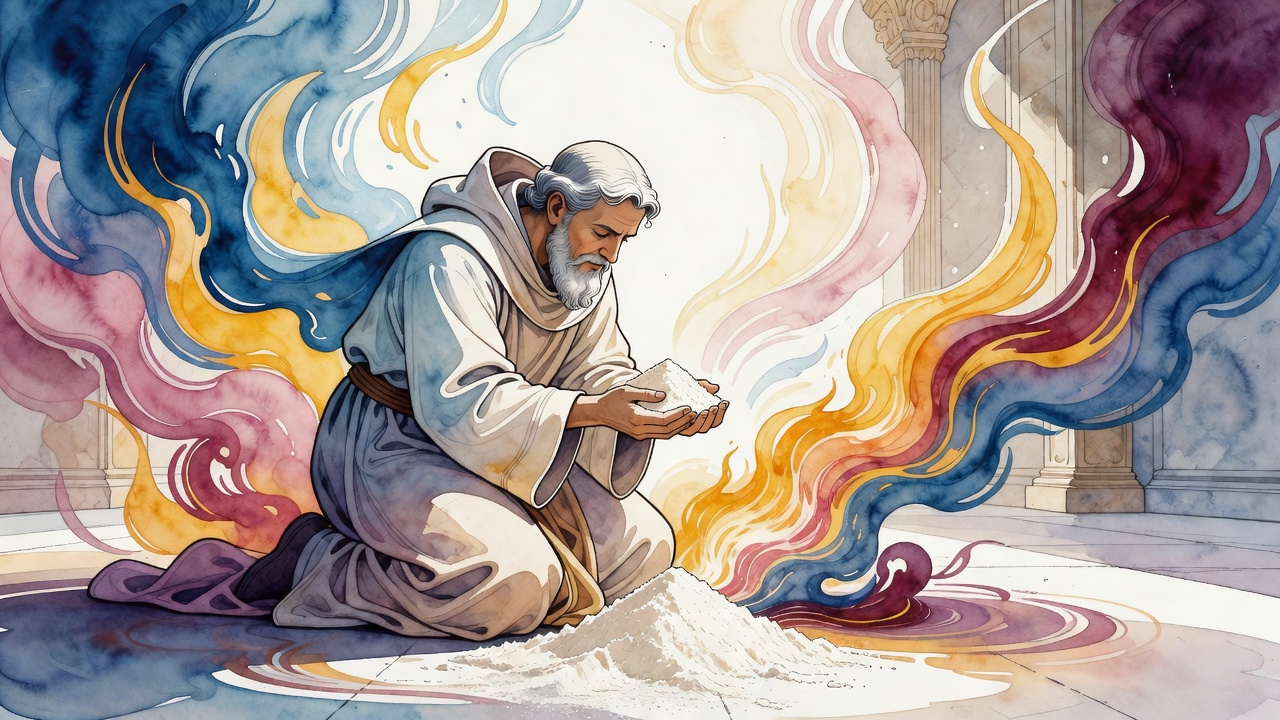
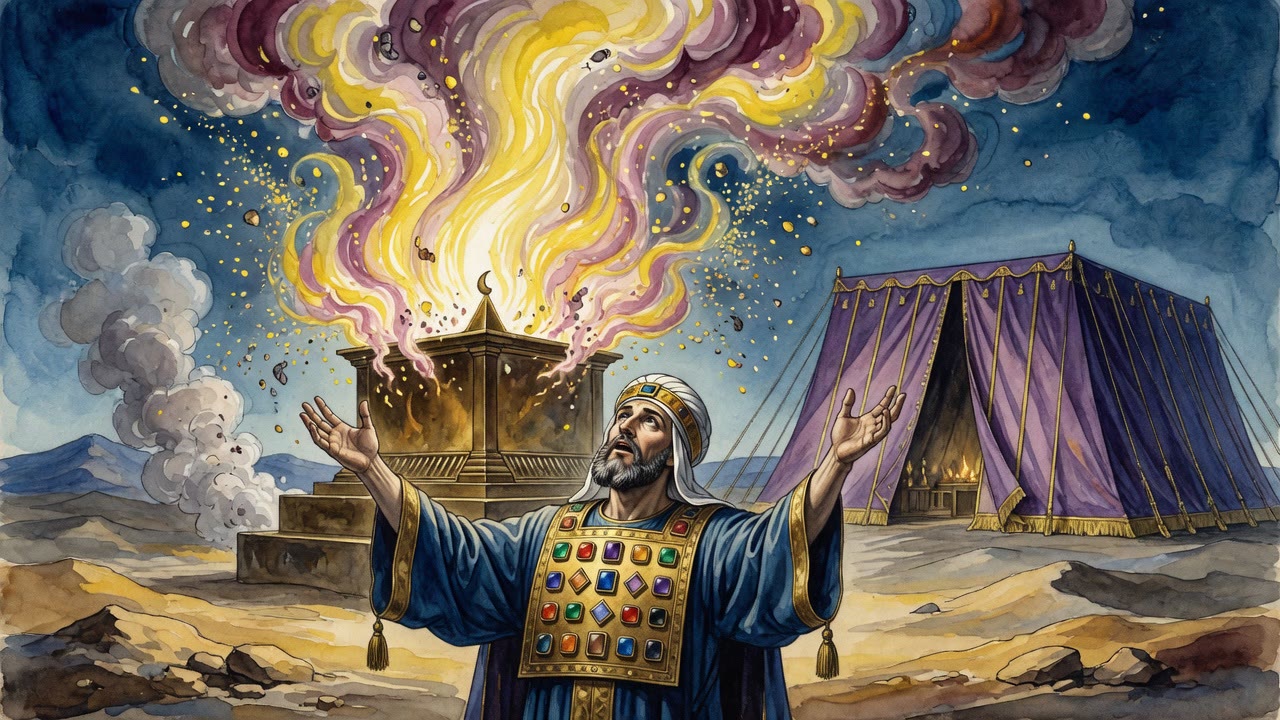
The priest's hand shook once, then steadied. Flour for a meal offering baked in a pan waited in the measure. He smoothed overflow with his thumb across the top and his little finger beneath until the curled palm held exactly enough, no more, no less.

The sages call this the hardest service in the Temple. Not the blood. Not the fire. The quiet demand for a complete handful.

He breathed. The grain settled. For a heartbeat he thought it was whole.

Sun cut through the courtyard haze and found the white dust on his wrist. Other priests moved with animals and knives. His war was smaller and somehow stricter.

A senior priest watched without speaking. Watching is also a service. Error loves an unwatched hand.

Fullness Said Twice

Scripture speaks of the fullness of his handful more than once. From the doubled wording the rabbis drew a strict rule. The smallest part is indispensable to the whole. If even a little is missing, what remains is not a valid handful at all.

The priest opened his fingers a fraction. A thread of flour escaped. The measure fell short by almost nothing. Almost nothing is enough to fail.

He did not argue with the air. He began again. The altar does not take nearly.

Shame heated his neck. In a place of public holiness, private embarrassment is still a teacher. He poured, smoothed, checked. The second attempt felt slower, as if time itself had become part of the measure.

"Fullness" said twice is not poetry for scribes. It is a wall against the human love of good enough.

What May Not Climb the Ramp

Elsewhere three teachers argue over sheep or goats for a burnt offering. "His offering" bars the stolen animal. A man cannot give what he does not own. Crossbred beasts are fenced out. Then the debate widens. Does past misuse, unlawful yoking, labor on sacred days, permanently taint the animal, or does the verse gather even wounded histories back in for certain freewill paths?

Rabbi Judah, Rabbi Simeon, and Rabbi Eliezer hear different exclusions and inclusions in the same short phrase. The common nerve is ownership and fitness. The gift must be truly yours and truly fit, or the fire is being asked to launder a theft.

The priest with flour understood the nerve in another medium. His handful had to be whole the way an offering had to be cleanly possessed.

A man once tried to bring a beast he had not paid for, hoping the smoke would blur the theft. The law does not blur. The priest's short handful was a quieter cousin of that failed trick. Heaven counts.

Fat for the One Who Spoke

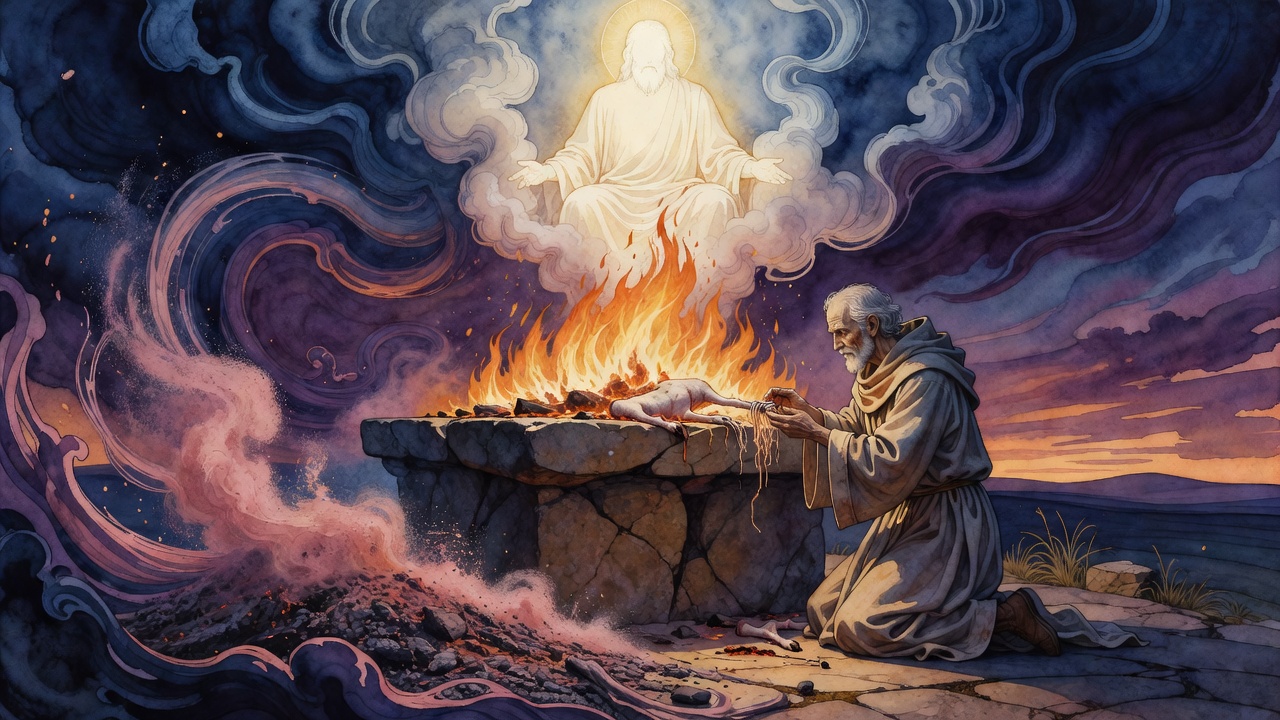
A freewill peace offering belongs to the individual, not the community. One heart overflows. One person brings. The pronoun "he" carries that weight. Priests cut the fat tail with care, not from the spine in a lazy line, but reaching the measure the law requires.

The fire is kindled for the sake of the One who spoke and the world came into being. Fats are called bread for the altar. Detail is not pedantry. Detail is how a body tells the truth to heaven.

The priest thought of that while flour dusted his wrist. A voluntary gift and an obligatory handful both refuse sloppiness.

Somewhere in the outer court a woman waited with a freewill gift she had saved for months. Her "he" was a "she" in the story of her heart, and the law still made room for a private overflow. The priest wanted his hands worthy of receiving such overflow when it came.

The Second Try

He filled the palm again. Thumb. Little finger. Breath held. This time the measure sat complete. He carried it toward the fire with the slowness of a man who has already failed once in public silence.

No trumpet announced the correction. No crowd cheered the grain that stayed. Only the altar received what the Torah asked, a whole handful, nothing missing, nothing stolen, nothing almost.

Smoke rose. The priest wiped his hands. Somewhere a poor man would later learn that a freewill gift is still his to bring. Somewhere a thief would learn his beast cannot buy him a clean name. And in the quiet between those lessons, a handful that once failed by one grain taught the priesthood that heaven counts the small as if it were the whole world, because sometimes it is.

That night he dreamed of flour and woke with his right hand already curled, practicing fullness in the dark. The Temple bells had not yet sounded. He smiled once, tired, and did not mind that the hardest service would be waiting again at dawn.


← All myths
From the tradition

Sources

3 sources

The texts behind this telling. Some cards carry a translation of the source; others are our own retelling of it, and each card says which. Every card links out to the original.

Yalkut Shimoni on Torah 449:4Yalkut Shimoni on Torah

Translation of the source text.Torat Emet (Yalkut Shimoni) · CC-BY-NC

For the pan offering and the deep-pan offering he wipes off the excess with the thumb above and with the little finger below, and this too is the hardest service in the Temple. The handful: its minimum is indispensable to its bulk. What is the reason? The verse says "the fullness of his handful" two times.

Full source
Yalkut Shimoni on Torah 445:6Yalkut Shimoni on Torah

Translation of the source text.Torat Emet (Yalkut Shimoni) · CC-BY-NC

"His offering" excludes the stolen animal. "From the sheep or from the goats" excludes the crossbred. You say these exclusions were stated for this purpose, or were they stated only to exclude an animal with which a transgression had been committed, or one that plowed with an ox and donkey together while it was consecrated, or mixed seeds in a vineyard, or work done in the Sabbatical year, on a festival, on the Day of Atonement, or on the Sabbath? Therefore Scripture teaches, "sheep for a burnt offering and goats for a burnt offering," to include all of them. These are the words of Rabbi Judah.

Rabbi Simeon says: Why does Scripture teach "sheep for a burnt offering and goats for a burnt offering"? To include the substitute animal. Is this not a matter of logic? If peace offerings, which are not fit to be brought from birds, have their substitute fit as a burnt offering, then a burnt offering, which is fit to be brought from birds, surely should have its substitute made fit. No: if you say so of peace offerings, which may be brought from females as from males, will you say the same of a burnt offering, which may not be brought from females as from males? Since it cannot be brought from females, perhaps its substitute should not be made fit either. Therefore Scripture teaches "sheep for a burnt offering and goats for a burnt offering," to include the substitute.

Rabbi Eliezer says: Why does Scripture teach "sheep for a burnt offering and goats for a burnt offering"? Because one might think only a surplus burnt offering may be brought as a burnt offering. How do we know to include the surplus of a sin offering, the surplus of guilt offerings, the surplus of the tenth of an ephah, the surplus of the bird offerings of men and women with a flux and of women after childbirth, and the surplus of the offerings of a Nazirite and a leper, and the case of one who consecrates his property and there are among it things fit for the altar, such as wines, oils, and birds? How do we know these are to be sold for the needs of that same kind, and burnt offerings brought with their proceeds? Therefore Scripture teaches "sheep for a burnt offering and goats for a burnt offering," to include all of them. But the Sages say: their proceeds fall to the freewill fund. Yet is not the freewill offering also a burnt offering? What then is the difference between Rabbi Eliezer and the Sages? When it comes as an obligation, one leans his hands upon it, brings its libations with it, the libations are from his own, and if he is a priest, its service and its hide are his. But when it comes as a freewill offering, one does not lean his hands upon it, does not bring libations with it, its libations are from the public funds, and even if he is a priest, its service and its hide belong to the men of the priestly watch.

Full source
Yalkut Shimoni on Torah 462:4Yalkut Shimoni on Torah

Translation of the source text.Torat Emet (Yalkut Shimoni) · CC-BY-NC

"If he offers a lamb" (Leviticus 3:7) - the first offspring is offered, the second offspring is not offered. "He" is offered, but the offspring of all consecrated animals are not all offered. The offspring of what? If of a burnt-offering or a guilt-offering, these are males and cannot bear young. If of a sin-offering, the law is received by tradition that it is left to die. To include the offspring of a tithed animal, why do I need a verse? Let us derive "passed, passed" - tithe from the firstborn: just as the firstborn does not have its offspring offered, since it cannot bear young, so too the tithe does not have its offspring offered. The verse was needed lest you say we do not derive what is possible from what is impossible; it teaches us that we do.

"He" - the individual brings freewill peace-offerings, but the community does not bring freewill peace-offerings. And if you should say I have already excluded the herd-animal, so that perhaps the community may not bring a herd-animal as a freewill peace-offering, since the community does not bring peace-offerings of this kind as an obligation, but the community may bring a flock-animal as a freewill peace-offering, since it does bring such offerings as an obligation - Scripture says "he," the individual brings freewill peace-offerings and the community does not bring freewill peace-offerings.

"And he shall offer from the sacrifice" (Leviticus 3:9-10) - even though he slaughtered them not for their own sake, even though he did not lay hands upon them. "A fire-offering to the LORD" - for the sake of fires to the LORD, for the sake of the One who spoke and the world came into being. "Its fat, the whole fat tail" - to include the fat adjoining the fat tail; this is the fat between the membrane, the words of Rabbi Akiva. Rabbi Yehuda says: "its fat, the fat tail" likens the fat tail to the fat - just as the fat falls under two prohibitions, so too the fat tail falls under two prohibitions. "The fat tail" - one might think he may fulfill the commandment of the fat tail; Scripture says "whole." One might think he may take it from the spine; Scripture says "close to the backbone." One might think along with the backbone; Scripture says "he shall remove it" - he reaches inside the backbone.

"And the fat that covers the entrails, and all the fat" - what does this teach? That one might think it is increased to include the fat of the flanks. And it is a logical argument: if the herd-animal, increased regarding libations, is lessened regarding the fat of the flanks, then the flock-animal, lessened regarding libations, surely should be lessened regarding the fat of the flanks. No: if you have said this of the herd-animal, which is lessened regarding the fat tail, will you say it of the flock-animal, which is increased regarding the fat tail? Since it is increased regarding the fat tail, it should be increased regarding the fat of the flanks. Therefore Scripture says "that covers the entrails and all the fat that is upon the entrails, and the two kidneys" - you have only what is stated in the matter. In the name of Rabbi Yishmael they said: because it was in the general category and went out to be treated as a new matter, Scripture returned it to its general category. "And he shall turn it to smoke" (Leviticus 3:11) - that he shall not mix the fats of one offering with the fats of another. "Bread, a fire-offering to the LORD" - to tell you that the fats are called bread. "Its fat, the fat tail" (this is written in Remez 443).

Full source