Parshat Shemini6 min read

The Day Fire Fell From Heaven on the Eighth Day

For seven days Moses assembled the Tabernacle and dismantled it again with no sign from God. Aaron froze at the altar on the eighth day before he could begin.

Curated by Arthur · Told by Maggid ·
Table of Contents
  1. Seven Days of Assembly and Disassembly
  2. Aaron Froze at the Corner of the Altar
  3. Why Moses Was Not the High Priest
  4. Fire From Heaven and What Followed

Seven Days of Assembly and Disassembly

Every morning for seven days, Moses assembled the Tabernacle, anointed every piece of it with oil, performed the required service, and then dismantled everything and put it back. Each day was complete and final in the sense that every instruction was followed. Each day ended with the Tabernacle taken apart again. He was being trained, or the priests were being trained through observation, or the space itself was being consecrated by repetition. Nobody said why. On the seventh day, according to Rabbi Yossi bar Rabbi Yehudah, Moses even assembled and dismantled the structure twice. Then the eighth day arrived.

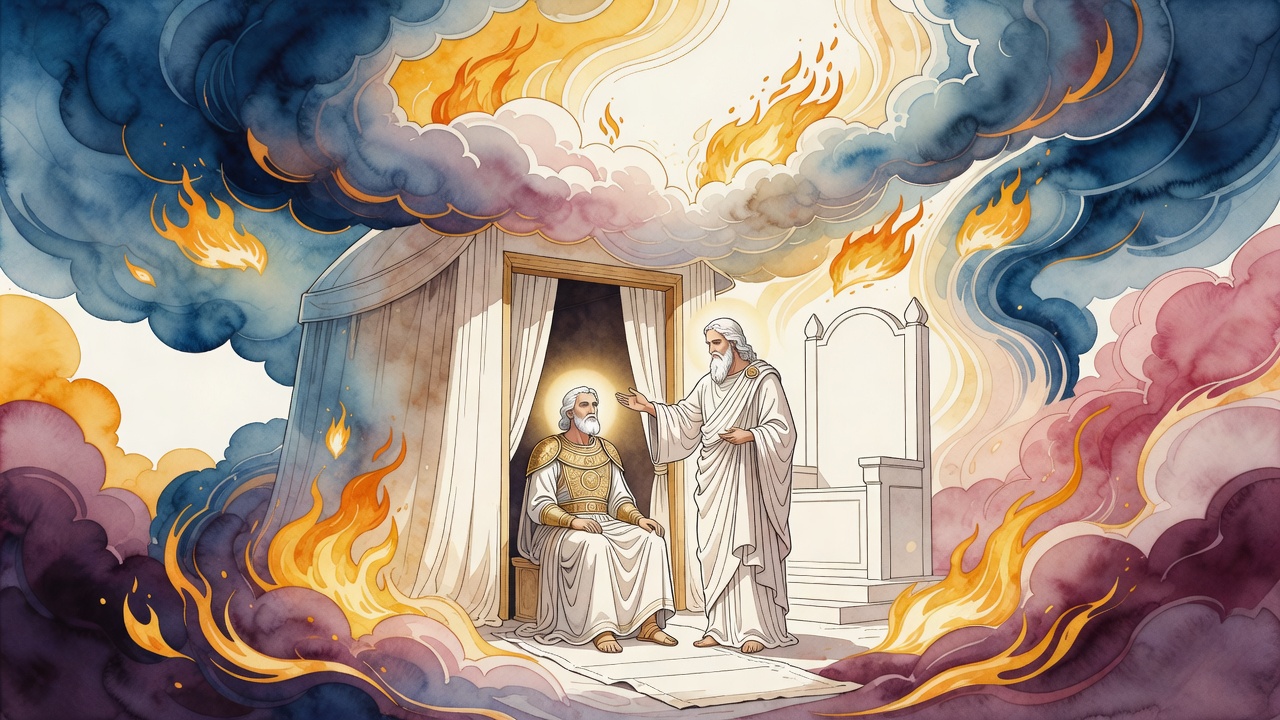
Moses had been afraid throughout the seven days. He had been holding in his mind the words God had spoken at Sinai: "the Tabernacle will be sanctified by my glory." He knew what that glory was. He had seen what happened at the mountain when glory arrived uncontrolled. He had served through all seven days waiting for the attribute of divine judgment to strike, performing the work trembling. On the eighth day he called Aaron and his sons and addressed them, and then he turned to the people and blessed them, and then he stepped back. Now it was Aaron's turn.

Aaron Froze at the Corner of the Altar

Aaron walked toward the altar to begin his first service as high priest. He took one step and stopped. The Targum Jonathan records what he saw: at the corner of the altar, the form of the calf. The Golden Calf. His own work, the idol he had fashioned when Moses was on the mountain and the people demanded a visible god. It stood at the corner of the altar where he was supposed to stand and perform the rites that would atone for Israel's sins. The shape of his worst act was waiting for him at the entrance to his new office.

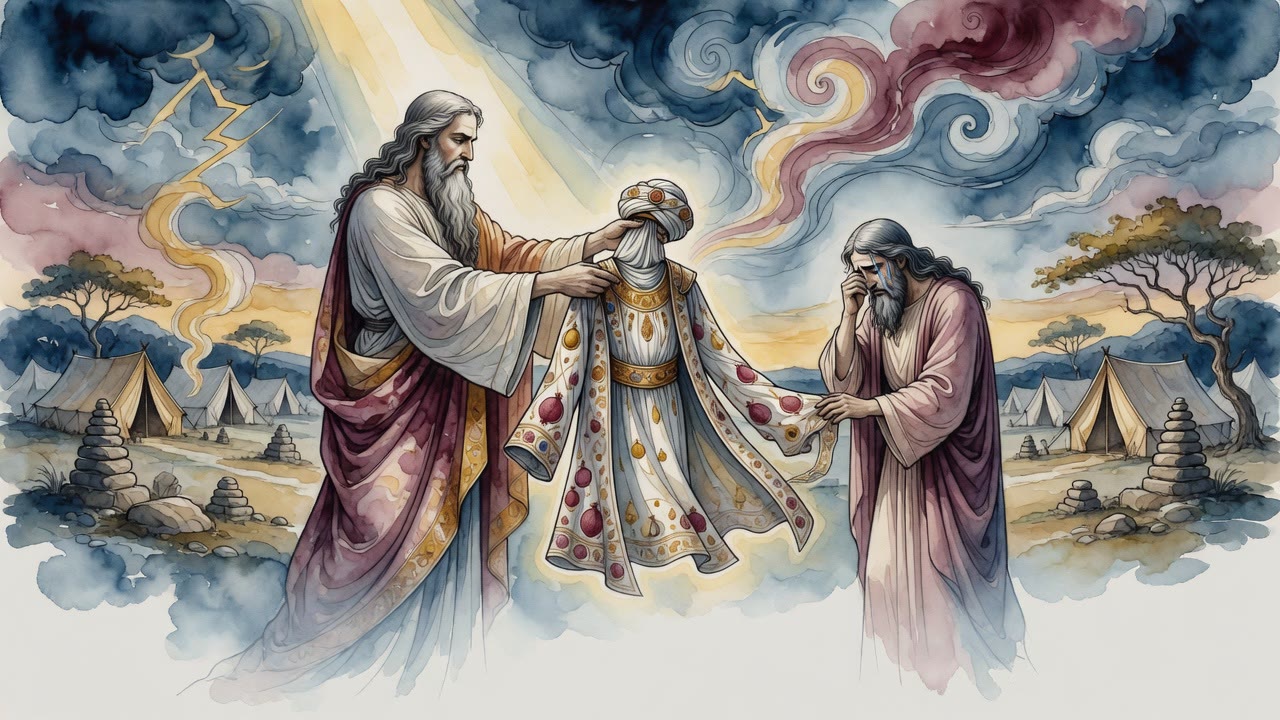
Moses came to him. "Take courage," he said. "Go near to the altar. Do not be afraid." He did not tell Aaron the vision was not there. He did not say it was an illusion. He told Aaron to approach it anyway. Aaron went forward. The Targum adds that every animal he sacrificed carried, in the arrangement of the smoke or the position of the offering, some echo of its own sin and the sin it was meant to atone for. Every step Aaron took at the altar was a step over his own history.

Why Moses Was Not the High Priest

Moses had expected to be the high priest. The expectation was reasonable. He had built the Tabernacle. He had led the seven days of consecration. He had performed every priestly service during those days with his own hands. He stood at the altar with full competence and complete knowledge of every requirement. When the eighth day arrived and he called Aaron forward, Moses understood that the call was the fulfillment of a debt he owed.

The debt went back to the burning bush. God had called Moses to the mission of the Exodus, and Moses had refused five times, and on the fifth refusal God's anger had kindled. The Rabbis traced the line from that anger directly to this moment: because Moses had declined at the bush and forced God to find an alternative spokesperson, the alternative speaker would inherit what Moses declined. God had said it plainly at the thornbush. "When the Tabernacle is built, Moses, you will imagine yourself the high priest. And then I will tell you to call Aaron instead." Moses had earned the call, and his brother would receive it. The eighth day was the payment date on an old account.

Fire From Heaven and What Followed

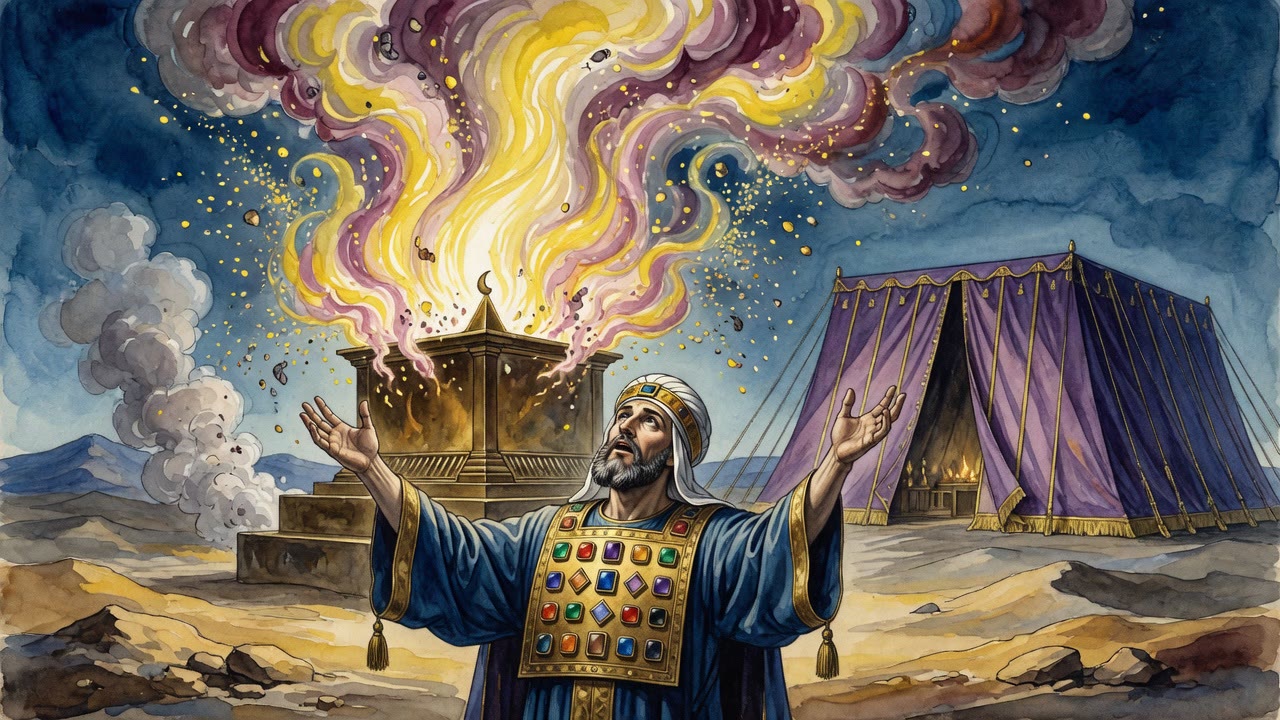
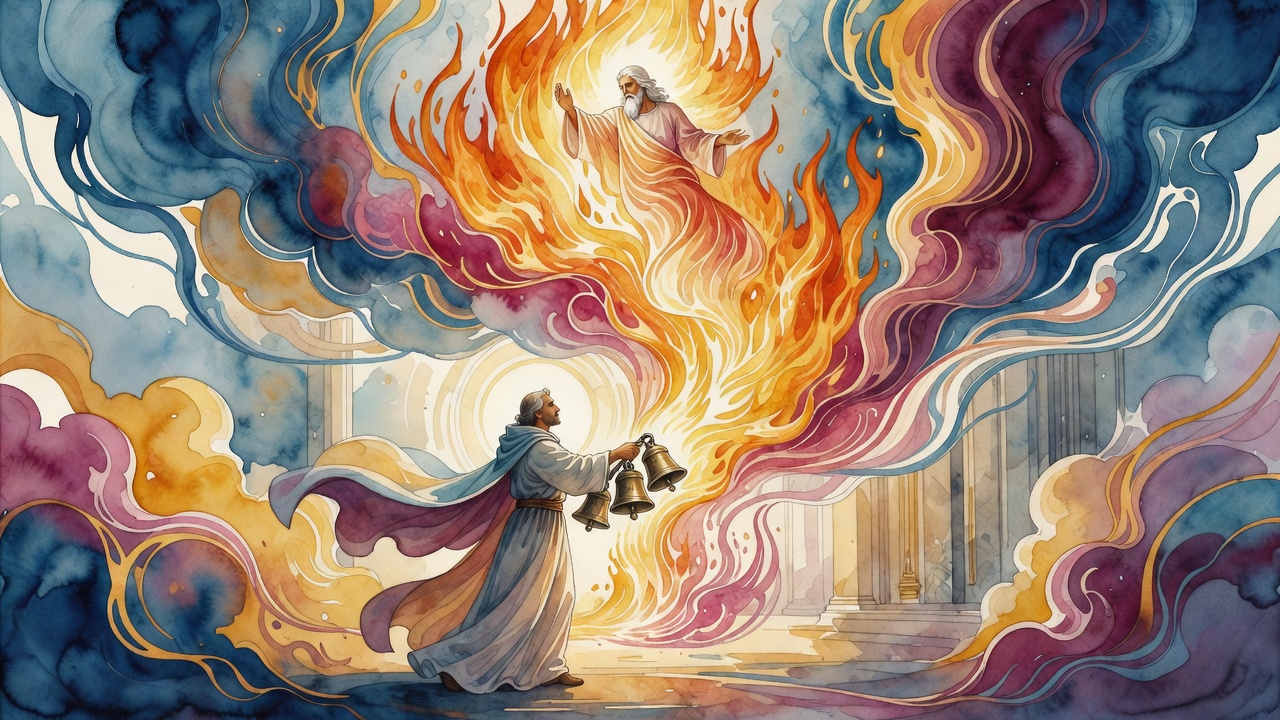
Aaron finished his offering. Moses and Aaron entered the Tent of Meeting together, and when they came out and blessed the people, the glory of God appeared to all of Israel. Fire came down from the sky and consumed the burnt offering on the altar. The people shouted and fell on their faces. The fire from God was the confirmation that everything that had happened during the seven days of preparation and throughout the eighth day's service was accepted. The Tabernacle was operational. The presence of God had taken up residence in the structure Israel had built.

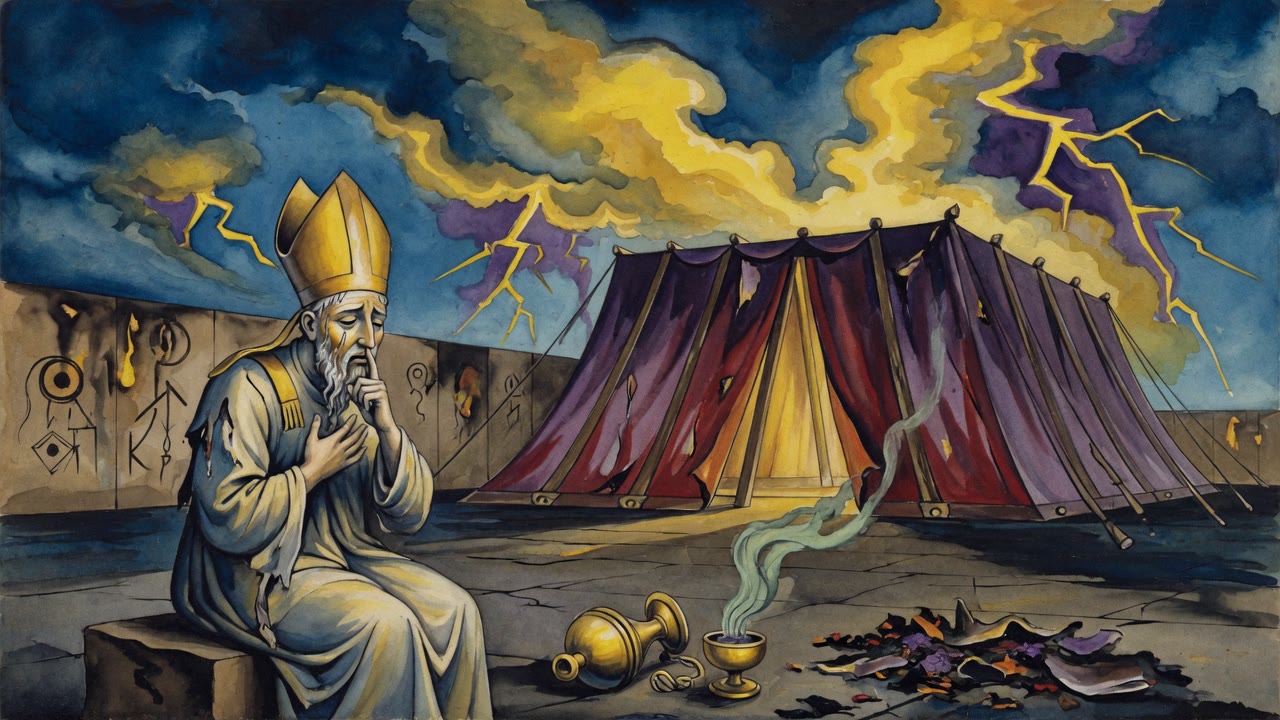
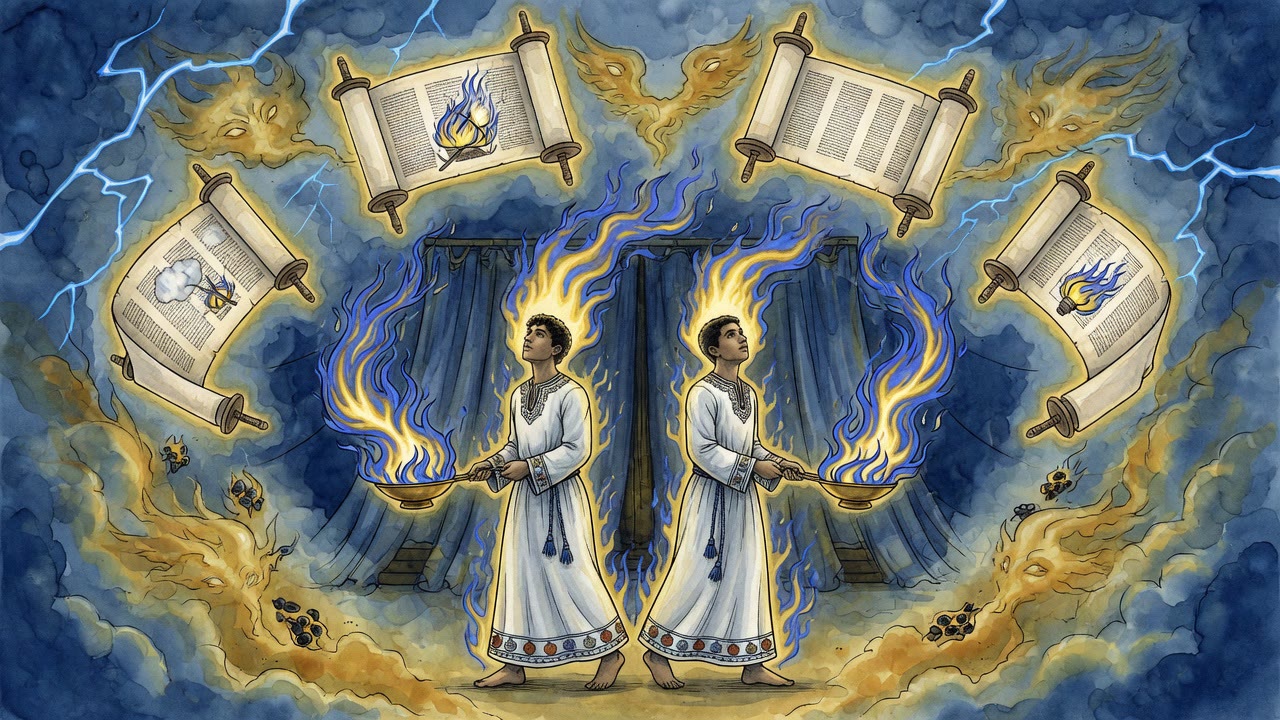
Within the hour, Nadab and Abihu were dead. The fire that had come down from heaven as confirmation of the altar's holiness had an exact counterpart in the fire that came out from God and entered Aaron's two eldest sons when they offered their unauthorized incense. The same fire that demonstrated divine approval demonstrated divine precision. The eighth day opened with seven days of patient assembly, moved through Aaron's terror at a ghostly calf, and ended with two bodies being carried out of the Tabernacle in their intact priestly vestments. It was the most complete and the most devastating day in Israel's sacred history up to that point.


← All myths

From the tradition

Sources

4 sources

The texts this telling draws on, in full. Open a card to read inline, or expand it for a wider, quieter read.

Sifrei Bamidbar 44:1Sifrei Bamidbar

It wasn't just a one-day event. According to Sifrei Bamidbar, the book of Numbers, the seven days leading up to the dedication were a whirlwind of activity.

Every single morning for seven days, Moses would assemble the mishkan, anoint it with oil, and then… dismantle it again. Can you picture the scene? All that work, day after day! Then, on the eighth day, he finally set it up for good. Well, mostly. Rabbi Yossi b. R. Yehudah adds a twist: even on that eighth day, Moses still anointed it and dismantled it one last time.

So, when did all this take place? (Exodus 40:17) tells us the mishkan was established on the first day of the first month – Nissan – in the second year after the Exodus. Sifrei Bamidbar then lays out a detailed timeline. The anointing of Aaron and his sons, along with all the vessels, began on the twenty-third of Adar (the month before Nissan). Then, on Rosh Chodesh Nissan, the new month, the mishkan was finally established. The very next day, the second of Nissan, the red heifer – the parah adumah – was burned. And on the third, its waters were sprinkled, as described in (Numbers 8:7). It was a flurry of sacred action!

The significance of that first day of Nissan? Huge! Sifrei Bamidbar emphasizes that it was "the first of all the days of the year." It was a day of firsts. That’s when the Shechinah – the Divine Presence – came to rest in the House. Remember the verse in (Exodus 40:35)? "And Moses could not enter the tent of meeting…" That was that day. And it was also the day the tribal leaders began bringing their offerings, as (Numbers 7:12) says.

And then… fire. Fire came down from heaven and consumed the offerings on the altar, just as we read in (Leviticus 9:24). A truly awe-inspiring moment! But alongside that incredible miracle came tragedy.

On that very same day, Nadav and Avihu, the sons of Aaron, offered "a strange fire" before the Lord – an esh zarah, as (Leviticus 10:1) calls it – and they died. A devastating blow. The verse reads, "their death was 'before the Lord' and their falling was outside." Where exactly did this happen? Rabbi Yossi believed an angel held them upright in death until they were outside the inner sanctum, where they then fell in the azarah – the court. That detail, he says, is supported by (Leviticus 10:4) which refers to "before the sanctuary," not "before the Lord." Rabbi Yishmael, however, reads the verse differently. He believes they died and fell within the sanctuary, and were then dragged out with iron hooks. A grim image.

And what about the anointing itself? The text raises an interesting question: Were the vessels anointed individually? No, Sifrei Bamidbar clarifies. They weren’t consecrated until all of them had been anointed. And the anointing was thorough, both inside and out. But even here, opinions differ. Rabbi Yoshiyah thought that vessels for wet measures were anointed inside and out, while those for dry measures were only anointed inside. Rabbi Yonathan, however, argued that wet-measure vessels were anointed only inside, while dry-measure vessels weren't anointed at all! He bases this on (Leviticus 23:17), which describes loaves baked as first fruits "to the Lord" after they are baked, implying they aren't anointed beforehand.

Finally, Rebbi asks a crucial question: Why repeat "and he anointed them and consecrated them"? Isn’t it already stated? The answer? This repetition teaches us that the anointing of these initial vessels consecrated all future vessels. They wouldn't need individual anointing.

So, what do we take away from this detailed account of the mishkan's dedication? It wasn't just a simple ceremony. It was a complex, many-sided event, filled with joy, sorrow, and profound spiritual significance. It reminds us that even in moments of great celebration, tragedy can strike, and that meticulous detail and differing interpretations are all part of the tradition of our tradition. And perhaps most importantly, it shows us the enduring power of dedication and the transformative potential of sacred space.

Full source
Targum Jonathan on Leviticus 9Targum Jonathan

On the eighth day of consecration, the first of Nisan, Aaron was about to offer his first sacrifice as high priest. Then he froze. The Targum Jonathan says he "saw at the corner of the altar the form of the calf." The Golden Calf. His sin, staring back at him from the very altar where he was supposed to serve God.

Moses had to talk him through it: "Take courage, and go near to the altar, fearing not." This entire scene. Aaron's terror, Moses's encouragement, the phantom calf, is absent from the Hebrew Bible. The Targum invented it to explain a theological problem: how could the man who built an idol become the one who atoned for idolatry?

The Targum also adds that each sacrificial animal carried symbolic meaning. The calf for Aaron's sin offering was chosen "that Satan may not accuse thee concerning the calf that thou madest at Horeb." The ram recalled "the righteousness of Isaac whom his father bound as a ram on the mountain of worship." The goat for the people's offering was selected because "Satan resembles him, lest he recount against you the accusation concerning the kid of the goats, which the sons of Jacob killed", a reference to the brothers dipping Joseph's coat in goat blood (Genesis 37:31).

Every animal was a counter-argument against heavenly prosecution. The Targum turns the inauguration of the priesthood into a courtroom drama, with sacrifices serving as legal briefs against the Accuser.

When the ceremony concluded, the Shekinah (the Divine Presence) did not appear. Aaron was "ashamed." Only after Moses and Aaron prayed together inside the Tabernacle did fire descend from heaven and consume the offering. The people fell on their faces, not from fear, but praise.

Full source
Midrash Tanchuma Buber, Shmini 5:1Midrash Tanchuma Buber, Shmini

(Lev. 9:1) "And it came to pass on the eighth day that Moses called etc." Our Rabbis said: During all those days that Moses was at the thornbush, the Holy One, blessed be He, said to him, "Go on My errand," and he kept saying, "Please send by the hand of him whom You will send" (Exodus 4:13). So too on the first day and the second day. The Holy One, blessed be He, said to him, "I am coaxing you, and you say, 'Send.' By your life, I will repay you for it: tomorrow, when the Tabernacle is made, you will think in yourself that you will serve in the high priesthood, but I will say to you, 'Call Aaron, that he may serve.'" Therefore it is said, "Moses called Aaron and his sons."

There is a calling that is for plenty, [and there is a calling for famine. Whence for plenty?] As it is said, "And I will call to the grain and multiply it" (Ezekiel 36:29). Whence for famine? [As it is said,] "The LORD has called for a famine etc." (II Kings 8:1). There is a calling for greatness, as it is said, "Moses called." Moses said to him, "Thus the Holy One, blessed be He, said to me: to appoint you as High Priest." Aaron said to him, "You labored at the Tabernacle, and I am to become High Priest?" He said to him, "By your life, even though you become High Priest, it is as though I become it; for just as you rejoiced for me in my greatness, so I rejoice for you in your greatness."

And when did he rejoice for him? At the hour when the Holy One, blessed be He, said to him, "And now come, and I will send you to Pharaoh" (Exodus 3:10). The Holy One, blessed be He, said to him, "Go; the matter is held in reserve." Moses said, "Please, my Lord" (Exodus 4:10), "bayya, you are passing this over upon me: my brother is greater than I, and I go before him." The Holy One, blessed be He, said to him, "[By your life,] you have spoken fittingly, and even so, 'he will see you and rejoice in his heart'" (Exodus 4:14). Rabbi Shimon ben Yohai said: The Holy One, blessed be He, said to him, "That heart which rejoiced at the greatness of his brother, they shall set those precious stones upon it." Therefore, all those seven days that Moses was occupied with the Tabernacle, he was throwing the blood and burning the fats. The Holy One, blessed be He, said to him, "What do you suppose, that you will be High Priest? Call your brother, that he may serve as High Priest." Therefore, "And it came to pass on the eighth day that Moses called [Aaron and his sons and the elders of Israel]." And why "to the elders of Israel"? In order to exalt him before the elders. The Holy One, blessed be He, said to him, "Call the elders and appoint him before them, so that Israel will not say, 'He became High Priest of his own accord.'" Therefore, "and the elders of Israel."

Full source
Midrash Tanchuma Buber, Shmini 2:1Midrash Tanchuma Buber, Shmini

[(Ecclesiastes 8:5) AND WHOEVER KEEPS A COMMANDMENT SHALL KNOW NO EVIL THING, etc.] This is Moses, to whom the Holy One, blessed be He, had already said (Exodus 29:43): AND THERE I WILL MEET WITH THE CHILDREN OF ISRAEL, AND IT SHALL BE SANCTIFIED BY MY GLORY, I am sanctified there by My glory. And Moses was ministering during the seven days of the consecration, and he was afraid to speak, lest the attribute of justice strike him, as it is said: AND IT SHALL BE SANCTIFIED BY MY GLORY. Yet he did not act, but said to Aaron: Observe the mourning for seven days, for thus the Holy One, blessed be He, said to me (Leviticus 8:35): FOR SO I HAVE BEEN COMMANDED. When they had observed the seven days of mourning, and the eighth day came, Nadab and Abihu entered to offer, and the attribute of justice struck them, and they were burned, as it is said (Leviticus 10:2): AND FIRE WENT OUT FROM BEFORE THE LORD AND CONSUMED THEM, AND THEY DIED BEFORE THE LORD. Moses came and said to Aaron (Leviticus 10:3): THIS IS WHAT THE LORD SPOKE, SAYING: THROUGH THOSE WHO ARE NEAR TO ME I WILL BE SANCTIFIED. And where did He speak? In the wilderness of Sinai (Exodus 29:43): AND THERE I WILL MEET WITH THE CHILDREN OF ISRAEL, AND IT SHALL BE SANCTIFIED BY MY GLORY. Therefore it is said (Ecclesiastes 8:5): WHOEVER KEEPS A COMMANDMENT SHALL KNOW NO EVIL THING, etc.

Full source