Parshat Chukat6 min read

The Serpent Answered Every Charge but the Last One

The creatures ring the serpent in the hedges and press it charge by charge, until the last question is one it refuses to answer for itself.

Curated by Arthur · Told by Maggid ·
Table of Contents
  1. The Fence It Broke and the Fence It Sleeps In
  2. The Tongue That Drags Through the Dust
  3. The Word That Comes Down and Finds It
  4. The Question It Refused to Take
  5. The Head That Turned Toward the Man With the Hoe

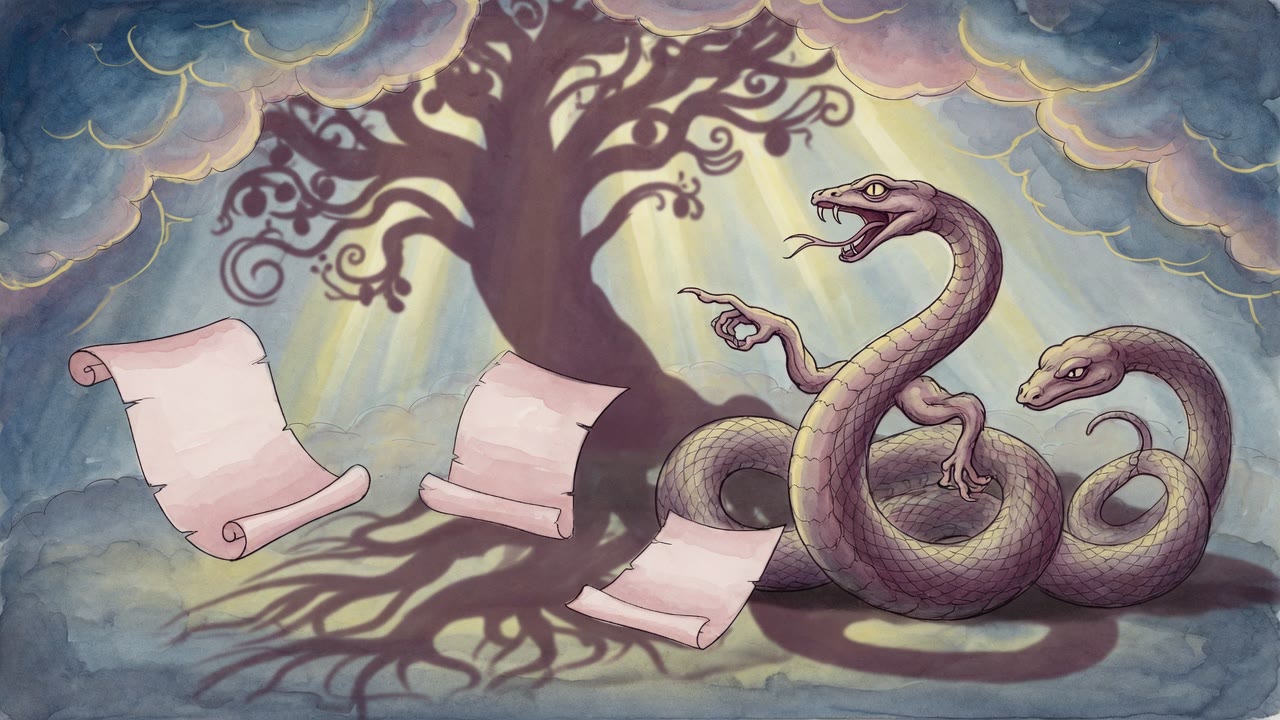
The hedge at the field's edge was thorn and dead vine grown into one wall, and the serpent lay flat in the roots of it. The creatures came at midday, two at first, then a dozen, then a ring pressed close enough that the shade went black under the branches. An ox at the front. A hare shifting its feet, a hyena, a stork with mud to its knees, and at the back a man up from the furrows with a hoe on his shoulder.
The Serpent Answered Every Charge but the Last One Click for full size

Nobody had convened them. They arrived the way a court arrives.

The Fence It Broke and the Fence It Sleeps In

The ox spoke first. "Why is it that you are always found in the hedges?"

The serpent's head came up out of the thorn, slow, no higher than a man's ankle. It had not been asked anything in a long time.

"I breached the hedge of the world," it said, and put its head back down among the roots.

The Tongue That Drags Through the Dust

"Your tongue," the hyena said. "The rest of you lies there like a rope and that thing never stops, wet, out, in, tasting the dirt. Why?"

"That," the serpent said, "is what did this to me."

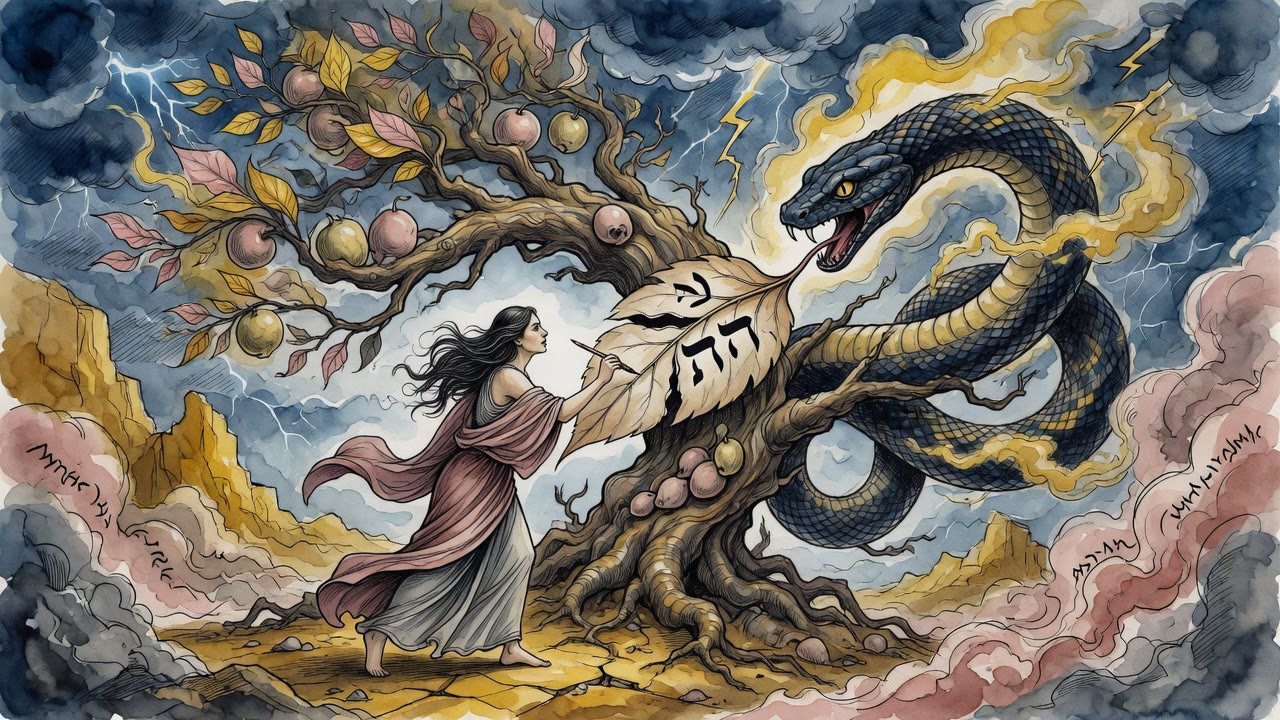
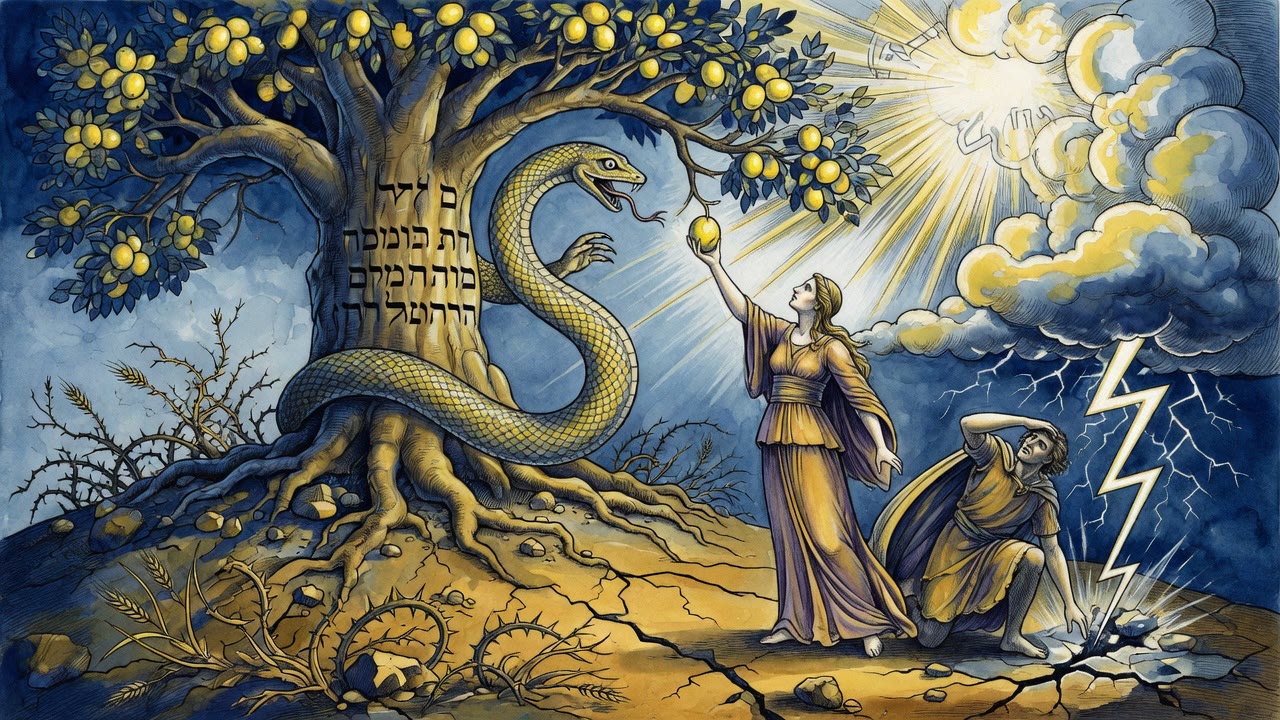
Then it told them what the tongue had done. There had been a tree, a woman at the tree, and the serpent upright beside her with all the time in the world. It did not begin with the fruit. It began with the Maker. "From this tree He ate," it told Eve, "and then He made the world. He forbids it to you so that you will not make worlds of your own. Every craftsman hates the man who works his trade."

She said nothing, so it kept going. Whatever is made later rules whatever came before it, the serpent said, and counted the days out for her the way a man counts coins onto a table. The firmament carries the heavens that preceded it. The trees water the firmament. The sun and the moon ripen the fruit of the trees. Last came the birds, and among them the Ziz, so wide that when its wings open the sun goes out behind them and the field turns to evening at noon.

"You were made at the end of everything, to rule everything," it said. "So hurry. Eat, before He makes another world and whatever comes after you stands over you the way you stand over me."

She looked at the tree and found it good. What she was looking at was the words of the serpent.

"I did that with this," the serpent said, and let the tongue slide out flat over the dirt. "It has been down here ever since."

The Word That Comes Down and Finds It

Into the quiet the ox put the question the field had come for. "All of us bite. The horse breaks ribs, the dog takes a hand at the wrist, and by harvest the man is up and cursing us. You touch a heel and he goes out feet first. Why you?"

"If the serpent bites when no charm has been whispered," the serpent said, and stopped there, as if the rest of the verse belonged to everyone. "Am I able to do a thing that has not been said to me from above? I am sent. I do not pick the house."

The hyena laughed. Nothing else in the ring did.

The Question It Refused to Take

The hare asked the last one, and asked it quietly, which is how the worst questions get asked. "You strike one limb. A heel. A finger. Why does the whole body feel it? Why does a man's jaw lock and his hands go cold over a wound in his foot?"

The serpent did not answer.

The stork shifted in the mud. The ox waited. When the head came up it came up higher than it had all day. "To me you say this?" the serpent said. "Say it to the master of the tongue."

The Head That Turned Toward the Man With the Hoe

The head turned, and every creature in the ring turned with it, toward the man with the wet blade on his shoulder.

"He is standing right here," the serpent said, "and he kills in Rome."

The man did not move.

The serpent told them how that is done. One word about a neighbor, dropped in a doorway at the hour when the jars go down to the well. A man who takes a wife, comes to hate her, and hangs an evil name on her at the gate. Out of the name comes a hatred nobody says aloud, out of the hatred the grudge, and the grudge gets paid, and the brother who was meant to live alongside him lies in a ditch one morning with his throat open.

The word gets onto the trade road with the caravans, crosses the water on a grain ship, and in Rome a man who has never seen this field is taken out of his house and killed for what was said in the doorway. The speaker's feet have not moved.

"I bite one limb and the whole body shakes," the serpent said. "He opens his mouth here and a man drops at the other end of the world. Put your question to him."

The stork went first, then the hyena, then the ox, back down toward the furrows. The man stood alone at the edge of the emptying ring, and nobody asked him anything. The serpent lowered itself through the thorn until only the wet line of the tongue showed.


← All myths
From the tradition

Sources

3 sources

The texts behind this telling. Some cards carry a translation of the source; others are our own retelling of it, and each card says which. Every card links out to the original.

Midrash Tanchuma Buber, Chukat 8:1Midrash Tanchuma Buber, Chukat

Translation of the source text.Midrash Tanchuma (Buber), Public Domain, on Sefaria · CC-BY-SA

Rabbi Samuel bar Rabbi Nachman said: They said to the serpent, "Why are you found among the hedges?" It said to them, "I breached the hedge of the world." They said to it, "Why do you go about with your tongue dripping?" It said to them, "It is what caused this to me." They said to it, "Why is it that all the beasts bite and do not kill, but you bite and kill?" It said to them, "(as it is written): 'If the serpent bites without a whisper-charm' (Ecclesiastes 10:11), is it possible for me to do anything, when it has not been told to me from on high?" "And why do you bite with one limb, yet all the limbs feel it?" It said to them, "To me you say this? Say it to the master of the tongue, who is here and yet kills in Rome."

Full source
Bereshit Rabbah 19:4Bereshit Rabbah

Translation of the source text.Midrash Rabbah -- TE · Public Domain

Rabbi Tanchuma said: This question they asked me in Antioch. I said to them: "For God knows" is not written [in the plural], but rather "For God knows" [yodea, singular] "that on the day you eat" (Genesis 3:5). Rabbi Yehoshua of Sikhnin in the name of Rabbi Levi said: He began to speak slander against his Creator. He said: From this tree He ate and created the world, and He says to you, "Do not eat from it," so that you should not create other worlds; for every craftsman hates his fellow of the same trade.

Rabbi Yehudah son of Rabbi Simon said: Everything that was created after its fellow rules over its fellow. The heavens on the first day, and the firmament on the second: does it not bear them? This is astonishing! The firmament on the second day, and the vegetation on the third: do they not supply its waters? The vegetation on the third day, and the luminaries on the fourth: do they not ripen its fruits? The luminaries on the fourth day, and the birds on the fifth.

Rabbi Yehudah bar Simon said: The Ziz is a pure bird, and at the moment it flies it covers the orb of the sun. And the human being was created after everything, to rule over everything. Hurry and eat before He creates other worlds, and they rule over you. This is what is written (Genesis 3:6): "And the woman saw that it was good, etc." She saw the words of the serpent.

Full source
Sifrei Devarim 235:3Sifrei Devarim

Retold in our words. Read the original at the link below.Sifrei by Rabbi Shraga Silverstein · CC-BY

Rabbi Yishmael, a sage whose words still resonate across centuries, puts it starkly: "Come and see what hatred causes." What does it cause? It leads to lashon hara, slander. As it says in (Deuteronomy 22:14), regarding a man who falsely accuses his wife, "And he libel her and give out about her an evil name." It starts with a whispered word, a seed of doubt planted in someone's mind, and before you know it, reputations are ruined, relationships shattered.

It doesn't stop there.

The Sifrei Devarim draws a direct line, a frighteningly logical progression, from neglecting what might seem like a "light" mitzvah (commandment) to violating a far more serious one. It's like a slippery slope, but instead of snow, it's paved with increasingly harmful actions.

This teaching uses the fundamental commandment of love as its foundation. Remember Vayikra (Leviticus) 19:18, “And you shall love your neighbor as yourself”? That's the starting point. When we fail in this, the consequences are dire.

What happens when we fail to love our neighbor? Well, according to the Sifrei Devarim, we are then destined to transgress the prohibitions that immediately follow it: "You shall not take revenge… and you shall not bear a grudge” (Leviticus 19:18). These are all interconnected. The lack of love breeds resentment, and resentment festers into revenge.

And it gets worse.

It continues, "You shall not hate your brother" (Leviticus 19:17). Notice how the commandments build upon each other? First, a failure to actively love. Then, the passive harboring of grudges. And finally, the active emotion of hate. The slope is getting steeper.

The text doesn't stop there. It mentions "And your brother shall live with you" (Leviticus 25:36). This refers to the obligation to support and care for our fellow human beings. Hatred erodes our sense of shared humanity, making it harder to empathize and assist those in need.

Where does it all lead? All the way "to the spilling of blood." The ultimate act of violence, the ultimate expression of hatred. The text concludes that "This is the intent of 'If a man take a wife, etc.'" referring back to the initial example of slander and its destructive consequences. The Sifrei Devarim sees a thread connecting these seemingly disparate scenarios.

That a failure to embrace love, a seemingly small act of negativity, can ultimately lead to such devastating outcomes.

So, what can we learn from this ancient wisdom? Perhaps it's a call to be more mindful of our thoughts and actions, to actively choose love over hate, understanding over judgment. Because, as the Sifrei Devarim so powerfully illustrates, the consequences of letting hatred take root can be far more devastating than we might ever imagine.

Full source