Parshat Bereshit5 min read

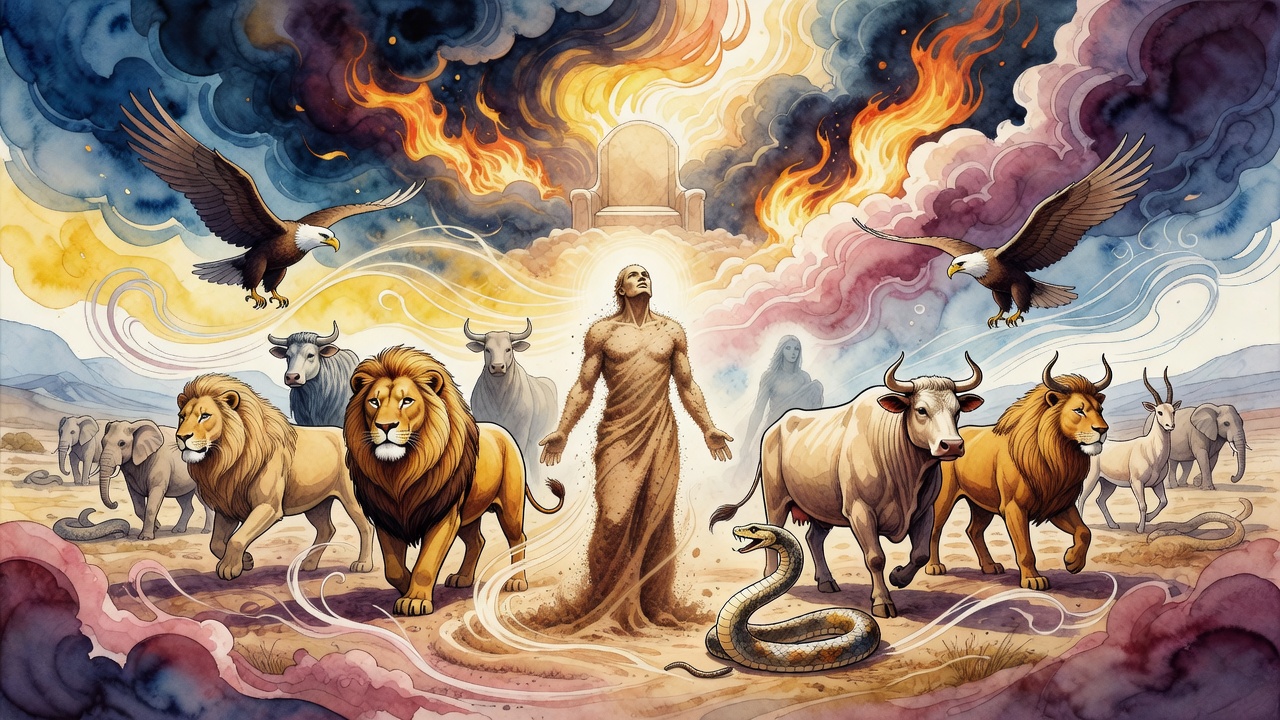
Adam Rose in the Twelfth Hour and Named Beasts

Fourth hour: breath pressed into clay until the clay could answer. Sixth hour: the beasts filed past with no whip. Lion. Ox. A bird he had never heard.

Curated by Arthur · Told by Maggid ·
Table of Contents
  1. Dust Before Noon
  2. Work That Was Not Watering
  3. Wedding, Couch, Descent
  4. The Serpent in the Names
  5. Twelfth Hour Judgment
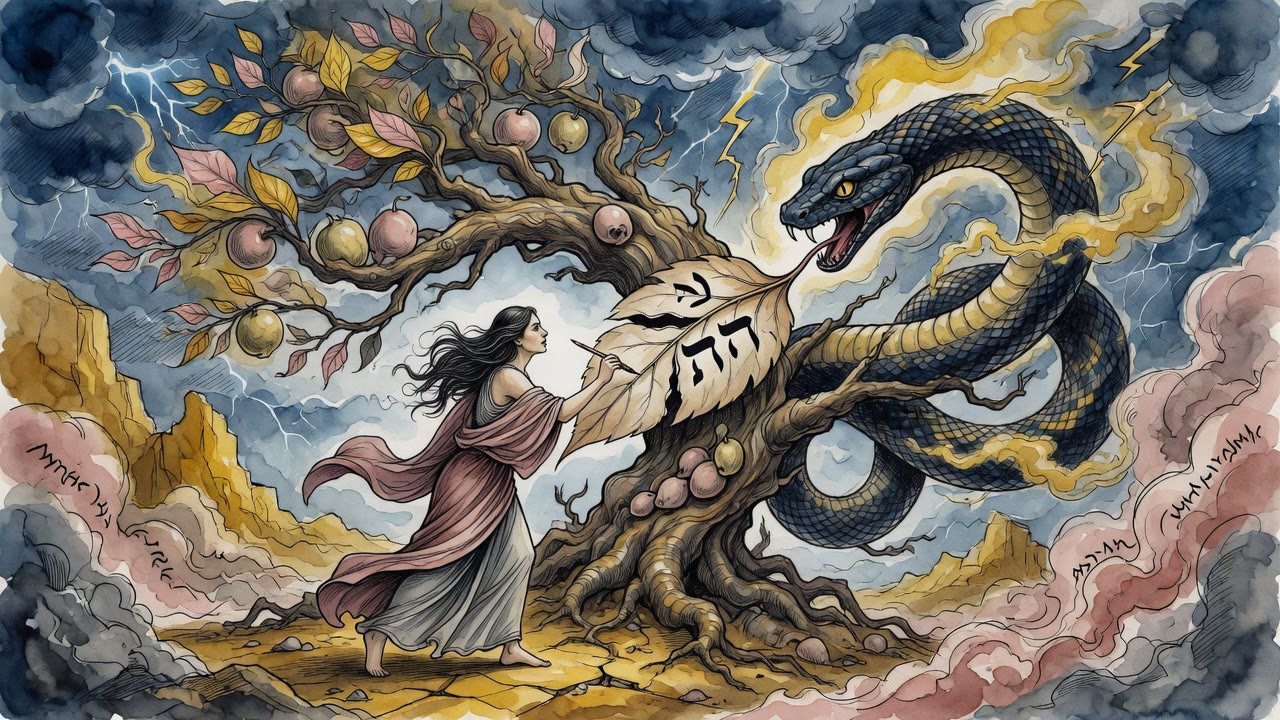
Adam Rose in the Twelfth Hour and Named Beasts Click for full size

Dust Before Noon

In the first hour God gathered dust. Not random grit from any path. Chosen earth, scraped and piled for a shape that did not yet know shame or hunger or the sound of its own name. In the second hour the dust became a golem, a mass waiting for edges, heavy and silent as wet clay before a potter's second thought. In the third the mass took contour, the hint of a face that would one day argue with angels and with a woman and with God.

Fourth hour: breath. Neshama (נשמה), soul, pressed into clay until the clay could answer. Fifth hour: Adam stood. The standing was itself a decree. Legs locked. Eyes opened on a garden already older than his first thought. Sixth hour: names. Beasts filed past in a parade that did not need a whip. He spoke them into place, dominion sounding like recognition rather than theft. Lion. Ox. Bird whose cry he had never heard and somehow knew.

By midday the garden had a speaker, and the speaker had a world arranged by syllables.

Work That Was Not Watering

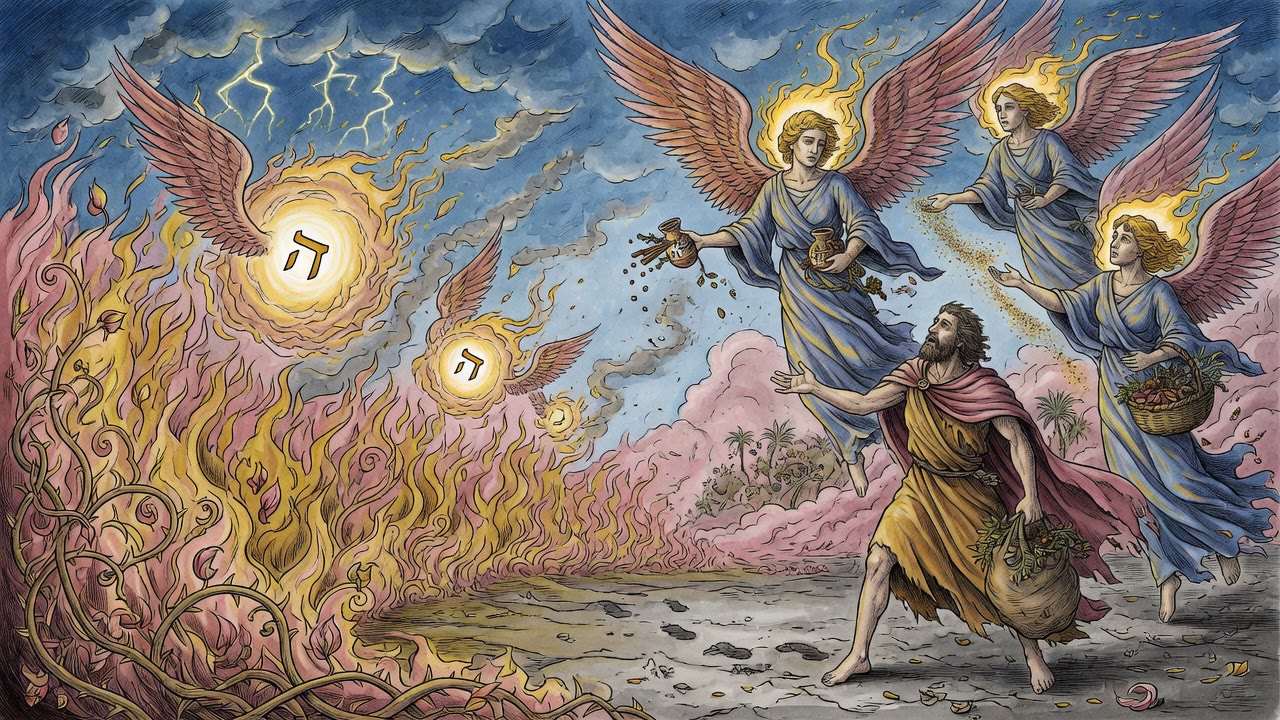
A river already left Eden to water the trees (Genesis 2:10). No bucket waited for Adam's shoulder. No ditch needed his heel. "To dress it and to keep it" could not mean irrigation when water did the obvious work without him. The charge bent toward words and fences of the soul: to keep the way of the tree of life, and the tree of life was Torah, "a tree of life to them that lay hold upon it" (Proverbs 3:18).

Adam's hands stayed clean of mud and full of commandments he had only begun to hear. The garden was a study hall wearing leaves. Fruit hung like unopened books. The only sweat he was meant to know was the sweat of attention, the strain of holding a boundary that looked like a tree and felt like a future.

He walked the paths and practiced the keeping. Keep. Dress. Hold. The verbs were light until they were not.

Wedding, Couch, Descent

Seventh hour: wedlock. Eve stood opposite him, not as afterthought but as the hour's own work, bone of his bone given back with a face he could answer. Eighth hour: the command about the fruit, simple as a fence, heavy as a mountain he had not yet learned to climb the wrong way. Do not eat. The sentence was short enough to memorize in a breath and long enough to break a world.

Ninth hour: they went up to their couch as two and came down as four, life multiplying inside the same day that had begun as dust. Joy had a short reign. Children were conceived before night fully understood its job. The hours still left room for counsel that would taste of scales.

Adam held Eve's hand and felt the day accelerate under them, twelve hours doing the work of years.

The Serpent in the Names

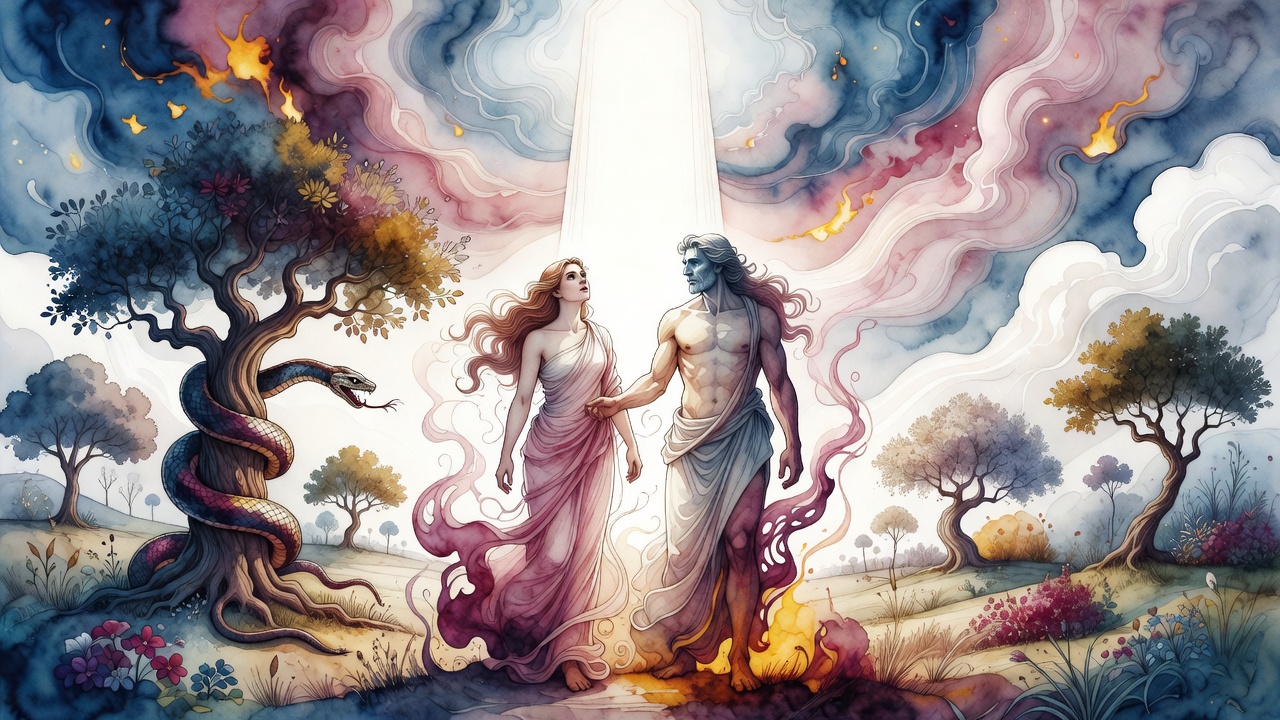
She was given to enliven him, the teachers would say, and then the same root twisted: counsel like a serpent, ḥivya. The word that meant life leaned until it meant fang. Adam would tell her, later, how many generations her choice had cost, counting forward through graves that did not yet exist. Rabbi Aḥa heard the bitter symmetry: the serpent was her serpent, and she became Adam's serpent in turn, a chain of mouths teaching mouths to fall.

The naming gift that had ordered beasts could not, by itself, order desire. The man who had spoken every animal's name discovered a speech that undid speech. Eve listened to a creature he had named and found a wisdom that was not the keeping he had been assigned. The garden's study hall gained a second teacher who did not love the fence.

When the fruit was gone, the names of the beasts still held. Only the ease of walking among them without fear had thinned like morning mist.

Twelfth Hour Judgment

By the twelfth hour the day that had begun in dust closed under judgment. Expulsion waited outside the leaves. The work of dressing and keeping would leave the garden and enter time, sweat, childbirth, and the long hope that Torah might still be a tree someone could hold when rivers no longer did the watering for free.

Adam looked once at the beasts he had named. They still wore the names. The names had not fled with innocence. He took Eve's hand. The river kept watering a garden they would not keep. The soul kept filling a body that now knew the cost of an hour, and the cost of a word, and the cost of a counsel that sounded like life until it bit.

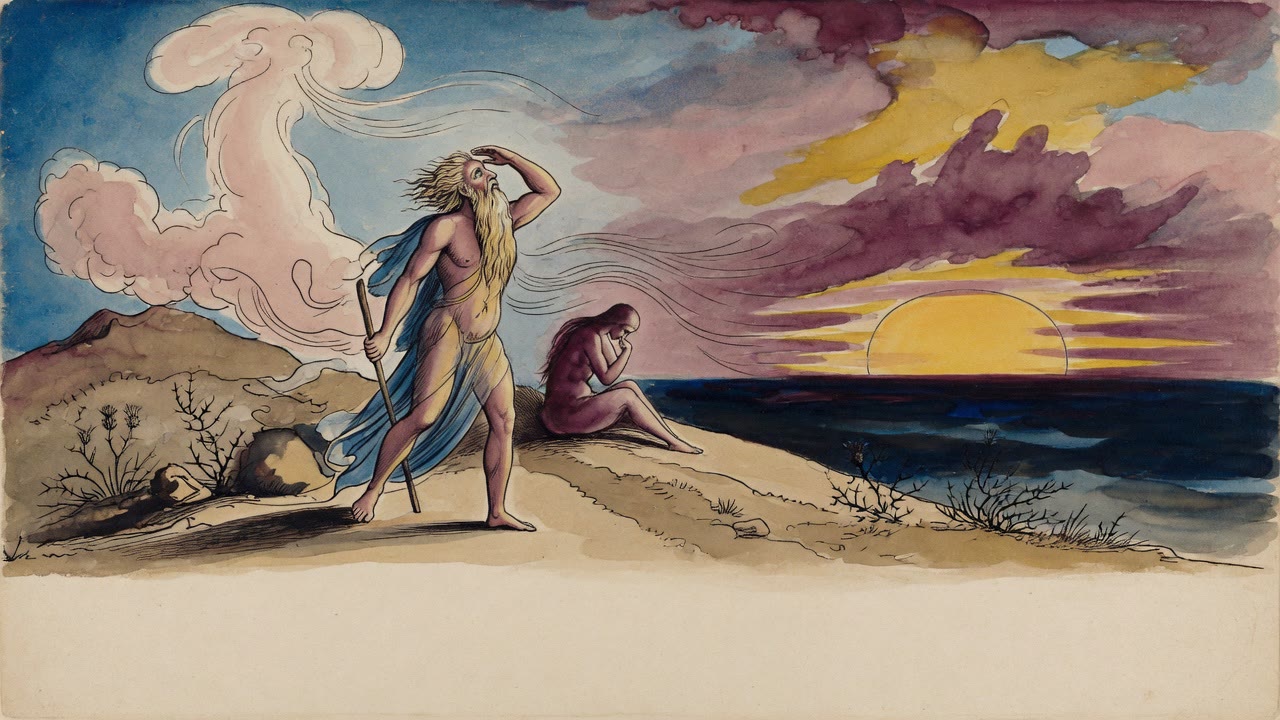
They walked east with the memory of standing in the fifth hour still in their legs, and the memory of falling in their mouths.


← All myths

From the tradition

Sources

3 sources

The texts behind this telling. Some cards carry a translation of the source; others are our own retelling of it, and each card says which. Every card links out to the original.

Pirkei DeRabbi Eliezer 11:7Pirkei DeRabbi Eliezer

Retold in our words. Read the original at the link below.Pirke de Rabbi Eliezer, trans. Rabbi Gerald Friedlander, London (1916) · CC-BY

Pirkei DeRabbi Eliezer, a fascinating early medieval text filled with stories and interpretations, gives us a glimpse into just that. It breaks down the day of Adam's creation into twelve distinct hours, each filled with its own divine activity.

Let’s walk through it together

In the first hour, God gathered the dust that would form Adam's body. In the second hour, that dust was formed into a golem, a mass, a shape waiting for life. The third hour saw this form take on a more defined shape, the contours of what would become the first human.

Then, in the fourth hour, comes the breath of life! God endows the form with neshama, the soul. Suddenly, in the fifth hour, Adam stands on his feet, a being of flesh and spirit.

The sixth hour is all about names. Adam, now fully alive, calls the animals by their names, asserting his dominion and understanding the world around him.

And then comes love. In the seventh hour, Eve is joined to Adam in wedlock. A partner, a companion, a reflection of himself. The eighth hour brings instruction: they are commanded concerning the fruits of the tree – a seemingly simple instruction with monumental consequences.

The ninth hour? Well, things get interesting. Pirkei DeRabbi Eliezer tells us they went up to their couch as two and descended as four. A rather poetic way of saying they were fruitful and multiplied, conceiving children.

But the joy is short-lived. In the tenth hour, they transgress God's commandment. The forbidden fruit is eaten, the boundary crossed. The eleventh hour brings judgment, the weight of their actions crashing down upon them.

Finally, in the twelfth hour, they are driven forth from the Gan Eden, the Garden of Eden. As the text quotes from (Genesis 3:24), "So he drove out the man."

What a day. From dust to dominion to disobedience, all in twelve hours. It's a powerful reminder of the human condition – our potential for greatness, our capacity for love, and our tendency to stumble. It is also a potent reminder that even God operates within time, creating, judging, and reacting within its confines.

So, the next time you look at a clock, maybe you'll think about Adam's creation. Think about all that can happen, all that does happen, in the space of a single day. Think about the choices we make, the consequences we face, and the enduring story of humanity that began in those twelve fateful hours.

Full source
Pirkei DeRabbi Eliezer 12:3Pirkei DeRabbi Eliezer

Retold in our words. Read the original at the link below.Pirke de Rabbi Eliezer, trans. Rabbi Gerald Friedlander, London (1916) · CC-BY

The familiar picture has them strolling among the trees, maybe tending to the flowers. But was there something more to their task?

Pirkei DeRabbi Eliezer, a fascinating early medieval text, tackles this very question. It asks, point blank: was there some other work to be done, like, say, watering the garden?

Seems logical. A garden needs tending.

Then the text throws a curveball. Didn't a river flow through Eden, watering the garden automatically? As (Genesis 2:10) tells us, "And a river went out of Eden to water the garden." So, if they weren't irrigating, what does it mean when the Torah says Adam was placed in the Garden "to dress it and to keep it?"

The answer, according to Pirkei DeRabbi Eliezer, isn't about horticulture at all. The phrase "to dress it and to keep it" is interpreted metaphorically. It's not about physical labor, but about something far more profound: engaging with the words of Torah and observing its commandments. The text connects this idea to the phrase "to keep the way of the tree of life" (Genesis 3:24). And what, pray tell, is the Tree of Life? Here's where it gets really interesting. The text equates the Tree of Life with the Torah itself! As (Proverbs 3:18) states, "It is a tree of life to them that lay hold upon it."

So, Adam's job wasn't weeding or pruning. His true calling was to immerse himself in Torah, to live by its principles. In Eden, paradise wasn't just a place; it was a state of being achieved through connection to the divine wisdom embodied in the Torah.

What kind of "garden" are we tending? And are we watering it with the right things? Perhaps the real work, like Adam's, is less about the physical and more about cultivating our spiritual selves through Torah and its commandments.

Full source
Bereshit Rabbah 20:11Bereshit Rabbah

Retold in our words. Read the original at the link below.The Sefaria Midrash Rabbah, 2022 · CC-BY

Jewish tradition loves to peel back the layers, and Bereshit Rabbah, that incredible collection of rabbinic interpretations of Genesis, dives deep into this very verse.

The text plays with the Hebrew words, as it often does. She was given to him, the rabbis suggest, to "enliven" him. But then comes a twist: she gave him counsel "like a serpent" [ḥivya]. See the connection? It's not always a compliment!

Another interpretation, a bit darker, says that Adam, the first man, told [ḥiva] Eve just how many generations she had caused to perish through her actions. Ouch. Rabbi Aḥa takes it even further, saying Adam essentially told her: "The serpent was your serpent, and you were Adam's serpent [ḥivya]." The serpent caused her downfall, and she, in turn, caused Adam's. It's a chain reaction of consequence.

Then, Rabbi Shimon ben Elazar offers another gem. "Because she was the mother [em] of all living" can also be read, "With [im] all life." What does this mean? Well, "life" here refers to a comfortable standard of living. The text goes on to explain: If a husband becomes wealthy, his wife "ascends" with him. She's excused from her domestic duties as he hires servants. But, interestingly, if he becomes poor, she doesn't "descend" with him. Her status, once elevated, remains so. It's a fascinating glimpse into societal expectations and marital roles.

But Rabbi Simon isn't finished. He takes us down a rather… unexpected path. He says that for the 130 years that Eve was estranged from Adam, "the male spirits would be aroused by her and she would bear offspring from them, and the female spirits would be aroused by Adam and would bear offspring from him." Whoa. According to Ginzberg's retelling in Legends of the Jews, this is because of the curse. He then connects this to II (Samuel 7:14), "Who, when he commits iniquity, I will rebuke him with the staff of men and with the afflictions of the children of man [adam]." These "children of Adam," he says, are malevolent spirits.

The text then presents differing opinions on house spirits – those malevolent spirits that inhabit one’s house. Are they good or bad? One opinion says they're better, because they "grow up" with the residents. Another says they're worse, because they know all their sinful thoughts. Then we get to "spirits of the field." Are they good or bad? Again, split opinions. Some say they're better because they don't know your sinful thoughts. Others say they're worse because they didn't "grow up" with you.

So, what do we take away from all this? Bereshit Rabbah 20 doesn't just give us a simple explanation of a name. It offers us a glimpse into the rabbinic mind, a world of wordplay, moral lessons, and a healthy dose of the supernatural. And maybe, just maybe, it makes us think twice about blaming Eve for everything.

Full source