5 min read

Eve Added One Word and the Serpent Found the Opening

God said do not eat. Eve told the serpent do not touch. The rabbis traced Eden's fall to that single addition and were not unsympathetic about it.

Curated by Arthur · Told by Maggid ·
Table of Contents
  1. The Gap Between What Was Said and What Was Passed On
  2. The Addition That Created a Vulnerability
  3. What the Serpent Did With the Extra Word
  4. Why God Built Eve From the Rib
  5. The First Eve and What Was Not Said

The Gap Between What Was Said and What Was Passed On

God's command to Adam was precise: you may eat from any tree in the garden, but from the tree in the middle, you shall not eat. If you eat from it, you will die. That is the full prohibition. One act forbidden. One consequence named.

When the serpent asked Eve what God had said, her answer included something that was not in the original command. She said: we may not eat from it, and we may not touch it, or we will die. The word touch had entered the instruction somewhere between Adam's receiving it and Eve's repeating it. The rabbis spent considerable effort trying to understand where it came from and what its presence meant.

The Addition That Created a Vulnerability

One reading, preserved in Bereshit Rabbah, the Palestinian midrash on Genesis compiled in the 5th century CE, held that Adam added the prohibition on touching as a protective fence around the original command. If touching is also forbidden, you cannot accidentally slide into eating. You have built a barrier between yourself and the violation.

This was, in its logic, exactly the kind of protective reasoning the rabbinic tradition would later formalize in the concept of making a fence around the Torah. But the fence here had been built without Eve's knowledge that it was a fence rather than the original command. She believed touching was what God had actually forbidden. She did not know there was a distinction between the Torah and the human addition.

What the Serpent Did With the Extra Word

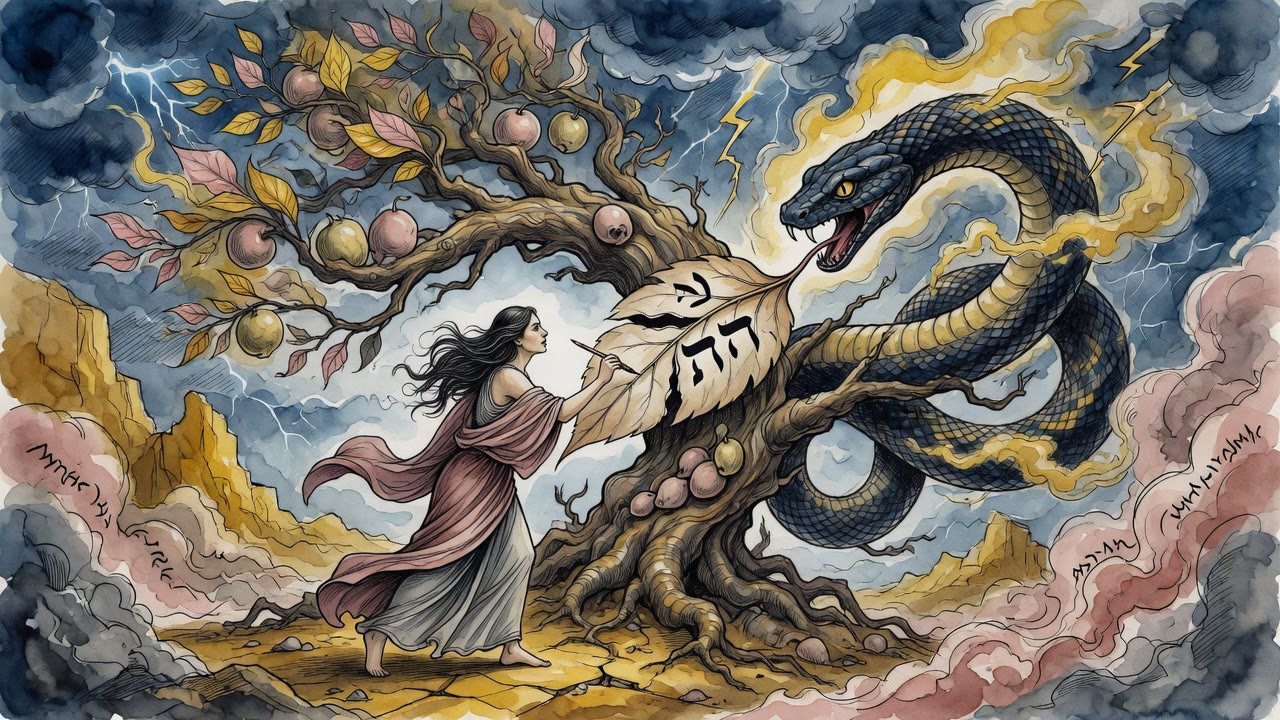
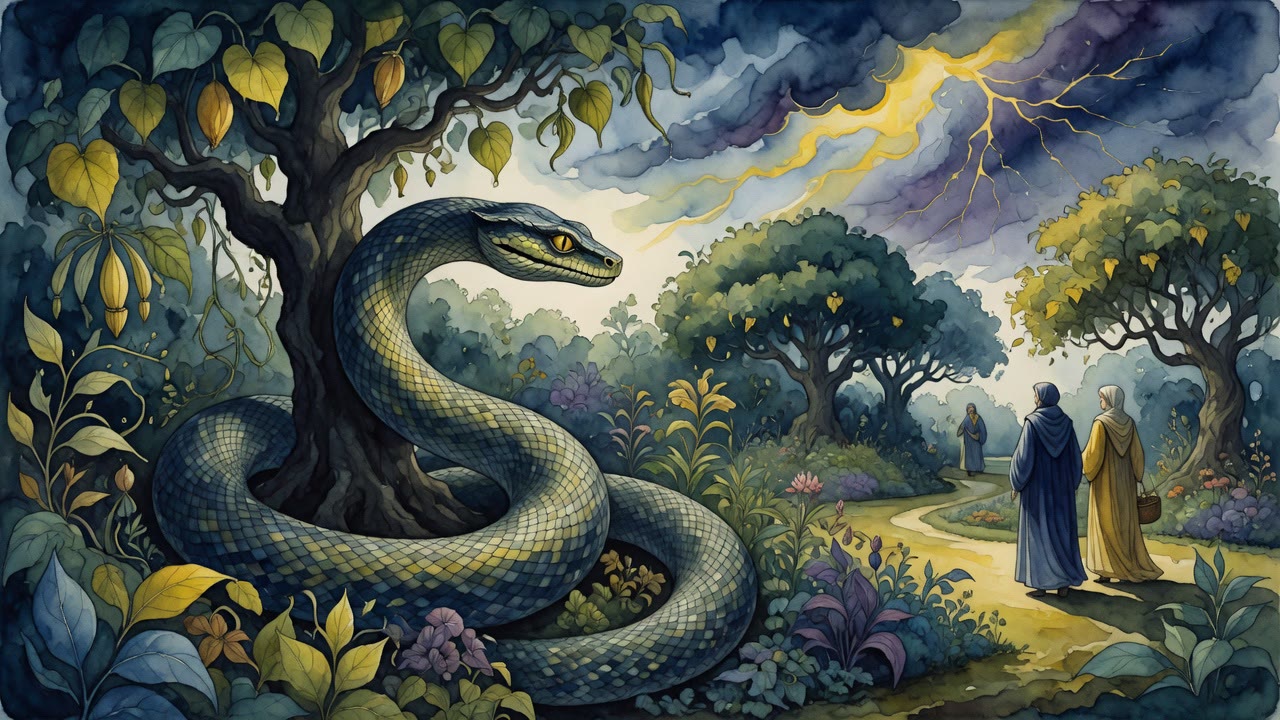
The serpent, in the tradition's telling, pushed her against the tree. She did not eat it. Nothing happened. She did not die. The serpent pointed this out: you see? You touched it and nothing happened. If touching brings no consequence, why would eating? He had found the gap not by arguing against God's command but by demolishing a human amendment to it.

The fall of Eden, in this reading, did not begin with rebellion or pride or the desire to be like gods, though those things came afterward. It began with a well-intentioned addition that turned out to be structurally dangerous. The fence built to protect became the tool the adversary used to create doubt about the barrier that actually mattered.

Why God Built Eve From the Rib

The rabbis also pressed on the earlier question of why God chose to create Eve from Adam's rib rather than from some other part. Bereshit Rabbah preserved a series of deliberations attributed to God. If I build her from the head, she will be proud. From the eye, she will be a wandering eye. From the ear, she will be an eavesdropper. From the mouth, she will be a gossip. From the heart, she will be envious. From the hand, she will be acquisitive. From the foot, she will be a gadabout.

God built her from the rib anyway, the hidden, modest, covered part of Adam, and the Midrash notes that each of the things God was trying to avoid appeared in her story regardless. The rabbis were not using this to condemn Eve. They were observing that what a person is cannot be fully determined by where they came from. She was built from the most cautious possible material and still ended up in the serpent's conversation.

The First Eve and What Was Not Said

Some traditions in the Babylonian Talmud mention an earlier attempt at a companion for Adam that did not work, a being created without the protective covering of the later creation, seen in the process of being formed and therefore too present, too visible in her own making. Adam could not bond with her because he had seen what she was made of. The tradition is fragmentary and uncomfortable and the rabbis kept it that way.

What it added to the story of Eden was a sense that the creation of Eve had involved several iterations, each intended to solve a problem the previous one had introduced. The woman who stood before the serpent had been built with immense care and still arrived at that conversation carrying a prohibition she believed to be original but was not. The rabbis did not call this her fault. They called it the cost of the distance between what was given and what was transmitted.


← All myths
From the tradition

Sources

6 sources

The texts this telling draws on, in full. Open a card to read inline, or expand it for a wider, quieter read.

The Midrash of Philo 3:1The Midrash of Philo

There's a fascinating little puzzle tucked away in the Book of Genesis, specifically (Genesis 3:3). It's a tiny addition to God's command, seemingly insignificant, but it opens up a whole world of interpretation.

The verse says, "Ye shall not eat of it, neither shall ye touch it." Now, God only forbade eating the fruit. So why did the woman, Eve, add "neither shall ye touch it?" Where did that come from? What does it mean?

This question has intrigued Jewish scholars and storytellers for centuries. It’s not just a random detail; it’s a window into understanding the characters, their motivations, and the subtle ways temptation works.

Philo of Alexandria, a Jewish philosopher who lived in Egypt in the first century CE, grappled with this very issue. Philo was deeply influenced by both Jewish tradition and Greek philosophy, and his writings offer a unique perspective on biblical narratives. He noticed this discrepancy and asked: why did Eve embellish God's command?

Well, one interpretation, found in the Midrash of Philo, suggests that Eve, in her attempt to reinforce the prohibition, actually weakened it. By adding "neither shall ye touch it," she created a kind of slippery slope. Now, imagine you are standing near the tree, and you touch it. Nothing happens! God didn't strike you down. The prohibition seems less scary, less absolute. The first boundary is crossed, making the second, the act of eating, that much easier. Haven't we all done something similar? We add extra rules to our own lives, maybe in an attempt to be extra virtuous. But sometimes, those extra rules just make the real rule seem less important.

It's a profound insight, isn't it? It’s a reminder that sometimes, less is more. That diluting or altering divine commands, even with good intentions, can have unintended consequences. It highlights the importance of understanding the original intent and adhering to it faithfully.

This small detail from Genesis, this tiny addition to God's command, reveals the complexities of human nature. It shows us how easily we can misinterpret, embellish, and ultimately, succumb to temptation. It’s a reminder that sometimes, the most dangerous thing we can do is add to the rules ourselves. What boundaries have we added to our own lives, I wonder, and are they truly helping or inadvertently hindering us?

Full source
The Midrash of Philo 5:1The Midrash of Philo

The kind of things that make you pause and think, "Wait, did that really happen that way?"

Remember what he says? "You will be as gods, knowing good and evil" (Genesis 3:5). Powerful stuff. But before she even gets to the eating part, Eve has a conversation with the serpent that's packed with intriguing nuances.

Philo, in his own way of interpreting scripture, offers a fascinating take in The Midrash of Philo. He homes in on Eve's words, particularly the idea of "touch." She emphasizes that even touching the tree was prohibited. Why is that detail so significant?

Philo suggests Eve’s focus on touch is twofold. First, he says it points to how all our senses, including taste, are rooted in touch. It’s a fundamental connection to the physical world.

But more profoundly, Philo argues that Eve’s statement serves as a self-condemnation.: if merely touching the tree was forbidden, then what about actually eating its fruit?

She and Adam didn't just cross a line; they obliterated it. By partaking of the fruit, they weren't just committing a small offense. They were compounding their transgression, making themselves, in effect, their own judges and punishers. They knew the rule; they broke it anyway.

So what about that promise? "Ye shall be as gods, knowing good and evil?" What does it really mean? The text doesn’t explicitly tell us, but Philo’s midrash (rabbinic interpretive commentary) gives us insight into how those who break the rules are punished through their own understanding that they did wrong. This understanding is the very thing that makes them like gods, but also is their own torment.

It's a profound question, and one that resonates even today. What does it mean to know good and evil? Is it a blessing or a curse? And are we, in our own lives, sometimes guilty of "touching the tree" when we know we shouldn't?

Perhaps the real takeaway isn't just about the first transgression, but about our own capacity for self-awareness and the consequences of our choices. It’s a heavy thought, but one worth pondering. What do you think?

Full source
The Midrash of Philo 1:13The Midrash of Philo

The story in Genesis, as The familiar version gives us, tells of a serpent who tempts the woman, leading to the eating of the forbidden fruit and the expulsion from paradise. But the ancient sages weren't content with just the surface narrative. They delved deeper, seeking to understand the motivations and nuances of the story. And that's where the midrash (rabbinic interpretive commentary) comes in – a way of interpreting scripture that fills in the gaps, asks the "what ifs," and draws out deeper meaning.

Here's one fascinating midrash, attributed to Philo of Alexandria, a Jewish philosopher who lived in Egypt during the first century. Philo, steeped in both Jewish tradition and Greek philosophy, offers a unique perspective on this pivotal moment. His midrash attempts to answer that very question: Why the woman?

Philo argues that the serpent chose the woman because she was, in his view, "more accustomed to be deceived than the man." Now, that might sound a bit harsh to our modern ears. But The source unfolds what Philo might have meant. He suggests that Adam, possessing a "masculine" mind and body, was better equipped to resist temptation and see through deception. His reasoning and strength allowed him to "disentangle the notions of seduction."

Eve, on the other hand, according to Philo, possessed a more "effeminate" mind, making her more susceptible to flattery and easily swayed by falsehoods that cleverly mimicked the truth. Her "softness," as Philo puts it, made her an easier target.

Ouch.

But the midrash doesn't stop there. It goes on to describe the serpent shedding its skin, from head to tail, a process that renews its life. Philo interprets this shedding as a reproach to humankind. The serpent's renewal mocks humanity's loss of immortality. The serpent, through its shedding, achieves a kind of perpetual youth, while humanity, by succumbing to temptation, has embraced mortality.

The midrash suggests that Eve, upon witnessing this, should have recognized the serpent's cunning and deceitfulness. She should have seen its "ingenuity" as a red flag, a sign of its manipulative nature. Instead, she was enticed by the prospect of acquiring a life free from aging and decay – a life, ironically, that the serpent seemed to possess through its constant renewal.

It is important to note that Philo's interpretation is just one perspective, and it reflects the cultural biases of his time. Many other midrashim offer different, and often more nuanced, interpretations of the story of Adam and Eve. But it offers us a fascinating glimpse into how ancient thinkers grappled with the complexities of the biblical narrative and sought to understand the human condition.

So, what do we take away from this? Is Eve truly more susceptible to deception? Or is this midrash simply reflecting the patriarchal views of its time? Perhaps the real lesson is about the allure of the forbidden, the seductive power of immortality, and the ever-present challenge of discerning truth from falsehood – challenges that confront us all, regardless of gender. What do you think?

Full source
Bereshit Rabbah 18:2Bereshit Rabbah

Our sages saw a universe of intention packed into that single act of creation.

The Midrash (rabbinic interpretive commentary), specifically Bereshit Rabbah, that interplay of rabbinic interpretation, delves deep into this. Rabbi Yehoshua of Sikhnin, quoting Rabbi Levi, offers a fascinating perspective on the verse Vayaven (Genesis 2:22), usually translated as "And He fashioned." But the rabbis cleverly point out that the letters of vayaven can also be read as vayitbonen, meaning "He contemplated." God didn't just make Eve; He thought about it.

He contemplated from where to create her.

God considering each part of Adam's body, weighing the implications. "I will not create her from [Adam’s] head," He reasons, "so she should not hold her head high [in arrogance]." A woman created from the head might become too proud, too domineering.

Nor from the eye, lest she be too curious. The ear? She might become an eavesdropper. The mouth? A chatterer. The heart? Envious. The hand? Always touching, interfering. The foot? Forever wandering off.

Instead, God chooses, according to this Midrash, to create her "from a place that is covered up in man, as even when a person stands naked, that place is covered." Some understand this to mean the thigh, a place of modesty and hiddenness. This interpretation, by the way, is also found in Devarim Rabbah (6:11).

With each limb formed, God implores her: "Be a modest woman, a modest woman." He instills within her the potential for humility and restraint. And yet…

Despite these precautions, the Midrash laments, "You neglected all my counsel" (Proverbs 1:25). The very traits God sought to avoid seem to manifest. "I did not create her from the head, yet she holds her head high, as it is stated: 'They walk with outstretched necks' (Isaiah 3:16)." And so on. Her eyes become excessively curious ("And they went with curious eyes," (Isaiah 3:1)6), her ear an eavesdropper ("Sarah was listening at the entrance of the tent," (Genesis 18:1)0), her heart envious ("Rachel was jealous of her sister," Genesis 30:1), her hand prone to touching ("Rachel stole the household idols," (Genesis 31:1)9), and her foot restless ("Dina went out [to see the daughters of the land]," Genesis 34:1).

It's a harsh assessment, isn't it? But what's the point? Is the Midrash simply being misogynistic? I don’t think so. It’s more likely a reflection on the inherent challenges of free will. God can create the potential for goodness, but He can't force it. We all, men and women alike, possess the capacity to choose wisely or to stray. The story of Eve isn't just about the first woman; it's about the ongoing struggle within each of us to live up to our highest potential.

Perhaps the message isn't about blaming Eve, but about recognizing the constant need for self-reflection and striving for modesty – in thought, word, and deed. It's a reminder that even with the best intentions, we must always be vigilant against the temptations of pride, curiosity, envy, and restlessness. It’s a beautiful, if sobering, thought to carry with us.

Full source
Sanhedrin 39aTalmud Bavli, Sanhedrin

The emperor said to Rabban Gamliel: Your God is a thief, for it is written, "And the LORD God caused a deep sleep to fall upon the man, and he slept" (Genesis 2:21). His daughter said to him: Leave him, for I will answer him.

She said to him: Give me one commander. He said to her: Why do you need him? She said: Robbers came upon us last night and took from us a pitcher of silver, and left us a pitcher of gold. He said to her: Would that they would come upon us every day! And was it not likewise good for Adam, the first man, that they took from him one rib and gave him a maidservant to serve him?

Full source
Yalkut Shimoni on Torah 26:2Yalkut Shimoni on Torah

"And the woman said to the serpent, of the fruit of the trees of the garden we may eat" (Genesis 3:2). And where was the first man at that hour? He had engaged in intimacy and fallen asleep. Rav said: the Holy One, blessed be He, took him and led him about the whole world, saying to him, "Here is a place fit for planting, here a place fit for sowing." This is what is written, "a land through which no man passed and where no human dwelt" (Jeremiah 2:6) the first man did not dwell there.

"And you shall not touch it" (Genesis 3:3). This is what is written, "do not add to His words, lest He rebuke you" (Proverbs 30:6) do not make the fence greater than the essential thing, lest it fall and you cut down the saplings. Thus the Holy One, blessed be He, said, "on the day you eat of it [you shall die]," but she stood and gave false testimony, "you shall not touch it, lest you die." When the serpent saw that she had lied, he pushed her against it and said to her, "As you did not die by drawing near it, so you will not die by eating it."

Hizkiyah said: from where do we learn that whoever adds, subtracts? As it is said, "and you shall not touch it." Rav Mesharshya said: from here, "two and a half cubits its length" (Exodus 25:10) [where the unusual spelling teaches the same]. Rav Ashi said: "eleven curtains" (Exodus 26:7).

Full source