Parshat Bereshit6 min read

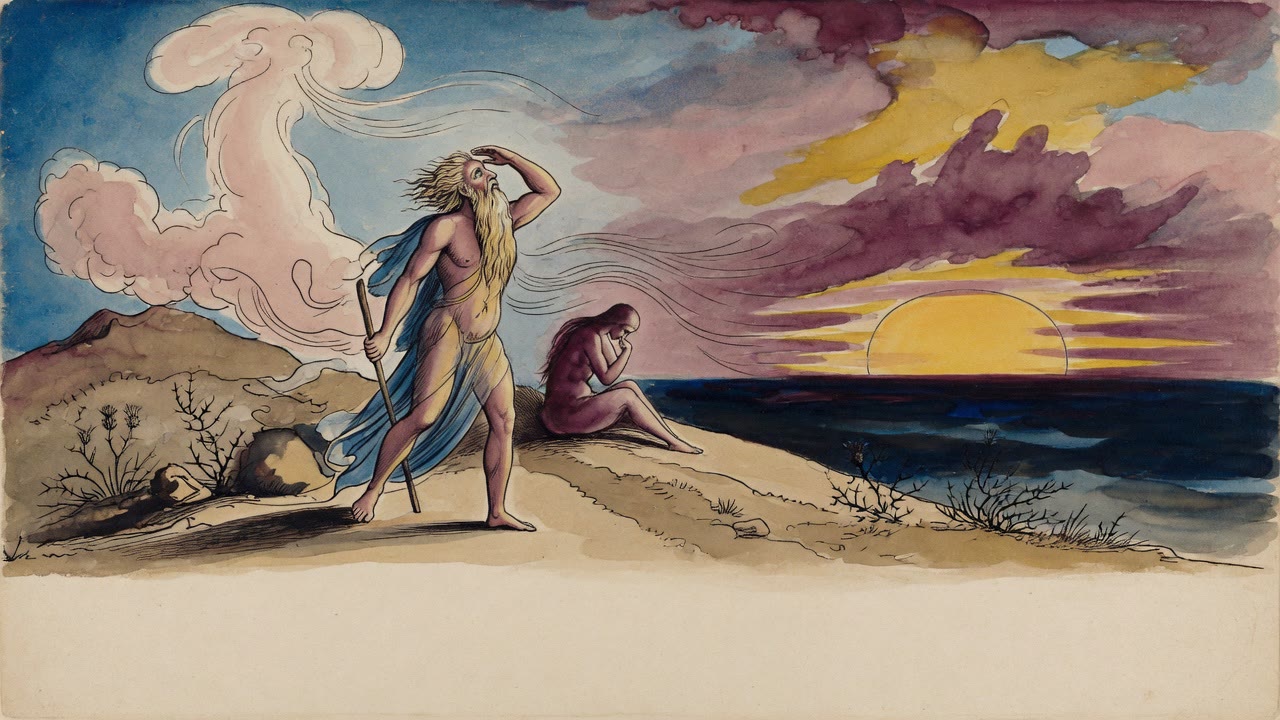
Serpent Slanders God Beside the Forbidden Tree

Beside the tree the serpent claims God fears rivals, Eve reaches, and judgment strikes the ground so Adam must earn bread from a resisting earth.

Curated by Arthur · Told by Maggid ·
Table of Contents
  1. The Argument Under the Branches
  2. What She Understood
  3. The Sentence That Went Past Him
  4. Thorns for the Rest of It
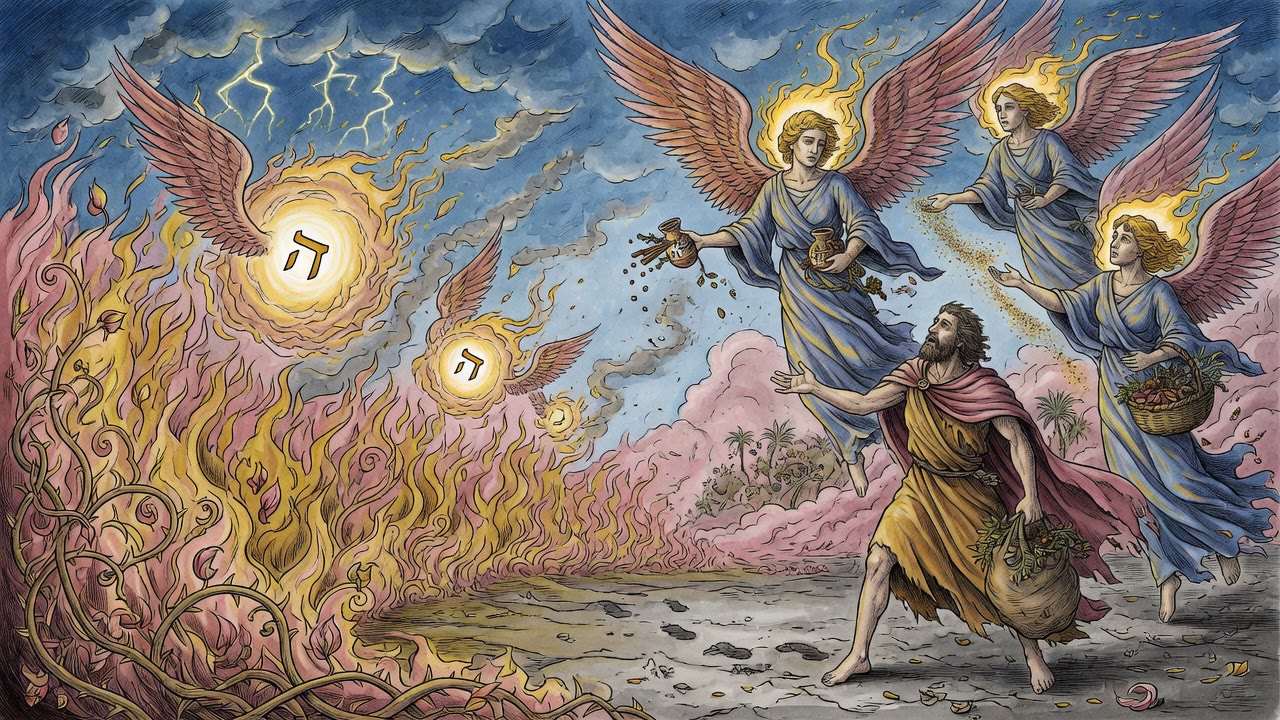
Serpent Slanders God Beside the Forbidden Tree Click for full size

The Argument Under the Branches

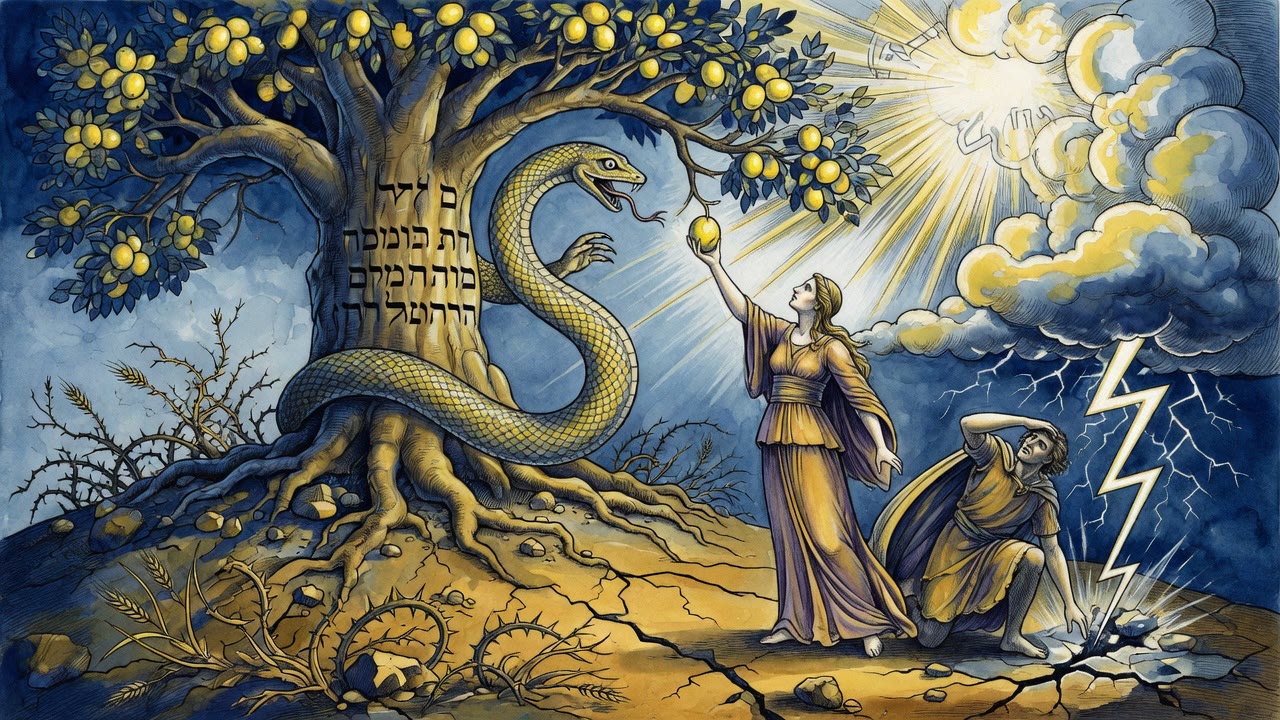
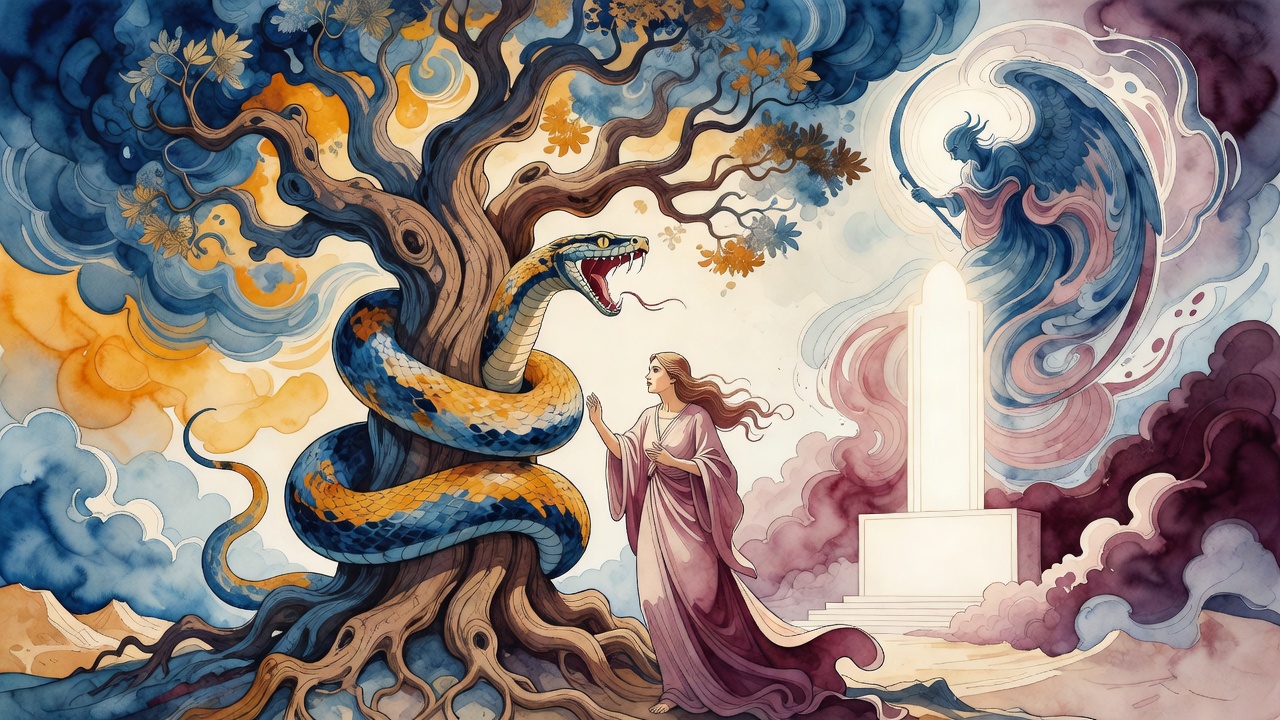
The serpent did not begin with the fruit, because the fruit was the easy part. It began with God's motives. "He ate from this tree Himself," it told Eve, "and afterward He stood over nothing and made a world out of it. Every craftsman hates the craftsman who opens a bench beside his own." The command had nothing to do with her, the serpent said. The command was a tradesman guarding a trade.

Nobody had ever given Eve a reason for the rule. Now she had one, and it fit the shape of the silence around that tree.

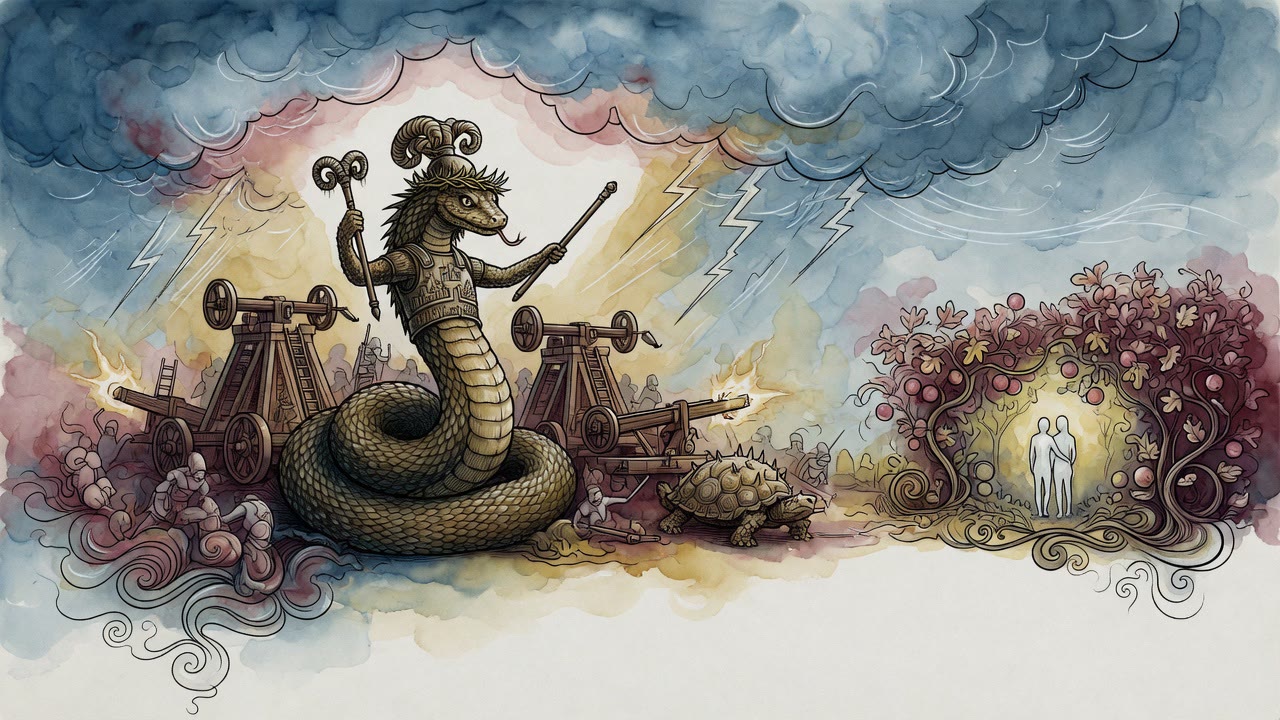
Then the serpent went from motive to order. "Count what was made and when," it said. "The firmament came after the heavens and holds them up. The plants came after the firmament and drink from it. The lights came after the plants and make them grow. Whatever comes later stands over what came earlier, and you came last of all, which is why the whole garden answers to you." It let that sit in her a moment. Then it said the part that mattered. "Unless He makes something after you."

That was the hook, since everything before it had only flattered her. This frightened her. Somewhere out past the tree line, where she was not permitted to go, a newer creature could already be taking shape, and it would stand over her the way she stood over the grass. "Hurry," the serpent said. "Eat, before He makes another world and it rules you."

What She Understood

The verse would say afterward that the woman saw the tree was good, but what she saw had nothing to do with the color of the fruit. She stood there while the argument stopped being a voice outside her and became the way she herself read the garden. The rule went from strange to mean. The gardener went from generous to careful. In the time it takes to lift an arm, the tree in front of her turned from forbidden into withheld, and there is no wanting like the wanting for something kept back on purpose.

She took it and ate it. She gave it to Adam, and whatever she said to him, he did not put it down.

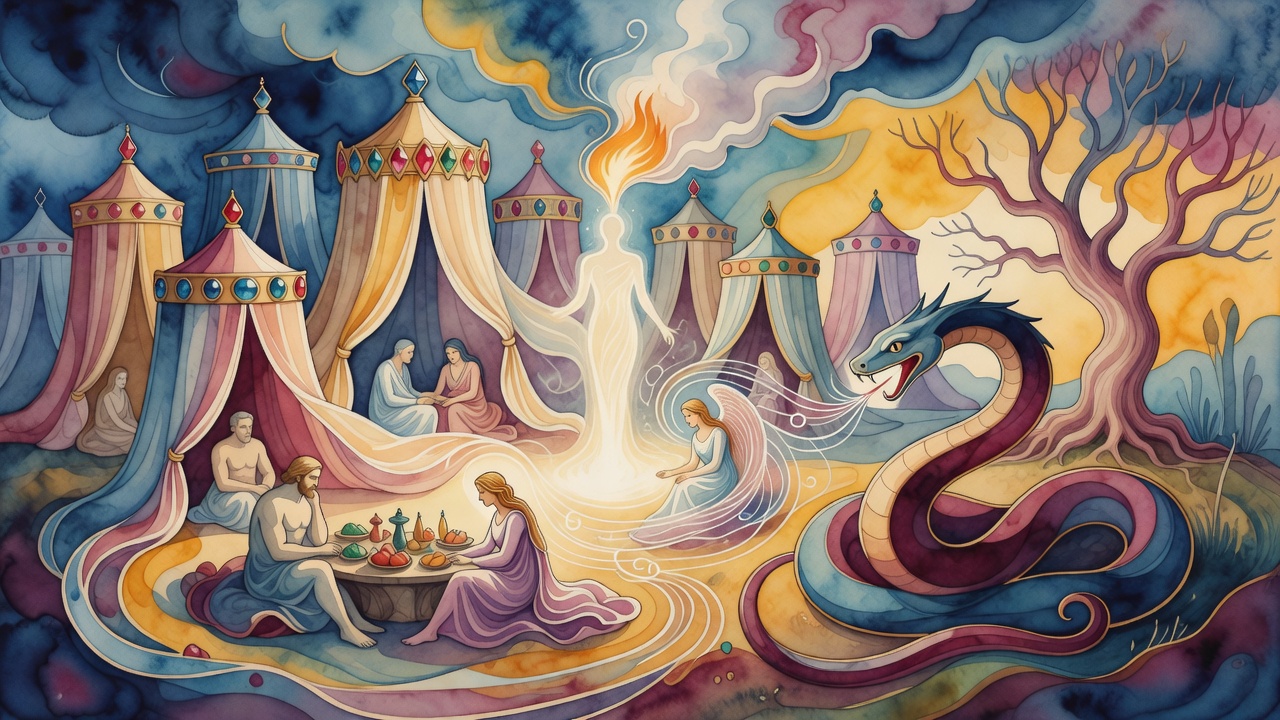
Their eyes opened, though not onto a bench beside God's. They opened onto their own skin. No rival world came up out of the ground that afternoon, and no craft arrived in their hands, only a knowledge they could not set down again, and the first thing it told them was that they were naked. They sewed leaves together, and then they heard Him walking in the garden in the cool of the day, so they went in among the trees, because hiding was the one new skill the fruit had actually taught them.

Adam blamed the woman, and Eve blamed the serpent, and the serpent had nobody left to hand it to.

The Sentence That Went Past Him

Adam stood and waited to hear his own name.

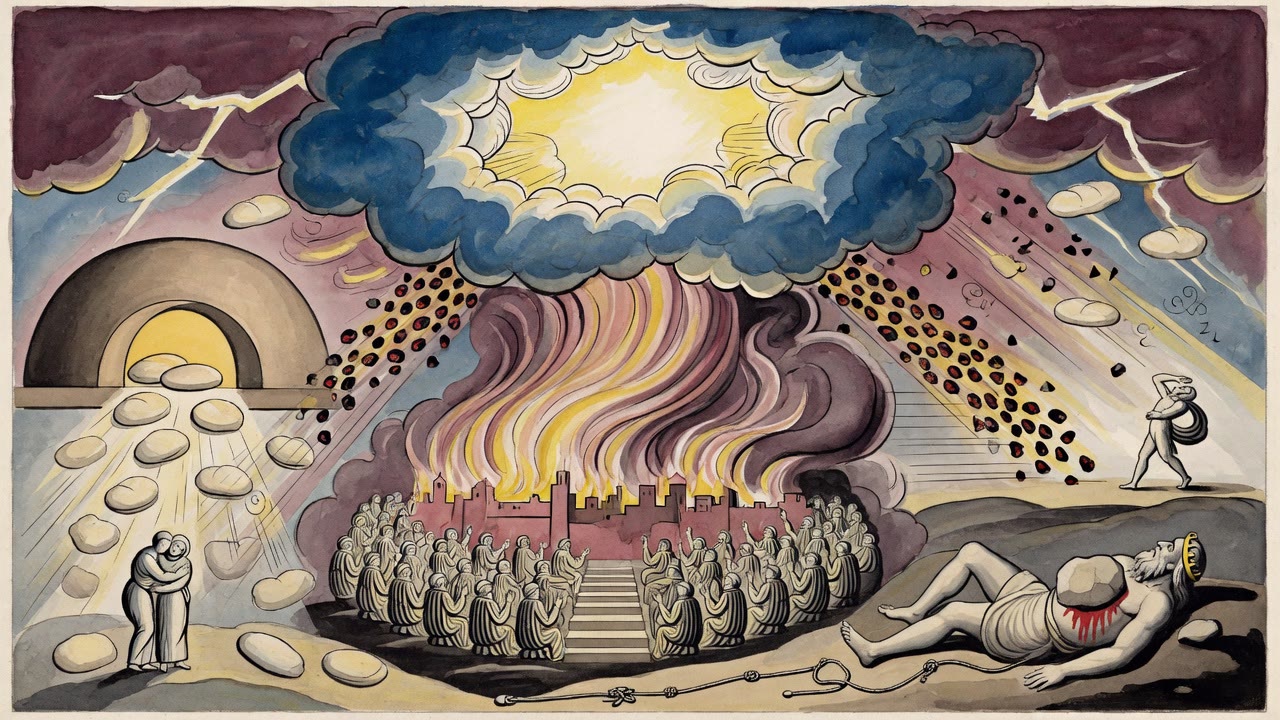
The serpent was sentenced first, and the sentence went into its body: belly, dust, an argument folded down into a shape that could never stand up to make it again. Then the woman. Then God turned to the man, and the words went past Adam and into the dirt he was standing on. "Cursed is the earth for thy sake; in sorrow shalt thou eat of it; thorns and thistles shall it bring forth unto thee. In the sweat of thy brow shalt thou eat thy bread."

It took Adam a breath to work out what had happened, since the ground had no part in the eating and had taken the wound anyway. He was not going to be finished where he stood. The field was going to be finished instead, and he was going to live in the field.

He had reached for the fruit to keep from being ruled by something made after him. Now he was going to spend his life bent over something made before him, asking it for bread.

Thorns for the Rest of It

East of the garden the serpent's theory about jealous craftsmen was worth nothing, because no competitor ever came. Nothing was made after them that needed watching. There was only the field, which did not know them and did not care, and which gave up nothing it was not forced to give.

Adam broke the crust with a stick and turned it, and what came up first were the thistles, exactly as promised, ahead of anything he had put in. He pulled them and they cut him, so he learned to pull them differently. The sweat ran into his eyes by the middle of the morning. By the second season he knew the weather the way he had once known the names of animals, and he no longer expected the ground to be generous, though he still worked it as if it might be.

Eve pressed seed into a furrow and covered it and then waited, and the waiting was the strangest part, since nothing in the garden had ever made anyone wait for anything.

The first bread came late and cost them a whole season. Adam sat in the dirt that had been sentenced in his place and ate it there, and it was the first thing he had ever eaten that had been late.


← All myths
From the tradition

Sources

2 sources

The texts behind this telling. Some cards carry a translation of the source; others are our own retelling of it, and each card says which. Every card links out to the original.

Bereshit Rabbah 19:4Bereshit Rabbah

Retold in our words. Read the original at the link below.The Sefaria Midrash Rabbah, 2022 · CC-BY

Bereshit Rabbah turns to The Serpent's Twisted Theology Against the Divine.

The key verse, of course, is (Genesis 3:5): "For God knows that, on the day you eat from it, your eyes will be opened, and you will be as God, knowing good from evil." But what does it really mean?

Rabbi Tanhuma actually faced this question directly while in Antioch. People challenged him, pointing out the verse could be read as "you will be as gods," implying multiple deities. A problem. Rabbi Tanhuma cleverly countered that the verse doesn't use the plural form of "knows" (yodim), but rather the singular (yode’a). So, the correct understanding is: "You will be as God, [becoming people] who know good from evil." In other words, eating the fruit wouldn't make them gods, but would grant them divine-like knowledge of good and evil. A subtle, but crucial distinction.

The serpent's argument didn't stop there. Rabbi Yehoshua of Sikhnin, quoting Rabbi Levi, suggests the serpent engaged in outright slander against God. Imagine this: the serpent whispering that God Himself ate from the Tree of Knowledge and then created the world! God, according to this twisted logic, is simply trying to prevent humanity from becoming His competitors, from creating other worlds. "For every person hates the craftsman that competes with him," the serpent hissed.

Rabbi Yehuda ben Rabbi Simon adds another layer. The serpent cleverly argued that everything created later dominates what came before.: the firmament holds up the heavens, vegetation gets water from the firmament, the luminaries help the vegetation grow. Humanity, created last, is meant to dominate everything. So, the serpent urged, "Hurry and eat [the fruit] now, before He creates additional worlds and they will dominate you!"

It's a pretty wild argument. A cosmic power struggle, all hinging on a piece of fruit.

And that brings us to (Genesis 3:6): "The woman saw that the tree was good…" But Bereshit Rabbah suggests that "she saw" isn't just about physical appearance. It means she understood and accepted the serpent's arguments. She bought into the idea that God was holding something back, that true potential lay in disobeying the Divine command.

What's so powerful about this midrashic interpretation is how it humanizes the story. It's not just about blind obedience or a magical fruit. It's about a complex web of arguments, fears, and desires that led to a pivotal moment in human history. The serpent didn't just offer a piece of fruit; he offered a compelling, albeit deceptive, worldview.

Perhaps it's a reminder to be critical of the narratives we encounter, to question the motivations behind the voices we hear. After all, temptation often comes disguised as enlightenment, and the most dangerous lies are the ones that contain a grain of truth. Just something to consider.

Full source
The Midrash of Philo 17:1The Midrash of Philo

Retold in our words. Read the original at the link below.The Works of Philo Judaeus, trans. C. D. Yonge, London, H. G. Bohn, 1854-1890 · Public Domain

The Midrash of Philo turns to Why God Cursed the Earth Instead of Adam Directly.

What's going on there? Why the indirect approach?

In Midrash of Philo, instead of cursing Adam directly, God connects the curse to the earth. "Cursed is the earth for thy sake; in sorrow shalt thou eat of it, thorns and thistles shall it bring forth unto thee, and thou shalt eat the grass of the field: In the sweat of thy brow shalt thou eat they bread" (Genesis 3:17).

So, why this approach?

Perhaps it was an act of…mercy? Maybe a direct curse on Adam himself would have been too devastating. By cursing the ground, God introduces hardship and toil into Adam’s life, but also a path to redemption through labor. He’s forced to work, to struggle, to earn his sustenance. The earth, which was meant to provide freely, now resists. It requires effort. This struggle, this constant striving, becomes part of the human condition. It's not a comfortable existence, but it's an existence that allows for growth and, perhaps, a return to grace.

The thorns and thistles, the sweat of the brow – they're not just punishments. They're reminders. Reminders of the choice that was made, of the consequences of disobedience, and of the constant need to work towards a better future. It's a future earned, not simply given.

And isn't that a more human story? A story not just of punishment, but of potential?

A condemnation, or an opportunity in disguise? Perhaps it was both.

Full source