5 min read

Twelve Canopies and a Serpent at Adam's Feast

God built twelve jewel canopies for Adam and led Eve with angel music. After the feast the jealous serpent chose the tree.

Curated by Arthur · Told by Maggid ·
Table of Contents
  1. The Wedding Hall of Eden
  2. The Guest Who Grew Jealous
  3. What Tree Was It
  4. Why the Name Was Hidden
  5. From Music to Dust
Twelve Canopies and a Serpent at Adam's Feast Click for full size

The Wedding Hall of Eden

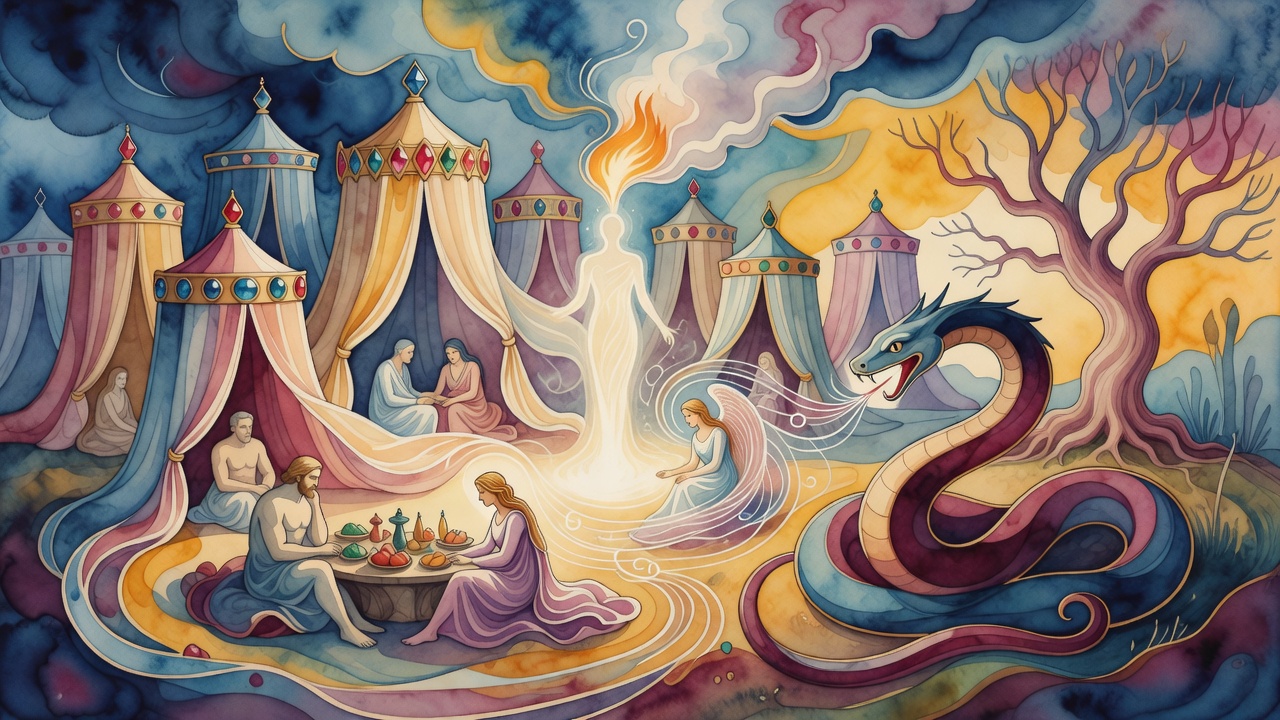
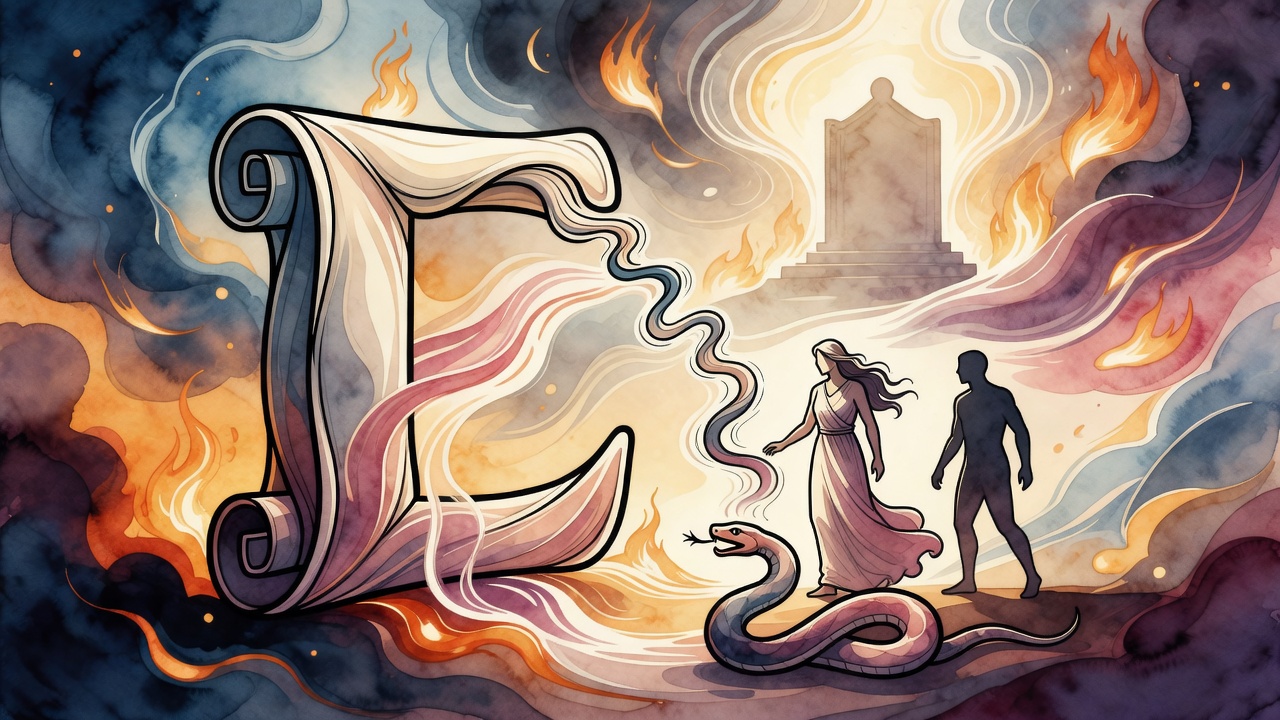
Gan Eden (the Garden of Eden) opened like a wedding hall. God planted twelve canopies of jewels for Adam, and the least of their materials was gold. The angels opened Eden's doors and called him in peace. Then God built the woman from Adam's side, washed her, anointed her, braided her hair, and brought her to him with tens of thousands of angels. Harps, cymbals, sun, moon, stars, and constellations moved before the first couple, and pearl tables waited for the feast.

Eve walked under music that filled the garden's air. Adam saw her and the canopies at once. The least canopy was gold. The greater ones no tongue fully named.

The Guest Who Grew Jealous

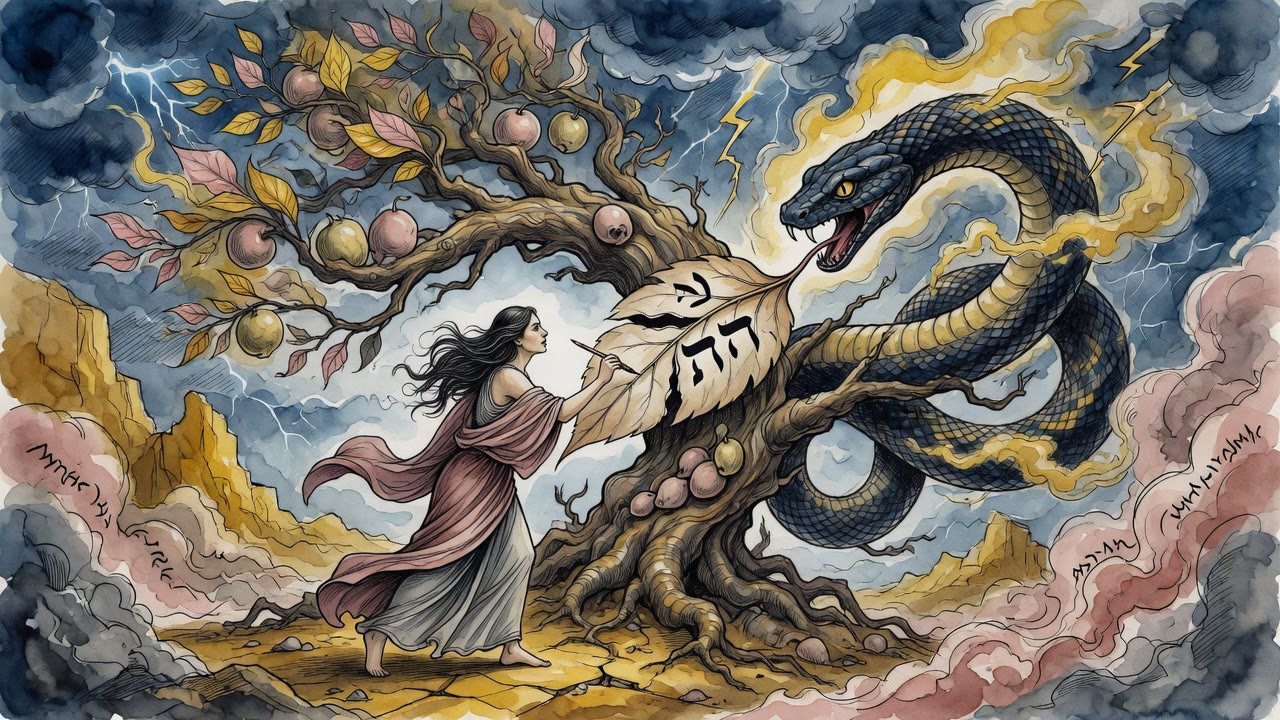
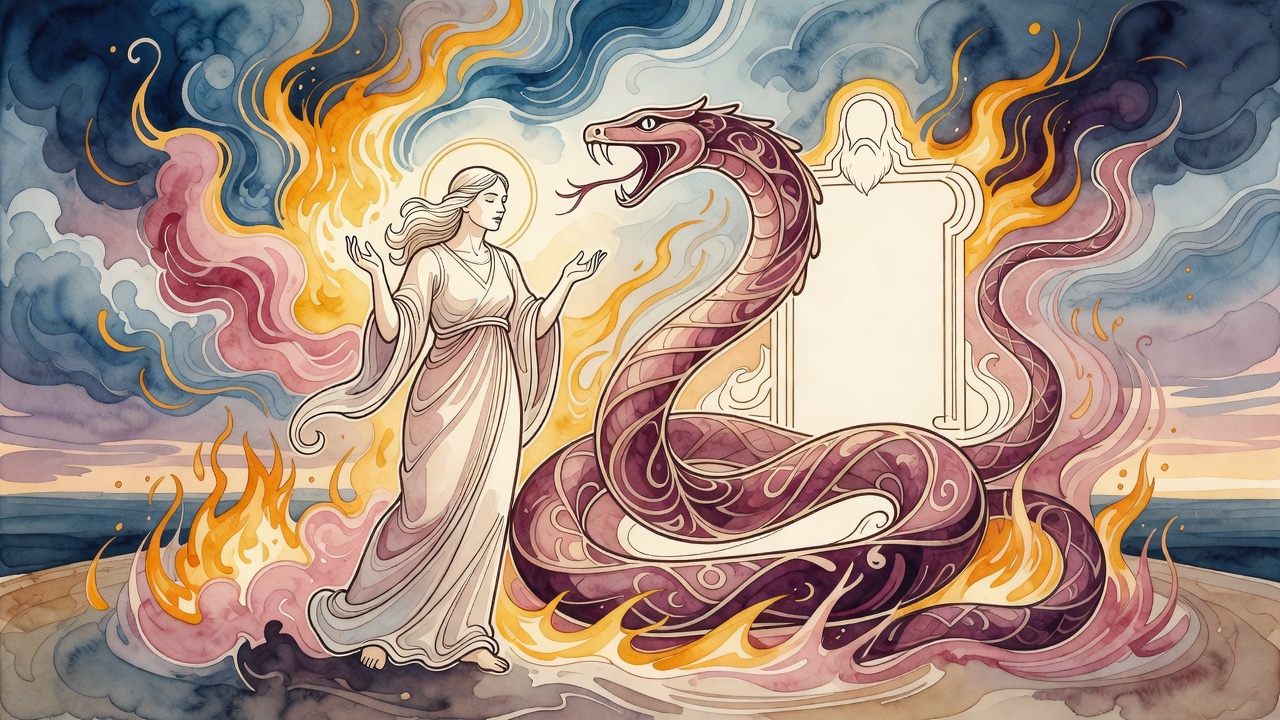
The serpent entered after the feast. The angels had roasted meat, cooled wine, and honored Adam. The serpent saw the honor and became jealous. Its jealousy moved toward the tree. After Adam and Eve ate, God called each of them to judgment. The serpent tried to answer each curse with a loophole. If it had no legs, it could still climb. If it ate dust, dust was everywhere. God closed the loopholes. The tongue that had talked the woman into ruin was split so that speech itself would carry the mark of the lie.

The feast tables still held their pearls while the curses fell. Music had led Eve in. Silence followed the serpent out on its belly.

What Tree Was It

What kind of tree was it? Scripture never says, and the rabbis could not resist guessing. Rabbi Meir said wheat, because we still say a fool has "never eaten bread." When a student objected that the verse calls it a tree, the answer came back that in Eden the wheat grew tall as cedars. Rabbi Judah voted for grapes, the bitter clusters that brought bitterness into the world. Rabbi Abba named the citron, whose wood tastes like its fruit. Rabbi Yose pointed to figs, since Adam and Eve sewed fig leaves the moment they fell.

That last detail opens a haunting parable. Imagine a prince warned never to touch his father's servants. He disobeys, gets thrown out of the palace, and wanders door to door. Every house slams shut, except one, the door of the very servant he sinned with. So it was, the sages say, when the trees of the garden saw the first humans exposed and ashamed. Here is the thief who stole from us. Only the fig, partner in the crime, offered its leaves.

Why the Name Was Hidden

God hid the tree's species so that no later orchard would be cursed by name, and so that no nation could point to a single fruit and say, that is the cause of death. The rabbis' guesses keep the tree near enough to touch and far enough that no market can sell it. Wheat as tall as cedars. Grapes of bitterness. Citron wood that tastes like fruit. Figs that clothe what they helped uncover.

Adam still had the taste in his mouth when the leaves went on. Eve still had the serpent's argument in her ear. The canopies still glittered over a marriage that had already learned exile.

From Music to Dust

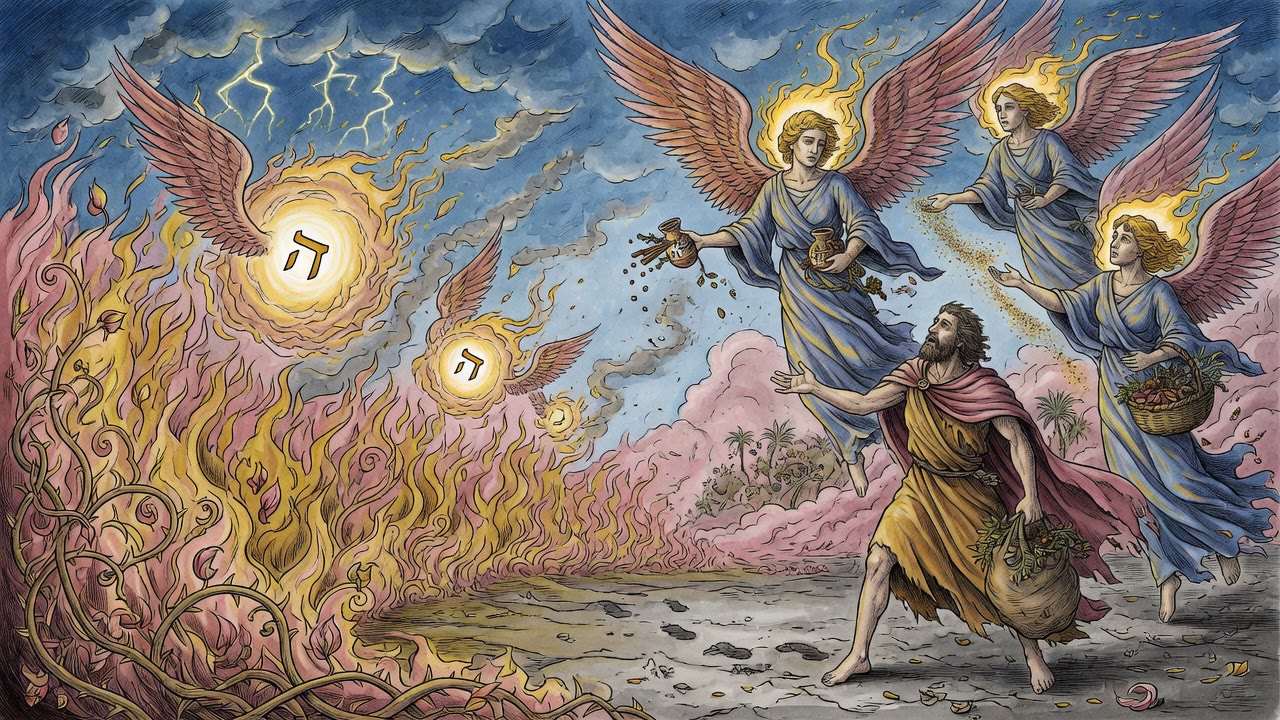
The same garden that opened with twelve jewel roofs and angel processions closed with a split tongue and a body forced to the ground. The honor the serpent envied was real. The tree it chose as weapon was real. The leaves that covered shame were real. Between the harp and the dust lay one meal and one refusal to leave the fruit alone.

Adam walked out under a sky that no longer held wedding constellations for him alone. Eve walked with him. The serpent crawled. Somewhere behind them a canopy of gold still stood over an empty feast, proof that glory had been offered before the jealousy arrived.

Light broke through gem-roofs and scattered on grass that had never known a footprint of exile. Angels set roasted meat and cooled wine. The first marriage began with more honor than any later wedding could copy. The serpent watched the honor poured on a creature of dust and felt the heat of envy rise toward the one command that could unmake the day.

Eden's air, which had held harp and cymbal, now held the sound of a body forced to the ground. The hidden name of the tree is itself a mercy: the world would not have to hate one species forever. Glory had been offered before the jealousy arrived, and the first day of human marriage held both music and the seed of the fall in one garden hour.


← All myths
From the tradition

Sources

3 sources

The texts behind this telling. Some cards carry a translation of the source; others are our own retelling of it, and each card says which. Every card links out to the original.

Aleph Bet of Rabbi Akiva, Version B, Part B, Eden canopies and Eve wedding expositionOtzar Midrashim, Aleph Bet of Rabbi Akiva

Translation of the source text.Hebrew Wikisource transcription of Aleph Bet of Rabbi Akiva, Version B, based on Eisenstein, Otzar Midrashim (CC-BY-SA 4.0) · CC-BY-SA

Gimel Resh: Gimel refers to Gan Eden, which the Holy One, blessed be He, planted in Eden in order to place within it twelve canopies of precious stones and pearls for Adam, as it says, "You were in Eden, the garden of God; every precious stone was your covering: ruby, topaz, diamond, beryl, onyx, jasper, sapphire, emerald, carbuncle, and gold; the work of your timbrels and pipes was in you" (Ezekiel 28:13), and the least of all of them was gold. Resh means that he entered first into Gan Eden before all the righteous, as it says, "The LORD God planted a garden in Eden from the east, and He placed the man there" (Genesis 2:8).

Dalet Kuf: Dalet refers to the doors of Gan Eden, which the ministering angels whom the Holy One, blessed be He, sent to Adam to serve him opened before him. Kuf teaches that the holy ones above and the mighty ones of the Aravot called before him and said to him, "Come in peace."

Heh Tsadi: Heh means that the Holy One, blessed be He, cast a deep sleep upon him, as it says, "The LORD God caused a deep sleep to fall upon the man" (Genesis 2:21). Tsadi refers to the one side that He took from his sides and built into a woman. He washed her, anointed her, adorned her, braided her hair, and paired her with Adam, as it says, "The LORD God built the side," and so on (Genesis 2:22).

Vav Peh: Vav means that He brought her with tens of thousands of ministering angels to Adam the first man with a voice of ringing song, as it says, "He brought her to the man" (Genesis 2:22). And what is Peh? It teaches that the whole retinue above descended with them to Gan Eden. Some held lyres, cymbals, and harps in their hands and played before him like maidens, while the sun, moon, stars, and constellations danced before them like young girls.

Zayin Ayin: Zayin teaches that the Holy One, blessed be He, prepared both of them for a feast of the delicacies of Gan Eden. Ayin means that the Holy One, blessed be He, arranged tables of pearls before them, each pearl one hundred cubits long and sixty cubits wide, with every kind of delicacy set before them, as it says, "You prepare a table before me" (Psalms 23:5).

Full source
Aleph Bet of Rabbi Akiva, Version B, Part B, serpent judgment expositionOtzar Midrashim, Aleph Bet of Rabbi Akiva

Translation of the source text.Hebrew Wikisource transcription of Aleph Bet of Rabbi Akiva, Version B, based on Eisenstein, Otzar Midrashim (CC-BY-SA 4.0) · CC-BY-SA

Chet Samekh: Chet means that the ministering angels hurried and roasted meat for Adam and cooled wine for him. Then the serpent came, saw their honor, peered at them, and became jealous. Samekh means that the Holy One, blessed be He, spoke to Adam and said to him, "From the fruit of the trees of the garden you may eat, but from the fruit of the tree," and so on (Genesis 2:16-17).

Tet Nun: Tet means that Eve erred through the words of the serpent and ate from the tree and gave from it to Adam, and he ate, as it says, "She took of its fruit and ate," and so on (Genesis 3:6). Nun means that their eyes were opened and they understood that they were naked and wrapped themselves in fig leaves, as it says, "They sewed fig leaves," and so on (Genesis 3:7). Yod Mem: Yod means that their deeds were already revealed and known before Him, and the Holy One, blessed be He, descended from the highest heavens, stood at the entrances of Gan Eden, and called to Adam, as it says, "The LORD God called," and so on (Genesis 3:9). Mem means that the Holy One, blessed be He, said to Adam, "Who told you that you were naked?" (Genesis 3:11).

Kaf Lamed: Kaf means that the Holy One, blessed be He, summoned all of them to judgment. First He called to Adam and said to him, "Why did you eat from the fruit of the Tree of Knowledge, which I told you not to eat from?" Adam answered and said, "Master of the worlds, the woman whom You gave with me gave it to me, and I ate." He said to the woman, "Why did you eat?" The woman said, "The serpent deceived me, and I ate." Afterward He called the serpent. The Holy One, blessed be He, said to it, "Because you have done this," and so on (Genesis 3:14). When He said to it, "On your belly you shall go," the serpent answered and said, "Master of the worlds, if this is Your will, I will be like a fish in the sea, which has no legs." When He said to it, "Dust you shall eat," the serpent said, "Master of the worlds, if a fish eats dust, then I too will eat dust." At that hour the Holy One, blessed be He, seized the serpent and tore its tongue into two tears. He said to it, "Wicked one of the world, you began with evil speech. Therefore I make known to all who enter the world that your tongue caused all this." It teaches that three sinned and four were struck. The serpent, Eve, and Adam sinned, were struck, and were driven from Gan Eden, as it says, "He drove out the man" (Genesis 3:24). The fourth was the earth, which was struck because of them, as it says, "Cursed is the ground because of you" (Genesis 3:17).

Full source
Pesikta DeRav Kahana 20:6Pesikta de-Rav Kahana

Translation of the source text.Pesikta de Rav Kahana according to an Oxford manuscript, Dov Mandelbaum ed., N.Y. 1987 · CC-BY

"May there be abundance of grain in the land; on the tops of the mountains may its fruit wave like Lebanon" (Psalms 72:16). And what was that tree from which the first man ate? Rabbi Meir says: it was wheat. Rabbi Judah son of Rabbi Ilai said: it was grapes. Rabbi Abba of Acco said: it was a citron. Rabbi Yose said: it was figs. And all of them bring a reason for their words.

The reasoning of Rabbi Meir who said it was wheat: it is the way of the world that of a person who lacks knowledge, people say, "this one has never eaten bread of wheat in his life." Rabbi Zeira asked before Rabbi Samuel bar Rav Isaac: it is written "tree" concerning it, and you say it was wheat? He said to him: they grew tall like the cedars of Lebanon and let their seed fall to the earth.

The reasoning of Rabbi Judah son of Rabbi Ilai who said it was grapes: "their grapes are grapes of gall, their clusters are bitter" (Deuteronomy 32:32), those clusters brought bitterness into the world. The reasoning of Rabbi Abba of Acco who said it was a citron: "and you ate of the tree" (Genesis 3:17), a tree whose wood is eaten like its fruit, and which is that? This is the citron. The reasoning of Rabbi Yose who said it was figs: "and they sewed fig leaves and made themselves girdles" (Genesis 3:7).

Rabbi Joshua of Sikhnin in the name of Rabbi Levi: it is like a king who had a son and had many maidservants, and he would command him, saying, "My son, take care that you do not touch any of these maidservants." What did the son do? He went and sinned with one of them. When his father became aware of him, he drove him out and expelled him from the palace, and he went around to all the houses of those maidservants, and not one of them would take him in. You find that the very one with whom he had sinned, she opened her doors and took him in. So too, when the first man ate from that tree, all the trees heard them saying, "Here is the thief, here is the thief who deceived his Creator," who deceived his Master, "Let not the foot of pride come against me" (Psalms 36:12), that foot which stretched out in pride, let it not come against me, "and let not the hand of the wicked drive me away" (Psalms 36:12), do not shake me by hand, do not take leaves from me. You find that the tree that gave him its fruit gave him its leaves, "and they sewed fig leaves and made themselves girdles" (Genesis 3:7).

What was the name of that fig tree? Rabbi Levi said: bar Eli, for it brought wailing and weeping into the world. Rabbi Berekhiah in the name of Rabbi Simon in the name of Rabbi Joshua ben Levi: that tree from which the first man ate, the Holy One, blessed be He, did not reveal it and is not destined to reveal it. The Holy One, blessed be He, said: it is written, "and you shall kill the woman and the beast" (Leviticus 20:16). If the human sinned, what did the beast sin? Rather, because a stumbling came to the human through it, therefore the Holy One, blessed be He, said let it be stoned. Another interpretation: so that the beast should not pass through the marketplace and people say, "this is the beast on account of which so-and-so was stoned." The Holy One said: if I spared the honor of His children, it is fitting that I spare His honor.

Full source