5 min read

The Serpent That Opens the Doe and the Rain That Never Touches

A doe too narrow to give birth, a raindrop that will not touch its neighbor, and all creation praising God in a silence louder than any voice.

Curated by Arthur · Told by Maggid ·
Table of Contents
  1. The Serpent Sent to Bite Her Open
  2. The Frenzy That Guards Her at the Water
  3. Rain That Would Not Mingle
  4. The Sea That Has No Hands

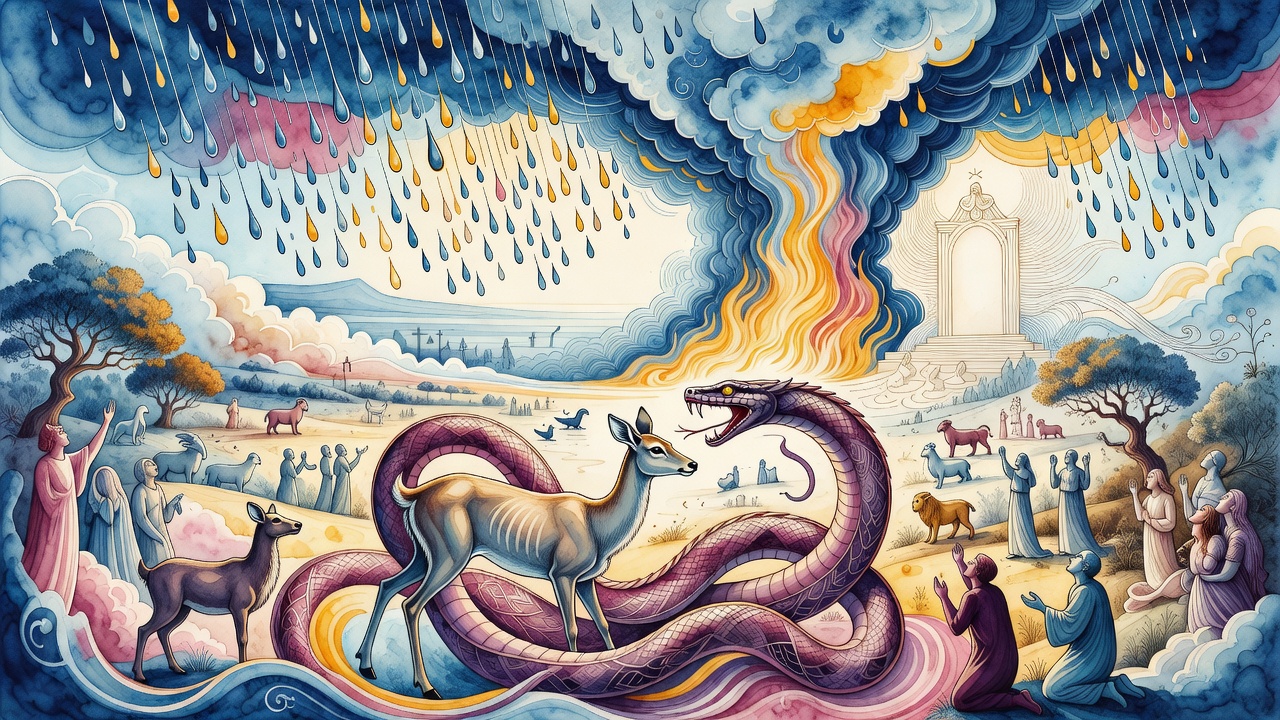
On the high rock where the wild goats climb, a hind went down into her labor and could not deliver. Her hips were narrow, her limbs drawn tight around the fawn, and every push sealed the passage it should have opened. She strained until her legs trembled. Nothing came. No herdsman climbed to her, no herd gathered. She lay alone on the stone with the life caught inside her.
The Serpent That Opens the Doe and the Rain That Never Touches Click for full size

The Serpent Sent to Bite Her Open

Out of the cracks in the rock came a serpent. It did not coil to kill. It struck once, a single measured bite, and where the fangs went in the tight limbs slackened all at once. The passage loosened. The fawn slid free onto the warm stone, wet and steaming and breathing. The bite that should have carried death had opened her like a fist unclenching. But the wound still burned, and torn and leaking blood she staggered up the slope, nosing through the scrub until she found the one herb that answered it. She cropped it, swallowed, and the tear knit shut and closed over clean. God had set the poison and the cure on the same mountain, an hour apart, and timed her agony to the minute.

The Frenzy That Guards Her at the Water

She came down thirsty to the stream, weak in the legs, and a wild beast waited in the reeds along the far bank. Then something took hold of her. A frenzy dropped into her chest and she beat the ground with her feet and slashed the air with her horns, stamping and wheeling like a creature gone mad. The beast in the reeds heard the drumming, could not read it, and broke and ran. She lowered her head and drank.

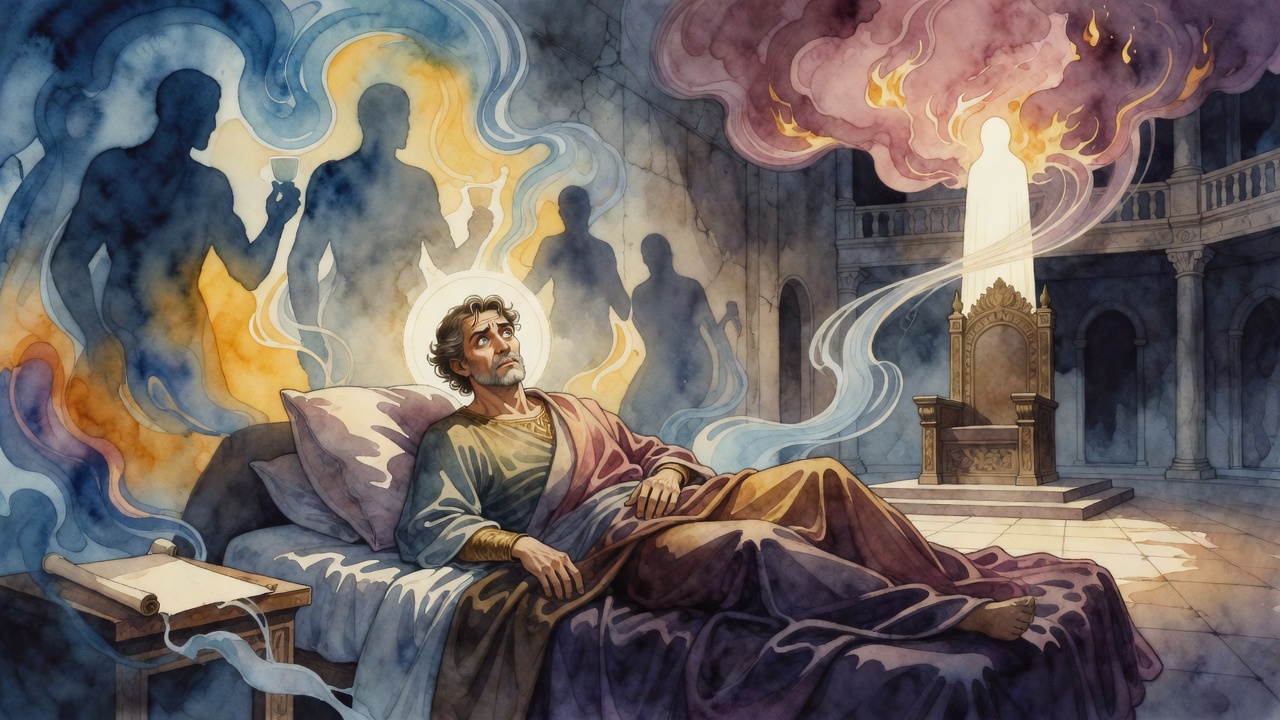
That same frenzy visits a man. He is asleep on his bed and a serpent has risen silent at the foot of it, poised, a hand's breadth from his ankle. He feels nothing. But a spirit flings into his sleep and throws him thrashing, hands lashing out, feet kicking, and he comes up tangled and gasping with his garment pulled on inside out. The serpent hears the storm of him and pours itself back down into the dark. He never sees it. He lies back down cursing the bad dream, guarded by the very thing he cursed.

Rain That Would Not Mingle

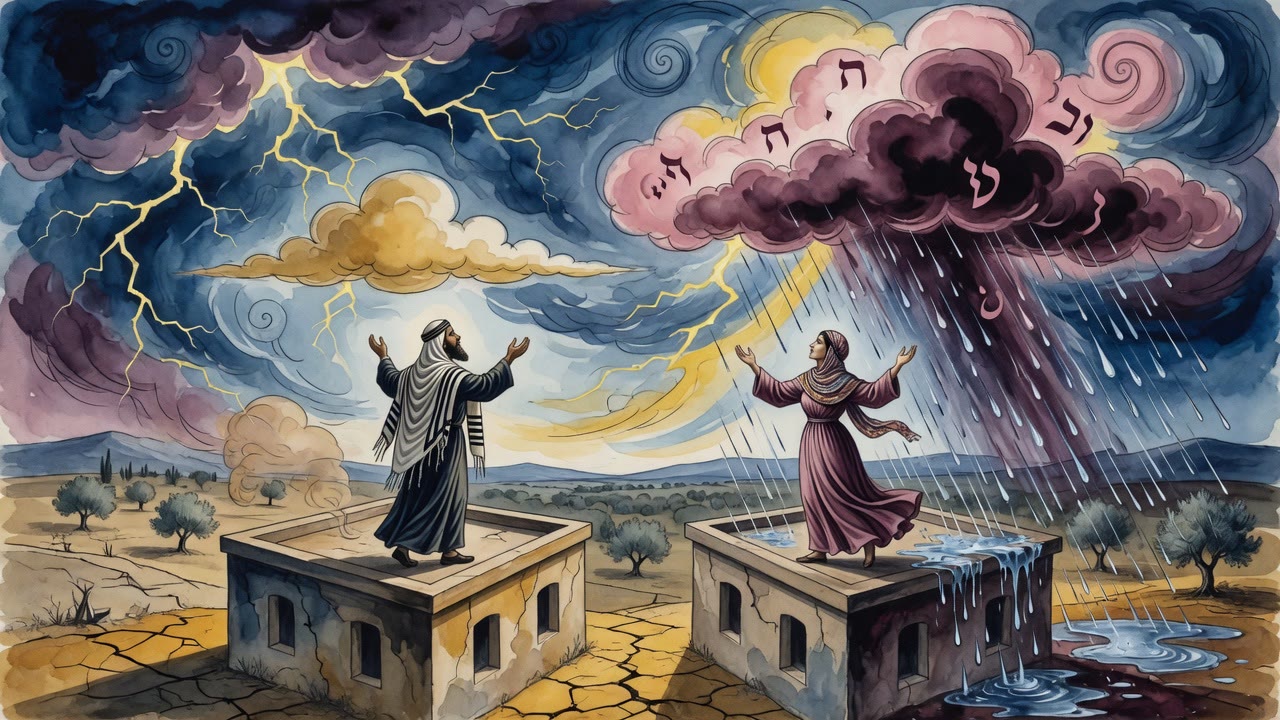
Rabbi Yochanan stood under the eaves in a downpour and cupped his hands to catch it, and the water that ran between his fingers taught him something he could not stop turning over. Scoop as fast as you like, he said, and you cannot gather a handful deep enough to walk down into, because the drops will not join. Each one falls sealed inside itself. Let the rain come five hundred years without stopping and still no two drops touch. Above the sea the clouds haul up the brine, bitter and undrinkable, and sweeten it in their bellies until what falls is fit to drink. And every drop is counted before it is dropped, weighed out and diminished to its exact measure, so that the same rain feeds one field and drowns none, judges one nation and nourishes another, each drop a separate verdict falling in its millions and never once colliding.

The Sea That Has No Hands

None of it speaks. The sea has no hands, yet it heaves and holds its line before God as though it were laboring. The earth has no ears, yet when the prophet stood over it and cried "O earth, earth, earth, hear the word of the Lord," it heard. It has no mouth, yet at a word it split under the rebels and swallowed them whole. The heavens have no heart, yet they stretch from end to end and pour out glory without a sound. Every mute and broken thing in creation stands complete before the One who made it and praises without a voice.

A man who tried to say that praise aloud would run out of world before he ran out of God. Pile up every name and every splendor and the sky would crack before the account was full. And so the truest praise came to be silence, the way a king rules a hundred provinces and each one tells of his gold and his armies, but only the province where he actually dwells knows what he is, and lowers its voice.


← All myths
From the tradition

Sources

3 sources

The texts behind this telling. Some cards carry a translation of the source; others are our own retelling of it, and each card says which. Every card links out to the original.

Midrash Tehillim 18:14Midrash Tehillim

Retold in our words. Read the original at the link below.Rabbi Mike Feuer, Jerusalem Anthology · CC-BY

The ancient Rabbis did. They saw in every raindrop a universe of wonder, evidence of the divine. to a fascinating passage from Midrash Tehillim, a collection of homiletic interpretations of the Book of Psalms, and explore their musings on clouds and rain.

This sparks a debate! Rabbi Nechemiah points out that the earth drinks only from the ocean. Rabbi Yehoshua challenges this, "But aren't the waters of the ocean salty?" A great question! Rabbi Nechemiah responds with a beautiful image: "They become sweetened in the clouds." The very process of rain is seen as a divine act of purification, transforming salty, undrinkable water into life-giving nourishment.

Rabbi Abba adds another layer, comparing the clouds to animals mingling their saliva. A bit of an unusual image for us perhaps, but the key is the mixing, the coming together. Resh Lakish picks up on this theme, suggesting the very name for clouds, in Hebrew, ‘avim, comes from their mingling, their interconnectedness.

Then Rabbi Yochanan shares a truly astounding observation: "There are miracles in the rain. A person can scoop up a handful of raindrops and not have enough to descend because the drops do not mix with each other." Wow. He goes on to say that even after five hundred years of rain, no two drops mix! What is going on here? It seems like an impossible image to conjure, yet it speaks to the utter control that God has over creation. He sees in this separation a sign of divine judgment and provision: "For by them He judges peoples; He gives food in abundance" (Job 36:31). The rain, each individual drop, is a carefully measured blessing.

Rav Yehuda bar Yechzekel recalls his father’s blessing, a prayer that praises God because "there are thousands upon thousands and myriads upon myriads [of raindrops], and not a single drop touches another," echoing the verse, "For He diminishes the drops of water" (Job 36:27). The Hebrew word for "diminishes" here, gera, can also mean "draws," suggesting God both withholds and provides.

The passage concludes with a seeming contradiction. Rabbi Chiya bar Abba notes that some say the clouds are dark and covered with water, citing (Job 22:14) again. Others say they are bright and emit light, referencing (Job 36:30), "He spreads His light upon it [the cloud]." Resh Lakish adds that the cloud rises from below, as it is said, "A mist would rise from the earth" (Genesis 2:6). How can the clouds be dark and light? Water and frost? The answer, as the Midrash (rabbinic interpretive commentary) suggests, lies in the transformative process. "When the clouds carry the water, they darken, but when the water is squeezed out, it is clear forever. Therefore, it is said, 'The darkness of waters and the hoarfrost of waters' (Job 38:29)."

It's more than just meteorology. The Rabbis invite us to see the rain, and indeed all of nature, as a complex, miraculous expression of God's will. It's a reminder that even in the seemingly mundane, there is profound beauty and divine intention. The next time you feel a raindrop, think about the ancient Rabbis, and consider the miracle contained within that single, separate, life-giving drop.

Full source
Midrash Shmuel 9:2Midrash Shmuel

Translation of the source text.Midrash Shmuel, Krakow 1893, Public Domain, on Sefaria · CC-BY-SA

Rabbi Yudan said: It is written, "The high mountains are for the wild goats" (Psalms 104:18). Rabbi Levi in the name of Rabbi Shimon ben Lakish said: This hind, her limbs are narrow, and she has difficulty giving birth. And what does the Holy One, blessed be He, do? He provides for her a serpent, and it bites her, and her limbs slacken. And when she gives birth, what does the Holy One, blessed be He, do? He provides for her an herb, and she eats it and is healed. This is what is written, "He does great things that we do not comprehend" (Job 37:5).

Rabbi Levi in the name of Rabbi Shimon ben Lakish said: This hind, her limbs are weak, and she seeks water, and she is afraid of a wild beast. What does the Holy One, blessed be He, do? He places in her a frenzied spirit, and she beats with her feet and beats with her horns, and the wild beast hears and flees. This is what is written, "[God thunders marvelously with His voice;] He does great things that we do not comprehend" (Job 37:5).

Rabbi Elazar said: This man sleeps upon his bed, and the serpent is poised before his bed. And what does the Holy One, blessed be He, do? He places in him a frenzied spirit, and he flings out with his hands and flings out with his feet and puts on his garments inside out, and the serpent hears and flees. This is what is written, "God thunders marvelously with His voice; He does great things that we do not comprehend" (Job 37:5).

Full source
Midrash Tehillim 19:2Midrash Tehillim

Retold in our words. Read the original at the link below.Rabbi Mike Feuer, Jerusalem Anthology · CC-BY

Midrash Tehillim turns to How All of Creation Sings God's Praises in Silence.

The passage begins by offering an alternative understanding of the phrase "kol pe'ul Hashem" – usually translated as "the voice of God's actions." Here, it's interpreted as "to His perfection." In other words, everything praises God because everything testifies to His perfect actions. But it goes further than that. Rabbi Berechiah, in the name of Rabbi Shimon, offers a radical thought: "One who has no head among people has a head before the Holy One, Blessed be He." What does this mean?

The Midrash (rabbinic interpretive commentary) beautifully illustrates this point. The sea has no hands, yet it acts before God. The earth has no ears, yet Jeremiah cries out, "O earth, earth, earth, hear the word of the Lord!" (Jeremiah 22:29). The earth has no mouth, yet we read, "And the earth opened its mouth" (Numbers 16:32). Heaven has no heart, but it resonates with God's presence, stretching "from one end of the heavens to the other" (Deuteronomy 4:32). And the heavens? The heavens themselves "declare the glory of God" (Psalms 19:2). Even things that seem incomplete or lacking in our human perception are complete and expressive before the Divine. The Zohar tells us of layers of reality, that we cannot begin to fathom the depth of the Divine presence.

This leads to a powerful realization: Our attempts to praise God might actually fall short. As Rabbi Abbahu says, "If a person tried to express the praise of the Holy One, Blessed be He, more than is necessary, the world would not be sufficient to contain it." David himself asks, "Who can utter the mighty acts of the Lord?" (Psalms 106:2). Are we doomed to silence, then? Are our prayers meaningless?

Not at all. The Midrash then recounts a story about Rabbi Chanina and Rabbi Yonatan, who politely corrected a chazzan (cantor) for adding too many adjectives to his prayer. Rav Huna, citing Rav, reminds us, "We have not found any fault with God's strength," alluding to (Job 37:23). Sometimes, less is more. The story emphasizes the importance of balance and humility in our expressions of praise.

This idea culminates in Rav Avin's interpretation of (Psalms 65:2), citing Jacob of Kfar Teveria who translated the verse as, "Silence is praise to You." This isn't just about being quiet; it's about recognizing the immensity of God, understanding that our words can only scratch the surface. The entire universe, the Midrash suggests, is silent before the hem of God's garment, because any praise we offer will always be inadequate.

But there’s more nuance here. Rabbi Pinchas HaKohen (a priest) Bar Chama points out how different leaders adjusted the prayer based on the historical circumstances. Moses established the original order, Jeremiah modified it after the Temple's destruction, and Daniel adapted it further. Eventually, the Men of the Great Assembly restored the original blessing. Why? Because they understood that true praise isn't about empty flattery. As Rabbi Yaakov, son of Rabbi Elazar, said, "They know that their God is true and do not flatter Him."

The Midrash concludes with a powerful analogy. Each kingdom boasts about the king's wealth and power. But only the kingdom where the king actually resides truly knows his glory. Similarly, we, as finite beings, can only glimpse God's glory. It’s when "the horn of Israel is exalted," when God's presence is manifest in the world, that we can truly begin to understand and express praise, as it says, “Praise the Lord from the earth” (Psalms 148:7).

So, what does this all mean for us? Perhaps it's an invitation to be more mindful in our prayers, to recognize the limitations of our words, and to appreciate the silent harmony of praise that emanates from all of creation. And maybe, just maybe, that silence speaks louder than any words ever could.

Full source