5 min read

Asenath and the Amulet That Found Joseph

Abandoned under a thornbush with the Holy Name at her neck, Asenath reached Egypt, met Joseph, and carried Jacob's house into Pharaoh's palace.

Curated by Arthur · Told by Maggid ·
Table of Contents
  1. The Child Under the Thornbush
  2. A Palace With Seven Maidens
  3. The Viceroy at the Window
  4. Seven Days Behind a Locked Door
  5. The Honey From Paradise

The baby was too dangerous to keep and too innocent to kill.
\n\n

Her mother was Dinah, wounded in Shechem and unwilling to walk away from the city as if nothing had happened. Her father was Shechem son of Hamor. When the child was born, the sons of Jacob looked at her and saw scandal with a heartbeat. A daughter could grow up. A daughter could be pointed at. A daughter could make the shame visible in Jacob's tents.

\n\n

The Child Under the Thornbush

\n\n

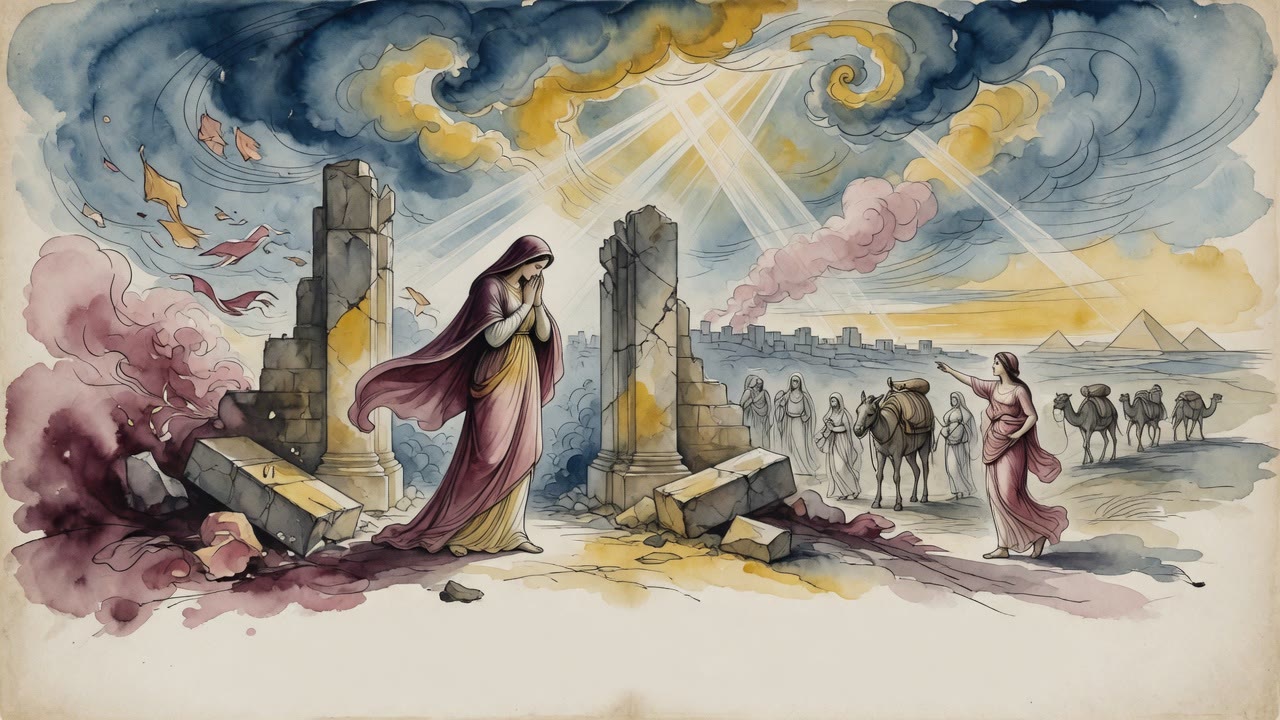
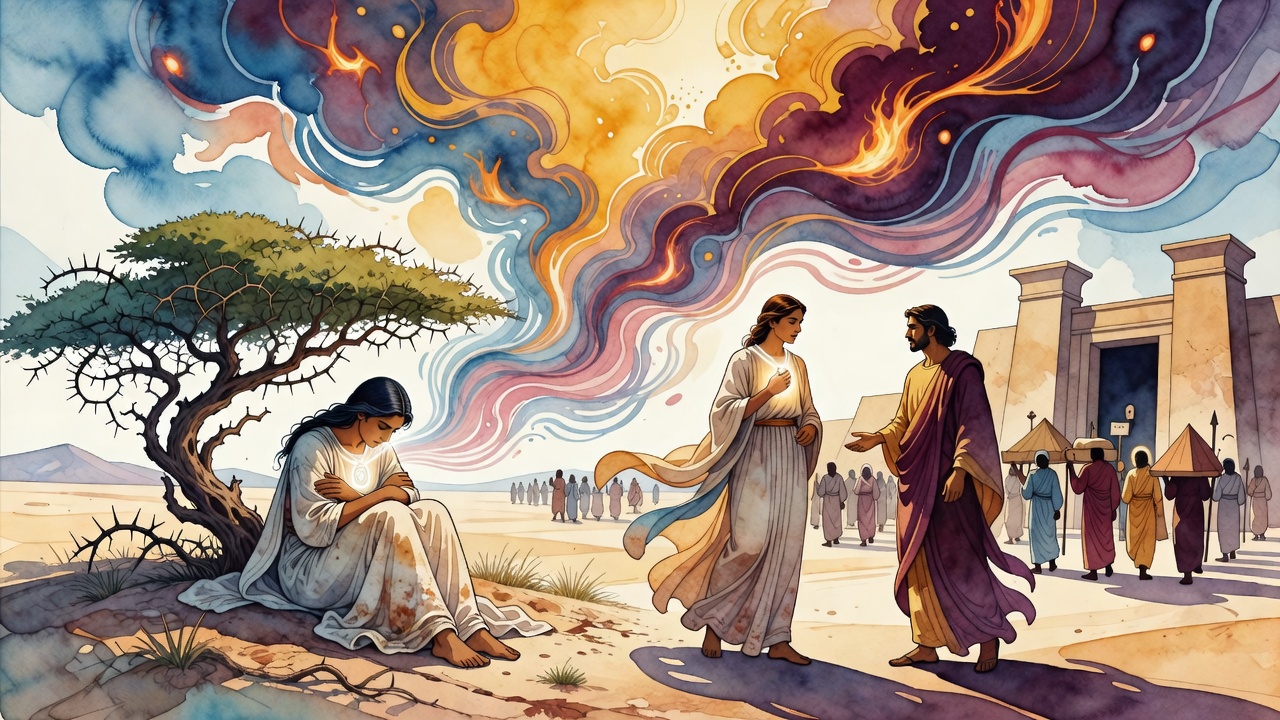
Jacob would not let them touch her. He took a thin plate of tin, inscribed the Holy Name upon it, and tied it around the infant's neck. The Shem ha-Meforash, the explicit Name, became her cradle mark and her only inheritance. Then he placed her beneath a thornbush and left her in the wild place between death and mercy.

\n\n

An angel came where the brothers would not. The child did not remain under thorns. She was carried down to Egypt, into the house of Potiphar, whose wife had no child. The Egyptian household received her as a daughter and gave her a room, servants, safety, and a name that would sound Egyptian in every court of Pharaoh.

\n\n

A Palace With Seven Maidens

\n\n

Asenath grew slender like Sarah, beautiful like Rebekah, radiant like Rachel. Seven maidens, all born the same day as she was, lived with her in a palace adjoining her parents' house. Men asked for her. Princes asked for her. Even Pharaoh's firstborn reached toward her, and power stood at her door with rings on its fingers.

\n\n

She let no man come near. The doors held. The windows watched.

\n\n

In the first year of plenty, Joseph sent word that he would lodge at Potiphar's house. Potiphar heard opportunity knocking with a viceroy's staff. He went to Asenath and spoke of marriage. She answered with contempt sharp enough to cut the room. "Why should she marry a fugitive, a slave, a foreign shepherd's son, a man accused in his master's house and released only because Pharaoh needed dreams interpreted? Better Pharaoh's son," she said.

\n\n

The Viceroy at the Window

\n\n

Then Joseph arrived.

\n\n

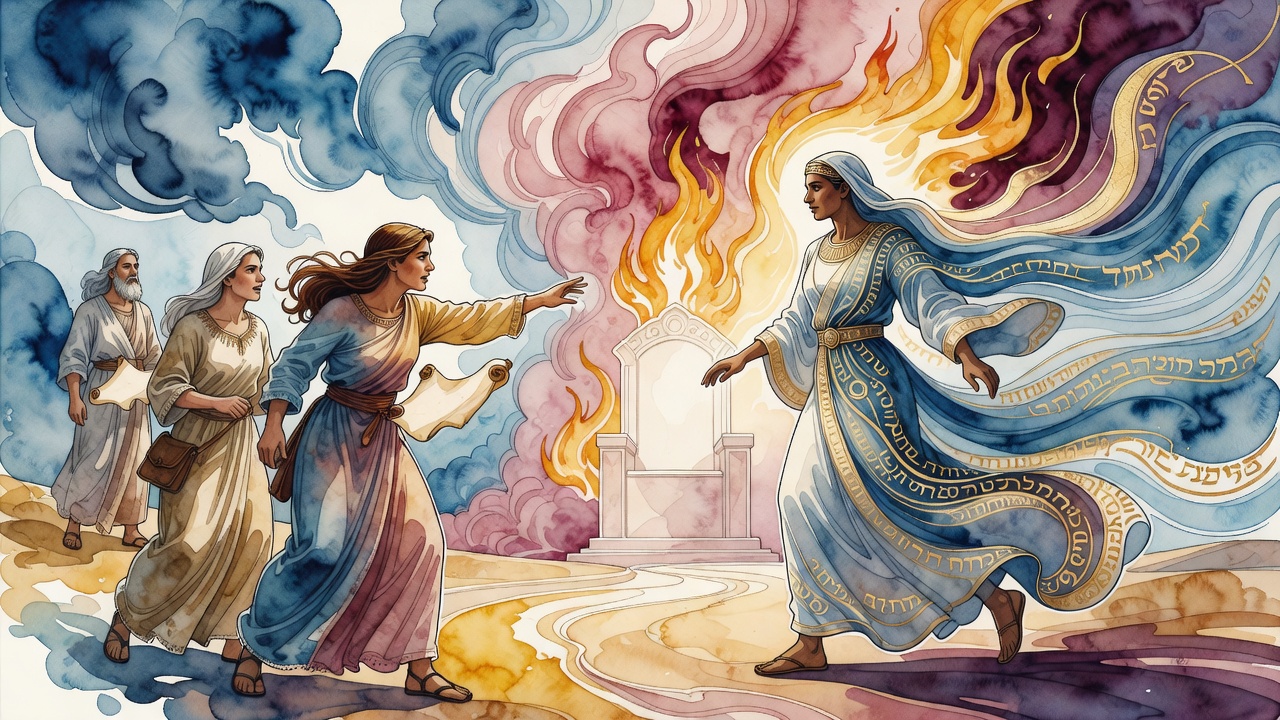
Asenath stood at her window and the insult died in her throat. The man below did not move like a slave. Splendor went from him like sunlight crossing a wall. She began to weep, not quietly. The rumors had lied to her. Her own mouth had lied for them. She begged the God of Joseph for pardon before Joseph had said one word to her.

\n\n

Joseph took his seat at Potiphar's table and noticed a maiden looking from the window. He ordered her removed. His father's warning still guarded him: keep away from the women of Egypt. Potiphar pleaded. This was his daughter, he said, a guarded girl who had never allowed a man near her. Joseph permitted her to enter.

\n\n

She greeted him with peace and called him blessed of God Most High. He returned the blessing. When she moved to kiss him, he refused. A man who blesses the living God, eats the bread of life, drinks the cup of immortality, and anoints himself with holiness must not kiss a woman who still blesses dead idols. The words struck her harder than a slammed gate.

\n\n

Then the metal at her neck answered the old question. The plate from Jacob's hand had crossed years, exile, and palace doors. Joseph knew the sign. Egypt had raised her, but Egypt had not made her.

\n\n

Seven Days Behind a Locked Door

\n\n

Asenath went back to her chamber and stripped off her robes. Jewels fell from her hands. Sackcloth scratched her skin. Ashes settled in her hair. For seven days and seven nights she let no attendant enter. No perfume. No music. No palace food set before her as if sorrow could be served on gold.

\n\n

On the eighth morning an angel stood in the room. He told her to rise, wash, and dress herself in state. That day, he said, she had been born anew. She would eat the blessed bread of life, drink the cup of life immortal, and anoint herself with the oil of life eternal.

\n\n

The Honey From Paradise

\n\n

She turned to set food before the stranger and found a honeycomb of wondrous shape and fragrance. The angel told her it came from the bees of Paradise, food for angels and the chosen of God. He took a small portion. The rest he placed in her mouth. From that day, her body would bloom like the flowers of Paradise, her bones would grow strong like its cedars, her beauty would not wither, and she would be like a fortified city.

\n\n

At her request, he blessed her seven maidens too, making them seven pillars in the City of Refuge. Then he ascended in a chariot of fire drawn by four horses of fire. Only after the flame lifted did she know what kind of guest had eaten in her room.

\n\n

Joseph returned and did not recognize her. She told him she had cast away her idols. She told him the heavenly visitor had given her to Joseph forever and given her a new name: City of Refuge, a place where nations could run for safety. Joseph confirmed the message. They embraced. Potiphar and his wife made a banquet, and later Pharaoh placed golden crowns on bride and groom. For seven days Egypt stopped its work to celebrate the marriage of the abandoned child.

\n\n

← All myths

From the tradition

Sources

4 sources

The texts this telling draws on, in full. Open a card to read inline, or expand it for a wider, quieter read.

Legends of the Jews 1:74Legends of the Jews

Consider the story of Joseph and his brothers. We know about the coat, the jealousy, the slavery in Egypt… but what about their lives outside of that central drama?

The year that Joseph faced his trials and tribulations was also a year of weddings for his brothers. Reuben, the eldest, married Elyoram, who the verse says was the daughter of Uzzi, a Canaanite from Timnah.

Then there's Simon. Now, his story takes a…complicated turn. The text says that Simon first married his sister Dinah. Remember Dinah? She was the sister who was violated by Shechem. According to this tradition, after Simon and Levi infamously took revenge on the city of Shechem, Dinah refused to leave, declaring, "Whither shall I carry my shame?". Simon then swore he would marry her, and he did. Later, when she died in Egypt, he brought her body back to the Holy Land for burial.

It’s quite a story, isn’t it? But it doesn’t end there. Dinah, it turns out, had a son with her brother Simon. And, even earlier, she had a daughter named Asenath from her union with Shechem, the son of Hamor.

Now, this is where things get really interesting. The sons of Jacob, horrified by this child born out of what they perceived as sin, wanted to kill Asenath. To protect the family's reputation, they considered infanticide. What did Jacob do?

He took a piece of tin and inscribed the Shem HaMeforash, the Holy Name of God, upon it. He bound this amulet around the baby’s neck, placed her under a thornbush, and…abandoned her.

Can you imagine?

But don't worry, this isn't the end of Asenath's story. An angel, as divine intervention often goes, carried the babe down to Egypt. There, Potiphar, the Egyptian official, adopted her as his own, since his wife was barren. According to Ginzberg's retelling in Legends of the Jews, Potiphar's wife raised Asenath as her own daughter.

Years later, when Joseph, now the viceroy of Egypt, traveled through the land, maidens showered him with gifts, hoping to catch his eye. Asenath, having nothing else to offer, removed the amulet from her neck – the very one Jacob had placed there – and gave it to him. This is how Joseph discovered her lineage. Seeing that she wasn't Egyptian, but connected to his own family through her mother, he married her. As we find this tradition recorded, Joseph recognized the significance of the amulet and the story it represented.

So, Asenath, the daughter of Dinah, abandoned as a baby, raised in an Egyptian household, ultimately becomes Joseph’s wife. It's an incredible twist of fate, isn’t it? A hidden thread connecting generations and weaving a story far more complex than we might have imagined. It makes you wonder about all the other untold stories, the hidden connections waiting to be discovered in the vast landscape of Jewish tradition. What other secrets are waiting to be revealed?

Full source
Legends of the Jews 1:180Legends of the Jews

Sometimes, the most fascinating tales lie just beyond the edges of the well-known ones. Take Joseph, for instance. We know he rose to power in Egypt, but what about his wife, Asenath? Her story is far more intriguing than you might realize.

Her very name, is a whispered history, a clue to a past shrouded in mystery. The ancient texts tell us she wasn't just any Egyptian woman. According to Legends of the Jews, a masterful compilation by Rabbi Louis Ginzberg, Asenath was the daughter of Dinah and Hamor. Dinah, you might remember, was the daughter of Jacob who was infamously abducted and, according to some sources, raped in the city of Shechem.

Asenath was abandoned near the Egyptian border. Can you imagine such a thing? To ensure her true identity wouldn't be lost, Jacob, her grandfather, engraved the story of her birth and parentage on a golden plate and fastened it around her neck. It's a poignant image, isn't it? A tiny baby, marked with her history, adrift in a strange land.

Here's where the story takes another turn. One day, Potiphar, an Egyptian captain, was walking near the city walls with his servants when they heard the cries of a child. They followed the sound and discovered the abandoned baby. At Potiphar's command, they brought her to him. Upon reading the golden plate, he learned her history and decided to adopt her, raising her as his own daughter. What a twist of fate!

Even Asenath's name itself is packed with meaning, a kind of coded biography. The Alef in Asenath, we're told, stands for On, where Potiphar served as a priest. The Samek represents Setirah, meaning "hidden," because she was kept concealed due to her extraordinary beauty. The Nun signifies Nohemet, "weeping," because she wept and entreated to be delivered from the heathen house of Potiphar. And finally, the Taw stands for Tammah, "the perfect one," a tribute to her pious and perfect deeds.

So, the next time you read the story of Joseph in Egypt, remember Asenath. Remember the golden plate, the abandoned baby, and the name that echoes with a hidden past. It reminds us that even in the grand sweep of biblical narratives, there are countless untold stories waiting to be discovered, each one offering a glimpse into the complexities and wonders of human experience. These hidden stories, like Asenath's, enrich our understanding and add layers of depth to the narratives we think we know so well.

Full source
Legends of the Jews 1:470Legends of the Jews

The familiar telling remembers Joseph, the dreamer, the interpreter of dreams, the one who rose to power in Egypt. But what about his personal life? Did he ever find love amidst all the political intrigue and hardship?

Well, the Legends of the Jews, that incredible collection of rabbinic stories and folklore compiled by Louis Ginzberg, gives us a glimpse into just that. It tells of a specific encounter that provides some interesting details about Joseph's life in Egypt.

Joseph, now a high-ranking official in Egypt, is being introduced to the family of Potiphar, the priest of On. Potiphar explains that the maiden at the window, his daughter, has never allowed men near her. In fact, Joseph, is the first man she has ever set eyes upon!

Can you picture the scene? The air thick with anticipation. Potiphar then asks Joseph if his daughter, named Asenath, might pay her respects to him. Joseph, ever gracious, grants the request.

And then, Asenath appears. She greets Joseph with the words, "Peace be with thee, thou blessed of God Most High." In Hebrew, this would be something akin to "Shalom aleichem, baruch atah l'El Elyon." And Joseph, in turn, returns the salutation, saying, "Be thou blessed of the Lord, from whom flow all blessings."

It's a simple exchange, really. But it's also pregnant with possibility. This meeting, as recounted in Legends of the Jews, sets the stage for the later marriage of Joseph and Asenath. It shows us a moment of connection, of mutual respect and blessing. It's a reminder that even in the midst of grand narratives of power and destiny, there are always human stories unfolding.

What do we make of this story? Perhaps it’s a reminder that even figures we see as larger-than-life, like Joseph, had personal lives, relationships, and moments of simple human connection. It's a beautiful reminder that blessings and peace can be found even in the most unexpected of encounters.

Full source
Legends of the Jews, I. Joseph, AsenathLegends of the Jews

The Jewish tradition has some fascinating stories about that, and one of the most intriguing is the tale of Asenath and Joseph. It's a story about beauty, prejudice, divine intervention, and ultimately, transformation.

The story, as retold by Ginzberg in Legends of the Jews, paints Asenath as a woman of extraordinary beauty. Think Sarah, Rebekah, and Rachel rolled into one! She's the daughter of Potiphar, a prominent Egyptian nobleman, and lives a life of privilege, secluded in her own palace with seven handmaidens. Suitors, including Pharaoh's own son, clamor for her hand, but she rejects them all. She wants nothing to do with marriage.

Then, Joseph arrives. Remember Joseph, the dreamer who was sold into slavery by his brothers? He's now a powerful figure in Egypt, thanks to his ability to interpret Pharaoh's dreams. Joseph announces he's coming to visit Potiphar, and Potiphar, eager to cement the connection, proposes a marriage between Joseph and Asenath.

Asenath is not impressed.

"Why," she asks, according to Ginzberg, "should I marry a vagabond, a slave, a son of a Canaanite herdsman?" She's bought into the rumors and the prejudices. She sees him as an outsider, someone beneath her. She even brings up the accusation that he tried to violate his master's wife! "I'd rather marry Pharaoh's son!" she declares.

But then she sees him.

Peeking from her window, Asenath is struck by Joseph's "divine beauty" and "indescribably noble carriage." It's a complete turnaround! Suddenly, she's filled with regret. "Poor, foolish me," she laments. "I permitted myself to be misled." She realizes the rumors were wrong. She even wonders if he's "a son of God," because such beauty, she believes, couldn't possibly exist in a mere mortal. She begs God for forgiveness, promising to marry Joseph if given the chance.

Joseph, however, is initially wary. He notices Asenath watching him and orders her away. He's committed to staying away from the Gentile women of Egypt, a principle instilled in him by his father, Jacob. He knows his beauty attracts unwanted attention, and he wants to avoid temptation.

Potiphar explains that Asenath is a virgin who has never looked upon another man. He asks Joseph to allow her to pay her respects. Joseph relents, and Asenath greets him with "Peace be with thee, thou blessed of God Most High." Joseph returns the greeting, but when Asenath tries to kiss him, he refuses.

"It is not meet," he says, "that a God-fearing man…should kiss a woman of a strange people, who blesses dead and unprofitable idols." Ouch! He's drawing a clear line, emphasizing the difference between his beliefs and hers. He sees her as someone who worships false gods and engages in practices that are spiritually harmful.

Asenath is heartbroken. But Joseph, seeing her distress, softens. He blesses her, asking God to "pour out His spirit over her and make her to become a member of His people and His inheritance, and grant her a portion in the life eternal."

This is where the story takes a truly fascinating turn. According to late antique traditions, Asenath does indeed convert to Judaism and becomes Joseph's wife. The Book of Asenath, an apocryphal text, expands on this, describing her repentance and conversion in detail, even featuring an angel who instructs her. She becomes a righteous woman, and their descendants are said to include important figures in Jewish history.

What can we take away from the story of Asenath? It's a reminder that first impressions can be deceiving, and that prejudice can blind us to the truth. It also speaks to the power of transformation and the possibility of finding common ground, even between people from very different backgrounds. It’s a beautiful tale of how love, combined with faith, can bridge divides and lead to unexpected blessings. Asenath's journey reminds us that even those who seem furthest away can be brought closer, and that the most unlikely unions can sometimes be the most blessed.

Full source