Parshat Miketz7 min read

Asenath at the Tower Window and the Honeycomb of Paradise

Potiphar's daughter mocks the slave Joseph, then sees him from her tower and falls. Seven days in ash, an angel, and paradise honey remake her.

Curated by Arthur · Told by Maggid ·
Table of Contents
  1. The Slave She Had Mocked Came in Light
  2. Seven Days in Sackcloth and Ash
  3. The Angel and the Honeycomb of Paradise
  4. A New Name and a Husband Who Did Not Know Her

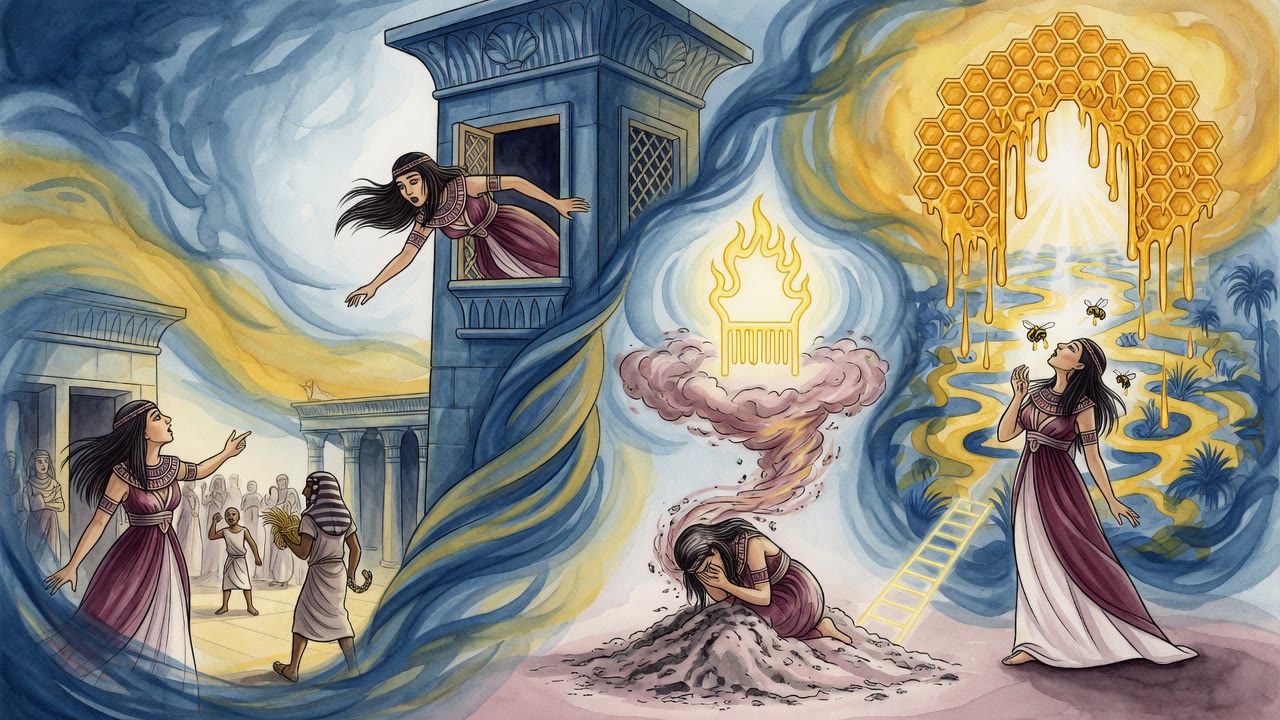
The moment the runners cried that Joseph was at the gate, Asenath left the courtyard and climbed to the high room of her tower, where no suitor had ever been permitted to stand. She had sent away every prince and noble's son in Egypt. She had told her father, Potiphar, the priest of On, that she would marry the heir to Pharaoh's throne or no one. Now she pressed herself to the window slit to look down on the Hebrew her father wanted to give her, the one she had called a vagabond and a slave.
The Slave She Had Mocked Came in Light

She had a speech ready, all contempt. He was the son of a Canaanite herdsman. He had been dragged to prison over another man's wife. Pharaoh had let him out for reading a dream, but a dream did not wash off a brand. She had said all of this to her father with her chin up. "Why would you want me to marry a vagabond, a slave?" she had demanded. "I am willing to marry the son of Pharaoh, the future ruler and king of Egypt."

Then the chariot came through the gate and the man stood up in it, and the speech died in her throat.

The light off him was like the light off the sun, and it came into her father's house and filled it. She gripped the cold stone of the window and began to weep. "Poor, foolish me," she said into the empty room. "What shall I do? I permitted myself to be misled by friends, who told me that Joseph was the son of a Canaanitish shepherd." She had looked down on him. She had spoken absurd nonsense against him. She said it aloud, naming her own audacity and folly to the walls. "I knew not that he was a son of God, as he must be, for among men such beauty as his does not exist."

She did not go down to the banquet with a bride's smile. She bent her head against the stone and prayed. "I pray Thee, O God of Joseph, grant me pardon. It was my ignorance that made me speak like a fool. If my father will give me in marriage to Joseph, I will be his forever."

Seven Days in Sackcloth and Ash

When at last Joseph spoke to her, his words went into her like a blade, and she wept again. He lifted his hands and asked his God to pour out the divine spirit upon her, to gather her into the people of the Lord, to grant her a portion in the life that does not end. Then he went out.

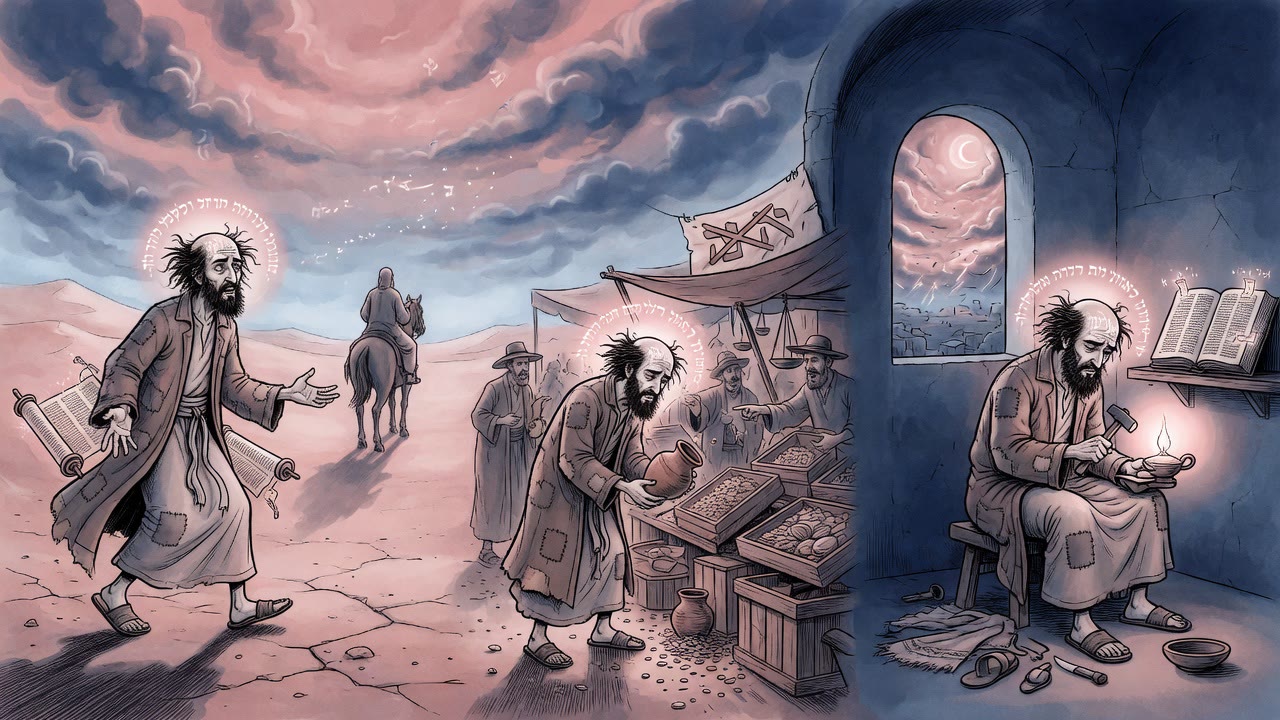
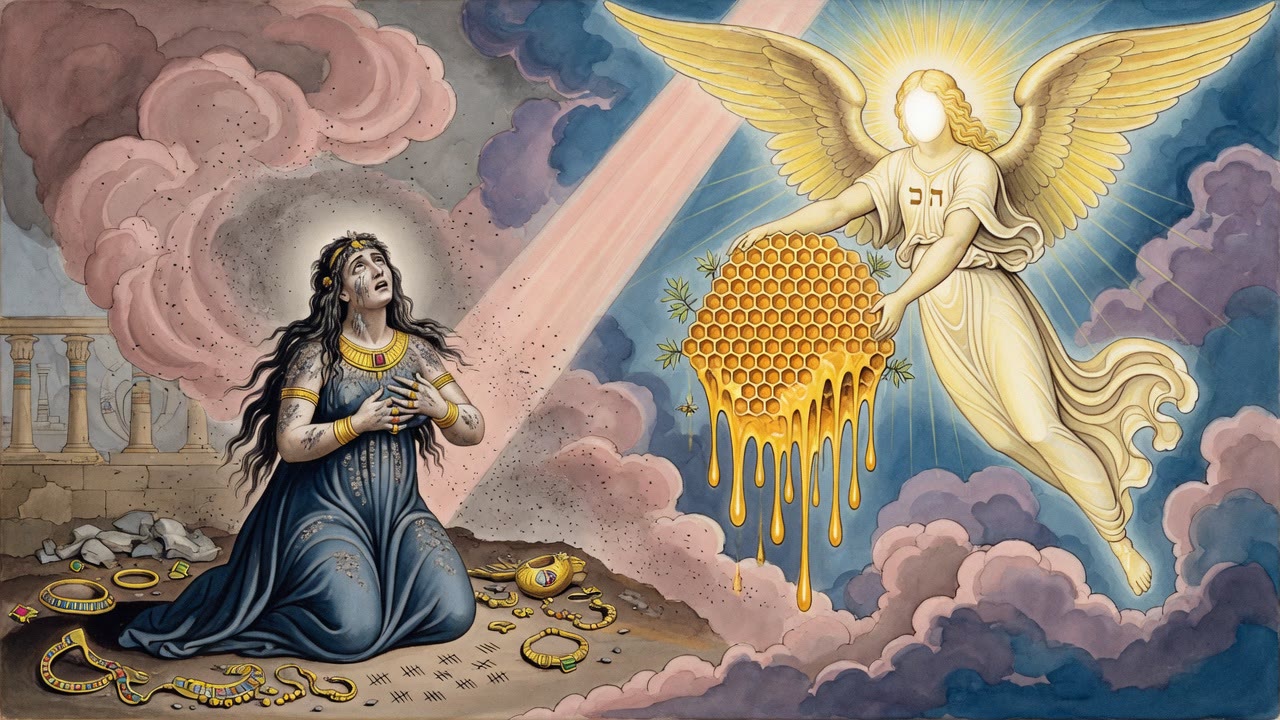
Asenath returned to her chamber and stripped herself. Off came the robes of state. Off came the jewels she had worn to outshine every other daughter in Egypt. She pulled rough sackcloth over her skin and raked ashes into her hair, and she shut the door. For seven days and seven nights she neither ate nor drank. She lay in the dark and begged forgiveness for every idol she had ever served, every false god in her father's house, and she would let no one in to comfort her.

On the morning of the eighth day the light came back, but this time it came inside the room.

The Angel and the Honeycomb of Paradise

An angel stood over her. He told her to throw off the mourning sackcloth and put on her finest garments, because she had been born new. The bread of life was hers now, he said, and the cup of immortality, and the oil that does not let beauty perish.

She rose to be a host even to a being of fire. She would set food and drink before her guest. And there on the table, where nothing had been, lay a honeycomb, white and enormous, breathing out a fragrance that filled the whole room. She stared at it. She had not made it. No bee of Egypt had made it.

The angel told her what it was. The bees of Paradise had built it, food for angels and for the chosen of God, and whoever ate of it would never die. He broke off a small piece and ate. Then he reached out and put the rest of it into her mouth. "From this day forth," he said, "thy body shall bloom like the eternal flowers in Paradise, thy bones shall wax fat like the cedars thereof, strength inexhaustible shall be thine, thy youth shall never fade, and thy beauty never perish, and thou shalt be like unto a metropolis surrounded by a wall."

The girl who had wanted only a crown now thought of her servants. She asked the angel to bless her seven attendants too. He did. "May the Lord bless you and make you to be seven pillars in the City of Refuge."

A New Name and a Husband Who Did Not Know Her

Then he gave her the name. "Thy name shall not any more be called Asenath, but thy name shall be City of Refuge, whither the nations shall flee for safety." When he left, he left like the thing he was, in a chariot of fire drawn by four steeds of fire, climbing back into the sky until the room was ordinary again.

She went to wash her face for Joseph's return, and the water gave her back a stranger. The angel's visit had remade her. The beauty in the basin was not the beauty she had carried up the tower stairs.

When Joseph came, he looked at her and did not know her. "Who are you?" he asked.

"I am your maid-servant Asenath," she said. She told him she had cast away her idols. She told him a man of heaven had fed her the bread of life and the blessed cup, and had given her to Joseph as his betrothed forever, husband to wife and wife to husband, never to be undone. Then she asked the one thing she could not see for herself. The angel had said he would go to Joseph as well. "Now, my lord, thou knowest whether the man was with thee and spoke to thee in my behalf."

They embraced and kissed in token of their betrothal, and Potiphar and his wife threw open their house for the feast. The wedding itself came later, in the presence of Pharaoh, who set golden crowns on both their heads and blessed them, and ordered seven days of celebration in which no one in Egypt, on pain of death, was permitted to do any work. The idolater's daughter who had refused everyone but a king became the mother of Joseph's sons, and the wall around her city held.


← All myths
From the tradition

Sources

5 sources

The texts this telling draws on, in full. Open a card to read inline, or expand it for a wider, quieter read.

Legends of the Jews 1:468Legends of the Jews

Potiphar – yes, that Potiphar, the Egyptian priest – had promised his daughter he wouldn't mention a certain… plan… again. The moment Joseph's arrival was announced, Asenath retreated to her own rooms. Imagine her, standing by the window, catching her first glimpse of Joseph.

And…bam! She was completely overwhelmed.

The Ginzberg's says retelling in Legends of the Jews, she was "so transported with his divine beauty and his indescribably noble carriage that she burst into tears." Tears! Can you imagine? It wasn't the reaction she expected.

"Poor, foolish me," she lamented. "What shall I do? I permitted myself to be misled by friends, who told me that Joseph was the son of a Canaanitish shepherd."

Ouch. Talk about a misjudgment!

Asenath’s perception shifted dramatically in that single moment. The splendor emanating from Joseph, she thought, was "like unto the splendor of the sun, illuminating our house with his rays." She realized she had been utterly wrong.

She continued her lament, acknowledging her own "audacity and folly." She confessed she had "looked down upon him, and had spoken absurd nonsense against him." It's a powerful moment of self-awareness.

And then comes the kicker: "I knew not that he was a son of God, as he must be, for among men such beauty as his does not exist." Now, that’s some serious admiration. This idea of divine beauty isn't unique to this story. We often find in Jewish texts the notion that exceptional beauty can be a sign of divine favor or even a hint of divinity itself.

In a heartfelt prayer, Asenath then pleaded, "I pray Thee, O God of Joseph, grant me pardon! It was my ignorance that made me speak like a fool. If my father will give me in marriage to Joseph, I will be his forever."

Forever!

It's a complete 180-degree turn. From disdain to devotion in a heartbeat. Asenath's initial prejudice, based on hearsay and social standing, crumbled before the sheer force of Joseph's presence.

What does it tell us? Maybe it's about the danger of judging a book by its cover. Or perhaps it highlights the transformative power of genuine beauty, both internal and external. Or maybe, just maybe, it reminds us that even our most deeply held beliefs can be challenged and changed when we open ourselves to seeing the world, and the people in it, with fresh eyes.

Full source
Legends of the Jews 1:480Legends of the Jews

Sometimes, the most fascinating tales are the ones that didn't quite make it into the main narrative. Consider a story spun around Joseph and his wife, Asenath.

Joseph, now a powerful figure in Egypt, is traveling with his beautiful wife, Asenath. Along their journey, they encounter none other than Pharaoh's own son, the heir to the throne. This prince is absolutely captivated by Asenath's beauty. So much so, that he hatches a truly wicked plan. He decides that the only way to possess Asenath is to eliminate Joseph.

Where does one go to get away with that kind of plot? Well, according to this legend, he turns to Simon and Levi, Joseph’s own brothers!

He tries to win them over with smooth talk and empty promises, attempting to convince them to get rid of Joseph. Can you imagine the audacity?

Simon, known for his fiery temper, is instantly ready to strike the prince down. But here's where it gets interesting. Levi, gifted with prophecy, senses the prince's true intentions. In a flash, he subtly thwarts Simon's impulsive reaction by stepping on his foot, all while whispering a crucial reminder: "Why art thou so angry, and so wroth with the man? We that fear God may not repay evil with evil." This echoes a key theme in Jewish thought.

Levi then turns to the Pharaoh's son, making it crystal clear that they would never participate in such a heinous act. Instead, he warns the prince against taking any action against Joseph, threatening him with the same sword that was used in the slaughter of the inhabitants of Shechem. Talk about a history lesson!

The prince, understandably terrified, collapses before Simon and Levi, begging for mercy. Levi, showing remarkable restraint, raises him up and says, "Fear not, but abandon thy wicked plan, and harbor no evil design against Joseph."

What's so striking about this little detour in the Joseph saga? It shows us the constant tension between impulsive action and thoughtful restraint, between revenge and adherence to a higher moral code. It reminds us that even in positions of power, the temptation to stray from ethical behavior is ever-present. And it highlights the importance of wise counsel, like Levi's, in navigating those difficult choices.

This story, though not found in the Torah itself, offers a powerful glimpse into the complex moral landscape of the time, and the ongoing struggle to choose righteousness over personal gain. Food for thought, isn't it?

Full source
Legends of the Jews 1:467Legends of the Jews

Legends of the Jews turns to Joseph Visited Potiphar and Was Offered Asenath in Marriage.

In Ginzberg's retelling in, Legends of the Jews, during the first of the seven years of plenty – the years Joseph so wisely predicted – Joseph decided to visit Potiphar. Remember Potiphar? The Egyptian official who originally bought Joseph as a slave? Well, Joseph, ever the diplomat, sent word that he would be staying at Potiphar’s house.

Potiphar, needless to say, was thrilled! He saw this as a golden opportunity, not just for the honor of hosting such an important figure, but also to hatch a little plan: a marriage between his daughter, Asenath, and Joseph. A savvy move. Marrying his daughter off to the second most powerful man in Egypt?

Here's where the story takes a turn. When Potiphar revealed his matchmaking scheme to Asenath, she wasn't exactly over the moon. In fact, she was pretty indignant. "Why would you want me to marry a vagabond, a slave?" she reportedly exclaimed.

Asenath's reaction is fascinating, isn't it? It reveals so much about the social hierarchy of ancient Egypt and the prejudices of the time. She continues, "He doesn't even belong to our nation! He's the son of a Canaanite herdsman!" Ouch. A "Canaanite herdsman" was not exactly the pedigree she was looking for.

And she doesn't stop there. She reminds her father, with a healthy dose of disdain, that Joseph was accused of trying to violate the honor of his mistress – a crime that landed him in prison. Remember that whole episode with Potiphar’s wife? And sure, Pharaoh did liberate him for interpreting his dream, but that didn't erase the stigma in Asenath's eyes.

"No, Father," she declares, "I will never become his wife! I am willing to marry the son of Pharaoh, the future ruler and king of Egypt!"

Talk about ambition! Asenath clearly had her sights set on royalty, and a formerly enslaved dream interpreter just didn't cut it. She wanted the ultimate power couple status.

This little scene, tucked away in the legends, gives us a glimpse into the complexities of Joseph's life in Egypt. It wasn't all smooth sailing and prophetic visions. He had to navigate social barriers, overcome prejudices, and maybe even win over a reluctant bride-to-be (eventually, of course, they do marry!). It makes you wonder, doesn't it? What kind of conversations, what kind of compromises, had to happen behind the scenes for this union to ultimately come to pass? What did Joseph think of all this? We only see Asenath’s initial resistance here.

It’s a reminder that even in the grand narratives of the Bible, there are human dramas playing out, filled with the same hopes, fears, and biases we confront today. And sometimes, the most interesting stories are the ones that fill in the gaps, the ones that give us a glimpse behind the curtain.

Full source
Legends of the Jews 1:474Legends of the Jews

Legends of the Jews turns to Asenath and the Heavenly Realms.

Asenath, a woman of stature and privilege, is deeply affected by the words of Joseph. So much so, that she’s moved to tears. Out of compassion, Joseph offers a blessing, imploring God to pour His spirit upon her, welcoming her into His people and granting her a share in eternal life. A powerful scene. According to Ginzberg's retelling in Legends of the Jews, Joseph's appearance and words had a profound impact. As soon as Asenath returned to her chambers, she cast aside her finery – the robes of state, the jewels – and replaced them with sackcloth. She covered her head in ashes, a symbol of mourning and repentance, and for seven days and nights, she prayed for forgiveness, completely isolating herself. level of dedication. Seven days and nights of intense introspection and seeking divine grace. It speaks volumes about the sincerity of her transformation.

Then, on the morning of the eighth day, something extraordinary happens. An angel appears to her! The angel tells her to put aside her mourning clothes and adorn herself in her finest garments because she has been born anew. He says she is now ready to partake in the blessed bread of life, drink from the cup of immortality, and anoint herself with the oil of eternal life.

Asenath, ever the gracious hostess, prepares to offer food and drink to her angelic guest. But then she sees it: a honeycomb of extraordinary beauty and fragrance. Where did it come from?

The angel reveals that this is no ordinary honeycomb. It was made by the bees of Paradise, food fit for angels and the chosen ones of God. He takes a small portion, and then, remarkably, he places the rest into Asenath's mouth. "From this day forth," he proclaims, "thy body shall bloom like the eternal flowers in Paradise, thy bones shall wax fat like the cedars thereof, strength inexhaustible shall be thine, thy youth shall never fade, and thy beauty never perish, and thou shalt be like unto a metropolis surrounded by a wall." What a powerful blessing!

And Asenath, in her newfound compassion, remembers her attendants. She asks the angel to bless them as well. He grants her request, saying, "May the Lord bless you and make you to be seven pillars in the City of Refuge."

This story, found in Legends of the Jews, is more than just a fantastical tale. It's a story of transformation, of the power of words and compassion, and of the potential for renewal that exists within each of us. It makes you wonder, doesn't it? What "honeycomb of paradise" might we encounter in our own lives, and how will we share its blessings with those around us?

Full source
Legends of the Jews 1:476Legends of the Jews

The story of Asenath, found in Legends of the Jews, gives us a glimpse into just such an experience.

An angel has just visited Asenath. Not just any visit,. As Ginzberg retells it in Legends of the Jews, the angel departs in a blaze of glory – a chariot of fire pulled by four fiery steeds, soaring back into the heavens. Can you picture the awe, the sheer wonder Asenath must have felt? She knew then, without a doubt, that she had been in the presence of something…otherworldly.

The story doesn't end there. Almost as soon as the celestial messenger vanishes, Joseph arrives. Asenath, eager to greet him, rushes to prepare herself. And As she washes her face, she sees her reflection and is astonished. The angel's visit has changed her, imbued her with a beauty she had never possessed before.

When Joseph arrives, he doesn't even recognize her! “Who are you?” he asks. Imagine the surprise, the confusion, perhaps even a little fear in his voice.

Asenath replies, "I am your maid-servant Asenath!" She explains that she has renounced her idols. She tells him of the heavenly visitor who offered her the "bread of life" and the "blessed cup." (We can’t help but think of parallels to late antique traditions here, can we?) More importantly, she reveals the angel's pronouncement: "I give thee unto Joseph as his affianced wife, that he may be thy affianced husband forever."

And then, a new name, a new destiny: "Thy name shall not any more be called Asenath, but thy name shall be City of Refuge, whither the nations shall flee for safety." Quite a change, wouldn't you say?

Finally, Asenath adds, "I go to Joseph, to tell him all these things that have reference to thee.' Now, my lord, thou knowest whether the man was with thee and spoke to thee in my behalf." She is essentially asking Joseph, did this angel visit you too? Did he confirm this divine plan?

This moment is so rich with meaning. It speaks to the transformative power of faith, the possibility of divine intervention, and the potential for even the most unexpected individuals to find a place in a sacred narrative. It’s a reminder that sometimes, the most profound changes come when we least expect them, leaving us almost unrecognizable to those who thought they knew us best. And it leaves us wondering, what "city of refuge" might we each be called to become?

Full source