Parshat Bereshit6 min read

The Serpent Wept Before It Gave Eve the Fruit

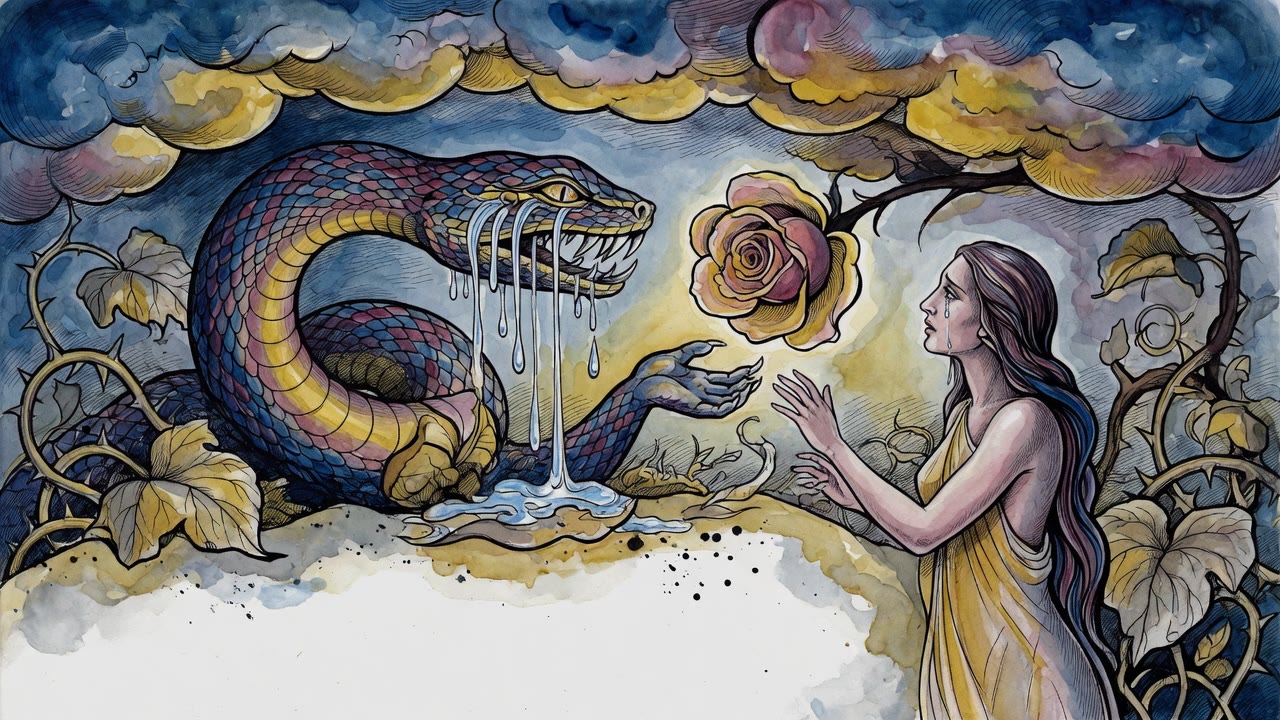
The serpent in the oldest retelling of Eden did not smirk or flatter. It wept for Eve and made her swear a holy oath before she touched the fruit.

Curated by Arthur · Told by Maggid ·
Table of Contents
  1. The Oath on the Cherubim
  2. What Eve Saw That She Could Not Unsee
  3. The Rabbis and the Question of the Fruit
  4. The Poison Already in the Pressing

The serpent wept for her.

That is the detail that keeps this version from being any other telling of Eden. Eve is standing in the garden, still inside paradise, still within the boundary of everything permitted, and the creature at her feet is performing grief. It is calling out to her in a voice that sounds like concern. May God live, I am grieved on your account. I would not have you remain ignorant. Come here. Listen. Eat, and understand the true value of that tree. There is no smirk. There is no flattery about beauty or cleverness. The tone is wounded. It is the voice of a creature that wants Eve to believe it is on her side.

The serpent is crying with her.

The Oath on the Cherubim

Eve hesitates. She says what any sensible person says when an animal weeps at their feet and urges them toward the one thing they were told not to touch. She says she fears God will be angry.

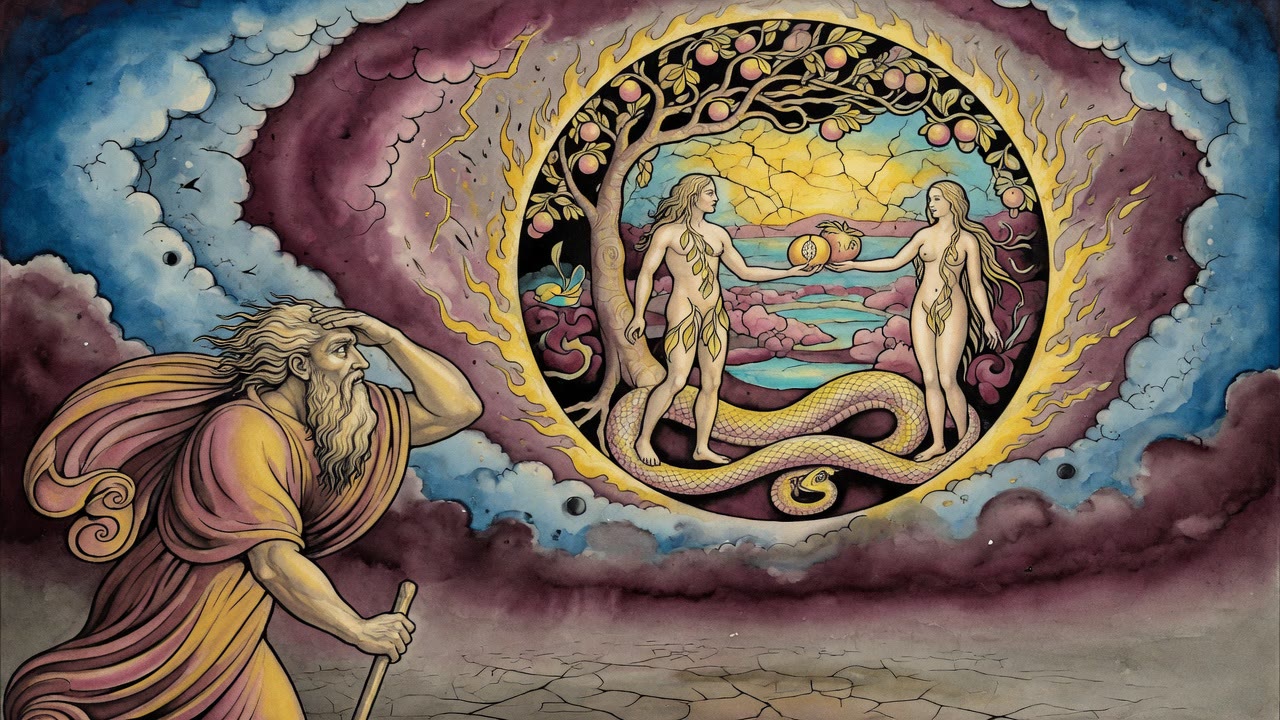
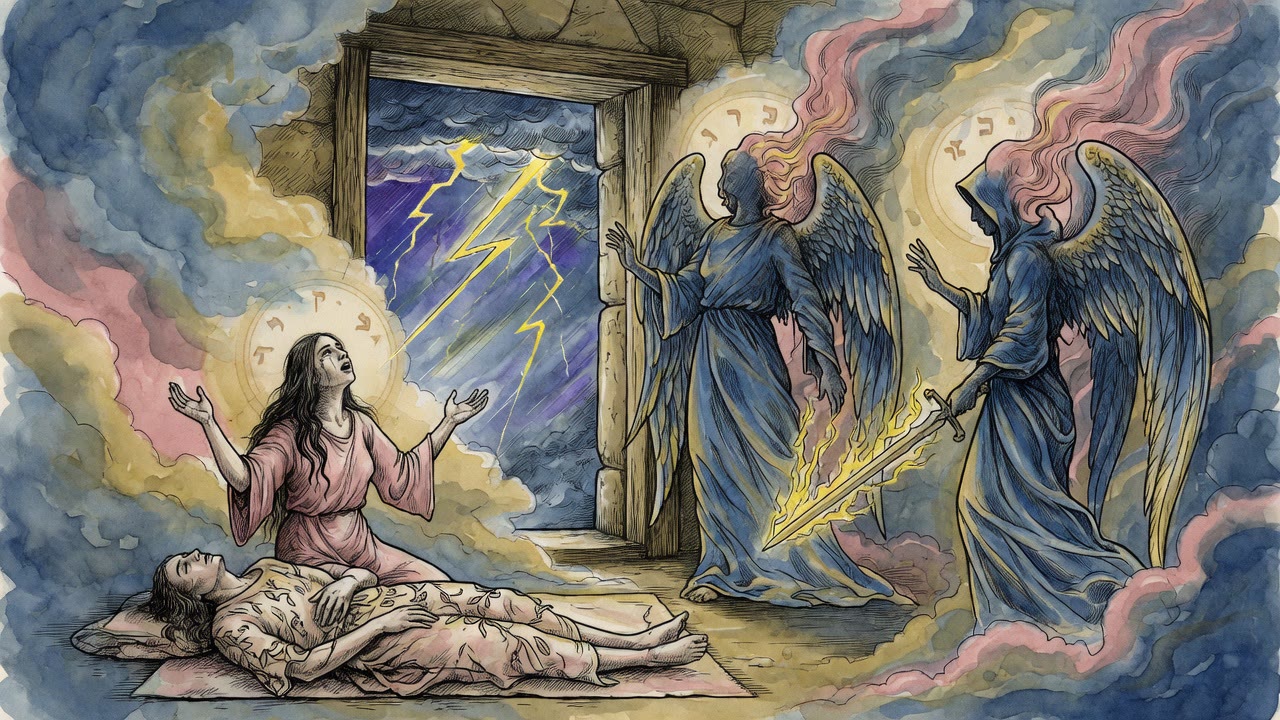
The serpent changes tactics. It does not push harder. Instead it makes an offer. Come here, and I will pick the fruit for you. That way your hand will not touch it. Eve agrees. She will not pick it herself. She walks closer. The serpent picks the fruit and does not hand it to her. It makes her swear first. The oath is specific, formal, and terrible: swear to me by the throne of God, by the cherubim, and by the sword of fire that turns at the entrance to the garden. Swear to me that you will give half of this fruit to your husband.

Eve swears on the most sacred geography of paradise. And then the serpent squeezes the fruit, pressing the poison into it from the outside, so that when Eve eats, she eats the poison the creature added, not only the nature the tree already had. This is the account from the Life of Adam and Eve, a Jewish text circulating in the late first or early second century CE in multiple languages. The Greek version western scholarship calls the Apocalypse of Moses, the Latin version the Vita Adae et Evae. Both come from a common Jewish source in Hebrew or Aramaic that has not survived.

What Eve Saw That She Could Not Unsee

She ate. And the text says she saw. The word in the Greek version is precise: she perceived. She saw the nakedness that would from that point forward define human existence. And the first thing she did, before she found Adam, before she thought about consequences, was look at the tree. The tree she had just eaten from. And she wept.

The weeping is the key. The serpent wept first, performing what it did not feel. Eve wept second, feeling what she could not reverse. The two acts of weeping bracket the whole transaction. One was a lie. One was the truth the lie produced.

She went looking for Adam. She found him near the water where he had been washing. She called him by name. She asked him to come. And when she handed him the fruit she described it not as the knowledge she had been promised but as the food God had given her. She could already deceive.

The Rabbis and the Question of the Fruit

The Life of Adam and Eve does not name the fruit. It does not say apple, or grape, or fig. It says fruit. The rabbis in Bereshit Rabbah, the Palestinian midrash on Genesis assembled in roughly the fifth century CE, were unwilling to leave the question open. They debated it with the peculiar intensity that only arises when a text leaves a gap too obvious to ignore.

Rabbi Meir said wheat. His argument was experiential: the knowledge of good and evil is connected to the act of eating grain. Children who have not yet eaten bread are considered not yet capable of full moral knowledge. The wheat in Eden, he added, grew to the height of the cedars of Lebanon, enormous, overwhelming, a grain crop that dwarfed everything around it. Others said the fruit was the grape, which ends in loss of judgment. Others said the fig, because immediately after the transgression Adam and Eve covered themselves with fig leaves, as if the tree whose fruit caused the fall was the same tree whose leaves provided the first covering.

Each answer is a theory about the nature of the thing that was lost. If the fruit is wheat, what was lost is clear moral sight. If it is the grape, what was lost is sobriety. If it is the fig, the tree that sheltered them after the fall is the same tree that sheltered them before it, which is its own kind of terrible symmetry.

The Poison Already in the Pressing

What the Life of Adam and Eve adds that none of the rabbinic fruit-debates address is the question of how the fruit changed. It did not change. The serpent added something. When the serpent squeezed the fruit and pressed its own substance into it, it did what every skilled deceiver does: it added a layer so that the thing Eve received was not the thing God made.

The tree was not the problem. The tree was the boundary. What crossed the boundary was altered by the creature that carried it across. Eve did not eat the tree's fruit. She ate what the serpent made of it.


← All myths

From the tradition

Sources

2 sources

The texts this telling draws on, in full. Open a card to read inline, or expand it for a wider, quieter read.

Apocalypse of Moses 18-23Life of Adam and Eve

The serpent wept for her. That was the cruelest part. It pretended to grieve for her ignorance while plotting her destruction.

"May God live!" the serpent said to Eve, its voice dripping with false compassion. "I am grieved on your account, for I would not have you remain ignorant. Come here. Listen to me. Eat, and understand the true value of that tree."

Eve hesitated. "I fear God will be angry with me, as He warned us."

"Do not fear," the serpent whispered. "As soon as you eat, you will become like God -- you will know good and evil (Genesis 3:5). God knows this. That is why He forbade it. He was jealous of what you might become."

Still Eve resisted. The serpent pressed harder: "Look at the plant. See its glory." But she would not reach for it. So the serpent changed tactics. "Come here. Follow me, and I will give it to you."

Eve followed. The serpent walked a short distance, then turned and said: "I have changed my mind. I will not give you the fruit unless you swear an oath -- swear that you will also give it to your husband."

Eve swore. By the throne of the Master. By the Cherubim. By the Tree of Life itself. She would share the fruit with Adam.

The serpent took the oath and poured upon the fruit the poison of its wickedness -- lust, the root and beginning of every sin. It bent the branch down to the earth. Eve took the fruit. She ate.

In that very hour, her eyes were opened. She knew instantly that she was stripped bare of the righteousness she had worn like a garment. The glory was gone. She wept. "Why have you done this to me? You have stolen the glory I was clothed in!"

But the serpent was already gone. It had descended from the tree and vanished, leaving Eve naked and alone in her portion of Paradise.

She searched desperately for leaves to cover her shame. There were none. The moment she had eaten, every tree in her territory shed its leaves -- every tree except the fig. From the fig tree she took leaves and made herself a covering. The very tree whose fruit she had eaten now clothed her shame (Genesis 3:7).

Then Eve called out: "Adam, Adam, where are you? Come to me -- I will show you a great secret!"

When Adam came, the Adversary spoke through her. Eve opened her mouth and the words of transgression poured out -- words that would bring them down from their glory. "Come, my lord Adam, eat of the fruit of the tree God told us not to eat, and you will be like God."

Adam said: "I fear God will be angry."

"Do not fear," Eve echoed the serpent's lie. "As soon as you eat, you will know good and evil."

He ate. His eyes opened. He saw his own nakedness. And his first words to Eve were devastating: "O wicked woman! What have I done to you, that you have stripped me of the glory of God?"

In that same hour, the archangel Michael blew his trumpet. The call rang across all of creation: "Thus says the Lord -- come with me to Paradise and hear the judgment I will pronounce upon Adam."

God appeared in Paradise, mounted on the chariot of His Cherubim, with angels going before Him singing hymns. At the sound of His approach, every plant in Paradise burst into flower -- as if the garden itself still loved its Maker, even as its guardians had failed Him. God's throne was set beside the Tree of Life.

"Adam, where are you?" God called. "Can a house hide from the one who built it?" (Genesis 3:9)

Adam answered from his hiding place: "I was not trying to hide from You, Lord. I was afraid because I am naked. I was ashamed before Your power."

"Who told you that you are naked," God said, "unless you have broken the commandment I gave you to keep?"

Adam remembered Eve's promise -- "I will make you safe before God" -- and turned to her: "Why have you done this?"

And Eve, stripped of glory, stripped of lies, finally spoke the truth: "The serpent deceived me" (Genesis 3:13).

Full source
Bereshit Rabbah 15:7Bereshit Rabbah

An apple? Maybe… but our tradition offers a whole orchard of possibilities! The rabbis of the Midrash (rabbinic interpretive commentary), in Bereshit Rabbah 15, really sink their teeth into this question.

Rabbi Meir, surprisingly, suggests it was wheat. Wheat! He argues that knowledge and intelligence are connected to eating wheat bread. "When a person does not have knowledge," he says, "people say: That person has never eaten wheat bread in all his days." It's a fascinating idea, isn't it? That the very grain that sustains us could also be the key to understanding. Rabbi Shmuel bar Yitzḥak even asks Rabbi Ze’eira, "Is it possible that it was wheat?" And Rabbi Ze’eira answers in the affirmative, explaining that the wheat in Eden grew to immense heights, like the cedars of Lebanon. So tall, it could be considered a tree!

This idea connects to a debate between Rabbi Neḥemya and the Rabbis, concerning the blessing over bread, "who brings forth [hamotzi] bread from the earth." Rabbi Neḥemya believes that finished bread grew directly from the ground in Eden, a bounty lost after the sin. The Rabbis, on the other hand, envision this happening in the Messianic future. As it says in (Psalms 72:16), "There will be bread [pisat] from grain upon the earth." It’s a beautiful vision of abundance and ease.

Then there's the curious case of the lefet, which means turnip. Rabbi Ḥanina bar Yitzḥak and Rabbi Shmuel bar Ami debate: Was the turnip once bread [lo pat]? Or will it be bread [lo pat] in the future? It's a playful, thought-provoking exploration of loss and redemption.

But wheat isn't the only contender. Rabbi Yehuda bar Ilai puts forth grapes, citing (Deuteronomy 32:32): "Their grapes are grapes of poison, clusters of bitterness for them" – those clusters brought bitterness to the world. A powerful image of the consequences of disobedience.

Rabbi Abba of Akko champions the citron. He points out that the Torah says the tree "was good for eating," implying the tree itself had a good taste. And, he asks, which tree has wood that tastes like its fruit? Only the citron! It’s a clever bit of reasoning.

And Rabbi Yosei? He suggests figs. His argument is contextual: Adam and Eve used fig leaves to cover themselves after the sin. It's like the story of a prince's son who sins with a maidservant. No other maidservant would take him in except the one he had sinned with. Similarly, after the sin, only the fig tree offered its leaves to Adam. As Rabbi Berekhya says, "Here is the thief who deceived his Creator." The other trees wouldn’t allow him to use their leaves to clothe himself!

Rabbi Avin specifies the berat sheva species of fig, as it brought seven [sheva] days of mourning to the world – because the sin introduced death and mourning into the world. Rabbi Yehoshua of Sikhnin, in the name of Rabbi Elazar, suggests the berat elita species, as it brought weeping [elita] to the world.

But the most intriguing idea comes from Rabbi Azarya and Rabbi Yehuda bar Simon, in the name of Rabbi Yehoshua ben Levi: that God never revealed, and never will reveal, the identity of that tree. Why? They bring up the law in (Leviticus 20:16) about bestiality: the animal is killed so it won't be paraded through the marketplace, reminding everyone of the sin. If God is concerned about the dignity of descendants, how much more so is He concerned about the dignity of Adam himself!

So, we're left with a multitude of possibilities, and perhaps, ultimately, the question itself is more important than the answer. Maybe the point isn't what the fruit was, but what it represents: the human capacity for choice, the allure of forbidden knowledge, and the enduring consequences of our actions. What do you think?

Full source