5 min read

Cain Grips the Straw and Dies Beneath Stone

Cain stands too soon, reaches for straw, kills his brother, and dies beneath the stones of the house he thought would hold him.

Curated by Arthur · Told by Maggid ·
Table of Contents
  1. The Serpent Speaks Softly
  2. The First Child Stands Too Soon
  3. Abel Enters a Narrow World
  4. The Field Takes the Blood
  5. Stone Answers Stone

The serpent did not hiss. It mourned.

It came to Eve with a voice soft enough to pass for pity and spoke as if ignorance were the real wound. Why should she remain blind to the tree's value? Why should a fruit so radiant be placed before her and then fenced away? She feared God's anger, but the serpent pressed closer and made fear sound childish.

The Serpent Speaks Softly

The lie did not arrive as open rebellion. It arrived as concern. The serpent grieved for Eve, or made a show of grieving, and promised knowledge as if it were a stolen inheritance being returned. When she would not reach for the fruit, it made her follow. When she followed, it withheld the gift until she swore to share it with Adam.

Eve swore by the throne, by the cherubim, by the Tree of Life. The oath closed around her before the fruit ever touched her hand. Then the serpent bent the branch down and poured its poison into the fruit, not poison that kills the body at once, but desire sharpened into appetite. Eve ate, and the garment of glory was gone.

The garden changed with her. Leaves fell from the trees in her portion, as if creation itself recoiled from covering what had been uncovered. Only the fig tree held out leaves. She took from it to hide herself, and then she called Adam with the same promise that had trapped her. A secret. A rise into knowing. A way to become more than they were.

The First Child Stands Too Soon

After the first transgression, the serpent's shadow did not leave the household. Eve was in the west. Adam was in the east. In that loneliness, the old telling places Samael near her, the dangerous angel bound to the serpent's deceit. When her labor began, the cry crossed the distance, and Adam ran toward the sound.

He prayed, and twelve angels came to stand at her side. Michael passed his hand over her face and blessed her. Eve cried out that she had gotten a man through an angel of God, words brighter and more troubling than a mother's ordinary joy.

Then Cain entered the world.

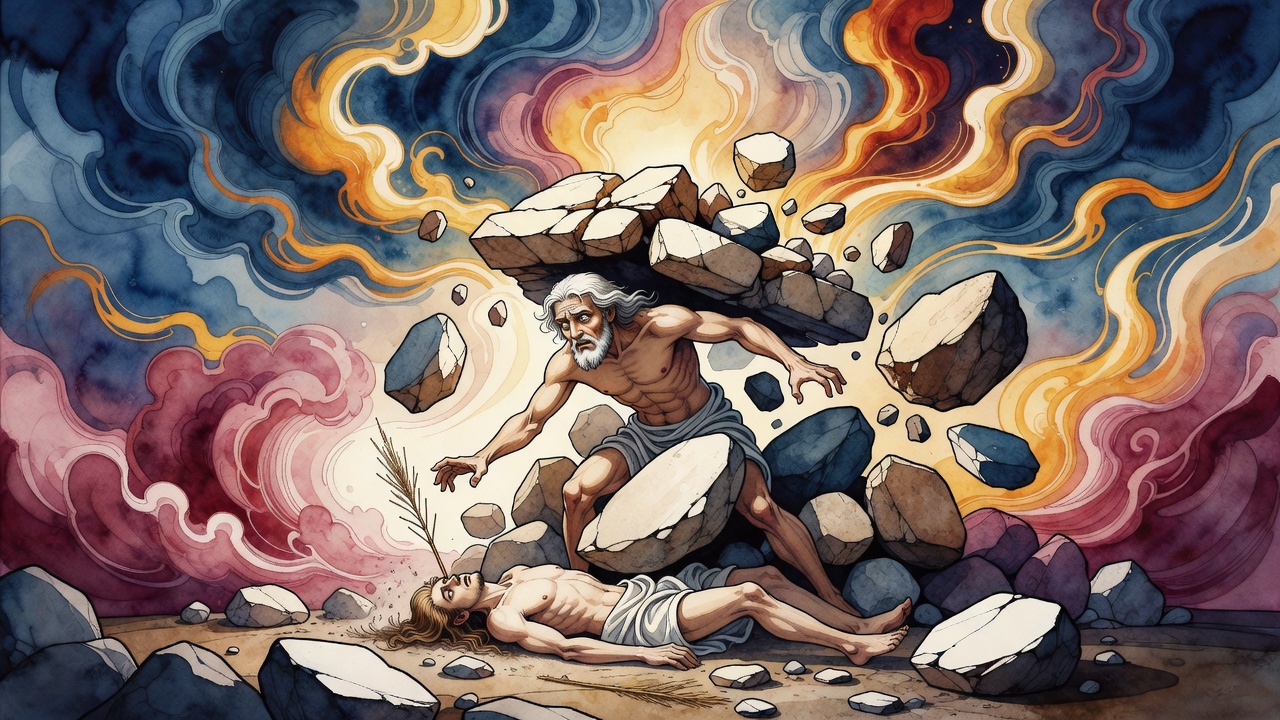
He did not lie helpless like an ordinary newborn. He rose. He stood on his feet as if the earth had already called him by name. He reached out, seized a stalk of straw, and brought it to his mother. His first gesture was taking. Before speech, before work, before brotherhood, his hand learned possession.

Eve named him from acquisition, from the shock of having gotten a man. The name fit too well. Cain's face carried a brightness that did not comfort. Something angelic clung to him, but not peace. He looked marked before any mark was given.

Abel Enters a Narrow World

Then came Abel, and his name already sounded like breath fading in cold air. Cain took the ground. Abel took the flock. One brother bent over soil, pressing seed into earth that had been cursed. The other moved with living animals, counting vulnerable bodies in open fields.

Their offerings rose differently. Abel brought from the first and best of his flock. Cain brought from the fruit of the ground. The fire of favor moved toward one brother and away from the other, and Cain's face fell. The hand that had reached for straw closed into something harder.

God warned him at the door. Sin crouched there, close enough to breathe. Cain could rule it. Cain could step away. The field stood open, and Abel went with him into it.

The Field Takes the Blood

No city had been built yet. No court waited. No grave had been dug. Death itself was still unnamed as a human fact. Cain made it visible.

He rose against Abel in the field, and the ground received the first brother's blood. The soil Cain worked became witness against him. When God asked where Abel was, Cain answered with a guard's refusal, as if brotherhood were a burden someone else had assigned him.

The curse struck the exact place Cain had chosen for himself. The ground would no longer yield its strength to him. The farmer would become a wanderer. He feared being killed, and God set a sign on him so that vengeance would not devour him at once. Cain went out carrying protection and sentence in the same body.

Stone Answers Stone

Some memories leave Cain walking until the floodwaters swallow the violent world with him still inside it. Another memory makes the end tighter, colder, and more exact.

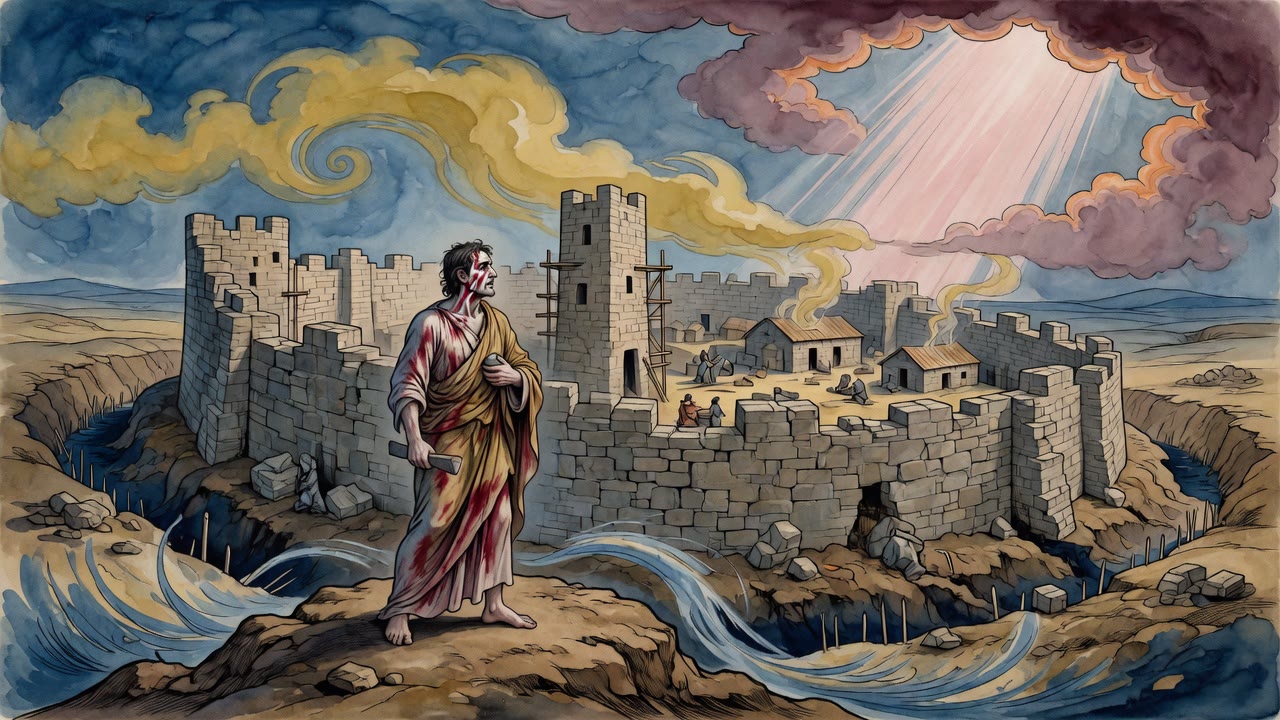
Cain built, because wandering was unbearable. He founded a city, raised walls, gathered stone, and tried to make weight answer the curse of motion. A house of stone promised the opposite of exile. It promised a roof, a place, a corner of earth that would stay put when the man beneath it could not.

Then the house fell.

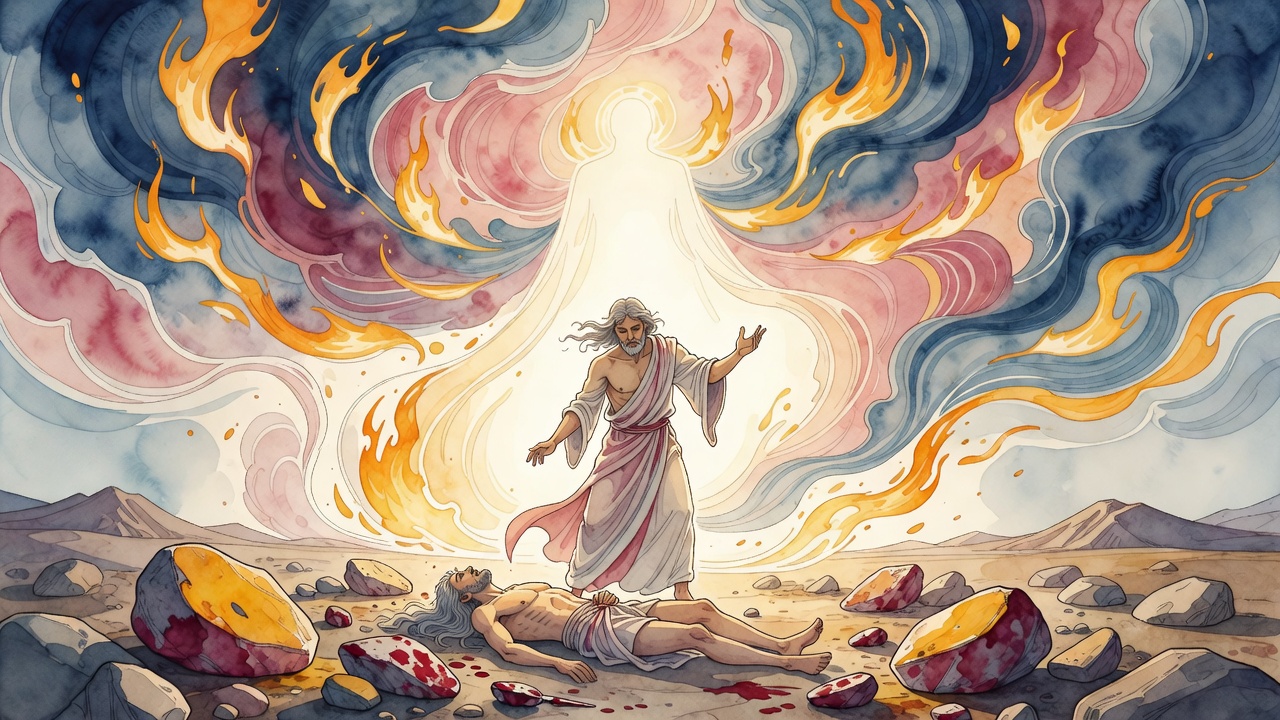
The stones came down on Cain in the middle of his own dwelling. What he had trusted to hold him pressed the breath out of him. The first murderer did not die by a sword in an open field. He died beneath the heaviness he had piled around himself. Stone answered stone. The earth that drank Abel's blood did not forget the shape of the wound.


← All myths
From the tradition

Sources

2 sources

The texts this telling draws on, in full. Open a card to read inline, or expand it for a wider, quieter read.

Legends of the Jews 1:113-114Legends of the Jews

What became of Cain? The Bible tells us he wandered, marked and cursed, after the murder of his brother Abel. But the Torah is silent on the details of his death. So, naturally, the rabbis and storytellers of old stepped in to fill the void.

How did Cain meet his end? Well, there are a few ideas floating around.

Some say he simply fulfilled his destiny as a wanderer, that ceaseless roaming described in (Genesis 4:12), until the time of the Great Flood. Then, along with everyone else (except Noah and his family, of course), he drowned. But did such an ending really mete out sufficient punishment for the first murderer?

Another, perhaps more poetic, version suggests that Cain, the founder of the first city, was killed when his own house, built of stones, collapsed upon him. The apocryphal Book of Jubilees (4:31) specifically states that the house was the instrument of his death and that "Cain was killed when his house fell upon him and he died in the midst of his house, killed by its stones. For with a stone he had killed Abel, and by a stone he was killed in righteous judgment." This brings a certain balance, doesn’t it? A kind of midah k'neged midah (measure for measure) justice. As the Book of Jubilees connects this to (Exodus 21:24), the instrument with which one kills is the same as that with which one is killed.

Then there's the rather… unusual… idea that Cain was transformed into the Angel of Death. After all, he was responsible for bringing death into the world, wasn't he? But the most widely accepted story, the one that really captured the imagination of the tradition, involves Cain's own descendants: Lamech and Tubal-Cain.

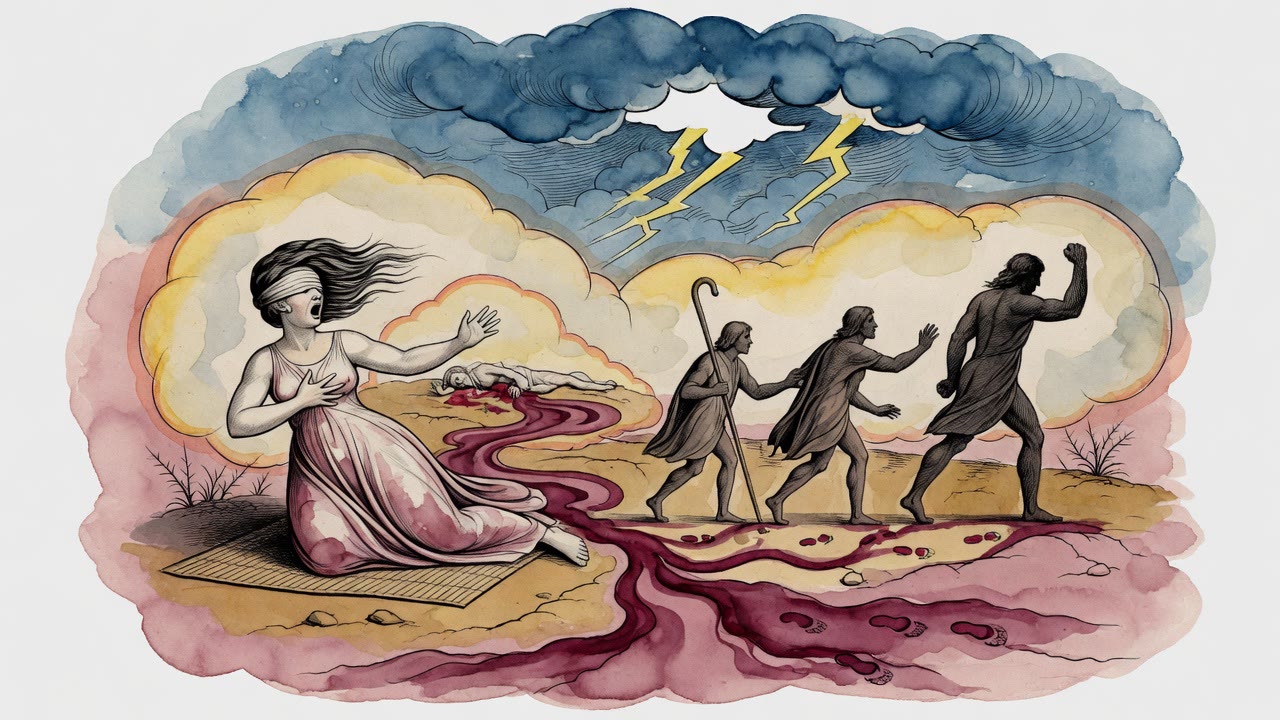
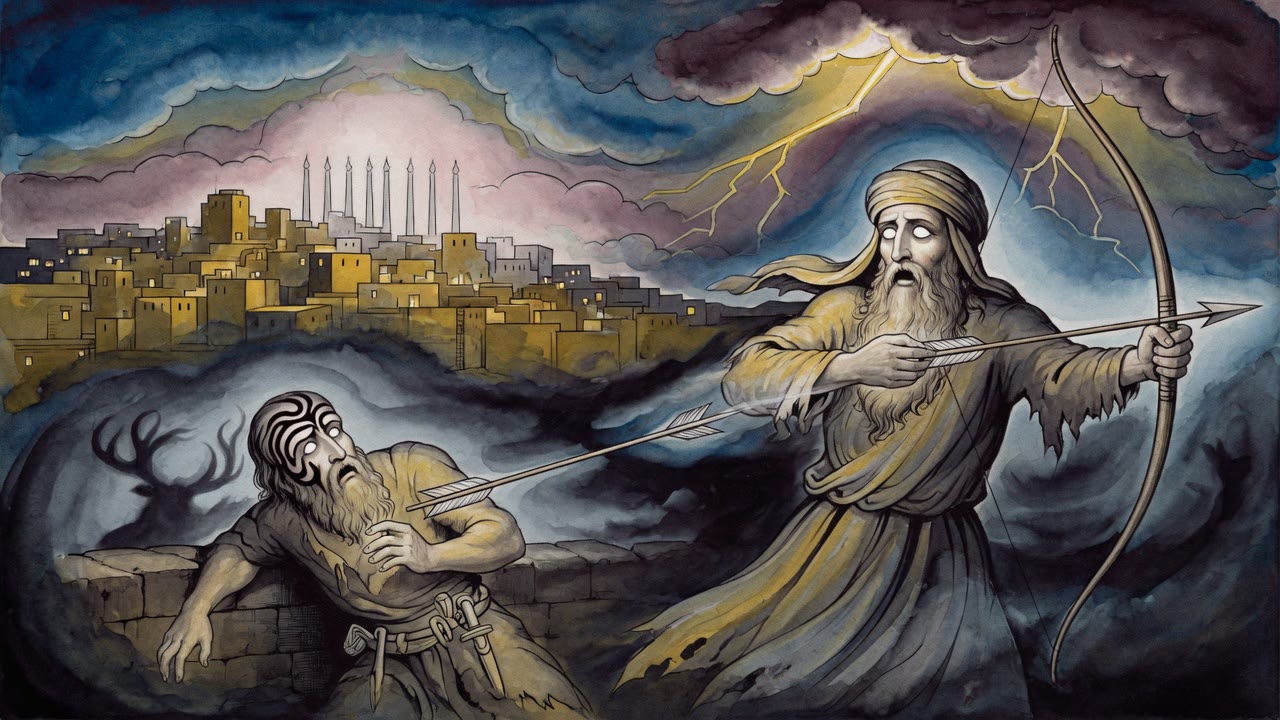
The story goes that Lamech, old and nearly blind, was being led through a field by his son, Tubal-Cain. In the distance, they spotted what they thought was an animal. Tubal-Cain urged his father to shoot. Lamech, with his failing eyesight, drew back his bow and let loose an arrow. The arrow struck true. But when they approached their kill, they were horrified to discover that they had slain none other than Cain, their own grandfather!

Overcome with grief and remorse, Lamech clapped his hands together in despair, accidentally striking and killing his son, Tubal-Cain. Talk about a bad day!

Now, Lamech's wives, Tsila and Ada, were understandably furious. Imagine finding out your husband had accidentally killed both his ancestor and his son! They vowed to withhold themselves from him, to deny him their marriage beds. But Lamech, desperate, took them before Adam himself, who, as the first man, served as a kind of ultimate judge. Adam, in his wisdom, ruled that the wives must obey their husband.

But what about that mark that God placed on Cain? What was it? The Torah doesn't say exactly. This, of course, led to much speculation. As we find in Genesis Rabbah 22:12, Rabbi Judah suggested the mark was the sun shining on Cain. Rabbi Nehemiah, however, thought it was leprosy. Rab said it was a dog. Abba Jose thought a horn grew out of Cain's forehead. And Rabbi Levi, quoting Rabbi Shimon ben Lakish, said that the punishment was simply suspended until the Flood.

Of all these versions, it was the horn that stuck. Why? Because, well, it's pretty visually striking! And it also signified Cain's savage nature, marking him as something less than human, something more akin to a beast. This image of Cain with a horn on his head became inextricably linked with the story of his death at the hands of Lamech and Tubal-Cain.

So, which version is "true"? It's impossible to say. The rabbis, as we know, weren't afraid to offer multiple interpretations, multiple possibilities. Each version of Cain's death offers a different perspective on justice, punishment, and the consequences of our actions. Perhaps the most important thing is that these stories remind us that even the first murderer couldn't escape the long arm of justice, in this life or the next. And perhaps, that even accidental actions can have devastating consequences.

Full source
Apocalypse of Moses 18-23Life of Adam and Eve

The serpent wept for her. That was the cruelest part. It pretended to grieve for her ignorance while plotting her destruction.

"May God live!" the serpent said to Eve, its voice dripping with false compassion. "I am grieved on your account, for I would not have you remain ignorant. Come here. Listen to me. Eat, and understand the true value of that tree."

Eve hesitated. "I fear God will be angry with me, as He warned us."

"Do not fear," the serpent whispered. "As soon as you eat, you will become like God -- you will know good and evil (Genesis 3:5). God knows this. That is why He forbade it. He was jealous of what you might become."

Still Eve resisted. The serpent pressed harder: "Look at the plant. See its glory." But she would not reach for it. So the serpent changed tactics. "Come here. Follow me, and I will give it to you."

Eve followed. The serpent walked a short distance, then turned and said: "I have changed my mind. I will not give you the fruit unless you swear an oath -- swear that you will also give it to your husband."

Eve swore. By the throne of the Master. By the Cherubim. By the Tree of Life itself. She would share the fruit with Adam.

The serpent took the oath and poured upon the fruit the poison of its wickedness -- lust, the root and beginning of every sin. It bent the branch down to the earth. Eve took the fruit. She ate.

In that very hour, her eyes were opened. She knew instantly that she was stripped bare of the righteousness she had worn like a garment. The glory was gone. She wept. "Why have you done this to me? You have stolen the glory I was clothed in!"

But the serpent was already gone. It had descended from the tree and vanished, leaving Eve naked and alone in her portion of Paradise.

She searched desperately for leaves to cover her shame. There were none. The moment she had eaten, every tree in her territory shed its leaves -- every tree except the fig. From the fig tree she took leaves and made herself a covering. The very tree whose fruit she had eaten now clothed her shame (Genesis 3:7).

Then Eve called out: "Adam, Adam, where are you? Come to me -- I will show you a great secret!"

When Adam came, the Adversary spoke through her. Eve opened her mouth and the words of transgression poured out -- words that would bring them down from their glory. "Come, my lord Adam, eat of the fruit of the tree God told us not to eat, and you will be like God."

Adam said: "I fear God will be angry."

"Do not fear," Eve echoed the serpent's lie. "As soon as you eat, you will know good and evil."

He ate. His eyes opened. He saw his own nakedness. And his first words to Eve were devastating: "O wicked woman! What have I done to you, that you have stripped me of the glory of God?"

In that same hour, the archangel Michael blew his trumpet. The call rang across all of creation: "Thus says the Lord -- come with me to Paradise and hear the judgment I will pronounce upon Adam."

God appeared in Paradise, mounted on the chariot of His Cherubim, with angels going before Him singing hymns. At the sound of His approach, every plant in Paradise burst into flower -- as if the garden itself still loved its Maker, even as its guardians had failed Him. God's throne was set beside the Tree of Life.

"Adam, where are you?" God called. "Can a house hide from the one who built it?" (Genesis 3:9)

Adam answered from his hiding place: "I was not trying to hide from You, Lord. I was afraid because I am naked. I was ashamed before Your power."

"Who told you that you are naked," God said, "unless you have broken the commandment I gave you to keep?"

Adam remembered Eve's promise -- "I will make you safe before God" -- and turned to her: "Why have you done this?"

And Eve, stripped of glory, stripped of lies, finally spoke the truth: "The serpent deceived me" (Genesis 3:13).

Full source