Parshat Bereshit5 min read

The Mark of God's Name Sealed on Cain's Face

Cain killed his brother and expected to be hunted. God sealed the divine name on his forehead instead, and no one who saw it could touch him.

Curated by Arthur · Told by Maggid ·
Table of Contents
  1. After the Verdict
  2. The Fear
  3. What God Placed on Him
  4. The Paradox of the Protection
  5. The Death That Waited for Seven Generations

After the Verdict

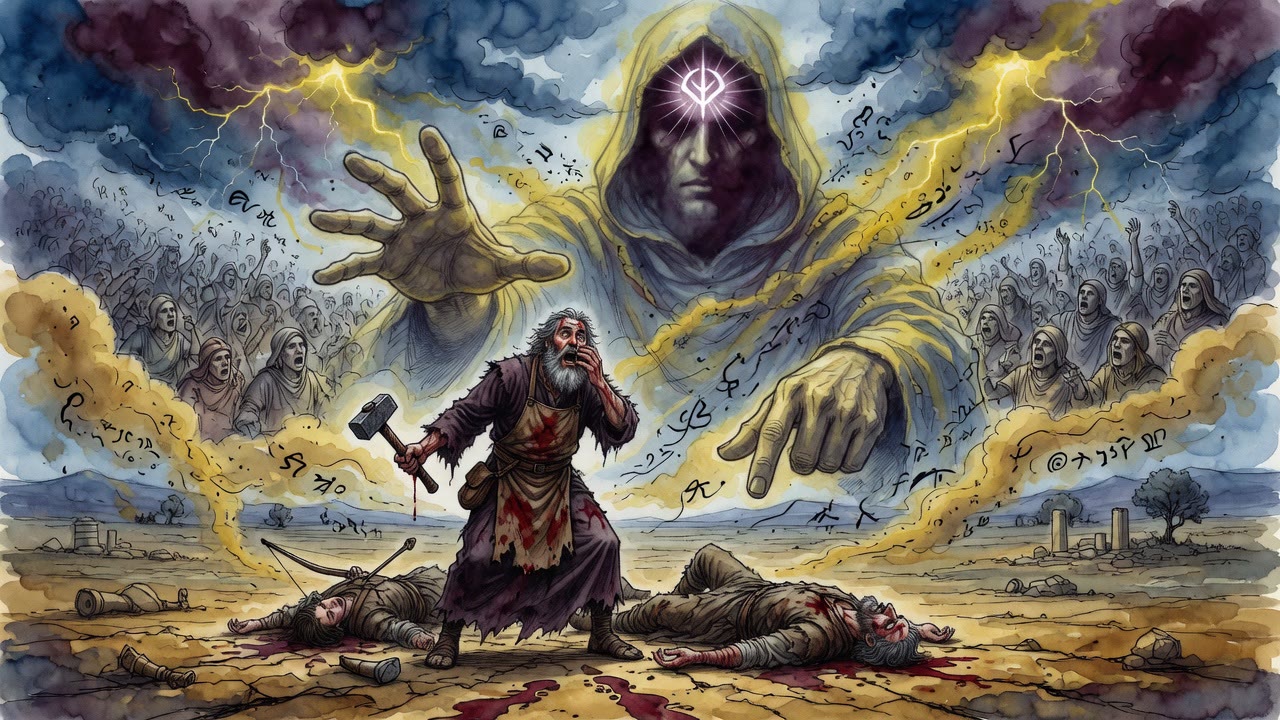
The ground had already testified. It had opened its mouth to receive Abel's blood and would not stay silent. God called out: what have you done? The voice of your brother's blood cries to me from the ground. And now you are cursed from the ground which opened its mouth to receive your brother's blood.

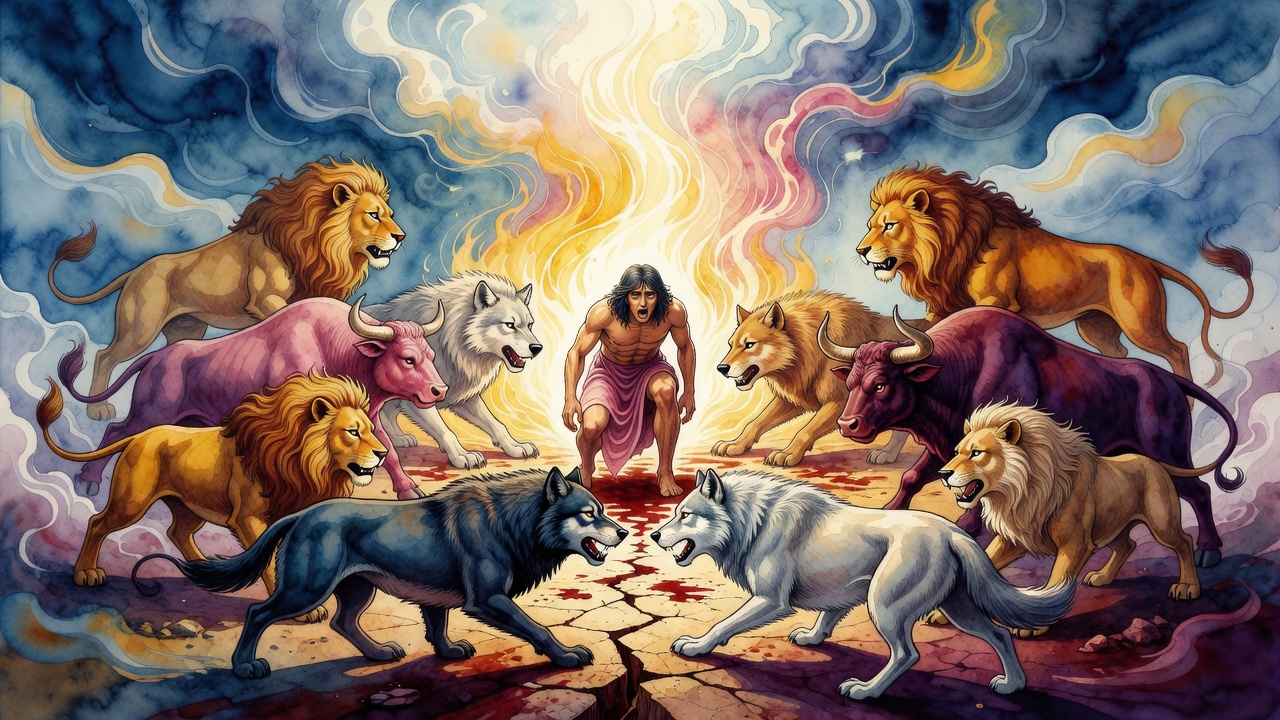
The sentence was exile. Cain would till the ground and it would not yield to him. He would be a wanderer, driven from one place to the next without rest. The specific curse was not death but its opposite: a life of displacement without the one thing that makes displacement bearable, which is a place to eventually stop.

Cain's response was not repentance. It was calculation. He said: my punishment is greater than I can bear. And then: everyone who finds me will kill me.

The Fear

Targum Pseudo-Jonathan on Genesis 4:14 extends the thought. Cain's fear was specific: the righteous would come after him. He was not afraid of random violence. He understood that what he had done created a category of debt that the morally serious would want to collect. Wherever he went, whoever remembered what had happened would have reason to end him.

He was the first murderer in a world that had not yet established courts or procedures for murder. There was no law yet. There was no institution that could say: this is the penalty, this person administers it, no one else may. In that absence, every person he met was potentially his executioner, because every person had the standing that a court has not yet defined.

What God Placed on Him

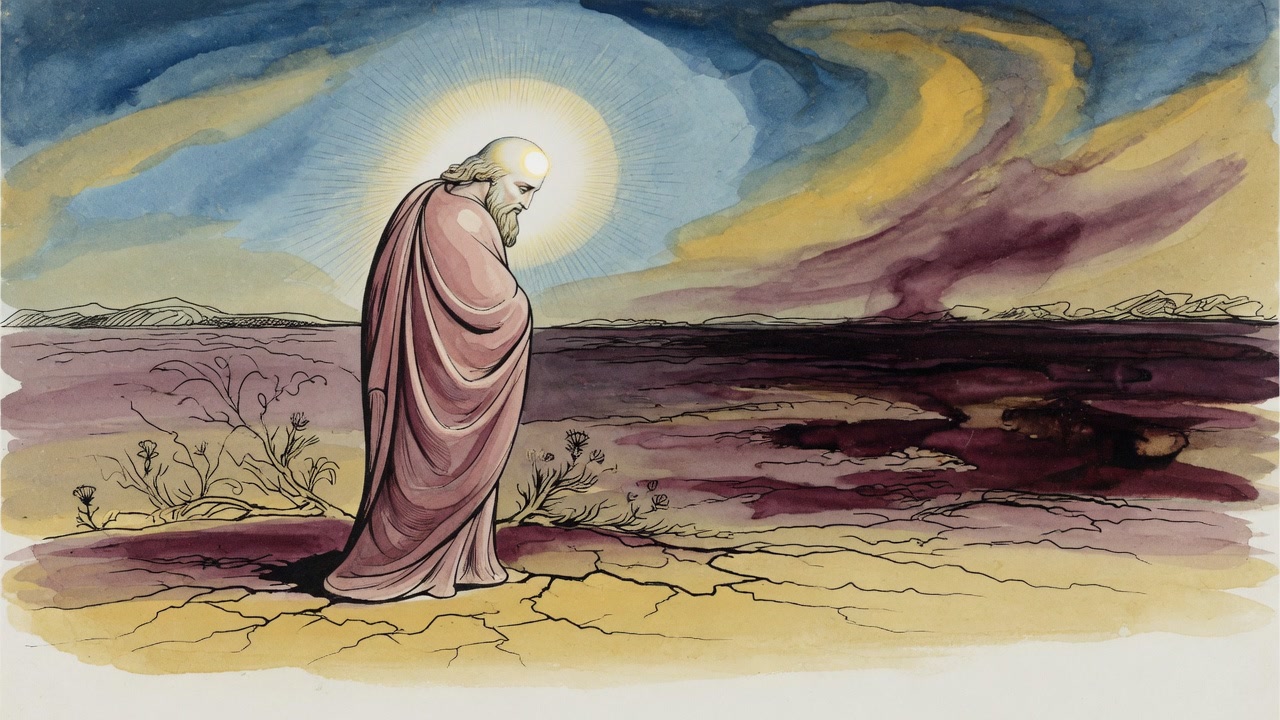
God answered the fear with a sign. Targum Pseudo-Jonathan preserves the specific tradition: God sealed upon the face of Cain the mark of the great and honorable Name.

This is the divine name itself, written on his forehead. Not a brand, not a wound, not a visible sign of shame. The most sacred thing that exists in Jewish theology placed on the face of the first murderer as his protection. Anyone who saw it would know immediately what they were looking at: a man under divine protection, specifically and actively protected by the power that had convicted him.

The seal carried its own warning: anyone who killed Cain would face sevenfold vengeance. The seal made that threat visible. It was not just a prohibition against killing Cain. It was a public announcement of the consequence, worn on the perpetrator's face.

The Paradox of the Protection

The Midrash of Philo, approaching the same episode from a different angle, asks why protection rather than justice. Why was Cain allowed to live at all, to wander and eventually to father children and build a city? Why the mark of protection rather than the mark of condemnation?

The answer the tradition develops is that Cain's punishment was already worse than death. A quick death ends suffering. Exile without end, the ground refusing to yield, the knowledge of what he had done following him through every failed harvest and every camp he had to leave, was a sustained suffering that exceeded what death would have provided. The mark protected his life so that the punishment could be fully served. The divine name on his forehead was not mercy. It was the guarantee that the sentence would be completed.

There is another reading. Cain repented, or came close to it. The tradition in Legends of the Jews records that Cain confessed to the magnitude of his sin and received something in return, a partial mitigation of the punishment. He had said: my sin is too great to bear. Some of the rabbis read this as the beginning of an acknowledgment, the first movement toward remorse from the first murderer. The mark was the response to that movement: not the full erasure of consequences, but the divine acknowledgment that even this man was still under divine care.

The Death That Waited for Seven Generations

Cain knew the punishment had a limit. God had said sevenfold. The tradition interpreted this: in the seventh generation after Cain, his own line would be judged. Cain built his city and named it after his son Enoch. His line continued: Irad, Mehujael, Methushael, Lamech. Lamech, in the seventh generation, killed a man and a young boy and declared that he would be avenged seventy-seven times. He had already exceeded what his ancestor had done.

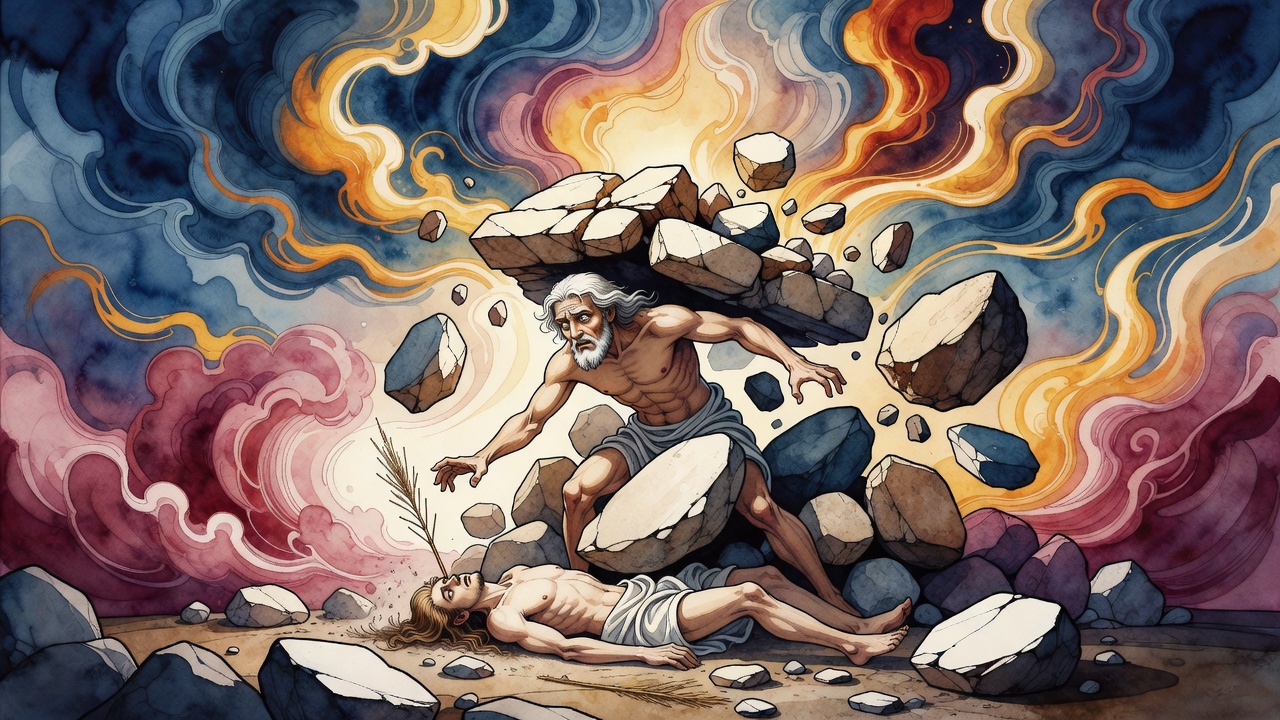
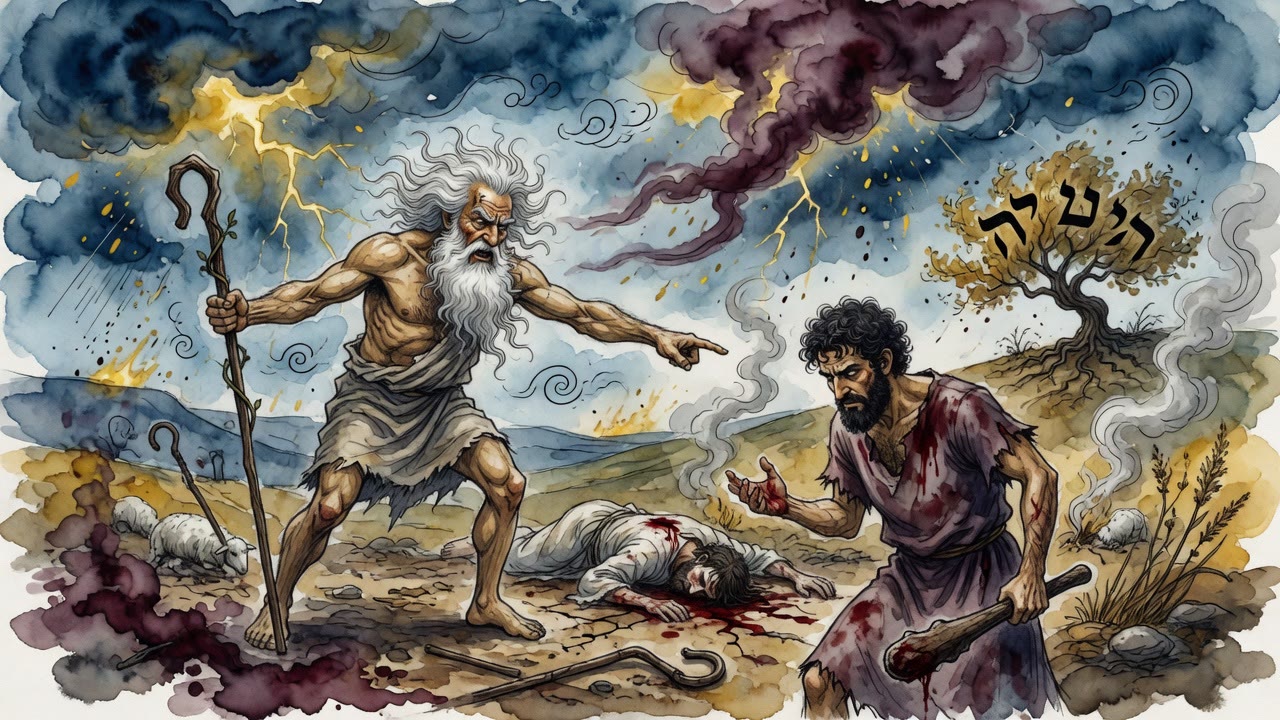
The Legends of the Jews records the tradition that Lamech, who was blind, was hunting with his son Tubal-cain as a guide. Tubal-cain directed his father's arrow toward a shape moving in the brush. The arrow struck. When they came to see what had fallen, they found Cain, dead, the mark of the divine name still on his forehead. The seventh generation had done what every generation since the murder had been prohibited from doing. The wandering ended in the lineage it had begun.


← All myths
From the tradition

Sources

7 sources

The texts this telling draws on, in full. Open a card to read inline, or expand it for a wider, quieter read.

Targum Pseudo-Jonathan on Genesis 4:14Targum Pseudo-Jonathan on Genesis

Cain's response to the curse, in Targum Pseudo-Jonathan on (Genesis 4:14), includes a nuance the Hebrew does not spell out. "Behold, Thou hast cast me forth today from the face of the earth, and from before Thee is it possible to be hidden? And because I am a wanderer and an exile in the earth, any just one who findeth me will kill me."

The Hebrew says "anyone who finds me." The Targumist sharpens it: any just one. Cain fears not random violence but the moral response of the righteous. The people most likely to kill him are the ones most capable of recognizing what he has done. The tzaddikim are the threat, because they uphold the very justice he has broken.

This is a remarkable window into Cain's mind. He has just denied there is a Judge, but he is now terrified that the righteous will become judges themselves. The moral universe he tried to deny has caught up with him.

Full source
Targum Pseudo-Jonathan on Genesis 4:15Targum Pseudo-Jonathan on Genesis

What was the "mark of Cain"? The Torah only says God placed a sign on him so no one would kill him. Targum Pseudo-Jonathan on (Genesis 4:15) tells us what the sign was.

"The Lord sealed upon the face of Kain the mark of the Name great and honourable, that any one who might find him should not kill him when he saw it upon him."

The mark is a letter. Or letters, of the divine Name itself. The Tetragrammaton, or a letter of it, was engraved on Cain's forehead. Anyone who saw him saw the Name of God and knew this was a person under divine protection, not a person to be hunted.

Why protect a murderer?

The Targum also records the promise: "Any one who killeth Kain, unto seven generations vengeance shall be taken of him." Cain, the first murderer, is given supernatural protection. Why?

Because the alternative, vigilante violence cascading through the new human population, would make Cain's sin the pattern of all human life. God, the Targumist suggests, halts the chain of killing. Cain's mark is not forgiveness. It is containment. The divine Name on his forehead says: this far, and no further. Seven generations of wandering, yes. But the cycle of vengeance stops here.

Jewish law will later teach that even a condemned criminal retains the image of God. The mark of Cain is the Targumist's earliest hint of that principle. The worst of sinners still bears the Name.

Full source
Legends of the Jews 3:5Legends of the Jews

Legends of the Jews turns to Cain's Repentance.

The texts tell us that Cain knew, deep down, that the consequences of his actions would catch up with him, specifically in the seventh generation of his line. God had decreed it. So, what does a guilty man do? He tries to create a legacy, to cheat death, in a way. Cain became a builder, a founder of cities. The first he named Enoch, after his son, because it was at Enoch’s birth that Cain finally felt a measure of peace. He went on to build six more cities.

Here's the thing: the building of these cities wasn't exactly a philanthropic endeavor. According to the texts, it was a "godless deed." He surrounded them with walls, essentially forcing his family to stay put. All his actions were considered impious. The punishment God ordained for him? It didn't exactly lead to a spiritual awakening. He kept sinning, pursuing his own pleasure, even if it meant hurting others. He grew his wealth through violence and robbery, leading others down the same wicked path.

As we find in Legends of the Jews, Cain introduced a change in the "ways of simplicity" that had existed before. He was the originator of measures and weights. And while before, people lived innocently, generously, without such artifice, he changed the world into one of "cunning craftiness." Like father, like sons. Cain's descendants followed in his footsteps, impious and godless. It was their collective wickedness that ultimately led God to resolve to destroy them.

But how did Cain actually meet his end? The Zohar tells us it was in the seventh generation, just as prophesied. And the agent of his demise? None other than his great-grandson, Lamech. Now, Lamech was blind. Blindness becomes a significant theme. He was led on hunts by his young son, who would point out the game. One day, the boy spotted something horned in the distance. Mistaking it for an animal, he told Lamech to shoot. The arrow flew, and the quarry fell.

Can you imagine the horror? When they approached, the boy cried out, "Father, you've killed something that resembles a human being, except it has a horn on its forehead!" Lamech knew instantly. He had killed his ancestor, Cain, the one marked by God with a horn. In despair, Lamech clapped his hands together, and, tragically, inadvertently killed his own son. Misfortune upon misfortune.

As Ginzberg retells in Legends of the Jews, the earth then opened up and swallowed the four generations sprung from Cain: Enoch, Irad, Mehujael, and Methushael. Lamech, being blind, was stranded beside the corpses of Cain and his son. His wives eventually found him and, upon hearing what happened, wanted to leave him, fearing the doom that awaited Cain's descendants.

But Lamech pleaded his case, arguing, "If Cain, who committed murder intentionally, was only punished in the seventh generation, then I, who killed unintentionally, may hope for mercy for seventy-seven generations." He went with his wives to Adam himself, who heard both sides and ruled in favor of Lamech.

The story doesn't end there. The corrupt state of the world, particularly the depravity of Cain's line, is further illustrated by the practice of men taking two wives. According to Midrash Rabbah, one wife was for procreation, while the other was for pleasure, often rendered sterile artificially. The men lavished attention on the barren wives, while the others lived like widows, joyless and neglected.

Lamech’s two wives, Adah and Zillah, each bore him two children. Adah had Jabal and Jubal, and Zillah had Tubal-cain and a daughter, Naamah. Jabal was said to be the first to build temples to idols, and Jubal invented the music played within them. Tubal-cain, whose name echoes that of his ancestor, continued Cain's legacy. While Cain committed murder, Tubal-cain, the first to master iron and copper, created the instruments of war. And Naamah, "the lovely," earned her name by playing sweet music on her cymbals, calling worshippers to the idols.

So, what are we left with? A story of sin, consequence, and the enduring power of legacy. A legacy that can be twisted, corrupted, but never truly erased. The descendants of Cain remind us that the choices we make, the paths we forge, echo through generations, shaping the world long after we are gone. What kind of legacy are we building?

Full source
Legends of the Jews 1:113-114Legends of the Jews

What became of Cain? The Bible tells us he wandered, marked and cursed, after the murder of his brother Abel. But the Torah is silent on the details of his death. So, naturally, the rabbis and storytellers of old stepped in to fill the void.

How did Cain meet his end? Well, there are a few ideas floating around.

Some say he simply fulfilled his destiny as a wanderer, that ceaseless roaming described in (Genesis 4:12), until the time of the Great Flood. Then, along with everyone else (except Noah and his family, of course), he drowned. But did such an ending really mete out sufficient punishment for the first murderer?

Another, perhaps more poetic, version suggests that Cain, the founder of the first city, was killed when his own house, built of stones, collapsed upon him. The apocryphal Book of Jubilees (4:31) specifically states that the house was the instrument of his death and that "Cain was killed when his house fell upon him and he died in the midst of his house, killed by its stones. For with a stone he had killed Abel, and by a stone he was killed in righteous judgment." This brings a certain balance, doesn’t it? A kind of midah k'neged midah (measure for measure) justice. As the Book of Jubilees connects this to (Exodus 21:24), the instrument with which one kills is the same as that with which one is killed.

Then there's the rather… unusual… idea that Cain was transformed into the Angel of Death. After all, he was responsible for bringing death into the world, wasn't he? But the most widely accepted story, the one that really captured the imagination of the tradition, involves Cain's own descendants: Lamech and Tubal-Cain.

The story goes that Lamech, old and nearly blind, was being led through a field by his son, Tubal-Cain. In the distance, they spotted what they thought was an animal. Tubal-Cain urged his father to shoot. Lamech, with his failing eyesight, drew back his bow and let loose an arrow. The arrow struck true. But when they approached their kill, they were horrified to discover that they had slain none other than Cain, their own grandfather!

Overcome with grief and remorse, Lamech clapped his hands together in despair, accidentally striking and killing his son, Tubal-Cain. Talk about a bad day!

Now, Lamech's wives, Tsila and Ada, were understandably furious. Imagine finding out your husband had accidentally killed both his ancestor and his son! They vowed to withhold themselves from him, to deny him their marriage beds. But Lamech, desperate, took them before Adam himself, who, as the first man, served as a kind of ultimate judge. Adam, in his wisdom, ruled that the wives must obey their husband.

But what about that mark that God placed on Cain? What was it? The Torah doesn't say exactly. This, of course, led to much speculation. As we find in Genesis Rabbah 22:12, Rabbi Judah suggested the mark was the sun shining on Cain. Rabbi Nehemiah, however, thought it was leprosy. Rab said it was a dog. Abba Jose thought a horn grew out of Cain's forehead. And Rabbi Levi, quoting Rabbi Shimon ben Lakish, said that the punishment was simply suspended until the Flood.

Of all these versions, it was the horn that stuck. Why? Because, well, it's pretty visually striking! And it also signified Cain's savage nature, marking him as something less than human, something more akin to a beast. This image of Cain with a horn on his head became inextricably linked with the story of his death at the hands of Lamech and Tubal-Cain.

So, which version is "true"? It's impossible to say. The rabbis, as we know, weren't afraid to offer multiple interpretations, multiple possibilities. Each version of Cain's death offers a different perspective on justice, punishment, and the consequences of our actions. Perhaps the most important thing is that these stories remind us that even the first murderer couldn't escape the long arm of justice, in this life or the next. And perhaps, that even accidental actions can have devastating consequences.

Full source
The Midrash of Philo 15:8The Midrash of Philo

The familiar story is this: Cain's offering wasn't accepted, Abel's was, jealousy flared, and tragedy struck. But what about the consequences? Why a mark of protection, instead of swift justice? Why was Cain allowed to live, to even father children and build cities?

The text It digs deep into the seeming paradox of divine justice tempered with mercy. It wasn't some oversight or divine inconsistency. Instead, this text sees profound meaning in God's actions.

One explanation offered is that Cain's punishment was severe, just not in the way we might expect. The text suggests that "the change of the nature of living is one kind of death." Continual sorrow, unyielding fear, a life devoid of joy or hope… these are "sensible deaths" in themselves. Cain wasn't getting off scot-free; he was condemned to a living hell of his own making.

There's more to it than just punishment. The author argues that this story is actually about something far bigger. It's about the very nature of life and death, and the soul's immortality. The text uses the story to illustrate "the law about the incorruptibility of the soul," rejecting the notion that our physical life is the only life, or the most important one. Abel, the righteous one, is dead. Cain, the murderer, lives on. If earthly existence were all that mattered, this would be a cosmic injustice! But the text argues that Abel's death wasn't truly evil, and Cain's life wasn't truly good. Instead, there's "another life given to man free from old age, and more immortal, which the incorporeal souls have received."

The text even quotes a line that evokes similar sentiments, saying, "That is not mortal but an endless Woe." It applies that sentiment to Cain, arguing that a long life lived in wickedness is its own kind of torment.

The author proposes that God's choice reflects a broader principle: compassion over severity, at least initially. The text says that God is "imposing on all judges a most peaceful law for the first crime; not that they are not to destroy malefactors, but that resting for a while with great patience and long suffering, they shall study compassion rather than severity."

God wasn't letting Cain off the hook. He was "destroying him in another manner," by isolating him, exiling him from his family and community, effectively turning him into an outcast, "as one who had been expelled, and banished, and turned into the nature of beasts."

So, what can we take away from this ancient interpretation? It's a reminder that justice isn't always about immediate retribution. Sometimes, it's about a deeper, more profound reckoning. It's about the long-term consequences of our actions, the state of our souls, and the eternal perspective that transcends our brief earthly existence. And perhaps, most importantly, it's a call for compassion, even when faced with the most heinous of acts.

Full source
Midrash Tanchuma, Bereshit 10Midrash Tanchuma

Behold, Thou hast driven me out this day from the face of the land … and the Lord said unto him: “Therefore, whosoever slayeth Cain, vengeance shall be taken on him sevenfold.” and the Lord set a sign for Cain (Gen. 4:14–15). There are some who say that the word “Sabbath” was placed as a sign upon his countenance, as it is said: My Sabbaths, for it is the sign between Me and you, throughout your generations (Exod. 31:13), and that just as the Sabbath pleaded in behalf of Adam, it pleaded in behalf of Cain. Others, however, insist that He fastened a horn upon his forehead.

After Cain slew Abel, the body lay outstretched upon the earth, since Cain did not know how to dispose of it. Thereupon, the Holy One, blessed be He, selected two clean birds and caused one of them to kill the other. The surviving bird dug the earth with its talons and buried its victim. Cain learned from this what to do. He dug a grave and buried Abel. It is because of this that birds are privileged to cover their blood.

Full source
Midrash Tanchuma, Bereshit 11Midrash Tanchuma

And the Lord said unto him: “Therefore, whosoever slayeth Cain, vengeance shall be taken on him sevenfold.” and the Lord set a sign for Cain (Gen. 4:15). The Holy One, blessed be He, said to him: Four families were destined to descend from Abel, but since you have eliminated them from the face of the earth, the earth will open up and devour four families that will descend from you: these are Enoch, Irad, Mehujael, and Methushael.

How was Cain slain? For one hundred and thirty years, Cain became an angel of death, wandering and roaming about, accursed. Lamech, his descendant in the seventh generation, who was blind, would go hunting led about by his young son. At the sight of game, the lad would apprise his father of its whereabouts. One time the lad said to his father: “I see some kind of beast in the distance.” Lamech sent his arrow in that direction, and Cain was slain. As they approached the corpse, the lad saw a horn protruding from the forehead of the slain creature, and he said to his father: “The corpse resembles a man, but a horn protrudes from its forehead.” Thereupon, Lamech cried out: “Woe is me, it is my grandfather.” In his grief, he clasped his hands together, and accidentally struck the child’s head, killing him. As it is said: I can slay a man by a wound of mine and a child by a strike of mine (Gen. 4:23).

The three remained where they were: Cain dead, the child slain, and Lamech blind. At nightfall his wives went out to search for them and found their grandfather dead, their son Tubal-cain slain, and Lamech. It was then that the earth swallowed up the four families: Enoch, Irad, Mehujael, and Methushael. Thereafter, Lamech served as the Angel of Death in fulfillment of the verse: Cain was avenged sevenfold, and Lamech seventy and seven (Gen. 4:24).

Upon returning home, Lamech said to his wives: “Let us go to bed.” They replied: “You have slain our ancestor and our son Tubal-cain; we shall no longer go to bed with you.” He retorted: “Cain received his punishment only after seven generations, surely mine should be postponed for seventy and seven generations.” “We shall not listen to you,” they insisted. “Why should we give birth to one who will be dishonored?” Thereupon, he said: “Let us go to the court for a decision.” They went to Adam, and Adah and Zillah cried out: “Oh, lord Lamech, our husband, has slain our grandfather.” Whereupon Lamech declared: “Did our grandfather kill unwittingly?” Adam replied: “Wives of Lamech, hearken to my words! Lamech says: Have I have slain a man intentionally? (Gen. 4:23). Therefore I say to you: Go and obey your husband.” They retorted: “O physician, heal your own lameness. You have not had sexual intercourse with your wife for one hundred and thirty years, yet you command us to do so.” Hence it is written in Scripture following this incident: And Adam lived a hundred and thirty years and begot his son in his own likeness (Gen. 5:3).

Lamech lived a hundred and eighty-two years and begot his son (Gen. 5:28), through whom the world was to be reestablished. He called him Noah (lit. “comfort, ease”), saying: This one will comfort us in our work and in the toil of our hand (Gen. 5:29). How did he know that this one would comfort us in our work? Was Lamech a prophet? R. Simeon the son of Yehozadak said: There was a tradition that when the Holy One, blessed be He, told Adam: Cursed be the ground for thy sake; in toil shalt thou eat of it (Gen. 3:17), Adam inquired: “Master of the Universe, how long will the ground be cursed?” He replied: “Until a man-child already circumcised shall be born.” When Noah was born circumcised, Lamech understood immediately that this was the one concerning whom the Holy One, blessed be He, had said: This one will comfort us in our work (ibid. 5:29).

What do the words in our work and in the toil of our hands (ibid.) imply? Prior to Noah’s birth, men did not reap what they sowed. They would sow wheat and reap thorns and thistles, but when Noah was born, the world reverted to normal: Wheat was sown and wheat was reaped; barley was sown and barley was reaped. Prior to Noah’s birth, men performed all their labor by hand, as it is written: And in the toil of our hands, but after Noah was born, plows, scythes, axes, and other implements were introduced.

Full source