The Third Day When Pain Peaks and a Father Guards His Son
Simeon and Levi waited until the men of Shechem were three days past circumcision and could barely stand. Then they came through the gate with swords.
Table of Contents
 Click for full size
The Day Simeon and Levi Chose
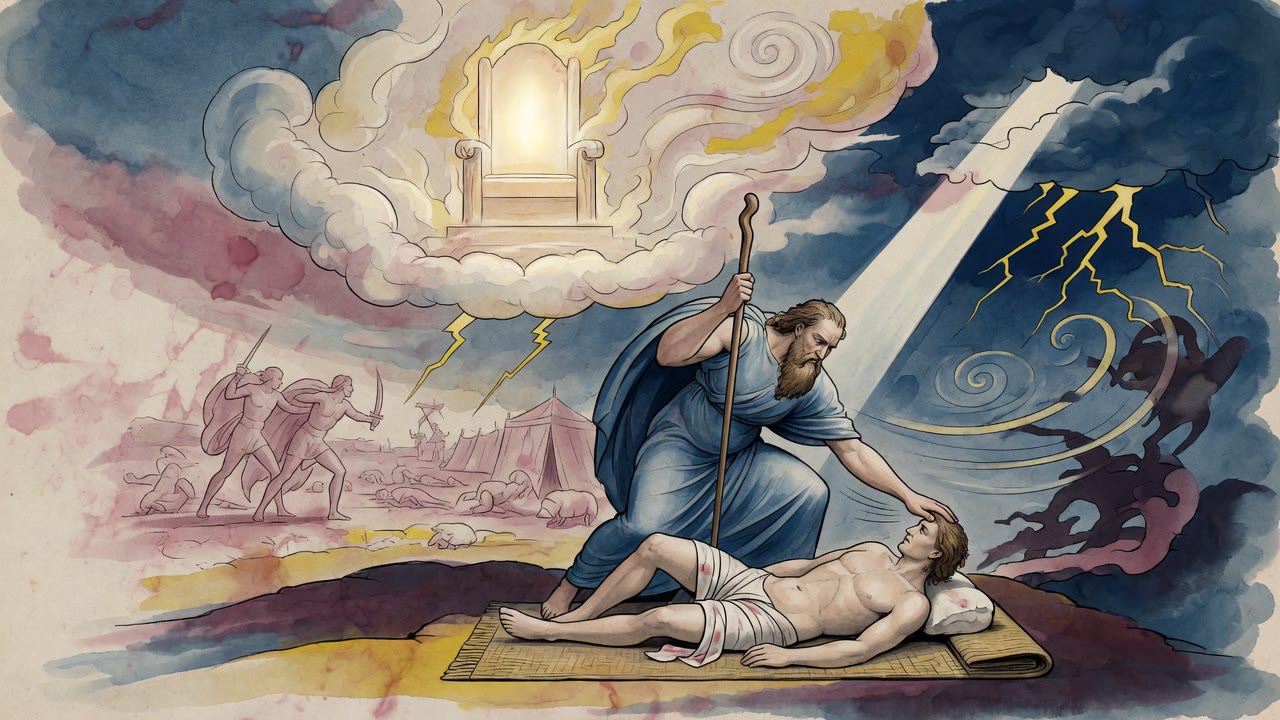
The men of Shechem had circumcised themselves. Every male in the city had agreed to the condition of marriage that Dinah's brothers had set, and now they were three days past the procedure, lying in their houses at the worst moment of the healing.
That was when Simeon and Levi came through the gates with their swords.
Genesis 34:25 records it plainly: it was on the third day, when they were in pain, that the two sons of Jacob took their swords and came upon the city with confidence and killed all the males. A massacre timed to the physiology of the wound. They did not come on the first day, when the men were still upright. They came on the third day, when the pain was at its highest point and a grown man could barely stand.
The Torah paused on that detail. On the third day, when they were in pain. The rabbis of Bereshit Rabbah circled the phrase and would not let go of it. If the Torah tells us explicitly that the third day is the day of greatest pain, the rabbis argued, then the Torah is teaching something about every circumcision, not just this one.
A Verse About a Massacre Becomes a Medical Rule
Bereshit Rabbah 80:9 took a verse about one of the most violent scenes in Genesis and turned it into a practical ruling about how to care for a newly circumcised infant.
A debate developed immediately. The rule was clear, the third day is the day of greatest pain, so a baby who has just had the brit milah needs particular attention on the third day. But when exactly does the count begin?
Rabbi Berekhya said the third day means the third day from the circumcision itself, not counting the day of the procedure. Rabbi Levi said it means the third day counting from the circumcision, so the circumcision day is day one.
The practical difference mattered. A father who was not sure which day was the third day, the day when he needed to be most attentive to his son's comfort and recovery, needed an answer. The sages gave him two answers and then argued about which one was binding. The violence at Shechem, the clinical precision of two brothers who knew exactly when to strike for maximum effect, became the text from which rabbis extracted the human body's healing timeline.
The Father Watching His Sons Leave for Egypt
The second passage in Bereshit Rabbah shifts from the wound of circumcision to a different kind of vulnerability. Jacob's sons are preparing to go down to Egypt for grain in the middle of a famine. Jacob watches them and says something the Torah records as a warning: why do you make yourselves conspicuous?
The midrash opened what Jacob meant. Do not take bread openly in your hands as you travel. Do not all enter through the same gate. Do not walk together in a group that announces itself. The concern was the evil eye, the ayin hara, the accumulated envy of people who see a household that still has food moving through a land where food has run out.
There was no shortage in Jacob's house. The family had grain. That was exactly the problem. A man with resources moving through a landscape of desperate people was a target not for theft alone but for something the rabbis regarded as a real force: the focused attention of resentment. Jacob told his sons to scatter their approach, to spread the evidence of their survival thin enough that it would not draw concentrated malice down on them.
The circumcised infant needed protection on the third day when his body was at its most exposed. Jacob's sons needed protection as they crossed into famine country with food in their sacks. In both cases, a father was calibrating the care to the specific shape of the danger.
Two Kinds of Exposure
The baby at the brit milah and Jacob's sons walking into famine country were both in the same position: at the moment of greatest vulnerability, with a careful father trying to calibrate exactly the right protection. Simeon and Levi had exploited that vulnerability once, and the rabbis of Bereshit Rabbah used the record of that exploitation to derive the medical rule. Jacob had lived with those sons. He knew what they were capable of. When his remaining sons prepared for the journey to Egypt, he told them to guard themselves against the same concentrated attention that his older sons had once used as a weapon.
The third day of circumcision was the day the infant's body was most exposed. The road through famine country was the stretch when the family's intact resources made them most visible. In both cases, the father's job was to know the specific shape of the danger and to build a protection that fit it precisely. Not a general caution. A targeted one.
Bereshit Rabbah held these two passages together because the same structural principle ran through them. The wound that heals and the road through hunger are different dangers. What Simeon and Levi did at Shechem and what Jacob feared from envious neighbors are different threats. But in both cases, the father who understood the physiology of vulnerability was the father who could protect what he was responsible for guarding.
← All myths