6 min read

The Two Days When Every Living Thing Tastes Death

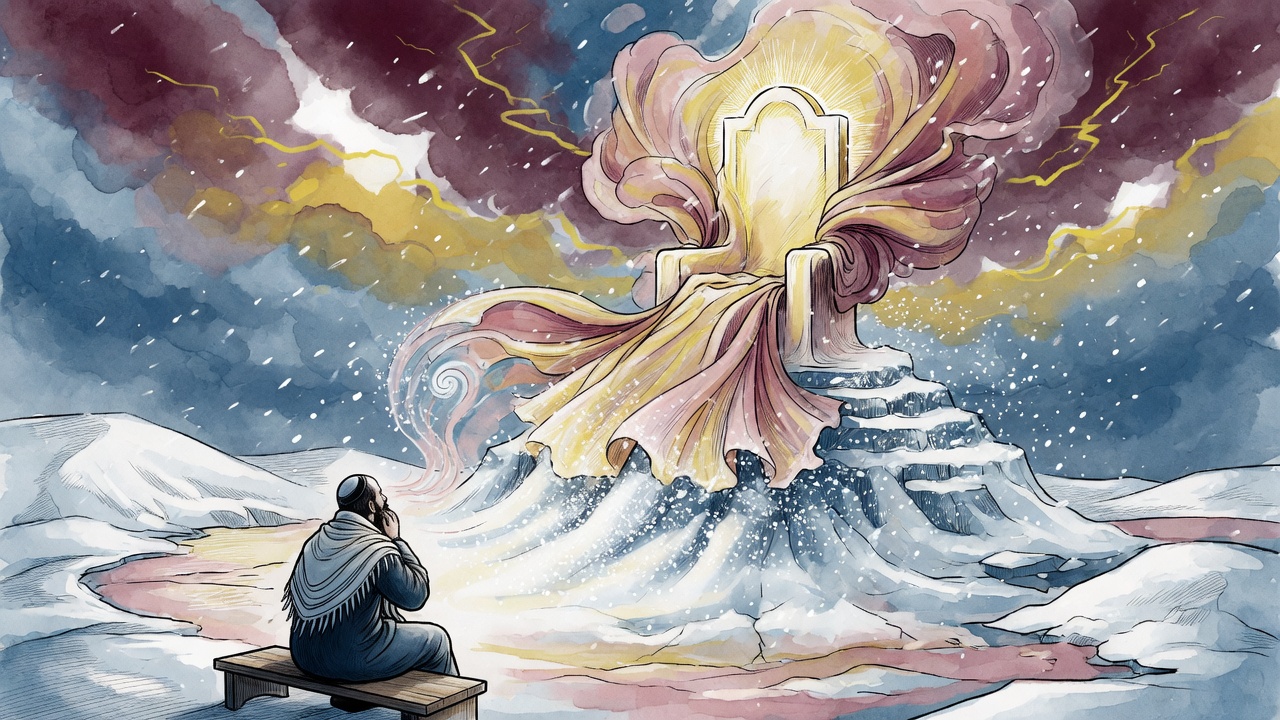
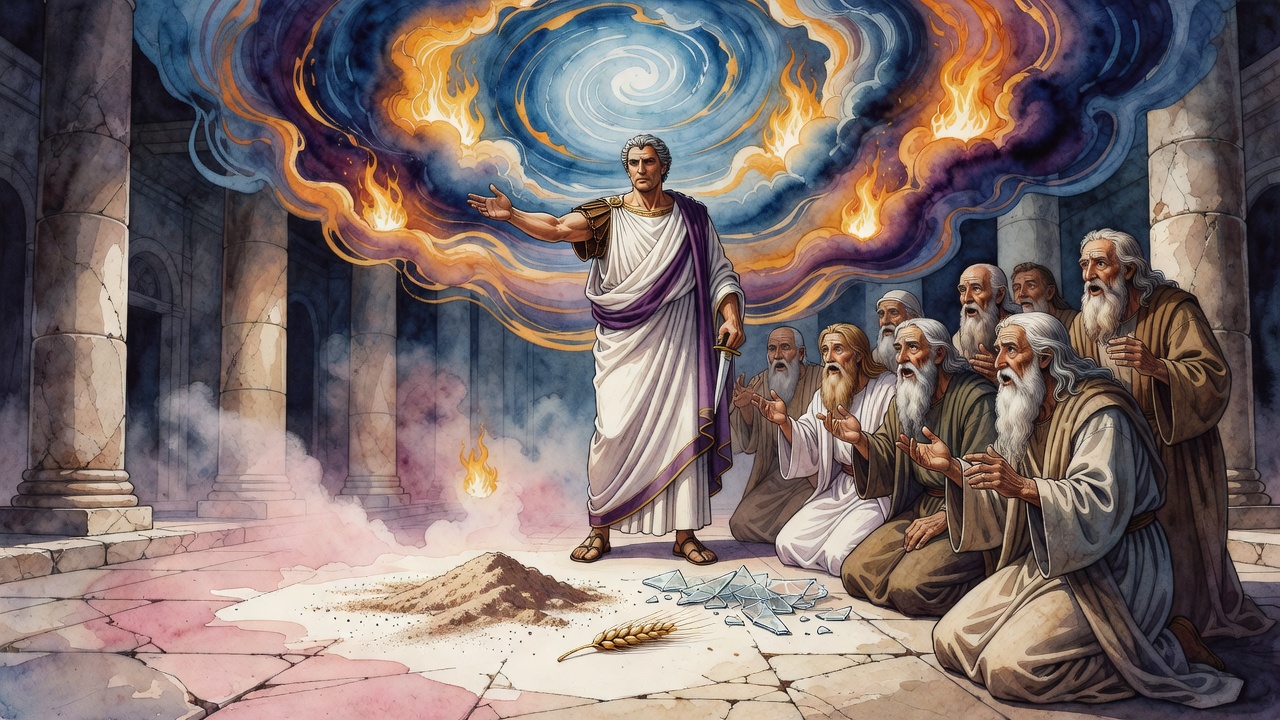
At the end of days the sun is remade sevenfold, and for two full days no soul of man or beast breathes anywhere on earth before the dead rise.

Curated by Arthur · Told by Maggid ·
Table of Contents
  1. The Sun Drowns Every Evening
  2. When the Hosts of Heaven Are Hauled Before the Throne
  3. Two Days of Silence
  4. The Third Day
  5. Waters That Heal the Salt Sea
The Two Days When Every Living Thing Tastes Death Click for full size

The Sun Drowns Every Evening

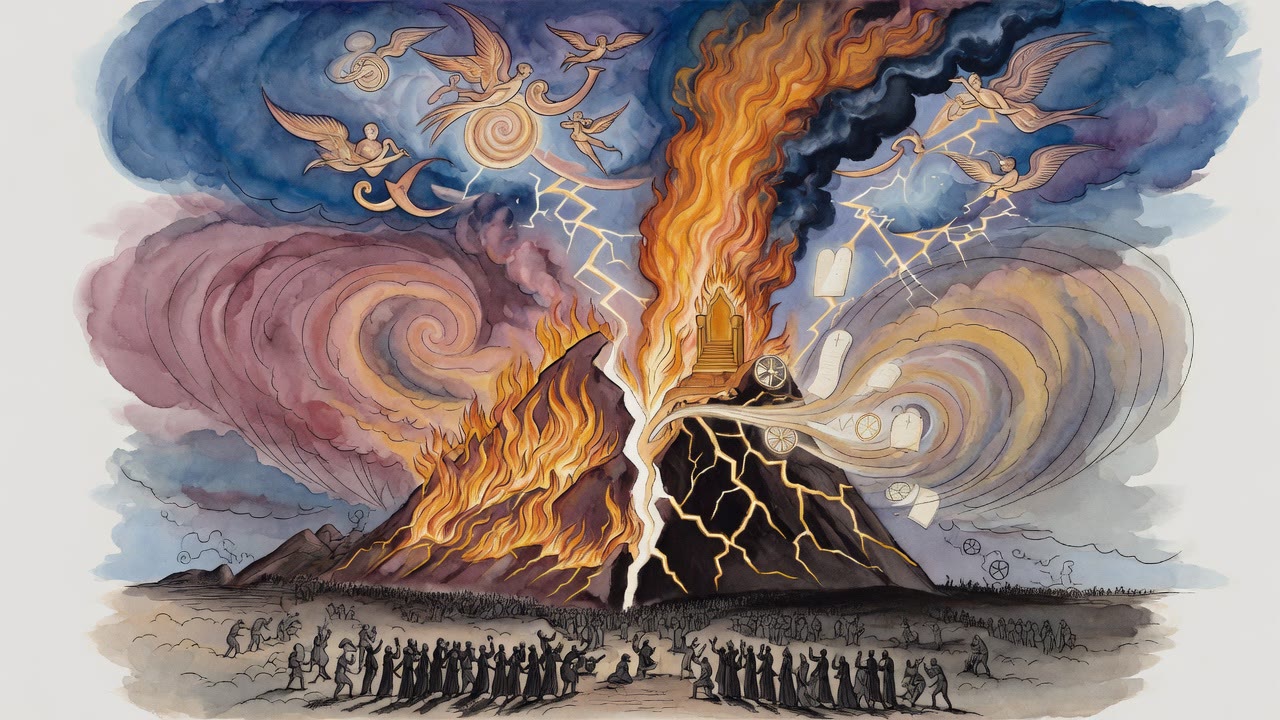
Every evening the sun does not simply set. It falls. When it reaches the western rim of the sky it plunges into the waters of the great Ocean, and the fire goes out of it with a hiss and a wall of steam. Then darkness, and the sun rides the whole night beneath the sea without light and without flame, a cold coal carried east under the world.

Before dawn it comes to a river of fire and immerses itself there like a man who kindles his lamp inside a furnace. It puts its flames back on. It climbs the eastern edge and pours light over the earth, and the work of the first Creation is done again, one more time, exactly as it has been done every single day. The moon and the stars keep their own ritual. Each night they wash themselves in a river of hail before they rise to burn over the dark.

Nobody looking up notices, because the fixtures hold. They drown and are reforged, and no mortal ever sees the seam.

When the Hosts of Heaven Are Hauled Before the Throne

But a day is set when the seam will show.

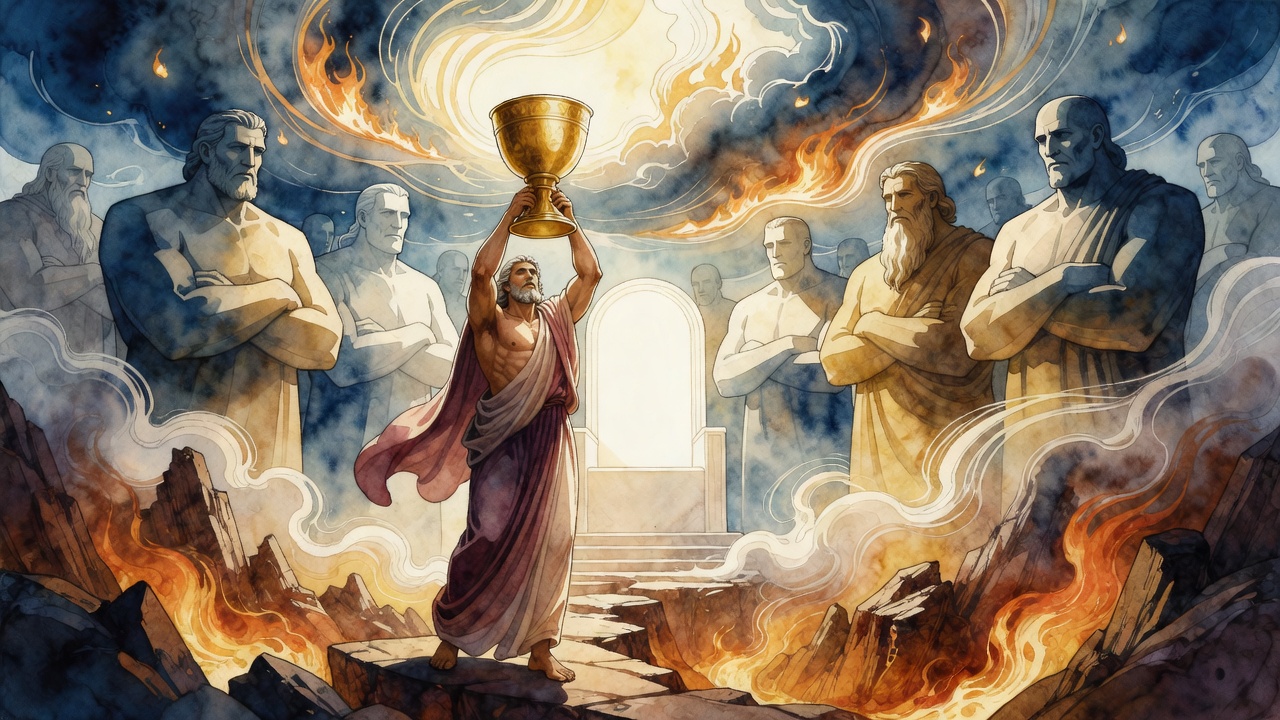
God will call the sun and the moon and the stars and the constellations up out of their courses and stand them before Him, and He will not merely relight them. He will remake them. He will take the moon, that pale borrowed thing, and give it the full strength of noon. He will take the sun and multiply it sevenfold, until a single day carries the light of seven days laid one on top of another. On that day, the prophet Isaiah said, the Holy One binds up the wound of His people and heals the bruise of their blow.

The vine already knows how this works. So does the fig tree. In autumn their leaves yellow and drop and the branches stand bare and dead-looking, stripped, finished for good. Then spring arrives and the same dead wood buds and greens and hangs heavy with fruit. The whole host of heaven will fade like that, like a vine, like a fig tree, and then blossom again before Him. What passes away does not really pass away. That is the thing hidden inside the dying.

Two Days of Silence

First, though, everything has to stop.

For two full days the earth will taste death. Not one creature spared. "And they that dwell therein shall die in like manner," the words go, and they mean all of them, the entire census of the living. No soul of man draws breath. No soul of beast. The birds do not drop from the air, because there is no dropping left, they simply are not there. The seas hold no fish that stir. The fields hold no worm that turns. For two days there is no heartbeat anywhere under the renewed and blinding sky, and the world lies as quiet as it was before the first word was ever spoken over the deep.

Two days, a silence with a floor and a ceiling and an end.

The Third Day

On the third day He renews them all.

He revives the dead. The ground gives them back. "After two days he will revive us, on the third day he will raise us up, and we shall live before him," the prophet Hosea had promised, and now the promise walks. The dead climb out of the earth and stand before Him and live. And the world they climb into is not the cracked one they left. In it there is no more evil. No more plague. None of the old catastrophes that used to find a person and break him. Behold, says God, I create new heavens, and the former troubles are not remembered and do not rise into any mind.

Waters That Heal the Salt Sea

Then the water starts to move.

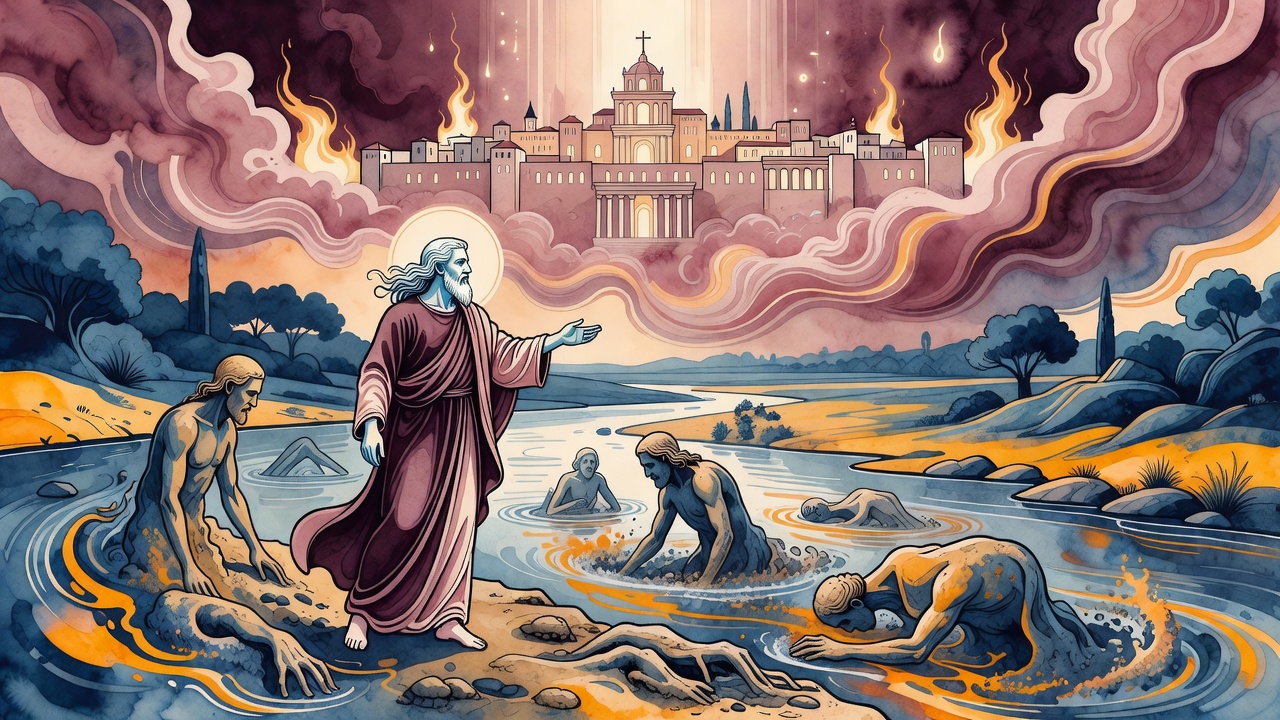
It runs out from the holy place and goes straight for the ground where nothing ever grew. Every field that never yielded, every vineyard that gave back nothing, a man leads these waters across them and they bud and bear. The waters do not stop. They run down toward the Yam ha-Melach (ים המלח), the Salt Sea, that flat bright dead pan of brine where nothing has lived since the beginning, and they pour in, and they heal it. The prophet Ezekiel watched it happen. Every swarming living thing, he said, wherever the river comes, shall live, for these waters come there so that all things may be healed.

Fish fill the healed sea. Every kind of them. And the strangest word of all is spoken over these fish, that they will be as sweet as the manna that fed the wilderness generation, food from heaven now swimming in water that used to be poison. The fish climb the current. They swim upstream, against the whole weight of the pull, all the way up to Jerusalem, and there the fishermen stand along the banks with their nets and haul them in gleaming, and the taste of heaven is caught in an ordinary net in the middle of the city.

The sun overhead burns seven days bright. The sea behind them runs fresh. The dead are walking the healed ground. And not one of them remembers the two days when nothing breathed, because what passed away did not, in the end, pass away.


← All myths
From the tradition

Sources

3 sources

The texts behind this telling. Some cards carry a translation of the source; others are our own retelling of it, and each card says which. Every card links out to the original.

Pirkei DeRabbi Eliezer 51:4Pirkei DeRabbi Eliezer

Retold in our words. Read the original at the link below.Pirke de Rabbi Eliezer, trans. Rabbi Gerald Friedlander, London (1916) · CC-BY

We see them every day, these celestial bodies that seem so constant, so reliable. But what if I told you that, according to ancient Jewish tradition, they’re not quite as static as we think?

Rabbi Jannai, a sage of the Talmudic era, offers a truly fascinating perspective in Pirkei DeRabbi Eliezer, a text filled with aggadic (story-based) expansions of Biblical narratives. He says, "All the hosts of heaven pass away and are renewed every day." Every. Single. Day.

So, what are these "hosts of heaven"? Rabbi Jannai clarifies: the sun, the moon, the stars, and the constellations. And how does this daily renewal happen? Well, buckle up, because

In this tradition, when the sun begins its descent in the west, it doesn't just politely dip below the horizon. Oh no. It plunges into the waters of the Ocean, extinguishing its fiery flames. It's left without light or flame throughout the night, a celestial ember waiting for its moment to reignite.

Then, as it approaches the east, it immerses itself in a "river of fire." It's like a cosmic blacksmith, forging itself anew. Pirkei DeRabbi Eliezer poetically describes it as "like a man who kindles his lamp in the midst of the fire." The sun then rekindles its lamps, puts on its flames, and ascends to give light upon the earth, renewing the work of Creation each and every day. Isn’t that a breathtaking image?

And the moon and stars? They get their own nightly ritual. As evening arrives, they wash themselves in a "river of hail" before ascending to illuminate the night. Talk about a refreshing cleanse!

But the story doesn't end there. It points towards a future, a time of ultimate redemption. The text continues, speaking of a time to come when the Holy One, blessed be He, will renew them and add to their light a sevenfold light. It references the prophet Isaiah (30:26): "Moreover, the light of the moon shall be as the light of the sun, and the light of the sun shall be sevenfold, as the light of seven days."

What day is being referred to? Pirkei DeRabbi Eliezer connects it to "the day of the redemption of Israel," when "the Lord bindeth up the hurt of his people" (Isaiah 30:26). A time of healing, of renewal, of light amplified beyond our current comprehension.

This passage from Pirkei DeRabbi Eliezer isn't just about astronomy or cosmology. It’s about the cyclical nature of existence, the constant process of death and rebirth, darkness and light. It’s about hope. It’s about the promise of a brighter future, a future so radiant that even the celestial bodies will shine with unprecedented brilliance.

Remember the daily renewal, the fiery rivers, the hailstorm baths. And remember the promise of a future where even the stars will shine seven times brighter. What does that say about the potential for light within ourselves?

Full source
Pirkei DeRabbi Eliezer 51:3Pirkei DeRabbi Eliezer

Retold in our words. Read the original at the link below.Pirke de Rabbi Eliezer, trans. Rabbi Gerald Friedlander, London (1916) · CC-BY

Pirkei DeRabbi Eliezer, in chapter 51, paints a dramatic picture. It tells us that all living things will experience a kind of cosmic pause. For two days, "all its inhabitants shall taste the taste of death," a complete standstill where "there will be no soul of man or beast upon the earth." A pretty stark image. The verse cited is "And they that dwell therein shall die in like manner," but the text doesn't specify where this quote comes from.

The text doesn't dwell on the destruction. Instead, it rushes towards renewal. "On the third day He will renew them all and revive the dead, and He will establish it before Him." This resurrection, this restoration, is linked to the verse from (Hosea 6:2): "On the third day he will raise us up, and we shall live before him." The idea of renewal after three days echoes, of course, in other pivotal moments within Jewish tradition, adding a layer of rich symbolism.

Rabbi Eliezer takes this cosmic renewal even further, extending it to the very heavens themselves! He says that "all the host of heaven in the future will pass away and will be renewed." He bases this idea on (Isaiah 34:4): "And all the host of heaven shall be dissolved."

Think about that for a moment. Not just the earth, but the entire celestial realm undergoing a transformation.

Rabbi Eliezer then uses a beautiful metaphor to explain this process. He compares it to the cycle of a vine and a fig tree. In the fall, the leaves fade and fall off, leaving the tree looking dry and lifeless. But then, in the spring, it blossoms again, producing new buds, fresh leaves, and abundant fruit. "Likewise," he says, "in the future will all the host of heaven fade away like a vine and a fig tree, and they will again be renewed before Him."

The key takeaway here is that even what appears to be complete destruction is not truly the end. There's a sense of cyclical time, of death and rebirth on a grand scale. This renewal serves "to make known that there is passing away (which) does not (really) pass away." It's a subtle but powerful distinction. Everything changes, but something essential remains.

And what does this renewed world look like? According to this passage, it's a world free from suffering. "No more shall there be evil, and no more shall there be plague, and (there shall) not be the former misfortunes." This vision aligns with (Isaiah 65:17), which promises, "For, behold, I create new heavens."

This passage from Pirkei DeRabbi Eliezer offers a message of hope amidst apocalyptic imagery. It suggests that even in the face of complete annihilation, there is the promise of renewal, of a world transformed and perfected. It speaks to the enduring Jewish belief in tikkun (spiritual repair) olam, repairing the world, and the possibility of creating a more just and compassionate future, even after – perhaps especially after – unimaginable upheaval.

Full source
Pirkei DeRabbi Eliezer 51:11Pirkei DeRabbi Eliezer

Retold in our words. Read the original at the link below.Pirke de Rabbi Eliezer, trans. Rabbi Gerald Friedlander, London (1916) · CC-BY

Pirkei DeRabbi Eliezer, a fascinating collection of Jewish stories and interpretations, gives us a glimpse of just such a miraculous future.

It speaks of a time when even the most desolate places will be revitalized. Imagine fields and vineyards, once barren and lifeless, now bursting with fruitfulness. What makes this transformation possible? Water. Not just any water, though. These are special waters, imbued with healing power.

The verse reads, "Every field and vineyard which did not yield fruit, people water them with those waters and they yield fruit." The source? The prophet Ezekiel, who declared, "And it shall come to pass, that every living creature which swarmeth, in every place whither the rivers come, shall live… for these waters are come thither, that all things may be healed and live" (Ezek. 47:9).

These waters don't just bring life; they bring healing.

The narrative continues, describing how these restorative waters flow onward, eventually reaching the Yam ha-Melach (ים המלח), the Dead Sea, also known as the Salt Sea. Now, that's a body of water known for its, well, deadness. Nothing lives there. But these waters, according to Pirkei DeRabbi Eliezer, have the power to heal even that. "Then (the waters) enter the Salt Sea and they heal it. And the waters 'shall go towards the sea,… and the waters shall be healed' (Ezek. 47:8)." The power to make the lifeless teem with life.

And it doesn't stop there! The text continues, "And there they generate all kinds (of fish)." Fish! In the Dead Sea!

But the miracle continues. "The Scripture text (here) gives a general rule concerning the fish, that they will be as sweet as Manna." Manna! The miraculous food that sustained the Israelites in the desert. These aren't just any fish; they're imbued with a divine sweetness.

What's even more remarkable is their journey. According to Pirkei DeRabbi Eliezer, these fish actually swim upstream, all the way to Jerusalem! "They ascend in the stream as far as Jerusalem, and there they are caught in its nets, as it is said, 'And it shall come to pass that fishers shall stand by it' (Ezek. 47:10). It is written, 'They shall stand by it.'"

Imagine that scene: fishermen standing by the waters of Jerusalem, casting their nets and hauling in fish that taste like manna. A vision of abundance, healing, and renewal.

So, what does this all mean? Is it a literal prophecy? A metaphor? Perhaps it’s both. Maybe it speaks to the potential for healing and renewal that exists within us and within the world around us. Even the most desolate places, the most seemingly hopeless situations, can be transformed by the power of life-giving waters. Waters of compassion, waters of wisdom, waters of action.

And isn't that a thought worth holding onto?

Full source