A Daughter's Whisper Turned a Greeting Into Four Deaths
He hid in the inner room because his daughter told him to watch. The kiss on her forehead was the same greeting as every other day.
Table of Contents
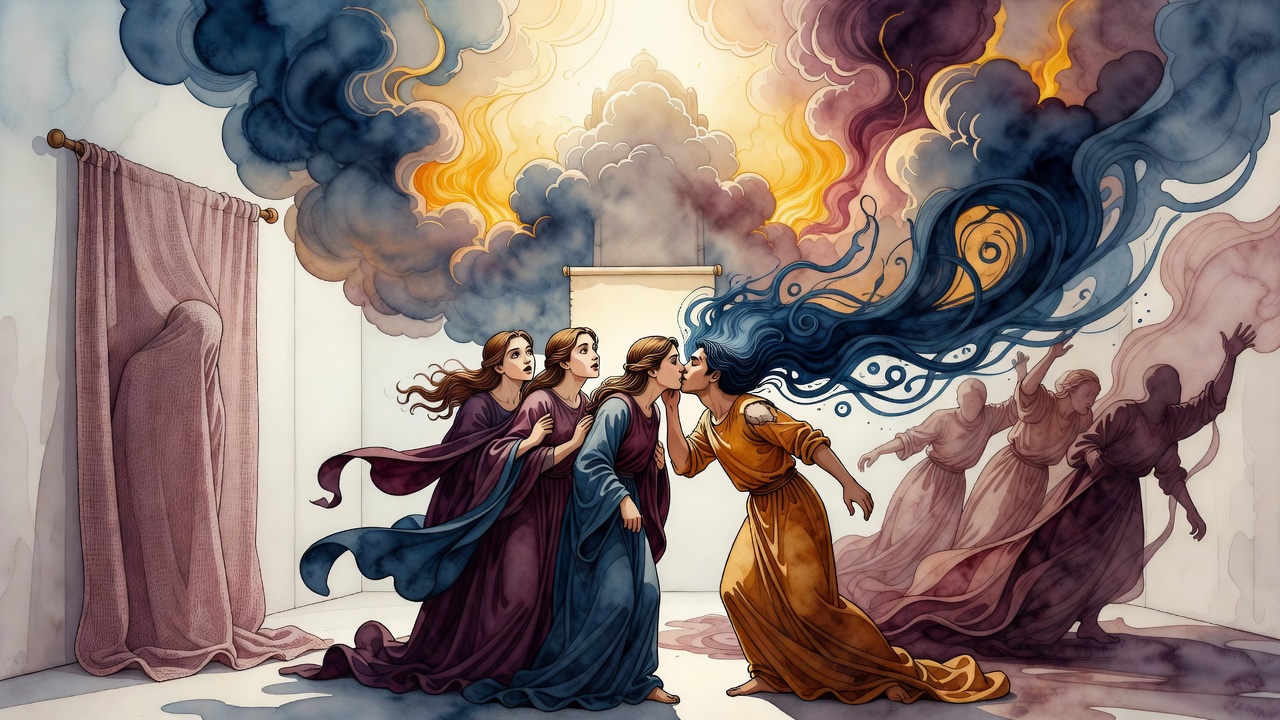
The father-in-law bent to kiss her forehead the way he had every afternoon since the wedding. She had already placed her own father behind the curtain. The room was arranged before the greeting arrived.
 Click for full size
"Be careful," she cried. "My father is here."
The sentence was built like a snare. It made a kiss look like a secret discovered mid-crime. The man behind the curtain did not wait for another witness.
Three Weddings and a Ledger of Faults
A man had three daughters, and the town already knew their names for the wrong reasons. The first could not keep her hand from what was not hers. The second would not rise to the work a household required. The third carried a tongue that cut wherever it landed, soft as a greeting and sharp as a verdict.
Still a neighbor came and asked for all three as brides for his three sons. He knew the ledger of their faults. He believed love, structure, and daily labor could rewrite the page. The weddings were celebrated with music that tried to drown the gossip.
Months later the father came to visit and measure the repair. The first two daughters praised their father-in-law without pause. He had covered for the thief when a missing object appeared. He had covered for the sluggard when chores went undone. He had made their lives soft enough to breathe.
The third daughter leaned close to her father's ear. She whispered that the old man's kindness hid a predator's intention, that his greetings were advances, that the house was a trap dressed as shelter. Her father did not fully believe her. That half-belief was already enough to move his feet.
The Invitation to Hide
"Come into the inner room," she said. "See with your own eyes."
He went. He stood in the dim behind a curtain that smelled of stored wool. He listened to ordinary house sounds: a dipper, a chair, a man humming without words. Nothing in those sounds was a crime. He waited anyway, because his daughter had asked him to become a judge.
The father-in-law entered and offered the usual kiss on the forehead, the greeting that had always passed cleanly between them in daylight. Then her cry cut the air and turned the watcher into a court with no time for questions.
Rage took the watching father before thought could catch him. He killed his son-in-law on the spot. The sons of the household heard the noise, saw the blood, and killed him in return. Four lives ended in an afternoon because one tongue needed an audience more than it needed truth.
Four Bodies Before Night
The first daughter stood in a doorway that now had no father-in-law in it. The second sat down on a stool and did not get up. The third still had the shape of the cry in her mouth. The sons who had answered blood with blood stood over two men who would not stand again: their father, and the guest who had hidden to protect a story.
Lashon hara (לשון הרע), the evil tongue, kills three at once: the speaker, the listener, and the one spoken against. This house climbed higher. A room arranged for theater had added a fourth.
The town that loved a good story had four funerals to attend before the lamps were lit. No one asked the forehead how it had been kissed in every other daylight. The cry had already done the asking, and the asking had been a lie shaped like concern.
The daughter did not lift a knife first. She lifted a story. The knife followed the story the way night follows a closed door.
A Teacher Unrolled Kedoshim
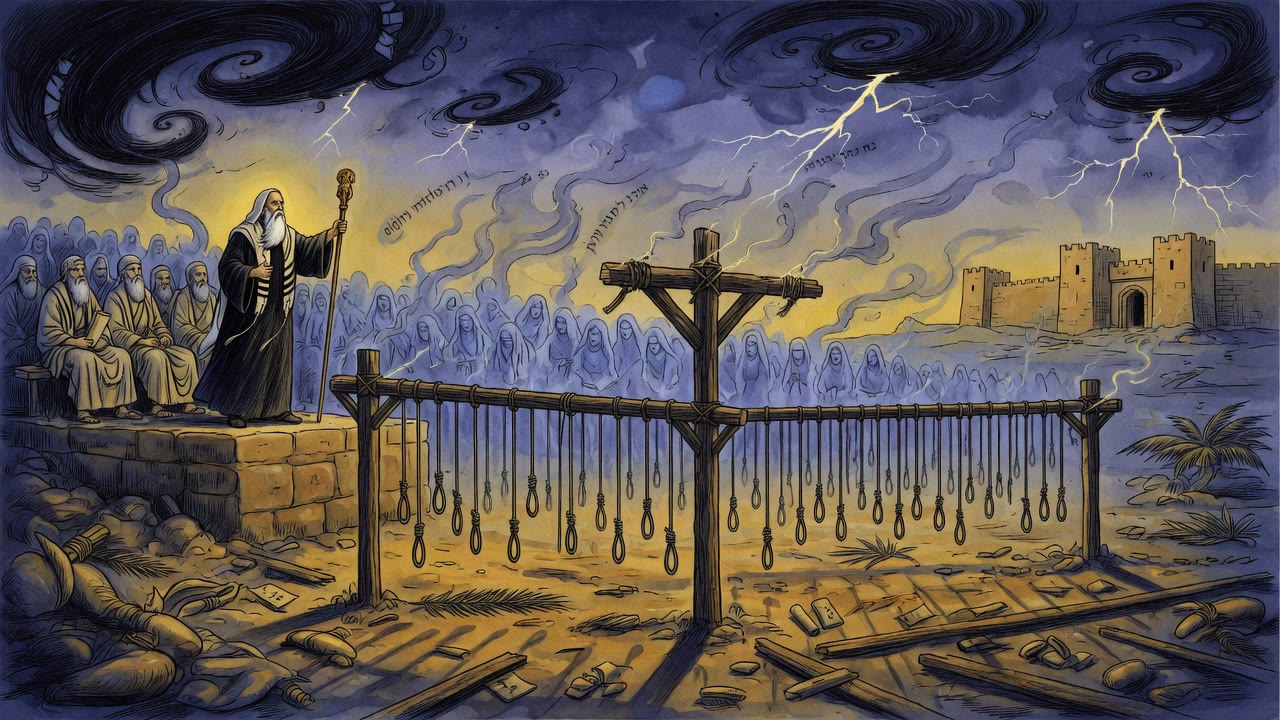
In the days after the burials, a teacher unrolled the portion that opens "You shall be holy" (Leviticus 19:2). The town still smelled of graves. He did not start with altar smoke. He read, "You shall not go about as a talebearer among your people" (Leviticus 19:16), and the room heard a cry from an inner chamber in that quiet line.
"You shall not bear false witness" had been shouted at Sinai (Exodus 20:16). Here the same mouth-law walked the street in work clothes. "You shall not stand upon the blood of your fellow" stood a verse later, as if the Torah already knew a whisper can arrange a corpse.
He did not map every commandment on the wall. He let those two lines sit on a town that had just learned what a greeting can become when a curtain is waiting. Holiness, that week, was the refusal to turn a kiss into a charge before anyone had asked a single careful question.
A student asked whether the father-in-law had been perfect in every habit of the house. The teacher did not answer that. The story had not asked for a perfect old man. It had asked what a tongue can do when it wants a verdict more than it wants truth.
Akiva Built Fences After the Funerals
Rabbi Akiva set fences where people think fences are too small to matter. A fence to honor, he told his students, is the avoidance of jesting that trains the mouth for cruelty. A fence to wisdom is silence when speech would only perform. Come not among scoffers, he said, lest you learn their ways and call the learning entertainment.
The third daughter had no fence. She had an audience, a half-willing father, and a talent for arranging rooms so that ordinary affection looked guilty under partial light. By the time the bodies cooled, every fence Akiva named had already been kicked down.
Walk backward through the afternoon. Remove the cry that framed the kiss. The greeting returns to what it was. The father leaves without a blade. The sons keep their father. The third daughter keeps her husband and loses only the thrill of being believed without proof. That reverse path is the fence Akiva wanted built before the first jest, before the first whisper, before the first arranged room.
Once the tongue has done its work, the law can bury bodies. It cannot unspeak a sentence that was built to murder a face.
← All myths