Twelve Questions Rode from Alexandria to Joshua
Alexandria liked hard questions the way merchants like accurate scales. Each one its scholars sent east rested on two verses pulling opposite ways.
Table of Contents
Alexandria's Jewish community was vast, one of the great diasporas of the first century, a city of docks, books, and arguments that did not end at sundown. Its scholars liked hard questions the way merchants like accurate scales. Once they packed twelve of them for Rabbi Joshua ben Hananiah and sent them east. Four bundles of three: law, narrative, common wisdom, ethics. Every question rested on a contradiction in Scripture, two verses pulling opposite ways like ropes on a single mast. The test was not only to answer. The test was to show how the knot untied without tearing the rope.
 Click for full size
Joshua took them in order. He answered all twelve. The room that sent the questions did not need a weaker Torah. It needed a Torah that could survive argument in a city that spoke Greek in the street and Hebrew in its bones.
Halakhah, Aggadah, and the Ordinary Day
Three questions pressed practical rulings that would change a kitchen, a court, or a doorway. Three pressed stories and the character of God when history refused to be simple. Three pressed the texture of ordinary life, the wisdom that is neither pure law nor pure legend. Three pressed the inner use of character, how a person spends courage and restraint. Apparent contradictions were not failures of the text. They were invitations written into the scroll on purpose.
A sage is someone who hears twelve clashes and feels his welcome extended to the next twelve. The Alexandrians had taken care. They did not send riddles for sport alone. They sent the kind of pressure a city of merchants and philosophers would feel when two verses refuse to shake hands and a household still has to decide what to do by evening.
A King Asks How to Be Free of Grief
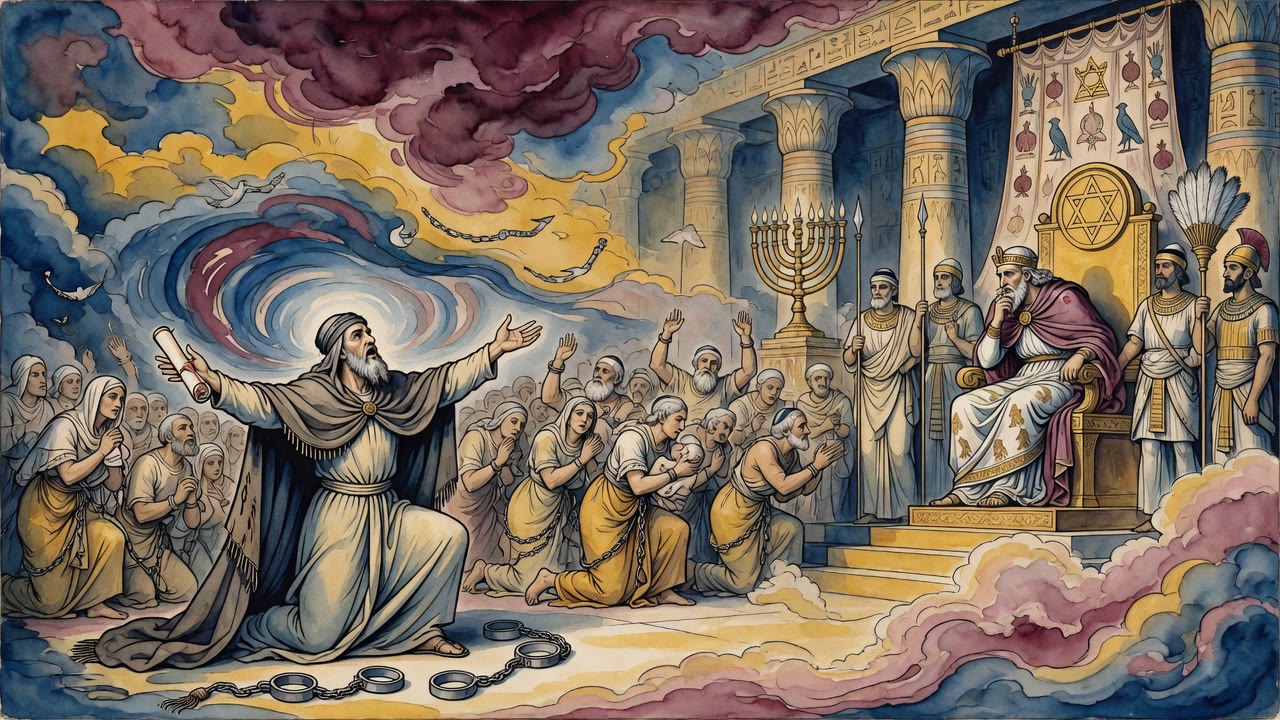
In another Alexandrian stream, a Greek king sits with Jewish elders under the polish of court hospitality and asks how a man can stay free of grief. One answers: never injure anyone, do good to everybody, follow the pathway of righteousness, for its fruits bring freedom from grief. Pray that unexpected evils, death, disease, pain, do not land without warning. Piety, he says, is already a shelter when the heart is trained toward the good. Another elder has just told the king that after failure a man must never again do what caused the fall; he must form friendships and act justly, for the gift of God is to do good actions and not the contrary.
The king is delighted, as kings often are when advice sounds noble and costs nothing yet. Delight is easy in a banquet hall with wine and clever speech. The harder work is the same work Joshua does with contradictions: live so that the next failure does not copy the last, and so that friendship is more than a toast.
Amen to a Stranger's Blessing
Back in the land of midrash, Rabbi Yishmael walks a road and meets a non-Jew who blesses him in the Name. Yishmael says, "The response is already stated." Another non-Jew curses him with heat. He gives the same answer in the same calm. His students stare as if he has lost the difference between honey and ash. How can blessing and curse share a reply? He points to the verse: those who bless you are blessed, and those who curse you are cursed (Numbers 24:9). The system is already running. Heaven does not need Yishmael to invent a new sentence for every mouth that opens on the road.
Elsewhere the sages permit "Amen" when a non-Jew blesses the Name, yet withhold Amen when the blessing of a Jew in God's name is judged empty of force. Rabbi Tanhuma opens a wider door: if a non-Jew blesses you personally, answer Amen, for "you shall be blessed more than all the peoples" (Deuteronomy 7:14). Blessing can arrive from unexpected nations. The ear that can resolve twelve scriptural clashes is the same ear that must decide whether to answer a stranger's good word.
One Diaspora, Three Pressures
Alexandria sends contradictions in a sealed bundle. A court sends moral questions across a table of food. The road sends blessing and curse from foreign mouths that do not know they are testing a rabbi. In each case a Jewish ear must decide whether the world is chaos or ordered speech. Joshua resolves verses without panic. The elders teach the king to stop repeating his own damage and to seek friends who pull him toward justice. Yishmael refuses to be rewritten by every stranger's mood, because the Torah already wrote the outcome of blessing and curse.
The diaspora does not dilute the argument. It multiplies the rooms where the argument must be won: study house, palace, roadside dust. Twelve questions ride from Alexandria to Joshua. A king asks how not to drown in grief. A rabbi answers Amen to the world heaven already governs. The sea between Egypt and the land does not silence any of it.
← All myths