Parshat Miketz6 min read

Two Kings Woke Shaking and Only One Could Remember

Two terrified kings wake in the dark, one with the dream still vivid and one with the vision torn away, and only the bell in Pharaoh's chest can be quieted.

Curated by Arthur · Told by Maggid ·
Table of Contents
  1. The Wise Men Came Up Empty
  2. The Butler Who Forgot
  3. The Prisoner Who Knew the Door
  4. The King Who Lost the Dream Itself

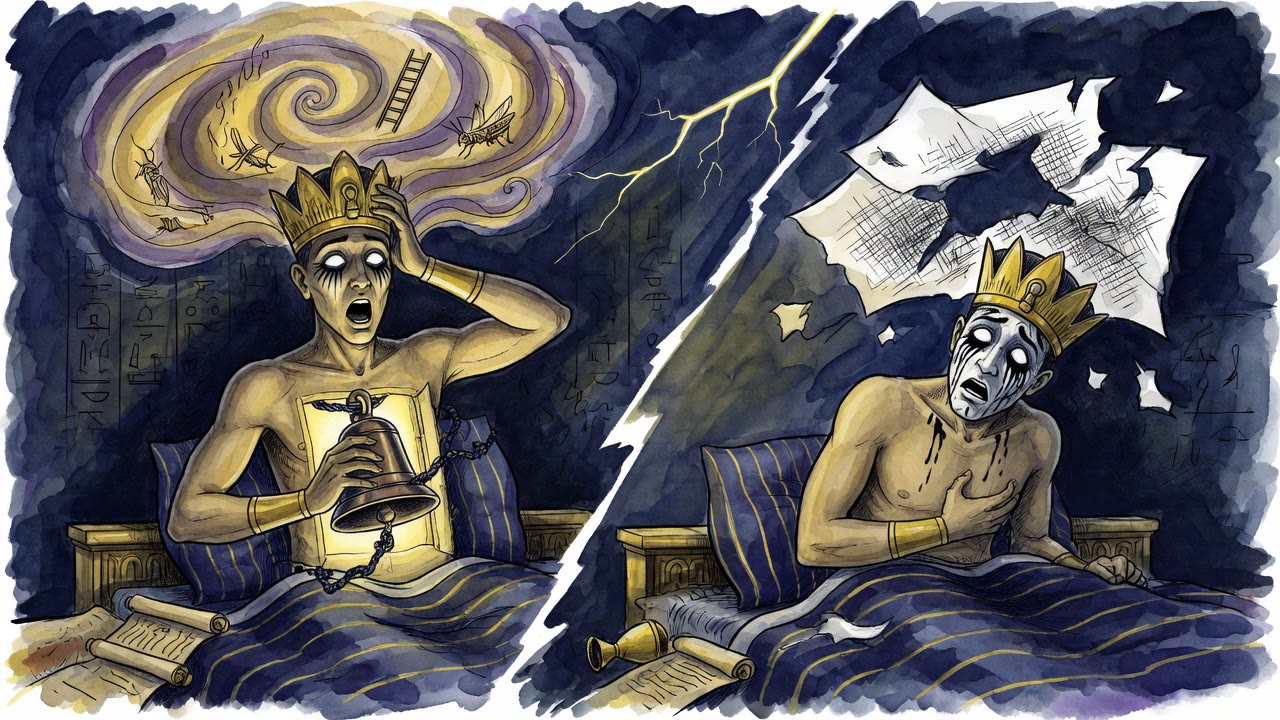
The bell hung in the temple of Memphis, bronze on a leather cord, and when a priest struck it the sound did not stop at the walls. It went on beating after the hand fell away, a long tremor in the metal that nobody could still. Pharaoh woke before dawn with that same beating inside his ribs. Not a heartbeat. Something struck and ringing, a clapper swinging against the inside of his chest, and no priest near enough to seize it and hold it quiet.
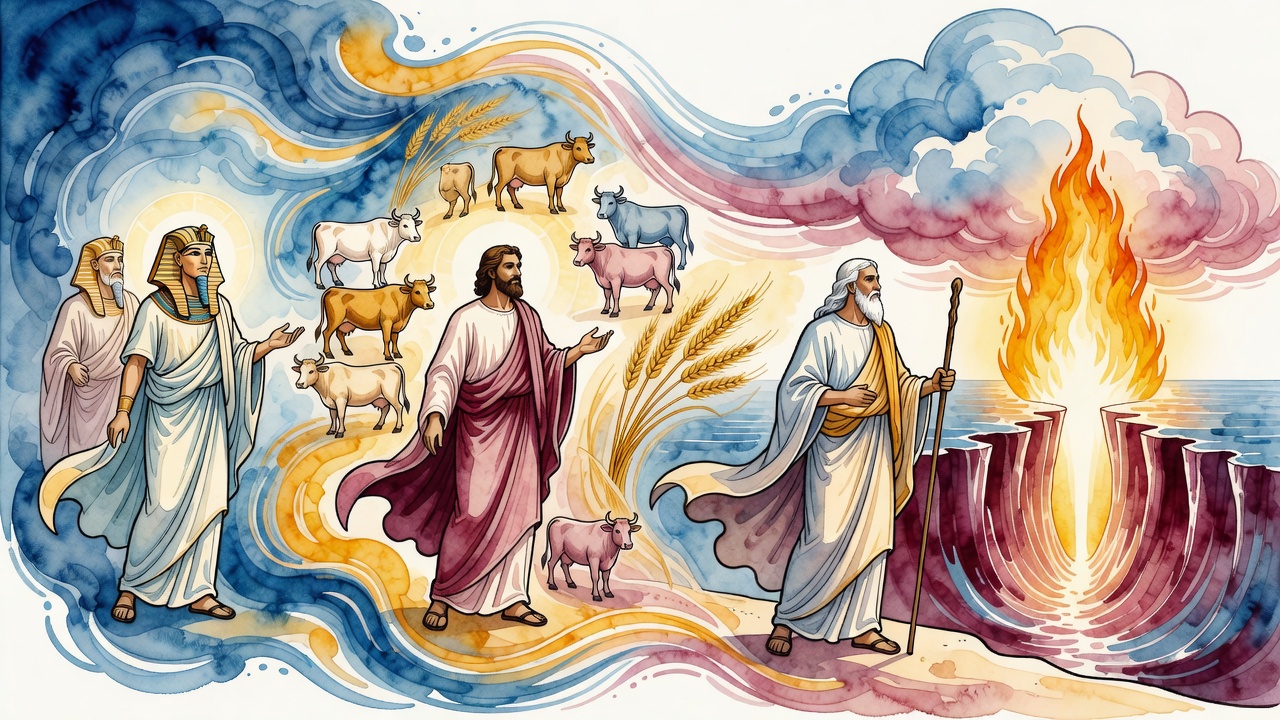
He had seen seven cows fat as river-mud climb the Nile bank, and seven cows behind them with their hides drawn over bone. He had seen the gaunt ones open their mouths and swallow the fat ones whole, and stand afterward as starved as before. Then seven ears of grain on one stalk, heavy and gold, and seven thin ears scorched by the east wind eating them down to nothing. He woke. He slept. He saw it twice. And both times the bell went on ringing.

The Wise Men Came Up Empty

By morning the court of Egypt stood in his chamber, the dream-readers with their scrolls, the magicians with their rods, every man in the kingdom who claimed he could open a sealed vision. Pharaoh told them the cows. He told them the grain. He gave them every image, exact, for he had forgotten nothing.

That was the strange mercy of his terror. The dream sat whole in his mind, lit and complete, a thing he could hand across the room. He lacked only one wall of the house. He had the rooms and not the door. The wise men bent over their scrolls and turned the cows this way and that, and one said the fat cows were seven daughters Pharaoh would father, and another said the thin cows were seven daughters who would die, and a third said nothing at all and stared at his own hands. None of it rang true, and Pharaoh knew it did not ring true, because the bell in his chest kept beating and would not be answered. A man tormented by a single torment. He knew what he had seen. He could not be told what it meant.

The Butler Who Forgot

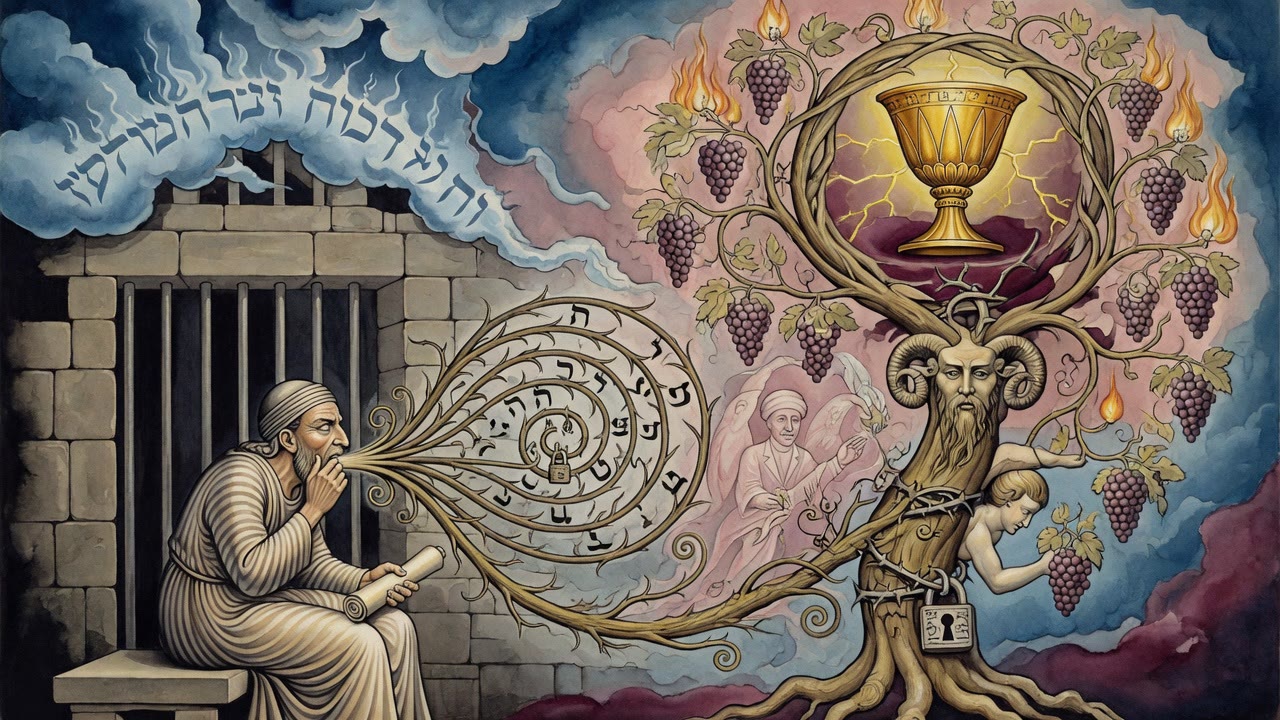
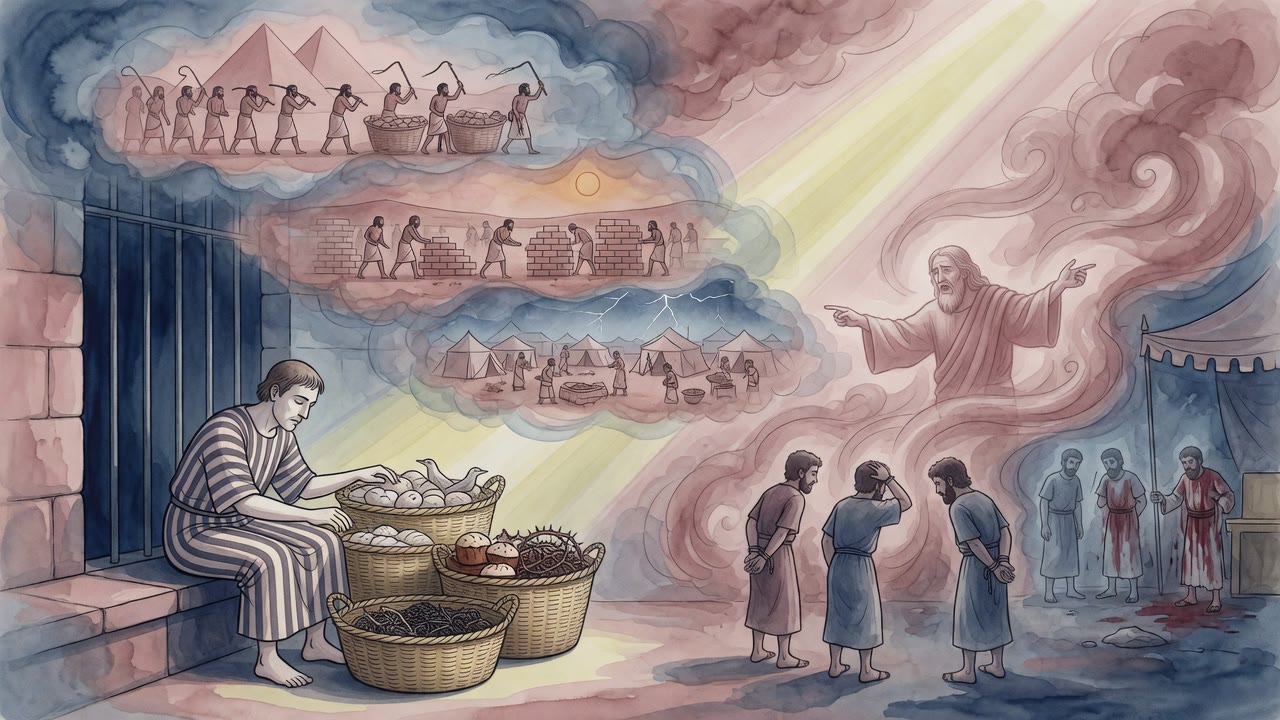
There was a man who could have ended it weeks before. The chief butler had sat in Pharaoh's own prison, and in that prison a young Hebrew had read his dream of the vine and the three branches and told him, "In three days Pharaoh will lift up your head and restore you to your cup." It happened exactly so. The butler walked free with the cup back in his hand.

And he forgot. He stood by Pharaoh's table pouring wine for two full years and never once said the Hebrew's name. The man who had unlocked his dream rotted in the cells below the palace while the butler poured and forgot and poured again. Only now, with the king ringing like struck bronze and every magician in Egypt humiliated, did the memory surface. "I remember my faults this day," the butler said, and named Joseph at last.

The Prisoner Who Knew the Door

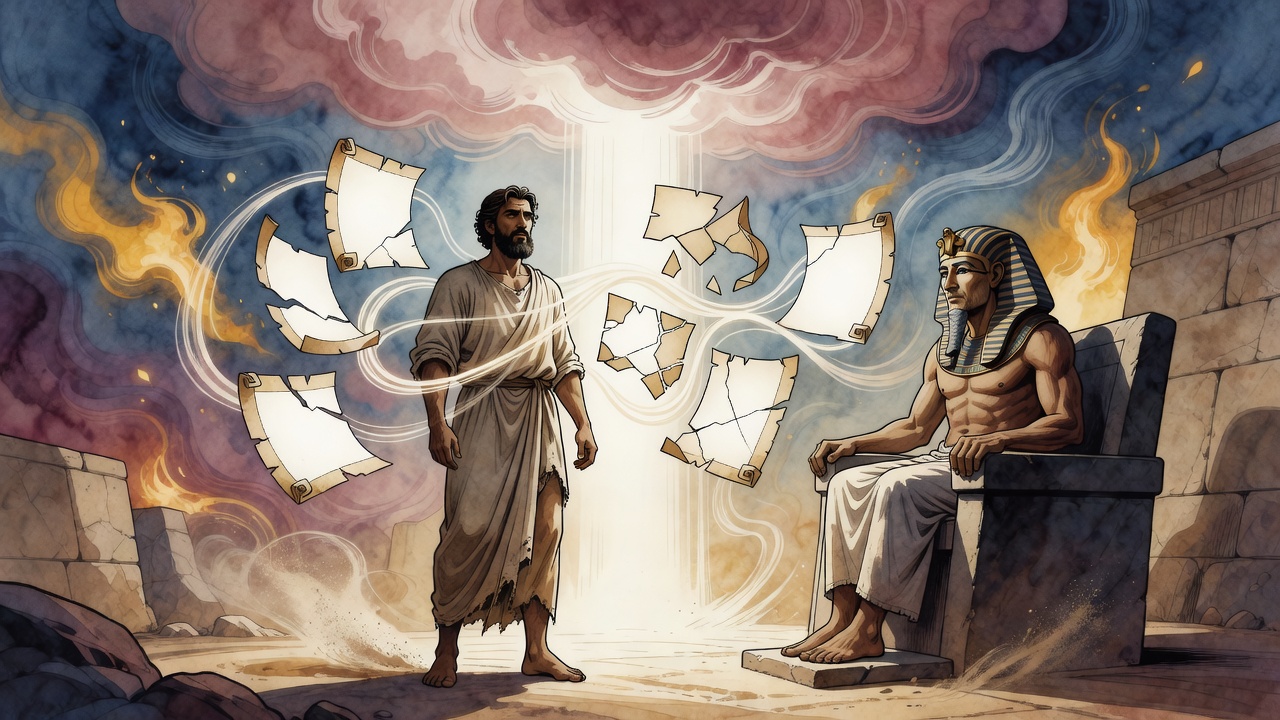
They shaved him, changed his prison clothes, and brought him up out of the ground. Joseph stood before the throne and Pharaoh recounted the cows and the grain, and the bell beat once more, waiting.

Joseph did not turn the cows into daughters. He said the two dreams were one dream, doubled because the thing was certain and would come soon. Seven cows, seven ears, seven years of grain heaped so high the granaries would burst. Then seven lean years to swallow them whole, a famine so total it would eat the memory of plenty the way the gaunt cows ate the fat ones and stayed gaunt. He told Pharaoh to find a wise man, store the surplus, lock the years of abundance against the years of hunger.

The bell stopped. The door had been set into the house. Pharaoh felt the ringing leave his chest the moment the meaning landed, and he looked at the prisoner and saw the only man in Egypt who could quiet bronze.

The King Who Lost the Dream Itself

Far to the east, in a later age, another king woke shaking, and his was a worse waking. Nebuchadnezzar of Babylon sat up in the night and the dream was already gone. Not the meaning. The dream. He reached for it and his hand closed on smoke. He knew only that something vast had stood before him and now there was a hole where it had stood, and the hole terrified him more than any image could.

So his spirit was troubled and his sleep broke off, and the words for him are doubled where Pharaoh's are single, because his loss was doubled. Pharaoh knew the dream and not its meaning, one torment, the door alone missing. Nebuchadnezzar knew neither the dream nor its meaning, two torments, the whole house gone. The sages counted his dreams as plural, dreams, in the night that held only one, because a man who forgets his vision dreams it twice. Once asleep, and once awake, hunting the dark for a thing that has already fled.

When his wise men came, he did not say the cows. He could not say anything. He commanded them to tell him the dream he could not remember and then to interpret it, or be torn limb from limb, and they answered that no king had ever asked such a thing of any man on earth. There was a young exile in Babylon who would be brought up, as Joseph was brought up, to do what no magician could. But Nebuchadnezzar had to be given back even the question before anyone could give him the answer. He had lost the bell and the temple both, and stood in the dark of his own chamber not knowing which way to strike.


← All myths
From the tradition

Sources

7 sources

The texts this telling draws on, in full. Open a card to read inline, or expand it for a wider, quieter read.

Midrash Tanchuma Buber, Miketz 4:1Midrash Tanchuma Buber, Miketz

"And his spirit was troubled" (Genesis 41:8), for it was beating against him like this bell.

Another interpretation of "and his spirit was troubled": Concerning Nebuchadnezzar it is written, "and his spirit was deeply troubled" (Daniel 2:1), while concerning Pharaoh it is written, "and his spirit was troubled." Why? Pharaoh knew the dream but did not know its interpretation; therefore he was distressed with the distress of his spirit. Why? Pharaoh knew the dream but did not know its interpretation; therefore he was distressed with a single distress. But Nebuchadnezzar knew neither the dream nor its interpretation; therefore, two distresses, as it is said, "Nebuchadnezzar dreamed dreams" (Daniel 2:1).

Rabbi Hiyya said: He dreamed one dream. And why does it say "dreams"? Because he forgot the dream. Rabbi Yannai says: He dreamed two dreams, one of a statue and one of a tree.

Full source
Book of Jubilees 40:6Book of Jubilees

The Book of Jubilees, an ancient Jewish text that retells and expands upon stories from the Hebrew Bible, gives us a glimpse into this pivotal moment.

Pharaoh wakes up, shaken. He's seen these powerful images, visions that clearly mean something important. He gathers all the dream interpreters, the wise men and magicians of Egypt. Surely, someone can unlock the secret behind these strange visions! But they all come up empty. Imagine the frustration, the growing anxiety!

Then, a glimmer of hope. The chief butler, who had been imprisoned alongside Joseph (yes, that Joseph, of the coat of many colors!), suddenly remembers the young Hebrew’s uncanny ability to interpret dreams. "Wait a minute," he thinks, "there's this guy..".

Joseph is summoned from the prison, brought before the mighty Pharaoh. Can you imagine the scene? The tension in the air? All eyes on this former prisoner, now tasked with deciphering the king’s mysterious dreams.

Pharaoh recounts his dreams. Joseph listens intently. And then, with unwavering confidence, he declares that the two dreams are, in fact, one and the same. They are two sides of the same coin.

What does it all mean?

Joseph explains to Pharaoh that seven years of incredible abundance are coming to Egypt. The land will overflow with food, more than anyone can imagine. But, and this is a big but, those seven years will be followed by seven years of devastating famine, a famine so severe that it will wipe out all memory of the previous prosperity.

It's a stark warning, a call to action. And it all hinges on Joseph's ability to understand and articulate the message hidden within Pharaoh's dreams. Imagine the weight of that responsibility! A whole nation's fate resting on his shoulders. What would you do in that situation?

Full source
Book of Jubilees 40:1Book of Jubilees

Book of Jubilees turns to Joseph Interprets Dreams in Pharaoh's Dungeon.

Jubilees 40, and its take on the Joseph story. You remember Joseph. Sold into slavery by his brothers, he rises through the ranks in Egypt, interpreting dreams and becoming a powerful figure. But before all that glory, there's a dark period: prison.

That's where our passage begins. The chief butler, freed from prison thanks to Joseph's accurate interpretation of his dream, completely forgets Joseph! The Book of Jubilees puts it bluntly: "But the chief butler forgot Joseph in the prison, although he had informed him what would befall him, and did not remember to inform Pharaoh how Joseph had told him for he forgot."

Ouch. Can you imagine? Joseph, stuck in prison, relying on this one man to speak on his behalf, and… nothing. Silence. Abandonment. It highlights a very human element in these grand narratives: people forget. Promises fade.

Why does Jubilees emphasize this forgetting? Perhaps to underscore the role of divine providence. Even with the butler’s failure, the story isn’t over. God still has a plan for Joseph.

Because what happens next? In the Book of Jubilees, as in Genesis, Pharaoh has those famous dreams about the famine. "And in those days Pharaoh dreamed two dreams in one night concerning a famine which was to be in all the land."

The dreams, of course, are the catalyst. They shake the Egyptian court and ultimately lead to Joseph's release and his rise to power. But think about that moment of forgetting. It's a poignant reminder that even when things seem bleak, when we feel overlooked and abandoned, the story isn't necessarily over. Divine timing, perhaps, is at play.

The Book of Jubilees, in its own way, offers a lesson in patience, resilience, and the enduring power of hope. Even when we're forgotten, our stories might just be taking an unexpected turn.

Full source
Bereshit Rabbah 89:6Bereshit Rabbah

How Egypt's Magicians Failed to Interpret Pharaoh's Dream is the question behind this passage from Bereshit Rabbah.

The passage begins, "He sent and summoned…" referring to Pharaoh gathering his wise men and magicians. Rabbi Yehoshua of Sikhnin, quoting Rabbi Levi, paints a rather unflattering picture of their attempts. Apparently, their interpretations "would not enter his ears." They offered simple, albeit grim, explanations: "The seven good cows [mean that] you will beget seven daughters. The seven bad cows – you will bury seven daughters." Similarly, the stalks of grain foretold either conquering kingdoms or facing rebellions. And utterly useless.

Bereshit Rabbah then quotes (Proverbs 14:6): “A scoffer seeks wisdom, and there is none” – applying it to Pharaoh’s magicians. But the verse continues, “But knowledge is easy for the discerning” – and this, of course, refers to Joseph.

There's more to this than just a contrast between good and bad advice. The text offers another layer, suggesting that every nation in the world gets five wise men to serve it. God provides each nation with three things: Chochmah (wisdom), Binah (understanding), and Gevurah (might). The commentary even cites the wicked Sennacherib, who boasted, "With the power of my hand I have accomplished" (Isaiah 10:13).

However, when judgment comes, these gifts are taken away. The passage quotes (Obadiah 1:8)–9: “I will eliminate the wise from Edom, and understanding from the mountain of Esau…Your mighty will be intimidated, Teiman.”

Now, here's the really interesting question the Rabbis tackle: Why did God orchestrate events so that all these other advisors and magicians had their say before Joseph was even brought in? Why not just have Joseph interpret the dream from the start?

The answer is surprising. It was all about ensuring Joseph received proper recognition. The Holy One, blessed be He, reasoned that if Joseph had been the first to interpret the dream, the magicians could have dismissed his interpretation, claiming they would have come to the same conclusion eventually.

Instead, God waited until they had exhausted themselves, until their spirit, or ruach, was drained. Then, and only then, did Joseph arrive and restore Pharaoh's spirit. In this light, Solomon's words in (Proverbs 29:11) take on new meaning: “The fool vents all his spirit” – that's Pharaoh's wise men. “But the wise man will soothe it, keeping it back” – that’s Joseph, who was recognized as unparalleled in understanding and wisdom (Genesis 41:39).

So what's the takeaway here? Sometimes, the path to the right answer is paved with wrong turns. Sometimes, we need to see the limitations of other perspectives before we can truly appreciate the value of true wisdom. And sometimes, a little bit of divine orchestration is necessary to ensure that the right person, with the right answer, gets the recognition they deserve. It makes you wonder how many "Josephs" are out there, waiting for their moment to shine after the "magicians" have had their say.

Full source
Midrash Tanchuma, Miketz 2Midrash Tanchuma

And, behold, there came up out of the river seven kine … and it came to pass in the morning that his spirit was troubled (Gen. 41:2–8). In this verse the word “troubled” is written vatipa’em, and in the verse relating to Nebuchadnezzar, And Nebuchadnezzar was troubled (Dan. 2:1), it is written vattitpa’em. Pharaoh recalled his dream, but did not know its explanation, and therefore was troubled only once. Nebuchadnezzar, however, forgot the dream and its explanation, and therefore was troubled twice. That is why it is written about Him: Nebuchadnezzar dreamed dreams (ibid.). R. Yannai said: He actually had two dreams; one related to an image and the other to a tree. Then the king commanded to call the magicians, and the astrologers, and the sorcerers (ibid., v. 2). Written without the tav, the magicians are those who inquire of the bones of the dead; the astrologers are those who examine the planetary constellations (for their answer). This is so because the root of the word asafim (astrologers”) means “to compel,” as it is said: Hear this, O ye that would oppress the needy (hashe’afim) (Amos 8:4); and the sorcerers are those who diminish the power of the heavenly and earthly courts.

To tell the king his dreams. So they came and stood before the king. And the king said unto them: “I have dreamed a dream …” Then spoke the Chaldeans to the king in Aramaic: “O king, live forever! Tell thy servants the dream, and we will declare the interpretation” (Dan. 2:2–4). Nebuchadnezzar replied: I am aware that if I should describe my dream to you, you might interpret it inaccurately, and still insist that it is the correct explanation; therefore I say to you: Only tell me the dream, and I shall know that ye can reveal unto me the interpretation thereof (ibid., v. 9).

They answered a second time, saying: “Let the king tell his servants the dream, and we will declare the interpretation” (ibid., v. 7). “I have ordered you,” he replied, “to relate the dream to me, and now you say to me: ‘Tell us.’ Do you believe that you are going to be permitted to chatter the time away until the noon hour and then depart unscathed? If ye make not known unto me the dream, there is but one law for you; and ye have agreed together to speak before me lying and corrupt words, till the time be changed; only tell me the dream, and I shall know that you can declare unto me the interpretation thereof.” The Chaldeans answered before the king, and said: “There is not a man upon the earth that can declare the king’s matter; forasmuch as no great and powerful king hath asked such a thing of any magician, or enchanter, or Chaldean. And it is a hard thing that the king asketh, and there is none other that can declare it (ibid., vv. 9–11). This verse indicates that the gift of prophecy is required for the interpretation of dreams, since the word hard (yakirah) is an expression that is employed with reference to prophecy, as it is said: And the word of the Lord was hard (yakar) in those days: there was no frequent vision (I Sam. 3:1).

And there is none other (aharan) (Dan. 2:11). It should have been written “there is no Aaron” (aharon). While the Temple stood, a man could go to one of Aaron’s descendants to consult the Urim and Thummin for answers to their questions, but now there is no Temple and no Urim and Thummin to consult.

Nebuchadnezzar retorted: “Obviously, the Temple must have been an extraordinary edifice, yet you advised me to destroy it.” He became infuriated with them and declared: “Let all the wise men of Babylon be eliminated.” So the decree went forth, and the wise men were to be slain; and they sought Daniel and his companions to be slain (ibid., v. 13). Daniel said to Arioch: “Wherefore is the decree so peremptory from the king?” Then Arioch made the thing known to Daniel (ibid., v. 16). Then Arioch immediately brought Daniel before the king and said unto him: I have found a man of the children of the captivity of Judah that will make known unto the king the interpretation (ibid., v. 25). The king asked: “Are you Daniel?” He did not say this because he failed to recognize him, but in order to inquire of him: Are you able to tell me the dream and its interpretation? (ibid., v. 26). Daniel answered: “Yes.” “When will you do so?” the king asked. And Daniel replied: “I ask not for thirty or twenty days, allow me only this night and morning, and then I will reveal the dream to you.”

Then Daniel went to his house, and made the thing known to Hananiah, Mishael, and Azariah, his companions (ibid., v. 17). Why? So that they might pray with him, as it is said: That they might ask mercy of the God of heaven concerning this secret; that Daniel and his companions should not perish with the rest of the wise men of Babylon. Then was the secret revealed unto Daniel in a vision if the night. Then Daniel blessed the God of heaven (ibid., vv. 18–19). The Holy One, blessed be He, declared: “Prophecy is restricted in this world to certain chosen ones, but in the world-to-come the gift of prophecy will be possessed by all men,” as is said: And it shall come to pass afterward, that I will pour out My spirit upon all flesh; and your sons and daughters shall prophesy; your old men shall dream dreams; your young men shall see visions (Joel 3:1).

Full source
Midrash Tanchuma, Miketz 3Midrash Tanchuma

And, behold, there came up out of the river seven kine (Gen. 41:2) After he (Pharaoh) had his dream, he summoned all his magicians. Whereupon the Holy Spirit called out: Where are they, then, thy wise men? (Isa. 19:12). Since they were unable to interpret the dream, the cup-bearer came forward and said: I make mention of my faults this day … And there was with us there a young man, a Hebrew, servant to the captain (Gen. 41:9–12). Accursed are the wicked, for even the good they do is accompanied by evil. For he said a young man, as though describing a callow youth without understanding; a Hebrew, as if to suggest that he was different from them; and a slave, an expression of contempt. It is written in Pharaoh”s constitution that a slave was not permitted to rule over them.

When Pharaoh heard this: Pharaoh sent and called Joseph (ibid. v. 13). R. Joshua the son of Levi said: Out of adversity comes tranquility; out of darkness, light; and out of the degradation of the righteous, their exaltation. Hence Scripture states: If thou hast done foolishly in lifting up thyself, or if thou hast planned devices, lay thy hand upon thy mouth (Prov. 30:2).

Hananiah, Mishael, and Azariah were ultimately exalted as a consequence of their humiliation: Then these men were bound in their cloaks, their tunics, and their robes, and their other garments, and were cast into the midst of the burning fiery furnace (Dan. 3:21), but later they were exalted, as is said: Then the king promoted Shadrach, Meshach, and Abed-nego, in the province of Babylon (ibid. v. 30). Daniel was hurled into the den of lions, and then was exalted: So this Daniel prospered in the reign of Cyrus the Persian (ibid. 6:29). It is written concerning Mordecai: And he put on sackcloth and ashes (Est. 4:1), but later Mordecai went forth from the presence of the king in royal apparel (ibid. 8:5). About Joseph it is said: His feet they hurt with fetters, his person was laid in iron (Ps. 105:18), but he too was exalted; and Joseph became ruler over the land.

Pharaoh said unto Joseph: I have dreamed a dream, etc. Joseph replied: “God will give Pharaoh an answer” (Gen. 41:15–16). Because He ascribed greatness to Him who possessed greatness, the Holy One, blessed be He, said to him: Since you did not seek to exalt yourself, be assured you will be elevated to greatness and leadership by Me.

And Pharaoh said unto Joseph: “I have dreamed a dream (ibid.). As he was about to relate the dream to him, he decided to test Joseph by altering the dream slightly. He said: “Seven kine went up out of the Nile, fat and well-formed,” whereupon Joseph replied: “That is not so, you saw fat and healthy kine.” “And there were,” he said to him, “seven lean and ill-favored kine.” And Joseph replied: “You did not see this but rather ugly-appearing and thin-fleshed kine.” “And there were seven full and good ears of corn,” he continued. Whereupon Joseph answered: “That too is not so, you saw fat and good ones.” “There were seven shrunken ears of corn,” he added. And Joseph responded: “That is not so, you beheld seven ears of corn, withered thin and blistered by the east wind.” Pharaoh began to wonder about this. He said to him: “You must have been behind me when I had my dream,” as it is said: For inasmuch as God hath shown thee all this, there is none so discreet and wise as thou (ibid. v. 39).

He was the one his father had blessed with the words: Joseph is a fruitful vine (ibid. 49:22). You should not read this as porat (“a fruitful vine”), but as parot (“kine”). Thereupon Pharaoh told him: Thou shalt be over my house (ibid. 41:40).

Our sages interpreted the verse Instead of thy fathers shall be thy sons (Ps. 45:17) to mean that everything that occurred to Jacob likewise happened to Joseph. Jacob was born circumcised, and so too was Joseph, as is said: These are the generations of Jacob, Joseph (Gen. 37:2). The former was called The son of my firstborn, Israel (Exod. 4:22), and the latter was spoken of as the firstborn was Joseph’s (I Chron. 5:2). The former was exiled to Haran, and the latter to Egypt. Jacob was exalted through a dream, as it is said: And He dreamed, and behold, a ladder set upon the earth (Gen. 38:22). Joseph interpreted Pharaoh’s dream. R. Simeon the son of Gamliel said: Joseph was rewarded for his actions, for his mouth did not kiss in sin. Thus, according to thy mouth shall all my people be ruled (ibid. 41:40).

Full source
Legends of the Jews 1:160Legends of the Jews

That’s kind of where we find Mirod, Pharaoh’s chief butler, in this story from Legends of the Jews (Ginzberg).

Pharaoh, is in a right state. He's had these terrifying dreams (we'll get to those, I promise!), and nobody can figure out what they mean. He’s so distraught, Mirod fears the king might actually… well, die of frustration. And a dead Pharaoh? Not exactly job security for the chief butler. Who knows if the new king would keep him around?

So, Mirod gets a bright idea – or rather, remembers a past one. He steps forward, perhaps a little nervously, and addresses the king. "I do remember two faults of mine this day," he begins, as we read in Legends of the Jews. "I showed myself ungrateful to Joseph…"

Ah, yes, Joseph. Remember him? The young Hebrew slave, skilled in dream interpretation? Mirod admits he basically forgot to mention Joseph's abilities to Pharaoh before. Major oversight.

And then comes the second fault: seeing the king in distress over the dream, and still keeping mum about Joseph! Mirod is really laying it on thick.

He continues, spinning a tale of how, when he and the chief baker were imprisoned, this "simple young man, one of the despised race of the Hebrews," correctly interpreted their dreams. Ginzberg bases this part of the narrative on the original biblical account (Genesis 41:9-13). "It came to pass, as he interpreted to us, so it was." Pretty convincing. Mirod, in his slightly belated attempt to save the day (and his own neck), pleads with Pharaoh. "O king, stay the hand of the hangmen, let them not execute the Egyptians." (Pharaoh was apparently considering drastic measures to solve his dream problem). He assures the king that Joseph is still in the dungeon.

And then comes the big pitch: "If the king will consent to summon him hither, he will surely interpret thy dreams."

Think about the risk Mirod is taking here. He’s admitting to past failures, vouching for a slave, and promising results. It's a gamble, for sure. But sometimes, a little bit of honesty – even if self-serving – can be the key to unlocking a whole new chapter. The fate of Egypt, and, Joseph's destiny, hangs in the balance. What do you think Pharaoh will do?

Full source