6 min read

God Spoke to Aaron Alone After His Two Sons Died

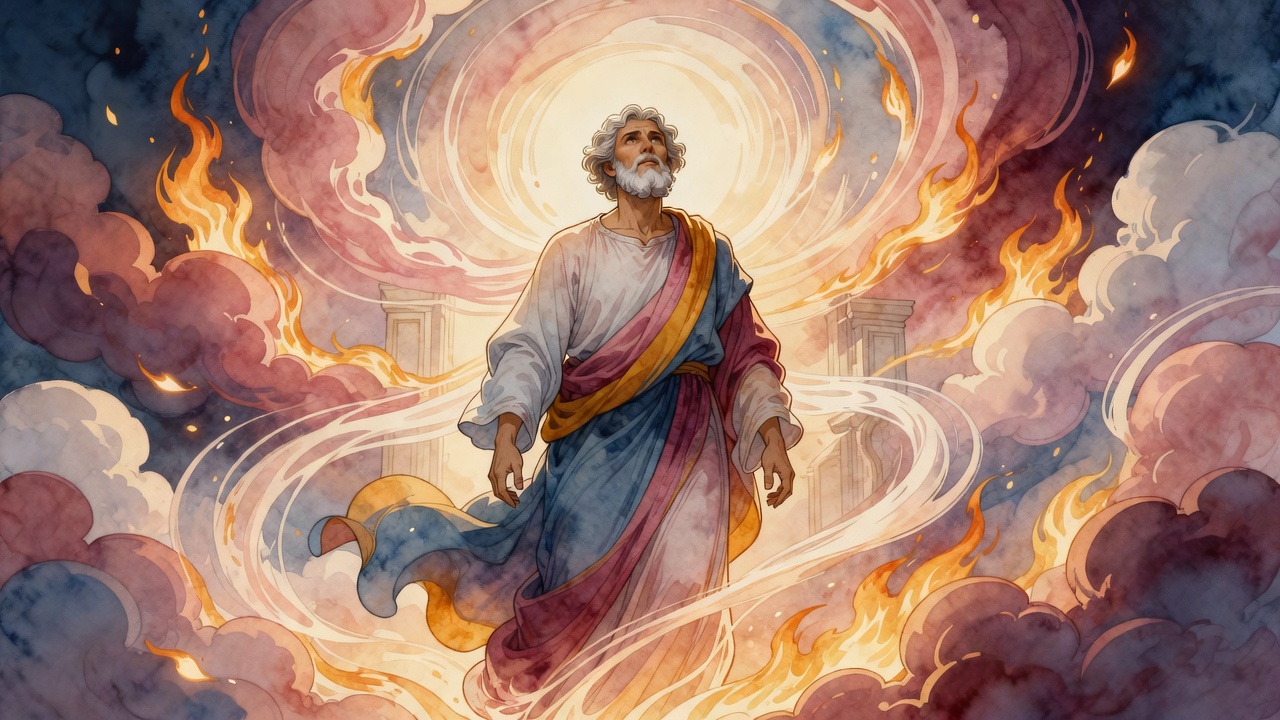
Aaron tore nothing and said nothing. His cousins carried his sons out of the camp by their tunics while he stood in the linen and kept still.

Curated by Arthur · Told by Maggid ·
Table of Contents
  1. Fire Came Out and the Camp Went Quiet
  2. Forbidden to Mourn
  3. The Cook Who Could Not Look at a Corpse
  4. The Voice That Did Not Go Through Moses
  5. He Answered His Brother and Won
God Spoke to Aaron Alone After His Two Sons Died Click for full size

Fire Came Out and the Camp Went Quiet

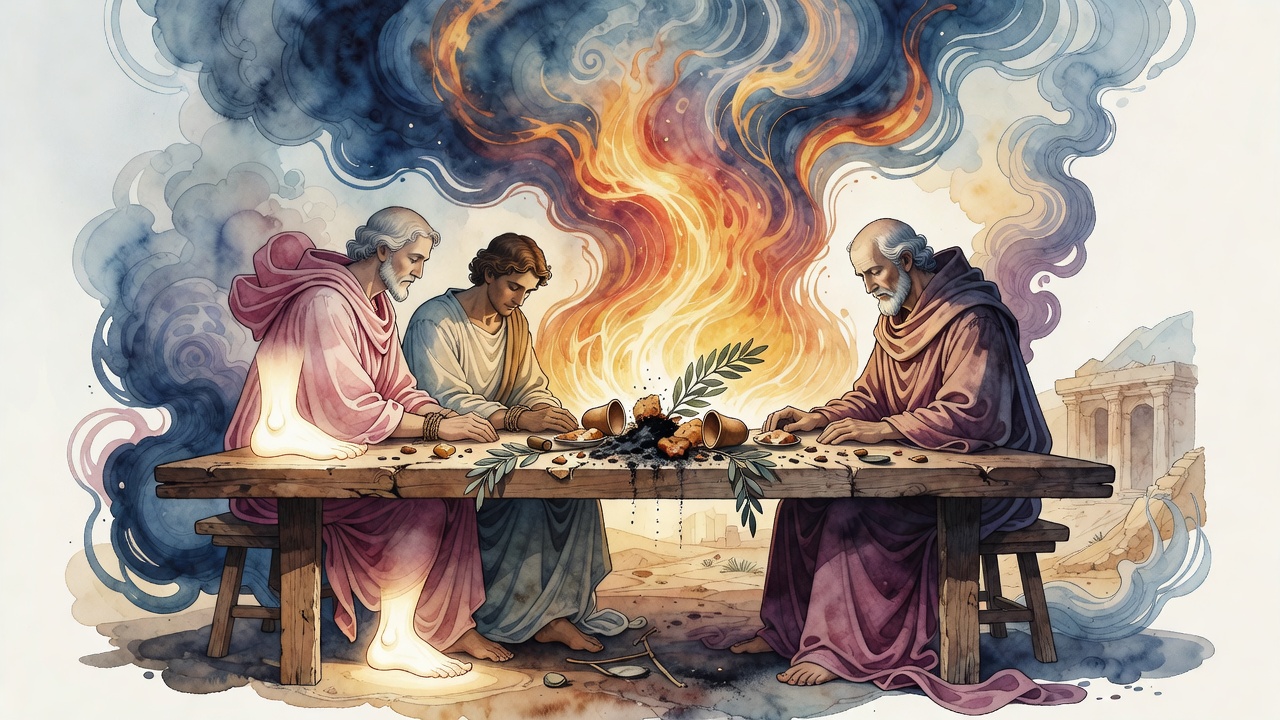
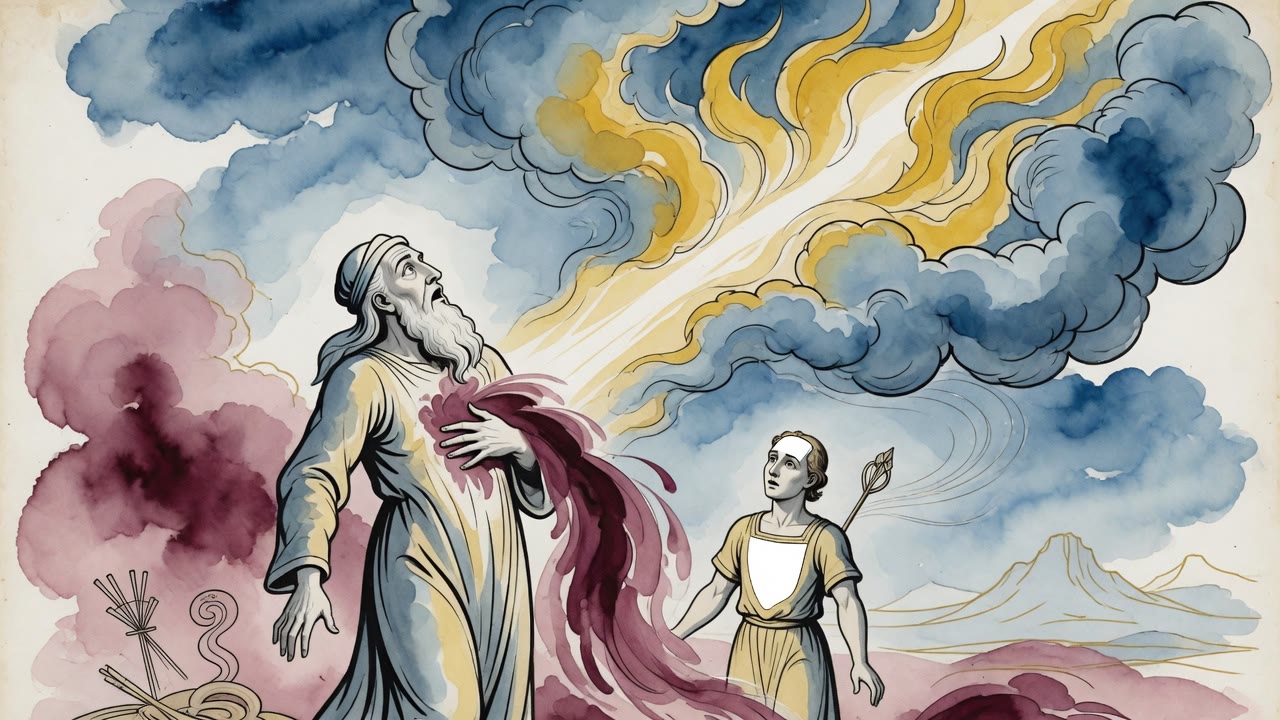
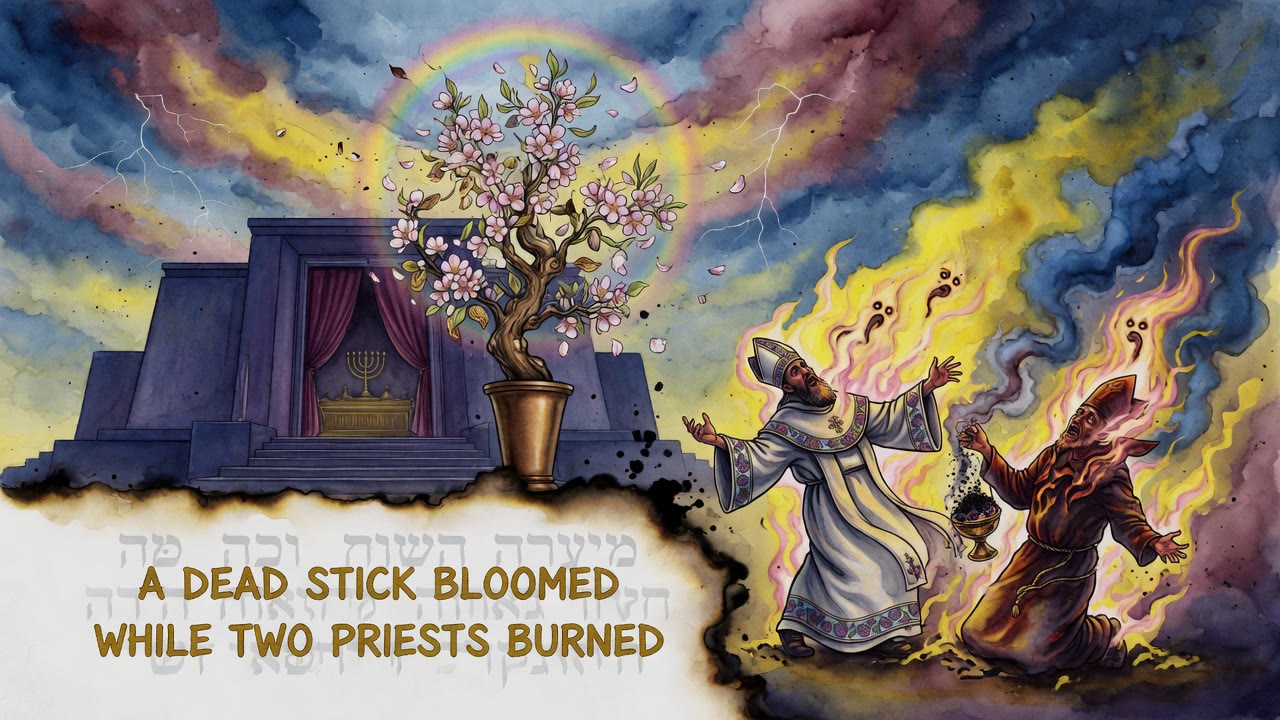
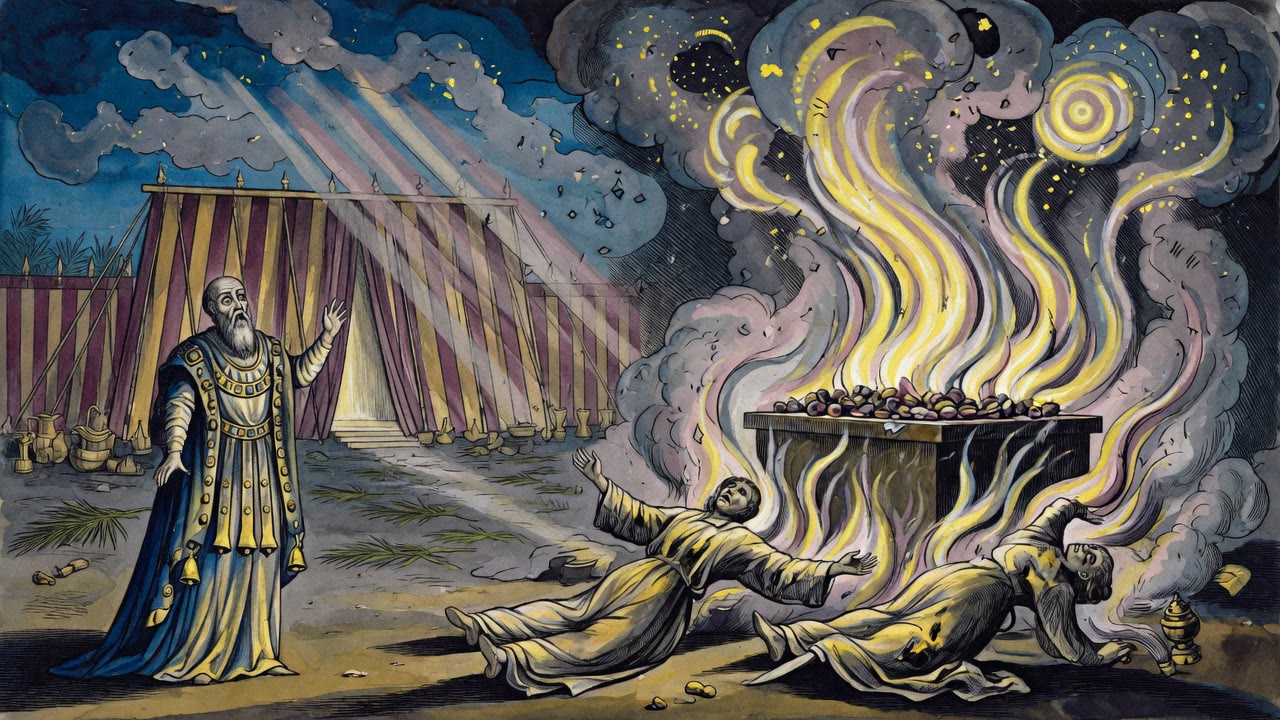
Two of Aaron's sons put coals in their censers, laid incense on top, and carried a fire in front of the Lord that nobody had asked them for. Fire came back out and ate them where they stood. Nadav and Avihu died at the door of the Tent on the eighth day, the day the service opened.

Moses turned to his brother and said this was the meaning of being sanctified in those who come near. Aaron held his peace.

Then Moses called in Mishael and Elzaphan, cousins of the dead men, and told them to carry their kinsmen out of the camp. The two came in, took hold of the tunics, and carried the bodies past the altar and out through the tents. Aaron watched them go and did not follow.

Forbidden to Mourn

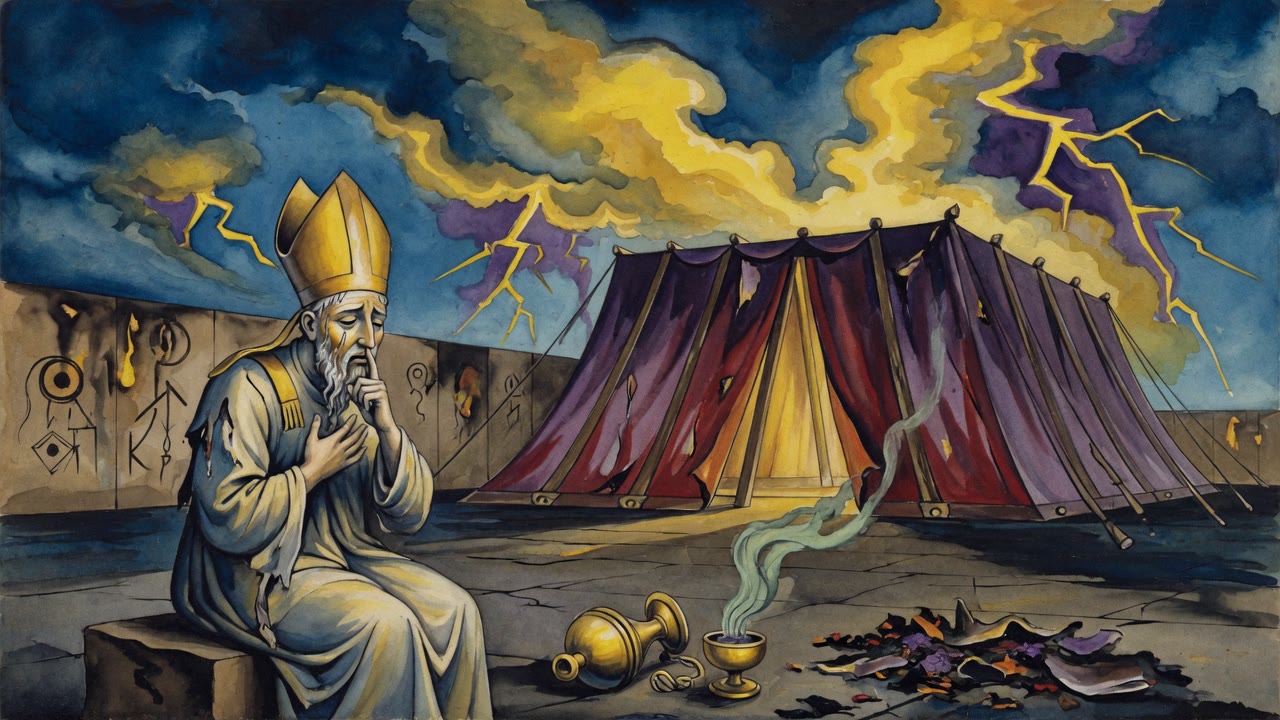
The order reached him while the smell was still in the air. Do not let the hair of your head go loose. Do not tear your clothes. Do not go out from the door of the Tent, or you will die too and the anger will fall on the whole congregation. Let your brothers, the whole house of Israel, weep for the burning. You stay dressed.

So the camp wailed and the father did not.

He stood in the linen breeches that run from the loins to the thighs, tied with cords, cut like a rider's trousers, made with no opening of any kind. Nobody in Israel would ever see that garment. He stood in the tunic under the sash, and the sash was tied where it is always tied, not below the loins and not above the elbows but level with them, at the place on a man where the sweat comes. The turban sat on his head and his hair showed in the gap between the turban and the gold plate.

The garments were the priesthood. A priest who takes the blood of an offering while one of them is missing has not made an error of dress. The offering is dead and he is standing outside his own office. Two tunics disqualify. A doubled sash disqualifies. So does a bandage under the cloth, a patch, a dead louse, a film of dirt, a loose thread lying where the linen is supposed to touch skin.

Aaron ran his hand down the cords at his thighs and went back to the altar. It was still the same day.

The Cook Who Could Not Look at a Corpse

A king kept a cook who went in and out of the palace all day and looked at the king's own face. One morning the king stopped him in the doorway.

"I decree upon you that you will not look at a dead body as long as you live. You come in here. You see me. You will not carry death into my house."

That is why the command to the priests arrives doubled, said and then said again, for a thing that should have needed saying once. They cross the threshold. They stand in front of the Presence. A man who looks at the King does not bring a corpse in on his clothes.

For Aaron the rule had faces on it. He was the one who could not go near his own dead, and as high priest he could not have gone near them for a father or a mother either. Mishael and Elzaphan had done for Nadav and Avihu the one thing their father was forbidden to do, and the cords at his thighs were the reason.

The Voice That Did Not Go Through Moses

Everything Aaron had ever been told came through his brother. God said to Moses, and Moses said to Aaron. That had been the arrangement since the burning bush.

Then, with two sons dead and the altar still working, a sentence started somewhere else. The Lord spoke to Aaron. Not to Moses about Aaron. To him.

Drink no wine and no strong drink, you and your sons with you, when you come into the Tent of Meeting, and you will not die. Separate the holy from the common and the unclean from the clean. Teach the children of Israel every statute.

A warning and a commission in the same breath, and underneath both of them the plain fact that heaven had used his name without sending it through anyone first.

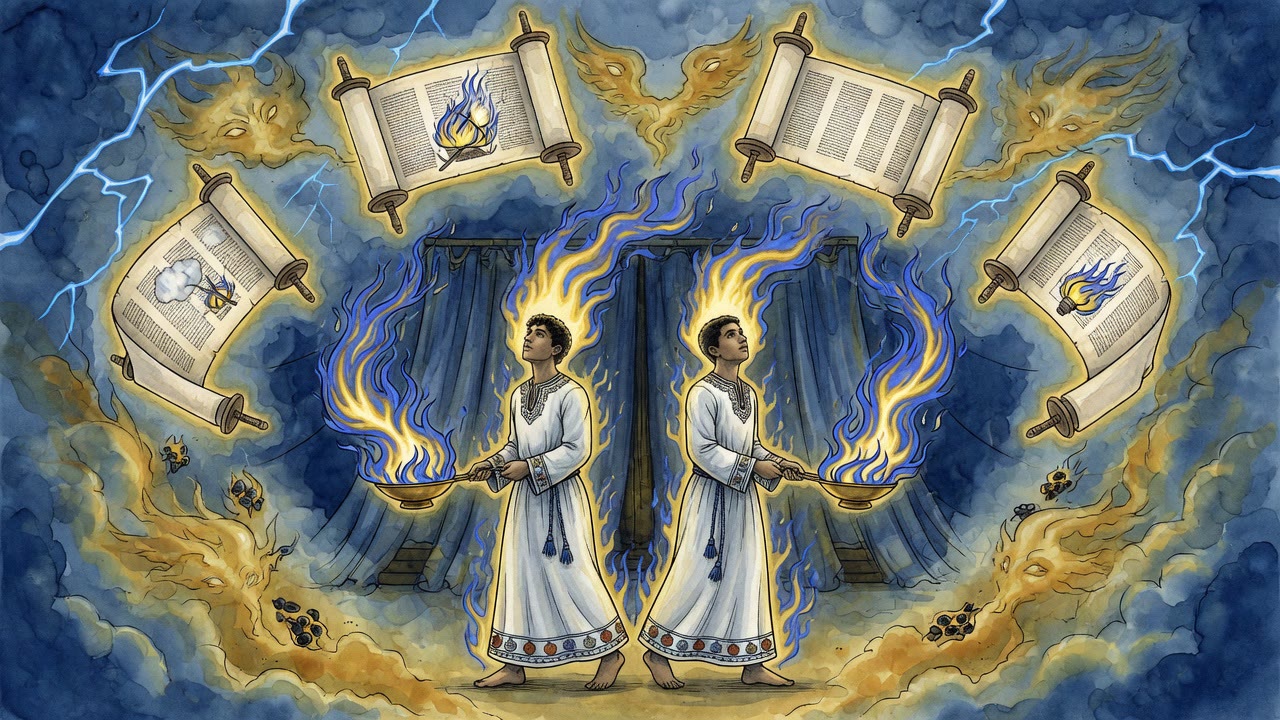
Words of Torah are a crown for the head and a chain for the neck. They are a remedy for the heart, a salve for the eyes, a cup of root potion for the gut, healing for the whole body of a man. The heart that had been under a stone since the eighth day came up. Aaron was glad, and it showed, and the camp saw the high priest glad on the day he buried nobody.

He Answered His Brother and Won

Later that same day Moses went looking for the goat of the sin offering and found it burned instead of eaten. He rounded on the two sons Aaron had left and demanded to know why they had not eaten it in the holy place.

Aaron answered him. It was the only time he did.

"Today they brought their sin offering and their burnt offering in front of the Lord, and things like this have happened to me. If I had eaten the sin offering today, would that have been good in the eyes of the Lord?"

Moses heard it, and it was good in his eyes, and he let it go.

The father who had not been allowed to tear his clothes had found the one thing he was permitted to say. He said it to the brother who had carried every word to him for a year, and the brother backed down.


← All myths
From the tradition

Sources

3 sources

The texts behind this telling. Some cards carry a translation of the source; others are our own retelling of it, and each card says which. Every card links out to the original.

Vayikra Rabbah 12:3Vayikra Rabbah

Retold in our words. Read the original at the link below.The Sefaria Midrash Rabbah, 2022 · CC-BY

Not just Torah as in, "read the text." More like, experience the Torah. The passage begins with a verse from Psalms (19:9): "The precepts of the Lord are upright, gladdening the heart.” But what does that mean, really?

Rabbi Ḥizkiya offers a beautiful, almost poetic interpretation. He says that the words of Torah become a crown for the head, a necklace for the neck, a remedy for the heart, a salve for the eyes, and even a cup of root potion for the intestines! Sounds like a complete wellness package. a bit. Where does he get these images? Well, he backs them up with scripture, of course.

A crown for the head? That comes from Proverbs (1:9): “For they will be a graceful adornment for your head.” And a necklace for the neck? Also Proverbs (1:9): “And necklaces for your neck.” See how the Torah itself illustrates and reinforces its own power?

“A remedy for the heart” goes back to our original verse: “The precepts of the Lord are upright, gladdening the heart.” And for the “salve for the eyes,” we have (Psalms 19:9) again: “The commandments of the Lord are clear, enlightening the eyes.” It's all interconnected, weaving together to paint a picture of Torah as something that revitalizes us from head to toe.

And that "cup of root potion for the intestines? It comes from (Proverbs 3:8): “It will be healing for your navel.” Taken literally, it sounds like a cure for a stomach ache. But maybe it hints at something deeper. Perhaps the Torah can soothe even our deepest, most hidden pains.

But it doesn't stop there. The passage connects this idea to the 248 limbs of the human body, drawing from (Proverbs 4:22): “For they are life for those who find them [and healing for all one's flesh].” The Torah, then, isn't just a mental or emotional exercise; it's something that can bring life and healing to our very physical being.

Then, the text shifts focus to Aaron, the High Priest. Remember what happened to his sons? It was a devastating loss, a source of profound sadness. And yet, when God spoke directly to him, Aaron found joy. Where do we see that? Well, the text points us to the simple phrase: "The Lord spoke with Aaron." This suggests that even in the face of unimaginable grief, connection with the Divine – through Torah, through divine speech – can bring solace and even joy.

So, what does this all mean for us today? It's an invitation, I think, to engage with Torah not just as a set of rules or stories, but as a source of profound healing and joy. It’s a call to see the words of the Torah as something that can adorn us, heal us, and connect us to something bigger than ourselves. It’s a reminder that even in the midst of sadness and difficulty, there is always the possibility of finding light and joy through connection with the Divine. And isn't that something worth striving for?

Full source
Yalkut Shimoni on Torah 384:1Yalkut Shimoni on Torah

Translation of the source text.Torat Emet (Yalkut Shimoni) · CC-BY-NC

"And make for them linen breeches" (Exodus 28:42). It was taught: to what are the priests' breeches comparable? To a kind of horsemen's riding trousers: above, up to the loins; below, down to the thighs; and they have cords. They have neither an opening for excretion nor an opening for nakedness. "And they shall be upon Aaron and upon his sons" (Exodus 29:1-9): any offering whose blood was received by a priest lacking his garments is invalid. From where do we know this? As it is written, "And you shall gird them with sashes, Aaron and his sons" (Exodus 29:9): when their garments are upon them, their priesthood is upon them. But is this derived from here? It is derived from there, as it was taught: from where do we know that one who served after drinking wine profaned the service? Scripture therefore teaches, "Drink no wine nor strong drink... that you may distinguish between the holy and the common" (Leviticus 10:9-10). From where do we know one lacking garments, or one who has not washed hands and feet? Scripture says "statute" and "statute" as a verbal analogy. If from there alone, I would have said this applies only to a service for which a non-priest is liable to death, but not to a service for which a non-priest is not liable to death; therefore it teaches us. And still, is it derived from here? It is derived from there: "And the sons of Aaron the priest shall put fire" (Leviticus 1:7), meaning a priest in his priesthood, so a High Priest who wore the garments of an ordinary priest and served has invalid service. If from there alone, I would have said this applies only to a service that blocks atonement, but not to a service that does not block atonement. And still, it is derived from there: "And the sons of Aaron the priests shall arrange the pieces" (Leviticus 1:8), meaning priests in their priesthood, so an ordinary priest who wore the garments of a High Priest and served has invalid service. If from there alone, I would have said this applies to lacking a garment, but not to adding an extra one; therefore it teaches us.

Our Rabbis taught: if his garments were drawn up, trailing, or worn thin, and he served, his service is valid. If he wore two tunics, two pairs of breeches, two sashes, lacked one garment or added one garment, had a bandage on his flesh beneath his garment, or the garments were soiled or patched, and he served, his service is invalid. Rav Yehudah said in the name of Shmuel: trailing garments are valid; drawn-up garments are invalid. But was it not taught that drawn-up garments are valid? Rami bar Chama said: it is not difficult. Here it speaks of one who drew them up with the sash; there, of garments that were not long enough from the beginning. Rav said: both this and that are invalid. Rava asked: if wind entered his garment, what is the law? Do we require "upon his flesh" (Leviticus 6:3), which is absent here, or since nothing interposes, is it acceptable? Another version: does a louse interpose? A dead one certainly interposes; what of a living one? Since it moves back and forth, is it treated as part of his bodily life and does not interpose, or since he is particular about it, does it interpose? Does dirt interpose? Dirt certainly interposes; what of a film of dirt? Does the armpit interpose? Do we require "upon his flesh," which is absent here, or is this the normal way of wearing? If he put his hand [editorial reading: into his bosom; alternate reading: outside], what is the law? Does his body interpose or not? A thread certainly interposes; what of a dangling thread? Mar son of Rav Ashi asked: if his hair came out through his garment, what is the law? Is hair considered like his body or not? Rabbi Zeira asked: do tefillin interpose? According to the one who says night is not the time for tefillin, do not ask, for if they interpose at night, they interpose by day. Ask according to the one who says night is the time for tefillin: does a commandment of the body itself interpose or not? The matter circulated and came before Rabbi Ammi. He said: it is an established teaching; hand-tefillin interpose. What is different about the hand? It is written, "he shall wear it upon his flesh" (Leviticus 6:3), so that nothing interpose between it and his flesh. But regarding the head, is it not written, "And you shall set the turban upon his head" (Exodus 29:6)? It was taught: his hair was visible between the frontplate and the turban, and there he placed the head-tefillin.

How did he clothe them? What happened, happened. Rather, how will he clothe them in the future? In the future too, when Aaron and his sons come with Moses our teacher, they will say. Rather, the question is how he clothed them, in order to understand the verses. The sons of Rabbi Chiyya and Rabbi Yochanan disagreed: one said Aaron and afterward his sons; one said Aaron and his sons at the same time. Abaye said: with the tunic and the turban, everyone agrees that Aaron came first and afterward his sons, for both in the command and in the performance Aaron comes first. They disagree only about the sash. The one who says Aaron and afterward his sons relies on "and he girded him with the sash," and afterward it is written, "and he girded them with sashes" (Leviticus 8:7, 8:13). The one who says Aaron and his sons at the same time relies on "and you shall gird them with sashes, Aaron and his sons" (Exodus 29:9). And according to the one who says Aaron and his sons at the same time, is it not written, "and he girded him with the sash," [and then it is written] "and he girded them with sashes"? He can say to you: the sash of the High Priest was not the same as the sash of an ordinary priest. And according to the one who says Aaron and afterward his sons, is it not written, "and you shall gird them with sashes, Aaron and his sons"? He can say to you: the sash of the High Priest was the same as that of an ordinary priest. Then why do I need both "and he girded him with the sash" and "and he girded them with sashes"? Learn from it that Aaron came first and afterward his sons. And can you find girding them at one time? It is needed for a case in which he began earlier. It was taught: when they gird themselves, they gird neither below their loins nor above their elbows, but opposite their elbows, as it is said, "They shall not gird themselves in the place of sweat" (Ezekiel 44:18). Abaye said: in the place where they sweat.

Full source
Midrash Tanchuma Buber, Emor 1:1Midrash Tanchuma Buber, Emor

Translation of the source text.Midrash Tanchuma (Buber), Public Domain, on Sefaria · CC-BY-SA

"And the LORD said to Moses: Speak to the priests, the sons of Aaron, and say to them: He shall not defile himself for a dead person among his people, etc." (Leviticus 21:1). This is what Scripture said: "The sayings of the LORD are pure sayings, etc." (Psalms 12:7). Everything concerning which the Holy One, blessed be He, warns Israel is for the sake of their holiness and their purity: "The sayings of the LORD are pure sayings." "Speak to the priests, the sons of Aaron, and say to them" (Leviticus 21:1), here "saying" appears two times. To what is the matter comparable? To a cook who would go in and out before the king. The king said: I decree upon you that you shall not look upon a dead person all your days, because you come in and behold my face, so that you not defile my palace. So too the Holy One, blessed be He, decreed concerning the priests who enter the Temple that they shall not be defiled for a dead person. Therefore it says: "He shall not defile himself for a dead person among his people" (Leviticus 21:1).

Full source