6 min read

Aaron Went Back Into the Room Where Fire Took His Sons

Fire killed two of his sons at the altar. The instructions that follow in the Torah tell their father how to walk into that same room once a year, alone.

Curated by Arthur · Told by Maggid ·
Table of Contents
  1. Two Bodies on the Dedication Day
  2. The Chapter That Opens After a Funeral
  3. Bull, Ram, Goat, and Four Threads of Linen
  4. Cloth That Cannot Go Back in the Drawer
  5. The Year the Elder Did Not Come Out
Aaron Went Back Into the Room Where Fire Took His Sons Click for full size

Two Bodies on the Dedication Day

The oil was still wet in Aaron's beard when it happened.

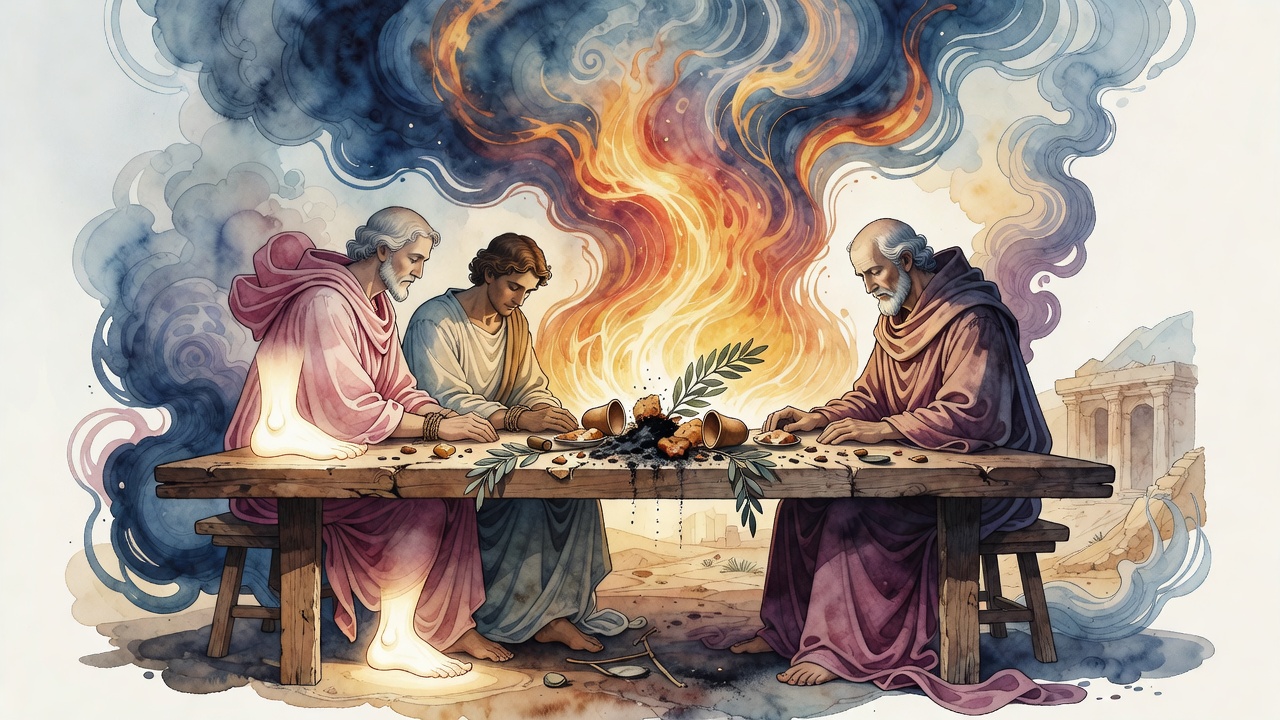
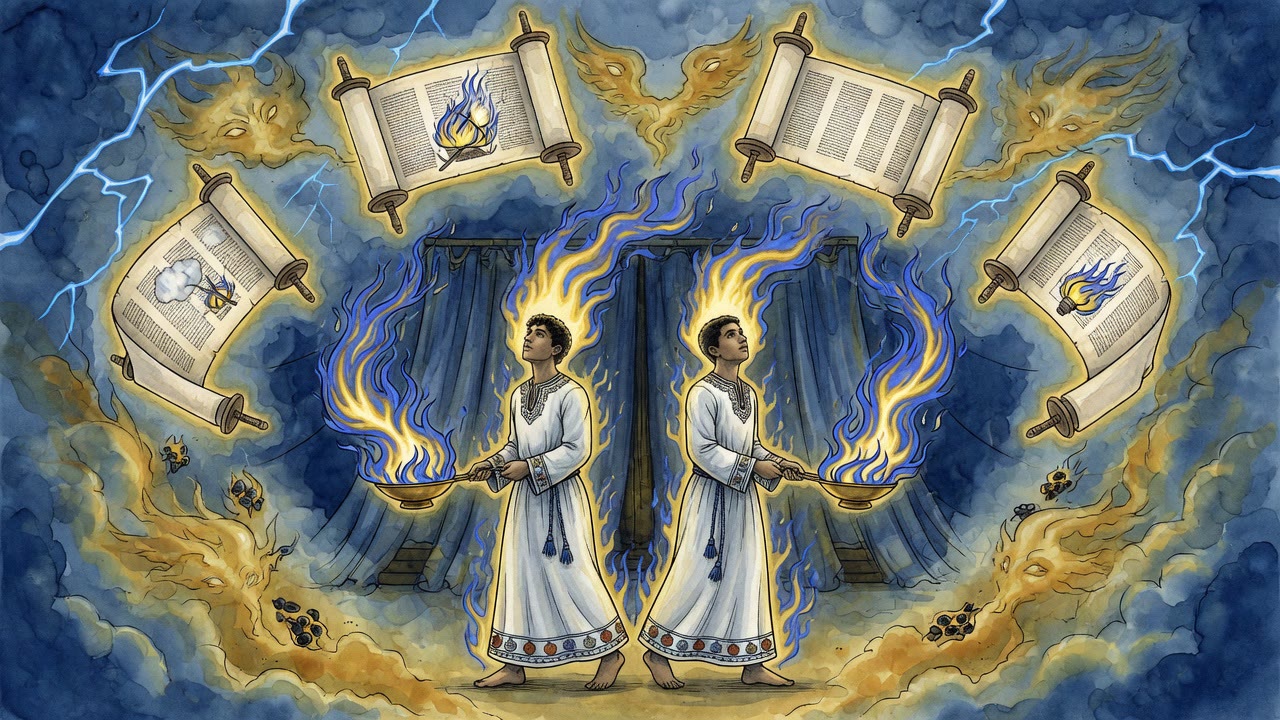
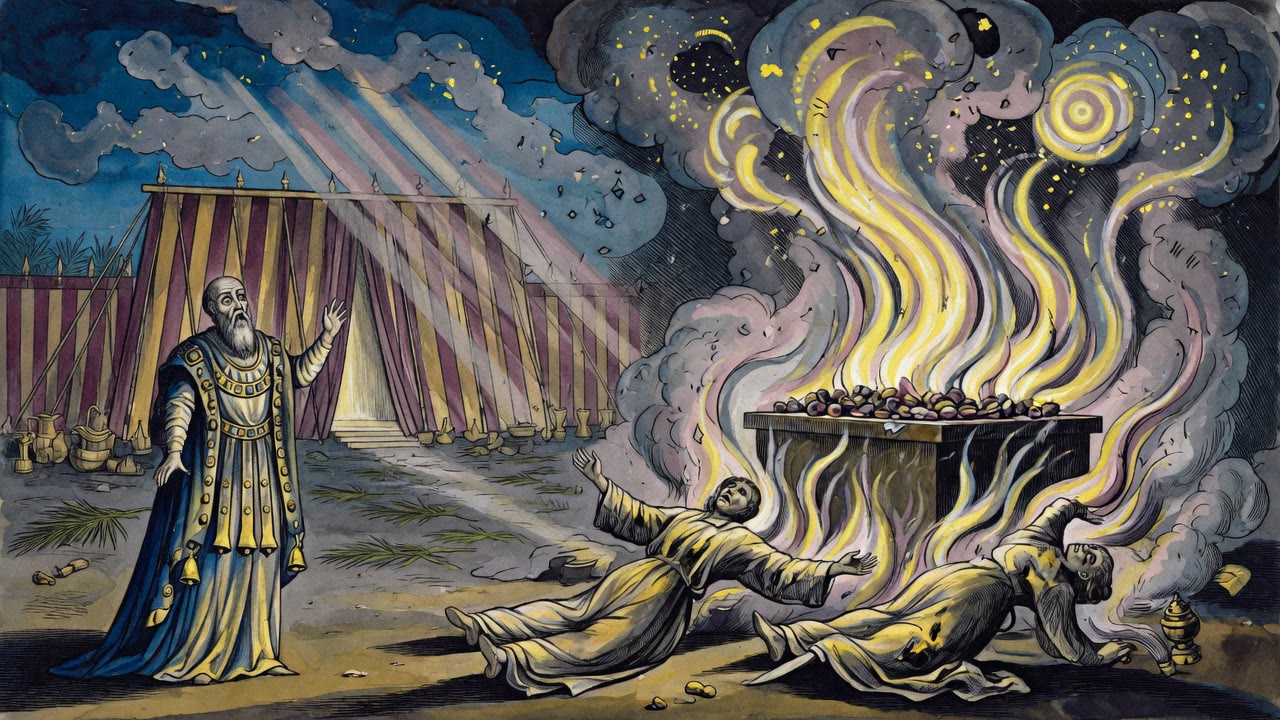
The sanctuary had opened that morning. Everything was new, the altar, the vestments, the smell of fresh cedar and blood, and Nadav and Avihu took their fire pans and brought in an offering nobody had asked them for. Fire came out from before the LORD and went through them and they were dead on the floor in their priestly linen while the service was still running.

Moses spoke. Aaron said nothing at all.

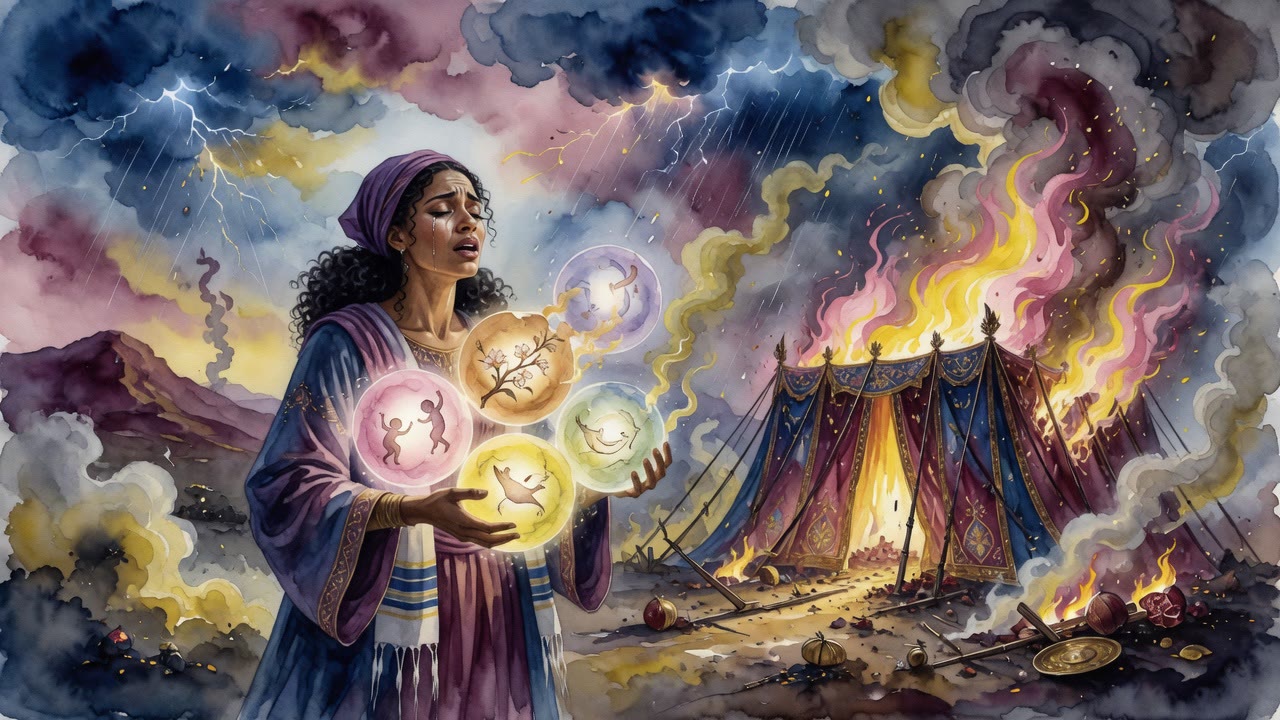
His wife Elisheva had woken up that morning holding more honor than any woman in the camp. Her brother-in-law led the nation. Her brother was a prince of Judah. Her husband was high priest. Two of her sons had walked in that morning as deputies to their father. By the time the incense burned off, two of the five were gone, and the loudest celebration Israel had ever held finished as a funeral nobody was permitted to conduct properly.

Every celebration in Israel carries the shadow of Aaron's sons after that. It was not a saying. It was a Tuesday.

The Chapter That Opens After a Funeral

What comes next in the scroll is not a lament. It is a procedure.

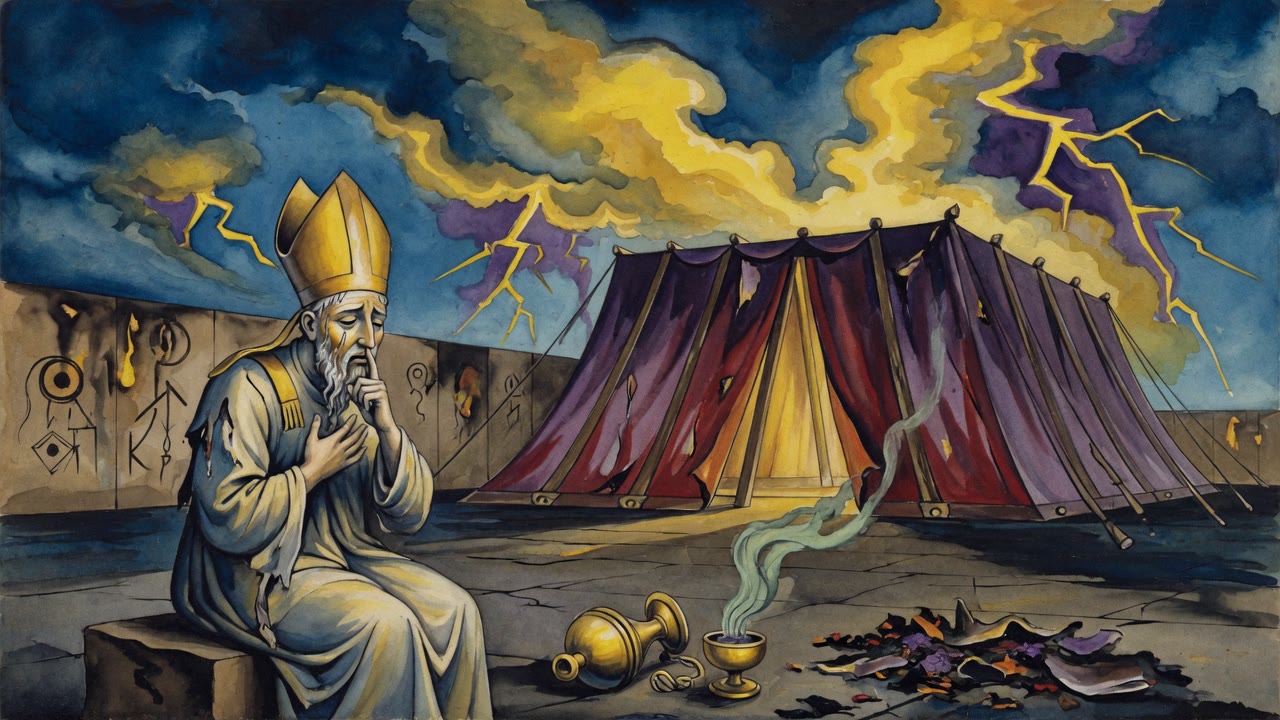
After the death of the two sons of Aaron, the LORD spoke to Moses, and the instructions that follow are addressed to the father of the dead men. He is to come into the Holy Place. Not never again. Once a year, on one day, and here is exactly how.

Read it in order and the arrangement is almost unbearable. Aaron's sons came too close and were killed for it, and the immediate consequence is that their father is given a standing appointment to do the same thing, correctly, for the rest of his life. The room did not become forbidden. It became scheduled.

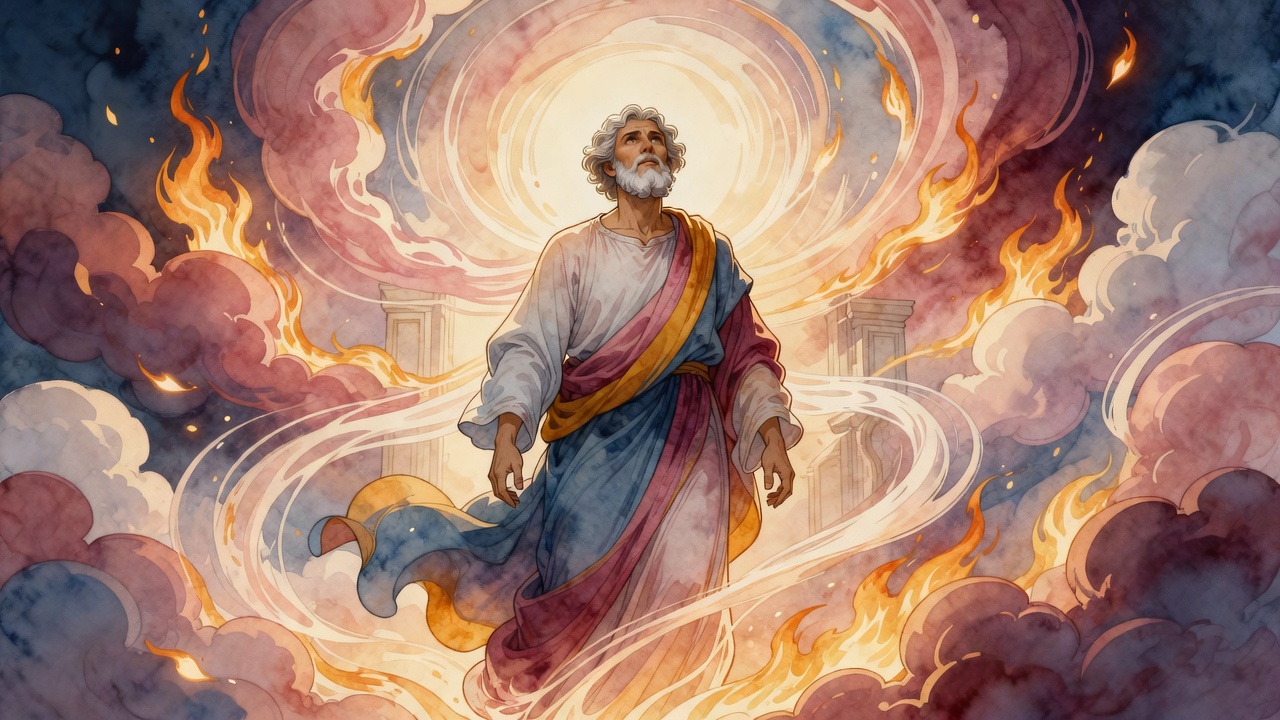
He is told what to take off first. The breastplate with its twelve stones, the gold, the blue robe with the bells sewn along the hem so the man inside could be heard moving. All of it comes off at the door. What he wears in is linen.

Bull, Ram, Goat, and Four Threads of Linen

Plain white, and nothing on it worth stealing. That is what a man wears into the room where the fire lives.

The animals waiting outside were not anonymous either. The bull was Abraham, who ran to the cattle himself when three strangers turned up at his tent in the heat. The ram was Isaac, because a ram had stood in the thicket on that mountain with its horns caught while a knife came down toward a boy. The goat was Jacob, the two kids his mother sent him for, good for him because he got the blessing out of them and good for his children because they get atonement out of them.

The word for linen appears four times in the description of the garments, and the sages counted it four times on purpose: Sarah, Rebecca, Rachel, Leah, one for each thread the high priest put on. He walked in wearing the matriarchs and leading the patriarchs on ropes.

Rabbi Berekhya and Rabbi Yirmeya said it in Rabbi Hiyya's name: as the service is above, so the service is below. Ezekiel saw one in the middle of them clothed in linen. So does the man at the door of the Tent.

Cloth That Cannot Go Back in the Drawer

He comes out and takes the linen off and leaves it there. The scroll says leave it, and says nothing about what happens to it afterward, and the sages split.

Rabbi Hiyya said the garments have to be buried. Not washed, not stored, not folded into the priestly chest with the everyday robes. Interred, like a body, and never worn into that room on any later Day of Atonement. They had held too much of one day.

Rabbi Dosa would not accept the waste. Let an ordinary priest wear them, he said. Common priests serve all year in four linen garments anyway. Put them back into circulation and let a man sweep ashes in them.

One of them looked at the cloth and saw a corpse. The other looked at it and saw a uniform. Both of them were reading a father who had buried two sons in their vestments and then been handed a new set.

The Year the Elder Did Not Come Out

Centuries later, Shimon HaTzadik came out of the Holy of Holies and told the priests around him that he would die that year.

They asked how he knew.

Every year, he said, an old man dressed in white and wrapped in white goes in with me and comes out with me. This year he went in with me. He did not come out.

No man shall be in the Tent of Meeting from the moment the high priest enters until he emerges, the scroll says, and Rabbi Abahu pushed on it. Who says the one walking beside him was a man at all. And then the harder question, because the high priest himself is standing in there. Is he not a man?

Rabbi Pinhas answered it. When the spirit rested on him, his face went up like torches. The priest is called a messenger of the LORD of hosts, and a messenger is not a man, and so the verse is exact: there was no man in the Tent of Meeting.

Aaron's line had been walking into that room since the morning two of them were carried out of it. Shimon counted the white shapes going in and coming out, the way you count children at a river crossing, and one year the count came up short, and he knew whose it was.


← All myths
From the tradition

Sources

3 sources

The texts behind this telling. Some cards carry a translation of the source; others are our own retelling of it, and each card says which. Every card links out to the original.

Vayikra Rabbah 20:2Vayikra Rabbah

Retold in our words. Read the original at the link below.The Sefaria Midrash Rabbah, 2022 · CC-BY

In Jewish tradition, this tension between joy and sorrow, celebration and mourning, is a constant theme. And it's beautifully, if somberly, explored in Vayikra Rabbah, specifically in chapter 20.

This passage opens with a seemingly simple verse from (Leviticus 16:1): "After the death of the two sons of Aaron.." But as is often the case in Jewish thought, a single verse can open a door to a vast landscape of ideas. Here, it's an exploration of why rejoicing can feel…complicated.

Rabbi Levi starts us off with a quote from Psalms: "I said to the revelers [laholelim]: Do not revel" (Psalms 75:5). The word laholelim itself is fascinating. Rabbi Levi interprets it as referring to those who are "confused," their hearts filled with wicked thoughts. He even calls them "woe-generators," suggesting that their negativity brings suffering to the world. Harsh. The idea is that the wicked shouldn't be rejoicing when the righteous themselves haven't fully experienced joy in this world. Reish Lakish, quoting Rabbi Shimon ben Menasya, takes us back to Adam, the first human. Imagine this: according to this tradition, the heel of Adam's foot outshone the sun! And his face? Even more radiant. Yet, he sinned almost immediately after his creation. So, if even Adam, with all his glory, couldn't sustain pure joy, what right do we have to revel?

Rabbi Levi, in the name of Rabbi Ḥama bar Ḥanina, paints a picture of God creating thirteen canopies for Adam in the Garden of Eden, each made of precious stones. (Ezekiel 28:13) lists these stones: ruby, topaz, quartz, and so on. Some say there were eleven canopies, others ten. The disagreement, the text explains, lies in how they interpret the phrase "every precious stone was your canopy." Does "every" imply three additional canopies, or just one? Or none? It's a beautiful, intricate detail that shows how deeply the Rabbis delved into the text.

But even with all this splendor, Adam was reminded: "You are dust, and to dust you will return" (Genesis 3:19).

The text then turns to Abraham. He waited until he was one hundred years old for a son, Isaac. And what happened? God commanded him to sacrifice that very son! The story in (Genesis 22:2) is heart-wrenching: "Take now your son…and offer him up there for a burnt offering…"

Imagine Abraham's three-day journey to Mount Moriah. He asks Isaac if he sees the cloud fixed on the mountaintop. Isaac does. But Ishmael and Eliezer don't. Abraham then says to them, since they and the donkey don't see it, they should stay behind. The text pointedly calls them "peoples comparable to the donkey" [am hadomim laḥamor].

Abraham builds the altar, arranges the wood, and prepares to slaughter his son. Only an angel's intervention stops him. The story goes that Isaac returned to his mother, Sarah, who cried out six times upon hearing what almost happened. These cries, the text says, correspond to six blasts of the shofar, the ram's horn, blown on Rosh Hashanah (the Jewish New Year).

After the averted sacrifice, Abraham worried that some flaw in Isaac had made the offering unacceptable. A Divine voice reassured him: "Go, eat your bread with joy" (Ecclesiastes 9:7). Even Abraham, the patriarch, faced immense trials that tempered his joy.

The text emphasizes that "Israel will rejoice in its Maker" (Psalms 149:2), suggesting that true, unadulterated joy is something for the future. Similarly, God "will rejoice in His works" (Psalms 104:31) in the future, in the actions of the righteous.

Finally, we meet Elisheva bat Aminadav, who experienced a moment of unparalleled joy when she saw five crowns attained by her relatives: her brother-in-law, Moses, was king; her brother, Nahshon, a prince; her husband, Aaron, the High Priest; her two sons, Nadav and Avihu, deputy priests; and her grandson Pinḥas was anointed for war. But then, her sons entered the sanctuary and were consumed by fire. Her joy turned to profound mourning. Hence, "After the death of the two sons of Aaron."

So, what does this all mean? Is joy forbidden? Of course not. But this passage reminds us that joy exists within a interplay of life, intertwined with sorrow, responsibility, and awareness of our own limitations. It suggests that true joy isn't about ignoring the pain and suffering in the world, but about finding moments of light within it, knowing that even those moments are precious and fleeting. Perhaps, by acknowledging the potential for sorrow, we can appreciate joy even more deeply.

Full source
Vayikra Rabbah 21:12Vayikra Rabbah

Retold in our words. Read the original at the link below.The Sefaria Midrash Rabbah, 2022 · CC-BY

See, (Leviticus 16:23) tells us that Aaron, the High Priest, would enter the Tent of Meeting – the Ohel Mo'ed – and remove the linen vestments he wore when he entered the Sanctum – the Kodesh, the Holy of Holies. But what then?

Rabbi Ḥiyya offers one opinion: these garments, imbued with the holiness of Yom Kippur (the Day of Atonement), require burial. They are, in his view, simply not fit for use on another Yom Kippur. They carry too much of the day's sacred energy.

Rabbi Dosa disagrees. He suggests that while the High Priest himself couldn't reuse those specific linen vestments for another Day of Atonement, a common priest could certainly wear them to perform the regular Temple service. Remember, ordinary priests wore four linen garments year-round. So, according to Rabbi Dosa, nothing goes to waste!

This difference of opinion highlights a key tension: how do we balance the unique holiness of the High Priest and Yom Kippur with the everyday sacredness of the Temple service?

Now, the text takes an even more intriguing turn. "And no man shall be in the Tent of Meeting," (Leviticus 16:17) states, "from his entry to atone in the Sanctum until his emergence." This verse prompts a mystical interpretation, especially when connected to the story of Shimon HaTzadik, a High Priest of the Second Temple period.

The year Shimon HaTzadik knew he would die, he told others that he knew that he would die. He explained that every year, a certain elder, clothed in white and wrapped in white, would enter the Holy of Holies with him and emerge with him. But this year, the elder entered… and didn't come back out.

A chilling premonition. Rabbi Abahu, however, offers a radical interpretation. He asks: who says it was a person who accompanied the High Priest? Perhaps, Rabbi Abahu suggests, it was the Holy One, blessed be He, in His glory!

But wait a minute, doesn't the verse specifically say "no man"? Rabbi Abahu anticipates the question. Isn't the High Priest a man?

He answers by quoting Rabbi Pinḥas, who says that when the Divine Spirit rested upon the High Priest, his face shone like flaming torches. The High Priest, in that moment, was more than just a man.

And here's where the verse from (Malachi 2:7) comes in: "For the lips of the priest will safeguard knowledge… as he is a messenger [malakh] of the Lord of hosts." The High Priest is called a malakh, which literally means an angel.

So, Rabbi Abahu concludes, when the High Priest entered the Holy of Holies in that state of divine connection, there truly was no man in the Tent of Meeting. Only a vessel for the Divine. The High Priest, on Yom Kippur, transcends his human limitations, becoming a conduit for God's presence. The physical laws and limitations that govern our world bend, just for that moment.

And sometimes, the most profound truths are hidden in the spaces between the lines of the text.

Full source
Vayikra Rabbah 21:11Vayikra Rabbah

Retold in our words. Read the original at the link below.The Sefaria Midrash Rabbah, 2022 · CC-BY

Take the sacrifices described in the Torah. Vayikra Rabbah, a collection of rabbinic teachings on the book of Leviticus, sees them not just as offerings, but as embodiments of our patriarchs and matriarchs. It's like a hidden code, waiting to be unlocked.

"With a young bull," the text says, "this is Abraham." Why? Because, as Genesis tells us, "Abraham ran to the cattle [habakar]" (Genesis 18:7) when he welcomed the three angels. The young bull, the ben bakar, becomes a symbol of Abraham's hospitality and eagerness to serve.

"a ram as a burnt offering," represents Isaac. We remember the Binding of Isaac, the Akeidah, where "afterwards, there was a ram caught in the thicket" (Genesis 22:13). The ram, spared in Isaac's place, is forever linked to his willingness to be offered as a sacrifice.

What about Jacob? He's connected to the goat. The Torah says, "Take for me from there two [fine] goat kids" (Genesis 27:9). Rabbi Berekhya, in the name of Rabbi Levi, sees deep meaning in the word "fine." It's "fine for you and fine for your descendants." Fine for Jacob, because through these goats he receives the blessings; and fine for his descendants, because through them they receive atonement on Yom Kippur, the Day of Atonement. As it's written: "For on this day shall atonement be made for you" (Leviticus 16:30).

But wait… where are the matriarchs in all of this? The Midrash (rabbinic interpretive commentary) anticipates the question. If the patriarchs are represented by the sacrificial animals, what about Sarah, Rebecca, Leah, and Rachel? The verse answers: "Each part shall be equal [bad bevad]" (Exodus 30:34). This refers to the spices used in the incense offering, but the Midrash connects it to the priestly garments worn on Yom Kippur. In (Leviticus 16:4), the word linen [bad] appears four times, referencing the vestments donned by the High Priest. These correspond to the four matriarchs, whose merit is invoked during the Yom Kippur service. According to the Etz Yosef commentary, the verse implies the four matriarchs were equal in their exceptional righteousness.

Rabbi Berekhya and Rabbi Yirmeya, citing Rabbi Ḥiyya, add another layer: "Like the service On High, so is the service below." Just as the service On High involves "one man in their midst…clothed in linen" (Ezekiel 9:2), so too, the service below requires the High Priest to "don a sacred linen tunic" (Leviticus 16:4). The earthly rituals mirror the heavenly ones.

So, what does it all mean? Their lives, their struggles, their virtues – they’re all present with us, woven into the very fabric of our tradition. Every time we perform a ritual, every time we read the Torah, we’re connecting to them, drawing strength from their stories, and keeping their memory alive. It is a beautiful way of remembering those who came before us, and acknowledging that their lives shaped our own. And maybe, just maybe, our lives will shape the lives of those who come after us.

Full source