Parshat Shemini5 min read

Alien Fire Took Nadav and Avihu Together

Two sons of Aaron entered with stove fire and separate pans. Four Torah tellings keep their single sin from becoming secret scandal.

Curated by Arthur · Told by Maggid ·
Table of Contents
  1. Two Pans, No Counsel
  2. Four Mentions, One Sin
  3. The Line That Stopped
  4. Speak to Aaron's Heart
  5. What the Stove Fire Cost
Alien Fire Took Nadav and Avihu Together Click for full size

Two Pans, No Counsel

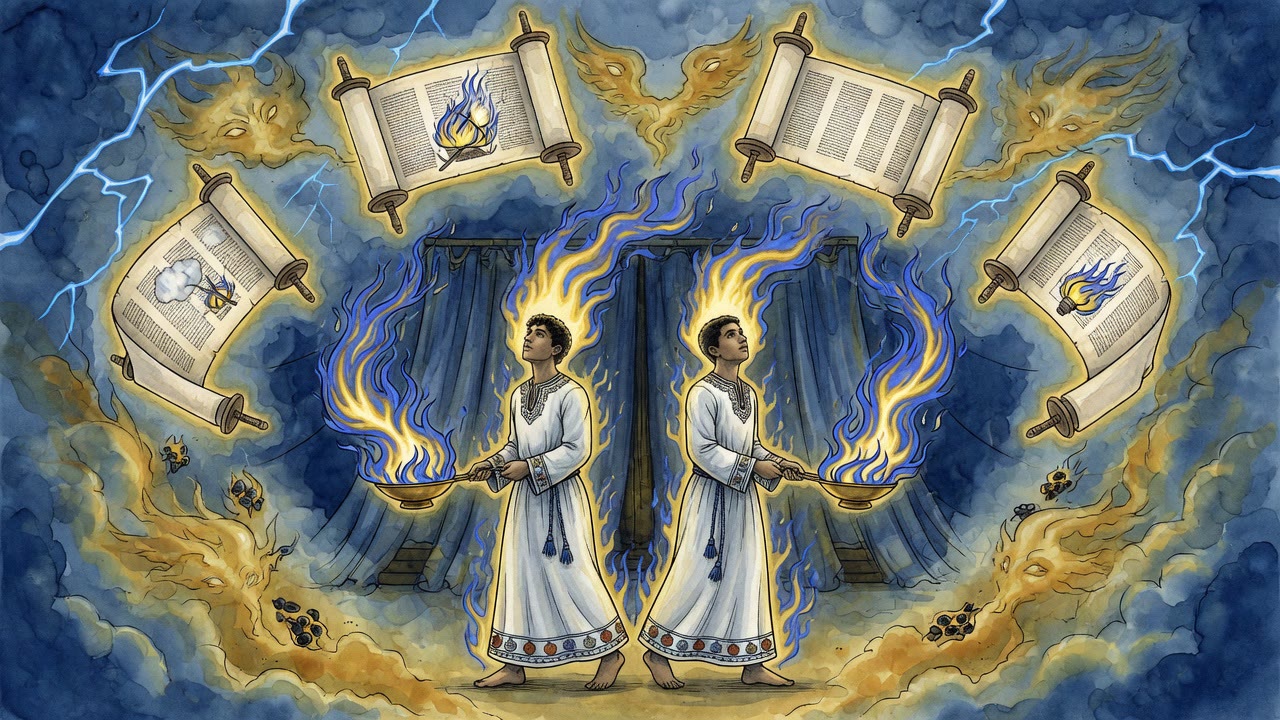
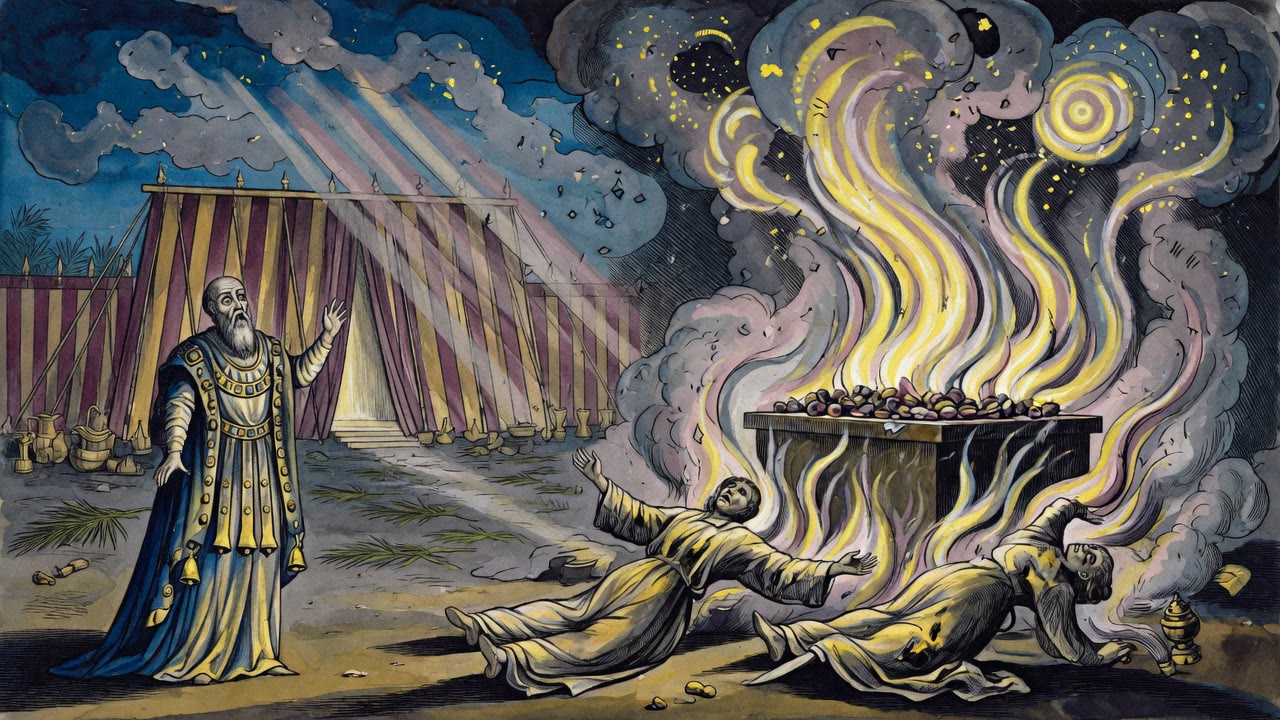
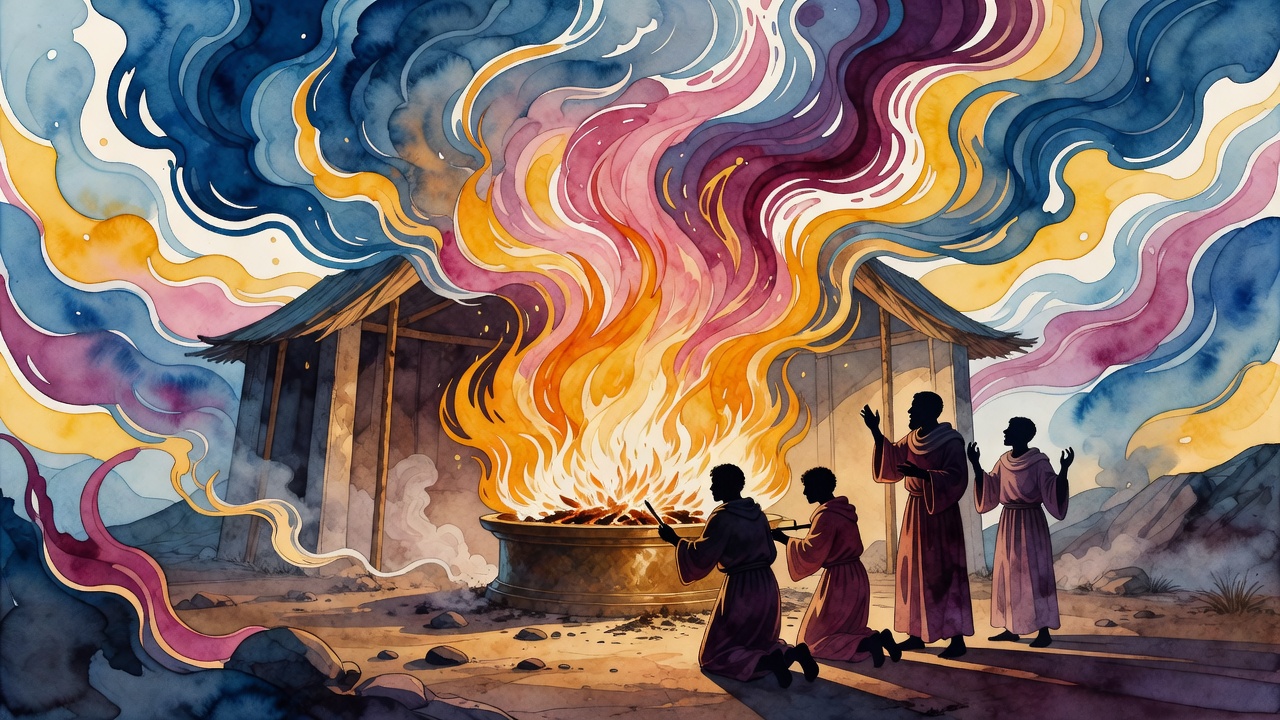
Nadav lifted his fire pan. Avihu lifted his. Neither asked the other what the other held. The verse later freezes that detail in a single merciless clause. Each took his own (Leviticus 10:1). Brotherhood stood in the same court and still failed to become counsel.

The fire in the pans was not the altar's. It came from a stove, ordinary heat dressed up for holy work. They moved toward a nearness the day had not commanded. Zeal without appointment. Heat without pedigree. Gold rims flashed. Coals settled with a small sound no one would remember until after.

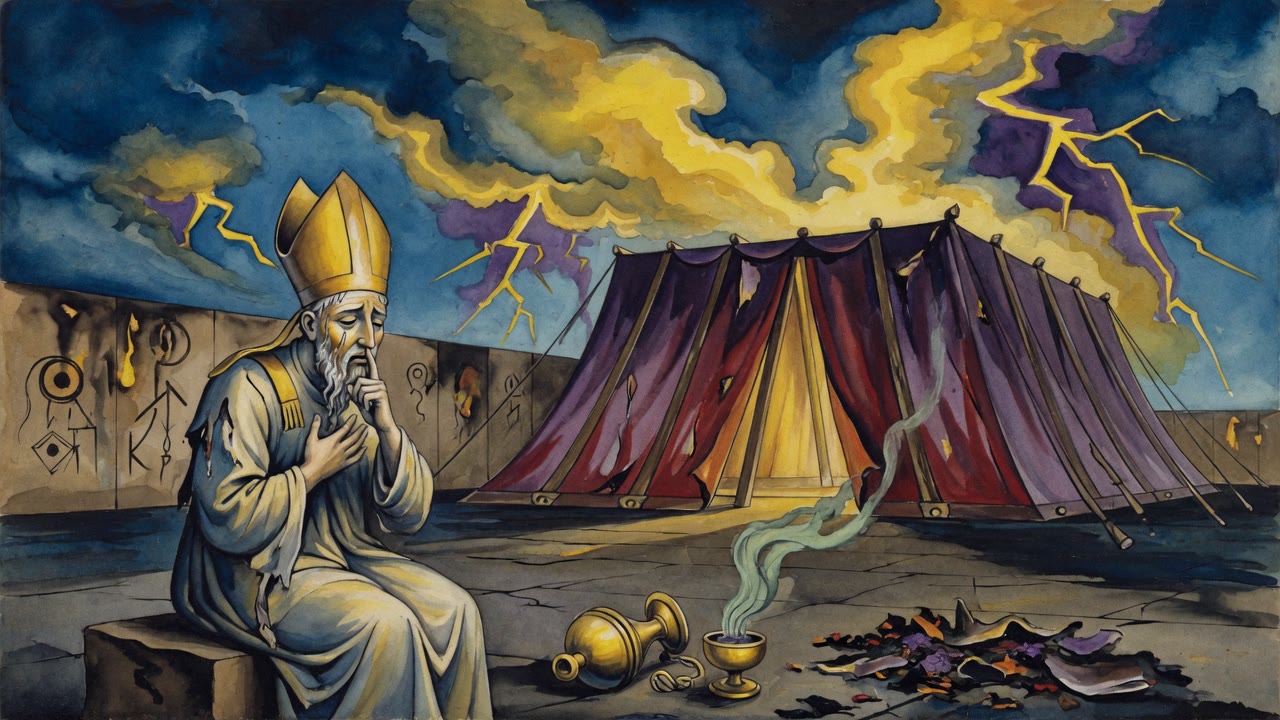
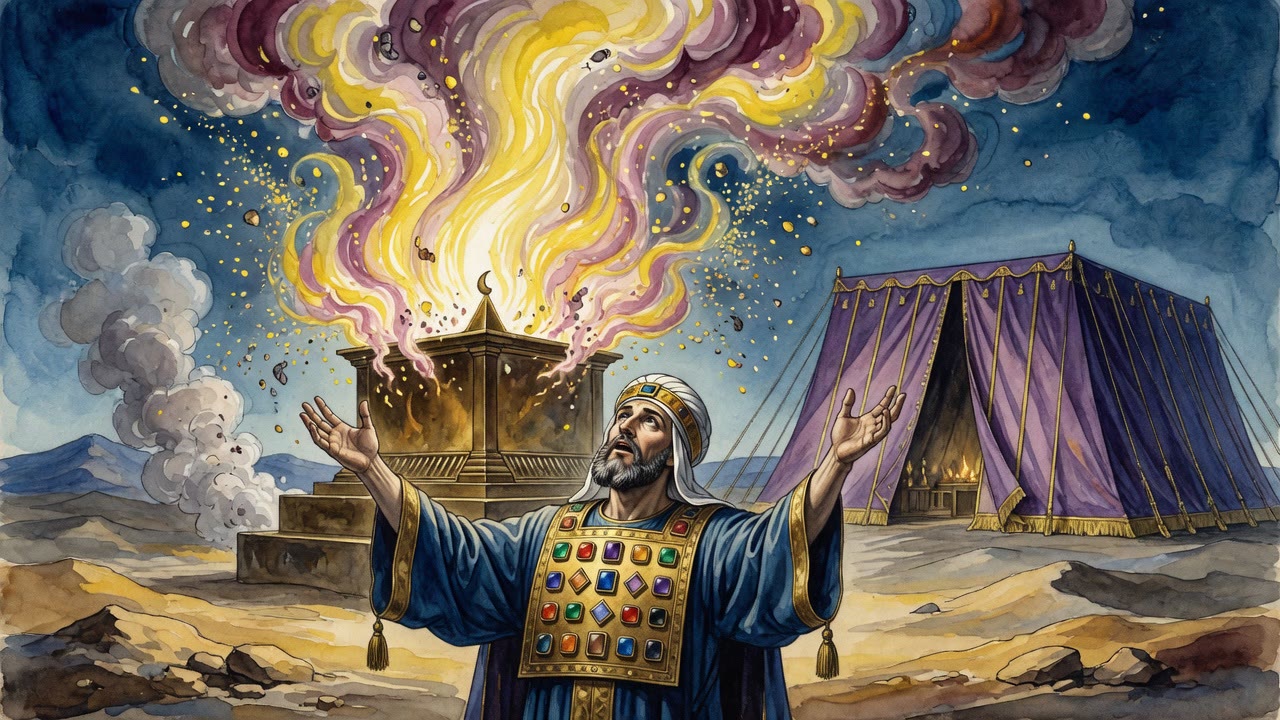
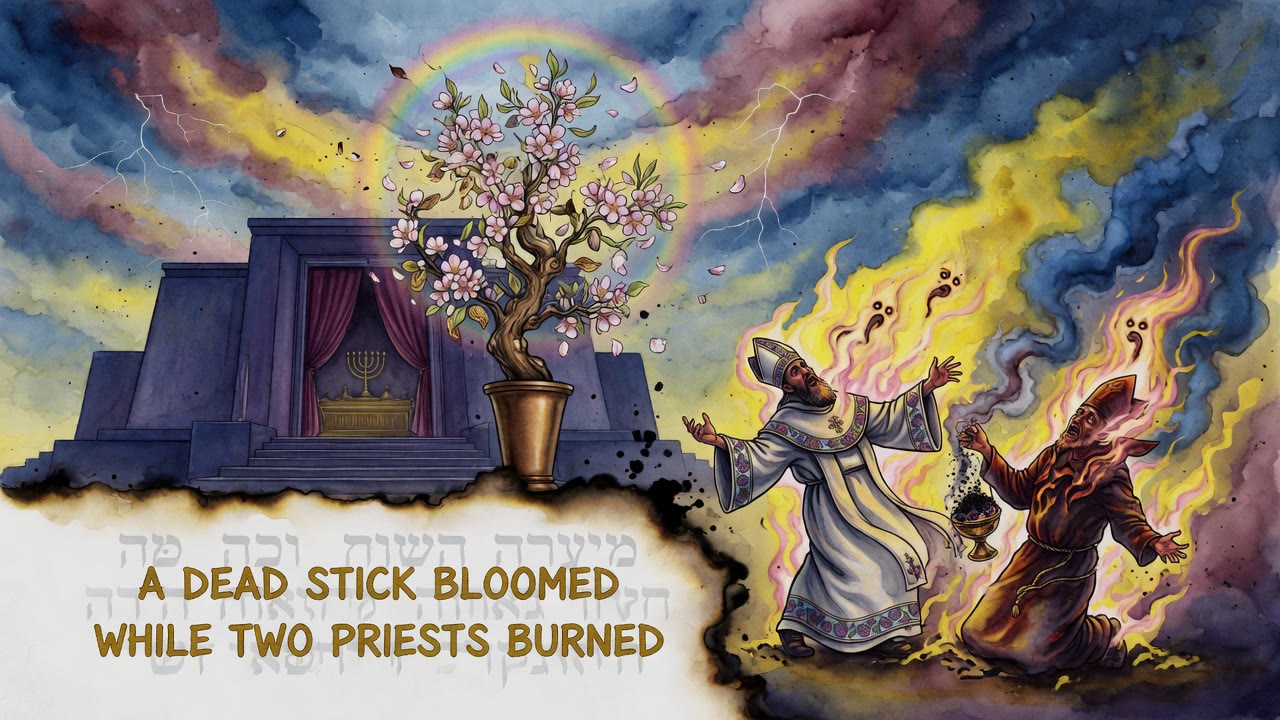
Flame answered from before the Lord. The sons of Aaron fell. The joy of the eighth day cracked down the middle (Leviticus 10:1-2). Music that had been preparing for celebration found itself walking toward burial. The smell of strange fire mixed with the smell of sanctioned offerings until the nose could not sort holiness from trespass without the story's help.

Four Mentions, One Sin

Bar Kappara, speaking in the name of Rabbi Yirmeya ben Elazar, would not let the deaths thin into rumor. Four reasons circle the same bodies. They drew near into a space reserved for the High Priest on Yom Kippur. They offered what had not been commanded. They carried alien fire. They failed to take counsel from one another.

The Torah names their death in four places and names the sin each time (Leviticus 10:1; 16:1; Numbers 3:4; 26:61). Rabbi Elazar HaModai heard the repetition as protection of their names. Anyone tempted to invent secret corruption would find the text already speaking. This was the sin. Not a hidden second life. Not whispered scandals. The fire and the nearness and the solitude of each pan.

Grief hates vacuum. Without the fourfold naming, rumor would have painted worse pictures on the sons of Aaron. Scripture refused the vacuum. Every retelling is a guardrail as much as a wound reopened. Israel is forced to remember accurately, which is harder than remembering cruelly.

The Line That Stopped

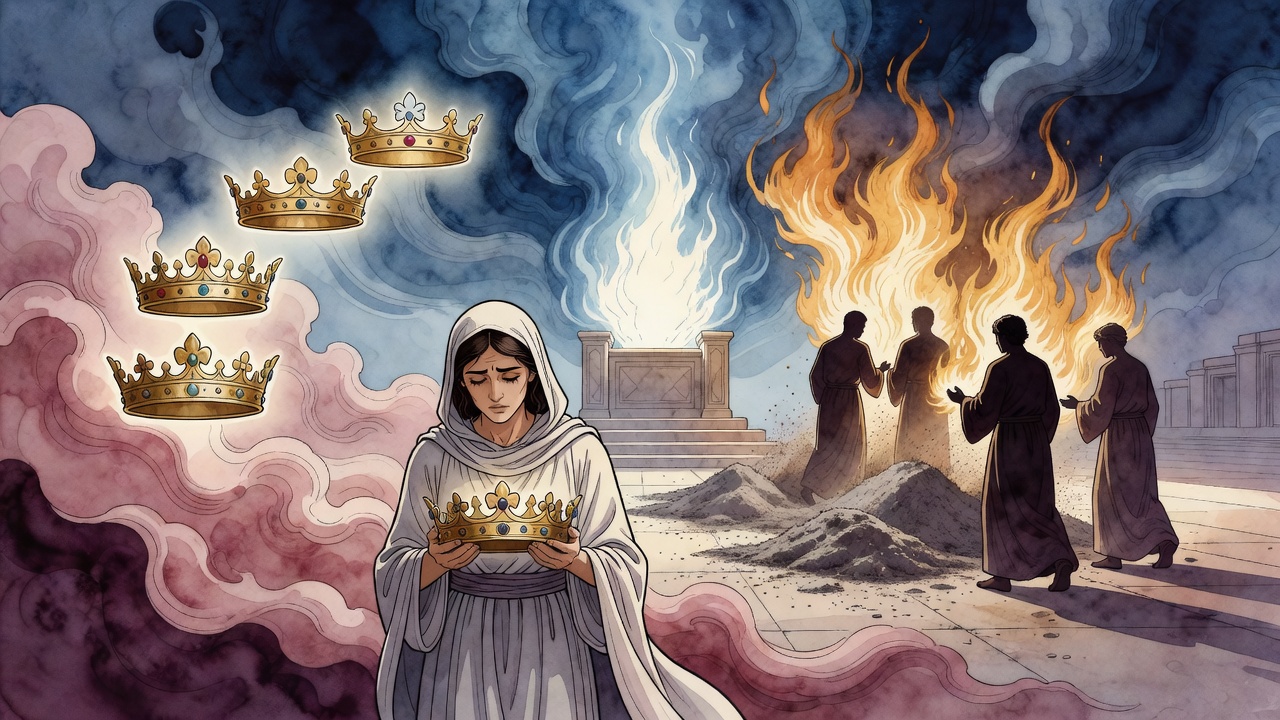
Another turn of the midrash stares at what did not happen. Had Nadav and Avihu left sons, those sons would have stood in line to lead Israel. The future priesthood shifted because two young men left no children behind the smoke. Genealogy is not only triumph. It is absence counted in empty places at the table of service.

Aaron still had to walk. The oil of anointing still clung to him. The dead sons still lay in the story every time the camp named the priestly houses. Leadership that might have been theirs became a counterfactual the sages were willing to say out loud. Unborn names press on the narrative like missing stones in a wall. The wall still stands. The gaps still catch the hand.

Cousins and younger brothers rearrange. History always does. The midrash simply refuses to pretend the rearrangement was costless.

Speak to Aaron's Heart

After the fire, the command came with a tenderness that did not cancel the law. Moses was told to speak to Aaron, and Rabbi Avin heard the phrase as speech to the heart, the way Isaiah would later demand comfort for Jerusalem (Isaiah 40:2; Leviticus 16:2). Comfort first. Boundary second.

"He shall not come at all times." The Holy of Holies would not become a room Aaron entered whenever grief or longing pushed. Moses himself, in one midrashic reading, tasted anguish at the limit placed on his brother. Had the surviving brother been reduced? The text answers by holding both truths. Aaron is consoled. Aaron is restricted. Love does not abolish the threshold.

The man who lost two sons still had to learn when not to enter. The House would not be ruled by panic or by private fire, even a father's. Moses' mouth, so often the tool of confrontation with God, now had to become a tool of gentle speech toward a grieving priest who still wore responsibility like a second skin.

What the Stove Fire Cost

Alien fire is not a metaphor for mild innovation. It is heat from the wrong place carried into the right place. The midrash keeps the stove in the picture so no one confuses sincerity with authorization. Nadav and Avihu may have felt full of worship. Heaven answered the source of the coal.

Each pan alone. Each brother sure. Together they made a silence where counsel should have been. The four Torah tellings keep repeating the scene so Israel cannot misfile it under mystery alone. Mystery remains. So does the inventory of the mistake.

Aaron's silence elsewhere in the chapter is its own fire. Moses speaks to the heart. The camp watches a high priest breathe through a day that began in celebration and ended in burial clothes for the young. Stove heat. Separate counsel. Empty next generation. A brother told not to come at all times. The eighth day holds all of it without offering a softer ending.


← All myths

From the tradition

Sources

3 sources

The texts behind this telling. Some cards carry a translation of the source; others are our own retelling of it, and each card says which. Every card links out to the original.

Vayikra Rabbah 20:8Vayikra Rabbah

Retold in our words. Read the original at the link below.The Sefaria Midrash Rabbah, 2022 · CC-BY

Take the story of Aaron’s sons, Nadav and Avihu. Their sudden, tragic deaths after offering "alien fire" before the Lord (Leviticus 10:1-2) is one of the most jarring moments in the Book of Vayikra, or Leviticus. It's a tough one. And the Torah mentions their deaths not once, but four times! What's up with that?

In Vayikra Rabbah, 20, the Sages grappled with this very question. They weren’t satisfied with a simple answer. They wanted to understand the depths of this tragedy.

Bar Kappara, quoting Rabbi Yirmeya ben Elazar, suggests four possible reasons for their demise. Four missteps that led to such a devastating outcome. First, they "drew near" – meaning they entered the innermost sanctum, the Holy of Holies, a space reserved only for the High Priest, and only on Yom Kippur (the Day of Atonement). Second, they sacrificed an offering that hadn't been commanded. They acted without specific instruction, perhaps out of zeal, but ultimately, presumptuously. Third, the infamous "alien fire." Bar Kappara suggests it was fire brought from a stove, a mundane, profane source, rather than the divinely kindled fire of the altar.

The fourth reason is perhaps the most subtle, and the most human: they didn’t take counsel from one another. "Each took his fire pan," the verse says (Leviticus 10:1). They acted independently, without collaboration, without seeking guidance. As Rabbi Yirmeya ben Elazar notes, the Torah mentions the death of Aaron’s sons in four different places (Leviticus 10:1, 16:1; (Numbers 3:4), 26:61), and in each instance, their sin is also mentioned. Why the repetition? To emphasize that this was the only sin they committed.

Rabbi Elazar HaModa’i adds another layer. He emphasizes how significant the death of Aaron’s sons was to God. Every time their death is mentioned, so is their sin. Why? To prevent anyone from saying, "Oh, they must have been secretly corrupt. That’s why they died." The repetition serves as a powerful declaration: they were righteous men, whose mistake, though grave, was singular. The Sages are telling us that even righteous individuals can make mistakes with devastating consequences. And that the Torah itself is concerned with preserving their reputation, with ensuring that they are not unfairly judged. It’s a profoundly compassionate reading of a difficult passage.

That we must be mindful of the sacred spaces we enter, both literally and figuratively. That we must follow instructions carefully, and not let our zeal outpace divine guidance. And, perhaps most importantly, that we should always seek counsel from one another. Because even the most well-intentioned acts can go awry if we act in isolation.

So, the next time you find yourself wondering why the Torah repeats itself, remember the story of Aaron’s sons. Remember that repetition can be a form of emphasis, a way of ensuring that we don’t miss the crucial lessons embedded within the narrative. And remember that even in moments of tragedy, there is always room for compassion, for understanding, and for growth.

Full source
Vayikra Rabbah 20:11Vayikra Rabbah

Retold in our words. Read the original at the link below.The Sefaria Midrash Rabbah, 2022 · CC-BY

Vayikra Rabbah turns to Had Nadav and Avihu Left Sons They Would Have Led Israel.

Rabbi Yaakov bar Avin, quoting Rav Aḥa, makes a crucial point: if Nadab and Abihu had had sons, those sons would have superseded Elazar and Itamar in the priestly line. Why? Because, as the verse states: “Anyone who takes precedence for inheritance takes precedence for honor, provided that he conducts himself in the manner of his ancestors.” A pretty big "if", considering their fiery end.

Then the text shifts to Elazar and Itamar, asking when exactly they served as priests in the presence of Aaron, their father. Rabbi Yitzchak suggests it was during Aaron's lifetime, while Rabbi Ḥiyya bar Abba believes it was after his death.

How can we possibly know? Well, each Rabbi finds textual support for their view. Rabbi Ḥiyya bar Abba focuses on the Hebrew word penei, meaning "presence." He points to (Genesis 23:3), where it says “Abraham arose from the presence of [penei] his dead” to describe the period after Sarah's death. So, too, here, he argues.

Rabbi Yitzchak, on the other hand, draws a parallel from (Genesis 11:28): “Ḥaran died in the presence of [al penei] Teraḥ his father.” Since Haran died while Terah was still alive, Rabbi Yitzchak argues that the "presence" of Aaron must have also been during his lifetime. See how these Rabbis use the entire Torah to understand just one little phrase?

The discussion moves to the practicalities: If Aaron became ritually impure, Elazar would serve. If Elazar became impure, Itamar would step in. This leads to a fascinating story about Shimon ben Kimḥit, a High Priest during the Second Temple period.

Shimon was about to go speak with an Arab king, but a bit of the king's spit accidentally landed on Shimon's garments, rendering him ritually impure. (Gross. ). So, his brother, Yehuda, had to step in and serve as High Priest in his place.

The text then tells us that Kimḥit had seven sons, all of whom served as High Priests! People were amazed and asked her what her secret was. Her reply? "The beams of my house have never seen the hair of my head or the hem of my robe.” In other words, she was incredibly modest and private. The Rabbis declared, "All the flours are flour, but the flour of Kimḥit is fine flour," and connected her to the verse “All the glory of the princess is within” (Psalms 45:14). Modesty, it seems, was seen as a virtue that brought great honor – not just to the woman herself, but to her entire family.

The text concludes by returning to the original question. If we accept Rabbi Ḥiyya bar Abba’s view that Elazar and Itamar served after Aaron's death, then when Aaron died, Elazar served, and when Elazar died, Itamar served. A clear line of succession, established in the wake of tragedy and maintained through ritual purity and, perhaps, a bit of well-placed modesty.

Is this just a story about priestly succession, or is there a deeper message about the importance of family, duty, and the unexpected ways in which honor can be earned? And what about Kimhit?

Full source
Vayikra Rabbah 21:7Vayikra Rabbah

Retold in our words. Read the original at the link below.The Sefaria Midrash Rabbah, 2022 · CC-BY

That feeling, that ache of separation, is what this week’s portion of Vayikra Rabbah (Leviticus Rabbah) touches upon. It centers around a seemingly simple phrase in (Leviticus 16:2): "The Lord said to Moses: Speak to Aaron your brother… He shall not come at all times."

What does this mean, "he shall not come at all times?" Who is being restricted, and why?

The verse refers to Aaron, the High Priest, and his entry into the Kodesh HaKodashim, the Holy of Holies. But before we explore the details, consider the context. Aaron had just suffered a devastating loss – the death of his two sons, Nadav and Avihu. So, how does God address Aaron in his grief?

Rabbi Avin offers a beautiful interpretation. He says that God tells Moses to, "Speak to the heart of Aaron," just as the prophet Isaiah implores, "Speak to the heart of Jerusalem" (Isaiah 40:2). It's an instruction to offer comfort, to soothe his pain. But then comes this restriction… "He shall not come at all times."

Rabbi Yehuda ben Rabbi Simon suggests that Moses himself was troubled by this limitation. According to this midrash (rabbinic interpretive commentary), Moses wondered with anguish, "Woe is me. Has Aaron my brother been expelled from His proximity?" Imagine Moses's concern! Was Aaron being punished, ostracized in his grief?

The Rabbis, in their wisdom, explore the meaning of "time" (et in Hebrew) in this verse. They expand upon the word et and suggest that “time” can mean an hour, a day, a year, twelve years (as in the years Joseph spent in prison, alluded to in (Psalms 105:1)9), seventy years (referencing the Babylonian exile, as mentioned in (Daniel 9:2) and Jeremiah 27:7), or even eternity, as illustrated in (Psalms 4:8) which discusses the constant yield of grain.

The Etz Yosef commentary adds that the verse indicates that if Aaron enters the Holy of Holies and then exits, he cannot re-enter immediately.

This wide range of interpretations emphasizes that the word "time" is flexible and depends on context. So, what is the context here?

God reassures Moses, saying it's not about a specific duration – not an hour, a day, a year, or even eternity. Instead, God emphasizes that Aaron can enter "at any time that he wishes to enter, provided that he enters with this protocol."

What is this protocol? Rabbi Yehuda ben Rabbi Ilai suggests it involves the High Priest’s garments, specifically the thirty-six bells and thirty-six pomegranates adorning his robe. Other Rabbis say seventy-two of each. While the High Priest wore simpler linen garments when inside the Holy of Holies, the Rabbis connect the entrance with the rituals and offerings performed beforehand in his full vestments.

So, what's the takeaway here? It’s not about arbitrary restrictions. It's about proper preparation, about approaching the sacred with the right intention and in the right way. Aaron wasn't being punished, but guided. God wasn't closing a door, but teaching Aaron how to enter with reverence and holiness.

This passage reminds us that even in moments of profound loss and grief, connection with the Divine is possible. But it requires humility, respect, and adherence to the sacred protocols that guide us. It's a message of hope, reminding us that even when we feel furthest away, the path back is always open, provided we approach it with the right heart and preparation.

Full source