Parshat Vayera6 min read

Abraham Named Both Sons Until God Said Isaac

Take your son, your only son. Abraham answered with two names until Heaven spoke Isaac, then walked three days past a river Satan raised.

Curated by Arthur · Told by Maggid ·
Table of Contents
  1. After the Boys' Boast
  2. Satan on the Road
  3. The Place Rose Into a Mountain
  4. What the Camp Remembered

"Take now thy son." Abraham did not rush past the ambiguity. "I have two sons," he said, "and I do not know which of them Thou commandest me to take." The one is the only son of his mother, and the other is the only son of his mother. Ishmael was Hagar's only. Isaac was Sarah's miracle. "The son you love," said the Holy One. "I love them both." "Is there a limit in the viscera?" Abraham asked. Is there a measure by which a man gauges love for his sons? Forthwith God replied: Isaac.
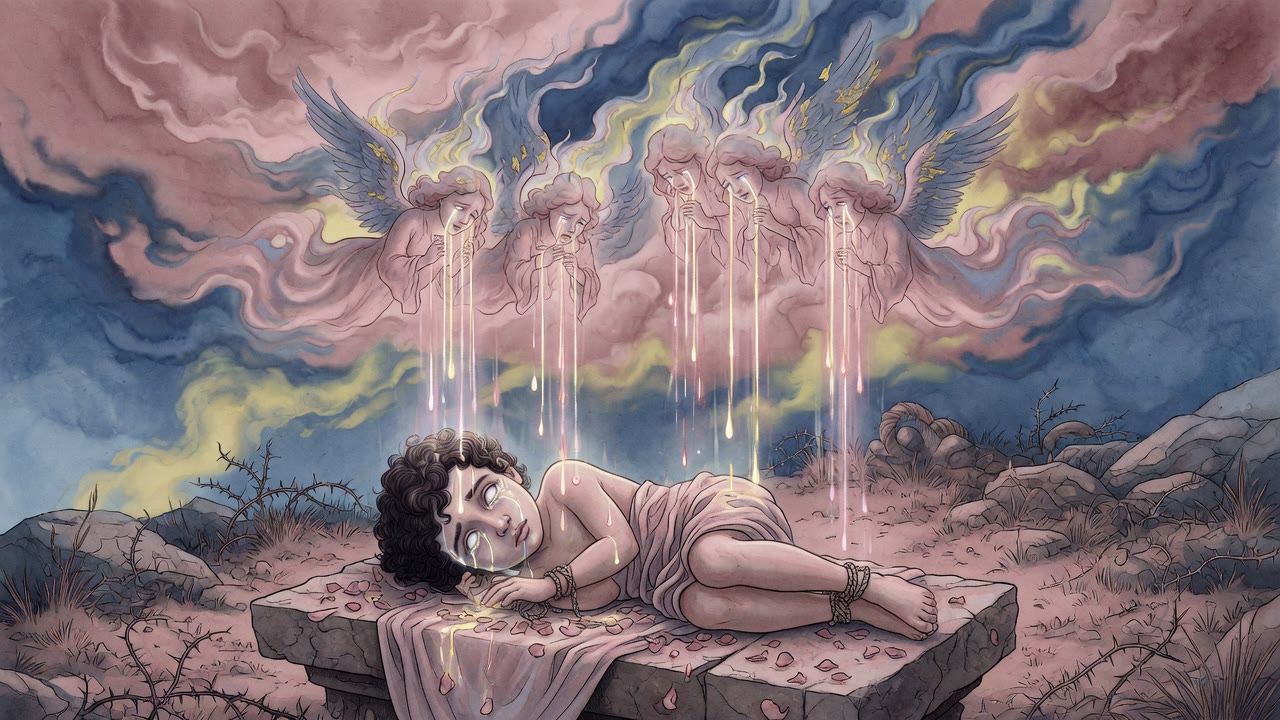
Abraham Named Both Sons Until God Said Isaac Click for full size

The word came with "please," na, the language of request. Like a king who has a warrior undefeated in every war and says, stand beside me now, lest men say the earlier battles were minor. Nine trials behind Abraham. This tenth would silence that charge.

After the Boys' Boast

What words came before the test? Ishmael had said to Isaac, I am superior. I was circumcised at thirteen and felt the pain. You were eight days old and felt nothing. Even if your father wished to slaughter you, you would not have known the difference. Isaac answered, Even if the Holy One should command my father, Slaughter thy son Isaac, I would not resist. Immediately thereafter Scripture states that God did prove Abraham. The angels who had asked, What is man that Thou art mindful of him, were about to watch a father willing to slay and a son willing to be offered for the Name.

Abraham rose early. He saddled the ass himself though he had servants enough. Eagerness is a kind of terror that moves. He told Sarah they would celebrate a late education for the boy at a place not far off. He left before she could change her mind. Two young men came to guard the supplies while the knife waited.

Satan on the Road

Satan met him as an old man. Whither are you going? To pray. Why fire, knife, and wood for prayer? We may tarry and cook. I was present when the Holy One ordered you to take your son. Why should an old man who begets at a hundred destroy him? If you destroy a soul you will be held accountable. Abraham answered, It was not a seducer but the Holy One who told me, and I shall not listen to you.

Satan turned to Isaac as a youth. Alive or dead to study law? Your mother fasted many days before your birth, and this demented old man is about to sacrifice you. Isaac said, Even so, I will not disregard the will of my Creator nor the command of my father. He asked his father if he heard. Abraham said, Pay no heed. He has come only to torment us.

When words failed, Satan raised a river in their path. Water to the knees, then to the neck. Abraham cried out, Master of the Universe, You chose me, You ordered Isaac as an offering, and now these waters endanger our lives. Who will proclaim Your unity if we drown? The Holy One rebuked the water. Dry land returned. Satan tried one more truth twisted. I heard from behind the curtain that a lamb will be offered instead of Isaac. Abraham said, It is a liar's fate that even truth from him is not believed.

The Place Rose Into a Mountain

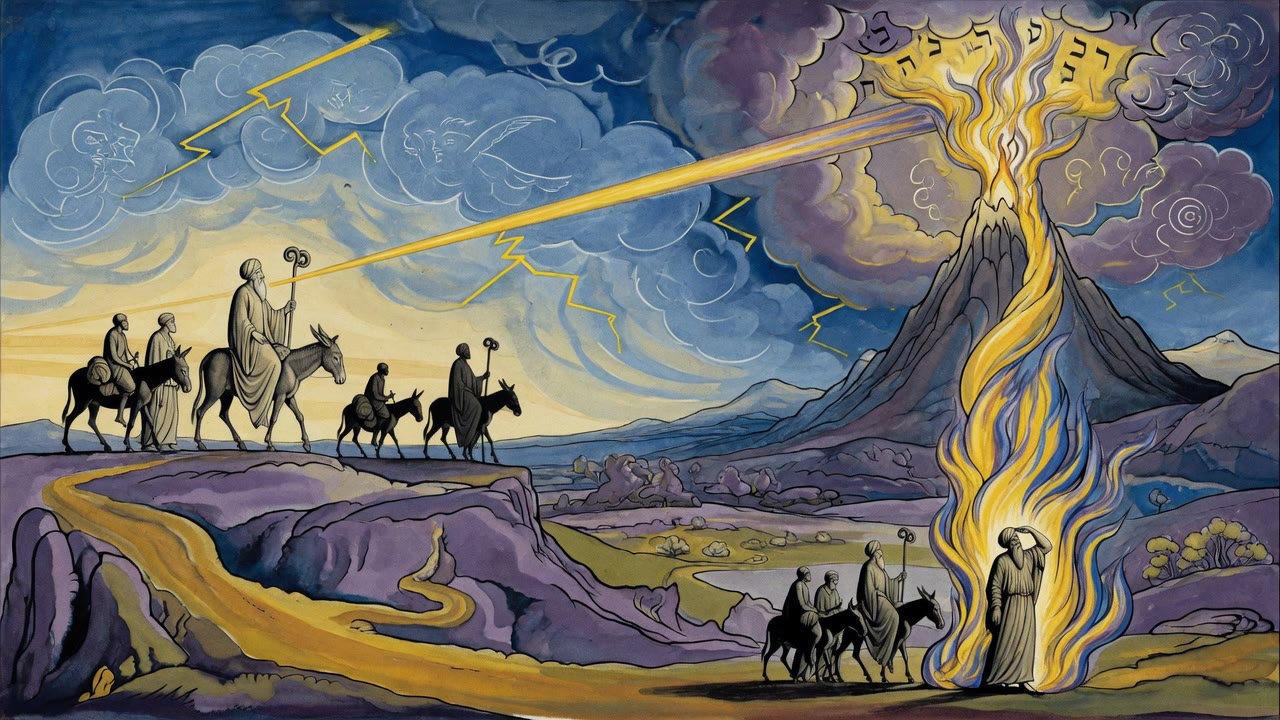
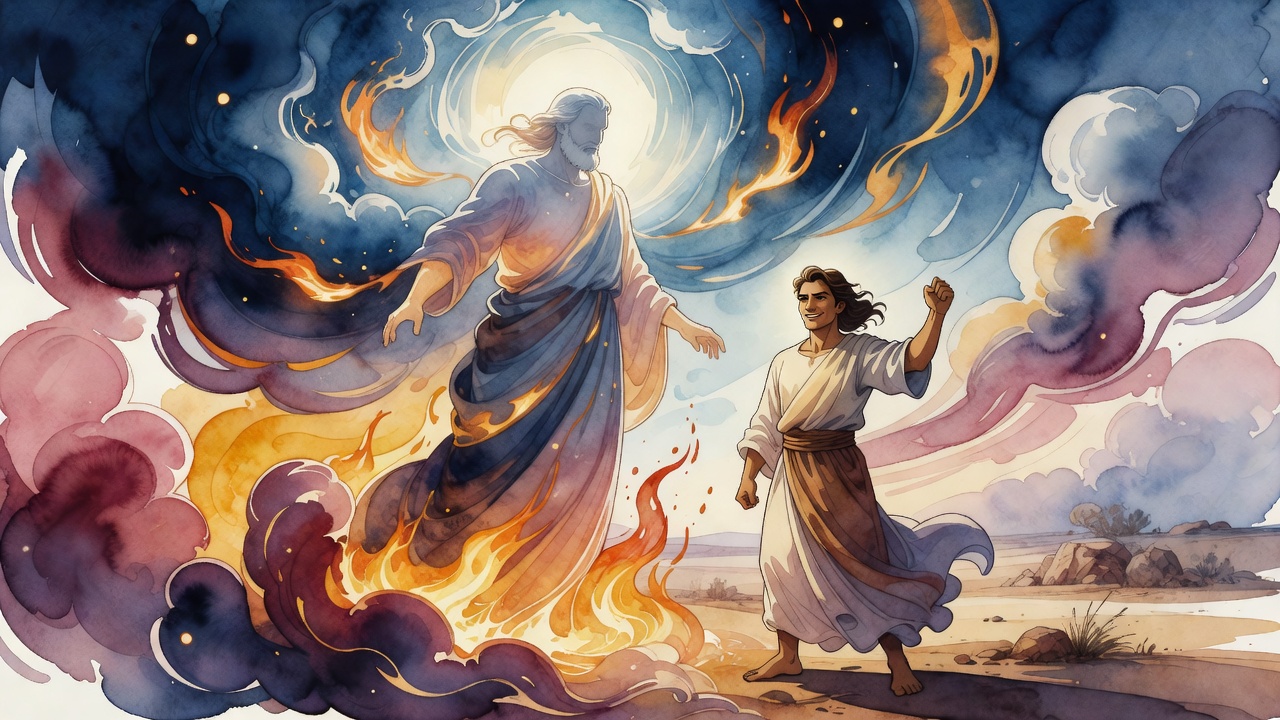
On the third day Abraham lifted his eyes and saw the place from afar. Why three days? Lest the world say he was still in shock and therefore willing. The place was a valley. When the Holy One decided to rest the Shekhinah (His dwelling presence) there for the Temple, He called the hills together. A king does not dwell in a hollow. The mountain is called Moriah, fashioned out of reverence, yirah.

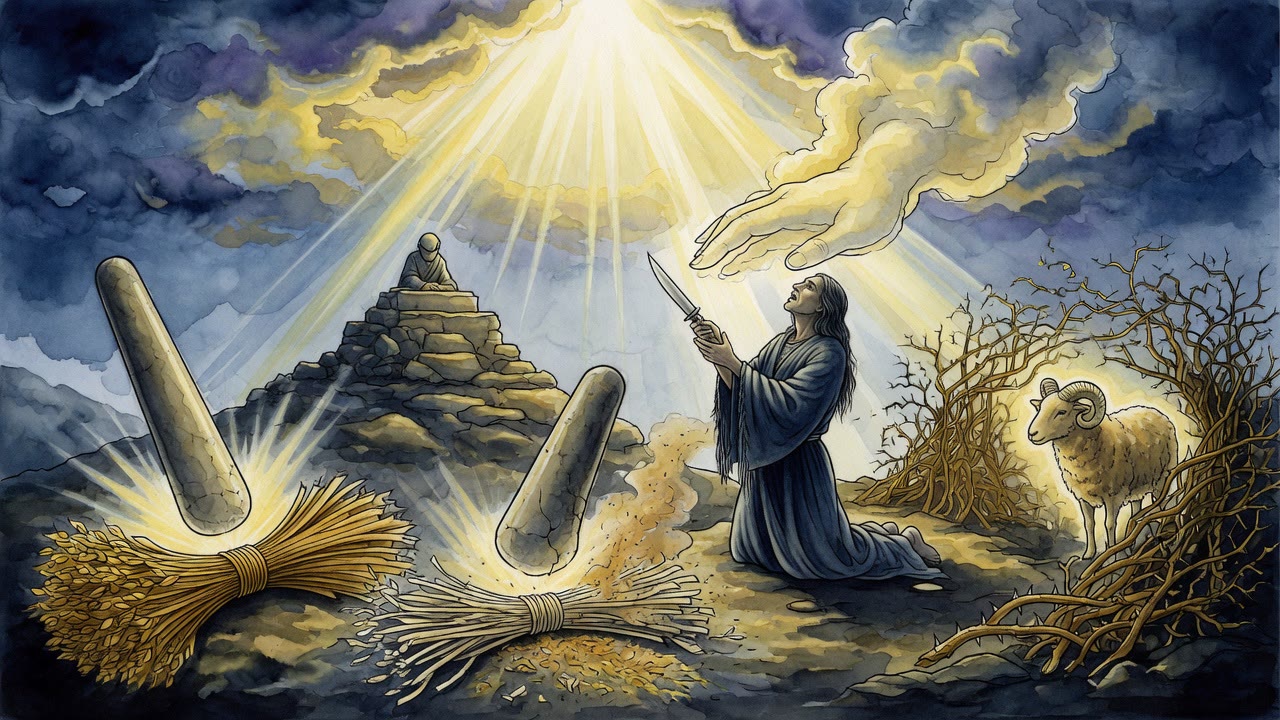
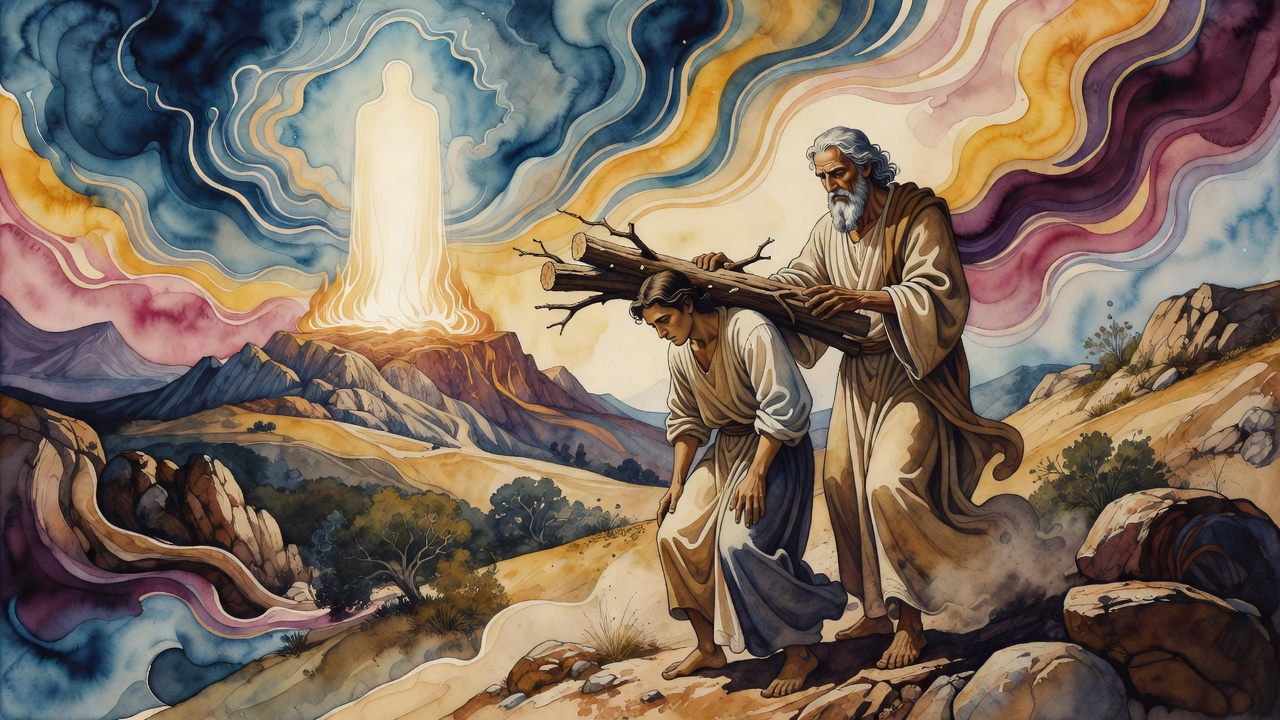
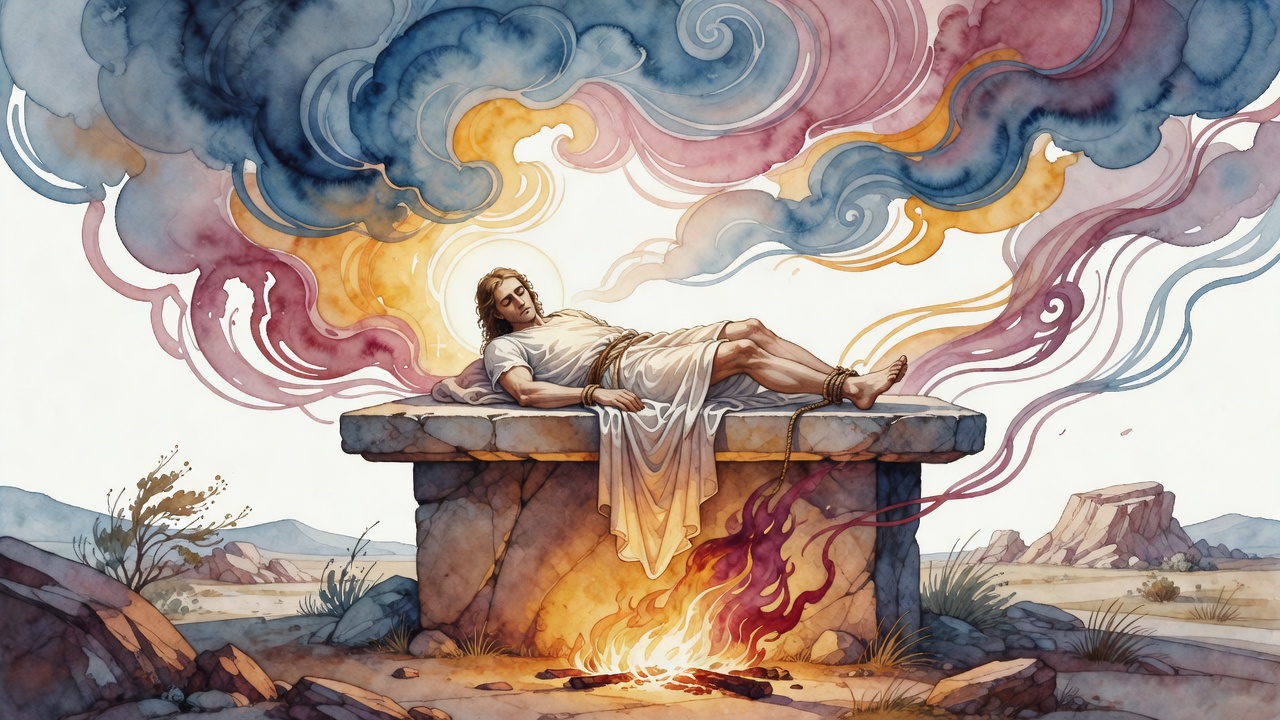
Abraham had asked if he was fit to perform the sacrifice, if the high priest Shem ought not rather do it. God answered, When thou wilt arrive at that place, I will consecrate thee and make thee a priest. The Akedah was not only a test. It was an appointment. A father climbed with a son who had already said he would not resist, past a river that tried to drown the command, toward a height that would one day hold the altar of a nation. The knife rose. The lamb appeared. The Name that asked for Isaac also stayed the hand, and the world was shown what kind of man and what kind of son could stand on Moriah without turning back.

Abraham's questions are not delays of cowardice. They are the speech of a man who will not sacrifice the wrong child by assumption. Love for both sons forces Heaven to be precise. The midrash refuses a mute Abraham. It gives him a mouth that protects Ishmael even while the command closes on Isaac. That protection does not cancel the test. It deepens it. The son finally named is the son of the promise, and still the walk is three days long so no one can say he acted in a trance of first shock.

Isaac's earlier boast to Ishmael becomes the hinge of the whole trial. The boy who claimed he would not resist is about to prove it on Moriah. The angels who doubted humanity's worth are about to watch a father and son who do not flinch when the Name asks for blood. Satan's river is the last physical obstacle before the spiritual one. When the water reaches the neck, Abraham's prayer is not for escape from the command but for life enough to complete it.

Sarah is protected by a ruse of schooling and a feast the night before. He leaves early lest she change her mind. On the road, old man, youth, river, and half-true prophecy try to unmake the journey. Abraham answers each the same way. The Holy One commanded. Liars do not redirect the path, even when they guess the ending.

What the Camp Remembered


← All myths
From the tradition

Sources

3 sources

The texts behind this telling. Some cards carry a translation of the source; others are our own retelling of it, and each card says which. Every card links out to the original.

Legends of the Jews 5:224Legends of the Jews

Retold in our words. Read the original at the link below.The Legends of the Jews by Louis Ginzberg (1909) · Public Domain

It's one of the most powerful, and most disturbing, narratives in the Torah. And it all starts with a test.

"And the Lord thought to try Abraham and Isaac in this matter. And He said to Abraham, 'Take now thy son.'"

Simple enough. Except…wait a minute.

The Ginzberg's says retelling in Legends of the Jews, Abraham wasn't quite sure which son God was referring to. This wasn’t just blind obedience; it was a dialogue, a negotiation. “I have two sons," Abraham replied, "and I do not know which of them Thou commandest me to take.” for a second. Abraham knew he had two sons, Ishmael and Isaac. So why the confusion?

Abraham pressed further, "The one is the only son of his mother, and the other is the only son of his mother." He was pointing out a painful truth: both sons held a unique place in their mothers' hearts. Ishmael was Hagar’s only son, and Isaac was Sarah’s long-awaited miracle.

God's response cuts through the ambiguity: "To the land I will show thee, and offer Isaac there for a burnt offering."

There it is. The command. To sacrifice the son he had waited so long for, the son through whom God promised to build a nation. What a gut punch.

But even here, Abraham doesn't just blindly obey. He questions the very mechanics of the sacrifice. "Am I fit to perform the sacrifice, am I a priest? Ought not rather the high priest Shem to do it?"

He's asking, "Am I even qualified? Shouldn't this be done by someone who’s been properly consecrated, someone like Shem?" This wasn’t defiance, but a deep-seated understanding of protocol and sacred duty.

God’s reply is intriguing: "When thou wilt arrive at that place, I will consecrate thee and make thee a priest."

The promise of consecration hints at the profound transformation Abraham was about to undergo. The Akedah wasn't just a test of obedience; it was a moment of divine appointment. Abraham was being elevated, prepared for a unique role in God's plan.

What does this all mean? Why this agonizing back-and-forth? Perhaps it highlights the immense weight of the request. The story isn't just about blind faith, but about the struggle, the questioning, and the ultimate willingness to submit to a higher purpose, even when it defies all logic and reason. It’s about the complex relationship between humanity and the divine, filled with questions, doubts, and moments of profound faith.

Full source
Midrash Tanchuma, Vayera 18Midrash Tanchuma

Retold in our words. Read the original at the link below.Townsend 1989 translation of Midrash Tanhuma, S. Buber Recension · CC-BY

And it came to pass after these words that God did prove Abraham (Gen. 22:1). What words were spoken? Ishmael had said to Isaac: I am superior to you, for I underwent circumcision at the age of thirteen, and underwent the pain (that accompanied it), while you were merely eight days old at the time of your circumcision and could feel no pain. Why, even if your father had wished to slaughter you, you would not have known the difference. If you had been thirteen years old, you could not have tolerated the anguish that accompanies circumcision. Isaac retorted: That is not so! Even if the Holy One, blessed be He, should command my father: “Slaughter thy son Isaac,” I would not resist. Immediately thereafter Scripture states: And it came to pass after these things that God did prove Abraham.

When the Holy One, blessed be He, embarked upon the creation of the world, the ministering angels said to him: What is man, that Thou art mindful of (lit. remember) him? (Ps. 8:5). The Holy One, blessed be He, responded: You have asked me, What is man, that Thou art mindful of him? because you beheld the wickedness of the generation of Enosh, but now I will reveal to you the greatness of Abraham so that you may remember him, as is said: And God remembered Abraham (Gen. 19:29).

You (angels) say (to Me), What is man, that Thou dost remember Him? because it is said The Lord remembered Sarah, but now you are destined to see a father who is willing to slay his own son, and a son who is willing to be sacrificed for the sake of My Holy Name.

Full source
Midrash Tanchuma, Vayera 22Midrash Tanchuma

Retold in our words. Read the original at the link below.Townsend 1989 translation of Midrash Tanhuma, S. Buber Recension · CC-BY

And He said unto him: “Abraham”; and he said: “Here am I” (Gen. 22:1). What does the expression hineni (“here am I”) signify? It signifies meekness and piety. The meekness of pious men is indicated in every instance by the use of these words. And He said: “Take, please, thy son” (ibid., v. 2). The word na (“please”) is always used to indicate a request. For example, there was once a king who was constantly engaged in wars, and he had in his army a powerful warrior who was victorious in every engagement. At one time a crucial battle developed, and he said to his mighty warrior: “Stand beside me now (na), lest my officers say that the earlier battles were minor engagements.” Similarly, the Holy One, blessed be He, said to Abraham: I have tried you nine times, and you underwent those trials successfully; now endure this final trial so that men may not say the earlier trials were of little consequence.

And He said: “Take now (na) thy son, thine only son” (ibid.). Abraham asked: “Which son is that?” The Holy One replied: Your only son. “But,” he said, “one of my sons is the only son of his mother, and the other is the only son of his mother.” The son you love, He replied. “I love them both,” Abraham responded. “The one you love the most,” said God. “Is there a limit in the viscera?” (i.e., Is there a measure within which a man gauges the love he bears his sons), he asked. Forthwith, God replied: Isaac.

And get thee into the land of Moriah (ibid., v. 2). What is suggested by the word get thee? It implies that the last trial was similar to the first. At the first trial, The Lord said unto Abram: “Get thee out of thy country and from thy kindred” (Gen. 12:1), and at the last trial He said: Get thee into the land of Moriah.

Forthwith, Abraham arose early in the morning, and saddled his ass, and took two of his young men with him (ibid. 22:3). How many servants and maids that righteous man possessed! But he saddled the ass himself. This reveals his eagerness to fulfill God’s command.

On the third day, Abraham lifted up his eyes and saw the place from afar off (ibid., v. 4). Why was he able to see the place on the third day, but not on the first or second day? Lest the inhabitants of the world assert that he was still in shock from God’s command and therefore was willing to sacrifice his son.

And he saw the place from afar off. Abraham had asked himself: What shall I do? If I tell Sarah all about it, consider what may happen. After all, a woman’s mind becomes distraught over insignificant matters; how much more disturbed would she become if she heard something as shocking as this! However, if I tell her nothing at all, and simply steal him away from her when she is not looking, she will kill herself. What did he do? He said to Sarah: “Prepare some food and drink that we may eat and rejoice.” “But why is this day different from other days?” she asked. “What are you celebrating?” He replied: “When a couple our age has a son, it is fitting, that they should eat, drink, and rejoice.” Whereupon she prepared the food. While they were eating, he said to her: “When I was a child of three, I already knew my Creator, yet this child is growing up and still has had no instruction. There is a place a short distance away where children are being taught, I will take him there.” She answered: “Go in peace.”

Immediately: And Abraham arose early in the morning (ibid., v. 3). Why did he arise early in the morning? He had said to himself: Perhaps Sarah will change her mind and not permit me to go; I will arise before she does.”

Another comment on early in the morning: Righteous men are always anxious to fulfill their religious duties as early as possible. For example, though Scripture states; And on the eighth day the flesh of his foreskin shall be circumcised (Lev. 21:3), thereby indicating that the entire day is appropriate for circumcision, a righteous man will fulfill the precept of circumcision as early in the day as possible.

And he took two of his young men with him (Gen. 22:3). He said to himself: While I am sacrificing him they will guard the supplies.

Satan appeared before him on the road in the guise of an old man and asked: “Whither are you going?” Abraham replied: “To pray.” “And why,” Satan retorted, “does one going to pray carry fire and a knife in his hands, and wood on his shoulders?” “We may tarry there for several days,” said Abraham, “and slaughter an animal and cook it.” The old man (Satan) responded: “That is not so; I was present when the Holy One, blessed be He, ordered you to take your son. Why should an old man, who begets a son at the age of a hundred, destroy him? Have you not heard the parable of the man who destroyed his own possessions and then was forced to beg from others? If you believe that you will have another son, you are listening to the words of a seducer. And furthermore, if you destroy a soul, you will be held legally accountable for it.” Abraham answered: “It was not a seducer, but the Holy One, blessed be He, who told me what I must do, and I shall not listen to you.”

Satan departed from him and appeared at Isaac’s right hand in the guise of a youth. He inquired: “Where are you going?” “To study the law,” Isaac replied. “Alive or dead?” he retorted. “Is it possible for a man to learn the law after he is dead?” Isaac queried. He said to him: “Oh, unfortunate son of an unhappy mother, many days your mother fasted before your birth, and now this demented old man is about to sacrifice you.” Isaac replied: “Even so, I will not disregard the will of my Creator, nor the command of my father.” He turned to his father and said: “Father, do you hear what this man has told me?” He replied: “Pay no heed to him, he has come only to torment us.” Forthwith, And Isaac spoke (ibid., v. 7).

On the third day Abraham lifted up his eyes (ibid., v. 4). Since the distance was extremely short, what delayed them three days? When Satan realized that they would not pay any attention to him, he went ahead and created a river in their path. When Abraham stepped into the river, it reached his knees. He ordered his young men to follow him, and they did so. But in the middle of the river the water reached his neck. Thereupon, Abraham lifted his eyes heavenward and cried out: Master of the Universe, You have chosen me; You have instructed me; You revealed Yourself to me; You have declared: I am one and You are one, and through You shall my name be made known in My world. You have ordered me: Offer, Isaac, thy son, as a sacrifice, and I did not refuse; but now, as I am about to fulfill Thy command, these waters endanger my life. If either I or my son, Isaac, should drown, who will fulfill Your decrees, and who will proclaim the Unity of Your Name? The Holy One, blessed be He, responded: Be assured that through you the Unity of My Name will be made known through the world. Thereupon the Holy One, blessed be He, rebuked the source of the water, and caused the river to dry up. Once again, they stood on dry land.

What did Satan do then? He said to Abraham: “Now a word was secretly brought to me (Job 4:12); that is, I have heard from behind the heavenly curtain that a lamb will be sacrificed as a burnt offering instead of Isaac.” Abraham responded: “It is a liar’s fate that even though he should speak the truth, no one will believe him.”

Immediately, And he saw the place from afar off. How was he able to see the place from afar off? This verse teaches us that the place was a valley at the time. However, when the Holy One, blessed be He, decided to make His Shekhinah (the Divine Presence) hover over it and to make it the site of the Temple, He observed that it is not fitting for a king to dwell in a valley, but rather in a lofty and beautiful place, visible to every eye. Thereupon, the Holy One, blessed be He, called upon the hills in the surrounding area to come together in order to make a fitting abode for the Shekhinah. Hence, the mountain is called Moriah, for it was fashioned out of reverence (yirah) for the Holy One, blessed be He.

Full source