6 min read

Isaac Bound on Moriah May Never Leave the Land

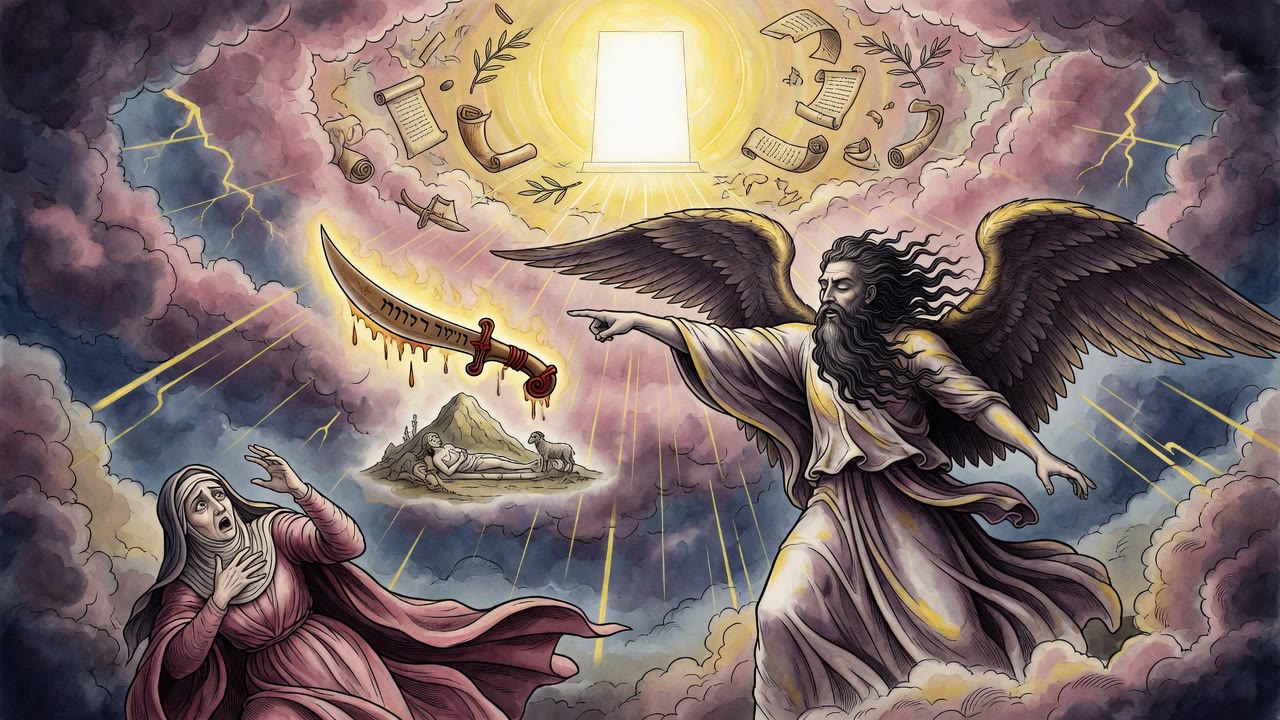
Bound on the altar as a living offering, Isaac was told that Egypt was forbidden ground, and famine could not drive him from the land that held his holiness.

Curated by Arthur · Told by Maggid ·
Table of Contents
  1. The Ram Burned and the Boy Did Not
  2. The Year the Wells Ran Thin
  3. You Are an Unblemished Offering
  4. Ishmael Had Called It Playing
  5. A Portion Now and the Rest Held Back

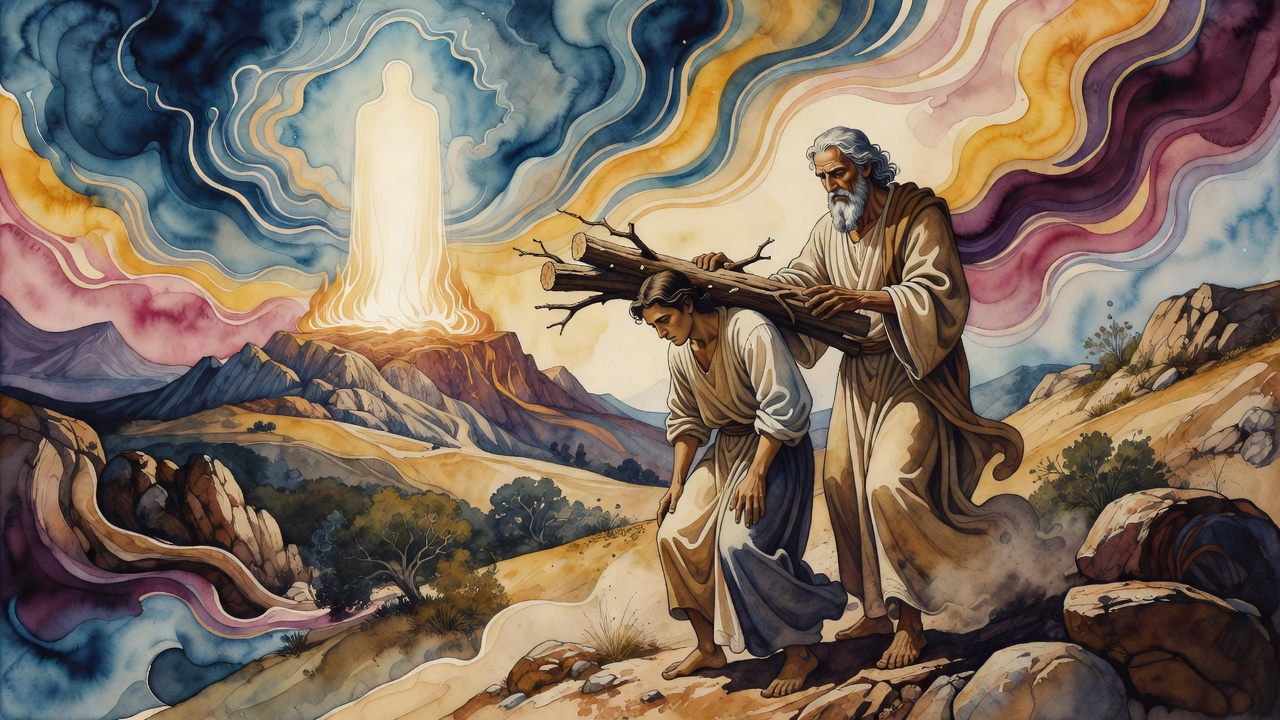
Abraham stopped on the road with the wood already cut and told the Holy One there had been a mistake about who should do this. He was not a priest. Killing on an altar is priest's work, and there was a priest available, since Shem was still alive and still held the office, so let Shem come out and take the boy off his hands and do it properly.
Isaac Bound on Moriah May Never Leave the Land Click for full size

The answer closed that road. When you reach the place, I will make a priest of you there. No substitute would be accepted for this one, not even a legitimate substitute, because the mountain does not borrow its servants from anybody. The name of the place holds the refusal inside it. Moriah, the exchange that was not allowed.

The Ram Burned and the Boy Did Not

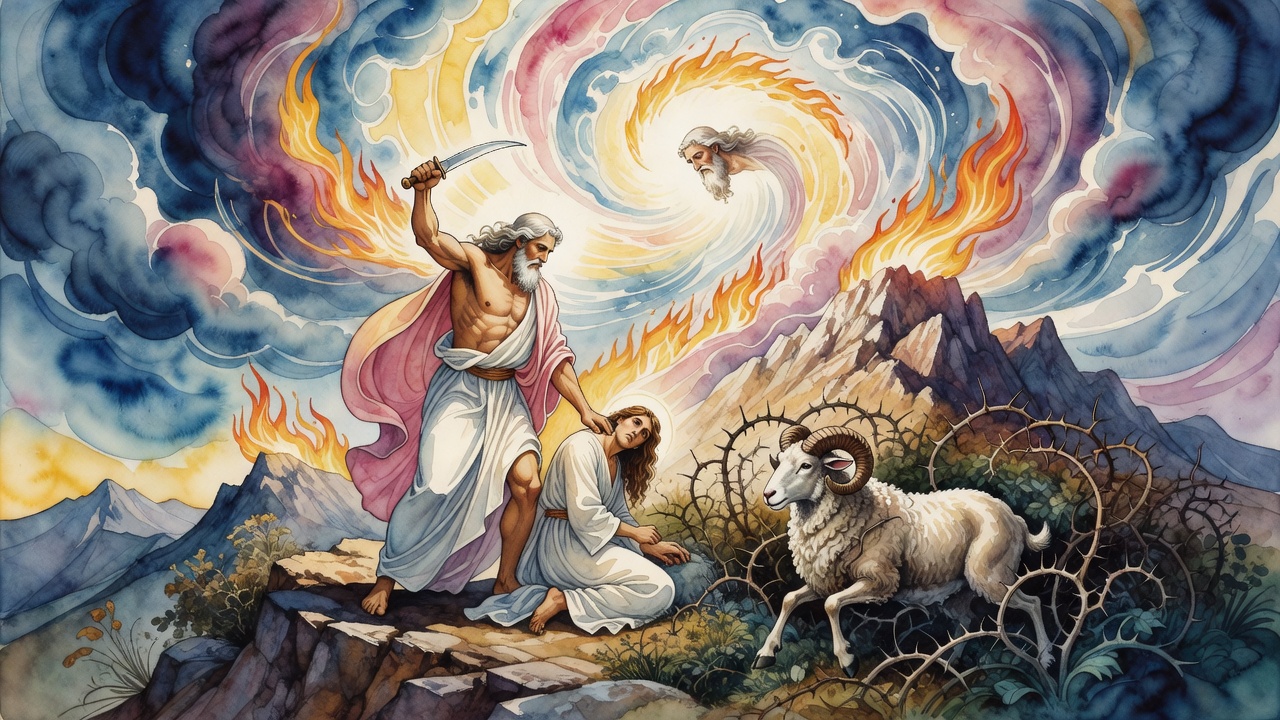
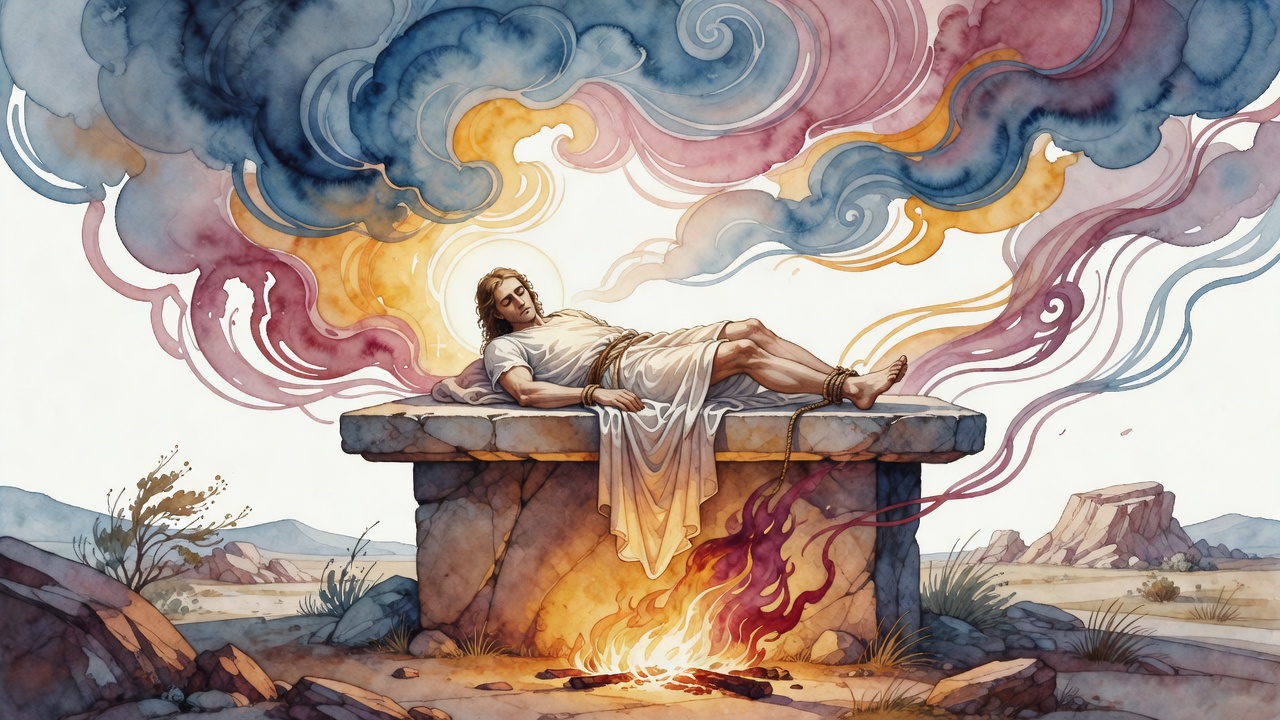
So Abraham did it himself, up to the last possible second, and Isaac lay on the wood with his father's hand on the knife and the whole sky holding still over both of them.

Then the ram came. It burned in his place, the smoke went up, and the two of them walked down the mountain together, which is the part everyone remembers. But the boy who came off that altar was not the boy who had gone up onto it. Heaven had taken delivery. The knife had stopped and the blood had stayed inside him, though the consecration did not come off with the ropes.

The Year the Wells Ran Thin

Hunger came into Canaan again in Isaac's own years, the way it had come in his father's. The grain went first, then the grass, and then every household in the hills was having the same argument, which was whether to go down to Egypt, since the river there does not care what the sky over Canaan is doing.

Isaac knew that road. His father had taken it once when the land turned on him and had come back up out of it richer than he went down, so there was no shame in it and no law against it. By the second bad month there was a man in Gerar willing to sell him pack animals.

You Are an Unblemished Offering

Then the word came, and it did not argue with him about the famine.

Stay in this land. You are an unblemished burnt-offering, and you know what happens to one of those. Carry a consecrated animal out past the hangings of the courtyard and it is finished, disqualified, no longer fit to go up on anything. Cross the border and the same thing happens to you.

He stood there with it. The road south was still open and still the sensible thing, and everyone he knew was going to take it before the month was out. What Moriah had done to him was not a memory he could leave behind in the house when he traveled; it was a fence, and it ran the whole length of the country's border, and he was inside it for good. He had walked three days to that mountain as a boy. He would spend the rest of his life not walking away from it.

Ishmael Had Called It Playing

He had been kept alive once before, and that time he had been too young to help.

Sarah had watched Ishmael with the boy in the yard and called what she saw playing, though the word is nothing like as soft as it sounds. Men on a field once said, let the young men get up and play in front of us, and the playing ended with twelve of them holding one another by the head with a sword in the other man's side, all of them down in the same instant. That was the game being played with Isaac.

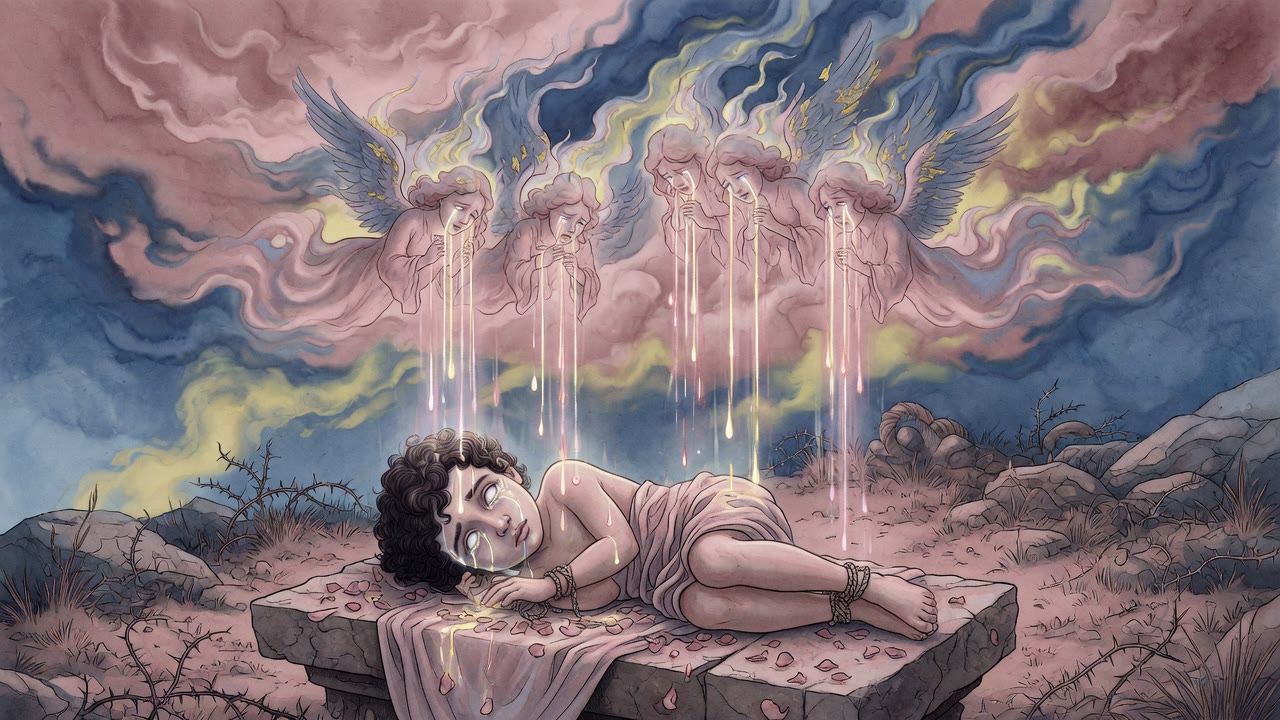
The eye of the Lord is on those who fear Him, on those who wait for His mercy, to deliver their soul from death and to keep them alive in famine (Psalms 33:18-19). Both halves of that verse were about the same child. The first half had already happened in the yard behind the tents. The second half was happening now, with the wells dropping a hand's width a week and the road to Egypt closed to exactly one man in Canaan.

A Portion Now and the Rest Held Back

The promise that came with the fence did not pretend to be small. To you and to your seed I will give all these lands. All of them, and not yet, because the wording keeps part of it back, a portion handed over now and the balance held on deposit for a time still coming. The man being told he could not cross one border was in the same breath handed a map he would never finish walking.

He stayed. He dug where his father had dug, and the herdsmen of Gerar came out and said the water was theirs, so he moved on and dug again, and they came again, and he moved again and dug a third time. He never got any closer to Egypt than the afternoon he stood in Gerar pricing donkeys. When the rain finally came back the offering was still inside the courtyard, arguing with shepherds over a hole in the ground, exactly where he had been left.


← All myths
From the tradition

Sources

3 sources

The texts behind this telling. Some cards carry a translation of the source; others are our own retelling of it, and each card says which. Every card links out to the original.

Yalkut Shimoni on Torah 111:8Yalkut Shimoni on Torah

Translation of the source text.Torat Emet (Yalkut Shimoni) · CC-BY-NC

"Sojourn in this land" (Genesis 26:3). [The Holy One, blessed be He, said to Isaac:] You are an unblemished burnt-offering. Just as a burnt-offering, if it goes outside the curtains [of the courtyard], is disqualified, so too you, if you go outside the land, are disqualified.

"For to you and to your seed I will give all these lands" (Genesis 26:3). "Ha-El" [these] teaches: only a portion of them. When do I give you the rest? In the time to come.

"Because Abraham obeyed My voice" (Genesis 26:5). At the age of forty-eight Abraham recognized his Creator. Rabbi Shimon ben Lakish said: at the age of three he recognized his Creator, as it is said, "because [ekev] Abraham obeyed," the numerical value of [the letters of] ekev being one hundred and seventy-two [the years Abraham lived after age three, by this reckoning].

Full source
Pesikta Rabbati 40Pesikta Rabbati

Retold in our words. Read the original at the link below.Rabbi Mike Feuer, Jerusalem Anthology · CC0

… And He said to him ‘go away to the land of Moriah and bring him up there for a burnt offering’ (Bereshit 22:2) What is the land of Moriah? There is a whole bundle of Sages here, each saying their own answer. R’ Yanai says ‘what is Moriah? The place from which awe and fear (morah and yirah) go out to the world,’ “You are feared, O God, from Your Sanctuary…” (Tehillim 68:36) R’ Chiya the elder says ‘the land from which instruction (hora’ah) goes out to the world,’ as it says “…for out of Zion shall the Torah come forth…” (Yeshayahu 2:3) Another explanation: the land from which, in the future, the Holy One will teach that the wicked should descend to gehinnom, as it says “Like sheep, they are destined to the grave; death will devour them, and the upright will rule over them in the morning, and their form will outlast the grave…” From where? “…his dwelling place (zevul).” (Tehillim 49:15) Another explanation of the land of Moriah. R’ Yehoshua ben Levi said ‘the land from which the righteous teach (morim) and make decrees upon the Holy One which He does,’ as it says “…and David and the elders, covered with sackcloth, fell upon their faces. And David said to God, "Did I not say to count the people?…I beg that Your hand be against me and against my father's house, but not against Your people for a plague." (Divre HaYamim I 21:16-17) Another explanation of the land of Moriah. R’ Yehudah bar Padiiya said ‘Moriah - he said to Gd, where is it? He replied – to the land which I will show (mareh) you.’ Another explanation of Moriah. Avraham said to Gd, Master of the World! But am I fit to offer sacrifices? Am I a kohen (a priest)? Let Shem the High Priest come and receive him from me. The Holy One replied to him – when you arrive at the place I will sanctify you and make you into a kohen. What is the meaning of Moriah? In exchange (temurah) for Shem. His replacement, as it says “He shall not exchange it or offer a substitute for it…” (Vayikra 27:10) Another explanation. What is Moriah? R’ Pinchas said ‘the land in which the master (maruto) of the world dwells,’ as it says “…and My eyes and My heart shall be there at all times.” (Melachim I 9:3) Another explanation. What is Moriah? R’ Shimon bar Yochai said ‘the land which was adorned opposite the altar above “…or cast down… (yaro yireh)” (Shemot 19:13) Another explanation. The land in which the incense is offered – “I will go to the mountain of myrrh (mor)…” (Shir HaShirim 4:6)

Full source
Midrash Tanchuma Buber, Toldot 5:5Midrash Tanchuma Buber, Toldot

Translation of the source text.Midrash Tanchuma (Buber), Public Domain, on Sefaria · CC-BY-SA

[Another interpretation of "Behold, the eye of the LORD is on those who fear Him":] This is Isaac. "On those who wait", for he was waiting in hope upon the Holy One, blessed be He. "To deliver their soul from death", for Ishmael sought to kill him, as it is said, "And Sarah saw the son of Hagar the Egyptian, making sport" (Genesis 21:9). And "making sport" means nothing other than killing, as it is said, "Let the young men now arise and play before us" (II Samuel 2:14). "And to keep them alive in famine", for the famine came in his days, as it is said, "And there was a famine in the land" (Genesis 26:1).

Full source