Parshat Vayera6 min read

Abraham Asked Isaac What He Saw on Moriah

On the third day Abraham stopped and asked his son what he saw. Isaac named a mountain wrapped in cloud. The servants named only desert.

Curated by Arthur · Told by Maggid ·
Table of Contents
  1. The Knife and the Missing Lamb
  2. Bind Me So I Do Not Spoil the Offering
  3. Abraham Refused an Angel's Order
  4. What the Road Cost on the Way Home

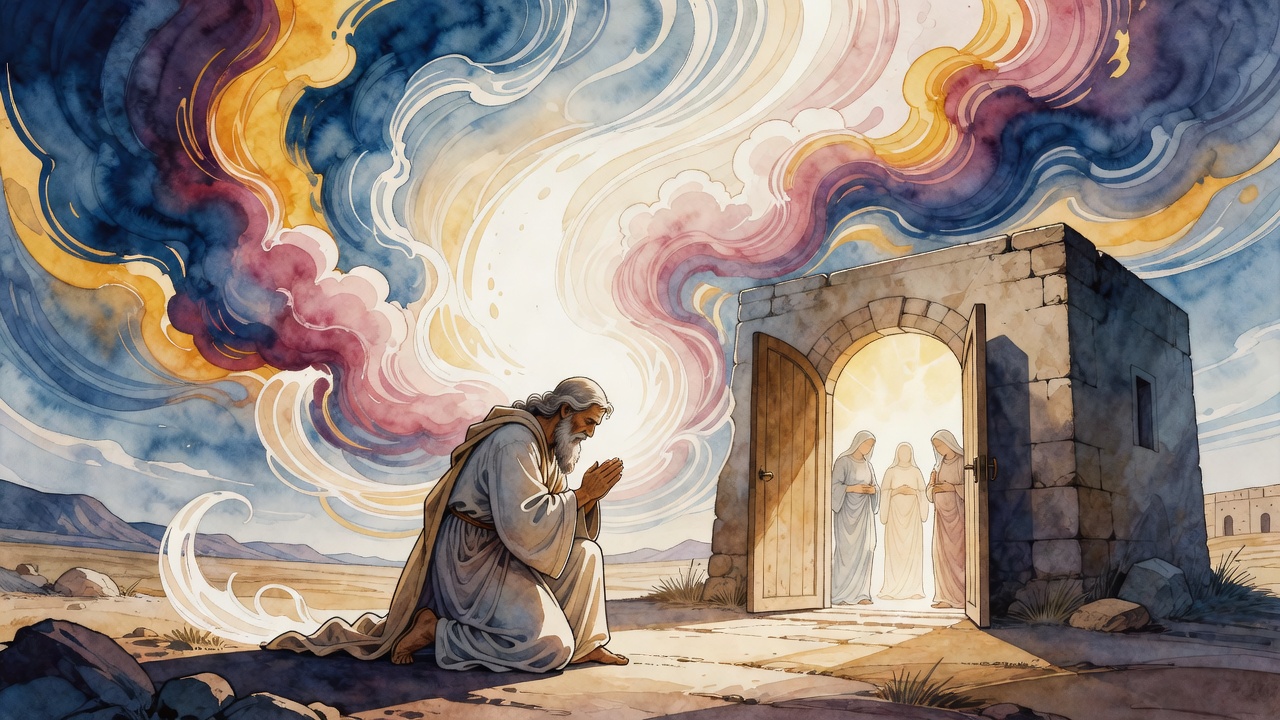
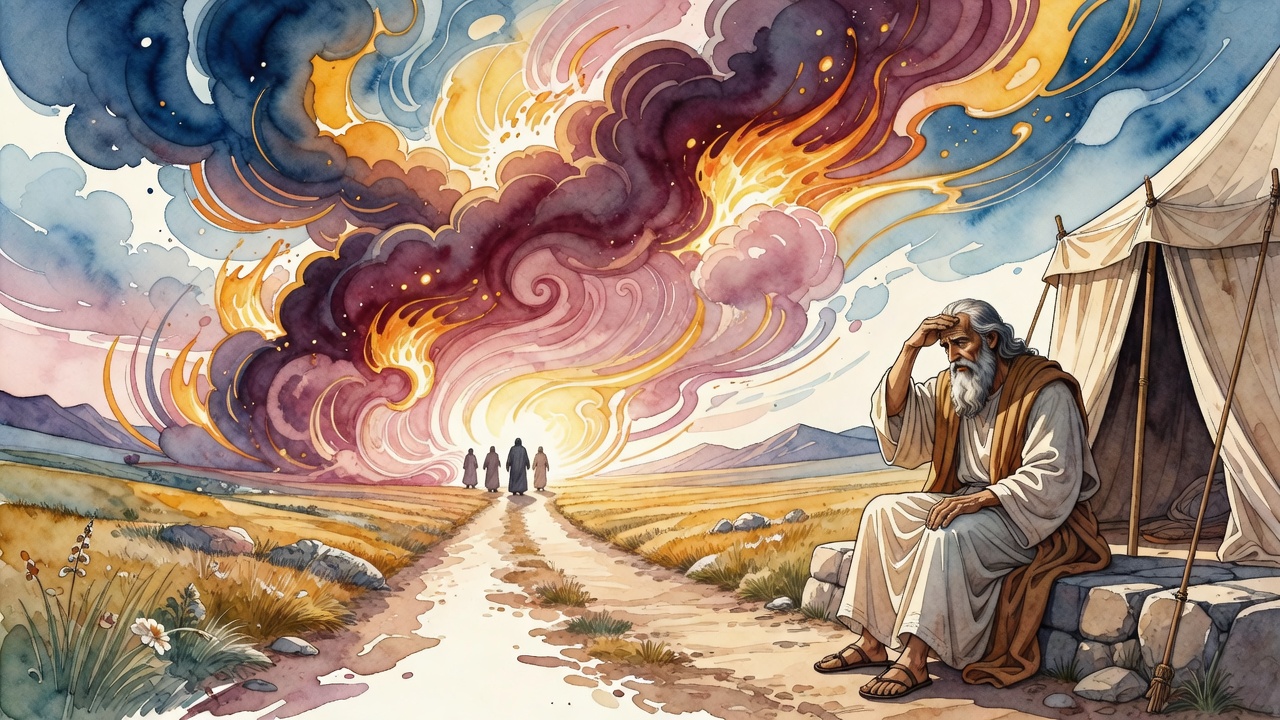
Abraham stopped on the third morning and lifted his face toward the ridge ahead. Dust clung to the hem of his robe. The knife rode hard against his hip. He did not look at the servants. He looked at the mountain.
Abraham Asked Isaac What He Saw on Moriah Click for full size

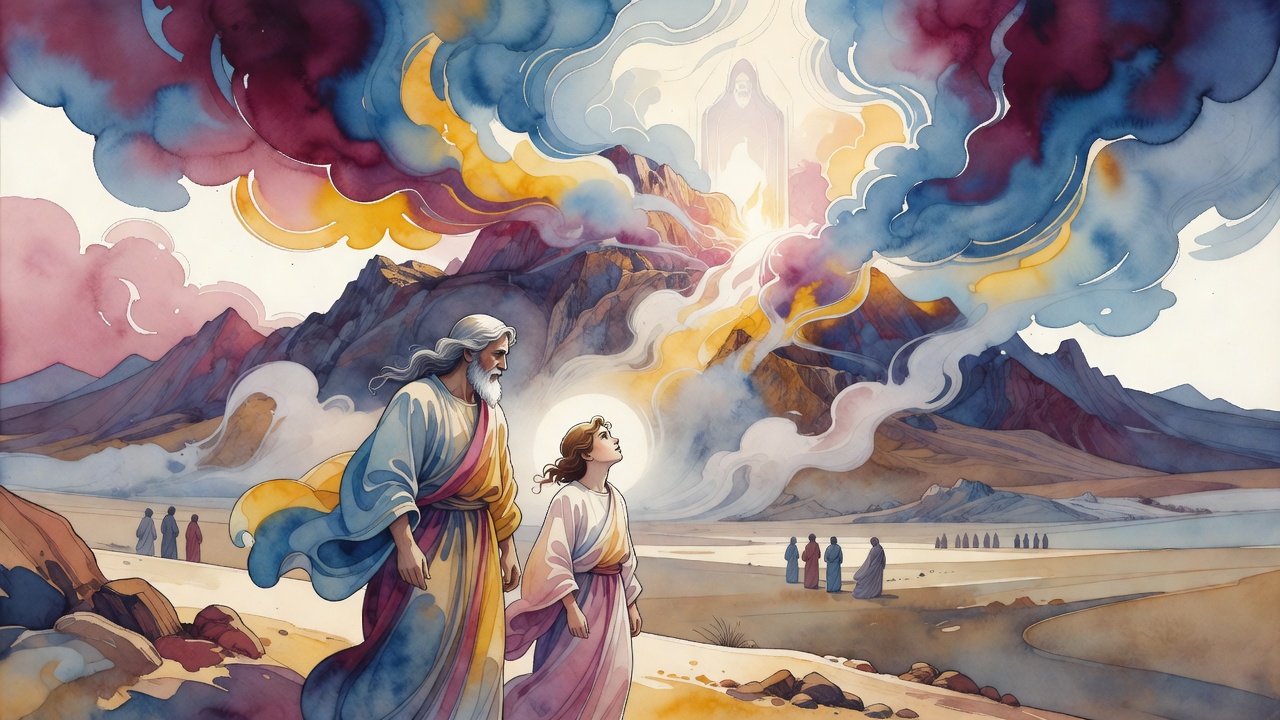
"Do you see what I see?" he asked Isaac.

Isaac was thirty-seven. His hands were already a man's hands. He shaded his eyes and answered without hesitation. "I behold a glorious mountain encircled by a cloud."

Abraham turned to the young men. "Do you see anything at all?"

They squinted at the same horizon. One rubbed grit from his lashes. "We see only desert," they said.

"Then abide with the ass," Abraham commanded. "The ass sees nothing, and you see nothing." He left them there like beasts that carry wood and never understand where the wood is going. The ass shifted its weight and snorted. The young men sat. Abraham and Isaac walked on alone.

The Knife and the Missing Lamb

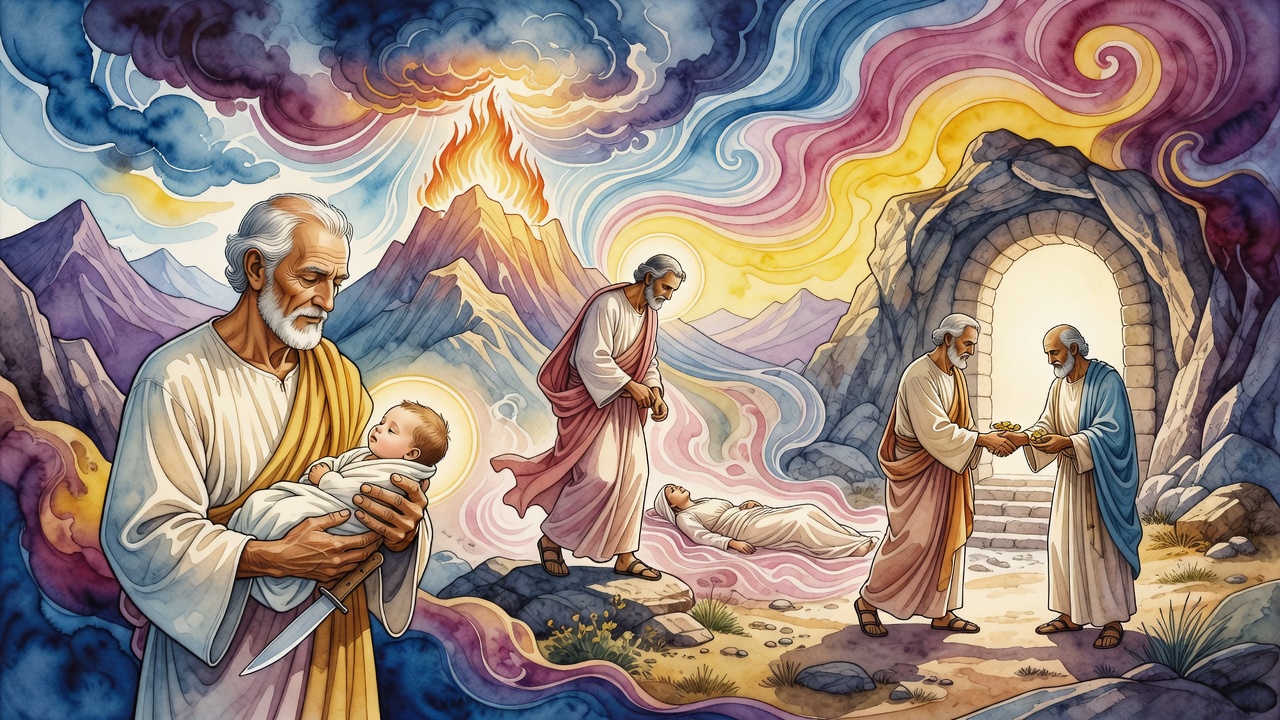
Abraham took fire and the slaughtering knife in his own hand. Isaac carried the wood on his back, the beams knocking his shoulders with every step. They walked yonder, toward the cloud, toward the place God had named. Abraham kept saying under his breath the old promise: so shall your seed be. He had told the servants they would worship and return. His mouth spoke peace. His body walked into a trial he himself had once invited when he begged heaven for a son and spoke of sacrifice in the heat of longing, then lived long enough to forget how heavy a vow can grow.

Wind pushed ash-smell up the slope. Isaac broke the quiet.

"My father."

"Here am I, my son."

"Behold the fire and the wood, but where is the lamb for a burnt offering?"

Fear seized Isaac the moment the question left him. His knees trembled. He had seen nothing prepared for the altar, and the absence told him more than any speech. He asked again, because the first answer might still be wrong. Abraham answered him straight. "Since you ask, the Holy One has selected you."

Isaac swallowed. Sweat ran into the corner of his mouth. "If He has chosen me, I will surrender my soul. But I am gravely concerned about my mother."

They went on together of one mind. One would slaughter. One would be slaughtered. The road did not fork. Father and son no longer looked like two men of the same age in every city. Trial had already begun to write years into Abraham's face, the mark he once asked for so the world could tell who must be honored first.

Bind Me So I Do Not Spoil the Offering

At the place God had shown him, Abraham built the altar stone by stone and arranged the wood. Isaac climbed up. The will to live was strong in him. He felt it rising like heat under his ribs, a living animal that did not care about heavens or vows.

"Father, bind my hands and feet," he said. "When I see the knife descending I may tremble, and the offering may become defective. Do not make me a blemished offering."

Abraham bound him. Rope bit into wrist and ankle. Isaac turned his face toward the empty air above the ridge and spoke one more charge. "Do not tell my mother about this while she stands at the edge of a pit or a roof, lest she hurl herself down and die."

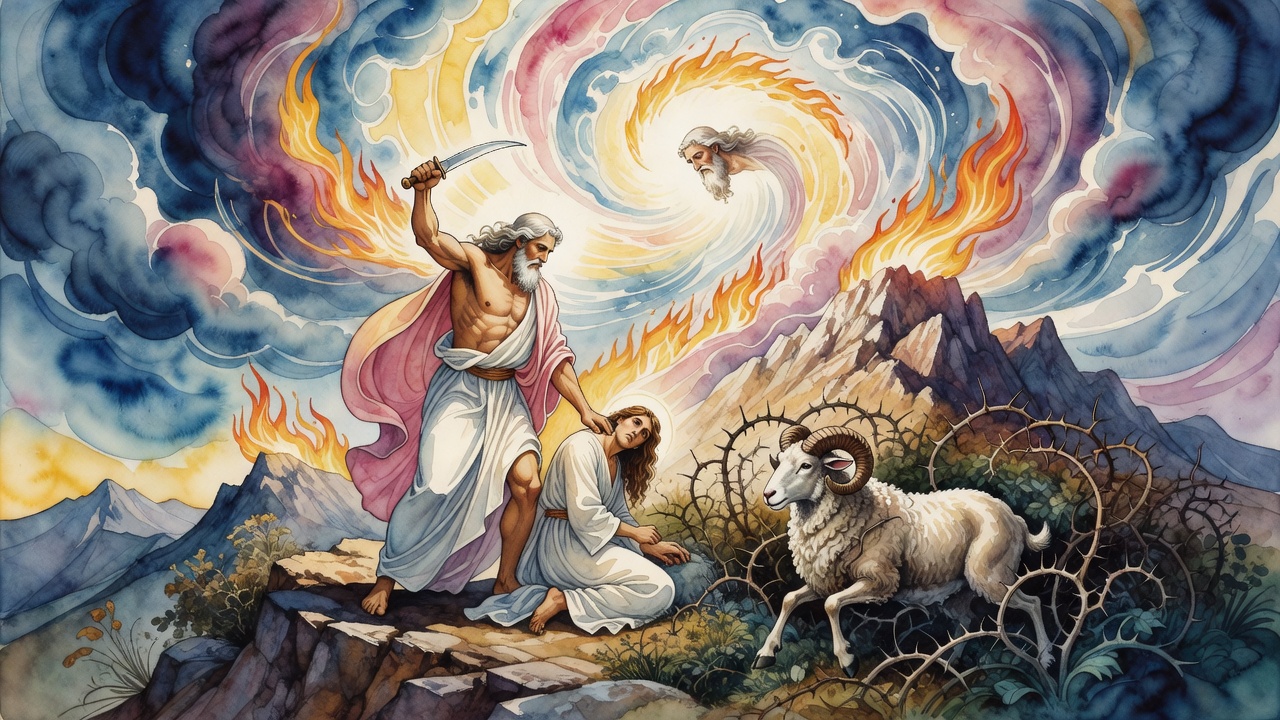
Abraham stretched forth his hand and took the knife. He meant to draw blood until a measure of it left the body. Ha-Satan, the Accuser who serves the court above, shoved the hand. The knife fell and rang on stone. Abraham stooped for it again, fingers scraping. A voice cut the sky. "Lay not your hand upon the lad."

If that voice had delayed another breath, Isaac would have been sacrificed. The rope still held. The wood still waited for fire that would not take a son.

Abraham Refused an Angel's Order

An angel of the Lord called twice, because Abraham was already hurrying toward the cut. "Abraham, Abraham." The first call did not stop him. He demanded the source of the command with the knife still near the rope.

"Who are you?"

"An angel."

"When I was commanded to take my son, the Holy One spoke to me," Abraham said. "If He now wishes to stop me, let Him tell me so."

Only then did heaven open a second time. Abraham stood over the bound body and argued upward. A man tests a companion because he does not know the heart. God knows the heart and the kidneys. Why this trial at all? Heaven answered that now it was known Abraham feared God. Abraham would not climb down. He swore he would not leave the altar until he spoke what he came to speak. He held God to the old star-count: seed through Isaac. He asked that when Isaac's children sin and suffer, heaven count the binding as if ashes already lay piled on the stones, and pardon them and release them from their anguish.

God told him to turn. Behind them a ram stood caught in a thicket by its horns, one of the ten things prepared from the twilight of the first Sabbath eve. Abraham untied his son. The ropes left red rings on Isaac's skin. They offered the ram. The horn that held the beast became, in the charge heaven laid on him, the horn Israel would blow when judgment comes near and mercy must be reminded of a mountain and a knife that did not finish its work.

What the Road Cost on the Way Home

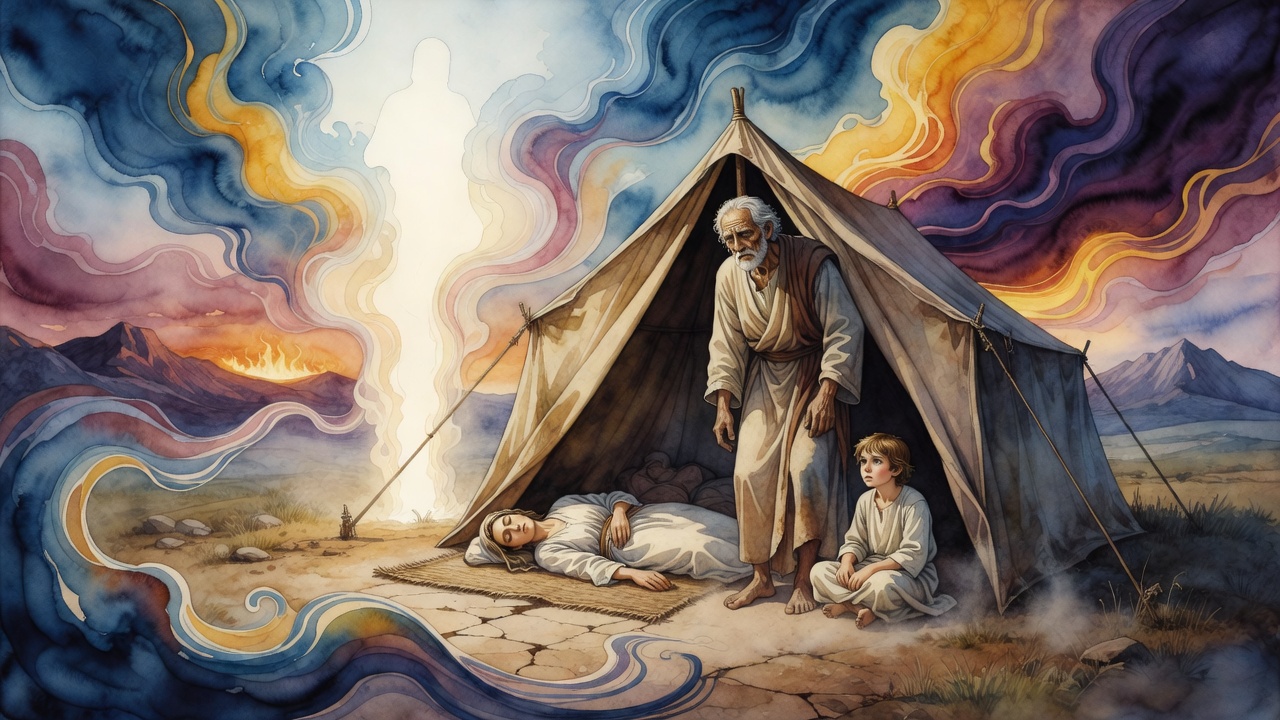
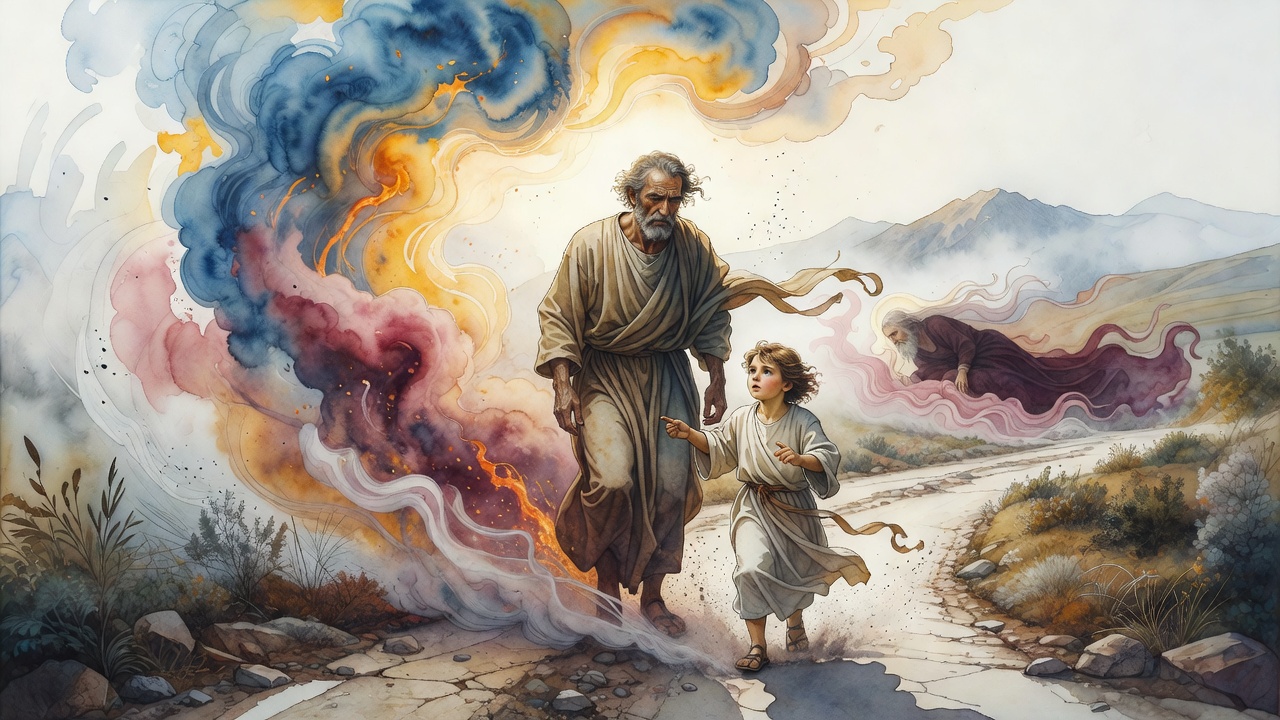
While the knife hung above Isaac, the Accuser went to Sarah in the guise of her son. She opened her arms. She asked what the father had done. The false Isaac told her of mountains, valleys, the altar, the rope, the blade. He said that only a cry from heaven had stopped the cut. Sarah fainted and died under that news, joy and terror collapsing into one. When Abraham came later to mourn and weep for her, he came from Moriah, still smelling of smoke and sheep's blood.

Isaac walked down the mountain with a body that had felt the rope. He did not speak much. Abraham walked with the trial written into his gait, white years and a vow kept and broken in the same hour. The cloud that only some eyes could see stayed behind them on the ridge. The servants waited with the ass in a desert that had never once looked like a mountain of glory. They rose when the two returned, and no one asked them what they had missed, because they still saw only sand.


← All myths
From the tradition

Sources

3 sources

The texts behind this telling. Some cards carry a translation of the source; others are our own retelling of it, and each card says which. Every card links out to the original.

Midrash Tanchuma, Vayera 23Midrash Tanchuma

Retold in our words. Read the original at the link below.Townsend 1989 translation of Midrash Tanhuma, S. Buber Recension · CC-BY

And he saw the place from afar off (Gen. 22:4). Abraham said to Isaac: “Do you see what I see?” “I behold a glorious mountain encircled by a cloud,” he replied. Then he asked his young men: “Do you see anything at all?” “We see only desert,” they answered. “Then abide with the ass,” he commanded, “for the ass sees nothing and you see nothing.” Abide ye here with the ass (ibid., v. 5), for ye are like unto them.

And I and the lad will go yonder (ibid.). What is meant by the word yonder (Heb. koh, which also means “thus, so”)? It means: “Let us see what will be the final outcome of koh. The Holy One, blessed be He, promised me: So (koh) shall thy seed be (Gen. 15:1).” And we will worship and come back to you (ibid. 22:5). His own mouth foretold him that they would both return in peace. And he took in his hand a fire and a knife (ibid., v. 6). Why was it called a slaughtering knife (ma’akhelet)? Because it made food (okhalin) suitable for eating.

Forthwith, And Isaac spoke unto Abraham, his father, and said: “My father.” And he replied: “Here am I, my son.” Then Isaac asked: “Behold the fire and the wood; but where is the lamb for a burnt-offering?” (ibid., v. 7). Immediately, an overpowering fear and violent trembling seized Isaac, for when he saw nothing to be sacrificed, he realized what was about to transpire. But he asked once again: “Where is the lamb for the burnt-offering?’ And Abraham responded: “Since you ask, the Holy One, blessed be He, has selected you.” “If he has chosen me,” Isaac replied, “I shall willingly surrender my soul to Him, but I am gravely concerned about my mother.” Nevertheless, they went both of them together (ibid., v. 8), of one mind: convinced that one was to slaughter and the other to be slaughtered. Isaac was thirty-seven years old at the time of his binding.

And they came to the place which God had told him of … and bound Isaac, his son (ibid., v. 9). As Abraham was about to slaughter him, Isaac cried out: “Father, bind my hands and feet, for the will to live is strong within me, and when I see the knife descending, I may tremble and the offering may become defective (as a result of the knife slipping). I implore you not to make me a blemished offering.” The Abraham stretched forth his hand and took the knife to slay his son (ibid., v. 10). Isaac said to him: “Father, do not tell my mother about this while she is standing at the edge of a pit or a roof lest she hurl herself down and die.” After they had constructed the altar, Abraham bound Isaac upon it and took the knife in hand to slaughter him until a fourth of a measure of blood would flow from his body, Satan appeared and pushed Abraham’s hand, causing the knife to fall. As he reached out to grasp the knife again, a voice emanated from heaven, saying: Lay not thy hand upon the lad (ibid., w. 13). If this had not happened, Isaac would certainly have been sacrificed.

While all this was transpiring, Satan visited Sarah in the guise of Isaac. When she saw him she asked: “What did your father do to you, my son?” He replied: “My father led me over mountains and through valleys until we finally reached the top of a certain mountain. There he erected an altar, arranged the firewood, bound me upon the altar, and took a knife to slaughter me. If the Holy One, blessed be He, had not called out, Lay not thy hand upon the lad, I would have been slaughtered.” He had hardly completed relating what had transpired when she fainted and died, as it is written: And Abraham came to mourn for Sarah, and to weep for her (ibid. 23:2). From where did he come? From Moriah.

When he was about to slaughter Isaac, an angel of the Lord called out to him from heaven, saying: Abraham, Abraham (ibid. 22:11). Why was his name repeated? Because he was hastening to slaughter him. And He said: Lay not thy hand upon the lad (ibid., v. 12). Abraham asked: “Who are you?” And he replied: “An angel.’ Thereupon Abraham retorted: “When I was commanded, Take now thy son, it was the Holy One, blessed be He, who spoke to me; if He now wishes to stop me, let Him tell me so.”

Thereupon, And the angel of the Lord called unto Abraham out of heaven a second time (ibid., v. 15), for he had refused to heed the first call. Then Abraham cried out to the Holy One, blessed be He: “Master of the Universe, a man tests his companion because he does not know what is in his heart, but You know what is in the heart and the kidneys, the seat of deliberation. Surely, You did not need to test me.” He answered: Now, do I know that thou art a God-fearing man (ibid., v. 12).

Thereupon, the Holy One, blessed be He, opened the sky and the cloud (surrounding Him) and said: “By myself have I sworn,” saith the Lord (ibid., v. 16). “You have sworn.” Abraham replied, “and now I swear that I shall not descend from this altar until I say what I wish to say.” “Speak,” He answered. “Did You not tell me,” said Abraham, “Count all the stars, if thou be able to count them; so shall thy seed be (Gen. 15:5)?” “Yes,” He replied. “But from whom shall my seed descend?” queried Abraham. “From Isaac,” the Holy One answered. “It was in my heart, yesterday, to remind You that You told me that Isaac was my seed, when You said to me: Take him for a burnt-offering. But I restrained myself and did not challenge You. Therefore, when Isaac’s descendants sin and are being oppressed, recall the binding of Isaac, reckon it as if his ashes were piled upon the altar, and pardon them and release them from their anguish.”

The Holy One, blessed be He, answered: “You have spoken what was in you heart, now I will say what I wish to say. In the future Isaac’s descendants will sin against Me, and I will judge them on Rosh Hashanah (the Jewish New Year). If they want Me to discover something to their credit, and to recall for their advantage the binding of Isaac, let them blow upon this shofar.” Abraham asked: “What shofar?” The Holy One, blessed be He, said: “Turn around. Then it was that Abraham lifted up his eyes, and looked, and behold, behind a ram caught in the thicket by his horns (Gen. 22:13). This was one of the ten things that were created at twilight.

A ram caught in the thicket by his horns (ibid.). The Holy One, blessed be He, said to Abraham: “Let them blow upon the ram’s horn to Me, and I will save them and redeem them from their sins.” This is what David meant when he sang: My shield and my horn of salvation, my high tower (Ps. 18:3). Then I shall remove the yoke of exile from them and comfort them in the midst of Zion, as it is said: For the Lord hath comforted Zion (Isa. 51:3). Amen.

Full source
Tanchuma, Vayera 23Midrash Tanchuma

Translation of the source text.Midrash Tanchuma -- Torat Emet · Public Domain

"And he took in his hand the fire and the knife" (Genesis 22:6). Why is it called a ma'akhelet (knife)? Because it makes foods fit (okhalin) for a person's mouth.

"And they came to the place of which God had told him, and he bound Isaac his son" (Genesis 22:9). When he came to slaughter him, Isaac said to him: Father, bind my hands and my feet, because the soul is brazen, and when I see the knife perhaps I will tremble and the offering will be rendered unfit. I beg of you, do not make a blemish in me.

Immediately the two of them built the altar, and he bound him upon the altar, and he took the knife in order to slaughter him until a quarter of his blood should go out from him. Then Satan came and pushed the hand of Abraham, and the knife fell from his hand. And as he stretched out his hand to take it, a heavenly voice went forth and said to him from heaven: "Do not stretch out your hand against the lad" (Genesis 22:12).

The Holy One, blessed be He, said to him: Thus, when the children of Isaac sin and enter into distress, the binding of Isaac shall be remembered on their behalf, and it shall be reckoned before You as though his ashes were heaped upon the altar, and You shall forgive them and redeem them from their distress.

Full source
Midrash Tanchuma, Noach 14Midrash Tanchuma

Retold in our words. Read the original at the link below.Townsend 1989 translation of Midrash Tanhuma, S. Buber Recension · CC-BY

And he planted a vineyard (Gen. 9:20). Noah was one of four men who introduced four things. Noah introduced planting, as it is written: And he planted a vineyard; cursing when he said: Cursed be Canaan (Gen. 9:25); slavery when he said: He shall be slave unto his brothers (ibid.); and drunkenness when he drank of the wine, and was drunken (ibid., v. 21).

Abraham introduced old age, trials, hospitality, and legacies. He introduced old age, for whenever he and his son entered a city, the inhabitants were unable to determine which of them was the elder of the two (and therefore the one) to be honored. Abraham was disturbed by this, and so he said: Master of the Universe, how shall one distinguish between father and son? The Holy One, blessed be He, replied: Be assured, I will begin with you (to distinguish between father and son), as it is said: Abraham was old (Gen. 24:1).

Trials. Abraham said to the Holy One, blessed be He: Master of the Universe, if You had made the generation of the flood feel secure, they would not have angered You or rebelled against You by saying: Depart from us (Job 21:14). Thereupon, the Holy One, blessed be He, said to him: I shall begin with you (to try men). And He tried him through his son (who was to be offered as a sacrifice), as it is written: And the child grew, and was weaned, etc. (Gen. 21:8).

R. Oshaya and R. Abin differed over the meaning of this verse. One said: He was weaned from his good inclination; while the other insisted: He was weaned from his evil inclination.

Hospitality. For it is said: And he planted a tamarisk tree (ibid., v. 33). R. Nehemiah stated: “Tamarisk tree” (alef-shin-lamed) contains the same letters as the word “ask” (shin-alef-lamed). Whenever a man approached him, Abraham would say: “Ask what you desire, and I will give it to you.” And he built an inn at the crossroads.

Legacies. As it is said: Unto the sons of his concubines Abraham gave gifts (Gen. 25:6).

Moses introduced priestcraft, priesthood, sacrifice, and the law. He introduced priestcraft when he officiated as priest for seven days during the inauguration (of the priesthood); priesthood when He appointed Elazar the son of Aaron to the office of priest in the Temple, as it is said: And the chief over the princes of the Levites was Elazar the son of Aaron the priest (Num. 3:32); sacrifice, for it is said: And Moses made the whole head ram smoke upon the altar; it was a burnt offering (Lev. 8:20); and law, for it is written: And I will give to thee the tablets of stone and the law and the commandments (Exod. 24:12). Balaam instituted gambling, plaiting the hair, sorcery, and unchastity. Hence, Noah was one of four men who introduced four things.

Full source