Parshat Vayera5 min read

Abraham Lifts the Knife Then Sees the Ram

A Moabite king once burned his own firstborn on a city wall to buy a battle, and the smoke bought nothing. On the mountain, Isaac's wrists felt the rope.

Curated by Arthur · Told by Maggid ·
Table of Contents
  1. The Climb Without a Second Son
  2. The Five-Second Edge
  3. Horns in the Thicket
  4. Smoke That Means Something Else
Abraham Lifts the Knife Then Sees the Ram Click for full size

The Climb Without a Second Son

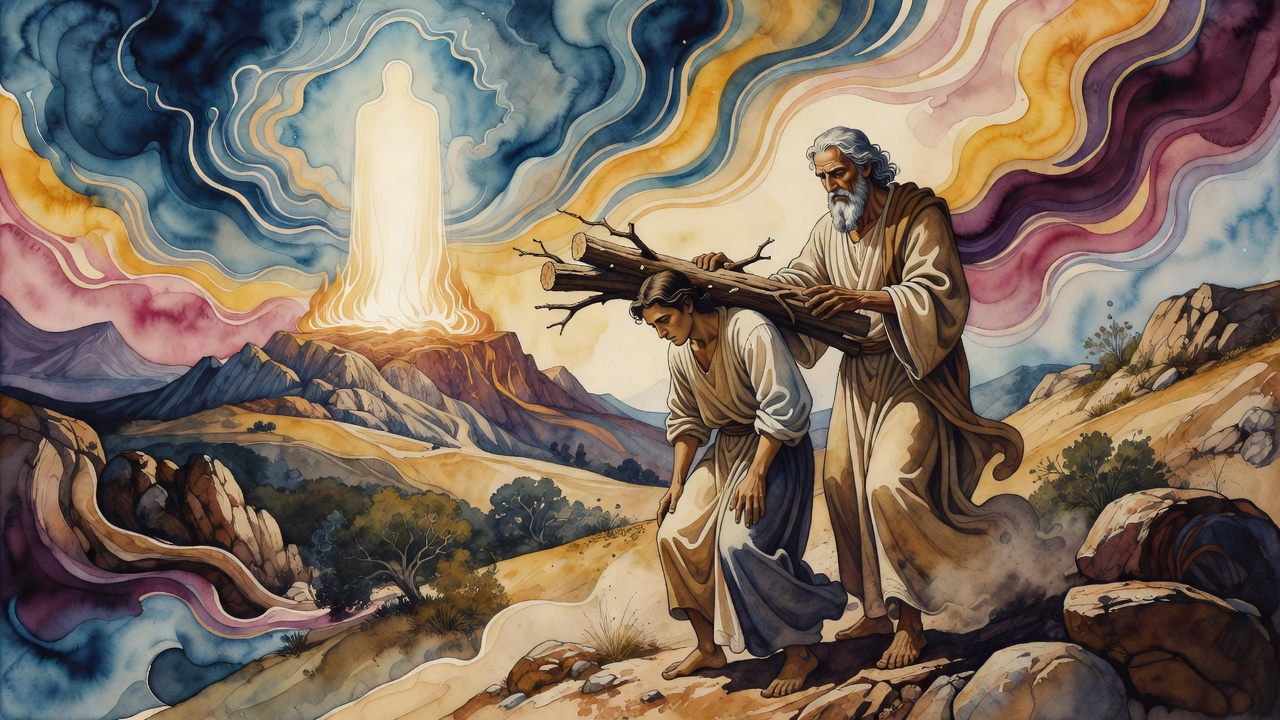
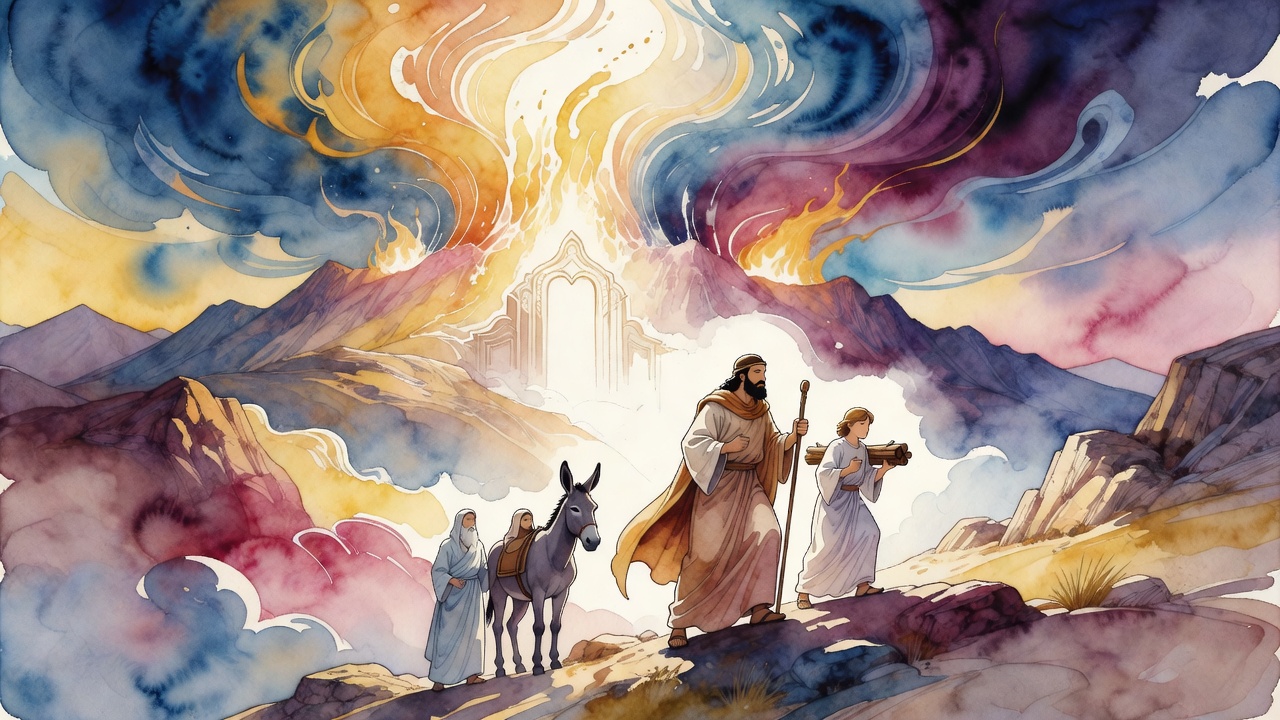
Abraham walked with wood, fire, and a knife, and with Isaac beside him asking where the lamb was. The mountain rose like a question that refused small answers. Servants stayed below with a donkey that chewed nothing important. Father and son climbed into thinner air.

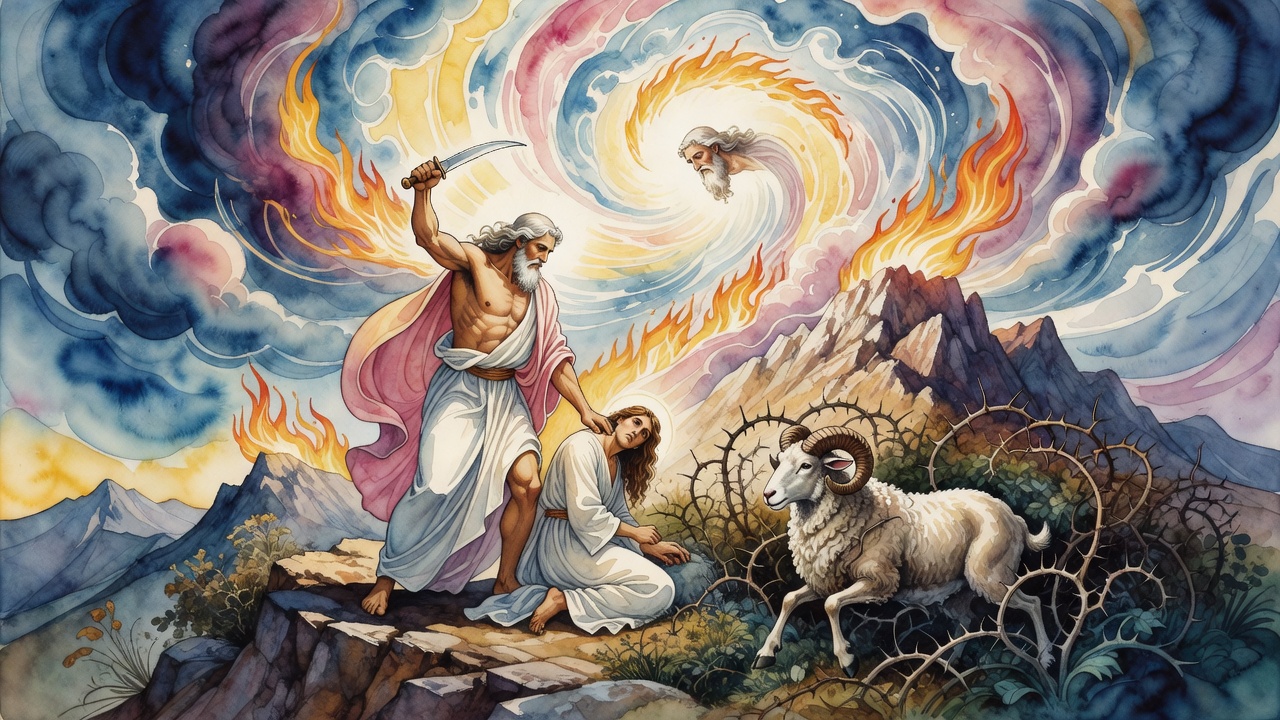
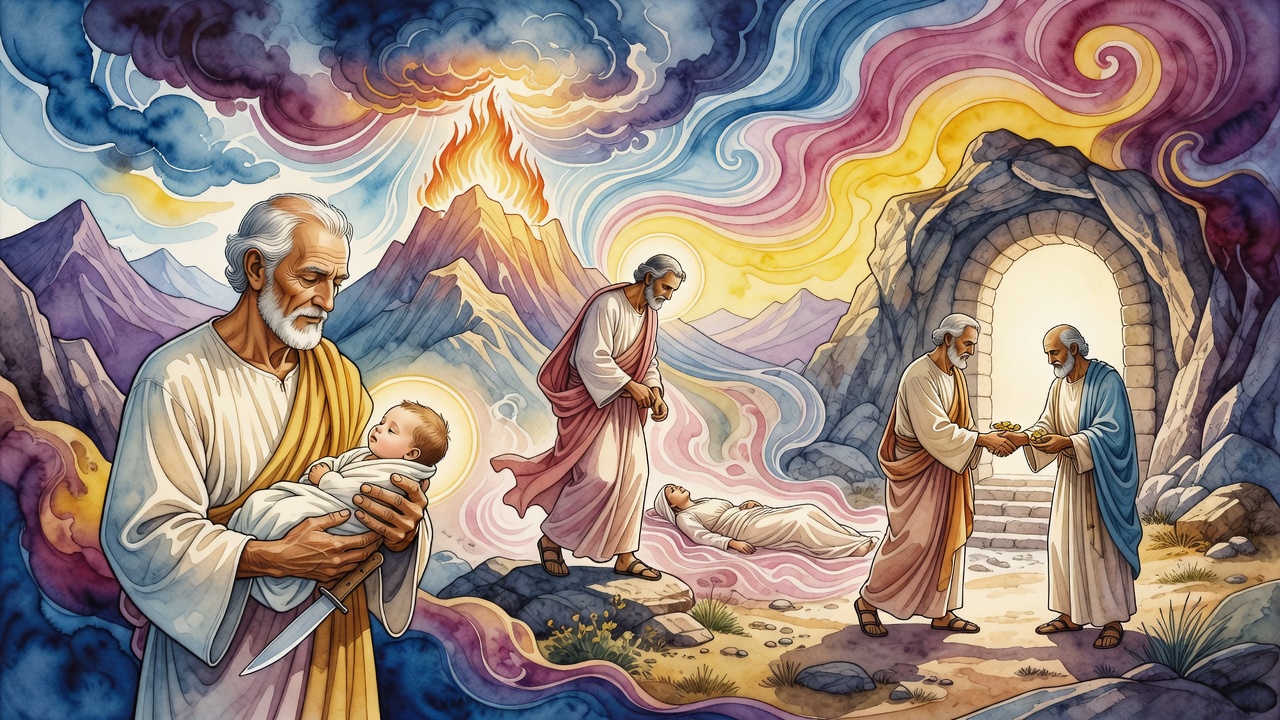
When the altar was built and the son bound, intention became as heavy as blood. Heaven was watching a willingness that most kings never reach even when they kill. A Moabite king named Meisha once burned his firstborn on a wall to buy a battle (II Kings 3:27). Smoke rose. The transaction failed the only court that matters. Micah's questions still hang in the air: shall I give my firstborn for my transgression (Micah 6:6-7)? One father offers a child as panic currency. Another offers obedience and is stopped before the cut.

Isaac's wrists felt the rope. Abraham's mouth was dry as the wood. Neither man made a speech for an audience. The mountain was enough of a witness.

The Five-Second Edge

Abraham's arm rose. Isaac's throat waited. The world narrowed to leather, skin, and a silence so loud it hurt the ears. Wind held its breath in the brush. Then the voice that had asked for the son asked for the son back. The knife did not finish its arc. What heaven took was the heart that would have finished it.

That is why the near-sacrifice counts as full and Meisha's completed rite counts as empty. Intention under command is not the same as desperation under idols. Abraham's love was tested without becoming a bargain for military weather. Isaac lived because the test was never a market.

Abraham's hands shook when he unbound the ropes. Isaac stood with the mark of almost-death already written in his eyes. For five seconds the knife had been the whole sky. After those seconds, the sky returned to being sky, and a father had to learn how to lower a blade without dropping his faith.

Blood that was never spilled still stained the hour. Mercy does not always feel soft. Sometimes it feels like a stopped motion in the shoulder.

Horns in the Thicket

Abraham lifted his eyes and saw a ram caught in the thicket by its horns after this (Genesis 22:13). He took the ram and offered it in place of his son. The little phrase "after this" opens a long future. The ram frees itself from one tangle and walks into another. So will Abraham's children move through kingdoms that snare and release and snare again.

Babylon. Medea. Greece. Edom. Four thickets. Four exiles. The animal thrashing in brush becomes a map of history worn on horns. Each time the people entangle in sin and misfortune, the sound of those horns returns as shofar (שופר), the ram's horn, blown until memory softens judgment.

On Rosh Hashanah the yearly entanglement meets the yearly blast. God remembers. Forgiveness finds a schedule. Zechariah hears the Lord God sound the shofar (a ram's horn) and protect (Zechariah 9:14-15). The mountain of the binding lends its horn to every later morning of return.

Abraham watched the ram's struggle before he took it. Freedom and snare alternating in one body. That rhythm would outlive both of them.

Smoke That Means Something Else

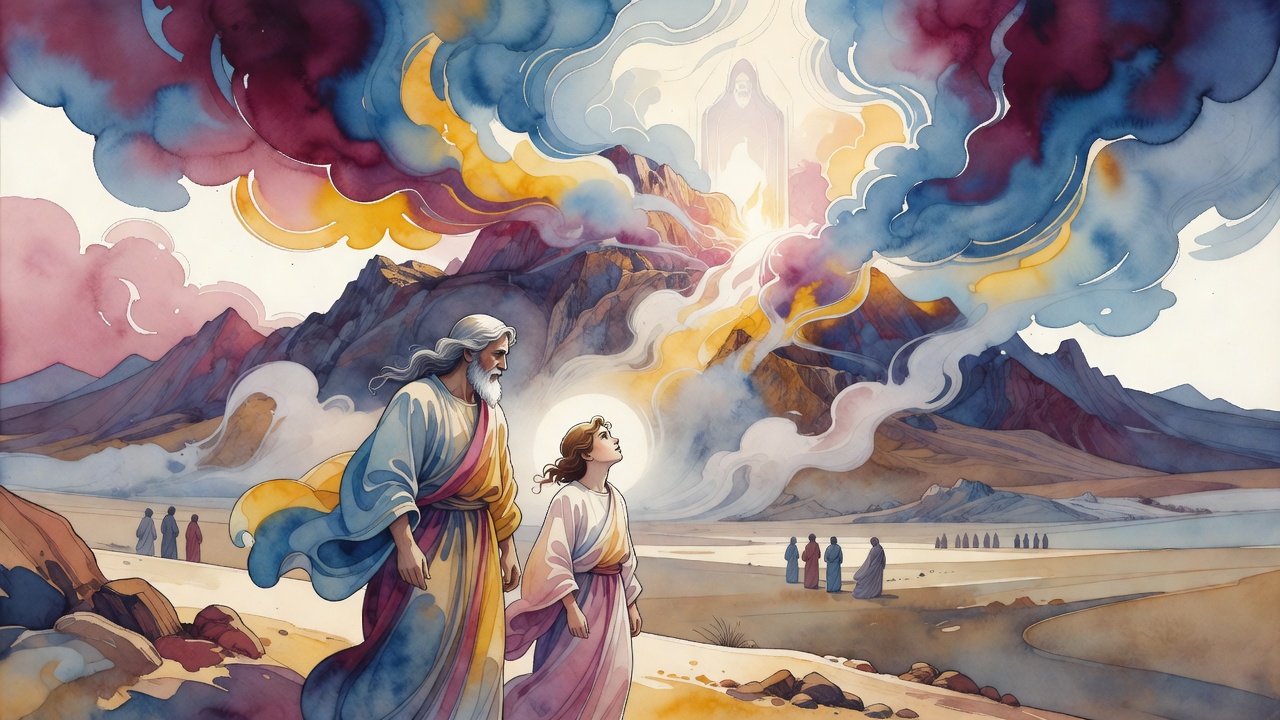
Abraham named the place by the seeing that saved them. Isaac walked down with a life restored and a story he would never tell lightly. Below the mountain, servants waited with a donkey that knew nothing of thickets or knives. Above, a ram's blood answered a command that had already been answered by restraint.

Later generations will confuse sacrifice with leverage and call panic piety. The mountain refuses the confusion. The accepted offering is the one heaven stops, then replaces with a ram whose horns keep preaching after the altar cools. Israel's traps are real. So is the blast that cuts them open.

Abraham leads Isaac home. Behind them the thicket still holds broken branches where a substitute struggled into prophecy. Ahead of them, every shofar note will taste faintly of that struggle, of a knife that rose and did not fall, of a father who learned that the Holy One wants the heart without collecting the child's breath as payment.

At the foot of the slope Isaac touched his own neck once, lightly, as if checking that skin still belonged to a living boy. Abraham saw the gesture and said nothing. Some mercies are too large for small talk on a path.

That night the campfire cracked like small bones. Isaac slept hard and woke once with the rope-memory on his wrists. Abraham watched the dark line of the mountain and heard, already, a horn that had not yet been carved from any ram. The future thickets were not visible. The substitute's smoke still hung in his clothes. He kept the knife, cleaned it, and did not pretend the climb had been ordinary travel.


← All myths
From the tradition

Sources

2 sources

The texts behind this telling. Some cards carry a translation of the source; others are our own retelling of it, and each card says which. Every card links out to the original.

Bereshit Rabbah 55:5Bereshit Rabbah

Retold in our words. Read the original at the link below.The Sefaria Midrash Rabbah, 2022 · CC-BY

Bereshit Rabbah turns to Should a Father Sacrifice His Son for Redemption.

The first reading, this verse seems to be about Meisha, the king of Moab. As we read in II (Kings 3:27), Meisha, facing defeat in battle, took his own son and offered him as a burnt offering to his god. A horrifying act. But Rabbi Yehoshua of Sikhnin, quoting Rabbi Levi, offers a completely different take. He says that while the verse appears to be about Meisha, it's really about Isaac. Yes, Isaac, of the Akeidah – the Binding of Isaac.

Wait, what? How can that be? Isaac wasn't actually sacrificed! That's the whole point! God stopped Abraham at the last second!

Exactly. And that's precisely the point the Rabbis are making. The Midrash (rabbinic interpretive commentary) continues by quoting more of Micah (6:6-7): “With what shall I approach the Lord, and bow to God on High? …Does the Lord desire thousands of rams, with tens thousands streams of oil? Shall I give my firstborn for my transgression?"

The Rabbis are highlighting a crucial distinction: with Isaac, God accepted the intention, the willingness, the near-sacrifice, as if it were the real thing. But with Meisha, even though he actually went through with the act, it was not accepted.

Why? What makes the difference?

The key isn’t simply the act itself, but the heart behind it. Abraham’s willingness to sacrifice Isaac was a demonstration of his complete and utter devotion to God. It was a test of faith, and Abraham passed with flying colors. God knew Abraham's heart.

Meisha’s sacrifice, on the other hand? It was an act of desperation, a last-ditch attempt to appease his deity and win a battle. It was a transaction, not an act of love or faith. It lacked the crucial element of pure, unadulterated intention.

So, what can we learn from this?

Perhaps it’s a reminder that God looks beyond our actions to the motivations behind them. It's about the kavanah (intention) we bring to our deeds. Are we acting out of love, faith, and a genuine desire to connect with the Divine? Or are we simply going through the motions, hoping to get something in return?

This Midrash invites us to examine our own intentions. Are we living a life of genuine meaning, driven by a sincere desire to connect with something greater than ourselves? Or are we just going through the motions, hoping to get by? The answer, as always, lies within our hearts.

Full source
Bereshit Rabbah 56:9Bereshit Rabbah

Retold in our words. Read the original at the link below.The Sefaria Midrash Rabbah, 2022 · CC-BY

Bereshit Rabbah turns to The Ram Caught in the Thicket and Temple Prophecy.

What does it really mean? The Torah tells us, “Abraham lifted his eyes and saw that behold, there was a ram, after this, which had been caught in the thicket by its horns. Abraham went, took the ram, and offered it up as a burnt offering in place of his son” (Genesis 22:13). That little phrase, “after this” – acharei zaken – is a tiny door opening into a vast landscape of interpretation.

Our sages, confronting this very question, offer some truly remarkable insights in Bereshit Rabbah. Rabbi Yudan suggests that “after” refers to all the times in the future when Israel will stumble, become entangled in sin, and face hardship. But ultimately, Rabbi Yudan says, they will be rescued by the sound of the ram’s horn – the shofar. He connects this to the prophecy in Zechariah (9:14-15): “The Lord God will sound the shofar…[the Lord of Hosts will protect them…].”

Rabbi Yehuda bar Simon echoes this sentiment, saying that “after many generations,” when Israel is caught in transgressions and misfortunes, the shofar will be their salvation. Again, he quotes Zechariah: “The Lord God will sound the shofar.”

And Rabbi Ḥanina bar Rabbi Yitzḥak takes it a step further. He says that every single day of the year, we become entangled in our failings. But on Rosh Hashanah, the Jewish New Year, we sound the shofar, and God remembers us and forgives us. The shofar becomes a yearly reset, a chance for renewal.

Then Rabbi Levi brings in a slightly different, and quite poignant, interpretation. He envisions Abraham seeing the ram repeatedly freeing itself from one thicket only to become ensnared in another. God tells Abraham that this foreshadows the future of his descendants: they are destined to become entangled in the four kingdoms – Babylon, Medea, Greece, and Edom – each representing a period of oppression and exile. This is a reference to the visions in the Book of Daniel, chapters 2 and 8. But even then, ultimate redemption will come through the sound of the shofar.

The text goes on to explore the word tachat, meaning "in place of." "Abraham went, took the ram, and offered it up as a burnt offering in place of [tachat] his son." Rabbi Banai offers a powerful prayer that Abraham makes: "Master of the universe, consider this ram’s blood as though it were the blood of Isaac my son, its fats [burnt on the altar] as though they were the fats of Isaac my son." It's as if Abraham is asking God to accept the sacrifice of the ram as a complete substitute for the sacrifice he was willing to make with Isaac. Rabbi Banai then connects this to a teaching about substitutionary offerings.

Rabbi Pinḥas adds another layer, suggesting Abraham prayed that God consider it as though he had sacrificed Isaac first and then the ram. He draws a parallel to the verse in II (Kings 15:7), "Yotam his son reigned after him [tachtav]." Just as Yotam didn't replace his father but reigned after him, Abraham is asking God to see both sacrifices as valid and meaningful.

The Midrash (rabbinic interpretive commentary) concludes by referencing a Mishna from Nedarim (1:3) about vows and offerings, and various rabbis offer different analogies for the ram: Rabbi Yoḥanan compares it to the sheep of the daily offering. Reish Lakish says it's like Isaac's ram. Others compare it to a sin offering or even a miraculous lamb that never suckled. Bar Kapara imagines it as a lamb created specifically for this moment.

What’s so striking about all these interpretations is their focus on the future. It's not just about Abraham and Isaac on that mountaintop. It's about us, about the Jewish people, about the challenges we face and the hope for redemption that echoes through the ages. The Akeda, the binding of Isaac, becomes a template for understanding our own struggles and finding solace in the promise of divine intervention. The shofar, blown each year, reminds us that even in the darkest of times, hope remains. It's a call to remember, to repent, and to believe in the possibility of a brighter future.

Full source