5 min read

Isaac Asks for the Lamb and Learns He Is It

On the road to Moriah Isaac names the missing lamb. Abraham answers with the truth, and Sarah dies before they reach home again.

Curated by Arthur · Told by Maggid ·
Table of Contents
  1. The Answer That Did Not Slow the Walk
  2. The Question Abraham Had to Ask Twice
  3. The Cords and the Ram
  4. The Tent With Nobody In It
  5. Three Years, and Then Rebecca

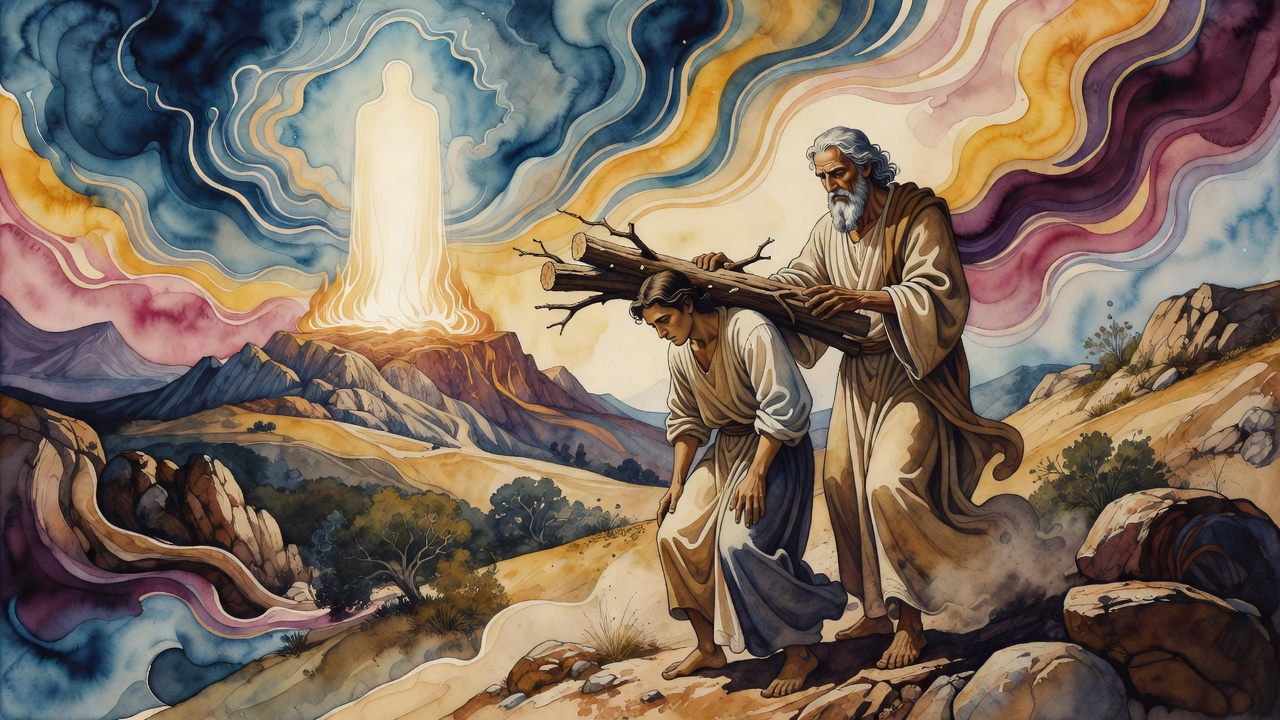
Isaac carried the wood, so he was the one who could count. His father had the fire and the knife, he had the load on his back, and between them, on a rope, there should have been an animal balking the way animals balk on a climb. There was no rope. They had walked three days and he had not asked, because as long as he did not ask, the lamb could still be waiting somewhere up the mountain.
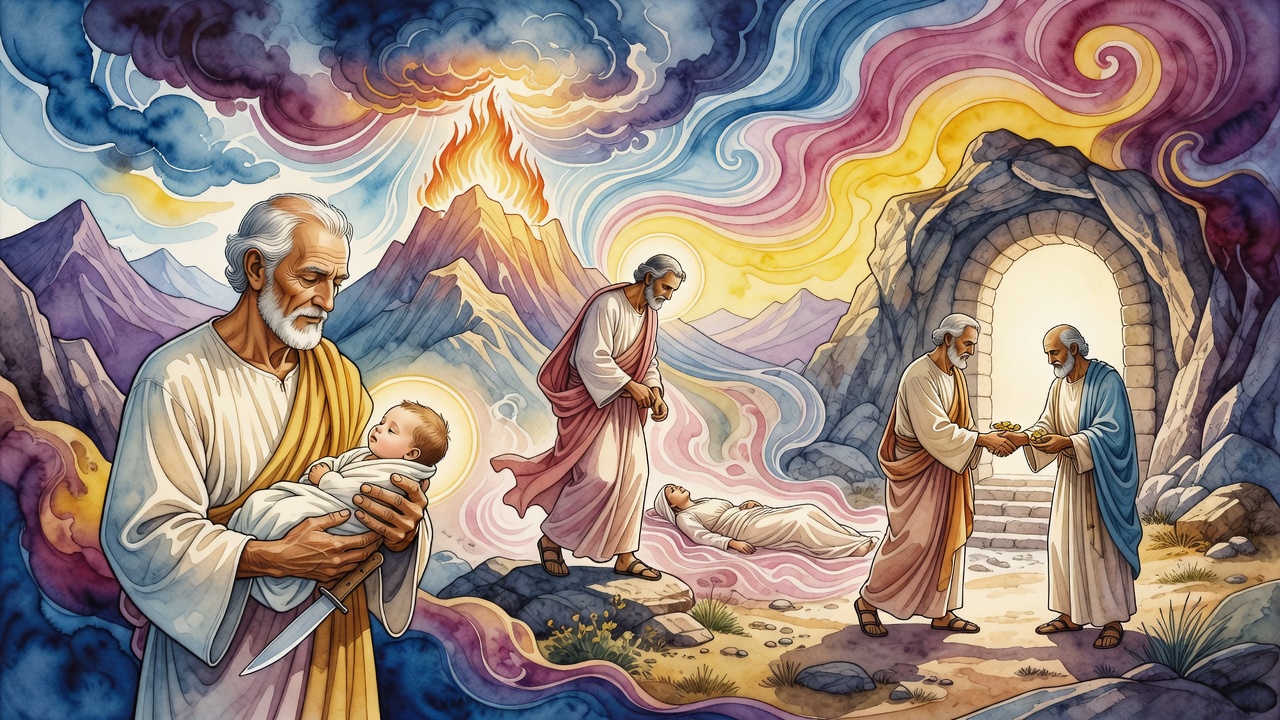
Isaac Asks for the Lamb and Learns He Is It Click for full size

He asked on the last stretch. "Behold, the fire and the wood," he said, "but where then is the lamb for a burnt offering before the Lord?" (Genesis 22:7). It did not come out soft. He had already worked it out and he wanted the words said aloud by the man who had been carrying them for three days.

The Answer That Did Not Slow the Walk

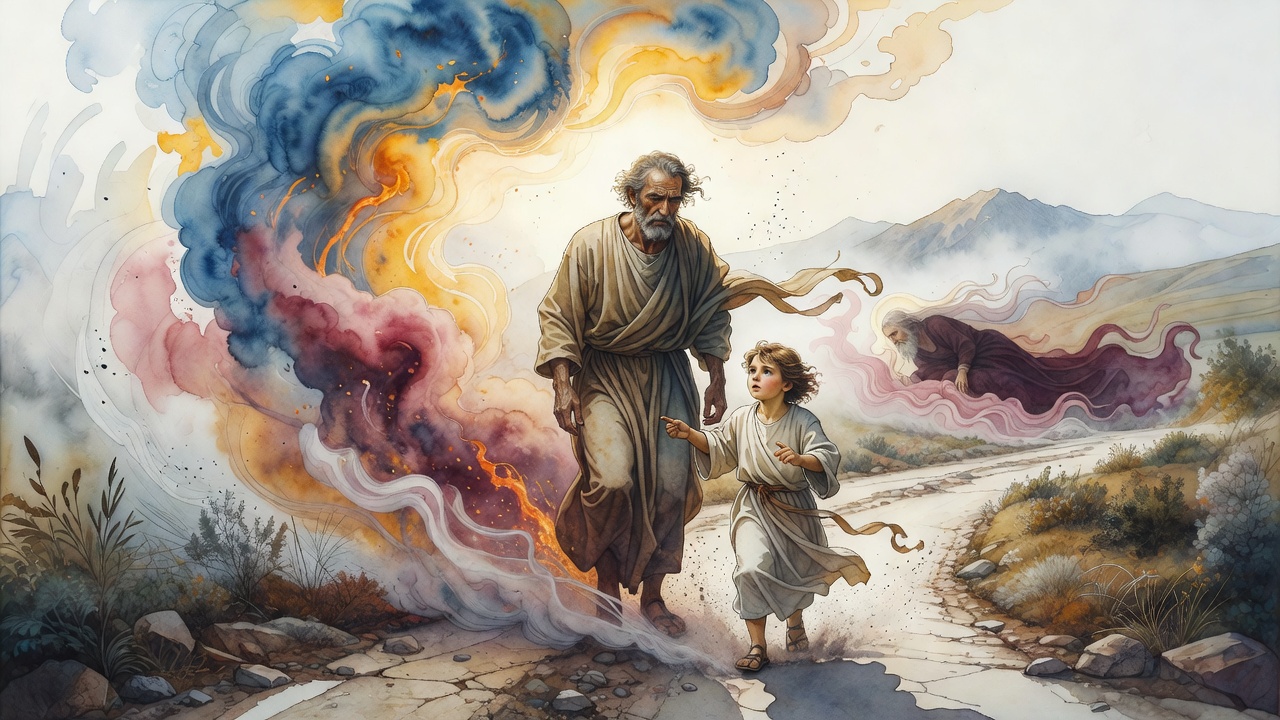
Abraham had a riddle ready if he wanted it, since the plain words about God seeing to the lamb would have held for another hour, but he did not use them. "The Lord hath chosen thee, my son, for a perfect burnt offering, instead of the lamb."

Nothing stopped. That was the part Isaac could not have braced for, if a boy can brace for anything on a road like that one: the sandals kept lifting the same dust in the same rhythm, and his father kept the fire steady at the same height, and the mountain sat exactly where it had been sitting before the sentence was spoken. He shifted the bundle because the strap had begun to cut into him. He was carrying the fuel for his own body and his shoulder had no opinion about it. There was a taste like a coin somewhere behind his teeth.

The Question Abraham Had to Ask Twice

Isaac did not run, and he did not ask for a year or a week. "I will do all that the Lord hath spoken to thee with joy and cheerfulness of heart."

That answer came out too clean, so Abraham pushed at it. "Is there in thy heart any thought or counsel concerning this which is not proper? Tell me, my son, I pray thee. Conceal it not from me." He needed the yes to hold weight, because a yes that cracks on the altar cracks in front of Heaven, and nothing up there can be repaired afterward.

Isaac swore by the life of the Lord and by his father's own soul that nothing in him had bent to the right or the left from the word that had been spoken, that neither limb nor muscle had stirred on account of it, and that he was joyful and cheerful in the matter, and blessed was the Lord who had chosen him this day to be a burnt offering. Abraham had asked for a flinch and had not been given one. There was nothing left to do but climb.

The Cords and the Ram

On the height the cords went on and the wood went under him, and because both of them had already said everything there was to say, the work went quickly. The knife came up. The knife stopped. A ram had a horn caught in a thicket and did not get free in time, so it burned in Isaac's place, though the cords had already left their marks on him and the marks stayed while it burned.

The Tent With Nobody In It

Abraham came down the mountain with his son walking beside him, which should have made that the lightest road of his life. Then he came to mourn for Sarah (Genesis 23:2). She had died while the two of them were gone, so the last she ever knew of Isaac was the morning he went out with the wood on his back, and there was nobody in the world who could go back and tell her the knife had stopped.

Isaac walked into a tent that had a body in it. He had been carried up a mountain to die and had been sent home alive instead, and the price had been paid anyway, in a room he was not standing in.

Three Years, and Then Rebecca

He mourned her three years. Three years is long enough to learn the shape of a tent without the person who used to be in it, and Isaac was not a man who did anything by halves, since he had already proved on Moriah how still he could hold.

Then Rebecca came up the road with Abraham's servant, and Isaac brought her into the tent that had been his mother's, and he forgot the mourning for his mother. Not because three years had used it up, and not because a son's love is cheap. Until a man marries, his love sits with his parents, but when he marries, the love of his soul cleaves to his wife, as it is said, therefore shall a man leave his father and his mother and shall cleave unto his wife (Genesis 2:24). The commandment to honor did not go anywhere. The weight moved.

The boy who had asked for the lamb was a married man in his mother's tent, and for the first time since Moriah there were two people breathing under that cloth.


← All myths
From the tradition

Sources

2 sources

The texts behind this telling. Some cards carry a translation of the source; others are our own retelling of it, and each card says which. Every card links out to the original.

Legends of the Jews 5:232Legends of the Jews

Retold in our words. Read the original at the link below.The Legends of the Jews by Louis Ginzberg (1909) · Public Domain

Legends of the Jews turns to Abraham, The Binding of Isaac.

The Torah gives us a glimpse, but the Legends of the Jews by Louis Ginzberg, drawing on centuries of midrashic (rabbinic interpretive commentary) tradition, fleshes it out, giving us a deeply human and profoundly moving exchange.

The scene: father and son, walking side by side. Isaac, ever observant, breaks the silence. "Behold, the fire and the wood," he says to Abraham, "but where then is the lamb for a burnt offering before the Lord?" A simple question, yet loaded with unspoken dread.

Abraham's response? It's not the curt, almost evasive answer we find in the biblical text. Instead, according to the Legends of the Jews, Abraham says, "The Lord hath chosen thee, my son, for a perfect burnt offering, instead of the lamb."

Pause for a moment. Can you feel the weight of those words? The unimaginable grief and faith intertwined?

And Isaac's reaction is even more startling. He doesn't recoil in horror. He doesn't plead for his life. Instead, he says, "I will do all that the Lord hath spoken to thee with joy and cheerfulness of heart."

Joy? Cheerfulness? How can that be? Is this blind obedience? Or something more profound?

Abraham, still confronting the enormity of it all, presses his son further. "Is there in thy heart any thought or counsel concerning this which is not proper? Tell me, my son, I pray thee! O my son, conceal it not from me." He needs to know. He needs to be absolutely certain.

And Isaac, in a moment of breathtaking selflessness, responds, "As the Lord liveth, and as thy soul liveth, there is nothing in my heart to cause me to deviate either to the right or the left from the word that He hath spoken unto thee. Neither limb nor muscle hath moved or stirred on account of this, nor is there in my heart any thought or evil counsel concerning this. But I am joyful and cheerful of heart in this matter, and I say, Blessed is the Lord who has this day chosen me to be a burnt offering before Him."

It's a powerful statement, evidence of Isaac's unwavering faith and trust. Was this truly Isaac's own will, or was it simply an acceptance of his father's authority? Did he understand the full implications of his sacrifice?

Perhaps the most compelling element of this legend is the sheer humanity on display. We see a father struggling with an impossible command, a son confronting his own mortality. It's a reminder that even in the most sacred of stories, we can find echoes of our own lives, our own struggles with faith, duty, and sacrifice.

The Akeidah isn't just about divine testing. It's about the agonizing choices we face, the difficult conversations we must have, and the enduring power of love and faith, even in the face of the unthinkable. What does this story tell us about the nature of sacrifice? About the relationship between parent and child? And about the depths of our own capacity for faith? These are the questions that linger long after the story ends.

Full source
Pirkei DeRabbi Eliezer 32:10Pirkei DeRabbi Eliezer

Retold in our words. Read the original at the link below.Pirke de Rabbi Eliezer, trans. Rabbi Gerald Friedlander, London (1916) · CC-BY

Pirkei DeRabbi Eliezer turns to Sarah, The Binding of Isaac.

The Pirkei DeRabbi Eliezer, a fascinating collection of stories and interpretations from around the 8th century, tells us that Abraham’s return from Mount Moriah was filled with sorrow. Remember, he'd just been through the unimaginable ordeal of the Akeidah, the binding of Isaac. He was returning, "And Abraham came to mourn for Sarah" (Gen. 23:2). He came home to find Sarah had passed away.

The Pirkei DeRabbi Eliezer doesn't linger on the immediate grief. Instead, it offers a poignant observation about love, loss, and the shifting tides of family.

Rabbi José offers a fascinating insight into Isaac's life after Sarah's death. He suggests that Isaac mourned his mother for three long years. Three years of grief, of absence, a shadow hanging over everything.

Then, after those three years, Rebecca enters the picture. Isaac marries her, and, according to Rabbi José, he "forgot the mourning for his mother." Now, that might sound harsh, but let’s consider what’s really being said here.

The text continues with a powerful observation: "Hence thou mayest learn that until a man marries a wife his love centres in his parents. When he marries a wife his love is bestowed upon his wife, as it is said, 'Therefore shall a man leave his father and his mother, and shall cleave unto his wife' (Gen. 2:24)."

This isn’t about abandoning familial duty. It's about the natural progression of love and commitment. Does a man then leave his father and mother with reference to the precept, "Honour"? Of course not! The Torah commands us to honor our parents.

But, the text clarifies, "the love of his soul cleaves unto his wife." The Hebrew word used here, davaq, translated as "cleave," is powerful. It suggests a deep, almost mystical connection. It's the same word used when describing Shechem's love for Dinah in (Genesis 34:3), "And his soul clave (unto Dinah)." And it echoes again in the verse about marriage, "And he shall cleave unto his wife" (Gen. 2:24).

The implication is clear: Marriage creates a new center of gravity. It doesn’t erase the past, or diminish the love for one's parents, but it establishes a new primary bond, a new foundation upon which to build a life.

And it all started with Abraham's long walk home from Mount Moriah.

Full source