Abraham Let Lot Choose First and Steered Him Left
Two men own a measure of wheat and a measure of barley. However the offer is phrased, the first man walks off with the wheat. Abraham made Lot that offer.
Table of Contents
 Click for full size
Two Herds in One Valley
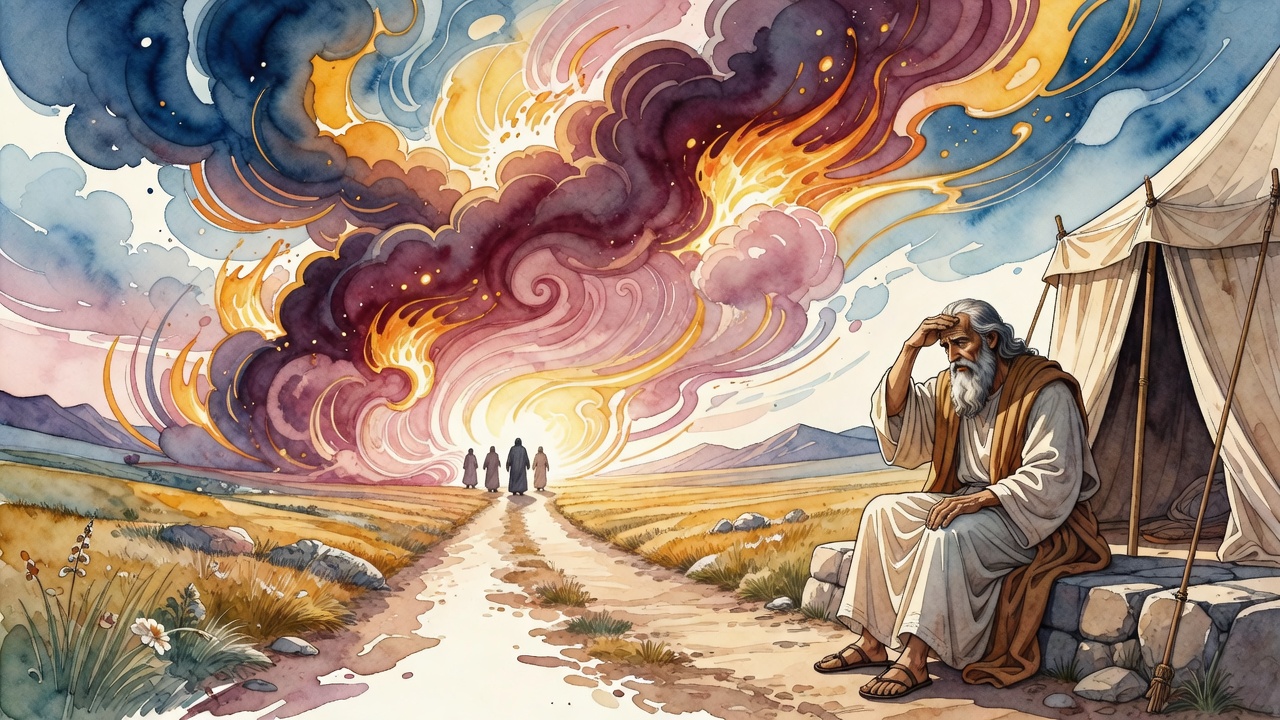
The herdsmen were fighting again. Abraham's men and Lot's men had been pushing their flocks onto the same thin grass for months, and the shouting had stopped being about grass. Canaanites and Perizzites were camped close enough to watch two households of foreigners come apart over pasture.
Abraham had carried this nephew out of Haran with him. He had gone to war to get him back once. Now he walked over and said the sentence that ends a family.
"Let there be no strife between me and you, or between my herdsmen and your herdsmen, because we are brothers. The whole land is in front of you. Separate from me. If you take the left, I will go to the right. If you take the right, I will go to the left."
It is the most generous thing a senior man ever says to a junior one. Lot took the first pick, because the first pick is what he had just been handed.
The Man Who Always Ends Up With the Wheat
Rabbi Hanina bar Pappa had a picture for what Abraham had just done.
Two men hold two measures of grain between them, one of wheat and one of barley, and whose is whose has not been settled. The first man speaks up. If yours is the barley, then mine is the wheat. And if mine is the wheat, then yours is the barley. Either way, I am taking the wheat.
Said quickly it sounds like arithmetic. It is not arithmetic. It is one man building a sentence with only one exit while the other man nods along, because he has been asked a question and a question feels like a choice.
Abraham Said It Twice and Not the Same Way
Rabbi Hanina ben Rabbi Yitzhak heard the trap in Abraham's Hebrew. Abraham did not say esmola, I will go to the left. He said asme'ila, which is one letter longer and means something else. Not I will go left. I will put you left.
In that language the right hand is where a wise man keeps his heart. The left is where a fool keeps his.
So the courteous offer had a floor under it, and the floor did not move. Take whichever side of the valley you want. Whichever one you take, you are the one going left.
The same sorting runs on down the family. Jacob, running from Laban, loaded his sons onto the camels first and his wives after them. Esau took his wives first, then his sons, and left his daughters, who could least look after themselves, for last. Right hand and left hand, in the order a man loads a camel.
Lot Lifted His Eyes Toward the Plain
Lot looked. That is the whole of his side of it. He lifted his eyes and saw the plain of the Jordan watered everywhere, green the entire length of it, and he counted water and did not count anything else.
He struck his tents and moved east and pitched as far over as Sodom, whose men were wicked and sinners against God, exceedingly. He had chosen to raise his household at their gate because the grazing was good.
Abraham stayed up on the dry ridge with the harder ground and the fewer animals and watched the dust of his nephew's herds go down into the green.
The Judge Who Gave the Signal
Generations later the phrase was still in use, and it still had a hand attached to it. A man would come before Rabbi Yehuda HaNasi for judgment and lose, and if he accepted the ruling that was the end of the matter. If he lost and would not accept it, the Nasi would turn to a member of his household and say, "Cause him to go left," and give the signal, and the man would be struck from the other side and put out of the room.
Nothing figurative about it in that courtroom. A word, a gesture, and a man standing on the wrong side of the floor.
Abraham never raised a hand or a voice. He offered his nephew the whole country and the first choice of it, and by the time the smoke came up off the plain, the arithmetic inside that offer had finished its work. Lot was down in the good grass. Abraham was on the ridge, watching what the good grass had cost.
← All myths