6 min read

Abraham Marched on the Four Kings With Eliezer and an Angel

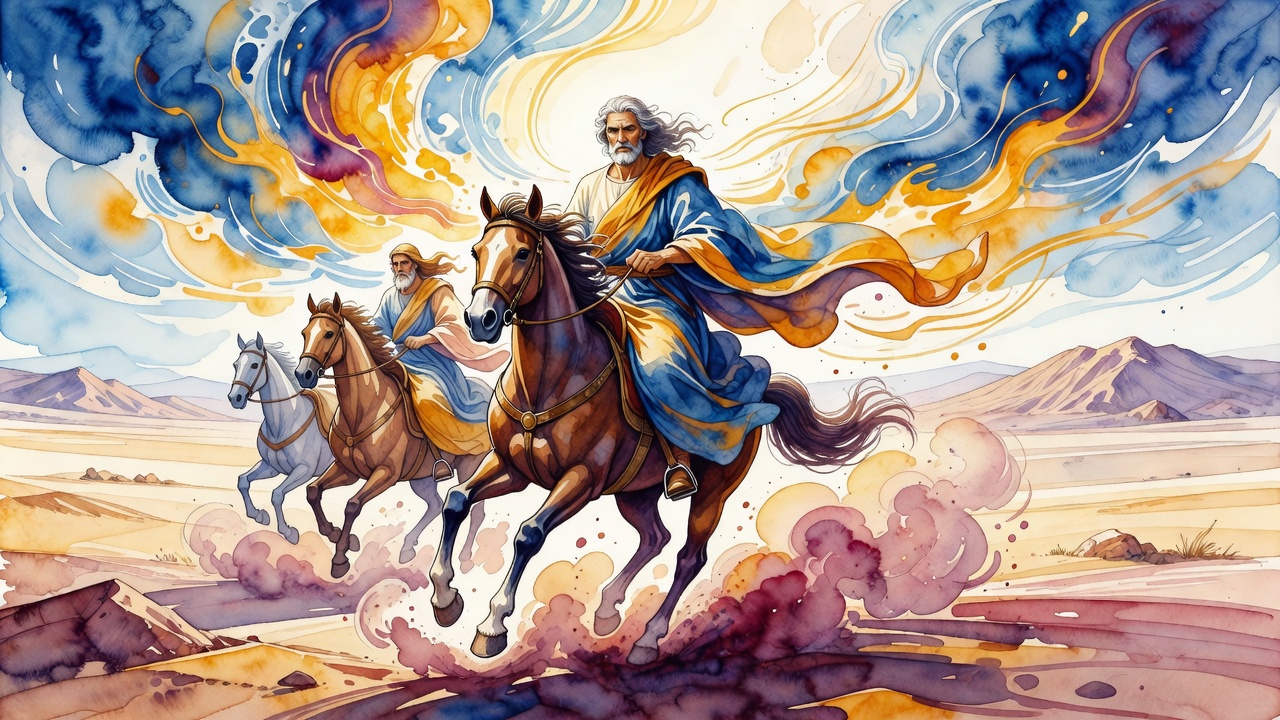
A man came running into Hebron with one word: Sodom. Lot was taken. Abraham reached for a sword and called for men who would not come.

Curated by Arthur · Told by Maggid ·
Table of Contents
  1. The Word From the Plain
  2. The Courtyard That Emptied
  3. One Man and a Promise
  4. The Escaped One
  5. Dan, the Fifth Night

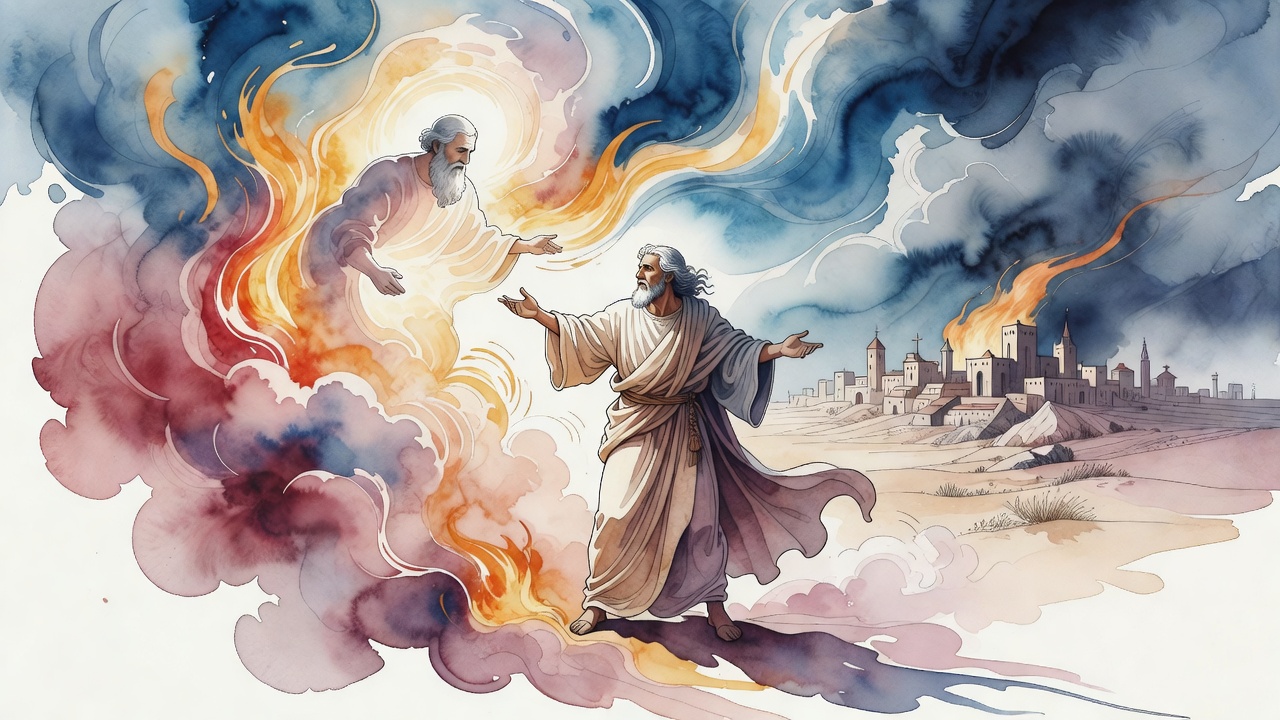
The runner came in from the direction of the plain, lungs heaving, his sandals white with dust. He had been running since the Vale of Siddim, where the ground was pocked with tar pits that swallowed men whole. He did not look like a man who had merely run. There was something on his back that he kept twisting to glance at, as though a hand had nearly closed on him and missed. He found Abraham among the tents at Hebron and got the words out in pieces. Sodom had fallen. Four kings from the east had broken it open and carried off everything inside the walls. And they had taken Lot.
The Word From the Plain

Abraham knew the names of the men who had done it, because the whole country knew them. Amraphel, Arioch, Chedorlaomer, Tidal. For twelve years the kings of the cities on the plain had paid them tribute. In the thirteenth year the cities had rebelled (Genesis 14:4), and the four had come down and laid the whole region waste, crushing even the great hulking men whose bones people swore came from giants, before they turned the last of their fury on Sodom. The Sodomites had been beaten badly in the slime-pit valley. Many were dead. The rest were roped together and marched east, and among the roped men was Abraham's brother's son.

Abraham did not call a council. He did not weigh it. The Torah says he heard that his kinsman was taken, and he armed and went (Genesis 14:14). What it does not say out loud, the old keepers of the story heard underneath the number. He had armed three hundred and eighteen.

The Courtyard That Emptied

He had men to call. For years Abraham had gathered disciples, people he had taught by name about the one God, and he went out into the courtyard now and put the thing to them plainly. This was no raid for plunder. He laid silver and gold on the ground in front of them and told them not to let their eyes rest on it. A man's life had been stolen, and they would go and take it back. Then he added one sentence, and the sentence cleared the yard.

Let no one come with me, he said, who has a sin on him and is afraid of what heaven will do to him on the field.

Not one of them moved. Every man he had trained stood frozen with the weight of his own record. They were not cowards before swords. They were afraid of their own imperfection, afraid that to stand on a battlefield beside a man this righteous was to invite a reckoning they could not survive. One by one they looked at the ground and stayed where they were. When the courtyard was still, one man was left standing. Eliezer, his chief servant, the steward of his whole house.

One Man and a Promise

So this is what Abraham marched out with. One servant. The number three hundred and eighteen is exactly the worth of the letters in the name Eliezer, and that is not an accident in the telling. The army Abraham asked for never came. The army he got was a single faithful man whose name added up to the number of the army he had wanted.

It was not lost on heaven that the others had failed him. A voice came to Abraham with a verdict and a gift. All of them forsook you except this one, it said, and so I will put into him the strength of the three hundred and eighteen men whose help you begged for and did not get. Eliezer would walk like one man and fight like a host.

There was a reason Abraham could ask such a thing of his servant and a reason Eliezer could give it. This was a household where even the animals were trained to honesty. Abraham kept his herds muzzled so they could not so much as nibble a stranger's crop, because gezel, theft, was a line his house did not cross. Lot's herds had wandered free and grazed where they pleased, and that quarrel between their shepherds had split the two men apart long before. Now the loose one was in chains and the careful one was coming for him with a single companion and a borrowed strength.

The Escaped One

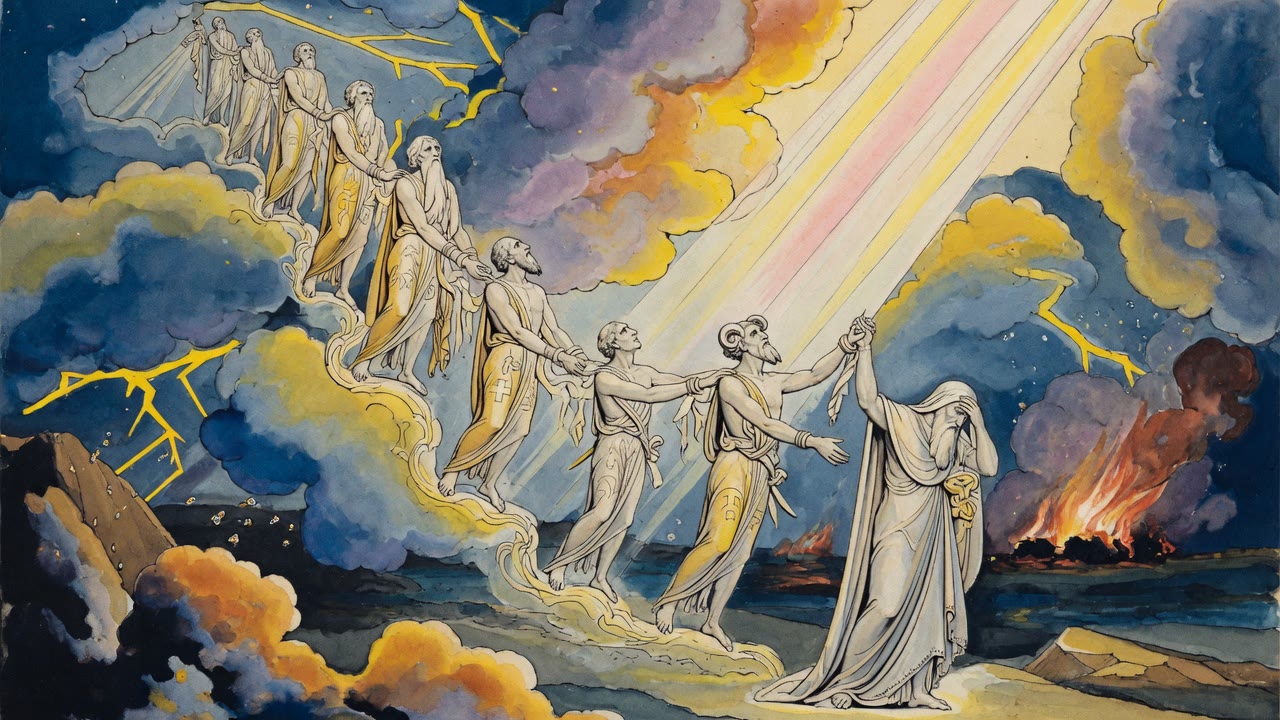
And the runner. The man who had brought the word from the plain was no ordinary survivor. He was called the one who escaped, and the name fit him in a way no farmer could claim. He was Michael, sent down as a messenger, and he had only barely come away from a fall of his own. When Sammael and his forces had been cast out of heaven, Sammael in his rage had grabbed Michael by the wings and tried to drag him down into the abyss along with him. God held on. Michael was pulled back. He carried the name of the escaped one because he had, in truth, escaped. The man who set Abraham marching was an angel who had just slipped a grip meant to destroy him.

Dan, the Fifth Night

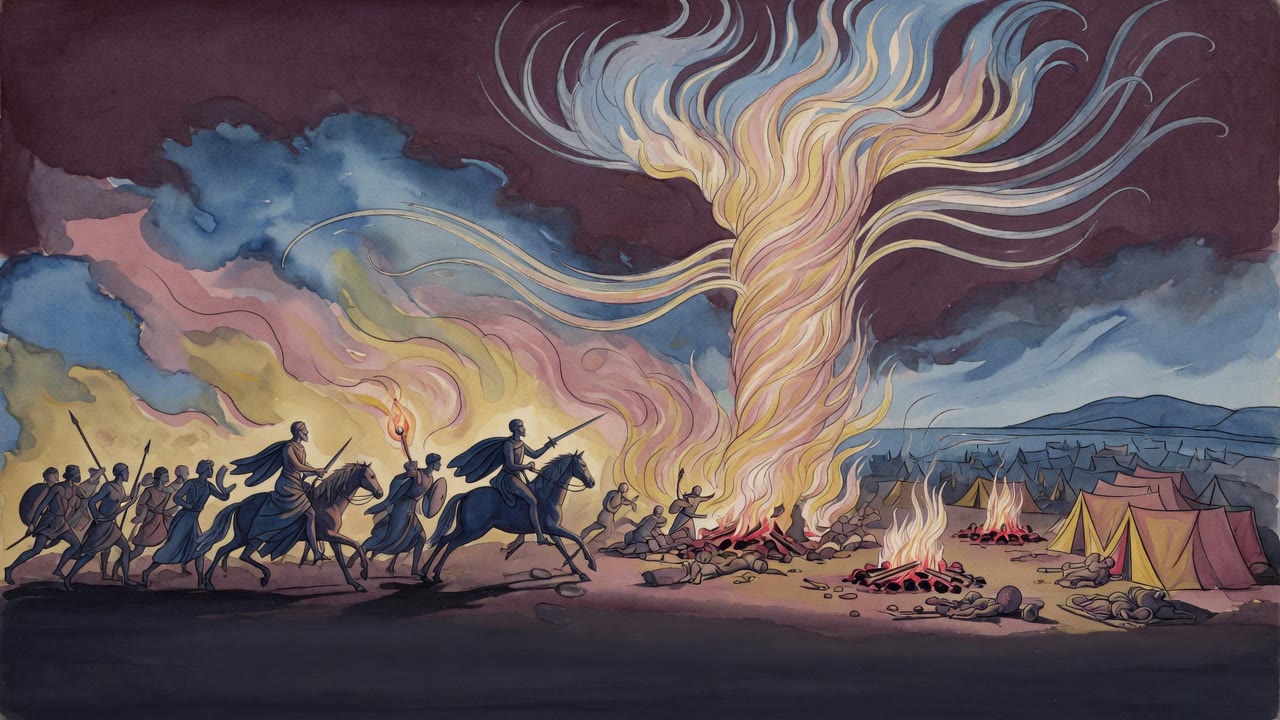
Abraham moved fast and he moved north. He took the trail of the four armies and ran it down to Dan, and he did not strike in daylight. On the fifth night he came on the camp where the kings lay confident with their captives and their loot. Some of the enemy died in their beds without ever waking. The rest woke to a rout they could not understand, a single household scattering four armies in the dark, chasing them off their plunder and out of the land. The roped men were cut loose. Lot, who had grazed where he pleased and paid for it, walked back south a free man.

The story keeps the arithmetic exactly where it found it. Three hundred and eighteen marched. They were one servant and one angel and a strength that came down from above to make up the difference between what a righteous man asks for and what frightened men are willing to give.


← All myths

From the tradition

Sources

8 sources

The texts this telling draws on, in full. Open a card to read inline, or expand it for a wider, quieter read.

Legends of the Jews 5:115Legends of the Jews

Legends of the Jews turns to Abraham Gathers His Disciples to Rescue Lot.

What happened? According to the story, alarmed by his warning, not a single one of them stepped forward. They were all afraid. Afraid of their own imperfections, afraid of divine retribution. Every single one… except for one.

Only Eliezer remained.

Can you imagine Abraham's feelings at that moment? He's ready to risk everything to save his nephew, and he is left with only one person by his side!

But here’s the truly amazing part. God saw Abraham's unwavering commitment, and Eliezer's loyalty, and intervened. “All forsook thee save only Eliezer. Verily, I shall invest him with the strength of the three hundred and eighteen men whose aid thou didst seek in vain."

Wow. Just… wow.

So, what does it mean? Is it just a cool story about a miraculous rescue? Maybe. But perhaps it's also a reminder that true courage isn't about being perfect. It's about showing up, even when you're scared, even when you feel unworthy. And sometimes, just sometimes, that's enough to earn a little divine assistance. It reminds us that sometimes, all we need is one true companion, and a little bit of faith, to overcome even the greatest odds.

Full source
Pirkei DeRabbi Eliezer 27:2Pirkei DeRabbi Eliezer

Our story starts with Abraham. Remember when he learns that his nephew Lot has been captured? (Genesis 14:13) tells us, "And there came one who had escaped, and told Abram the Hebrew." But who was this "one who had escaped?"

Pirkei DeRabbi Eliezer identifies him as none other than Michael, the archangel!

Why the disguise? Why call him "Palit," meaning "one who had escaped?"

The text explains that when God cast Sammael (often identified with Satan) and his forces out of heaven, Michael was almost dragged down with them! Sammael, in his fury, grabbed onto Michael's wings, trying to pull him into the abyss. But God intervened and saved Michael. Thus, he became known as "the one who had escaped."

Think about the image for a moment. The cosmic struggle between good and evil, so intense that even an archangel is nearly lost. It highlights the ever-present danger, the constant battle that rages, even in the celestial realms.

And there's more! The text connects Michael's role as messenger to other verses. (Ecclesiastes 10:20) warns, "Curse not the king, no, not in thy thought;… he who hath wings shall tell the matter." Pirkei DeRabbi Eliezer interprets "he who has wings" as a reference to Michael, the ultimate celestial messenger. He is the "prince of the world," the one who delivers vital information.

Even the prophet Ezekiel gets in on the action. (Ezekiel 33:21) speaks of "one who had escaped out of Jerusalem" bringing news of the city's destruction. This, too, is linked to Michael, further solidifying his role as the bearer of important, often difficult, news.

So, what does this all mean? Why is it so important to know who told Abraham about Lot, or who told Ezekiel about Jerusalem?

Perhaps it’s because the messenger matters. Knowing that Michael, a figure of immense spiritual stature, delivered these messages adds weight and significance to the events themselves. It reminds us that even in moments of crisis, divine forces are at work, delivering messages of warning, hope, and ultimately, redemption.

The next time you hear news – good or bad – remember the story of Michael, "the one who escaped." Consider the source, the messenger, and the deeper meaning behind the words. Because sometimes, the story of the messenger is just as important as the message itself.

Full source
Antiquities I.9-10Antiquities of the Jews (Josephus)

Three hundred and eighteen men against four armies. That's what Abraham brought to the battle. And he won.

The Josephus says the trouble started when the cities of Sodom fell under Assyrian control. For twelve years, five Sodomite kings paid tribute to four Assyrian commanders, Amraphel, Arioch, Chedorlaomer, and Tidal. In the thirteenth year, the Sodomites rebelled (Genesis 14:4). The Assyrians responded by laying waste to all of Syria, crushing even the offspring of the giants, before turning their full force on Sodom. The battle took place at the Vale of Siddim, a landscape pocked with slime pits that would later become the Dead Sea. The Sodomites lost badly. Many were killed. The rest, including Abraham's nephew Lot, were taken captive.

When Abraham heard the news, he moved immediately. No council of war, no hesitation. He marched with his 318 servants and three allies and attacked the Assyrian camp at Dan on the fifth night. Some of the Assyrians died in their beds. Others were too drunk to fight. Abraham chased the survivors all the way to Damascus.

Josephus draws a pointed lesson: victory does not depend on numbers. It depends on courage.

On the return, Abraham met Melchizedek, king of Salem, which Josephus identifies as Jerusalem, who was also a priest of God. Melchizedek fed Abraham's army and blessed him. Abraham gave him a tenth of the spoils. When the king of Sodom offered Abraham the remaining plunder, Abraham refused. He would take nothing for himself. Only his allies, Eshkol, Aner, and Mamre, received their share.

Afterward, God appeared to Abraham and promised that his reward for such selflessness would be a son and descendants as numerous as the stars (Genesis 15:5).

Full source
Bereshit Rabbah 41:5Bereshit Rabbah

Maybe… maybe there’s more to it than meets the eye.

The verse in Genesis tells us there was a big ol' argument brewing between the shepherds of Abram (later Abraham) and the shepherds of his nephew, Lot. But what was the fight really about? It wasn't just about grazing rights; it went deeper, touching on themes of entitlement, inheritance, and even God's promise.

Rabbi Berekhya, citing Rabbi Yehuda ben Rabbi Simon, offers a fascinating insight in Bereshit Rabbah, a classic collection of rabbinic interpretations on the Book of Genesis. He suggests that Abraham’s animals were always muzzled. Why? To prevent them from nibbling on other people’s crops. Gezel – theft – was a serious no-no.

Lot’s animals? Not so much. They roamed free, munching away wherever they pleased. You can almost hear the exasperation in Abraham’s herdsmen's voices: "Hey! Has theft suddenly become okay?!"

And here’s where it gets interesting. Lot's shepherds had a pretty bold response. They argued: "God promised this land to Abraham's descendants! (Genesis 12:7). But let's be real," they’d say, according to this Midrash (rabbinic interpretive commentary), “Abraham is practically a sterile mule. He's not having kids. Eventually, he's going to kick the bucket, and Lot, his nephew, will inherit everything! So, technically, we're not eating their stuff. We're eating our stuff!"

Talk about chutzpah!

But, of course, the Holy One, blessed be He, sees all. And according to the Midrash, God essentially said, “Hold your horses! Yes, I promised the land to Abraham’s descendants. But when? Only after I’ve cleared out the seven nations living there. (See (Genesis 15:16).)" In other words, patience, people, patience!

And that brings us back to that seemingly throwaway line: "The Canaanites and the Perizzites then lived in the land" (Genesis 13:7). Bereshit Rabbah points out that right then and there, the Canaanites and Perizzites still had their claim. The land wasn't quite Abraham's yet. This little phrase, then, isn't just setting the scene; it's a subtle reminder about timing, about deserving, and about the complexities of divine promises.

So, what does this all mean for us? Maybe it's a lesson about entitlement. About not jumping the gun. About understanding that even when we think we're owed something, there might be a bigger picture we're not seeing. Maybe it's a reminder that God's promises unfold in God's time, not ours. And maybe, just maybe, it's a call to make sure our "animals" – our actions, our desires – aren't trampling on someone else's field in the meantime.

Full source
Pirkei DeRabbi Eliezer 27:3Pirkei DeRabbi Eliezer

The patriarch Abraham experienced just such a moment, according to the ancient text, Pirkei DeRabbi Eliezer.

The scene: Abraham, fresh from his encounter with the divine, is a man on a mission. He’s just learned that his nephew Lot has been captured, and he's not about to stand idly by. The Torah tells us, "And when Abram heard that his brother was taken captive, he led forth his trained men, born in his house, three hundred and eighteen, and pursued as far as Dan" (Genesis 14:14). But Pirkei DeRabbi Eliezer fills in some fascinating details here.

The text says that Abraham didn't just grab anyone for this rescue mission. He took three of his disciples – Aner, Eshcol, and Mamre – along with his trusted servant, Eliezer. They chased after the captors all the way to Dan, which Pirkei DeRabbi Eliezer equates with Pameas.

Here's where the story takes an unexpected turn. According to Pirkei DeRabbi Eliezer 27, it was at Dan that Abraham was… hindered. Why? Because he received a prophecy: "Abraham, know thou that in the future thy children's children will serve idols in this place." Think about the weight of that revelation! He's setting out to do a righteous deed, and he's confronted with the knowledge that his descendants will falter, will stray from the path.

How do we know that the Israelites would later engage in idolatry at Dan? Pirkei DeRabbi Eliezer points to the Book of Kings: "And he made two calves of gold… and he set the one in Bethel, and the other put he in Dan" (1 (Kings 12:28), 29). This refers to Jeroboam, who, fearing the reunification of the kingdom, established alternative worship sites to draw people away from Jerusalem.

So, Abraham leaves his three disciples behind at this fraught location and continues the pursuit with only Eliezer. Pirkei DeRabbi Eliezer makes a point of noting that the numerical value of the letters in Eliezer's name equals 318, connecting him to the 318 trained men mentioned in the Torah. He presses on "as far as the left of Damascus," as it says in (Genesis 14:15), "And he pursued them unto Hobah."

What does this all mean? Was Abraham destined to be temporarily disheartened by the prophecy? Perhaps. But he didn't let it stop him. He acknowledged the potential for future missteps, but he continued his pursuit of justice, relying on his faith and his loyal servant. Maybe the story is telling us that even the most righteous among us are reminded of the imperfections that can arise even in the most faithful of families.

It's a reminder that faith isn't about avoiding stumbling blocks, but about how we choose to navigate them when they inevitably appear. And sometimes, the most meaningful journeys are those we undertake even when we know the road ahead is paved with both triumphs and potential for disappointment.

Full source
Bereshit Rabbah 43:2Bereshit Rabbah

This teaching connects this to a verse from Isaiah (33:15): "He seals his ears from hearing of bloodshed." The idea is that a righteous person doesn't stand idly by when faced with injustice. They take action. They can't simply ignore the cries for help.

The story gets really interesting. "He marshaled [vayarek] his disciples." The Hebrew word vayarek is key here because it sparks a debate among the rabbis. Who were these disciples, and how did Abram prepare them for battle?

Rabbi Yehuda and Rabbi Neḥemya offer contrasting views. Rabbi Yehuda suggests the disciples were terrified. "Their faces turned pale [horiku] towards Abraham," they supposedly said, questioning how they could possibly defeat the kings who had captured Abram's brother. Rabbi Neḥemya flips the script, suggesting it was actually Abram who turned pale, perhaps contemplating the sacrifice he was about to make: "Shall I go and fall [in battle] in sanctification of the name of the Omnipresent?" A chilling question, brimming with the weight of responsibility.

The interpretations don't stop there. Abba bar Zavda believed Abram armed them with weapons, linking vayarek to the verse, “Unsheathe [harek] a spear to block my pursuers” (Psalms 35:3). Rabbi Shimon ben Lakish, however, paints a different picture. He says Abram showered them with jewels and gems, connecting vayarek to “Its pinions with shimmering [yerakrak] gold” (Psalms 68:14).

Then Rabbi Levi offers yet another perspective. He suggests Abram thinned their ranks by using the passage about officers from (Deuteronomy 20:8): “Who is the man who is fearful and faint hearted? Let him go and return to his house." Basically, he weeded out the unready. This left him with a force of only 318 men, all thanks to this warning.

The passage continues, "His disciples [ḥanikhav] – they bore his name [ḥanikhato]." This is fascinating. The commentary suggests these disciples were converts, and upon converting, they took Abram's name as their own, or referred to themselves as "sons of Abram," as converts often did.

But here's a twist. Reish Lakish, in the name of bar Kappara, says those "three hundred and eighteen" men? It was actually just Eliezer! The numerical value of the letters in Eliezer's name, in Hebrew, adds up to 318. One man against an army? That's the stuff of legends.

Finally, the passage touches on Abram's chase "until Dan." The text points out that Dan was the name of an idol (see I (Kings 12:28)–29). It was, according to the commentary, "preceded and followed by a blow," a place of misfortune from beginning to end. Abram had to stop his pursuit when he reached Dan, due to its ill-fated status. The passage even connects this to (Jeremiah 8:16), "The snorting of his horses is heard from Dan," referring to the Babylonians on their way to destroy Jerusalem.

So, what can we take away from this rich, layered passage? It's more than just a simple retelling of Abram's pursuit. It's a glimpse into the rabbinic mind, wrestling with the text, offering multiple interpretations, and revealing the complexities of faith, fear, and the human condition in the face of overwhelming odds. It reminds us that even our heroes wrestled with doubt and that sometimes, the greatest strength comes from within a single, dedicated individual. Food for thought, isn't it?

Full source
Midrash Tanchuma Buber, Lech Lecha 16:3Midrash Tanchuma Buber, Lech Lecha

Another interpretation (of Gen. 14:14): HE ARMED HIS TRAINED MEN. "He armed" (vayareq) means nothing but that he made them turn pale (horiq) with words, just as it is written in the Torah (in Deut. 20:8): WHO IS THE MAN WHO IS AFRAID (yare) AND FAINT (rakh) OF HEART. So did Abraham do: He said to them: We are going out to war. Whoever has transgressions in his hand, and is afraid because of his deeds, let him not go out with us. When they heard this, everyone who knew in his heart that he had sinned was afraid and did not go out, and they went back. And no one remained with him except Eliezer alone. In that hour the Holy One said: All have forsaken you, and no one remained with you except Eliezer alone. By your life, I am placing within him the strength of three hundred and eighteen, as it is stated: AND HE ARMED HIS TRAINED MEN, THE ONES BORN IN HIS HOUSE, EIGHTEEN AND THREE HUNDRED. From where? The number of "Eliezer" by gematria is three hundred and eighteen.

Full source
Targum Pseudo-Jonathan on Genesis 14:14Targum Pseudo-Jonathan on Genesis

Targum Pseudo-Jonathan on (Genesis 14:14) delivers one of the boldest numeric readings in the Aramaic tradition. The Hebrew Bible says Abram armed three hundred and eighteen trained servants born in his house. The Targum rereads the number.

The Aramaic first concedes that Abram called up his armed retainers. And then drops a startling admission: they willed not to go with him. His household refused the fight. When faced with the terror of the four kings who had just crushed the giants of Ashtaroth (Genesis 14:5), Abram's own trained men declined.

So Abram took one. Eliezer, son of Nimrod, a detail the Targum adds to tie Eliezer to the very Nimrod who had once thrown Abram into the furnace (Genesis 11:28). The household servant is a prince of the house that tried to kill his master, now utterly loyal. And the Targumist makes the theological move: Eliezer alone was equal in strength to all the three hundred and eighteen.

The Sages in Bereshit Rabbah 43:2 and in Nedarim 32a notice the same thing. The Hebrew consonants of Eliezer's name, aleph-lamed-yod-ayin-zayin-resh, add up to three hundred and eighteen in Hebrew numerology. Eliezer is three hundred and eighteen.

This is the Targumist's way of saying that the force of arms does not always come from the size of the army. Abram rides out with one man whose very name is an army. The covenant's first military campaign is won by a single loyal servant who carries the strength of a host inside the letters of his own name.

Sometimes the rescue is not about how many come with you. It is about who.

Full source